Hepatitis C virus (HCV) is transmitted primarily through contact with the blood of an infected person, and healthcare-associated HCV infection outbreaks are well documented. 1 The prevalence of HCV infection among patients with end-stage renal disease (ESRD) who receive hemodialysis (HD) is high (7.8%–14%).Reference Goodkin, Bieber, Gillespie, Robinson and Jadoul 2 HCV infection is an independent risk factor for death in HD patients and increases the chance of graft failure and death after renal transplantation.Reference Kalantar-Zadeh, Kilpatrick and McAllister 3 Although interferon injection therapies are poorly tolerated in HCV-infected HD patients, those who completed the therapies demonstrated improved survival.Reference Kalantar-Zadeh, Kilpatrick and McAllister 3 In 2014, all-oral curative HCV therapies became available specifically for patients with ESRD.Reference Roth, Nelson and Bruchfeld 4
Testing is essential to detect HCV infection in high-risk populations. The Centers for Disease Control and Prevention (CDC) recommends routine screening of chronic HD patients for HCV antibody (anti-HCV) upon facility admission and every 6 months to identify possible dialysis-related transmission.Reference Alter, Lyerla and Tokars 5 Patients who test positive for anti-HCV should undergo confirmatory HCV nucleic acid testing (NAT) to detect HCV RNA.Reference Getchell, Wroblewski and DeMaria 6 HCV-infected patients should be evaluated for recommended care and treatment.Reference Alter, Lyerla and Tokars 5
Testing has frequently identified HCV transmission and outbreaks in dialysis units that may otherwise be difficult to detect because of the typically asymptomatic nature of acute infection. Basic infection-control lapses are often identified in dialysis centers with HCV outbreaks.Reference Alter, Lyerla and Tokars 5 As a result, any case of new HCV infection in a patient undergoing HD should be reported to public health authorities to facilitate investigation and rapid correction of breaches. Rigorous adherence to recommended infection control practices is needed to protect patients and prevent outbreaks in this population. We analyzed data from outbreaks of HCV in dialysis facilities reported to the CDC for opportunities to reduce HCV prevalence in this population.
METHODS
We assessed outbreaks of HCV among dialysis patients reported to the CDC during 2008–2015 to determine changes over time in the number of reported outbreaks. We defined an HCV outbreak as 2 or more cases with confirmed linkages by epidemiological (patients cared for in the same facility in proximity to each other) and/or molecular analysis. The molecular analysis was accomplished by amplifying the HCV HVR1 region to determine whether HCV-infected patients were linked by transmission using next-generation sequencing technology (454/Roche GS Junior system) at the CDC Viral Hepatitis Laboratory, as recently described.Reference Nguyen, Gutowski and Ghiselli 8
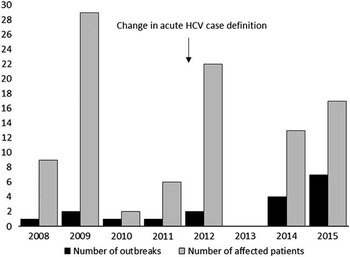
Cases of acute HCV infection are nationally notifiable. When identified, cases are reported to the appropriate state and local public health authorities. In 2012, the Council of State and Territorial Epidemiologists (CSTE) redefined the acute hepatitis C public health surveillance clinical case definition to include “a documented negative HCV antibody laboratory test result followed within 6 months by a positive test result,” even in the absence of acute infection clinical signs or symptoms; this seroconversion window was expanded to 12 months in 2016.Reference Hepatitis 7
RESULTS
During the period between 2008 and 2012, 7 outbreaks of HCV infection meeting this case definition in outpatient dialysis facilities were detected and reported to the CDC; these outbreaks affected 68 patients (mean, 14 patients per year) (Figure 1). During the period 2013–2015, 11 HCV infection outbreaks were reported, affecting 30 patients (mean, 10 patients affected per year). More than 2,500 persons undergoing HD were tested for HCV because of these outbreaks during the period 2008–2015. Because of the increase in reported HCV outbreaks, the CDC released a Health Alert Notice (HAN) in January 2016 to draw attention to the issue. 9 Lapses in infection control (eg, injection safety, environmental disinfection, and hand hygiene) were commonly identified at these facilities.
Black bars represent the number of hepatitis C virus (HCV) outbreaks (consisting of 2 or more outbreak cases with confirmed transmission links to patients in the same facility) in US hemodialysis facilities reported to the Centers for Disease Control and Prevention (CDC) by year. Grey bars represent the number of persons newly infected with HCV during US hemodialysis facility outbreaks reported to the CDC by year.

DISCUSSION
Chronic HD patients have a high burden of HCV infection and are at risk for acquiring HCV when basic lapses in infection control occur during their care. Hemodialysis patients should be routinely tested for HCV to facilitate early detection of dialysis-related HCV transmission.Reference Alter, Lyerla and Tokars 5 , Reference Getchell, Wroblewski and DeMaria 6 Although fewer patients were involved per outbreak in the outbreaks that occurred during 2014 and 2015 compared to some previous years, more outbreaks were detected, possibly indicating earlier detection and implementation of control measures.
The steps necessary for an outbreak to be detected and reported to the CDC typically include screening by the facility, reporting ≥1 case of new infection to a health department, health department investigation of the case(s), and reporting to the CDC. Transmission events communicated to the CDC and meeting outbreak criteria do not represent all cases of transmission, and changes over time may reflect increases in screening, reporting, and/or public health investigation. An increase in reported acute HCV infections might be multifactorial. Regardless, this increase underscores the widespread potential for patients to acquire serious infections during dialysis care.
Dialysis providers should actively implement recommended practices to prevent the spread of HCV infection. In addition, they should be familiar with HCV testing recommendationsReference Alter, Lyerla and Tokars 5 , Reference Getchell, Wroblewski and DeMaria 6 and should comply with state-specific reporting requirements. Public health reporting of cases provides an opportunity to initiate public health investigations to address the root causes of HCV infections among dialysis patients and prevent additional cases. An important additional benefit provided by screening is that infected patients may be identified for care and treatment to reduce the increased morbidity and mortality associated with chronic HCV infection. HD patients should be a high priority for prevention of HCV infection and if infected, for HCV treatment. 10
ACKNOWLEDGMENTS
Financial support: No financial support was provided relevant to this article.
Potential conflicts of interest: All authors report no conflicts of interest relevant to this article.
Disclaimer: The findings and conclusions in this report are those of the authors and do not necessarily represent the official position of the Centers for Disease Control and Prevention.