


Introduction
Cognitive Behavioural Therapy (CBT) has been proven to be effective in the treatment of Panic Disorder with or without agoraphobia (PD). A considerable number of studies and several meta-analyses demonstrated that approximately 80% of the patients are panic free after treatment and show clinically significant improvement on the various dimensions of panic disorder, such as general anxiety, fear of fear, and agoraphobic avoidance (e.g. van Balkom et al., Reference Balkom, Bakker, Spinhoven, Blaauw, Smeenk and Ruesink1997; Margraf, Barlow, Clark and Telch, Reference Margraf, Barlow, Clark and Telch1993; Oei, Llamas and Devilly, Reference Oei, Llamas and Devilly1999).
Rather than trying to enhance treatment outcome for the already highly successful CBT for panic disorder in general, a number of researchers have in the past 30 years directed their attention to the early identification of nonresponders by searching for demographic, disorder-related, psychological, and socio-psychological variables that could reliably predict treatment outcome. The relevance of an early identification of nonresponders lies in the fact that adjusted treatment programmes can be offered to the identified patients in order to reduce the incidences of nonresponse or dropout.
Research into predicting variables for treatment outcome in PD has been reviewed several times (e.g. Emmelkamp and van der Hout, Reference Emmelkamp, Hout, Foa and Emmelkamp1983; Jansson, Öst and Jerremalm, Reference Jansson, Öst and Jerremalm1987; Steketee and Shapiro, Reference Steketee and Shapiro1995). The most recent and most extensive review was conducted by Steketee and Shapiro (Reference Steketee and Shapiro1995). From this latter review, and also from the previous reviews, it can be concluded that most of the investigated demographic, disorder-related, psychological, and socio-psychological variables are not or inconsistently related to treatment outcome in PD. These disappointing findings might be caused by methodological problems of outcome prediction research as described by Keijsers, Hoogduin and Schaap (1994a) and Steketee and Chambless (Reference Steketee and Chambless1992).
Predictive variables
In the present study, five predictive variables, understudied in previous outcome prediction studies, were selected for investigation in a large sample of PD patients receiving manualized CBT. The selection of these five predictive variables was partly based on Steketee and Shapiro's review and partly on prediction studies after the publication of the review. These variables are: (1) initial symptom severity; (2) comorbid anxiety disorders; (3) comorbid depressive disorders; (4) comorbid cluster C personality disorders; and (5) initial motivation for treatment.
Initial symptom severity
Initial avoidance behaviour was inconsistently associated with treatment outcome according to the review by Steketee and Shapiro (Reference Steketee and Shapiro1995). A more recent study revealed significant predictive value of initial anxiety level, avoidance behaviour, and panic frequency (Sharp and Power, Reference Sharp and Power1999) and in 2004, Ramnerö and Öst also found initial severity of avoidance behaviour to be predictive of treatment outcome.
Comorbid anxiety and depressive disorders
To date, there are inconsistent findings in regard to the possible negative or even positive effects of comorbid anxiety or depressive disorders on PD treatment outcome. Brown, Antony and Barlow (Reference Brown, Antony and Barlow1995) failed to find an effect for comorbid general anxiety disorder or depression (collapsed across major depression and dysthymia) on treatment outcome. They did, however, find that significantly more patients who met high end-state criteria had been diagnosed with comorbid social phobia. In another study, comorbid dysthymia was associated with lower immediate treatment outcome and comorbid major depression and comorbid social phobia were associated with lower treatment outcome after 6 months (Chambless, Renneberg, Gracely, Goldstein and Fydrich, Reference Chambless, Renneberg, Gracely, Goldstein and Fydrich2000). A year later, Steketee, Chambless and Tran (Reference Steketee, Chambless and Tran2001) found that comorbid major depressive disorder predicted immediate treatment outcome in PD. A disadvantage of both studies, however, is the relatively small sample sizes (respectively 51 and 43). A recent study by Joormann, Kosfelder and Schulte (Reference Joormann, Kosfelder and Schulte2005) showed that panic and depressive symptoms remained higher in PD patients with co-morbid major depression after PD treatment. However, the amount of change over the course of the treatment was similar for those with and without co-morbid major depression.
Comorbid cluster C personality disorders
The research findings on the effects on outcome of comorbid cluster C personality disorders are inconsistent (Steketee and Shapiro, Reference Steketee and Shapiro1995). In 1994, Dreessen, Arntz, Luttels and Sallaerts concluded that a comorbid personality disorder did not affect treatment outcome in PD. More recently, Ramnerö and Öst (Reference Ramnerö and Öst2004) similarly found that cluster C personality disorders did not affect treatment outcome in PD. Others, however, hold that several comorbid personality disorders, such as avoidant personality disorder (Chambless, Renneberg, Goldstein and Gracely, Reference Chambless, Renneberg, Goldstein and Gracely1992; Chambless et al., Reference Chambless, Renneberg, Gracely, Goldstein and Fydrich2000, Steketee et al., Reference Steketee, Chambless and Tran2001) are likely to predict poor treatment outcomes in PD. The differences in findings may be explained by differences in type of measurement, especially self-report (as used by Chambless et al., Reference Chambless, Renneberg, Goldstein and Gracely1992) versus semi-structrured interview (as used by Dreessen et al., Reference Dreessen, Arntz, Luttels and Sallaerts1994; Chambless et al., Reference Chambless, Renneberg, Gracely, Goldstein and Fydrich2000; Ramnerö and Öst, Reference Ramnerö and Öst2004; Steketee et al., Reference Steketee, Chambless and Tran2001). Measurement of personality is sensitive to state factors like anxiety and depression (Reich, Reference Reich2003) and therefore it is suggested by several authors that semi-structured interview has preference above self-report, because axis I disorders are better controlled for in an semi-structured interview (Dreessen and Arntz, Reference Dreessen and Arntz1998). On the other hand, other authors state that patients who are embarrassed about certain aspects of their illness are more likely to reveal these symptoms or behaviours in a self-report questionnaire (Reich, Reference Reich2003) and that results of self-report questionnaires are more consistent (Widiger and Samuel, Reference Widiger and Samuel2005).
Initial patients' motivation for therapy
In one study with PD patients a significant association was reported between moderate initial treatment motivation and poor treatment outcome (Keijsers et al., Reference Keijsers, Hoogduin and Schaap1994a). Others, however, failed to find such relationship (de Beurs, Reference Beurs1993; Ramnerö and Öst, Reference Ramnerö and Öst2004).
The present study was designed to overcome methodological weaknesses in outcome prediction research (Steketee and Chambless, Reference Steketee and Chambless1992), and was a renewed attempt at investigating whether the aforementioned predictors affect CBT outcome for PD in a large sample size. It was hypothesized that (1) initial symptom severity, (2) comorbid anxiety disorders, (3) comorbid depressive disorders, (4) comorbid cluster C personality disorders, and (5) initial motivation for treatment were associated with poorer treatment outcome.
Method
Patients
The patients were all being treated in two centres: an outpatient clinic for anxiety disorders, and a university outpatient clinic. Patients had either referred themselves or had been referred to one of the clinics by general practitioners, psychiatrists or the Dutch Association for Phobias. All patients (N = 161) met the DSM-IV criteria (APA, 1994) for PD with or without agoraphobia, assessed with the Dutch adaptation of the Anxiety Disorder Inventory Schedule-Revised (ADIS-IV; Bouman, de Ruiter and Hoogduin, Reference Bouman, de Ruiter and Hoogduin1995; DiNardo, Brown and Barlow, Reference DiNardo, Brown and Barlow1994).
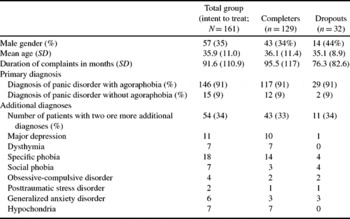
At referral, patients were asked to participate in the study. Inclusion criteria were a present diagnosis of PD, age between 18 and 65 years, and agreement with assessments for research. Exclusion criteria were a present diagnosis of schizophrenia, organic mental syndrome, mental retardation, alcohol or psychoactive substance abuse or dependence, or attendance of other therapies. Patients with a clear wish or plan to commit suicide were also excluded. Patients who used antidepressant medication were asked to discontinue their medication under supervision prior to the start of the CBT. They entered the study after a washout period of 2 weeks (Sokolov and Joffe, Reference Sokolov and Joffe1995). Patients who used benzodiazepines were asked to discontinue their medication under supervision, or to adhere to a fixed daily dose throughout the duration of the treatment study. A total of 161 patients enrolled in the study. Of these, 13 patients had to taper their antidepressant medication, 43 patients used benzodiazepines initially, of whom 17 tapered their medication use. The remaining 26 patients were asked to keep their benzodiazepine use at a fixed dose. Of these 26 patients, 13 used oxazepam (range 5–30 mg daily), one used temazepam (10 mg), two used diazepam (range 5–20 mg), four used alprazolam (range 0.25–0.5 mg), two used lorazepam (1 mg), one used bromazepam (3 mg), two used clorazepate (range 10–15 mg), and one used buspirone (30 mg). During treatment 32 patients (19.9%) dropped out. Dropouts and completers did not differ significantly on age, symptom duration, symptom severity, gender or presence of agoraphobia. Table 1 provides an overview of patient characteristics for the total group, the dropout group and the completers.
Patient characteristics for the total group, the completers and the dropouts

Therapists
Treatment was administered by experienced cognitive behaviour therapists and graduate students in Clinical Psychology working as trainees at one of the clinics. All therapists had received intensive training in the manualized treatment. Throughout the duration of the study the treatment was supervised by four experienced cognitive behaviour therapists on a weekly basis. Deviations from the manual were discussed in detail.
Treatment
The treatment (CBT) consisted of 15 weekly sessions of 50 minutes, in accordance with the Panic Control Treatment manual of Craske and Barlow (Reference Craske, Barlow and Barlow1993) and Craske, Meadows and Barlow (Reference Craske, Meadows and Barlow1994). It consisted of the following five components: (1) providing patients with information about panic and anxiety; (2) relaxation techniques; (3) cognitive therapy and behaviour experiments; (4) interoceptive exposure; and (5) exposure-in-vivo. Following the initial CBT there was a 4-week interval prior to the evaluation of the therapy. Treatment integrity was maintained by utilizing a structured and manualized treatment protocol. During treatment, patients monitored their panic attacks.
Instruments
Therapy outcome was assessed for the various components of PD: the frequency of panic attacks, catastrophic agoraphobic cognitions, fear and frequency of physical panic sensations, and agoraphobic avoidance in patients with PD with agoraphobia.
Frequency of catastrophic agoraphobic cognitions was assessed with the Dutch adaptation of the Agoraphobic Cognitions Questionnaire (ACQ; Chambless, Caputo, Bright and Gallagher, Reference Chambless, Caputo, Bright and Gallagher1984). Agoraphobic avoidance was measured with the Dutch adaptation of the Mobility Inventory (Chambless, Caputo, Jasin, Gracely and Williams, Reference Chambless, Caputo, Jasin, Gracely and Williams1985). The Mobility Inventory contains three subscales: avoidance when alone (MI-AAL), avoidance when accompanied (MI-AAC), and frequency of panic attacks (MI-PF). MI-AAL and MI-AAC scores were added to yield one avoidance score (MI). The third subscale, MI-PF, contains a definition of panic attacks, followed by a question about the number of panic attacks that occurred during the past 14 days. The ACQ, MI, MI-PF and their Dutch adaptations were found to have good test-retest reliability, high internal consistencies, and reasonably concurrent validity (de Beurs, Reference Beurs1993; Bouman, Reference Bouman1995; Chambless et al., Reference Chambless, Caputo, Bright and Gallagher1984, Reference Chambless, Caputo, Jasin, Gracely and Williams1985).
Fear and frequency of physical panic sensations were measured with the Dutch adaptation of the two subscales of the Body Sensations Questionnaire (BSQ; Chambless et al., Reference Chambless, Caputo, Bright and Gallagher1984), the BSQ-fear (BSQa) and the BSQ-frequency (BSQb). The original questionnaire and the Dutch version were found to be highly internally consistent and reliable (Bouman, Reference Bouman1998; Chambless et al., Reference Chambless, Caputo, Bright and Gallagher1984).
In addition, the Dutch version of the Anxiety Discomfort Scale (Watson and Marks, Reference Watson and Marks1971) was used. The Anxiety Discomfort Scale assesses five idiosyncratic situations or circumstances in which patients feel discomfort or anxiety.
Predictive variables of outcome were measured by means of the following instruments: Initial severity of the complaints was measured by the BSQ, the ACQ, and the MI.
Diagnosis and comorbid diagnoses on axis I were checked with the Dutch adaptation of the Anxiety Disorder Inventory Schedule-IV (ADIS-IV; Bouman et al., Reference Bouman, de Ruiter and Hoogduin1995; DiNardo et al., Reference DiNardo, Brown and Barlow1994) for DSM IV (APA, 1994).
Personality psychopathology was assessed with the Dutch adaptation of the Personality Diagnostic Questionnaire-Revised (PDQ-R; Ouwersloot, van den Brink, de Boer and Hoogduin, Reference Ouwersloot, Van Den Brink, de Boer and Hoogduin1989) for DSM-III-R. This questionnaire consists of 133 true/false items and resembles the PDQ-R developed by Hyler et al. (Reference Hyler, Rieder, Williams, Spitzer, Hendler and Lyons1983, Reference Hyler, Rieder, Williams, Spitzer, Hendler and Lyons1989). Internal consistency of the personality disorders is found to be satisfactory though the agreement with clinical diagnosis is low (Hyler et al., Reference Hyler, Rieder, Williams, Spitzer, Hendler and Lyons1989). No psychometric data for the Dutch version are available.
Initial motivation was measured by the Nijmegen Motivation List (NML-2; Keijsers, Schaap, Hoogduin, Hoogsteyns and de Kemp, Reference Keijsers, Schaap, Hoogduin, Hoogsteyns and de Kemp1999). The NML-2 and its previous version have been used in several previous studies to measure the patients' own evaluation of their initial motivation for CBT (Haan de, Hoogduin, Buitelaar and Keijsers, Reference De Haan, Hoogduin, Buitelaar and Keijsers1998; Keijsers et al., Reference Keijsers, Hoogduin and Schaap1994a; Keijsers, Hoogduin and Schaap, Reference Keijsers, Hoogduin and Schaap1994b; Keijsers et al., Reference Keijsers, Schaap, Hoogduin, Hoogsteyns and de Kemp1999; Keijsers, Kampman and Hoogduin, Reference Keijsers, Kampman and Hoogduin2001; Ramnerö and Öst, Reference Ramnerö and Öst2004).
The NML-2 comprises three subscales, labelled preparedness (willingness for active participation), distress (demoralization), and doubt (reserved attitude towards treatment). Internal consistencies and re-test reliabilities of the subscales are good (Keijsers et al., Reference Keijsers, Schaap, Hoogduin, Hoogsteyns and de Kemp1999). In the present study the total-score was used.
Procedure
After referral, two intake sessions took place. If patients were diagnosed with PD, and after they had given their permission, they entered the study. One week after the intake sessions, patients completed Assessment 1 (pre-treatment). The diagnosis PD had to be confirmed by an independent assessor using the ADIS-IV. When the diagnosis was not confirmed, patients were excluded from the study. They received treatment as usual. During Assessment 1 and in addition to the ADIS-IV, interview patients completed the ACQ, the MI, the MI-PF, the BSQ, the ADS, the PDQ-R, and the NML-2.
Following Assessment 1 the patients were assigned to a therapist and received 15 weekly sessions of standardized CBT. One week after session 15, Assessment 2 (post-treatment) took place in which patients again completed the ACQ, the MI, the MI-PF, the BSQ, and the ADS. Assessment 2 was followed by a 4-week therapy-free interval period after which Assessment 3 – consisting of the same measurements as used in Assessment 2 – was administered to obtain follow-up results (FU).
Results
Analyses
An alpha level of .05 was used for all statistical tests.
Outcome
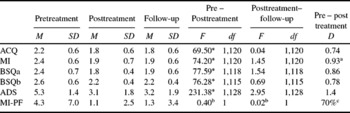
First, we analysed the treatment effects. Table 2 presents an overview of the differences between pre-treatment, posttreatment and FU (4 weeks) effects for completers. A repeated measures analysis was used to investigate whether significant improvement had been achieved during treatment and whether this improvement had persisted during the 4 weeks following treatment (FU). The exact F-statistics of Wilks's Lambda were used. All F-values were significant at p < .001. All differences remained significant after Bonferonni-Holm correction (p < .008). Helmert contrasts showed that differences between pre-treatment and posttreatment measures were significant (p < .001) and that differences between posttreatment and FU were not (p > .05).
Means, standard deviations, MANOVA (repeated measures) and effect sizes for pretreatment, posttreatment, and Follow-up Assessments for completers

Note. ACQ = Agoraphobic Cognitions Questionnaire; MI = Mobility Inventory; BSQa = Body Sensations Questionnaire-fear of sensations; BSQb = Body Sensations Questionnaire- frequency of sensations; ADS = Anxiety Discomfort Scale; MI-PF = Mobility Inventory: Frequency of panic attacks during last 2 weeks. a = Mi n = 114; only panic disorder patients with agoraphobia were included. b = panic attacks were analysed with the nonparametric Kendall's W test. c = percentage of panic free patients posttreatment. *p < .001.
Because the frequency distribution was skewed to the right, the variable “panic frequency” was transformed. Values ranging from 6 to10 panic attacks were recoded into the value 6, and values above 10 panic attacks were recoded into the value 7. Next, the differences in frequency of panic attacks were analysed with the non-parametric Wilcoxon Signed Ranks Test and were found to be significant for pre- and posttreatment scores but not for posttreatment and FU outcomes (see Table 2).
Effect sizes for repeated measures were calculated according to the Cohen's formula (Reference Cohen1977) and are also reported in Table 2. Intent-to-treat analyses also showed a significant reduction in panic disorder symptoms (p < .001).
Prediction
Initial symptom severity
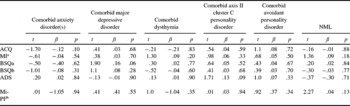
Linear regression analyses were conducted for each of the outcome measures to obtain correlations between pre-treatment and posttreatment values. Table 3 presents an overview of the statistics. The linear regression analyses showed significant findings for agoraphobic cognitions (ACQ: R (125) = .60, F (1, 124) = 70.6, p < .001), agoraphobic behaviour (MI: R (112) = .72, F (1, 111) = 118.3, p < .001), fear and frequency of body sensations (BSQa: R (123) = .440, F (1, 122) = 29.2, p < .001; BSQb: R (120) = .61, F (1, 119) = 69.2, p < .001), and anxiety discomfort (ADS: R (128) = .50, F (1, 127) = 42.1, p < .001. Also, Kendall's tau-b for frequency of pre-treatment and posttreatment panic attacks was significant (τ (129) = .32, p < .001). Initial severity of panic disorder symptoms was predictive of posttreatment symptom severity.
Overview of statistics emerging from linear regression analyses predicting ACQ, MI, BSQa, BSQb and ADS, and of logistic regression analyses predicting the presence or absence of panic attacks

Note: ACQ = Agoraphobic Cognitions Questionnaire; MI = Mobility Inventory; BSQa = Body Sensations Questionnaire-fear of sensations; BSQb = Body Sensations Questionnaire-frequency of sensations; ADS = Anxiety Discomfort Scale; MI-PF = Mobility Inventory: Frequency of panic attacks during last 2 weeks. aonly patients diagnosed with panic disorder with agoraphobia; bMI-PF scores (frequency of panic attacks) were recoded into present or absent. Prediction of presence versus absence of panic attacks was analysed with logistic regression; Wald statistic, beta's, and p-values are reported.
Comorbid anxiety or depressive disorders
Linear regression analyses were conducted for each of the outcome measures at posttreatment and the presence of a comorbid anxiety disorder (including social phobia), or a comorbid depressive disorder or dysthymia, after forced entry of the pre-treatment measure. As comorbid social phobia was diagnosed only three times in the present sample, separate analyses for the presence of social phobia were not meaningful. Specific phobia is a common disorder in the general population and is considered highly unlikely to affect treatment outcome. Therefore, the presence of the disorder was not included in the analyses. Table 3 presents an overview of the statistics. There were no significant findings for comorbid anxiety disorder, major depressive disorder or dysthymia.
To predict posttreatment panic frequency, this variable was transformed into a dichotomous variable: patients reporting one or more panic attacks and patients reporting no panic attacks. Next, logistic regression analyses were conducted with comorbid disorders as the independent variable and posttreatment panic frequency as the dependent variable. No significant results were found (Table 3).
Comorbid cluster C personality disorder
In total, there were 60 patients with one or more comorbid cluster C personality disorder, whereas 65 patients did not have a comorbid cluster C personality disorder. Of the 60 patients, 47 patients were diagnosed with an avoidant personality disorder. Linear regression analyses were conducted for each of the outcome measures at posttreatment and the presence of a comorbid cluster C personality disorder, and additionally the presence of an avoidant personality disorder, after forced entry of the pre-treatment measure. Table 3 presents an overview of the statistics. No significant results were found. Logistic regression analyses were conducted with comorbid cluster C personality disorders as the independent variable and posttreatment panic frequency as the dependent variable. No significant results were obtained.
Initial motivation
Mean score on the NML was 78.8 (SD = 8.6). Linear regression analyses were conducted for each of the outcome measures and initial motivation as measured with the NML, after forced entry of the pre-treatment measure. Table 3 presents an overview of the statistics. No significant results were found. A logistic regression analysis was conducted with NML-score as the independent variable and posttreatment panic frequency as the dependent variable. No significant results were observed.
To investigate whether the selected variables have a cumulative effect, the last step was to conduct backward multiple linear regression analyses for all the predictive variables together on the outcome measures. Outcome on the posttreatment measures of the ACQ, MI, BSQa, BSQb and ADS was not predicted by the above- mentioned variables taken together, after forced entry of the pre-treatment measure. All predictive variables were excluded from the backward regression analyses. A multiple logistic regression was conducted for posttreatment panic frequency. The above-mentioned predictive variables taken together did not predict panic frequency.
Discussion
Outcome
There was a significant reduction of symptoms when pre-treatment and posttreatment outcome scores were compared. This improvement remained intact from posttreatment to 4 weeks follow-up. Therefore it can be concluded that the treatment for panic disorder was successful. This conclusion is in line with findings from several previous studies, indicating that the Panic Control Treatment can successfully be transported to a community mental health centre (Sanderson, Raue and Wetzler, Reference Sanderson, Raue and Wetzler1998; Wade, Treat and Stuart; Reference Wade, Treat and Stuart1998). The percentage of panic-free patients after treatment (70%) found in the present study is comparable with that of other studies investigating similar therapies (e.g. Barlow, Craske, Cerny and Klosko, Reference Barlow, Craske, Cerny and Klosko1989; Michelson, Marchione, Greenwald, Testa and Marchione, Reference Michelson, Marchione, Greenwald, Testa and Marchione1996; Sanderson et al., Reference Sanderson, Raue and Wetzler1998; Wade et al., Reference Wade, Treat and Stuart1998).
The effect sizes of the outcome measures at posttreatment ranged from .74-1.4 for treatment completers. These effect sizes are lower than the average effect sizes reported in meta-analyses of van Balkom and colleagues (Reference Balkom, Bakker, Spinhoven, Blaauw, Smeenk and Ruesink1997) but are comparable with the results of meta-analyses conducted by Gould, Otto and Pollack (Reference Gould, Otto and Pollack1995). Perhaps the non-academic regular treatment setting, the few exclusion criteria and therefore the large variability in patients were responsible for the lower effect sizes.
Dropout rates are rather high compared to some studies (Clark et al., Reference Clark, Salkovskis, Hackmann, Middleton, Anastasiades and Gelder1994), but equal to other studies (Bakker, van Dyck, Spinhoven and van Balkom, Reference Bakker, van Dyck, Spinhoven and van Balkom1999; Beck, Stanley, Baldwin, Deagle and Averill, Reference Beck, Stanley, Baldwin, Deagle and Averill1994).
Prediction
Initial symptom severity proved to be highly predictive of symptom severity at the end of the treatment for all outcome measures. The proportion of explained variance ranged from 20% to 51%. Patients who suffered from severe symptoms prior to treatment do improve substantially but still have more symptoms at the end of a fixed treatment duration than those patients who reported fewer severe symptoms at the start of the treatment. Comparable findings have been reported by other researchers (Keijsers et al., Reference Keijsers, Hoogduin and Schaap1994a). Pre-treatment symptom severity in panic disorder, therefore, appears to be a potent predictor of symptom severity at a fixed posttreatment period. It seems that in other studies this issue has somewhat been overlooked, perhaps because it may be argued that the fairly substantial correlations between pre- and posttreatment symptom severity measures is rather obvious. Nevertheless, these findings have a clinical implication of which the patients should be properly informed: patients suffering from severe symptoms at the start of treatment can be successfully treated but probably need more sessions in order to achieve a full recovery. On the other hand, patients with mild anxiety symptoms may need fewer sessions to gain complete recovery (Kampman, Keijsers, Hoogduin and Hendriks, Reference Kampman, Keijsers, Hoogduin and Hendriks2002). Providing patients with the proper information at the start of their treatment may prevent discrepant outcome expectancy and reduce the likelihood of patients dropping out of the treatment.
Initial comorbid axis 1 anxiety or depressive disorder did not affect the treatment results on any of the applied outcome measures at posttreatment. These findings are consistent with the findings presented in other studies (Brown et al., Reference Brown, Antony and Barlow1995; Joormann, et al., Reference Joormann, Kosfelder and Schulte2005; McLean, Woody, Taylor and Koch, Reference McLean, Woody, Taylor and Koch1998), but inconsistent with the finding of Chambless et al. (Reference Chambless, Renneberg, Gracely, Goldstein and Fydrich2000) and Steketee et al. (Reference Steketee, Chambless and Tran2001).
The present study, however, employed a large sample of PD patients, used a manualized treatment, and comorbid diagnosis were assessed with a semi-structured interview (ADIS-R). The findings in the present study may be confounded, however, because severely depressed patients with suicidal ideation had been excluded from the study. Unfortunately, the positive effects of a comorbid social phobia found in two studies (Brown et al., Reference Brown, Antony and Barlow1995; Warshaw, Massion, Shea, Allsworth and Keller, Reference Warshaw, Massion, Shea, Allsworth and Keller1997) could not be replicated because in the present sample of 161 PD patients a comorbid diagnosis of social phobia occurred infrequently. More research with large groups is needed to test the hypothesis that patients with a comorbid diagnosis of social phobia will improve more than patients without such a comorbid diagnosis.
The presence of a comorbid cluster C personality disorder or an avoidant personality disorder failed to predict treatment outcome on all applied outcome instruments. These findings are inconsistent with the results of Chambless and colleagues (Reference Chambless, Renneberg, Goldstein and Gracely1992, Reference Chambless, Renneberg, Gracely, Goldstein and Fydrich2000) and Steketee et al. (Reference Steketee, Chambless and Tran2001) who did find that avoidant personality disorder was a strong predictor of treatment outcome, but consistent with Dreessen et al. (Reference Dreessen, Arntz, Luttels and Sallaerts1994), Keijsers et al. (Reference Keijsers, Hoogduin and Schaap1994a) and, more recently, Ramnerö and Öst (2005).
A possible explanation for these inconsistent findings may be found in the different instruments that were used to assess personality disorders and the small sample size of the Chambless studies and Steketee study. Chambless and colleagues (Reference Chambless, Renneberg, Goldstein and Gracely1992) used the Millon Clinical Multiaxial Inventory (I and II). In this study we applied the PDQ-R and found fewer pre-treatment comorbid cluster C personality disorders than Chambless et al. A possible limitation of the present study is the use of a self-report measure. The PDQ-R is known to have high sensitivity and moderate specificity (Hyler, Skodol, Oldman, Kellman and Doidge, Reference Hyler, Skodol, Oldham, Kellman and Doidge1992). Therefore, the results of the present study need to be interpreted with some reservation.
Patients' initial treatment motivation is a difficult concept and is understudied in relation to CBT. Treatment motivation assessed with the NML was related to outcome in one PD study (Keijsers et al., Reference Keijsers, Hoogduin and Schaap1994a). In the present study, a more recent and extended version of the NML was used. The results of the previous study could not be confirmed, presently, and were not confirmed by Ramnerö and Öst (Reference Ramnerö and Öst2004). Pre-treatment motivation, as measured with the NML-2, did not affect treatment outcome. Pre-treatment motivation, however, did significantly predict treatment dropout (Keijsers et al., Reference Keijsers, Kampman and Hoogduin2001). The nonsignificant findings in the present study could have been caused by the dropout of unmotivated patients.
General conclusions
Whether all possible predictors were taken separately or simultaneously, no variable clearly affected treatment outcome. The only clear predictors of treatment outcome were pre-treatment severity scores.
As mentioned in the introduction, it has to be stressed that 30 years of empirical research has not provided us with any clear, replicable predictors of CBT response in panic disorder. The present study has once more failed to deliver significant results for four of five potential predictors of treatment response that had previously been insufficiently studied. It is possible that treatment non-response cannot be predicted and that certain sets of patient characteristics, symptom characteristics or treatment characteristics affect treatment outcome in one patient but not in another. In some cases, therapists or patients may be able to deal with nonbeneficial characteristics, whereas in other cases they are not. In addition, the fact that particular predictors are found to predict outcome in several studies but not in others indicates that the associations with treatment response are likely to be weak. Perhaps that treatment non-response can be better identified by factors associated with early treatment response during treatment rather than by demographic, disorder-related, psychological, and socio-psychological variables measured at treatment onset. With respect to comorbid anxiety disorders, comorbid depressive disorders, comorbid cluster C personality disorders, and initial treatment motivation, the findings of the present study have a positive implication: CBT for PD can be applied in a wide range of patients without clear restrictions or exclusions.



Comments
No Comments have been published for this article.