
Introduction
Objects made of jade are some of the most characteristic types of ancient Chinese material culture. Colloquially, the term jade is used to cover a variety of stone types. Under a more restrictive definition, however, this term relates to two extensively used minerals: tremolite-actinolite and jadeite. The use of tremolite-actinolite dates back to c. 7200 BC (Heilongjiang Provincial Institute of Cultural Relics and Archaeology & Cultural Relic Management Institute of Raohe County 2019), while the history of jadeite use is much more recent, with the earliest evidence dating to the Yuan Dynasty (AD 1271–1368) (Liu & Guo Reference Liu and Guo2017). Tremolite-actinolite—chemical structure: Ca2(Mg,Fe)5[Si4O11]2(OH)2—usually presents in various different shades of green due to the presence of iron (Fe2+), and can be carved and polished to produce exquisitely decorated artefacts. As a result, this mineral was widely preferred over others.
Jade objects were used in a variety of rituals. Rong Wang, for example, has confirmed the existence of burnt jade sacrifices at several Chinese sites, such as the Tomb of Fuhao at Yinxu, Henan Province, dating to the late Shang Dynasty (1250–1046 BC) (Wang et al. Reference Wang, Wang and Tang2018), and Xuechi in Shaanxi Province, dating to the Qin and Western Han Dynasties (221 BC–AD 8) (Wang & Tian Reference Wang and Tian2020). These data prove that burnt jade sacrifices first occurred no later than the late Shang Dynasty, before being incorporated into wider Chinese sacrificial ceremonies. Oracle bone inscriptions dated to the late Shang period (thirteenth to twelfth century BC) also record these phenomena; for example, one states:
in the day of bing wu [from the ancient Chinese method of numbering the days according to ten heavenly stems and twelve earthly branches, 丙戌], the oracle [que, 㱿] divined whether to burn a jade tablet [gui, 圭] in memory of Wang Hai [the seventh leader of the Shang tribe, 王亥]. (Hu Reference Hu1999a: 587)
This general practice persisted for nearly 3000 years, until the Qing Dynasty (AD 1644–1911). One typical example is the royal sacrificial ceremony in the Temple of Heaven, when Emperor Guangxu (r. AD 1875–1908), together with his officers, performed a sacrificial burning of jades, silks, livestock and cereals as ritual offerings to worship the heavens (Aisin Gioro & Li Reference Aisin Gioro and Li1899).
Although jade burning is now well attested from the Shang period onwards, the origins of these practices are less well understood. A particular issue centres on the highly variable appearance of jades in terms of their colour, glossiness and translucence, which not only vary in precise physical properties and chemical composition, but also as a result of processes such as exposure to high temperatures or burial environment. Simple visual examination is insufficient to distinguish between the different potential causes of colour change; methods such as Fourier transform infrared spectroscopy (FTIR) and Raman spectroscopy are therefore required.
In this article, we focus on jade artefacts from a late Liangzhu-period (2600–2300 BC) tomb at Sidun, using a suite of archaeometric and experimental archaeological techniques to determine whether the intentional burning of jades can be traced back from the Shang period into the Neolithic, and to consider the function and significance of this practice.
Liangzhu and Sidun
Located on the lower reaches of the Yangtze River, in the Taihu Basin, the Liangzhu Culture (3300–2300 BC) is one of the most significant of the many Chinese Neolithic archaeological cultures, covering an area of 36 500km2. The eponymous site of Liangzhu was listed as a UNESCO World Heritage Site in 2019 in recognition of its status as the earliest regional state in Late Neolithic China, and possibly the earliest in East Asia more generally (Renfrew & Liu Reference Renfrew and Liu2018). The Liangzhu Culture is characterised by defined social hierarchies and shared practices, including an extensive urban complex, the use of jades, rice cultivation, large-scale infrastructure including extensive hydraulic management, early writing, and elaborate ritual (Liu et al. Reference Liu, Wang and Chen2019). Among these developments, the remarkable jades display advanced craftsmanship and were produced for unique purposes (e.g. decoration, worship and as symbols of power). Their shapes, decorations and functions are considered distinct when compared with artefacts from other contemporaneous societies (e.g. Egypt, Mesopotamia and the Indus Valley).
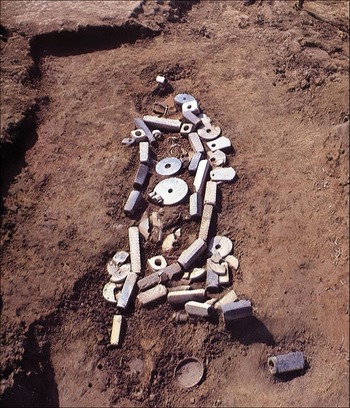
The archaeological discovery of distinctively white tremolite-actinolite artefacts associated with the Neolithic Liangzhu Culture (3300–2300 BC) has drawn scholars’ attention for several decades. Specifically, debate has focused on the question of whether the white colour of these jade objects provides evidence for intentional burning, as part of sacrificial ceremonies, or whether it is a result of natural processes in the burial environment. Much of the discussion has focused on the site of Sidun (Figure 1).
A view of the jades unearthed from Tomb 3 at Sidun (figure credit: Nanjing Museum).

In 1982, Zunguo Wang suggested that the jade discs (bi, 璧), tubes (cong, 琮) and axes (yue, 钺) recovered from Tomb 3 at the Liangzhu-period cemetery of Sidun were probably broken into fragments after being burnt in a fire (Nanjing Museum 1984). This interpretation was refuted in 1991, however, and the breakages and supposed traces of burning were attributed to physical and chemical processes—possibly from weathering in the burial environment (Nanjing Museum 1991; Wang Reference Wang1992; Fang Reference Fang2014). Subsequently, this debate was extended to jades from other Liangzhu-period sites, such as Caoxieshan in Jiangsu Province and Fuquanshan in Shanghai (Huang Reference Huang and Museum2005). Xuanpei Huang (Reference Huang and Museum2005) discovered a later context at Caoxieshan and Fuquanshan that contained further whitened jades. These did not display a pattern of natural weathering, and Huang (Reference Huang and Museum2005) argued that the colouration could be explained by burning; moreover, it was suggested that the purpose of burnt jade sacrifices in the Liangzhu society might be to worship the god of fire or the sun through the act of producing such white jades (Huang Reference Huang and Museum2005).
Sidun is located in the northern part of the Taihu Basin (now in Wujin, Changzhou, Jiangsu Province) and became an important regional centre during the late Liangzhu period (2600–2300 BC). The site was first excavated in 1973 and produced evidence for activity in the late Songze (3500–3300 BC), the late Liangzhu (2600–2300 BC) and the Spring and Autumn periods (770–476 BC). Between 1978 and 1982, Nanjing Museum conducted three archaeological excavations at Sidun and discovered a Songze-period tomb (Tomb 2) and three Liangzhu-period tombs (Tombs 1, 3 and 4) (Nanjing Museum 1981, 1984). Following this, Nanjing Museum, together with Changzhou and Wujin Museums, conducted two further excavations between 1993 and 1995. These uncovered another large Liangzhu-period tomb (Tomb 5) (Archaeological Team at Sidun in Jiangsu Reference Huping1996).
Table 1 lists the types of jade artefacts recovered from the four Liangzhu-period tombs at Sidun. Tubes, discs and personal ornaments are the most prevalent types of jade artefacts present in all the Liangzhu-period tombs. Tomb 3, however, contains higher numbers of jade artefacts, as well as a broader range of types that are less common in the other tombs (Figure 1). Tubes and discs have been suggested to represent the worship of heaven and the earth (Sun Reference Sun1987), as well as serving to communicate status. Therefore, the tomb's occupant was probably a person of high social and religious status. The presence of an axe (yue), together with a mao (瑁) and dui (镦), collectively represents the presence of a jade sceptre (the wooden staff was not preserved), indicating that this individual also possessed military power. This evidence has been used to suggest that the deceased may have been a royal figure (People's Government of Zhejiang Province & The Palace Museum 2019).
Shapes and numbers of Liangzhu jades excavated from Sidun.

Methods
In order to identify whether the jade artefacts from Sidun were burnt prior to their burial, we analysed the 112 artefacts from Tomb 3 using the scientific methods outlined below.
Colour and gloss
Colour and gloss are two fundamental characteristics of jade artefacts. Quantifying these characteristics helps us to better understand the visual appearance of these jades. Data were obtained using a Konica Minolta CM-2300d portable integrating sphere spectrophotometer. Chroma (vividness of colour) is presented in CIE L*a*b* colour space. L* stands for luminosity, ranging from 0 to 100; the higher this value, the brighter the colour. The values of a* and b* range from −120 to 120. As the value of a* increases, the colour changes from green to grey and finally to red, while an increase in b* represents a change in colour from blue to grey and finally to yellow. Relative glossiness is represented by the unit Gs, with higher values indicating an increase in glossiness.
Chemical analyses and mineral composition
X-ray fluorescence (XRF) was used to analyse the chemical elements and their relative proportion within each jade artefact, in order to identify the specific minerals present. The analyses were conducted using a Bruker Tracer III-SD portable XRF spectrometer with a vacuum unit. Minor elements were detected using a voltage of 40kV and current of 30μA, while major elements were detected using a voltage of 15kV and current of 42μA.
Raman spectroscopy and FTIR spectroscopy were used to assist in the identification of the mineral components, as well as to detect subtle structural changes resulting from burning. The Raman test was performed using a BWTEK I-Raman portable Raman spectrometer, with a 785nm laser wavelength and 20× objective lens; the spectra range from 65 to 3200cm−1 and the resolution is 4cm−1, while the integral time is 10s. The FTIR was performed using a Bruker compact ALPHA-II FTIR spectrometer with accessories for diffuse reflection.
Results
Combining the results from the XRF, Raman spectroscopy and FTIR, the analyses demonstrate that most of the ceremonial jade artefacts from Tomb 3, including the tubes, discs and two of the axes, were produced from tremolite-actinolite, while personal ornaments, such as bracelets and necklaces, were produced using a variety of raw materials (see Table 2). For most of the ceremonial jade artefacts, the optical characteristics and mineral composition of those areas of colour alteration are clearly distinguishable from those of naturally occurring jades. The results are discussed below according to artefact type.
Materials used in the production of the excavated jades from Tomb 3 at Sidun.

Tubes (cong)
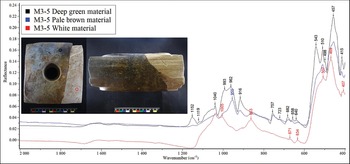
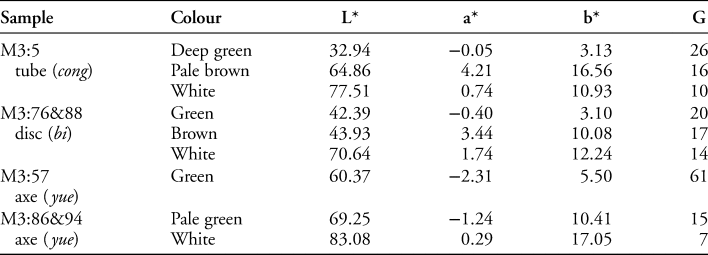
Some 32 intact or partial tubes were recovered from Tomb 3. Fourteen are complete (M3:26 displays a crack), 13 have been reconstructed from multiple fragments and a further five tubes are represented only by fragments. Tube M3:5 provides an example. The tube was broken into two unequally sized pieces. The distinct colours of the two pieces indicate that the colour change of one of the pieces occurred after the artefact had been broken. Figure 2 and Table 3 show that the larger fragment is deep green in colour, with higher glossiness (26Gs), while the smaller piece is pale brown and white, with a lower glossiness of approximately 16Gs (and as low as 10Gs in the whitest region).
FTIR spectra of tube (cong) M3:5, measuring 132–137mm in length and width, and 61mm in height. There is a drill hole with an outer diameter of 40–41mm and inner diameter of 32mm (figure credit: Rong Wang).

Chroma and relative glossiness of samples of different colour regions.

The FTIR data demonstrate that both the deep green and pale brown surface areas of these two fragments are tremolite-actinolite, although the characteristic peaks of the former are stronger (Figure 2 and see Table S1 in the online supplementary material (OSM)). The white surface area of the smaller fragment, however, is mainly diopside. The XRF data from the deep green area of the larger fragment show that the relative amount of iron (Fe) is 2.04 per cent and the magnesium-to-iron ratio, namely Mg/(Mg+Fe), equals 0.95. This provides further confirmation that the tube's original raw material was tremolite (a ratio over 0.9 implies tremolite and, otherwise, actinolite).
Discs (bi)
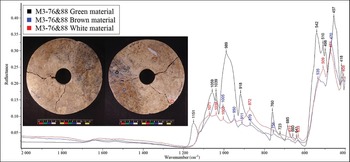
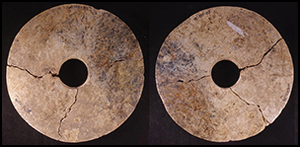
Only one intact disc was recovered. Another three exhibit slight breakage of their edges and a further 20—each broken into between two and eight fragments—can be reconstructed. Fragments of 15 of these reconstructed discs were recovered from a single location, while fragments of the remaining five were distributed around the deceased's body: fragments from all five discs were found around the head, including all of those from M3:48&85; additional pieces of M3:49&95 were associated with the chest; M3:50&91 with the shoulders; M3:76&88 (Figure 3) with the abdomen; and M3:78&84 with the legs.
FTIR spectra of disc (bi) M3:76&88, with an outer diameter of 171–173mm, an inner diameter of 40mm and thickness of 13mm (figure credit: Rong Wang).

Table 3 shows that the data for disc M3:76&88 are in accordance with the visual observations of colour that were made; the values of b* for the brown and white areas are higher than those of the green area. The green area displays a higher glossiness (20Gs), compared with the brown (17Gs) and white (14Gs) areas. The FTIR results (Figure 3 & Table S1) indicate that the green area is composed of tremolite-actinolite, while the white area mainly comprises diopside. The brown area, however, contains two minerals, revealing the tendency for tremolite-actinolite to transform into diopside. XRF further confirms that the original raw material was tremolite; the relative amount of Fe is 1.78 per cent and the ratio of Mg/(Mg+Fe) is 0.96. Unlike tube M3:5, discussed above, where the change in colour occurred after breakage, the change in the mineral composition of M3:76&88 occurred before the artefact was broken.
Axes (yue)
Six axes were recovered from Tomb 3, two of which are made of tremolite (M3:57 and M3:86&94, both shown in Figure 4). M3:57 was mostly intact, with a slightly broken edge, while M3:86&94 was reconstructed from 15 individual fragments.
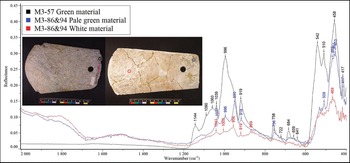
FTIR spectra of axes (yue) M3:57 and M3:86&94. M3:57 (left) is 194mm in length, 87–130mm in width and 4mm in thickness, with a drill hole measuring 16–17mm in diameter. M3:86&94 (right) is 236mm in length, 85–125mm in width and 7mm in thickness, with a drill hole measuring 16mm in diameter (figure credit: Rong Wang).

The glossiness of the green area of M3:57 measures as high as 61Gs. Combining the results from the FTIR (Figure 4 and Table S1) and XRF analyses, the axe's original material is confirmed to be tremolite, with a relative amount of Fe at 1.42 per cent and a Mg/(Mg+Fe) ratio of 0.97.
Table 3 shows the differences in the glossiness of M3:86&94. The pale green area displays a glossiness of 15Gs, while the white area measures only 7Gs. As for the value of b*, the white area is higher than the green area. The data presented in Figure 4 and Table S1 indicate that the light green area represents tremolite-actinolite, while the white area is mainly diopside. The XRF results further confirm that the original raw material was tremolite, given that the relative amount of Fe is 1.50 per cent and the ratio of Mg/(Mg+Fe) is 0.97. It is worth noting that the distribution of the colouration is independent of the fracture, again suggesting that the change in material occurred before breakage.
Simulated burning experiments
In order to explore whether the changes in colour and composition of the jades were the result of exposure to fire, we and other researchers conducted a series of burning experiments. Previous experiments simulated burning using an electric kiln with accurate temperature control to heat modern samples of tremolite-actinolite. The results show that, under various heating rates and exposure times, tremolite-actinolite starts to transform into diopside at approximately 700–900°C (detailed results are listed in Wang Reference Wang2017: tab. 1 and Wang et al. Reference Wang, Wang and Tang2018: table S1).
Following on from these experiments, for the present article, we conducted an open-air experiment to burn the jade using firewood on flat ground, in order to simulate past technology more closely (Figure 5). Each jade sample was bound with a thermocouple thermometer to observe temperature change throughout the process. The exact temperatures of each jade sample were recorded by video camera. The experiment was divided into two parts: the first used a short burning time (up to 50 minutes), while the second used a longer burning time (up to 300 minutes).
Example of the simulated outdoor burning experiment (figure credit: Rong Wang).

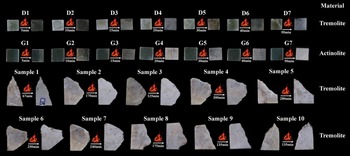
For the first stage of the experiment, both pale green tremolite with a low concentration of iron (FeO & Fe2O3 = 1.79 per cent) and dark green actinolite with a high iron content (FeO & Fe2O3 = 7.27 per cent) were selected. These were cut into 14 pieces, each measuring 15 × 15 × 5mm. For each sample, one surface was polished, where the values of chroma and glossiness were collected. The tremolite samples were labelled D1 to D7 and the actinolite samples labelled G1 to G7; sample labels correspond to different burning times, ranging from five to 50 minutes. For the second stage, pale brown tremolite with a low iron content (FeO&Fe2O3 = 0.51 per cent) were cut into 10 irregular samples and labelled as samples 1 to 10, corresponding to burning times ranging from 67 to 300 minutes.
Temperatures
In the first, short-timeframe experiment, average temperatures of the 14 samples were calculated at 30 second intervals, and ranged between 533.7 and 828.0°C. In the second, longer-timeframe experiment, the average temperatures of the 10 samples ranged from 672.9 to 852.5°C (see Tables S2 & S3). Taking sample 2 as an example, it can be observed that the temperature rose rapidly and reached over 700°C within 20 seconds (Figure 6), but temperatures then levelled off, indicating that temperature and burning time were not correlated. In the presence of a strong wind, for example, temperatures could increase by 200°C in an instant, and the highest temperature observed was 1251.0°C (Table S4). The experiment demonstrates that the temperatures reached and their duration in an open-air environment meet the conditions required to change the chemical structure of jade—that is, approximately 700–900°C.
Temperature changes of sample 2 during the short-timeframe burning experiment (figure credit: Rong Wang).

Macroscopic analyses
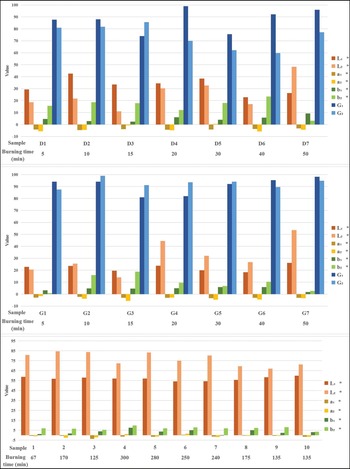
The visual appearance of each sample changed noticeably as a result of exposure to heat (Figure 7). The data in Figure 8 and Table S5 show that the values of L* first decrease and then increase, implying that the colour of the jade samples initially turned darker before becoming paler in colour. There is no obvious change in the values of a* or glossiness, but the value of b* increases, indicating that tremolite and actinolite turned yellow as a result of heating. Moreover, illuminating the jade samples with a strong light source allows their transparency to be observed; this shows that the higher the temperature, the lower the transparency of the samples.
Comparisons of sample appearances before and after the burning experiment (figure credit: Rong Wang).

Comparisons of the chroma and glossiness of samples before and after the burning experiment (L1*, a1*, b1*, G1 refer to the values before the experiment; L2*, a2*, b2*, G2 refer to the values after the experiment) (figure credit: Rong Wang).

Microstructure analyses
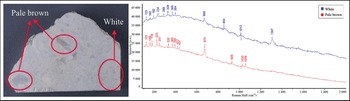
As shown in Figure 9, the Raman spectrum of the pale brown area on sample 2 contains characteristic peaks commonly attributed to tremolite at 123, 159, 178, 223, 251, 332, 369, 394, 417, 437, 674, 929, 1030 and 1059cm–1. In addition to the above peaks, the spectrum of the white area also contains peaks at 234, 328, 669, 854 and 1012cm–1. These are attributed to diopside and indicate that the white area is composed of material that has transformed into an intermediate state between tremolite and diopside.
Raman spectra of sample 2 (figure credit: Rong Wang).

Discussion
Generally speaking, tremolite has a double-chain silicate structure and contains constitutional water (that is, water in the form of OH groups present in the mineral's crystal structure; Posnjak & Bowen Reference Posnjak and Bowen1931), while diopside has a single-chain silicate structure without constitutional water (Zhao Reference Zhao2017). Based on the result of simulated burning experiments, tremolite-actinolite transforms into diopside at approximately 700–900°C, or forms an intermediate state between tremolite and diopside when the temperature cannot be steadily sustained at 900°C. This is because absorbed water (that is, water existing either on the surface or in between gaps within the mineral structure; Wang Reference Wang2020) and constitutional water are lost successively within these temperature ranges. Without the essential linkage of constitutional water, the double-chain silicate structure of tremolite gradually breaks down into the single-chain structure of diopside (Chen Reference Chen2008). The chemical equation for this reaction is: Ca2Mg5−Si8O22(OH)2 (tremolite) + heat → 2CaMgSi2O6 (diopside) + 3MgSiO3 (enstatite) + SiO2 (cristobalite) + H2O (gas) (Deer et al. Reference Deer, Howie and Zussman1997).
The results presented above demonstrate the presence of both tremolite and diopside on the surfaces of fragments from individual jade objects from Sidun. A number of explanations can be considered. The first is weathering or other transformative processes in the burial environment. The simulated burning experiments demonstrate that tremolite-actinolite transforms into diopside at approximately 700–900°C; as this cannot have been achieved without the intentional application of fire, we can exclude the possibility that tremolite was converted into diopside due to post-depositional processes in the burial environment.
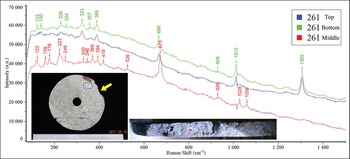
Another possibility is that diopside is associated with tremolite within the same raw mineral deposits. If such a mineral were processed or carved into an artefact, then the distribution of diopside would be expected to be random. Although it is difficult to observe the cross-section of the jade artefacts excavated from Tomb 3, given that they have now been reconstructed from their individual fragments, other jades from the same site (discovered by local farmers in the 1970s and now housed in Changzhou Museum) can be used for comparison. Their optical characteristics and mineral compositions show a high degree of similarity to the jade artefacts from Tomb 3, suggesting that they underwent the same processes (Wang Reference Wang2020). Examining a fracture surface on disc (bi) no. 261, Raman spectroscopy reveals that the pale green interior is tremolite, with characteristic peaks of 123, 159, 178, 223, 249, 330, 346, 369, 394, 419, 526, 673, 928, 1028, 1059cm−1, while the white surface layers on either exterior face contain the characteristic peaks of both tremolite and diopside (140, 228, 254, 323, 357, 389, 666 and 1012cm−1) (Figure 10). The regular distribution of diopside demonstrates that the effects of burning trend down from the surface to the interior, and therefore excludes the possibility of diopside being a naturally occurring associated mineral.
Raman spectra of disc (bi) no. 261 (figure credit: Rong Wang).

Diopside might also have been generated during jade mining. Jing Yang (Reference Yang2017) has suggested that fire (and cold water) could have been used as a means to fracture and extract jade prior to the introduction of the string saw or rigid straight saw (as demonstrated in Sax & Ji Reference Sax and Ji2013: fig. 2). The use of fire in this way would also lead to a random distribution of diopside within an artefact; however, disc (bi) no. 261, as discussed above, demonstrates that this is not the case and, therefore, the use of fire for jade extraction can be ruled out as an explanation for the presence of diopside within these artefacts.
Finally, we consider intentional burning. Due to the uneven heating of different parts of the jade samples when burnt in an open-air environment, diopside is not the only mineral distributed on the experimental samples’ surfaces; tremolite and the intermediate tremolite-diopside state remain present due to inadequately high temperatures, thus leading to the coexistence of green, brown and white surface areas. The mineral composition and their distribution in the experimental samples are comparable to those observed for the artefacts from Sidun. Moreover, when the burning time is extended, the entire surface can be completely transformed into diopside, which can even penetrate deeper into the material.
In summary, the diopside and the intermediate tremolite-diopside state observed on the surfaces of the excavated jades from Sidun cannot be attributed to the presence of associated minerals in the raw materials, nor are they the result of mining processes or transformation in the burial environment. Instead, we argue that the presence of these minerals results from chemical reactions caused by burning in a poorly controlled, open-air environment.
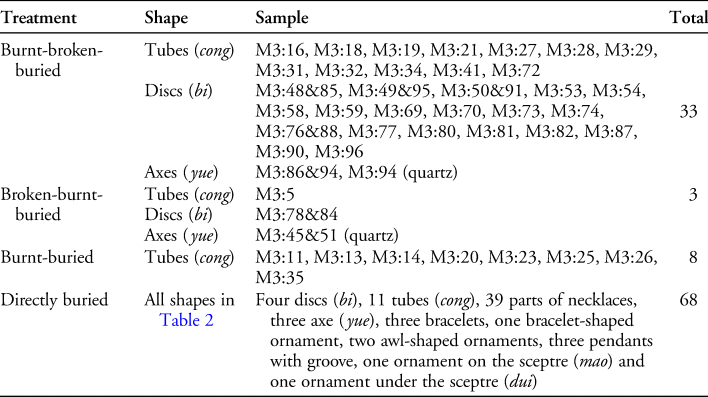
In addition to the changes in the chemical composition of the artefacts brought about by burning, most excavated jade artefacts were also broken into fragments. The sequence of these two events can be distinguished by observing the relationship between the changes in chemical composition (the presence of diopside or tremolite-diopside) and the position of fractures. Our results show that there are four different sequences evidenced at Sidun (Table 4): burnt then broken prior to burial; broken and then burnt prior to burial; burning before burial with no breakage; and, finally, burial without being burnt or broken.
Sequence of treatments on jade wares.

Several archaeological parallels from later periods help to elucidate the purpose behind the burning of the jade artefacts from Sidun. Several of the jades buried in the Sanxingdui sacrificial pit in Guanghan, Sichuan Province, of the late Shang Dynasty (1250–1046 BC), had been burnt, broken and buried (Sichuan Provincial Cultural Relics Management Committee et al. 1987, 1989). In Tomb 1001 at Houjiazhuang, in the Yin Ruins of Anyang, the centre of the Shang Dynasty, several jade fragments were recovered from the ash pit outside the northern tomb passage and from the burnt charcoal layer within Pit 1567. Shuping Deng (Reference Deng and Jisheng2012) has suggested that these remains were buried after being burnt as a sacrifice and may also have been intentionally broken. Several of the jades from the late Shang Tomb of Fuhao and from the east of Huayuanzhuang were also burnt prior to burial, although were not broken (Institute of Archaeology Chinese Academy of Social Sciences 2007; Wang et al. Reference Wang, Wang and Tang2018). These examples suggest that burning and intentional breakage of jade artefacts prior to burial were commonplace during the Shang Dynasty—a series of actions which the institutions and researchers mentioned above attribute to sacrifice.
Oracle bone inscriptions dating to the Shang Dynasty are one of the earliest forms of Chinese writing and can provide further written evidence to support this interpretation. There are more than 1600 records regarding burnt sacrifices recorded in such inscriptions, at least 14 of which mention jade artefacts as sacrificial burnt offerings, called liao yu (燎玉). Such sacrifices were made to honour the heavens, the earth and the ancestors, or as prayers for rainfall (Wang & Wang Reference Wang and Wang2022).
The breaking and burying of jades are two other significant sacrificial rites observed during the Shang period, referred to as gang yu (刚玉) and kan yu (坎玉) respectively. Furthermore, in the Shang period, these sacrifices were usually burnt prior to being broken. One of the inscriptions states,
in the day of ding mao [丁卯], the oracle divined whether to prepare jade artefacts as offerings, burn three groups of xiao lao [pig and sheep/goat, 小牢] and destroy three groups of da lao [pig, cattle/buffalo and sheep/goat, 大牢]. (Hu Reference Hu1999b: 483)
The purpose of burning and breaking such sacrifices might have been to prevent people or ghosts from purloining such offerings (Zhai Reference Zhai2011), prior to the final step of burial.
Conclusions
The Liangzhu site of Sidun became an important political centre in the late Liangzhu period (2600–2300 BC). Abundant decorative and ceremonial jade artefacts recovered from Tomb 3, including a jade sceptre, suggest that the deceased person buried there held high military and religious—perhaps even royal—status. All of the ritual jade artefacts from Tomb 3, including the tubes, discs and sceptre, were made of tremolite-actinolite; the axes, however, were produced from a variety of raw materials, including tremolite, quartz, rutile and shale. In addition to tremolite, personal ornaments were also made from serpentine and talc.
Most of the excavated jade artefacts display a differentiation of colours, which correlate to differing values of glossiness and mineral composition. These phenomena are comparable to those observed on the jade samples burnt as part of our simulated open-air heating experiment using firewood. This experiment confirms that, in the presence of strong winds, the temperature of such fires can reach 1251.0°C, which exceeds that required to transform tremolite-actinolite into diopside. Due to the instability of the temperatures produced by such fires, however, diopside and the intermediate state of tremolite-diopside may exist side-by-side on the surface of a single piece of jade; this is similar to what is observed on the excavated jade artefacts. Therefore, we suggest that most of the ceremonial jade artefacts from Tomb 3 had undergone a similar burning process in an open-air environment.
In addition, we have sought to reconstruct the entire sequence through which these jade artefacts passed before inclusion in the burial. All of the personal ornaments, as well as 18 of the ceremonial jades, including 11 tubes, four discs and three axes, were buried intact and unburnt; 33 ceremonial jades, including 19 discs, 12 tubes and two axes were first burnt and then broken before burial; one tube, one disc and one axe were first broken and then burnt before burial; and the remaining eight tubes were burnt before burial but not broken. In the context of the Liangzhu Culture, where jade played a significant role in ritual activities, the burning, breakage and burial of such valuable resources probably related to sacrificial rites, in a similar way to that documented in the later Shang-period oracle bones.
Our analyses confirm that the jade artefacts from Sidun provide the earliest evidence for burnt jade sacrifices so far found in China, bringing to an end an academic debate that has persisted for nearly 40 years. Compared with the records from oracle bone inscriptions dating to the late Shang Dynasty, the sacrificial burning of jades at Sidun took place more than 1000 years earlier. This demonstrates the diversity and complexity of sacrificial rites in the Neolithic period and broadens our understanding of the Liangzhu Culture. It also reveals a much longer history and stronger continuity of burnt jade sacrifices than previous thought, beginning some 4500 years ago and continuing through to the Qing Dynasty (AD 1644–1911). It remains to be seen whether other, earlier examples of burnt jade sacrifices exist. Indeed, whether this practice was particular to Sidun or more widespread across Late Neolithic China requires further study, which should focus on jades of the earlier Liangzhu periods, as well as those from other regions.
Acknowledgements
We would like to thank Xuefei Zhang and Mingli Tian from Nanjing Museum for providing kind advice and support during this research.
Funding statement
This research is funded by the Ministry of Education of Humanities and Social Science Project (grant no. 18YJCZH174).
Supplementary information
To view supplementary material for this article, please visit https://doi.org/10.15184/aqy.2022.101.