Psychoactive substances played an important role in ritual practice throughout the ancient world (Fitzpatrick Reference Fitzpatrick2018). In North America, one of the most powerful hallucinogens was and continues to derive from plants in the genus Datura (Rafferty Reference Rafferty2021). Plants in this genus are members of the Solanaceae family; their flowers, leaves, and seeds contain tropane alkaloids like atropine and scopolamine that produce hallucinogenic effects (Hawkes et al. Reference Hawkes, Nee and Estrada-Ramos1991). Ethnographic descriptions of Datura practice show it can be used for a variety of purposes from treating physical injuries to ritual divination and enhancing spiritual journeys (see Rätsch Reference Rätsch2005:477–485). The method of delivery determines the dose and usage and includes topical application, smoking leaves, and consuming teas made from seeds and leaves, with the latter delivering the highest doses used in shamanism and spiritual journeys.
Although plants in this genus are found throughout the world, several species appear to be indigenous to the Americas (Symon and Haegi Reference Symon, Haegi, Hawkes, Lester, Nee and Estrada-Ramos1991). For centuries, the Indigenous people of the Americas employed various species of Datura for their medicinal and psychotropic effects (Rafferty Reference Rafferty2021; Safford Reference Safford1922). Its use in North America has deep roots, as supported by archaeological evidence spanning millennia from 2500 BC to the seventeenth century AD (King et al. Reference King, Powis, Cheong, Deere, Pickering, Singleton and Gaikwad2018; Rafferty Reference Rafferty2021). In two papers, Lankford (Reference Lankford2012, Reference Lankford2014) put forth the hypothesis that a particular version of Datura ceremonialism was transferred from the US Southwest into the Eastern Woodlands sometime in the thirteenth and fourteenth centuries AD.
In this article, we analyze the archaeological record and absorbed residues to explore Lankford’s ideas on the nature and spread of that ritual complex. Ultimately, we argue that the available evidence supports the existence of such a complex linking the Southwest and Southeast. We further suggest that Datura moved through the Americas as part of practices controlled by ritual sodalities. Datura, with its vision-inducing properties, was a key element of those practices as it facilitated legerdemain theatrics that served to underscore the efficacy of ritual sodalities. Ritual sodalities are non-kin groups organized for a specific purpose, such as the veneration of an other-than-human being or a place in the cosmoscape. They are generally restrictive, secretive, and typically expressed as cultic institutions, medicine societies, or military associations. Membership is often based on dreams and visions that bestow personal power on the supplicant, making Datura a potentially valuable component of ritual sodality practice.
A Hypothesized Datura Ritual Complex
In their exploration of shamanistic practices in the American Southwest, VanPool and colleagues have argued that a shamanistic tradition existed in the region involving Datura, noded vessels, and imagery featuring Datura flowers and seed pods, entoptic designs inspired by altered states of consciousness and a moth–human supernatural (Huckell and VanPool Reference Huckell, VanPool, VanPool, VanPool and Phillips2006; VanPool Reference VanPool2009). It is believed the moth–human figure has a natural analog in the Hawk or Sphinx Moth, which is a key pollinator of important ritual plants including tobacco and Datura. These practices are linked to Datura through ancient imagery and continuing Hopi narrative traditions (Huckell and VanPool Reference Huckell, VanPool, VanPool, VanPool and Phillips2006; Kay Reference Kay2005).
Lankford (Reference Lankford2012) recognized that pottery vessels covered with small nodes were made and used during the Mississippian period (AD 900–1600) and were found from the Mississippi River Valley to the South Appalachian region (Figure 1). He hypothesized that, like their Southwest counterparts, these vessels also were intended to be Datura seed pod effigies used in ceremonies. Lankford’s interest in noded vessels, however, went beyond explaining the presence of a ceramic decorative mode. For many decades, archaeologists in both the southeastern and southwestern United States have noted the conspicuous lack of evidence for contact between the complex societies that developed in the two regions. Lankford’s deeper interest lay in arguing that the noded vessels found in Mississippian contexts revealed the transfer of the Southwest Datura ritual complex eastward.
Fortune Noded ceramic vessel (from Griffin Reference Griffin1952:Figure 124).

In his 2012 paper, Lankford suggested that a shamanic tradition, similar to the Southwest ritual complex involving Datura consumption, noded vessels, and imagery featuring Datura, entoptic designs, and a human–moth supernatural, made its way to the southeastern United States. To evaluate this idea, he argued for the testing of three hypotheses. The first is the connection between Datura and noded pottery vessels, which can be assessed by attempting to detect Datura residues in noded vessels. His second hypothesis is that noded ceramics and, more generally, the Datura ritual complex traveled from the Southwest through the Caddo area and into the Central Mississippi Valley. This idea, he suggests, may best be evaluated through a detailed examination of the dating of noded vessels in all three regions. Lankford’s third hypothesis is that Datura was used in ritual practices of the Central Mississippi Valley. We evaluate each of these hypotheses, beginning with new absorbed residue evidence as support for the idea that noded vessels were key objects of Datura ceremonialism.
Hypothesis 1: Fortune Noded Vessels Are Connected to Datura
As Lankford (Reference Lankford2012) outlines, key support for his ideas about the Datura complex is evidence that noded vessels once held Datura. As he notes, one readily available way to find this evidence is to conduct a chemical analysis of samples from the interiors of Mississippian noded vessels. Hooven and colleagues (Reference Hooven, Russ and Dye2016) were the first to attempt to directly evaluate Lankford’s Hypothesis 1 by conducting an absorbed residue study on Fortune Noded vessels. In that study, two Fortune Noded vessels were sampled by sonicating them in a liquid solvent (1:2 MeOH:chloroform with 1% NH4OH). The samples were then analyzed using gas chromatography/mass spectrometry (GC/MS) and gas chromatography with flame ionization detection (GC-FID). For this study the authors attempted to detect the two most important tropane alkaloids found in plants in the Datura genus: atropine and scopolamine. Neither alkaloid was detected, however, because the sample size was small; however, even though these results were negative, they were not definitive.
2017 Fortune Noded Sampling. In 2017, Adam King visited the Gilcrease Museum at the Thomas Gilcrease Institute of American History and Art in Tulsa, Oklahoma, to further test Lankford’s Hypothesis 1 using a larger sample of noded vessels. We selected 17 whole vessels from the Banks site assemblage and the Lemley collection housed at the museum. Information on each vessel is presented in Table 1; it is limited largely because the vessels were not recovered by professionally trained archaeologists. The founder of the museum, Thomas Gilcrease, had acquired the vessels from dealers, who presumably acquired them from their original collectors. As Table 1 shows, 14 of the 17 vessels were covered in small nodes and fit the type description Fortune Noded. We sampled three additional vessels that were not Fortune Noded: two Matthews Incised and one Mississippi Plain vessel.
Samples Collected and Atropine Positives.

We subjected each vessel to a sampling strategy informed by the one used by King and colleagues (Reference King, Powis, Cheong, Deere, Pickering, Singleton and Gaikwad2018). A cotton ball was rinsed in distilled water and then used to remove a swab of dust from the interior of each vessel. Our intent was to collect any information on potential surface contamination. In a different part of the lower portion of each vessel interior, we removed a burr sample using a Dremel bit. We rinsed the bit with distilled water after each use and put on new gloves and used a new cleaned cotton ball with each burr sample. We collected four dust samples using a cotton ball rinsed with distilled water to assess surface contamination in the storage areas. Two were collected from shelves holding the Lemley collection, and two were taken from shelves holding the Banks site collection.
We analyzed all samples for the presence of atropine only. Scopolamine is volatile enough that it is not expected to survive in the archaeological record. We also did not attempt to detect tropine and tropic acid, which are key metabolites of atropine, because they are found in other plants. We analyzed our samples using an ultraperformance liquid chromatography tandem mass spectrometer (UPLC/MS-MS). To prepare for analyses, we incubated burr and cotton swipe samples with 200 ml and 1 ml distilled water, respectively, at 80°C for 30 minutes. After incubation, we vortexed and centrifuged all samples. The resulting sediment from the burr sample was removed and the supernatant filtered using 5 kD membrane filters. For cotton samples, we dried the extract and added 200 ml of a 1:1 mix of water and ethanol. We sonicated, vortexed. and filtered the resulting mixture using 5 kD membrane filters. All the filtrates were then transferred to vials for UPLC/MS-MS analysis.
We used a Waters Acquity UPLC system connected with a Waters triple quadruple mass spectrometer when conducting UPLC/MS-MS analyses of all the samples. Analytical separations on the UPLC system were conducted using an Acquity UPLC C18 1.6 mm column (2 × 150 mm) at a flow rate of 0.15 ml/min. The gradient started with 100% A (0.1% formic acid in H2O) and 0% B (0.1% formic acid in methanol), was changed to 50% A over five minutes, and was followed by a five-minute linear gradient to 10% A, resulting in a total separation time of 10 minutes. We introduced the resulting elutions from the UPLC column to the mass spectrometer.
Subsequently, a triple quadruple mass spectrometer (Waters, Milford, Massachusetts, USA) recorded MS and MS-MS spectra using electro spray ionization (ESI) in positive ion (PI) mode, capillary voltage of 3.0 kV, extractor cone voltage of 3 V, sample cone voltage of 32 V, and detector voltage of 500 V. We set the cone gas flow at 30 L/h, and maintained the desolvation gas flow at 300 L/h. We set source temperature and desolvation temperatures at 150°C and 350°C, respectively. The acquisition range was 20–500 Da. A pure standard of atropine was introduced to the source at a flow rate of 10 ml/min by using a 1:1 methanol to water mixture and 0.1% formic acid mixture as the carrier solution to develop the method for UPLC/MS-MS operation. We analyzed and processed the resulting data from LCMS analysis from all samples using MassLynx 4.1 software.
Because atropine could have entered the samples at several points in this process, we analyzed a series of blanks at key points in that process. Three unused cotton balls were analyzed to assess any potential contamination resulting from sampling materials and methods. A blank was collected during sample preparation and analyzed to rule out contamination occurring during the preparation process. Finally, six blanks were distributed among the archaeological samples during the LCMS analyses to ensure there was no contamination caused by the analysis of pure atropine samples. None of the blanks contained atropine.
Consistent with Hooven and colleagues’ (Reference Hooven, Russ and Dye2016) results, none of the samples in Table 1 contained atropine. Given that Datura residues can contain other compounds, it is possible that the vessels we sampled once contained Datura, despite our inability to detect atropine. We suspect this is unlikely because analyses of samples from other contemporary vessels in the Gilcrease collection did detect atropine (King et al. Reference King, Powis, Cheong, Deere, Pickering, Singleton and Gaikwad2018; Lambert et al. Reference Lambert, Perttula and Gaikwad2021). These results make a clear statement about Lankford’s first hypothesis about noded vessels. We conclude that none of the vessels sampled held Datura-containing concoctions—at least not concoctions that were absorbed into the vessel matrices.
When we looked more closely, however, our results presented a puzzle. The dust samples from seven of the vessel interiors included atropine, and another two contained potential traces of atropine. Three of the four dust samples from shelving also contained atropine. This clearly seems to suggest that atropine is present in surface contamination both on the vessels and in the storage area. One puzzling aspect of these results is that the burr samples contained no atropine. Presumably they should have also included atropine because the burr samples would have captured any dust that had accumulated on the vessel interior at the location where the burr was collected.
The clear presence of surface contamination containing atropine presents its own puzzle. In their study performed in 2014, King and colleagues (Reference King, Powis, Cheong, Deere, Pickering, Singleton and Gaikwad2018) collected surface samples from 14 locations in storage and working areas at the Gilcrease Museum and detected no atropine; however, they did not collect dust samples from vessel interiors. King and coworkers (Reference King, Powis, Cheong, Deere, Pickering, Singleton and Gaikwad2018) interpreted the results to indicate that the atropine present in the vessels was the result of the Mississippian period use of Datura rather than from recent contamination. The 2017 surface sampling leads us to hypothesize that some new source of contamination was introduced to the collection after 2014. See Supplementary Text 1 and Supplementary Tables 1–5 for analyses and discussion supporting our hypothesis.
Fortune Noded and Datura Ceremonialism. As noted earlier, the absence of atropine in the burr samples collected from 13 Fortune Noded vessels in the Gilcrease collection indicates that no atropine was absorbed into the matrix of any of those vessels. This likely means they never held liquid concoctions made using Datura. This, however, does not necessarily disprove Lankford’s hypothesis that Fortune Noded vessels were used in Datura ceremonialism. Historical information indicates that people in the Americas ingested the plant in one of two ways: smoking either leaves or seeds or drinking a tea from seeds or leaves (Rätsch Reference Rätsch2005). Archaeological evidence for both types of ingestion has been recovered from Mississippian period contexts (Carmody et al. Reference Carmody, Davis, Tadi, Sharp, Hunt and Russ2018; King et al. Reference King, Powis, Cheong, Deere, Pickering, Singleton and Gaikwad2018; Lambert et al. Reference Lambert, Perttula and Gaikwad2021). It is possible a powdered snuff also could have been used as a method of ingestion. The most effective way for atropine residues to become absorbed into vessel matrices is by being included in some liquid concoction. Yet, our 2017 results indicated that Fortune Noded vessels were not used for the preparation or consumption of Datura beverages. King and colleagues’ (Reference King, Powis, Cheong, Deere, Pickering, Singleton and Gaikwad2018) initial results show that other kinds of containers, particularly bottles and small bowls (including those made using marine shell), were the containers most likely used for those purposes.
Ultimately, our results do not necessarily disprove Lankford’s hypothesis. It is possible that Fortune Noded and other noded types found in the Mississippian world were used in Datura-related rituals—but in ways that did not cause atropine to be absorbed into the bodies of pots. If Fortune Noded vessels were intended to be Datura seed pod effigies, they could have been used in other aspects of Datura ceremonies. One possible use could have been as containers for drying seed pods or seeds. This use would have less likely allowed atropine residues to become absorbed into the body of containers.
It is also important to accept that these results may not apply to all noded vessels. We think they are probably representative of the use of Fortune Noded vessels in the Mississippi Valley but may not be a good indicator of how similar vessels from the Caddo area, the southwestern United States, and Mexico were used. Only additional studies focusing on those containers will reveal any connections to Datura.
In addition to sampling other noded vessel types, other avenues of research will help evaluate this Datura complex in more detail. Although our absorbed residue results indicate that Fortune Noded vessels did not hold Datura liquids, they do not address other uses of the vessels such as containers for seeds or seed pods. One way to evaluate this use is to recover microbotanical evidence for the presence of Datura (pollen, phytoliths, and starch grains) from noded vessels. Even vessels in legacy collections that have been washed may still contain pollen, phytoliths, and starch grains that can be freed from a vessel’s matrix through sonication.
Further, noded vessels are not the only connection between the Datura complex of the Southwest and the Central Mississippi Valley. At least four Mississippian period bottles exhibiting moth-related imagery have been recovered and should be sampled for Datura absorbed residues. Datura residues already have been detected in some Mississippian and Caddoan bottles, suggesting that at least some elaborate bottles did hold Datura liquids. If it can be demonstrated that these four bottles once held Datura, a direct connection between the moth–human supernatural, Datura, and the Central Mississippi Valley can be established.
We also propose another possible material correlate of a Datura complex in the Central Mississippi Valley. At the same time that Fortune Noded vessels were being used, two related effigy bottle forms were also being made. One is called the gourd effigy because it resembles a gourd. This form is usually painted or negative painted, is found in the Cairo Lowlands of the Central Mississippi Valley, and dates between AD 1300 and 1500. The later form is called the teapot, is also painted, and dates between AD 1500 and 1625. Without firm support, we propose that both bottle types may have been designed to deliver enemas and that those enemas contained Datura.
Ritual enemas are not unknown in the history of Central and South America (de Smet Reference De Smet1985; Furst and Coe Reference Furst and Coe1977). There is historical information suggesting they were used by the Huastec of northern Mexico (Furst and Coe Reference Furst and Coe1977:88–90; Miller and Taube Reference Miller and Taube1993:85; Robicsek Reference Robicsek1978:23), and there is a great deal of imagery and historical evidence indicating that enemas were part of ritual practice among the ancient Maya (de Smet Reference De Smet1985; Furst and Coe Reference Furst and Coe1977). In the Maya area, it has been argued that enemas likely contained fermented liquids and Datura (de Smet Reference De Smet1985; Stross and Kerr Reference Stross, Kerr, Kerr and Kerr1990).
Although there is currently no evidence suggesting that Native North Americans made alcohol, there is archaeological evidence showing that Datura was used at least into the eighteenth century. There is also no historic information suggesting a tradition of ritual enemas. However, the gourd effigies and teapot vessels of the Mississippi River Valley are distinct in the Mississippian world and were uniquely designed to deliver enemas. Given this, it is possible that they were part of the ritual use of Datura, and because they were made at the same time and in the same region as the Fortune Noded vessels, bottles with moth imagery, and other elaborate bottles with Datura residues, they may have been part of the hypothesized Datura ritual complex. As with the bottles bearing moth imagery, gourd and teapot vessels could be sampled for absorbed residues of Datura concoctions.
Hypothesis 2: The Complex Traveled from the Southwest through the Caddoan Area to the Central Mississippi Valley
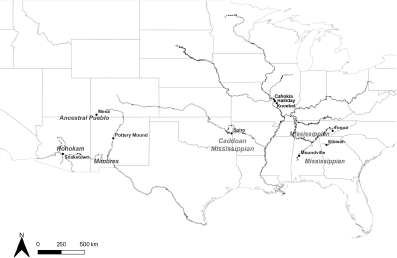
This hypothesis suggests that the Datura complex began in the American Southwest (possibly influenced by practices in Mexico) and made its way through the Caddoan area of eastern Texas, northeastern Louisiana, and western Arkansas before arriving in the Central Mississippi Valley. In this section, we evaluate this hypothesis by summarizing information on the dating of key aspects of the complex in the three areas under consideration. We also extend the spread of the complex beyond the Mississippi Valley (Figure 2).
Map showing the location of archaeological cultures and sites referenced in the text.

Litzinger (Reference Litzinger1981) argued that this complex probably had its origins in Mexico and made its way to the Southwest as part of the well-known connections between the two regions. As Litzinger (Reference Litzinger1981), VanPool and colleagues (Huckell and VanPool Reference Huckell, VanPool, VanPool, VanPool and Phillips2006; VanPool Reference VanPool2009), and Lankford (Reference Lankford2012) all summarize, ceramic vessels covered with small nodes are found throughout the Southwest culture area from the Hohokam to the Mimbres and Ancestral Pueblo. They further connect Hawkmoth and moth–human imagery to this complex. In the Hohokam area, noded vessels seem to appear at Snaketown from as early as AD 850 but persist to as late as AD 1300 (Gladwin et al. Reference Gladwin, Haury, Sayles and Gladwin1937). In the Mimbres area, noded vessels have been found in Classic Mimbres contexts dating from AD 1000 to 1300 (Huckell and VanPool Reference Huckell, VanPool, VanPool, VanPool and Phillips2006). In the Mesa Verde region, similar noded vessels have been recovered in contexts as early as AD 1000 to as late as AD 1200 (Hayes and Lancaster Reference Hayes and Lancaster1975; Litzinger Reference Litzinger1981). Additionally, moth–human and Datura imagery are common on Classic period Mimbres pottery (AD 1000–1300; Berlant and Maurer Reference Berlant and Evan2018; Huckell and VanPool Reference Huckell, VanPool, VanPool, VanPool and Phillips2006) and on the famous kiva murals of Pottery Mound during the Pueblo IV period (AD 1300–1500; VanPool Reference VanPool2009).
Near the end of the temporal range of noded vessels and moth–human imagery in the Southwest, noded vessels appear in the Caddoan region (Phillips et al. Reference Phillips, Ford and Griffin1951). This area, comprising parts of eastern Texas, southeastern Arkansas, and northeastern Louisiana, lies between the greater Southwest culture area and the Mississippian region of the East. In the Caddo area, vessels covered with small nodes have the type name Moore Noded: they look very similar to Fortune Noded vessels, with some temper and paste differences (Wood Reference Wood1981). With the exception of one known brazier form, most Moore Noded vessels are small jars and bowls, more like Central Mississippi Valley types than the lidded jars and braziers of the Southwest. Moore Noded is not particularly well dated but is identified as being present in various Middle and Late Caddo phases dating from as early as AD 1200 to as late as AD 1700 (Perttula and Seldon Reference Perttula and Selden2014). As noted earlier, Datura residues were recovered from two Caddoan ceramic and 14 shell containers dating from as early as AD 1300 and as late as AD 1700 (King et al. Reference King, Powis, Cheong, Deere, Pickering, Singleton and Gaikwad2018). Known Datura or moth imagery from the Caddoan region is scant. Two engraved shell plaques recovered from the Great Mortuary of the Spiro site depict what Knight and Franke (Reference Knight, Franke, F. Kent and Garber2007:145–147) suggest is the caterpillar form of the moth supernatural. These two images are executed in what is understood to be the Caddoan Craig A style (Phillips and Brown Reference Phillips and Brown1984:Plate 145), which was likely made somewhere after AD 1200 but before AD 1400.
In the Central Mississippi Valley, Fortune Noded is concentrated in the Parkin phase (AD 1400–1650) of the St. Francis River Valley and the Nodena phase (AD 1400–1650) of the Mississippi River in northeastern Arkansas. The type is not very common in any one site, but it is known from as many as 24 sites in the area (Mainfort Reference Mainfort2003). Although the dates of both phases begin around AD 1400 and last to the early seventeenth century, the type may have its origins up to a century earlier. As discussed later, Fortune Noded vessels have been recovered from well-dated fourteenth-century contexts in the South Appalachian region. In addition to the presence of Fortuned Noded vessels, Datura residues were detected in both bottles and bowls from the Mississippi Valley dating from AD 1300 to after the coming of Europeans (King et al. Reference King, Powis, Cheong, Deere, Pickering, Singleton and Gaikwad2018). Moth imagery, although not common, has been recovered from the area as well. A vessel with moth-related imagery was recovered from the East Prairie site in the Cairo Lowland of the Mississippi–Ohio River Confluence region (Knight and Franke Reference Knight, Franke, F. Kent and Garber2007; LaDassor Reference LaDassor1954). This bottle was made between AD 1200 and AD 1400 and is painted with a pars-pro-toto rendition of the moth–human figure, depicting just its wings and curled and spikey proboscis.
The Mississippian “heartland” of the proposed Datura complex may have been the Central Mississippi Valley, but eastern parts of the Mississippian world were no strangers to Datura or the proposed ritual complex. Fortune Noded vessels have been recovered from the Gower’s Place site on the middle Cumberland River of central Tennessee (Moore and Smith Reference Moore and Smith2009), the Toqua site on the Tennessee River of eastern Tennessee (Polhemus Reference Polhemus1987), and the Etowah site in northwestern Georgia (Brain and Phillips Reference Brain and Phillips1996). In each case, the noded vessels were recovered from mortuary contexts dating to the middle to late fourteenth century (King Reference King2003; Koerner et al. Reference Koerner, Sullivan and Braly2011; Moore and Smith Reference Moore and Smith2009).
In addition to the Fortuned Noded vessels in eastern Tennessee and northern Georgia, the moth supernatural appears on a series of gorgets found throughout the region—and all the way to the Central Mississippi Valley and Caddoan region (see Brain and Phillips Reference Brain and Phillips1996:49). These were made in the northern Georgia Hightower style sometime early in the fourteenth century (King Reference King, George, F. Kent and James F.2011; Muller Reference Muller and Galloway1989). To the south, the Moundville site in central Alabama produced several examples of the moth supernatural. Among those are three painted bottles with the wings and proboscis of the moth, two engraved sherds exhibiting elements of the moth’s wing (Knight and Franke Reference Knight, Franke, F. Kent and Garber2007:150), and a fully realized version of the moth supernatural on a sandstone disk known as the Willoughby Disk (Knight and Franke Reference Knight, Franke, F. Kent and Garber2007). Each of these images was likely made in the period from AD 1300 to AD 1450.
If we look at the broad outline of the temporal and geographic distribution of Lankford’s material correlates of the proposed Datura ritual complex, it fits reasonably well with his Hypothesis 2. It seems to appear earliest in the Southwest and only later makes its way eastward. The noded vessels and moth imagery appear in the Southwest as early as AD 1000. Based on the chronological information currently available, it appears that the complex may have arrived in the Caddoan area and Central Mississippi Valley at about the same time, possibly as early as AD 1200 but more likely closer to AD 1300.
Although this chronology seems to cast doubt on the assumption that the Datura complex moved through the Caddo area before arriving in the Central Mississippi Valley, the dating and distribution of nonlocal items of Southwest origin tell a different story. To date, no pottery or turquoise or obsidian artifacts of Southwestern origin have been found in Mississippian contexts of the Central Mississippi Valley. In contrast, a small number of Caddo sites in eastern Texas have produced Southwest pottery (n = 11), turquoise (n = 7), and obsidian (n = 8; Crook and Perttula Reference Crook and Timothy2018). As Crook and Perttula (Reference Crook and Timothy2018:25) summarize, although these artifacts are found in contexts that date from AD 800 to 1600, the majority of the Southwest cultural materials are recovered from “Middle Caddo (around AD 1200–1400) and Late Caddo (around AD 1400–1680) components.” This presents a pretty compelling case that the proposed Datura complex likely followed long-standing connections between the Southwest, the Great Plains, and the Caddo to enter the Mississippian world.
If Datura ritual complexes arrived in the Central Mississippi Valley from the west, it is likely they moved through the northern Caddoan polities, especially the Spiro ritual center, which witnessed sustained contacts and interactions with the Mississippian world over some five centuries, ending in the early fifteenth century (Brown Reference Brown1996, Reference Brown, Timothy and Chester2012; Dye Reference Dye, Charles and Ryan2020a; Emerson and Jackson Reference Emerson and Jackson1984; Singleton and Reilly Reference Singleton and Reilly III2020). Spiro shows greater affiliations with the Mississippian world than with the more southern Caddoan polities, where ritual sodalites venerated the mescal bean, peyote, or tobacco and may not have been receptive to innovative ritual practices based on Datura.
This inference finds support in King and colleagues’ (Reference King, Powis, Cheong, Deere, Pickering, Singleton and Gaikwad2018) detection of Datura residues in shell cups reportedly recovered from Spiro and likely its Craig Mound. It is further supported by various iconographic connections between the Southwest, especially the Mimbres area, and Spiroan imagery, including the Hawkmoth horned caterpillars, as well as spiral proboscis imagery that is well documented in the Mimbres area and is prominently illustrated in Craig-style engraving at Spiro (Knight and Franke Reference Knight, Franke, F. Kent and Garber2007; Lankford Reference Lankford2014). Additionally, Caddoan and Mimbres imagery share other Datura-related imagery, such as anthropomorphic beings with belt sashes, diamond-shaped eyes, hourglass-shaped hair buns, and serpent capes. Entoptic designs and motifs found on Mimbres bowls are also present on Craig-style shell art and include checkerboard or cross-hatching, concentric circles and ovals, interlocking spirals, quadripartite and rotational symmetry, and zigzags (Phillips and Brown Reference Phillips and Brown1984).
Assuming the Caddo area was the entry point, ideas and practices surrounding Datura traveled quickly into the Central Mississippi Valley. With greater temporal resolution, we may see that more clearly in the archaeological record. Just as quickly, it appears the complex was brought to the South Appalachian region. At least in northwestern Georgia, King (Reference King and Townsend2004, Reference King, Sullivan and Mainfort2010, Reference King, Eric and Reilly III2020a, Reference King, Charles and Ryan2020b) has argued that people, materials, and ideas arrived at the Etowah site via the movement of people directly from the Cairo Lowlands of the Mississippi Valley. In the Southwest and the South Appalachian region, evidence of the complex seems to disappear before the sixteenth century. However, in both the Caddo region and Central Mississippi Valley it persists into the seventeenth century.
Hypothesis 3: Datura in the Central Mississippi Valley
For Lankford’s argument to be viable, evidence must exist indicating the use of Datura in the Central Mississippi Valley. We know Datura was used in the eastern United States for several millennia before the appearance of Lankford’s proposed complex. In fact, the earliest recorded use of Datura comes from residues detected in a Late Archaic period smoking tube recovered at the Flint River site on the Tennessee River in northern Alabama (Carmody et al. Reference Carmody, Davis, Tadi, Sharp, Hunt and Russ2018). Still predating the proposed complex, another smoking tube—this one dating to the Early Mississippian period (AD 900–1150) from the Spencer site outside Nashville—also tested positive for a key alkaloid found in Datura, atropine (Parker and Simon Reference Parker, Simon, Brad and Timothy2018:142).
In the Mississippi Valley, the earliest appearance of Datura comes in the form of the small numbers of seeds recovered in Early Mississippian contexts. In all cases recorded so far, these sites are in the American Bottom, north of the distribution of Fortune Noded vessels. Datura seeds have been recovered in Lohmann phase contexts (AD 1050–1100) at the Knoebel and Halliday sites and in Stirling phase contexts (AD 1100–1200) at the BBB Motor and Goose Ditch sites (Emerson and Jackson Reference Emerson and Jackson1984; Parker and Simon Reference Parker, Simon, Brad and Timothy2018:141–142). Although most of these seeds were recovered in what have been interpreted as ritual contexts, the clearest example comes from the BBB Motor site where Datura seeds were found in a feature associated with a ritual building (Emerson and Jackson Reference Emerson and Jackson1984).
The most direct evidence for the use of Datura in ritual contexts in the Central Mississippi Valley is the detection of absorbed residues in pottery vessels. In their 2014 study described earlier, King and colleagues (Reference King, Powis, Cheong, Deere, Pickering, Singleton and Gaikwad2018) analyzed absorbed residues found in ceramic and shell containers housed at the Gilcrease Museum. The goal of the study was to find evidence for the use of a series of plants known to be consumed in ritual beverages by native North and Central Americans, including cacao, vanilla, chili peppers, and Datura. The sample focused on vessels most likely to have once held ritual drinks, such as effigies and highly decorated bottles and bowls. The clearest evidence was produced by the search for atropine. Among the vessels sampled were 31 ceramic and 18 shell vessels from Central Mississippi Valley and Caddoan contexts dating between AD 1400 and 1700. Seven of the ceramic vessels and 14 of the shell containers tested positive for the presence of atropine (King et al. Reference King, Powis, Cheong, Deere, Pickering, Singleton and Gaikwad2018). The results of this study confirm that Datura was used not only in the Central Mississippi Valley but also in the Caddoan area.
That Datura use occurred in the Caddoan and Mississippian worlds has been reinforced by a recent residue study conducted by Lambert and coworkers (Reference Lambert, Perttula and Gaikwad2021) in which samples were analyzed from two additional vessels from the Lemley Collection. These are unique compound bottles of the type Avenue Polychrome (AD 1400–1700), each with a perforated disk built just below the neck of the vessel. Mass spectrometry analysis of samples collected from each vessel confirmed the presence of Datura. The authors argue that bottles like these were containers specifically designed to make ritual teas.
A Datura Ceremonial Complex in the Central Mississippi Valley
Our absorbed residue analyses of Fortune Noded vessels do not support Lankford’s hypothesis that they were used in Datura-related rituals. However, it remains possible that Fortune Noded and other noded types found in the Southeast were used in Datura-related ritual, but in ways that did not cause atropine to be absorbed into the bodies of pots. Further, there are other vessels whose absorbed residue records may yet make a clear connection between Datura, the moth supernatural, and the Southeast. Despite our results, Lankford’s thesis about a Datura ritual complex in the Southeast remains compelling.
The Spread of a Complex
Perhaps more interesting than simply the recognition of a widespread Datura ritual complex is understanding its place in ritual and social practice and the mechanisms that facilitated its movement across regions in the Americas. This requires looking beyond the basics of Lankford’s material correlates and exploring processes that move ideas and practices. We suggest that Datura circulated through human agency as a component of ritual practice entangled with avian visions, charter narratives, dramatic theatrics, entoptic iconography, and ritual paraphernalia. As it spread, Datura ritual practice embraced interconnected and varied expressions, iterations, and transformations of ritual sodalities that used Datura for its vision-inducing properties. In some areas, circumstances, and polities, Datura sodalities underwrote the ambitions of aristocratic families and individuals, in conjunction with dramatic legerdemain theatrics and legitimizing charter myths (Dye Reference Dye, Eric and Reilly III2020b).
Datura as a Magic Drug
Magical plants have a long history of entheogenic, iconographic, medicinal, political, and religious importance in Native North America (Berlant and Maurer Reference Berlant and Evan2018; Bollwerk and Tushingham Reference Bollwerk and Tushingham2015; King et al. Reference King, Powis, Cheong, Deere, Pickering, Singleton and Gaikwad2018; Parker and Simon Reference Parker, Simon, Brad and Timothy2018; Rafferty Reference Rafferty2021; Winter Reference Winter and Joseph2000). Datura’s ritual importance is based in part on its enhancing one’s ability to contact the spirits of the dead and to divine future events through visionary experiences and endowing ritual practitioners with the sensation of flight (Applegate Reference Applegate1975), as well as acquiring guardian spirits (Benedict Reference Benedict1923:19; Driver Reference Driver1969:113–114). Knight and Franke (Reference Knight, Franke, F. Kent and Garber2007) argue that in eastern North America Datura aided in communing with other-than-human beings and powers of the Beneath World, as well as mortuary ritual practices. Although ritual sodalities embracing Datura drinking and smoking were extensive throughout North America, Datura and other narcotic-based sodalities were mutually exclusive (Driver Reference Driver1969:113; La Barre Reference La Barre1938), perhaps reflecting the competitive nature of ritual sodalities and the fundamental differences in magical plant entheogenic experiences.
The institutional organization of ritual practice in North America is often entangled with bundles, entheogenic substances, performative theatrics, regalia, and visionary experiences (Holland-Lulewicz et al. Reference Holland-Lulewicz, Conger, Birch, Kowalewski and Jones2020). Irwin (Reference Irwin1994:152) notes that dreamers and visionaries tend to form societies that revolved around encounters with dream spirits, resulting in, for example, bear dreamer societies, buffalo dreamer societies, and elk dreamer societies. Sodality drug use was prevalent throughout North America to achieve altered states of consciousness and to acquire visions for ritual society creation or admission (Hayden Reference Hayden2018; Irwin Reference Irwin1994; Winter Reference Winter and Joseph2000). Datura “societies” may have resembled widespread North American mescal bean, peyote, and tobacco societies (Campbell Reference Campbell1958; Howard Reference Howard1957; La Barre Reference La Barre1938; Troike Reference Troike1962; Winter Reference Winter and Joseph2000).
Movement of Datura Ritual Sodalities
There is substantial archaeological evidence for interaction among groups from Mesoamerica to the Southwest (Gilman et al. Reference Gilman, Thompson and Wyckoff2014) and more limited confirmation of contact between the Southwest and the Caddo world after AD 900 (Crook and Perttula Reference Crook and Timothy2018). However, sustained interaction between the northern Caddo polities, especially the Spiro ritual center, and the Mississippian Southeast is well documented (Brown Reference Brown1996; Dye Reference Dye, Charles and Ryan2020a; Emerson et al. Reference Emerson, Hughes, Hynes and Wisseman2003). It is important to note that “only ritual imagery and religious notions seem to have connected” the Mississippian polities and the Mesoamerican region (White and Weinstein Reference White and Weinstein2008:258). Following the lead of Helms (Reference Helms1979, Reference Helms1988, Reference Helms, Alex and Timothy1992), we suggest such connections are not trading partnerships nor down-the-line exchange; they involved long-distance treks by special people generally between regions that resulted in the acquisition of ritual knowledge and thus some degree of political power, rather than economically motivated ventures (Ashley and Thunen Reference Ashley and Thunen2020; Mehta and Connaway Reference Mehta and Connaway2020).
More interesting than the recognition of a Datura-related ritual complex is understanding the meanings and the mechanisms that facilitated its movement across several regions of North America. Following Dye (Reference Dye, Eric and Reilly III2020b, Reference Dye, Bondarenko, Kowalewski and David2020c) we posit that the movement of the Datura ritual complex took place through ritual sodality purchases that afforded an elite element, perhaps organized as competitive, exclusive, and interacting social houses, some degree of authority and power achieved through secret rituals and performative theatrics showcasing life-and-death legerdemain theatrics.
Concerning the mechanism by which the complex moved from the Southwest to the Southeast, we propose that the most logical means was through the exchange of knowledge and accoutrements between members of ritual sodalities. Here we draw on Weiner’s (Reference Weiner1992) reformulation of Mauss’s (Reference Mauss1990) concept of inalienable possessions. Many of the elaborate objects made and distributed across North America may be best understood as inalienable possessions connected to ritual sodalities. Mills (Reference Mills2004) identified three classes of inalienable possessions in Ancestral Pueblo societies of the tenth to fourteenth centuries that created hierarchy but dampened its centralization. Inalienable possessions have histories and meaning that cannot be separated from the group and context from which they derive. Although they can be possessed, exchanged, or given as gifts, their symbolic potency is connected to their original purpose and social context, and they are meaning-laden as part of ritual beliefs, institutions, and practices. In the proposed Datura ritual complex, inalienable possessions may have included noded vessels and Datura-related imagery, as well as other objects, regalia, knowledge, songs, and prayers that were part of its ritual practices. Inalienable possessions define memberships in restricted corporate structures—in the case of the Datura complex, ritual sodalities—and that membership creates a web of affiliations and interconnections across social boundaries. Individuals or corporate groups, often those searching for ways to build or consolidate social standing, will use their membership in ritual sodalities, such as Datura societies, to create connections to distant people and groups within the wider region. In addition, they may define themselves as possessing special ritual authority and power.
Conclusions
The objectives of this article are to evaluate Lankford’s ideas about his proposed Datura ritual complex and to explore the mechanisms involved in its movement. Our absorbed residue data did not support the suggestion that noded vessels in the Southeast once held concoctions that included Datura. As we acknowledge, that does not mean those vessels were not part of Datura ritual practice. It simply means they never held liquids with Datura as an ingredient. Other possibilities for their involvement in Datura-related ritual practice have yet to be explored.
Despite the lack of a clear connection between noded vessels and Datura, available imagery, residues, and material objects appear to support Lankford’s proposals that a set of ritual practices moved through the Southwest and into the Caddoan and Mississippian worlds. We argue this movement was not simply the result of economic exchanges or the movement of prestige goods and associated knowledge. The ideas and objects of the proposed complex were part of a set of practices belonging to ritual sodalities, which passed knowledge of and rights to perform their rituals through networks of practitioners via apprenticeships and bundle purchase.
Although we see support for Lankford’s proposed Datura ritual complex in the archaeological record, we also acknowledge that more needs to be done to increase our understanding of the material correlates of that complex. Specifically, additional absorbed residue studies on other containers will be valuable. Such studies can be performed on noded vessels from the Southwest and northern Mexico, as well as on vessels with moth imagery and so-called teapot forms from the Southeast. We also see value in microbotanical (starch, pollen, phytolith) studies of the contents of noded vessels in exploring the possibility that they held Datura seeds or seed pods.
Regardless of the work still to be done, our evaluation of Lankford’s hypotheses supports his suggestion that complex Indigenous societies of the Southwest and Southeast were connected by a set of shared ritual practices. Those ritual practices, although apparently sharing some fundamental elements, seem to have been modified to fit various cultural contexts from the Mimbres River Valley to the Etowah River Valley. Instead of those contacts being formed by purely economic or prestige exchange networks, they were created by the spread of practices innovated, owned, and transferred by members of ritual sodalities.
Acknowledgments
We would like to thank the Thomas Gilcrease Institute of American History and Art for providing access to their collections and especially Laura Bryant for help with every aspect of the sampling process. We would also like to Nina Schreiner for valuable comments on earlier versions of this paper, Noah Safari for drafting Figure 3, and Nicaela Cartagena for translating the abstract. Finally, we would like to acknowledge the support provided by the University of South Carolina.
Funding Statement
Funding for this research was provided by the South Carolina Institute of Archaeology and Anthropology of the University of South Carolina.
Data Availability Statement
The absorbed residue data generated during this project are currently available by request through the authors.
Competing Interests
The authors declare none.
Supplementary Material
The supplementary material for this article can be found at https://doi.org/10.1017/aaq.2024.40.
Supplementary Text 1. Atropine Contamination at the Gilcrease.
Supplementary Table 1. Samples Collected from Shelves.
Supplementary Table 2. Samples Collected from Surfaces.
Supplementary Table 3. Non-Fortune Noded Mississippian Vessels Sampled.
Supplementary Table 4. Re-sampling of 2017 Vessels.
Supplementary Table 5. West Mexico Vessels Sampled.