Introduction
Many researchers have indicated that socioeconomic differences measured by size of home residence, degree of urbanization or by income level have a significant impact on the health state and bio-demographic parameters of a population. Standards of living and socioeconomic status greatly influence puberty, as well as life expectancy, morbidity and mortality. Effects of this sort have been observed in contemporary and also historical populations (for example Adler & Ostrove, Reference Adler and Ostrove1999; Woynarowska & Mazur, Reference Woynarowska and Mazur2000; Haynes & Gale, Reference Haynes and Gale2000; Deaton, Reference Deaton2003; Budnik et al., Reference Budnik, Liczbińska and Gumna2004; Schellekens & Poppel, Reference Schellekens and Van Poppel2006; Tatarczuk, Reference Tatarczuk2006; Chen et al., Reference Chen, Martin and Matthews2006; Budnik & Liczbińska, Reference Budnik and Liczbińska2006; Asienkiewicz, Reference Asienkiewicz2007; Steckel, Reference Steckel2008; Bacon et al., Reference Bacon, Bouchard, Loucks and Lavoie2009; Liczbińska, Reference Liczbińska2010; Hatton, Reference Hatton2011). However, the observed impact of environmental factors on development and health state in units of time has been uneven and has changed, both in terms of role (increase or decrease) and in terms of the character of individual modifiers (Mackenbach et al., Reference Mackenbach, Kunst, Cavelaars, Groenhof and Geurts1997; Von Dem Knesebeck et al., Reference Von Dem Knesebeck, Lüschen, Cockerham and Siegrist2003).
The influence of socioeconomic differences on health state and mortality level of historic populations has been studied as early as the middle of the 19th century, with huge differences being noted in death rates of poor and rich people (Van Poppel et al., Reference Van Poppel, Jonker and Mandemakers2005). Other research has confirmed that higher economic status was, in general, related to better health and lower mortality levels (Sullivan, Reference Sullivan2004; Budnik et al., Reference Budnik, Liczbińska and Gumna2004; Budnik & Liczbińska, Reference Budnik and Liczbińska2006; Liczbińska, Reference Liczbińska2010). The demographic parameters of a population are, however, also greatly influenced by habitat (defined by extent and character of the social environment). The influence of habitat often endures the impact of social status (Van Poppel et al., Reference Van Poppel, Jonker and Mandemakers2005). Rural populations were characterized by higher birth rates and stronger population dynamics rates than the populations of large cities or smaller towns (Budnik, Reference Budnik2005). Much evidence has been found for the negative impact of urbanization on mortality rates and state of health. Significantly higher morbidity and mortality in cities than in agricultural, non-industrialized areas have also been noted (Preston et al., Reference Preston, Haines and Panuk1981; Lewis, Reference Lewis2002; Budnik et al., Reference Budnik, Liczbińska and Gumna2004; Budnik & Liczbińska, Reference Budnik and Liczbińska2006). This has been observed most often among the populations of 19th century England, Wales, France, Norway, Switzerland and Germany, where infant mortality was in general higher in larger cities than in smaller towns and rural areas (Preston & Van de Walle, Reference Preston and Van de Walle1978; Haines, Reference Haines, Schoefield, Reher and Bideau1991; Vögele, Reference Vögele1998; Woods et al., Reference Woods, Watterson and Woodward1998; Van Poppel et al., Reference Van Poppel, Jonker and Mandemakers2005; Schoch et al., Reference Schoch, Staub and Pfister2012).
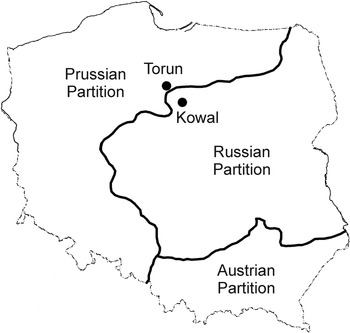
The main aim of this study was to analyse the influence of place of residence on childbearing and death rates in the central part of modern Poland in the second half of the 19th century. It also includes a comparative analysis of the mortality of children up to 5 years of age in two local centres that were different in terms of population size, state of development and industrialization. The research hypothesis was that infant and child mortality strictly correlated with the generally defined living conditions of the populations, including environmental and socio-agronomic factors (such as agronomic and farm management practices, household income distribution or intra-household relations and decision-making). The research populations (the villages of Kowal Parish and the city of Toruń) were characterized at first sight by radically different habitats: on the one hand Toruń was a fast-developing city (providing uncomfortable living conditions), and on the other hand non-industrial villages that had a positive influence on their population's health. The two places were different not only in terms of urbanization level, but also because they were under the rule of different occupants (Fig. 1), which influenced the political, agricultural and social factors providing different living conditions for the populations of the areas (see Historical background section). The area annexed by Prussia, which included Toruń, provided better living conditions than the Kuyavian village, which was Russified, developing slowly, and was economically confined by the politics of the occupants (Dziki, Reference Dziki and Cieśla2007a). Considering these descriptions, stabilization of living standards, at least in small part, should be expected, and through this, to a certain degree, stabilization of bio-demographic parameters describing the health state of those populations.
Map of 19th century Prussian, Russian and Austrian partitions with Toruń and Kowal Parish on a background of contemporary Poland.

Historical background
In the 18th century areas of contemporary Poland were partitioned and taken under the rule of three invading countries: Russia, Prussia and Austria. Each of three invading empires introduced their own economic rules in the occupied lands, which caused huge discrepancies in economic development in specific parts of the country. The frontier between Prussian-, Russian- and Austrian-occupied lands divided Europe into two different economic development zones. To the west of this frontier a capital-intensive and fast-developing economy dominated, and to the east an extensive and mainly traditional economy within relatively long-lasting feudal relations was present. The economic discrepancies deepened over the years (Łukasiewicz, Reference Łukasiewicz1968, Reference Łukasiewicz1988; Dziki, Reference Dziki and Cieśla2007a). The reform of peasants' enfranchisement, implemented in a relatively short time in areas of Prussian occupation, brought, at first, an increased number of ruined and disinherited people, but at the same time it provided an opportunity to modernize the agricultural economy by introducing crop rotation and better equipment. These changes allowed for the intensification of agricultural and breeding production, which in consequence positively influenced the development of cities. Furthermore, the output market ensured by the united German nation very positively influenced further agricultural development. However, on agricultural holdings in the areas annexed by Russia the introduction of machines was very slow, even for the wealthiest. From the end of the 19th century, despite the relatively fast development of large industry in these areas, agricultural progress was comparatively slow. Such factors as the greater dependence on crop exports (the price of which consequently decreased), the slow mechanization process and the division, after enfranchisement reform, into agricultural holdings often with very small plots, resulted in very low agricultural productivity (Łukasiewicz, Reference Łukasiewicz1988). In 1863, when the January Uprising failed, this area was also affected by extremely severe repressions (asset confiscation, Russification, mass arrests and deportation to Siberia). Oppression in economic terms was also gradually increasing, markedly slowing down the economic development of this area (Buszko, Reference Buszko2001).
Kowal is a small town in the eastern Kuyavian area. It is located on a wide plain surrounded by forests. Kowal and neighbouring villages, since their beginning, did not develop very intensively, and the inhabitants of these areas were living mainly on agriculture and, at times, crafts (Gruszczyńska & Poraziński, Reference Gruszczyńska, Poraziński, Kallas, Leliński, Stelmach, Tomczak and Trojanowska2002; Dziki, Reference Dziki and Zasada2007b). As a result of partition, Kowal Parish was first included under Prussian occupation in the province of South Prussia, and then it was taken under Russian occupation (Zasada, Reference Zasada and Zasada2006, Reference Zasada and Zasada2007). At that time the economic situation in the whole of eastern Kuyavia, including Kowal and its neighbourhood, was critical. The crisis was deepened by contributions and costs that had been incurred while the French armies were passing through (Dziki, Reference Dziki and Zasada2007b). The parish avoided the industrialization of the 19th century. Through to the end of that century no meaningful manufacturing or medium-sized industrial factory was established there (Dziki, Reference Dziki and Zasada2007b). The development of Kowal was also blocked by the urban reform executed in the Kingdom of Poland in 1869, and as a result it lost its civic rights for half a century. The town was degraded to the rank of settlement (Zasada, Reference Zasada and Zasada2006; Dziki, Reference Dziki and Zasada2007b). Life in Kowal was quite similar in many aspects to life in the village rather than to life in the city (Dziki, Reference Dziki and Zasada2007b). Through all these aspects, Kowal and villages located in the area of Kowal Parish, measuring overall about 18 km2, might be defined as ‘typical’ agricultural colonies.
Nineteenth century Toruń was initially shaped by the Teutonic Knights in the 13th century. The newly established centre was expected to be a focal point from which to conquer Prussian tribes and to establish the Teutonic empire. The intensive development of the city and the immigration of people influenced the extension and building of a new structure on Toruń's frontiers, which was necessary to satisfy increasing social needs (Jasiński, Reference Jasiński and Biskup1999). As a result of the partition of Poland, Toruń was taken under Prussian occupation. In the 19th century the most important technical achievements of civilization (road construction, a telegraphic station, a new wood pile bridge on the Vistula River, modernization and enlargement of the plumbing system, a city gas plant and an electrical plant) appeared in Toruń. Through these changes the outlet market was enlarged, and thereby the strategic and economic significance of Toruń increased, although it put the city in escalating competition (Niedzielska, Reference Niedzielska and Biskup2003; Salm, Reference Salm and Biskup2003). The economic evolution of Toruń was also ensured in 1867 by the elimination of payment for inhabiting the city peripheries. What is more, after 1878 Toruń fortress experienced significant spatial and architectural changes. As a result the fortification system was extended from the downtown area to a length of 3–3.5 km, and suburb construction markedly developed. The effect of all these changes was that the number of Toruń's citizens increased from about 14,000 in 1861 to 26,000 in 1905 (Wajda, Reference Wajda and Biskup2003).
Methods
Data concerning the population of Toruń were taken from the original Prussian statistical yearbooks (Preussische Statistik). These were annually compiled summary reports published by the Royal Statistical Bureau (Königslische Statistische Bureau) in Berlin, containing data on medicine, economy, climate, finance, mortality and fertility and migratory movements of the population. They were reliable and showed in summary way the actual state of population demography, and researchers have found that the Prussian state had the highest population statistics standards. The parochial metrical documents from Kowal Parish, which were lodged in the National Archive in Toruń, Department in Włocławek, are annual volumes that are kept in the Russian language and contain three types of listing: notes on baptisms, weddings and deaths in single years. These books contain, inter alia, exact data and place of the ritual and the ages of the people involved. In 19th century Catholic parishes like Kowal, the birth of a child had to be reported in church in the register book within a week, and a stillbirth by the next day; marriage on the day of the wedding; and a death within 2 days. Data concerning the population of Kowal Parish were taken from baptismal and death records from 1876–1890 and 1892–1894.
At the beginning of the 19th century neonatal deaths constituted 30% of total mortality. This allows for the best and the simplest test of reliability of historical registers (Gieysztorowa, Reference Gieysztorowa1962, Reference Gieysztorowa1976; Sułowski, Reference Sułowski1962). Gieysztorowa (Reference Gieysztorowa1976) argued that frequencies of deaths of children in the age category 0–1 year below 30% and for the age group 0–5 years below 50% should be treated with suspicion. Furthermore, the ratio of numbers of births to numbers of marriages (B/M) and the numbers of deaths to numbers of marriages (D/M) in any historical period should be a very good test of register accuracy (Gieysztorowa, Reference Gieysztorowa1962). Gieysztorowa argued, based on French and Polish studies, that the first ratio should be in the vicinity of 5.0 and the latter should be approximately 3.0. The values of all these indicators for the parish of Kowal were within the specified ranges. After summing up they are undoubtedly comparable with data from Toruń.
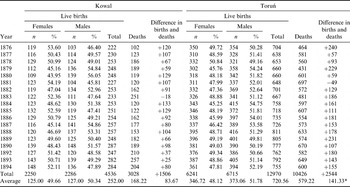
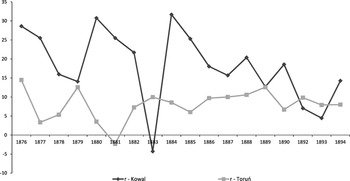
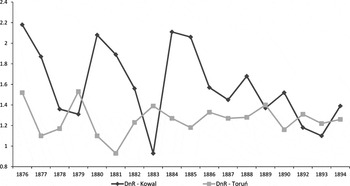
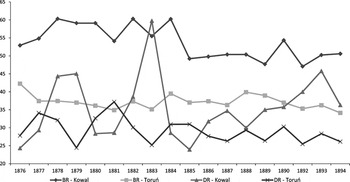
The ascertainment of the annual number of live births and deaths (Table 1), and also information about the distribution of the two study populations, allowed birth rates, death rates and natural increase rate to be estimated (Figs 2–4). Birth rates (BR) and death rates (DR) were analysed by sex and age group, and also by population structure. The natural increase rate (r) indicates differences in birth and death rates, but does not show the correlation between them. Thus for the two populations the number of births divided by the number of deaths was estimated, and this was defined as the Demographic Dynamics Rate (DnR) (Budnik, Reference Budnik2005). The child mortality rate for ages 0–5 years was estimated. Analogically to the infant death rate (IDR), which is used in the literature and illustrates the ratio of the number of children who died before one year of age to the number of births in the research period (Budnik, Reference Budnik2005; Liczbińska, Reference Liczbińska2009a, Reference Liczbińskab), the death rates (DR(0–5)) of children who died before the age of 5 years were estimated (by sex). In the same way the death rates of children who died before the age of 5 years, in accordance with consecutive annual age ranges, were estimated with and without considering the sex of the deceased (Tables 2–4).
Live births and deaths in Toruń city and Kowal Parish research populations in second half of the 19th century

* p<0.05.
Natural increase rate (r, ‰) in research populations in the second half of the 19th century.

Demographic dynamics rate (DnR, ‰) in research populations in the second half of the 19th century.

Birth and deaths rates (BR and DR, ‰) in research populations in the second half of the 19th century.

Differences in death rates (DR) per 1000 population of children up to 5 years of age in Toruń and Kowal Parish

* p<0.05.
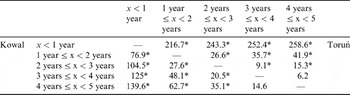
Comparison of the mean child death rates for Kowal Parish and Toruń for separate annual age groups

* p<0.05.
Differences in death rates (IDR and DR) per 1000 of boys and girls up to 5 years of age in Toruń and Kowal Parish

* p<0.05.
The results were analysed using non-parametric statistical Mann–Whitney U tests and Kruskal–Wallis rank ANOVA. A significance level of p=0.05 was adopted. When the significance of differences between tests was confirmed by ANOVA analysis, this significance was examined by the Mann–Whitney U test (Bonferroni corrected) between subsequent groups, in pairs. Calculations were made in Excel 2000, Statistica 9.0 PL (test version ‘0’) and in the PAST application (version 2.04: http://folk.uio.no/ohammer/past).
Results
During the research period, 4536 live births and 3028 deaths were recorded in Kowal Parish. During the same period in Toruń, almost three times more children were born (12,970 live births) and 10,426 deaths were recorded (Table 1). The distribution of numbers of births and deaths, and also the distribution of the difference in number of births and deaths, were similar in the two populations. However, some trends, especially those pertaining to deaths, and to the birth–death differences associated with them, appeared about 2 or 3 years earlier in the city under Prussian annexation than in the rural parish annexed by Russia (compare, for example, the sharp increase in the crude number of deaths in 1881 and in 1890 in Toruń, and in 1883 and 1893 in Kowal Parish). The birth rates of the Kowal population achieved values ranging from 47.05‰ in 1892 to 60.31‰ in 1882, and in Toruń from 34.14‰ in 1894 to 42.26‰ in 1876.
The estimated birth rates were higher in Kowal Parish than in Toruń, indicating a greater number of births in the rural than the city population (mean birth rates were as high as 53.67‰ for the rural parish annexed by Russia and 37.19‰ for Toruń city annexed by Prussia; p<0.001) (Fig. 4). However, a significantly higher mortality level was found in rural Kowal Parish than in Toruń city (the mean death rate for Kowal Parish reached 35.57‰ compared with 29.19‰ in Toruń; p=0.02).
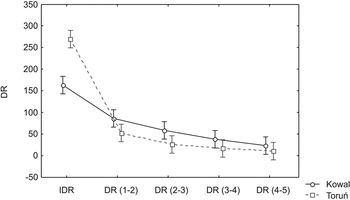
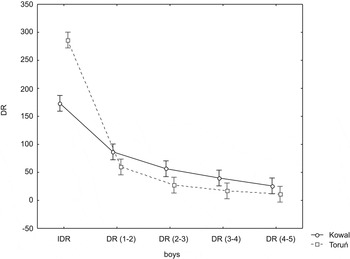
In both Kowal Parish and Toruń, child mortality (in the wide age group of 0–5 years) remained at similar levels over the years studied (Kruskal–Wallis ANOVA test: Kowal: p=0.50; Toruń: p=0.98), although in Kowal Parish in 1883–1885 a markedly higher frequency of death was noted (Table 2, Fig. 5). Despite the fact that in both populations a decrease in the mortality in much older children was observed, these populations were significantly different in terms of subsequent age groups. Infant mortality was significantly higher in the city (Kowal: 163 people for 1000 born; Toruń: slightly over 269 for 1000 born; p<0.05). In subsequent age groups the situation was the opposite, and a significantly higher child mortality was observed in the rural parish (in age groups: 1 year≤x<2 years: 33.6‰; 2 years≤x<3 years: 32.6‰; 3 years≤x<4 years: 21.2‰; 4 years≤x<5 years: 12.8‰; p<0.05). What is interesting is that research on child mortality in the wide age group of 0–5 years indicates that there were no significant differences between the populations (Kowal: 369 deaths per 1000 born; Toruń: slightly over 375 deaths for 1000 born; p=0.85). Thus, the high infant mortality is balanced in Toruń by the higher mortality in children aged 2–5 years in Kowal Parish. These results also indicate that the analysis of death share over a long period of time (0–5 years) makes it impossible to observe a high death share of the infants in Toruń and older children (2–5 years old) in Kowal.
Average death rates (DR) of children at 5 years of age by age groups (‰) in research populations in the second half of the 19th century. Bars denote 95% confidence intervals.

In the research period, both in Kowal Parish and in Toruń, a decrease in child mortality in subsequent age groups was recorded. The differences between subsequent age groups in Kowal Parish, as in Toruń, are statistically significant (Kruskal–Wallis rank ANOVA for both populations, p<0.05). Apparently it depends on differences in child mortality in younger age groups because in both cases the Mann–Whitney U test used (Bonferroni corrected) for post-hoc analysis indicates that there are no significant differences in mortality level among groups of 4- and 5-year-old children (Table 3).
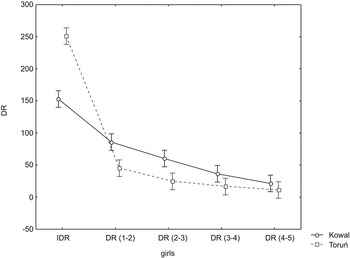
Considering mortality separately in girls and boys in the two populations (Table 4, Figs 6 and 7) it is noted that there is an usually higher mortality in boys than in girls in almost all age groups (the opposite situation occurs only in Kowal among children who died between the ages of 2 and 3 years, and in Toruń among children who died in the 4–5 year group). However, the significantly higher frequency of male deaths pertains only to infants from Toruń (age group 0–1 years; p<0.05). In Kowal Parish, in the whole research period, significantly lower mortality among the youngest girls (p<0.05) and significantly higher mortality in girls from three subsequent age groups were observed. In the oldest age group, girls' mortality in villages and in cities was developing at a comparable level (p=0.06). A similar situation existed with regards to the mortality of boys. In the youngest group it was significantly lower in Kowal Parish than in Toruń (p<0.05), and was significantly higher in four of the other age groups.
Average death rates (IDR and DR) of girls up to the age of 5 years by age groups (‰). Bars denote 95% confidence intervals.

Average death rates (IDR and DR) of boys up to the age of 5 years by age groups (‰). Bars denote 95% confidence intervals

Discussion
The results suggest that the Polish city habitat in the area annexed by Prussia in the 19th century did not provide comfortable living conditions. The rural parish of Kowal, in comparison, enjoyed better conditions, and in consequence achieved a higher birth rate, despite the fact that it was located in the area annexed by Russia. However, overall population mortality was higher in the rural community, while the death rate in Toruń was similar to levels recorded in other cities in this period. Thus, the higher death rate in Kowal Parish might suggest a lower health potential of this population. Meanwhile, the significantly higher natural increase rates and higher demographic dynamics rate values of the Kowal Parish population confirm the better biological condition of this population. It should be noted that the political situation in the two areas was not conductive to migration. The huge wave of migration was about 10 years earlier, after the failure of the January Uprising in 1863. In 1870–1890 migration was barely noticeable, with virtually no migrating families with infants, and probably having a small impact on the child mortality in the wide age group of 0–5 years. People moved mostly before starting a family. The fourth decade of the 19th century was a period of economic stagnation. Right at the end of the 19th century serfdom was abolished and there was a partial enfranchisement of peasants, allowing a massive influx of the rural population into the cities (Mikulski, Reference Mikulski and Biskup2003; Niedzielska, Reference Niedzielska and Biskup2003; Nieuważny, Reference Nieuważny and Biskup2003; Dziki, Reference Dziki and Cieśla2007a).
Kowal Parish was a typical, relatively wealthy rural parish. Multigenerational families lived in two- or three-rooms wooden huts with straw roofs and no sanitary system (sewerage system or water supply pipes); water was drawn from domestic wells and the barn was used for defaecating. Time and rhythm of life of rural residents were marked by the sun and nature. People lived off agriculture, crafts and trade (Dziki, Reference Dziki and Cieśla2007a, Reference Dziki and Zasadab). On the other hand houses in Toruń were constructed by the ‘Prussian wall’ technique, whereby a wooden framework was erected and filled with bricks or hard clay. A mains sanitary sewer was constructed collecting all sewage and pollutants in a stream called the Struga Toruńska. Sewage devices, consisting of wooden troughs that removed sewage to a kind of cesspit, functioned only in the properties of the richer bourgeois. The inhabitants of the poorer districts of Toruń took their sewage beyond the range of the building to the street, creating street gutters. Municipal regulations from 1845 governed the issue of export latrines, manure and cleaning gutters. In 1888 the Police Board issued a regulation specifying the conditions of waste disposal. In 1884 a municipal slaughterhouse was opened and in 1893 urban waterworks units were created. A sewer system consisting of outlet ducts was installed in 1854 in the first part of the ‘Old City’. A bigger development, which directed sewage to the first municipal waste water treatment plant, came in the following year. This waste water treatment plant allowed for the mechanical purification of waste water by separating sand, mineral suspension, solid and floating parts of sewage. Toruń residents benefited from free medical and hospital care (Tandecki, Reference Tandecki and Biskup1999; Niedzielska, Reference Niedzielska and Biskup2003; Nieuważny, Reference Nieuważny and Biskup2003; Salm, Reference Salm and Biskup2003; Wajda, Reference Wajda and Biskup2003).
The birth rates for the population of Toruń were slightly lower (mean 37.19‰) and higher for Kowal Parish (mean 53.67‰) compared with data obtained by other researchers for different areas of modern Poland (1871–1890, parish in south Poland: 36.7–46.1‰ (Piasecki, Reference Piasecki1970); 1891–1910, parishes in central Poland: 42.1–43.7‰ (Łukasiewicz, Reference Łukasiewicz2005); parishes in north Poland at the end of the 19th century: 42.9‰ (Klotzke, Reference Klotzke1980; Budnik, Reference Budnik2005)). According to the present results, the rural parish of Kowal is characterized by the highest birth rate, while the population of Toruń is characterized by the lowest one.
The mean death rates reached 29.19‰ for the population of Toruń and 35.57‰ for Kowal Parish. The higher mortality level of the Kowal population compared with other researched rural populations from different areas in the same period is taken into consideration (1871–1890, parish in south Poland: 29.0–35.0‰ (Piasecki, Reference Piasecki1970); 1891–1910, parishes in central Poland: 21.1–27.8‰ (Łukasiewicz, Reference Łukasiewicz2005); parishes in north Poland at the end of the 19th century: 21.4‰ (Klotzke, Reference Klotzke1980; Budnik, Reference Budnik2005)). In the 19th century the mortality rates in Polish cities such as Wrocław, Szczecin, Gdańsk, Warsaw and Poznań were relatively high and similar. Death rates varied between 26 and 39 per 1000 citizens (Budnik & Liczbińska, Reference Budnik and Liczbińska2006). In the small parish of Czarnowo near Toruń in 1880 the death rate reached 29.7‰ (Kamińska, Reference Kamińska1981), while in neighbouring Chełmża the death rate in 1885–1886 reached 44.2‰ and in 1895–1896 decreased to 28.9‰ (Zielińska, Reference Zielińska2001). It should be noted that in 1880–1886 an unexpected increase in mortality was observed, appearing in different times in different parishes. In Toruń it was in 1881, and in Kowal Parish in 1883. Variation in the death rates could be caused by, or connected to, some kind of local epidemics, perhaps associated with the fifth wave of Asiatic cholera (dated as 1881–1896 by Evans (Reference Evans, Ranger and Slack1992), as 1883–1896 by Siudikas (Reference Siudikas1998) or as 1882–1896 by Winkle (Reference Winkle1997)).
The mean natural increase rates were significantly higher for the rural parish (for Kowal: 18.11‰; for Toruń: 8.0‰; p<0.001). For comparison, the natural increase rate for parishes in central Poland was 15.9–19.6‰ (Łukasiewicz, Reference Łukasiewicz2005) and for parishes in north Poland at the end of the 19th century it was 18.8–24.1‰ (Klotzke, Reference Klotzke1980; Budnik, Reference Budnik2005).
The mean demographic dynamics rates in the researched period reached 1.59‰ for Kowal Parish and 1.26‰ for Toruń (p<0.001), which shows a significantly lower level of live births in relation to the number of deaths in the city population.
Marked differences in birth rate, death rate (including infant mortality) and demographic dynamics rate have been found between the rural and urban populations, suggested a lower level of biological condition of city populations compared with non-urbanized, non-industrial rural populations (Budnik & Liczbińska, Reference Budnik and Liczbińska1997, Reference Budnik and Liczbińska2006; Budnik, Reference Budnik2005). The present study found that birth rates were significantly higher in Kowal Parish, indicating that there were a greater number of births in the rural than in the city population (mean values were as high as 53.67‰ for the rural parish annexed by Russia and 37.19‰ for the city annexed by Prussia; p<0.001). However, on comparing the death rates of Kowal Parish and Toruń, a significantly higher mortality rate was observed in the rural population (mean death rate for Kowal Parish reached 35.57‰, and 29.19‰ for Toruń; p=0.02). These results are not consistent with analyses carried out by other researchers. In Poznań, the crude death rate reached 29.16‰ in 1878–1882, 28.76‰ in 1883–1887 and 26.89‰ in 1888–1892. In the small towns of the Poznań regency, this rate reached 29.20‰, 29.40‰ and 26.13‰, respectively, although in the rural neighbourhood of Poznań the respective rates were 23.58‰, 26.42‰ and 22.87‰. When comparing villages–small towns and villages–Poznań, a statistical significance of differences was noted for all values (Budnik & Liczbińska, Reference Budnik and Liczbińska2006). Urban–rural differences in mortality rates were also noted between Warsaw and its neighbouring provinces, where the mean death rates in the second half of the 19th century reached 37 and 26 per 1000 people, respectively (Budnik & Liczbińska, Reference Budnik and Liczbińska2006).
The uncomfortable living conditions in cities of the 19th century and their impact on bio-demographic population rates have often been described in the literature. In the second half of the 19th century in Europe, the crude death rate reached 26–39‰ and infant mortality was huge, ranging from about 100‰ in Denmark to about 300‰ in Russia and Bavaria (Kintner, Reference Kintner1988; Schoefield & Reher, Reference Schoefield, Reher, Schoefield, Reher and Bideau1991; Landers, Reference Landers1993; Van Poppel et al., Reference Van Poppel, Jonker and Mandemakers2005). Researchers of this subject accept that high infant mortality was caused to a great extent by uncomfortable and insanitary living conditions, which killed the youngest children mainly in big, developing and industrial cities such as Toruń.
Previous research also indicates that a significantly lower mortality rate was typical for infants from small towns and villages (Łuczak, Reference Łuczak1976; Haines, Reference Haines1977; Budnik & Liczbińska, Reference Budnik and Liczbińska1997, Reference Budnik and Liczbińska2006; Bogin, Reference Bogin, Mascie-Taylor and Lasker1998; Haines & Kintner, Reference Haines and Kintner2000). Such differences were also noted by Jorde & Durbize (Reference Jorde and Durbize1986) among Mormons in Utah before 1880 (with a higher mortality in strongly urbanized centres than in villages). Differences in mortality rates have been noticed not only by rank and size of residence place, but also by religious groups. Usually, lower infant mortality has been observed among Evangelists and Jews, and higher rates among Catholics (e.g. 59‰ among Evangelists in Germany; 68‰ among German Catholics) (Schmelz, Reference Schmelz1971; McQuilian, Reference McQuillian1999; Kemkes-Grottenthaler, Reference Kemkes-Grottenthaler2003). This is usually explained by differences in hygienic care and by cultural differences in duration of breast-feeding (Van Poppel, Reference Van Poppel1992; Van Poppel et al., Reference Van Poppel, Schellekens and Liefbroer2002). Longer period of breast-feeding in Kowal Parish than in Toruń could be due to its convenience for mothers while working with their children in the fields and farms. In Toruń mothers mostly had to go back to work without the possibility of bringing their children with them.
Research on infant and child mortality in Poland is limited because analysis is usually focused on spatially limited parts of the country. There is also a lack of comprehensive publications that clearly define the character of the relations described above and their variability in time and space (Budnik & Liczbińska, Reference Budnik and Liczbińska2006). Similarly to Western Europe (compare Antonovsky & Bernstein, Reference Antonovsky and Bernstein1977; Spree, Reference Spree1981; Garret et al., Reference Garret, Reid, Schürer and Szreter2001; Van Poppel et al., Reference Van Poppel, Jonker and Mandemakers2005), research is mostly focused on differences in mortality in the infant and post-infant period, but does not include an extensive consideration of this problem for older children (Piasecki, Reference Piasecki1990; Kędelski, Reference Kędelski, Topolski and Trzeciakowski1994; Budnik, Reference Budnik2005; Budnik & Liczbińska, Reference Budnik and Liczbińska2006). The relationship between socioeconomic factors and child mortality might be markedly different in subsequent age groups (Garret et al., Reference Garret, Reid, Schürer and Szreter2001, after Van Poppel et al., Reference Van Poppel, Jonker and Mandemakers2005).
The mean infant mortality rate was higher in industrial Toruń (269.2‰) than in the rural parish of Kowal (163‰). In 19th century Poland infant mortality varied between 170‰ and 306‰, and this variability was conditioned by factors similar to the whole of Europe (Kędelski, Reference Kędelski1986, Reference Kędelski, Topolski and Trzeciakowski1994; Piasecki, Reference Piasecki1990; Budnik & Liczbińska, Reference Budnik and Liczbińska1997, Reference Budnik and Liczbińska2006; Liczbińska, Reference Liczbińska1999, Reference Liczbińska2010; Budnik, Reference Budnik2005). At this time, in Sweden, the infant mortality rate decreased to 193‰ in cities and to 119‰ in villages (Preston et al., Reference Preston, Haines and Panuk1981; Bogin, Reference Bogin, Mascie-Taylor and Lasker1998). In Polish cities the infant death rate was higher than in villages (Budnik & Liczbińska, Reference Budnik and Liczbińska2006; Liczbińska, Reference Liczbińska2010). Kula (Reference Kula2002) explained this fact by the more accurate registration of infant deaths in this city. However, higher child mortality in cities is connected to a great extent with over-population, with an increased frequency of infectious diseases and difficult access to water, inadequate medical care and much worse living conditions compared with rural, agricultural populations, living in a healthier, natural environment (Rosset, Reference Rosset1975; Liczbińska, Reference Liczbińska1999, Reference Liczbińska2010). The higher child mortality level in Toruń than in Kowal Parish could be caused by over-population and pollution, despite better health care.
Infant mortality in Western Europe at the end of 19th century has usually been found to have decreased significantly or remained at a constant level without strong fluctuations (Van Poppel, Reference Van Poppel1992). In the second half of the 19th century, in England, Wales and Scotland, the infant death rate oscillated between 120 and 150 deaths for 1000 live births (Hatton, Reference Hatton2011). In the 19th century, among populations in England and Wales, increased infant mortality was observed only in the 1890s, which was connected to a sequence of dry, hot years (Woods et al., Reference Woods, Watterson and Woodward1998). Meantime, in the area of modern Poland an infant mortality decrease began no earlier than in the 20th century, while in the 19th century the rate often increased continuously because of worse sanitary conditions resulting from intensive industrialization, urbanization and higher natural increase in cities at that time (Zielińska, Reference Zielińska2001; Budnik, Reference Budnik2005; Budnik & Liczbińska, Reference Budnik and Liczbińska2006). In the 1890s sharp birth rate decreases and sharp death rate increases were often observed (analogically, in Kowal in 1883 and in Toruń in 1881 a higher number of deaths was noted). The same situation has been observed in other parishes (Piasecki, Reference Piasecki1970; Gralla, Reference Gralla1974; Klotzke, Reference Klotzke1980; Kamińska, Reference Kamińska1981; Budnik, Reference Budnik2005), probably as a consequence of some kind of epidemic.
In Kowal Parish and in Toruń there was usually a higher mortality of boys compared with girls in almost all age groups. A higher frequency of male mortality has sometimes been noted in the literature (Vielrose, Reference Vielrose1961; Holzer, Reference Holzer1970; Klotzke, Reference Klotzke1980; Piasecki, Reference Piasecki1990; Kula, Reference Kula2002). In the district of Luzino, in the 0–4 year age group, deaths of boys were more frequent, reaching 57‰ (45‰ for girls). It should be noted that this proportion was the result of differences in the numbers of deaths for both sexes in the age group 0–1 years (the infant death rate for boys reached 156‰; for girls 143‰). In the age group 1–4 years no differences were noted between the sexes (Klotzke, Reference Klotzke1980). In the second half of the 19th century in Gdańsk, similar to Toruń, a higher mortality of male infants was noted compared with mortality in villages or small towns (Liczbińska, Reference Liczbińska1999). Higher neonatal mortality among girls on the Helski Peninsula was noted by Budnik (Reference Budnik2005), who explained this by the better care of male children, which was a result of tradition concerning the inheritance of possessions and surname, or the house-providing duty of male descendants. In Chełmża, near Toruń, at the end of 19th century a notorious mortality increase among children in the age groups 1 year old and 1–4 years has been noted. This was connected with inadequate sanitary conditions in this centre at a time of industrial change. Among infants, in the period from 1881 to 1900, deaths of boys in this centre prevailed (Zielińska, Reference Zielińska2001).
Conclusions
Numerous studies have concluded that a village, with its better access to food, lower level of population growth and lower pollution, provided better living conditions than an overpopulated, polluted 19th century European city. Therefore, the health conditions of populations inhabiting rural areas were relevantly better than those in the cities. In this study demographic parameters were analysed describing two populations living in radically different environments: on one hand, a fast-developing city in the area annexed by Prussia, providing more effective economic development, and on the other hand Kuyavian villages – slowly developing, Russified and economically limited by the politics of the inhabitants. Therefore, it should be expected that the socioeconomic differences would be transferred into living conditions and would diminish, even in small part, discrepancies arising from human habitats. Furthermore, it should be expected that the values of death rates, parity and other parameters describing the biological state of the populations would be balanced at least in small part. However, the demographic dynamics rates confirm differences resulting from worse living conditions in the city habitat, despite its privileged economic position. There are lower rates of birth, natural increase and demographic dynamics, and over-mortality of boys in relation to girls in the population of Toruń compared with in the parish of Kowal (in rural populations death rates for both sexes are similar). Toruń, despite being in a better position as an area annexed by Prussia, provided much worse living conditions than the villages of Kowal Parish, but this pertained only to the youngest children (up to 1 year old). In other age groups the situation was surprisingly the opposite (a statistically higher mortality rate in children aged 1–5 years was observed in rural habitats).
The habitats of city and rural populations seem to have no impact on child mortality providing that the observations pertain to a wide age group, i.e. 0–5 years old. What is more, child mortality was observed to decrease with age, regardless of place of residence. For separate annual age groups, significant relationships between mortality rate and size and industrialization level of the population centres were noted.
Natural selection in the city had the greatest impact on the youngest children (up to the age of 1 year). Children who survived were strong enough continue to survive. In the countryside, maybe because of cultural factors (breast-feeding or work that made full-time baby-sitting possible), infants were not subjected to such strong natural selection. After this period, most often another child was born into the family, which caused a radical deterioration in living conditions among older children, and natural selection with twice more intensive impact eliminated the weakest children. Thus, the significantly higher infant mortality is balanced in the city habitat by the higher mortality of children aged 2–5 years in the rural habitat. It should be emphasized that it is important to analyse the impact of habitat on child mortality rates not only in wide age range, but in subsequent one-year age range too.
Kowal Parish and Toruń were different not only in terms of urbanization level, but also in being located under different partitions. The area annexed by Prussia provided better living conditions than the rural parish, which developed slowly and was Russified and economically confined by the politics of the inhabitants. However, the living conditions were better in rural areas than in the city. Differences in the mortality of the youngest children resulted from ecological and cultural conditions rather than from social and economic factors (living under different partitions).