Introduction
Public organizations are under constant pressure to initiate reform and changes in responses to the changes in government policies, tighter budgets, safety standards, legislation and information technology (Fernandez & Rainey, Reference Fernandez and Rainey2006; Kelman, Reference Kelman2005; Kuipers, Higgs, Kickert, Tummers, Grandia, & Van der Voet, Reference Kuipers, Higgs, Kickert, Tummers, Grandia and Van der Voet2014; Pollitt & Bouckaert, Reference Pollitt and Bouckaert2011). The extant literature posits that although reform and change programs are often initiated by elected or politically appointed officials and executives, the actual changes in public organizations are executed by middle- and first-line managers as well as front-line employees such as teachers, nurses, police officers and other front-line public servants (i.e., change recipients) (Ahmad, Liu, & Butt, Reference Ahmad, Liu and Butt2019a). Research has demonstrated that recipients' favorable change-supportive intentions (CSIs) play a significant role in determining change outcomes both in the private sector (Herold, Fedor, Caldwell, & Liu, Reference Herold, Fedor, Caldwell and Liu2008; Oreg, Vakola, & Armenakis, Reference Oreg, Vakola and Armenakis2011), as well as in the public sector (Ahmad & Cheng, Reference Ahmad and Cheng2018; Hassan, Zhang, Ahmad, & Liu, Reference Hassan, Zhang, Ahmad and Liu2020; Kelman, Reference Kelman2005; van der Voet, Reference van der Voet2015), as these CSIs typically precede the degree to which they will subsequently engage in agentic and change-supportive behaviors throughout the implementation process (Jimmieson, Peach, & White, Reference Jimmieson, Peach and White2008; Straatmann, Kohnke, Hattrup, & Mueller, Reference Straatmann, Kohnke, Hattrup and Mueller2016; Straatmann, Nolte, & Seggewiss, Reference Straatmann, Nolte and Seggewiss2018).
Due to the crucial role of recipients' CSIs and behaviors, past research has examined and integrated a series of antecedents of recipients' CSIs during times of change (Armenakis & Bedeian, Reference Armenakis and Bedeian1999; Kuipers et al., Reference Kuipers, Higgs, Kickert, Tummers, Grandia and Van der Voet2014; Oreg, Vakola, & Armenakis, Reference Oreg, Vakola and Armenakis2011). For instance, a line of research has investigated the role of change content, context, process, leadership and individual differences on recipients' responses to change with a notable empirical support (Ahmad & Cheng, Reference Ahmad and Cheng2018; Armenakis & Bedeian, Reference Armenakis and Bedeian1999; Caldwell, Roby-Williams, Rush, & Ricke-Kiely, Reference Caldwell, Roby-Williams, Rush and Ricke-Kiely2009; Oreg, Vakola, & Armenakis, Reference Oreg, Vakola and Armenakis2011; Van der Voet, Kuipers, & Groeneveld, Reference Van der Voet, Kuipers and Groeneveld2015). Another line of research has utilized the established theory of planned behavior (TPB) by Ajzen (Reference Ajzen1991) as a theoretical framework for better understanding the predictors of recipients' CSIs (Jimmieson, Peach, & White, Reference Jimmieson, Peach and White2008; Straatmann et al., Reference Straatmann, Kohnke, Hattrup and Mueller2016).
Currently, a significant body of valuable research is available that acknowledges the importance of these two lines of research in modeling recipients' CSIs. However, a review of the literature shows that there exist a number of notable gaps that warrant further investigation.
First, although previous studies highlight the significant role of organizational context (i.e., the existing internal and external conditions that influence organizational effectiveness) in determining how employees respond to change initiatives (Ahmad & Cheng, Reference Ahmad and Cheng2018; van der Voet, Reference van der Voet2014), the role of employee perceptions of organizational culture (OC) as an important aspect of organizational context has not received ample empirical attention. This is inconsistent with the organizational change literature that has proposed that an examination of OC is essential for understanding the processes that lead to successful change implementation (Cummings & Worley, Reference Cummings and Worley2014; Jones, Jimmieson, & Griffiths, Reference Jones, Jimmieson and Griffiths2005; Kuipers et al., Reference Kuipers, Higgs, Kickert, Tummers, Grandia and Van der Voet2014; Straatmann, Nolte, & Seggewiss, Reference Straatmann, Nolte and Seggewiss2018). Second, although we acknowledge the dearth studies that have examined the role of OC on employee reactions to organizational change efforts, the psychological processes underlying this association still remain unspecified. Hence, it is not clear how and to what extent different dimensions of OC of public organizations predispose employee psychological reactions to specific organizational change efforts. Third, the two lines of research (mentioned above) have mostly separately been studied in the field of organizational change. Even though they have different focus, both frameworks have contributed significantly to the field of organizational change by providing theoretical rationales for organizing and integrating research on employees' reactions to organizational change (Straatmann et al., Reference Straatmann, Kohnke, Hattrup and Mueller2016). Fourth, despite frequent calls for the importance of OC as a factor facilitating/inhibiting change implementation (Schein, Reference Schein2010; Weston, Reference Weston2018), not much empirical research has examined OC as a contextual aide to organizational change processes (Weston, Reference Weston2018). That is, rather than looking at OC as an antecedent of employee responses to change, past studies have mainly focused on OC as a social factor often looked upon as the change target (Robertson, Roberts, & Porras, Reference Robertson, Roberts and Porras1993).
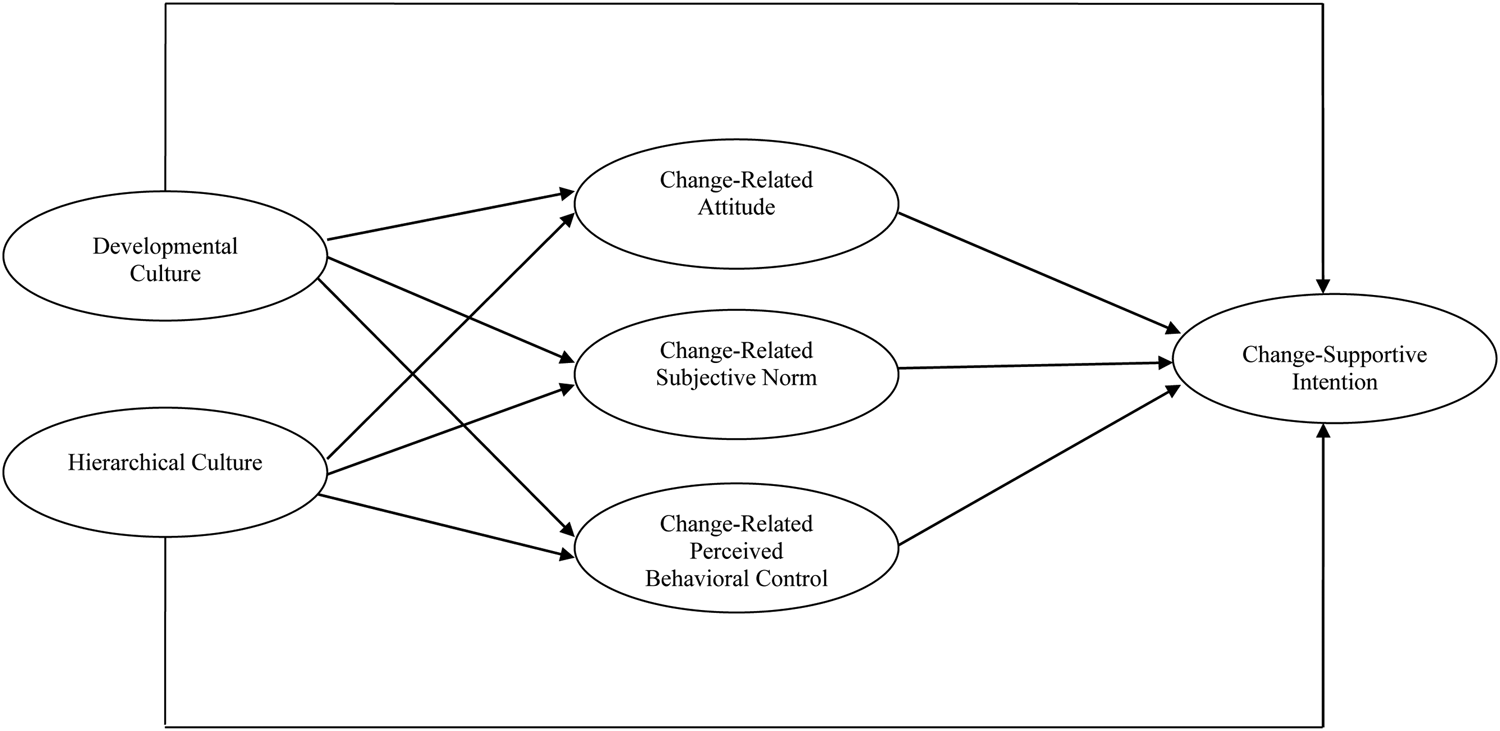
In light of the above, there is a palpable need to investigate and understand the role of OC in fostering (or impeding) recipients' CSIs in order to manage change efforts more effectively. The primary focus of this paper is, thus, to address this research need by systematically linking OC as one of the main determinants of employees' responses to change (Armenakis & Bedeian, Reference Armenakis and Bedeian1999; Kuipers et al., Reference Kuipers, Higgs, Kickert, Tummers, Grandia and Van der Voet2014) with CSIs. More specifically, we aim to address this nexus by exploring the effects of two dimensions of OC (hierarchical [HC] and developmental culture [DC]) on CSIs in several public schools in the Kurdistan Region of Iraq through three mediating variables derived from TBP (Ajzen, Reference Ajzen1991) (see Figure 1). Because of their different foci, the ultimate integration of both perspectives could provide a theoretically well-founded and systematic approach for the design of change assessments (Straatmann, Nolte, & Seggewiss, Reference Straatmann, Nolte and Seggewiss2018). Such theoretically based diagnostic approaches have the potential to facilitate an evidence-based management of change by guiding change managers in the implementation and evaluation of change interventions in applied settings.
Conceptual model of the study linking OC with TPB.

With this study, we make two distinct contributions to the literature. First, the study contributes to the organizational change management literature by exploring how perceived OC – one aspect of the internal change context – influences employee CSIs. Although the change context can encompass a number of external factors (Ahmad & Cheng, Reference Ahmad and Cheng2018; Armenakis & Bedeian, Reference Armenakis and Bedeian1999; Oreg, Vakola, & Armenakis, Reference Oreg, Vakola and Armenakis2011), this study focuses on OC's role because of its potential to influence change outcomes. Specifically, the study argues that understanding how OC influences the formation of CSIs is central for researchers and practitioners who try to buy-in recipients' responses to organizational change efforts. It differs from past studies in that we treat OC as a contextual antecedent, rather than the outcome of change, which can, depending on its nature, be a resource or constraint during times of organizational change (Hansen, Reference Hansen2007). Second, the study explicitly focuses on investigating the underlying psychological processes linking two dimensions of OC with CSIs in the context of a complex change initiative. Specifically, direct and indirect effects of OC are explicated and analyzed based on the established TPB. Such knowledge advances our understanding of change as it explains how and to what extent OC predisposes employees' psychological reactions to promote or impede employee CSIs particularly in the context of public organizations. The high resolution and theoretical foundation of the psychological reactions provided by the TPB can help researchers and practitioners to better identify starting points for long-term and change-specific interventions to enhance CSIs.
Literature review
Since the end of the 1980s and early 1990s, a new model of public sector management emerged in the developed and many emerging countries. Although the new public sector management model was referred to by a number of different names, including: ‘new public management – NPM’ (Hood, Reference Hood1991); ‘post-bureaucratic paradigm’ (Barzelay, Reference Barzelay1992); ‘entrepreneurial government’ (Osborne & Gaebler, Reference Osborne and Gaebler1992) or ‘managerialism’ (Pollitt, Reference Pollitt1993); they all principally point to the same phenomenon. That is, ongoing modernization, improving public management, reducing budgets and spendings, privatization, marketization of public sector organizations and improving the quality of services delivered to citizens (Ahmad, Liu, & Butt, Reference Ahmad, Liu and Butt2019a). In other words, the reforms and changes that were introduced by many governments around the world through public management reforms have mainly focused on the enhancement of efficiency and effectiveness of public goods and services (García-Morales, Jiménez-Barrionuevo, & Gutiérrez-Gutiérrez, Reference García-Morales, Jiménez-Barrionuevo and Gutiérrez-Gutiérrez2012; Hameed, Khan, Sabharwal, Arain, & Hameed, Reference Hameed, Khan, Sabharwal, Arain and Hameed2019), and making public organizations more adaptive and flexible to the changing environment similar to their private sector counterparts.
Public management reform has been defined as deliberate attempts by political as well as senior administrative leaders to change structural, cultural or processes features of ‘public sector organizations with the objective of getting them (in some sense) to run better’ (Pollitt & Bouckaert, Reference Pollitt and Bouckaert2011: 2). To date, public sector reform has been studied from a number of perspectives; namely, institutional perspective (Olsen, Reference Olsen2009), instrumental, cultural and perspectives (Christensen, Lægreid, Roness, & Røvik, Reference Christensen, Lægreid, Roness and Røvik2007), innovation theory and principal agent perspectives (Van de Walle & Groeneveld, Reference Van de Walle and Groeneveld2016). Although these different perspectives offer interesting insights about reform and change in the public sector, they all focus on reform and change at the national or sector level (i.e., macro-level) (Ahmad, Straatmann, Mueller, & Liu, Reference Ahmad, Straatmann, Mueller and Liu2020). For instance, Oreg, Michel, and By (Reference Oreg, Michel and By2013) indicated that majority of studies on organizational change has taken on a macro perspective, ‘focusing on the strategic process of managing organizational change’ (p. 3). Hence, attention to micro-processes in public sector organizations seems dearth (Kuipers et al., Reference Kuipers, Higgs, Kickert, Tummers, Grandia and Van der Voet2014).
In recent years, however, scholars have shifted their attention to micro-level factors by focusing on how change is implemented and managed in individual organizations and how employees respond to such changes (Ahmad et al., Reference Ahmad, Straatmann, Mueller and Liu2020; Ahmad & Cheng, Reference Ahmad and Cheng2018; Hameed et al., Reference Hameed, Khan, Sabharwal, Arain and Hameed2019). The focus on micro-level factors is important because extant literature shows that employee responses to change are among the most critical factors that determine the outcome of change efforts (Ahmad, Liu, & Butt, Reference Ahmad, Liu and Butt2019b; Beer & Nohria, Reference Beer and Nohria2000; Hameed et al., Reference Hameed, Khan, Sabharwal, Arain and Hameed2019; Hassan, Zhang, & Ahmad, Reference Hassan, Zhang and Ahmad2020). Put differently, to successfully implement a change initiative, it is argued that employees should have positive responses to change and also behave in a change-supportive manner (Ahmad, Liu, & Butt, Reference Ahmad, Liu and Butt2019a). The categorization of employee responses to change began with Lewin (Reference Lewin1947) who conceptualized and modeled employee resistance to change, which was followed by further constructs measuring reactions to change such as readiness for change (Armenakis, Harris, & Mossholder, Reference Armenakis, Harris and Mossholder1993), openness to change (Wanberg & Banas, Reference Wanberg and Banas2000), willingness to change (Metselaar, Reference Metselaar1997) and affective commitment to change (Herscovitch & Meyer, Reference Herscovitch and Meyer2002). Recent studies by Hameed et al. (Reference Hameed, Khan, Sabharwal, Arain and Hameed2019) and van der Voet, Steijn, and Kuipers (Reference van der Voet, Steijn and Kuipers2017) show empirically the significance of employee positive responses to change in public sector organizations. Hence, in the section that follows, we conceptualize employee positive responses to change (as measured by their CSIs), which is argued, in line with the TPB (Ajzen, Reference Ajzen2011), to precede the degree to which they will adopt and engage in subsequent change-supportive behaviors (Ahmad et al., Reference Ahmad, Straatmann, Mueller and Liu2020; Holt, Armenakis, Feild, & Harris, Reference Holt, Armenakis, Feild and Harris2007; Jimmieson, Peach, & White, Reference Jimmieson, Peach and White2008).
Hypotheses
Recent organizational change research has built on the established TPB by Ajzen (Reference Ajzen1991) as a theoretical framework for better understanding the predictors of recipients' CSIs to behaviorally engage in actions toward the successful implementation of a change effort (Jimmieson, Peach, & White, Reference Jimmieson, Peach and White2008; Straatmann et al., Reference Straatmann, Kohnke, Hattrup and Mueller2016; Reference Straatmann, Nolte and Seggewiss2018). The TPB is designed to predict and explain human behavior in specific contexts (Ajzen, Reference Ajzen1991, Reference Ajzen2011; Ajzen & Sheikh, Reference Ajzen and Sheikh2013). Originally derived from the theory of reasoned action (Fishbein, Reference Fishbein1980; Montaño & Kasprzyk, Reference Montaño and Kasprzyk2015), the TPB contends that, although behavioral prediction is dependent upon a plethora of factors; the most proximal determinant of human behavior is a person's intention to perform a specific behavior (Ajzen, Reference Ajzen1991). TPB is built upon the assumption that the stronger an individual's intention, the more likely the individual to be motivated to perform behavior (Ajzen, Reference Ajzen1991). In the TPB, intentions are defined as the indication of an individual's willingness to perform a given behavior (such as supporting or not supporting a change initiative). This assumption is in line with suggestions made in research on willingness to change (Metselaar, Reference Metselaar1997), affective commitment to change (Herscovitch & Meyer, Reference Herscovitch and Meyer2002) and readiness for change literature (Holt et al., Reference Holt, Armenakis, Feild and Harris2007), which assume that psychological processes predict whether employees' behaviors will be supportive or unsupportive of change (Straatmann et al., Reference Straatmann, Kohnke, Hattrup and Mueller2016).
According to the TPB, behavioral intentions are largely the function of three determining factors (Ajzen, Reference Ajzen1991). The first determinant of intentions is the person's attitude toward the behavior of interest; conceptualized as beliefs based on the potential positive or negative outcomes of enacting the behavior of interest (Ahmad et al., Reference Ahmad, Straatmann, Mueller and Liu2020). Thus, attitude toward change may be described as the extent to which recipients feel positively or negatively about the impact of the change on their working lives or the organization (Dawkins & Frass, Reference Dawkins and Frass2005). When a change is imposed on recipients (as is often the case) (Oreg, Bartunek, Lee, & Do, Reference Oreg, Bartunek, Lee and Do2018), employees will evaluate the impact of a change based on its projected effect on recipients (Ahmad & Cheng, Reference Ahmad and Cheng2018). To the extent that recipients perceive the impact of change efforts, they are more likely to have a favorable change-related attitude (CRA) toward change. In the organizational change literature, the attitude–intention link has long been proposed by scholars studying readiness for change (Armenakis, Harris, & Mossholder, Reference Armenakis, Harris and Mossholder1993; Kelman, Reference Kelman2005). Several authors have posited that favorable and positive evaluative judgments about the need for and implications of a change effort for employees and/or the wider organization are likely to lead to more positive reactions and subsequently change supportive behaviors (Ahmad & Cheng, Reference Ahmad and Cheng2018; Ahmad, Liu, & Butt, Reference Ahmad, Liu and Butt2019a; Oreg, Vakola, & Armenakis, Reference Oreg, Vakola and Armenakis2011). Therefore, it is hypothesized that:
Hypothesis 1a: Favorable change-related attitudes will be positively related to change-supportive intentions.
The second determinant of intentions is subjective norm relating to a behavior, which is conceptualized as the perceived social pressure to perform or not perform the behavior in question (Ajzen, Reference Ajzen2011). Subjective norm is based on the perceptions of important referents (colleagues, subordinates and managers) toward behavior. The more positive these significant others are toward a certain behavior, the stronger is expected to be an individual's intention to perform that behavior (Tummers, Steijn, & Bekkers, Reference Tummers, Steijn and Bekkers2012). The important role of social influence for the interpretation of events in organizational change processes has long been recognized (e.g., Armenakis, Harris, and Mossholder, Reference Armenakis, Harris and Mossholder1993). For instance, Hawthorne studies showed that subjective norms and group factors significantly affect individual behavior and had more effect on productivity than incentive plans (Robbins & Judge, Reference Robbins and Judge2013). Such a notion is based on the idea that social influence creates pressure among change recipients to act (or not to act) in change-supportive ways (Jimmieson, Peach, & White, Reference Jimmieson, Peach and White2008). Recipients are typically leery of change efforts because they can lead to, among others, layoffs and increased workload (Oreg, Vakola, & Armenakis, Reference Oreg, Vakola and Armenakis2011). When considering a change with its attendant uncertainty (Hornung & Rousseau, Reference Hornung and Rousseau2007) recipients will look for sources of information and support they can trust. In such cases, when recipients perceive that the significant others are supportive of a new change, this will positively contribute to their CSIs and subsequent behaviors (Jimmieson, Peach, & White, Reference Jimmieson, Peach and White2008). Tenkasi and Chesmore (Reference Tenkasi and Chesmore2003), for instance, suggested that change agents can, and should, capitalize on the social networks that exist in organizations as a tool for creating power bases and alliances that inform and influence one another to create shared meaning during times of change. The influence of significant others on employee intentions to implement change efforts and policies has gained some empirical support. Tummers, Steijn, and Bekkers (Reference Tummers, Steijn and Bekkers2012), for instance, showed that the subjective norm of managers and colleagues were significantly related to public professionals' willingness to implement a new policy. Others (e.g., Jimmieson, Peach, & White, Reference Jimmieson, Peach and White2008; Straatmann et al., Reference Straatmann, Kohnke, Hattrup and Mueller2016) also demonstrated the significance of social norms on employee reactions to change. Thus, the following hypothesis will be tested:
Hypothesis 1b: Positive change-related subjective norms will be positively related to change-supportive intentions.
The third determinant of intentions is the perceived degree of personal prerogative regarding the behavior (perceived behavioral control – PBC), defined as ‘perceived ease or difficulty of performing the behavior of interest’ (Ajzen, Reference Ajzen1991: 183). PBC is the recipients' assessment of the barriers they are likely to face and their ability to overcome those barriers (Dawkins & Frass, Reference Dawkins and Frass2005). Conner (Reference Conner1992) argued that being confident about one's ability to cope with the change is an essential determinant of actual behavior. The assumptions of the TPB concerning PBC are closely tied to the work on self-efficacy by Bandura (Reference Bandura1982). Indeed, when defined at a specific level, self-efficacy and PBC are very similar concepts (Ajzen, Reference Ajzen2002). Bandura (Reference Bandura1997) argued that individuals commonly avoid activities that they believe exceed their coping capabilities. In contrast, individuals will undertake and perform those behaviors that they judge themselves to be capable. Employees with high levels of PBC have the feeling that they are able to carry out a range of broad and interpersonal roles beyond the traditionally prescribed requirements of their position (Parker, Reference Parker1998). Because PBC raises employee's feelings of confidence and the perceived likelihood of change success, it is no surprise that PBC (and the related change-related self-efficacy) have been found to be associated with behaviors such as voicing opinions (Withey & Cooper, Reference Withey and Cooper1989), employee responses to change (Jimmieson, Peach, & White, Reference Jimmieson, Peach and White2008; Straatmann et al., Reference Straatmann, Kohnke, Hattrup and Mueller2016) and change proactive behaviors (Ahmad, Liu, & Butt, Reference Ahmad, Liu and Butt2019a). Hence, the following hypothesis will be tested:
Hypothesis 1c: A high change-related perceived behavioral control will be positively related to recipients' change-supportive intentions.
Organizational Culture and Employee Change Supportive Intentions
The TPB is an expectancy-value theory (Vroom, Reference Vroom1964) that is particularly useful for predicting and explaining employees' intention and behavior in organizations because, among other things, it focuses on employees' beliefs, the opinions of relevant others and the degree to which employees believe they can control their behavioral choices (Dawkins & Frass, Reference Dawkins and Frass2005). However, the TPB focuses on psychological variables and does not explicitly incorporate environmental or contextual variables. Understanding specific, systematic relationships between organizational level variables and elements of the TPB can have considerable practical value, because it would provide managers with insights into how an organization's context might be related to underlying psychological processes that promote/impede support for organizational change and encourage/discourage employees to become involved (Straatmann et al., Reference Straatmann, Kohnke, Hattrup and Mueller2016). Furthermore, understanding the psychological processes linking the contextual variables with employees' intentions to engage in the change offers the opportunity to tailor change interventions to achieve a particular psychological effect. The TPB describes the integration of external influences in specific settings (Ajzen, Reference Ajzen1991), and postulates that, just as behaviors and intentions have antecedents, external influences on individuals' intentions are mediated by attitudes, subjective norms and perceived control of the relevant behavior (Armitage & Conner, Reference Armitage and Conner2001). For example, Jimmieson, Peach, and White (Reference Jimmieson, Peach and White2008) showed that the effects of two common change management variables – communication and participation – on employees' CSIs were partially mediated by attitudes, subjective norm and PBC. More recent studies reported the impact of perceived change factors such as participation, communication, management support and organizational commitment on employees' CSIs were partially mediated by psychological processes specified in the TPB (Straatmann et al., Reference Straatmann, Kohnke, Hattrup and Mueller2016, Reference Straatmann, Nolte and Seggewiss2018). In the same vein, this study takes into account the role of OC in shaping employee CSIs and psychological mechanisms in times of organizational change.
OC, which is the determining factor in the organization's success and failure, is seen as a potential resource and organizational capital in providing a sustainable competitive advantage (Crous & Scheel, Reference Crous and Scheel2007). Although Schein (Reference Schein1996) indicates that there are many elements of an OC, Christensen et al. (Reference Christensen, Lægreid, Roness and Røvik2007) define OC as a set of distinct informal norms, values and beliefs that unite and integrate organization members. It is the integrative glue that develops a true collective feeling in organizations and provides standards for how employees should behave. Employees in organizations act according to historical norms, values and what is seen as appropriate.
An acceptance of the role of OC as a shaper of employee beliefs and administrative behavior is central to traditional business and public administration scholarship, as illustrated by three giants of the field (Barnard, Barnard, & Andrews, Reference Barnard, Barnard and Andrews1968; Gulick, Reference Gulick1937; Selznick, Reference Selznick1996). Gulick (Reference Gulick1937) represents an early acceptance of the central role of formal structures and procedures in shaping employee outcomes, whereas Barnard, Barnard, and Andrews (Reference Barnard, Barnard and Andrews1968) points to the role of informal norms. Selznick (Reference Selznick1996) notes how deviations from formal structures become embedded normative organizational characteristics over time and the sense of value that institutionalization can infuse in the tasks. More recent studies suggest that ‘human behavior and cognition is often also shaped by institutional and organization factors’ (Jilke, Olsen, Resh, & Siddiki, Reference Jilke, Olsen, Resh and Siddiki2019: 3), demonstrating the need to consider organizational factors (such as OC) when studying employee responses to change.
Christensen et al. (Reference Christensen, Lægreid, Roness and Røvik2007) argue that the importance of OC often becomes more apparent when public organizations go through reform and change processes. During times of change, OC can be enabler or barrier to successful organizational change, depending on its type and strength. To examine the role of OC in shaping recipients' CSIs, this study employs Kimberly and Quinn (Reference Kimberly and Quinn1984) categorization of distinct value types: developmental, hierarchical, group and rational cultures (in the current study, we examine two OC dimensions – developmental and hierarchical). This typology was selected as it was found (from observation) that the categorization of the cultural types appeared similar or comparable to organizations in Kurdistan Region of Iraq.
Organizations with a DC focus on flexibility, adaptability and readiness and resource acquisition (Moynihan & Pandey, Reference Moynihan and Pandey2007). A key component incorporated in organizations with DC is the value placed on change and development (Watkins & Marsick, Reference Watkins and Marsick1993). These organizations are future-oriented and view change as key to success and ultimately survival. Leaders of organizations with a DC value employee adaptability and readiness for change, and as such, change-related behaviors are valued and rewarded (Weston, Reference Weston2018). To foster readiness for change, leaders aim to foster high levels of cohesion and morale among employees through training and development and open communication (Jones, Jimmieson, & Griffiths, Reference Jones, Jimmieson and Griffiths2005). In such cultures, employees are motivated and empowered to be a part of the change, participate in the decision making process, and take an active role in facilitating change (Marsick & Watkins, Reference Marsick and Watkins2003). As such, DC is assumed to have a positive main effect on employees' intentions to carry out change-supportive behaviors.
HCs, on the other hand, tend to focus on people control and organizational stability (Zammuto & Krakower, Reference Zammuto and Krakower1991). A HC emphasizes rules and procedures, maintaining the status quo and stifles employees to take initiatives. Similar to bureaucracy, HCs tend to emphasize rule-based control of employees and bureaucratic personality (Moynihan & Pandey, Reference Moynihan and Pandey2007). Organizations with a HC have more rules and tighter organizational structures (O'Reilly, Chatman, & Caldwell, Reference O'Reilly, Chatman and Caldwell1991) than cultures that are change-oriented (e.g., DC), which would restrict employees from being innovative and taking risks (Denison & Mishra, Reference Denison and Mishra1995). A HC is made up of relatively stable and permanent characteristics that limit employees' and organizations' ability to respond quickly to increasingly dynamic environments; and thus, making them resistant to change. HC create challenges for employees in communicating and cooperating with one another, and in reaching consensus and implementing change programs effectively; all of which have the potential to result in change failure (Buick, Carey, & Pescud, Reference Buick, Carey and Pescud2018; Quinn, Kahn, & Mandl, Reference Quinn, Kahn and Mandl1994; Schein, Reference Schein2010). Furthermore, extensive rules and hierarchical levels would hold employees back from actively engaging in the change process (Watkins & Marsick, Reference Watkins and Marsick1993). A strong HC is particularly resistant to change because employees have become so committed to them (Weston, Reference Weston2018).
Evidence suggests that OC plays a significant role in shaping employee behavior in general and their responses to change in particular. At the general level, a survey of more than 2,200 managers and employees of various public and private organizations around the world showed that 86% of executives and 84% of managers and employees argued that culture is critical to organizations' success (Aguirre, von Post, & Alpern, Reference Aguirre, von Post and Alpern2013). In the public sector in particular, there has been a normative aura around culture, with scholars and practitioners often portraying it as the critical link for achieving desired outcomes, such as joined up working, high performance, commitment and employee productivity (Buick, Reference Buick2013; Kimberly & Quinn, Reference Kimberly and Quinn1984). At a more specific, change-related, level, Zammuto and O'Connor (Reference Zammuto and O'Connor1992) argued that organizations with flexible structures and supportive climates were more conducive to the successful implementation of advanced technologies than more mechanistic organizations characterized by inflexibility and control. Eby, Adams, Russell, and Gaby (Reference Eby, Adams, Russell and Gaby2000), on the other hand, found that employees who rated their division as having flexible policies and procedures were more likely to evaluate their organization and its members as being more ready for change. Based on a study in the Malaysian context, Abdul Rashid, Sambasivan, and Abdul Rahman (Reference Abdul Rashid, Sambasivan and Abdul Rahman2004) found an association between OC and affective, cognitive and behavioral tendency of attitudes toward organizational change. Finally, using a temporal design, Jones, Jimmieson, and Griffiths (Reference Jones, Jimmieson and Griffiths2005) found that employees who perceived strong human relations values in their division at Time 1 reported higher levels of readiness for change at pre-implementation which, in turn, predicted computing system usage at Time 2. Based on the preceding theories and empirical studies, we hypothesize that:
Hypothesis 2: (a) Developmental culture will be positively related to change-supportive intentions, whereas (b) hierarchical culture will be negatively related to change-supportive intentions.
Mediating role of TPB factors
As previously highlighted, one of the central assumptions of the TPB is that the influence of external factors (e.g., OC) on a person's behavioral intentions are mediated by attitudes, subjective norms and PBC (Ajzen, Reference Ajzen1991). Therefore, this study assumes that the influences of DC and HC on recipients' CSIs are mediated by psychological factors suggested by the TPB, namely change-related attitudes (CRAs), change-related subjective norms (CRSNs) and change-related perceived behavioral control (CRPBC) (Figure 1). In this way, the TPB permits an examination of how OC influences behavioral intention by tracing its effects via the more proximal antecedents (i.e., CRA, CRSN and CRPBC) of CSIs (Jimmieson, Peach, & White, Reference Jimmieson, Peach and White2008).
Jones, Jimmieson, and Griffiths (Reference Jones, Jimmieson and Griffiths2005: 364) argued that recipients' responses to change may differ within an organization and such difference are attributed to cultural aspects ‘that polarize the beliefs, attitudes, and intentions of members’. In light of this, the current study proposes that change recipients who perceive their organization to be dominant in DC are more likely to hold positive attitudes toward organizational change. Within a DC, valuing change positively may function as a subjective norm as recipients feel that their significant others in the organization are supportive of the change and also encourage change-supportive behaviors. Indeed, a development culture is characterized by the training and development of its employees, which may relate to change recipients' skills, confidence, capability and control to undertake new workplace challenges, such as change efforts (Myklebust, Motland, Garnås, Bjørklund, Bjørkli, & Fostervold, Reference Myklebust, Motland, Garnås, Bjørklund, Bjørkli and Fostervold2020; Weston, Reference Weston2018). It follows that a DC has the ability to affect the formation of positive CRAs, subjective norms and PBC and, through these mechanisms, recipients' CSIs. Therefore, it is hypothesized that:
Hypothesis 3: The relationship between developmental culture and change-supportive intentions will be fully mediated by recipients' (a) change-related attitude, (b) change-related subjective norms and (c) change related perceived behavioral control.
Unlike DC, HC tends to emphasize rule-based control of employees that creates consistency of administrative behavior. Although this consistency may be an asset in a stable environment, it may burden the organization and make it difficult to respond to changes (Moynihan & Pandey, Reference Moynihan and Pandey2007). Such a HC is made up of relatively stable and permanent characteristics that tend to make it very resistant to change. The literature on organizations with a HC indicates such climates often yield negative employee reactions. Accordingly, a number of studies suggest negative relationships between HC and employee attitudes and behaviors such as job satisfaction, intrinsic motivation, performance, absenteeism and organizational commitment (Berson, Oreg, & Dvir, Reference Berson, Oreg and Dvir2008; Lone, Garnås, Myklebust, Bjørklund, Hoff, & Bjørkli, Reference Lone, Garnås, Myklebust, Bjørklund, Hoff and Bjørkli2017; Myklebust et al., Reference Myklebust, Motland, Garnås, Bjørklund, Bjørkli and Fostervold2020). In line with this notion, this study expects that organizations with a HC make employees to have negative CRAs since such organizations value stability and maintaining the status quo. In such organizations, recipients clearly perceive that significant others in the organizations are not motivated to or supportive of the change and also perceive they do not have required control over the behavior required to support the change. Based on this, it is hypothesized that:
Hypothesis 4: The relationship between hierarchical culture and change-supportive intentions will be fully mediated by recipients' (a) change-related attitude, (b) change-related subjective norms and (c) change related perceived behavioral control.
Method
Research context
The study was conducted in Kurdistan, a semi-autonomous region in the north of Iraq. With a population of nearly 6 million, the Iraqi constitution defines Kurdistan as a federal entity of Iraq with its own government that has the right to exercise legislative, executive and judicial powers (Ahmad, Hassan, & Al-Ahmedi, Reference Ahmad, Hassan and Al-Ahmedi2017).
The theoretical population of interest for this study was public school teachers participating in an intensive English language training program in August 2018. In 2016, the Ministry of Education of the KRG decided to change the language of instruction for Mathematics and Science subjects (M & S) to English in primary schools, from grade 1 (age 6). This change aims to promote student learning of M & S, and also to increase students' proficiency in English starting from an early age. The policy change redefines Math and Science teachers’ (MSTs) roles and requires them to teach their classes in English. MSTs attended a 10-week long English language preparatory program to enable them teach their classes in English. The paper–pencil survey questionnaire was distributed to all 184 participants of the English training program in August 2018 via two trained research assistants and the help of director of the English language training program. Before distributing the questionnaires, teachers were informed that participation in the survey was voluntary and they were assured of the confidentiality of the responses. Teachers were given 15 min at the end of the class to complete the survey questionnaire and return it to the research assistant.
Of the distributed 184 questionnaires, 180 teachers completed and returned the survey, providing a response rate of 97.8%. After removing nine responses due to too many missing answers and monotonous answering patterns, 171 valid responses (93%) were retained.
A breakdown of the sample demonstrates a fair amount of heterogeneity among the respondents. The average age of participants was 34 years (SD = 7.8), and over half of respondents were male (51.5%). In terms of the highest education obtained, most respondents held a vocational education (73.1%), followed by bachelor's degree (19.9%), and master's degree (7%). The respondents had an average overall working experience of 10.5 years (SD = 6.48).
Measures
Unless stated otherwise, all measures were based on a 5-point Likert-type scale (1 = strongly disagree; 5 = strongly agree). Previously established scales were adapted from Ahmad et al. (Reference Ahmad, Straatmann, Mueller and Liu2020) to measure the four dimensions of TPB (CRA, CRSNs, CRPBC and CSI). OC was measured with items developed by Zammuto and Krakower (Reference Zammuto and Krakower1991) and adapted by Moynihan and Pandey (Reference Moynihan and Pandey2007). OC items were slightly adapted to fit within the context of the study. The questionnaire was administered in the respondents' native language (Kurdish).
Change-related attitude: Four items were used to measure teachers' overall evaluation of the change initiative. A sample item is ‘Teaching mathematics/science in English is an important step for offering a better quality education’.
Change-related subjective norms: This variable was measured with three items. A sample item is ‘My manager expects me to teach mathematics/science in English’.
Change-related perceived behavioral control: This variable was measured with three items. A sample item is ‘I will have enough time and opportunities to teach mathematics/science in English’.
Change-supportive intention: Intention to engage in the change was assessed by four items. A sample item is ‘Overall, I intend to integrate the changes resulting from teaching mathematics/science in English in my classes’.
Developmental culture: This variable was measured with two items slightly adapted from the original source. A sample item is ‘My school is a very dynamic and entrepreneurial place’.
Hierarchical culture: HC was also measured with two items. A sample items is ‘My school is a very formalized and structured place’.
Common source bias
Data for the study variables were collected using self-reports at a point in time, which might raise concerns about common source bias (CSB) (Podsakoff, MacKenzie, & Podsakoff, Reference Podsakoff, MacKenzie and Podsakoff2012). Debate regarding the likelihood and impact of CSB continues and recent research by Spector (Reference Spector2019) argue that claims about CSB's influence might be exaggerated and that ‘whether or not CSB is a universal inflator of correlations in self-reported variables seems to be pointing toward a negative answer – it is not’ (George & Pandey, Reference George and Pandey2017: 245). Furthermore, George and Pandey (Reference George and Pandey2017) contend that CSB is not a major threat if the variables (such as those in our study) are perceptual in nature, since such variables could only be measured by asking the respondents about their perceptions. Despite these claims, care was taken by following design procedures such as psychological separation, protection of anonymity and reducing evaluation apprehension (MacKenzie & Podsakoff, Reference MacKenzie and Podsakoff2012). In addition, following Van Loon (Reference Van Loon2017), all the items of the latent constructs were loaded into one common factor and compared the fit indices of this model with the measurement one. The common latent variable model showed a worse fit (χ2 = 831.622; df = 118; χ2/df = 7.047; IFI = .65; CFI = .65; TLI = .59; RMSEA = .19) compared to the full-measurement model, suggesting that the reported results may not be affected by common method bias (Podsakoff, MacKenzie, & Podsakoff, Reference Podsakoff, MacKenzie and Podsakoff2012). Nevertheless, future research would benefit from employing a temporal separation of the predictor and criterion variables.
Results
Construct validity
A series of confirmatory factor analyses were conducted to evaluate the distinctiveness of our main study variables. Table 1 shows that the hypothesized six-factor model (model 1) has a good fit to the data (χ2 = 225.506; df = 104; χ2/df = 2.17; IFI = .94; CFI = .94; TLE = .92; RMSEA = .08), whereas all other competing models provide inferior fit. Given these results, and the Cronbach's alpha scores across all measurement scales (reported in parentheses in Table 1), the measures seem to be distinct and consistent enough to confidently proceed with the analyses.
Fit statistics from measurement model comparison

Notes: + represents two factors merge into one. All models are compared to the full measurement model (model 1).
χ2, chi-square discrepancy; df, degrees of freedom; CFI, comparative fit index; IFI, incremental fit index; TLI, Tucker–Lewis index; RMSEA, root mean square error of approximation; χ2diff, difference in chi-square; CRA, change-related attitude; CRSN, change-related subjective norm; CRPBC, change-related perceived behavioral control; CSI, change-supportive intentions; DC, developmental culture; HC, hierarchical culture.
***p < .001.
Descriptive statistics
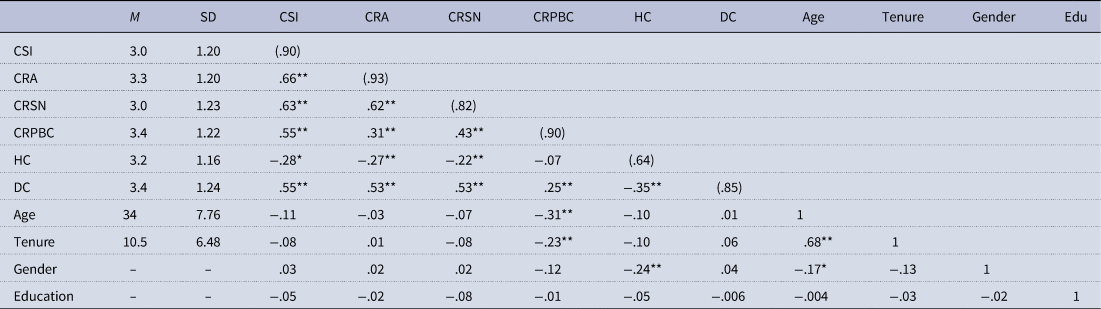
Descriptive statistics, bivariate correlations and Cronbach's alphas are provided in Table 2. As expected, all but one bivariate correlations among the main model variables are statistically significant and in the anticipated direction. An examination of the correlation matrix also highlights that none of the control variables were significantly related to the dependent variable (CSIs). Consequently, we did not include control variables for the main model testing.
Descriptive statistics, bivariate correlation matrix and Cronbach's alpha of study variables
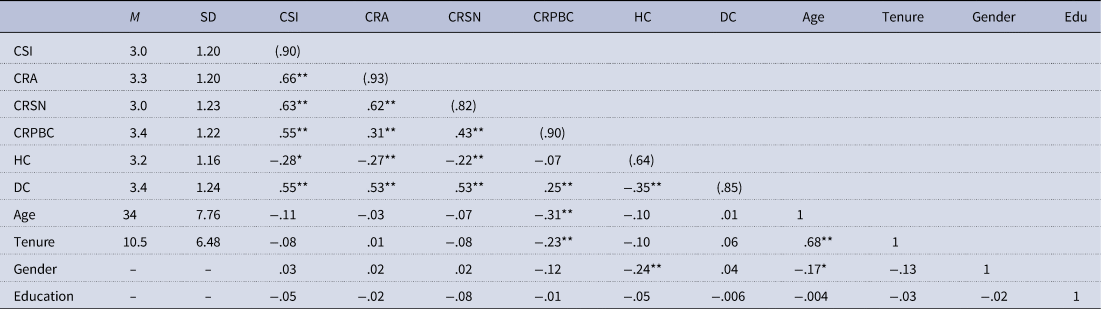
Notes: Cronbach's alphas are shown in parentheses. Gender (1 = male, 0 = female) and supervisory position (1 = yes, 0 = no).
CSI, change-supportive intentions; CRA, change-related attitude; CRSN, change-related subjective norm; CRPBC, change-related perceived behavioral control; HC, hierarchical culture; DC, developmental culture.
*p < .05, **p < .01.
Hypotheses testing
The hypotheses were tested using regression analyses in SPSS and the PROCESS macro for SPSS from Hayes (Reference Hayes2017).
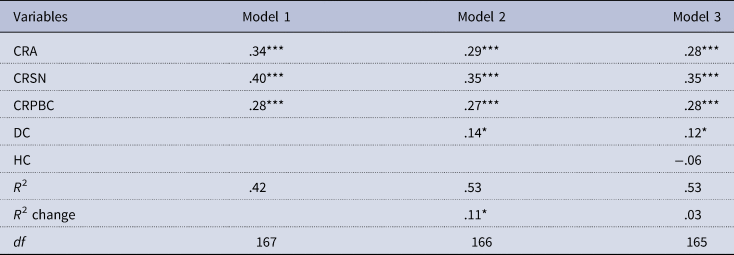
As shown in Table 3, entry of the standard TPB variables into model 1 of the equation accounted for a significant amount of variance in CSIs (R 2 = .42, p < .001). As expected, entry of DC in model 2 of the equation accounted for a significant increment of variance in CSIs (R 2 change = .11, p < .001). Contrary to our expectations, HC did not add a significant increment of variance in CSIs (R 2 change = .03, ns). When all variables were entered, hypothesis 1 was fully supported in that CRA was significantly related to CSIs (β = .28, p < .001), as were CRSN (β = .35, p < .001) and CRPBC (β = .28, p < .001). DC was found to be a statistically significant predictor of CSIs (β = .14, p < .05). Thus, hypothesis 2a was supported. Contrary to our expectations, hypothesis 2b was not supported, as HC was not found to significantly related with CSIs (β = −.06, ns).
Hierarchical multiple regression analysis predicting change-supportive intentions
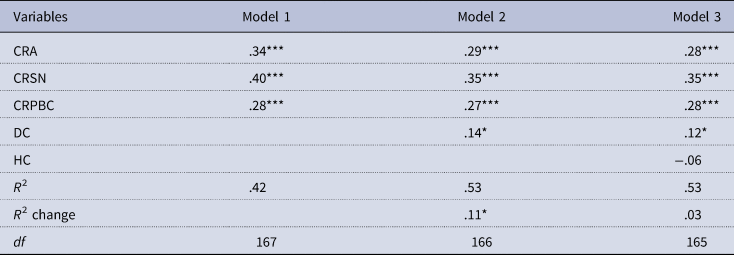
Standardized regression coefficients are reported. *p < .05, **p < .01, ***p < .001.
Mediation (hypotheses 3–4)
We used Hayes's (Reference Hayes2017) regression-based PROCESS tool, which is specifically designed for testing complex mediation, to test the significance of the indirect effects. Bootstrapping was set to 5,000 bootstrap samples. Separate mediation models were examined for DC and HC and are presented below.
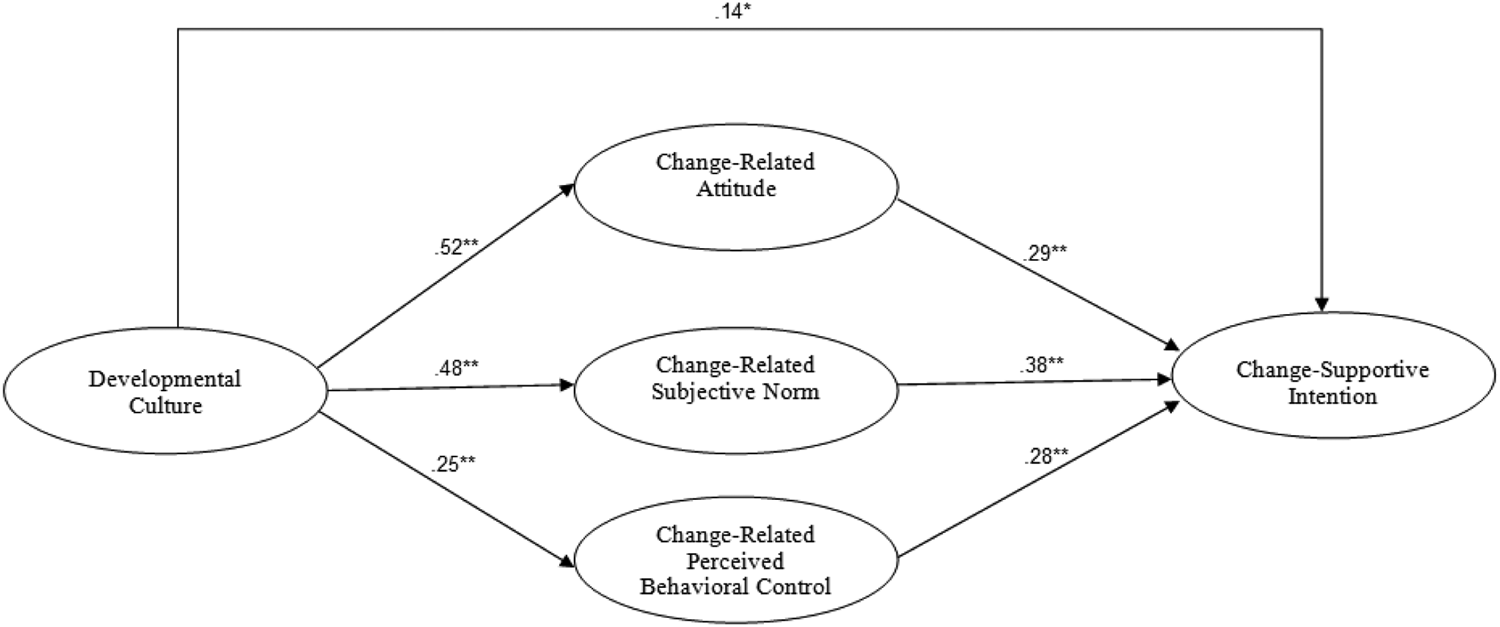
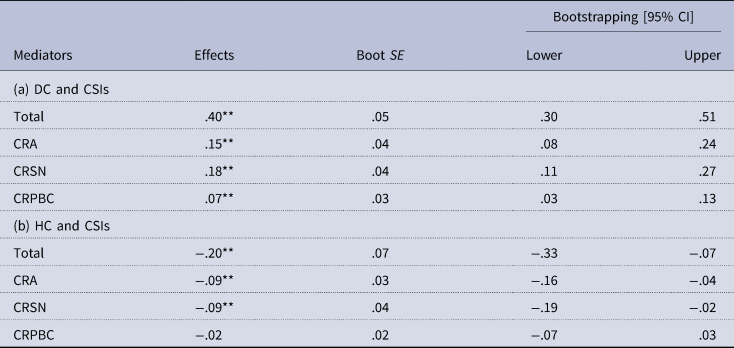
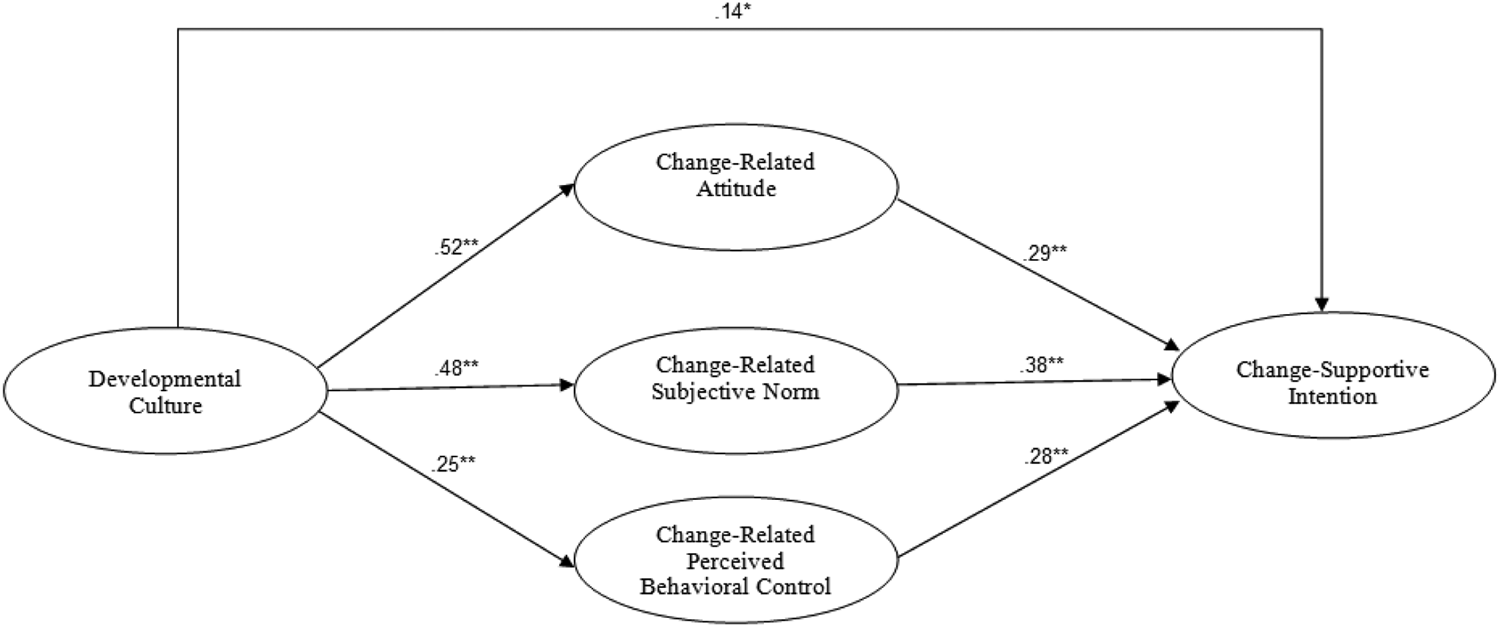
First, consistent with hypotheses 3a, 3b and 3c, Table 4a shows that the indirect effect of DC on CSIs was statistically significant, as evidenced by the no-zero in their respective confidence intervals. Thus, CRA, CRSN and CRPBC are significant mediators, such that DC was positively related to CRA (B = .52, p < .01); CRSN (B = .48, p < .01), CRPBC (B = .25, p < .01), which in turn were positively related to CSIs (B = .29, p < .01), (B = .38, p < .01) and (B = .27, p < .001) respectively (see Figure 2). Results in Table 4a also show that, of the three mediation effects that compose the total indirect effect, mediation of DC on CSIs via subjective norm is the strongest, with a standardized effect of .18. Altogether, the total indirect effect of DC on intention amounts to .40. Additionally, the direct effect of DC on CSIs was significant (B = .14, p < .05), indicating that CRA, CRSN and CRPBC partially mediate the relationship between DC and CSIs.
Multiple mediation model of DC on CSIs through CRA, CRSN and CRPBC. Note: Standardized estimates are shown. *p < .05, **p < .01.
Indirect effects of developmental and HC on CSIs through CRA, CRSN and CRPBC
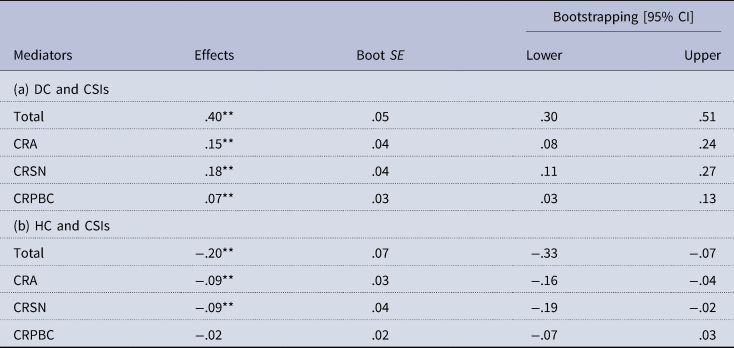
Notes: Boot SE = bootstrap standard errors; boot 5,000 bootstrap samples, CI: limit confidence interval; CI that excludes zero indicates that the conditional indirect effects are significant; *p < .05, **p < .01.
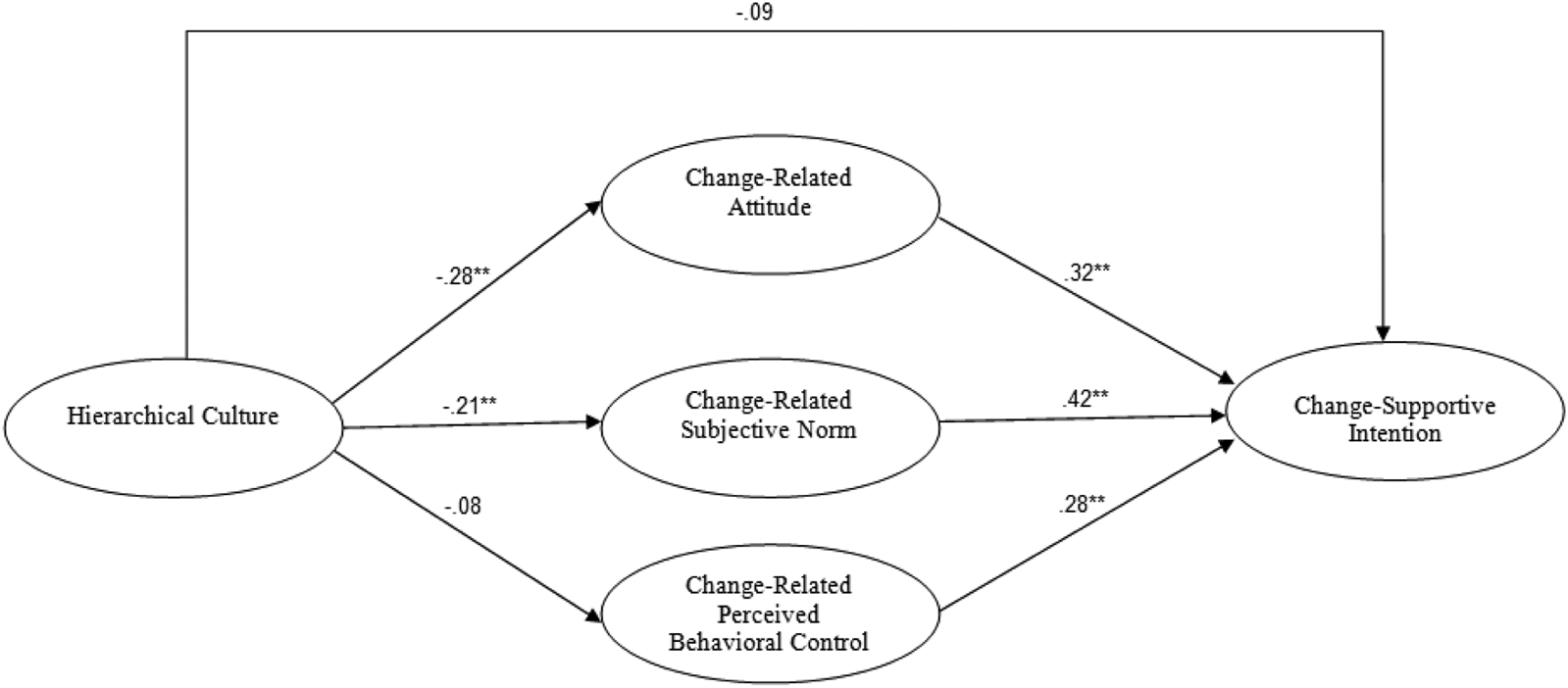
Second, Table 4b indicates that, consistent with hypotheses 4a and 4b, the indirect effect of HC on CSIs was statistically significant through CRA and CRSN; but not through CRPBC as the confidence intervals for the indirect effects of CRPBC control contains zero. Thus, CRA and CRSN are significant mediators; such that HC was negatively related CRA (B = −.28, p < .001), CRSN (B = −.21, p < .001) but not to CRPBC (B = −.08, ns), which in turn were positively related to CSIs (B = .32, p < .001), (B = .42, p < .001) and (B = .28, p < .001) respectively (see Figure 2). Additionally, the direct effect between HC and CSIs was not significant (B = −.09; p > .05) (Figure 2), indicating that CRA and CRSN fully mediate the relationship between HC and CSIs (Figure 3).
Multiple mediation model of HC on CSIs through CRA, CRSN and CRPBC. Note: Standardized estimates are shown. *p < .05, **p < .01.

Discussion
The purpose of this study was to investigate the relationship between two dimensions of OC (developmental and hierarchical) and recipient's CSIs, and mediating roles of CRA, CRSN and CRPBC in this relationship in Kurdistan Region's public schools.
Although the TBP has been extensively used in organizational and behavioral research (Armitage & Conner, Reference Armitage and Conner2001); its application to understand the mechanisms through which OC affects recipients' intentions is, to the best of our knowledge, absent. Yet, our findings suggest that the TPB provides a comprehensive framework with strong validity and incorporates well-justified theoretical components that can be accurately operationalized and empirically examined.
In line with findings obtained from previous studies (Jimmieson, Peach, & White, Reference Jimmieson, Peach and White2008; Straatmann, Nolte, & Seggewiss, Reference Straatmann, Nolte and Seggewiss2018), our data provide good support for the TPB as a valid framework to predict employee CSIs in that CRA, CRSN and CRPBC were significantly related to CSIs. In combination, these three variables accounted for 42% of the variance in CSIs. Given Armitage and Conner's (Reference Armitage and Conner2001: 481) finding that the average variance accounted for was 39% in their meta-analysis of the efficacy of the TPB, the constructs in the model presented here explained a fair amount of the variance in CSIs. Such a finding implies that employees with a positive CRA, CRSN and higher CRPBC are expected to provide support for organizational change efforts. Of the three factors, subjective norm had the strongest effect on employee intention to provide subsequent support for the change. Such a finding is surprising considering that attitude is generally found to be the strongest predictor of intention according to a meta-analysis of the efficacy of the TPB whereas subjective norm is found to be the weakest predictor (Armitage & Conner, Reference Armitage and Conner2001: 481–482). Although it is difficult to explain such conflicting results, we can offer some explanations. Since most of the studies analyzed in the meta-analyses were carried out in individualistic, western societies, and few examples of studies in collectivist cultures were included, it is possible that the cultural background has implications for the relationships proposed by the TPB (Heiny, Ajzen, Leonhäuser, & Schmidt1, Reference Heiny, Ajzen, Leonhäuser and Schmidt2019). Ybarra and Trafimow (Reference Ybarra and Trafimow1998: 369) for instance, argued that ‘a majority of behaviours in individualistic cultures are also likely to be attitudinally controlled. But in collectivistic cultures, where the collective self is stronger and more accessible, more behaviours are likely to be under normative control’. In collectivist cultures, social norms and ties are more pervasive than in individualist cultures, as such, play a major role in the decision making process to engage (or not to engage) in change-supportive behaviors. Such a notion is in line with decision making process as proposed by bounded rationality models (Battaglio, Belardinelli, Bellé, & Cantarelli, Reference Battaglio, Belardinelli, Bellé and Cantarelli2018) which state that ‘decision makers are limited in their abilities to process information, then in a dynamic environment they are likely to look for decision-making heuristics, like the support of others they respect’ (Dawkins & Frass, Reference Dawkins and Frass2005: 525).
The findings also indicate that the TBP is sufficiently robust, both conceptually and empirically, to serve as a framework for integrating contextual factors that influence employee CSIs. Our findings are in line with both affective events theory (Weiss & Cropanzano, Reference Weiss, Cropanzano, Staw and Cummings1996) that contend that employees form their attitudes and behavioral intentions based on the social context and on their interactions with surrounding employees. More specifically, the results show both direct and indirect relationships between DC and CSIs in that DC explained 11% of the variance in CSIs. The mediating roles of CRA, CRSN and CRPBC imply that organizations characterized with a DC shape change recipient’ cognition, normative beliefs and PBC regarding the enactment of change-supportive behaviors. Our results also show that, of the three mediation effects that compose the total indirect effect, mediation of DC on intention via subjective norm was the strongest. Contrary to our expectations, our results do not support the direct relationship between HC and CSIs. However, HC was indirectly related to CSIs through CRA and CRSN, but not through CRPBC. These findings provide empirical support for the claims that employee perception of OC influences organizational members' behavioral intentions and subsequent behaviors in general and employee responses to organizational change in particular (Abdul Rashid, Sambasivan, & Abdul Rahman, Reference Abdul Rashid, Sambasivan and Abdul Rahman2004; Jones, Jimmieson, & Griffiths, Reference Jones, Jimmieson and Griffiths2005). Moreover, OC may not necessarily generate its effect on CSIs employee directly, but through mediating variables such as those identified in the TPB.
Theoretical and practical implications
This study provides support for a number of unique relationships and therefore, makes important contributions to the literature on employees' responses to change in public organizations. First, it has been suggested in the literature that more research was needed on the mechanisms linking employee perceptions of OC with employee responses to change (Straatmann, Nolte, & Seggewiss, Reference Straatmann, Nolte and Seggewiss2018). From this point of view, the current investigation extends the available literature on OC-recipient responses to organizational change relationships by shedding light on the theoretical mechanism underlying this relationship. Second, we systematically examined two dimensions of OC as main determinants of CSIs (Armenakis & Bedeian, Reference Armenakis and Bedeian1999; Kuipers et al., Reference Kuipers, Higgs, Kickert, Tummers, Grandia and Van der Voet2014). As the relationship between OC and employee reactions to change may not be straightforward, we built and empirically tested a theoretically sound mediated model that potentially allows greater understanding of the mechanisms through which different dimensions of OC generate their effect. There is a growing agreement that prediction without sound theoretical justification is less capable of extending extant knowledge or catalyzing future research than prediction built on a comprehensive underlying theory (Biswas, Boyle, Mitchell, & Casimir, Reference Biswas, Boyle, Mitchell and Casimir2017).
This study has practical implications, particularly for managers and agents responsible for designing and implementing organizational change efforts. Although changes can be easily imposed on recipients from above by political and senior public leaders (Ahmad, Liu, & Butt, Reference Ahmad, Liu and Butt2019a), the changes will be much more successful if managers can convince the affected employees to embrace and support the new change. Consequently, it is important to understand the factors that foster or impede recipients support for change. As attitude, subjective norm and PBC are all found to be strong predictors of employee behavioral intentions to support change, it is important for change managers to ensure that recipients have a positive attitude toward the change and create a working environment that fosters collaboration among employees. With respect to behavioral control, management also needs to make sure that employees have the necessary skills and ability to be successful in implementing the change. Employees who lack such skills and capabilities to deal with the changes should be provided with training and development (as was done to the teachers in the context of the change investigated in this study). Thus, in a given change context, recipients must believe they are capable of executing the new behaviors required by the change initiative (Armenakis, Bernerth, Pitts, & Walker, Reference Armenakis, Bernerth, Pitts and Walker2007). Otherwise, the outcome of a change initiative may be less than expected.
Another implication for management practice is that change supportive intentions should not, and cannot, be viewed separately from the social context of the workplace. In other words, intentions and behaviors have to be understood in terms of the organizational context. More specifically, it is important for management to consider OC as a contextual antecedent, rather than the outcome of change, when designing and implementing changes. A development culture can buy-in recipients' support for organizational change and foster CSIs whereas organizations characterized by HC can hold back employees to support change efforts. We argue that understanding what kind of OC fosters/impedes the formation of CSIs is central for practitioners who try to bring in employee support to organizational change efforts. Therefore, it is important for management to create a working environment that encourages change-related behaviors and such behaviors should be recognized and rewarded. Without such a working environment it is possible to expect employees create problems for the change implementation.
Limitations and directions for future research
Although we believe that the current study makes important contributions to the extant literature, the findings must be judged in light of some limitations that are presented here as opportunities for future research. First, the results of our study are drawn from cross-sectional data that do not allow for specific tests of the direction of causality. This said, there is a logic to our proposed model which is aligned with the TPB framework that has received substantial empirical support (Armitage & Conner, Reference Armitage and Conner2001; McEachan, Conner, Taylor, & Lawton, Reference McEachan, Conner, Taylor and Lawton2011). Second, focusing on intentions it is another limitation of our study: CSI and change-supportive behavior need not stand in a one-to-one relation. However, meta-analyses suggest that intention alone explain 27% of variance in behavior (mean correlation = .47) (McEachan et al., Reference McEachan, Conner, Taylor and Lawton2011). Results of a recent study showed that CSIs significantly predict change-supportive behaviors with a high beta coefficient (B = .527) (Ahmad et al., Reference Ahmad, Straatmann, Mueller and Liu2020). Third, our research was carried out in Kurdistan Region of Iraq's public schools. Although conducting this study in such an overlooked part of the world provides interesting insights about the utility of TPB above and beyond what is found in the western world, the generalizability of our findings to other national contexts that differ in terms of their institutional and/or cultural norms is limited. The generalizability of the results would be enhanced by future investigations that will utilize a random sampling, increased sample size and including different types of organizations.
Despite these limitations, the findings of this study provide an enriched understanding of the mechanisms through which different types of OCs impact employee CSIs by applying the TBP in a non-Western research setting. Our findings provided support to the majority of hypothesized relationships and the utility of the TBP in understanding employee responses to organizational change efforts.
Financial support
The authors would like to thank National Natural Sciences Foundation of China (Project 71673185), National Social Science Fund of China (20AZD020) and SMC-Chenxing Young Scholar Program (Shanghai Jiao Tong University) for financial support.
Ahmad Bayiz Ahmad (ahmad.bayiz@sjtu.edu.cn) is a Postdoctoral Research Fellow at the School of International and Public Affairs of Shanghai Jiao Tong University. He is also a lecturer at the University of Raparin and University of Kurdistan Hewler in Kurdistan Region of Iraq. His current research focuses on organizational change, public sector reform and knowledge management. Twitter: https://twitter.com/Ahmad_Bayiz.
Atif Saleem Butt (atif.butt@aurak.ac.ae) is an assistant professor at the American University of Ras Al Khaimah, UAE. His research interests focus on management of new business processes within organizations, and changes in organizational culture and structures (organizational change management).
Dingxiang Chen (cdx1217@foxmail.com) is a PhD candidate at the School of International and Public Affairs of Shanghai Jiao Tong University. His research focuses on organizational change, public employee motivation management and strategic human resource management.
Bangcheng Liu is a professor of organizational behavior and human resource management at the School of International and Public Affairs, Shanghai Jiao Tong University. His current research focuses on cross-cultural organizational behavior and strategic human resource management, especially for public organizations. He also is interested in talent policy and innovational and entrepreneurial management.