Introduction
Fruit flies (Diptera: Tephritidae) are of major economic importance in nearly all tropical, subtropical and temperate countries worldwide. They are among the worst pests in agriculture, causing enormous devastation to both production and international trade of fresh horticultural commodities (Klassen et al., Reference Klassen, Lindquist, Buyckx, Calkins, Klassen and Liedo1994; Hendrichs, Reference Hendrichs, McPheron and Steck1996). They are also among the causes of poverty and malnutrition in large areas of tropical developing countries, where climatic conditions are favourable for labour-intensive fruit- and vegetable-based agroindustries (Waterhouse, Reference Waterhouse1993a, Reference Waterhouseb; Allwood and Leblanc, Reference Allwood, Leblanc, Allwood and Drew1996; Allwood, Reference Allwood and Tan2000). As insecticide-based control of fruit flies is not sustainable due to environmental, health and resistance problems, their study and management have received considerable national and international attention over the last four decades. International organizations of the UN family such as the Food and Agriculture Organization (FAO) and the International Atomic Energy Agency (IAEA) as well as others have been actively involved in developing more environmentally friendly control tactics, including the sterile insect technique (SIT), and in supporting Member States in their application (Dyck et al., Reference Dyck, Reyes Flores, Vreysen, Regidor Fernandez, Teruya, Barnes, Gómez Riera, Lindquist, Loosjes, Dyck, Hendrichs and Robinson2005).
Significant resources have been allocated to develop and validate the SIT against fruit flies of economic importance, e.g. the Mediterranean fruit fly Ceratitis capitata Wiedemann, the Mexican fruit fly Anastrepha ludens (Loew), the West Indian fruit fly A. obliqua (Macquart), the Caribbean fruit fly A. suspensa (Loew), the melon fly Bactrocera cucurbitae (Coquillett), the Queensland fruit fly B. tryoni (Froggatt) and some species of the Bactrocera dorsalis complex. As a result, in several countries, the SIT has been successfully integrated with other control tactics to suppress, eradicate, contain or prevent the establishment of these pests using area-wide integrated pest management (AW-IPM) approaches (Enkerlin, Reference Enkerlin, Dyck, Hendrichs and Robinson2005; Hendrichs et al., Reference Hendrichs, Vreysen, Enkerlin, Cayol, Dyck, Hendrichs and Robinson2005, Reference Hendrichs, Kenmore, Robinson, Vreysen, Vreysen, Robinson and Hendrichs2007).
To be effective, the SIT requires that large numbers of high-quality insects be released on a sustained and area-wide basis to suppress the reproductive capacity of a resident fertile population, leading to suppression or, in some situations, eradication (Dyck et al., Reference Dyck, Reyes Flores, Vreysen, Regidor Fernandez, Teruya, Barnes, Gómez Riera, Lindquist, Loosjes, Dyck, Hendrichs and Robinson2005). The cost-effectiveness and applicability of the SIT against these fruit fly pests have been increasing due to the development of new, improved and refined methodologies to: (a) mass-produce insects on an industrial scale (Parker, Reference Parker, Dyck, Hendrichs and Robinson2005), (b) standardize sterile fruit fly quality control (Hendrichs et al., Reference Hendrichs, Robinson, Cayol and Enkerlin2002; Calkins and Parker, Reference Calkins, Parker, Dyck, Hendrichs and Robinson2005; Cáceres et al., Reference Cáceres, McInnis, Shelly, Jang, Robinson and Hendrichs2007), (c) release only sterile males as a result of genetic sexing of strains (Rendón et al., Reference Rendón, McInnis, Lance, Stewart and Tan2000a, Reference Rendón, McInnis, Lance and Stewartb; Franz, Reference Franz, Dyck, Hendrichs and Robinson2005), (d) pack, ship, emerge and release sterile males after factory production (Enkerlin, Reference Enkerlin2007), and (e) apply to sterile males hormonal, semiochemical and nutritional performance-enhancing treatments before their release (Pereira et al., Reference Pereira, Yuval, Liedo, Teal, Shelly, McInnis and Hendrichs2013).
This has directly benefited ongoing fruit fly suppression and eradication programmes that integrate the SIT, which in turn has reduced insecticide use, improved fruit quality and facilitated international trade, stimulating investment and creating much employment. As the release of sterile insects is totally friendly to the environment, it has also added to the quality of life of rural communities and improved the agricultural environment. In addition, regions under high risk of introduction of exotic fruit fly pests have been using sterile male releases as a preventative measure to maintain their fruit fly-free status (Dowell et al., Reference Dowell, Siddiqui, Meyer, Spaugy and Tan2000; Hendrichs et al., Reference Hendrichs, Vreysen, Enkerlin, Cayol, Dyck, Hendrichs and Robinson2005) as an alternative to a more reactive approach to deal with costly outbreaks (http://www.cdfa.ca.gov/plant/pdep/prpinfo/).
Rationale for coordinated research project (CRP)
The experience gained and the success achieved implementing AW-IPM fruit fly programmes that apply the SIT have demonstrated that it is feasible to colonize and mass-produce sterile insects and manage their quality to address local, regional or international pest fruit fly concerns (Enkerlin, Reference Enkerlin, Dyck, Hendrichs and Robinson2005). The transboundary transport and distribution of sterile insects for these fruit fly pests are a reality today and have been made possible due to the above-mentioned improvements. However, there are many other fruit fly pests of economic importance against which the SIT would also be a valuable control tactic as part of an AW-IPM approach. Many of these pest insects are increasing their geographical and/or host crop range (e.g. Bactrocera carambolae Drew and Hancock, B. cucurbitae Coquillett, B. invadens Drew, Tsuruta & White, B. oleae Rossi and B. zonata Saunders). The lack of suitable technologies to mass-produce insects of these and other species to satisfy the demand for such AW-IPM programmes is a major bottleneck.
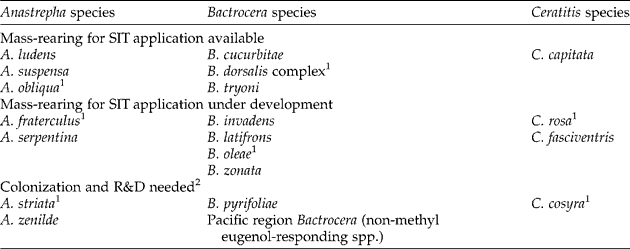
An FAO/IAEA Consultants Meeting on ‘Development and Improvement of Rearing Techniques for Anastrepha and Bactrocera Fruit Flies’ was held in Vienna, Austria, from 23 to 27 October 2002, and a list of major fruit fly pest species was developed in relation to the status of mass-rearing technologies (Table 1). Based on the degree of development and level of knowledge on the mass-rearing of these different fruit fly species, the list was divided into three categories: (i) species for which mass-rearing for SIT application was available, but refinement would be useful for some of these; (ii) species for which mass-rearing for SIT application was under development; this category included species that had been reared in some laboratories but not been brought to mass-rearing status; and (iii) species for which research to develop colonization and rearing methods was needed; this included species of regional or global economic importance where little or no technology for rearing on artificial diets was available. These species would require initial R&D to develop the basic rearing techniques necessary for eventual implementation of the SIT. Certain species of the genus Rhagoletis were also identified as potential candidates for the development of rearing methods to apply the SIT. However, the presence of a pupal diapause in these species and the lack of understanding of their physiology to manage them for continuous rearing present a unique challenge, and it was recommended that a future CRP should address specifically diapause and dormancy management in Rhagoletis and other pest species.
Present rearing status of selected fruit fly species of economic importance
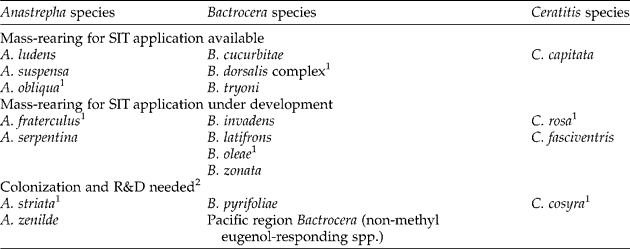
SIT, sterile insect technique.
1 Species for which development or further improvement considered most urgent due to their potential threat and/or current level of economic losses.
2 Includes also Dacus ciliatus.
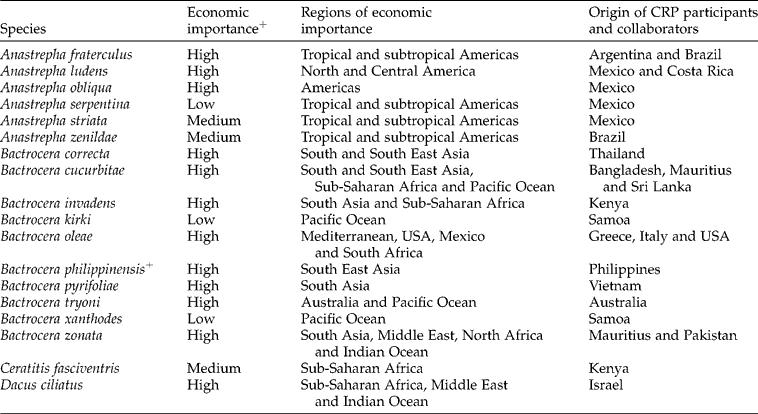
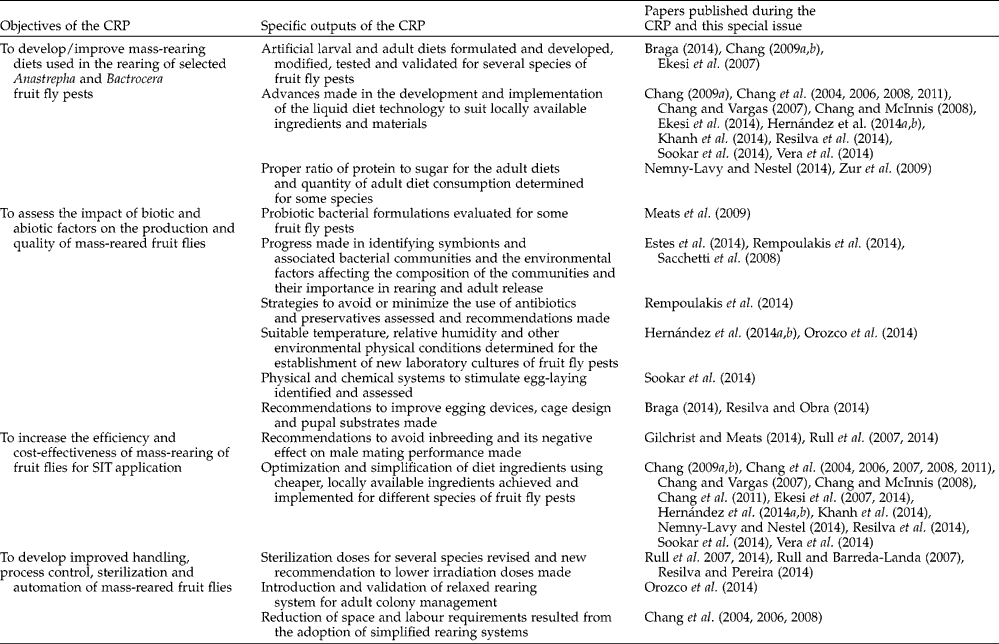
Based on the recommendations of this Consultants Meeting, an FAO/IAEA CRP, implemented under the IAEA Research Contract Programme (www.iaea.org/programmes/ri/uc_infoi.html), was coordinated between 2005 and 2009 with the participation of 22 scientists from 18 countries. This special issue of the International Journal of Tropical Insect Science summarizes the results of the 5-year CRP on ‘Development of Mass Rearing for New World (Anastrepha) and Asian (Bactrocera) Fruit Fly Pests in Support of Sterile Insect Technique’. Table 2 lists the various species that were studied under the CRP, their economic and regional importance, and the countries involved. Table 3 lists the specific objectives of the CRP and the related outcomes, as reflected in the papers published during the CRP and in this special issue.
Tephritid fruit fly species of economic importance in different regions of the world for which the sterile insect technique is or could be a key component for control and that were targeted during the coordinated research project (CRP) for the development and improvement of mass-rearing or related techniques

+ B. philippinensis is now considered a morphotype of B. dorsalis.
Specific objectives and outputs of the coordinated research project (CRP)
SIT, sterile insect technique.
This introductory paper highlights the key findings of the CRP related to the development or improvement of fruit fly mass-rearing methods and to nutrition and diets, including the role of symbionts and the effects of irradiation doses and handling procedures. It also aims to identify some gaps and areas for future research. The papers included in this special issue do not cover rearing protocols for all fruit flies of economic importance that could be addressed, but give an idea of rearing systems that could be adapted to rearing other species for which there might be an interest in applying the SIT.
Specific outcomes
Group I: species for which mass-rearing for SIT application was available, but further refinement would be useful
Some participants of the CRP addressed specific issues that resulted in improved mass-rearing protocols for selected fruit fly species already under mass-production for SIT purposes and thereby increasing the quality or cost-effectiveness of the released insects. Hernández et al. (Reference Hernández, Rivera and Artiaga-López2014a) explored the possibility of using a generic artificial larval diet for rearing closely related Anastrepha species (A. ludens, A. obliqua and A. serpentina (Wiedemann)) at the Moscafrut mass-rearing facility located in Chiapas, Mexico, that provides sterile flies for the National Fruit Fly Campaign in Mexico. The application of the SIT for the control of A. ludens is a routine activity in northern Mexico and southern Texas, USA. Simple oligidic larval diets based on local cheap ingredients have been used to rear more than 400 million A. ludens sterile pupae per week in Mexico, Guatemala and the USA (Reyes et al., Reference Reyes, Santiago, Hernandez and Tan2000). More recently, the Moscafrut facility has also been producing 100 million A. obliqua to be released to suppress populations or protect the areas that have already been freed of this pest in northern Mexico (Artiaga-López et al., Reference Artiaga-López, Hernández, Domínguez-Gordillo, Moreno, Orozco-Dávila and Barnes2004). The findings presented by Hernández et al. (Reference Hernández, Rivera and Artiaga-López2014a) indicate that with minor adjustments the A. ludens larval diet is a formulation that can also be used to rear A. obliqua and A. serpentina larvae. The availability of such a generic larval diet that responds to the nutritional needs of these three species maintained in multi-species mass-rearing facilities will optimize the cost-efficiency of their production without reducing their quality.
Orozco et al. (Reference Orozco, Artiaga-López, Hernández, Domínguez and Hernández2014) revised current rearing protocols for A. obliqua that is being produced at the Moscafrut facility in Chiapas, Mexico. An important finding of this research was the introduction and validation of the concept of relaxed rearing conditions for the adult colony to reduce the inadvertent selection for colony adaptation and therefore loss of competitiveness (Liedo et al., Reference Liedo, Salgado, Oropeza and Toledo2007). Trials using not only different adult fly densities in colony cages but also different larval densities in the diet revealed that a reduction from 100,000 to 60,000 adults per cage and a reduction from six to three larvae/g of diet for colony maintenance resulted after some generations in increased egg-to-pupa conversion and an increase in pupal weight. Relaxed rearing conditions not only can increase rearing efficiency and the quality of immature stages and adults, but can also improve male sexual performance as already demonstrated in C. capitata (Liedo et al., Reference Liedo, Salgado, Oropeza and Toledo2007). This will result in increased efficiency of operational programmes with an SIT component against Anastrepha species.
Rull et al. (Reference Rull, Arredondo and Diaz-Fleischer2014) evaluated the effect of different irradiation doses on the overall competitiveness of A. ludens. The main finding of this study was that in conventional field cage experiments, A. ludens males irradiated at a lower dose tended to induce more sterility in wild females than those irradiated at a higher dose when competing with wild males. When in competition with wild males for wild females, mass-reared flies (male and female) irradiated at 40 Gy and wild non-irradiated flies mated randomly, while flies irradiated at the high standard dose of 80 Gy mated assortatively. This finding can help insect pest control managers to revise current irradiation protocols used in fruit fly programmes with an SIT component and to create awareness that for other species also optimal doses to induce sterility are not those that cause the highest sperm sterility (Robinson and Hendrichs, Reference Robinson, Hendrichs, Dyck, Hendrichs and Robinson2005; Rull and Barreda-Landa, Reference Rull and Barreda-Landa2007) and furthermore that the optimal dose might be different when selecting a suppression, eradication or preventive control strategy.
Gilchrist and Meats (Reference Gilchrist and Meats2014) addressed alternatives for improving insect quality that is reduced as a result of the colonization process. Insect colonization can induce homozygosis due to genetic drift that results in genetic diversity loss and poor colony insect competitiveness with their wild counterparts in the field (Shelly, Reference Shelly2001; Zygouridis et al., Reference Zygouridis, Argov, Nemny-Lavy, Augustinos, Nestel and Mathiopoulos2013). Gilchrist and Meats (Reference Gilchrist and Meats2014) demonstrated that crossing two inbred lines of B. tryoni already adapted for several generations to mass-rearing conditions induced heterozygosis and increased offspring quality. In comparison, strains only refreshed with wild material collected directly from the field had diminished values for some of the traits assessed. Mating competitiveness with wild insects was not compared and should be a subject of future studies. This alternative, although requiring that two inbred strains be reared in parallel in a mass-rearing facility, can be particularly useful for those fruit fly species for which genetic sexing strains have already been developed in view that the availability of sex separation mechanisms can facilitate the directed mating of males of strain ‘A’ and females of strain ‘B’ and vice versa to produce F1 males for sterilization and release as previously suggested by Robinson and Hendrichs (Reference Robinson, Hendrichs, Dyck, Hendrichs and Robinson2005). Strategic options of colony management such as strain replacement, strain refreshment, hybrid vigour and relaxed mother colony holding still require more investigation, but are all potential alternatives to improve insect quality to counter deterioration of their biological attributes induced by mass-rearing for many generations (Robinson and Hendrichs, Reference Robinson, Hendrichs, Dyck, Hendrichs and Robinson2005; Liedo et al., Reference Liedo, Salgado, Oropeza and Toledo2007; Rull and Barreda-Landa, Reference Rull and Barreda-Landa2007; Rull et al., Reference Rull, Diaz-Fleischer and Arredondo2007).
Resilva and Obra (Reference Resilva and Obra2014) reported on improved rearing protocols for B. philippinensis Drew and Hancock, a member of the B. dorsalis complex, that consisted of new adult oviposition cages that had perforated egging tubes and the replacement of sweet potato as a bulking agent in the larval diet with sugarcane bagasse. In a separate paper, Resilva et al. (Reference Resilva, Obra and Chang2014) assessed the potential of rearing B. philippinensis on a liquid larval, and although initial results look promising, more work is needed, especially to increase larval yield.
Resilva and Pereira (Reference Resilva and Pereira2014) used the degree-day model of Ruhm and Calkins (Reference Ruhm and Calkins1981) to derive the correct physiological age for irradiation of pupae held at different temperatures based on the correlation with pupal eye colour for bisexual and genetic sexing strains of C. capitata (Resilva et al., Reference Resilva, Obra, Zamora and Gaitan2007). Using this correlation, they also developed models timing irradiation for 11 other tephritid species: Anastrepha fraterculus (Wiedemann), A. ludens, A. obliqua, A. serpentina, B. cucurbitae, B. dorsalis (Hendel), B. invadens, B. oleae, B. philippinensis, B. tryoni and B. zonata. Synchronization and timely exposure of mature pupae to the irradiation treatment at an optimal age are crucial to obtain a desirable level of sterility with minimal negative somatic effects on sterile male quality.
Group II: species for which mass-rearing for SIT application was under development in the laboratory, but that had not reached mass-rearing status
Braga (Reference Braga2014) and Vera et al. (Reference Vera, Oviedo, Abraham, Ruiz, Mendoza, Chang and Willink2014) demonstrated that A. fraterculus larvae can be reared on a diet that has agar replaced (Salles, Reference Salles1995; Jaldo et al., Reference Jaldo, Ramajo and Willink2001) either with organic bulking agents such as sugarcane bagasse or with synthetic sponges. Both types of diets led to reasonable numbers of larvae that yielded adults in numbers and quality above the minimum requirements for this parameter as stipulated in the FAO/IAEA/USDA quality control manual for this species (FAO/IAEA/USDA, 2003). However, more research is required to assess what is logistically and economically feasible for the utilization of these diets in mass-rearing.
For SIT effectiveness, it is essential that artificial rearing does not reduce male mating competitiveness. Gómez-Cendra et al. (Reference Gómez-Cendra, Segura, Alberti and Vilardi2014) compared several morphometric traits to detect differences between a wild population and a laboratory-adapted strain of A. fraterculus that originated from the same wild population. Eight morphometric traits were analysed as indicators of body size, head shape and mobility. Findings indicated important morphometric differentiation between wild and laboratory-adapted strains of A. fraterculus that could be due to environmental and genetic factors or a consequence of genetic drift during colony establishment and maintenance. Short-distance interactions during courtship among individuals are more frequent in colony insects maintained at high colony densities, which might have favoured increased facial trait sizes as a result of sexual selection. Future studies are recommended to further assess whether these traits can be associated with mating success of sterile insects.
With respect to species members of the genus Bactrocera, good progress was made with the rearing of B. invadens and B. zonata. Ekesi et al. (Reference Ekesi, Mohamed and Chang2014) reported successful rearing of B. invadens on a liquid larval diet with values for certain larval quality control and production parameters often exceeding those obtained for larvae reared on a carrot-based solid diet (Chang et al., Reference Chang, Cáceres and Jang2004, Reference Chang, Vargas, Jang, Cáceres and Cho2006, Reference Chang, Cáceres and Ekesi2008, Reference Chang, Afuola and Li2011; Chang and Vargas, Reference Chang and Vargas2007; Ekesi et al., Reference Ekesi, Nderitu and Chang2007; Chang and McInnis, Reference Chang and McInnis2008; Chang, Reference Chang2009a, Reference Changb). The use of a liquid larval diet could be a potential alternative to rearing B. invadens for possible future programmes with an SIT component.
Sookar et al. (Reference Sookar, Alleck, Ahseek, Permalloo, Chang and Bhagwant2014) and Shah et al. (Reference Shah, Sarwar, Ahmad and Tofique2014) reported on the development of mass-rearing protocols for B. zonata that were slightly modified from those used for rearing B. dorsalis (Vargas and Chang, Reference Vargas and Chang1991). These included the use of perforated plastic egging devices and the use of water to stimulate egg-laying inside the oviposition receptacles instead of using commercially available papaya, mango, peach and guava juices. The use of solid larval diets that were based on sugarcane bagasse and ground maize as bulking agents resulted in the expected number of good-quality larvae. In addition, Sookar et al. (Reference Sookar, Alleck, Ahseek, Permalloo, Chang and Bhagwant2014) reported that there is potential for using the liquid larval diet technology for B. zonata, but further improvements need to be made.
The use of the SIT as a control tactic against the olive fruit fly has in the past been hampered due to difficulties in mass-rearing high-quality insects on an artificial diet (Estes et al., Reference Estes, Nestel, Belcari, Jessup, Rempoulakis and Economopoulos2012). Rempoulakis et al. (Reference Rempoulakis, Dimou, Chrysargyris and Economopoulos2014) present attempts to overcome some of these problems. Their research confirmed that the practice of adding antibiotics to the diet is not required and even counterproductive in view of the presence of essential symbionts in the gut of olive fly larvae (Dimou et al., Reference Dimou, Rempoulakis and Economopoulos2010). It was clearly demonstrated that the gut microflora of laboratory flies was different from that of wild flies and that the microflora of wild flies varied with the different varieties of olives used as host in the field. The use of a liquid larval diet could be a potential alternative to avoid the use of cellulose as a bulking agent in the larval diet. Estes et al. (Reference Estes, Segura, Jessup, Wornoayporn and Pierson2014) reported that the olive fruit fly symbiont Candidatus Erwinia dacicola was present in both wild and laboratory flies, but the symbiont was found in significantly fewer individuals in laboratory populations than in wild populations. The presence of C. E. dacicola did not influence the mating behaviour of the olive fruit fly in field cage studies. Future experiments were recommended to assess additional fitness parameters to better understand the benefits of the presence of C. E. dacicola in relation to insect quality. Earlier research has indicated some mating time asynchrony between laboratory and wild olive flies (Economopoulos, Reference Economopoulos1972) and, therefore, the release of only sterile males could be the solution to this problem. However, until now, there has been no genetic sexing strain developed for the olive fruit fly. Transgenic approaches could be an alternative to generate such strains needed for improving the SIT for the olive fruit fly. Rempoulakis et al. (Reference Rempoulakis, Dimou, Chrysargyris and Economopoulos2014) assessed the quality parameters of the first green fluorescence protein transgenic strain developed for the olive fruit fly, but all standard quality control tests revealed inferior results for the transgenic strain when compared with a standard mass-reared strain.
Ekesi et al. (Reference Ekesi, Mohamed and Chang2014) addressed the improvement of the larval diet for Ceratitis fasciventris (Bezzi), a fruit fly species that is reared in the laboratory on a solid diet that includes carrot powder as a bulking agent. The research focused on an assessment of the possibility of rearing C. fasciventris on a liquid larval diet. The results revealed that C. fasciventris larvae were able to develop on the liquid diet, but in contrast to those of C. capitata and other species of fruit flies (Chang et al., Reference Chang, Cáceres and Jang2004, Reference Chang, Vargas, Jang, Cáceres and Cho2006, 2007, Reference Chang, Cáceres and Ekesi2008, Reference Chang, Afuola and Li2011; Chang and Vargas, Reference Chang and Vargas2007; Ekesi et al., Reference Ekesi, Nderitu and Chang2007; Chang and McInnis, Reference Chang and McInnis2008; Chang, Reference Chang2009a, Reference Changb), the values of several parameters assessed indicated that the performance of C. fasciventris flies maintained on a liquid larval diet was significantly lower over five generations than that of flies maintained on a solid diet. This is evidence that success in adapting fruit flies to an artificial diet is dependent on the fly species and diet type (Souza et al., Reference Souza, Matioli and Souza1988). This should be taken into account when improvements for mass-rearing are intended or when new species are to be adapted to mass-rearing conditions.
Group III: species for which research to develop colonization and rearing methods was needed
To assess the rearing potential for Anastrepha striata (Schiner), Hernández et al. (Reference Hernández, Rivera and Artiaga-López2014b) determined demographic, rearing and quality parameters for this difficult-to-rear species. Acceptable values for rearing and quality control parameters of laboratory-adapted flies were obtained when compared with those reported for the F1 generation of wild insects collected in the field from infested guavas. However, some rearing aspects such as larval survival and egg production still need to be improved to make mass-rearing of this species economically viable.
Anastrepha zenildae Zucchi coexists sympatrically with A. fraterculus and is an endemic pest of fruits in tropical areas of northern Brazil. Braga (Reference Braga2014) reported good progress developing and establishing rearing protocols for this species that in principle are similar to the protocols developed for A. fraterculus (Braga, Reference Braga2014; Vera et al., Reference Vera, Oviedo, Abraham, Ruiz, Mendoza, Chang and Willink2014). The best oviposition device was an agar panel over a glass bottle. Post-zygotic compatibility of several populations of A. fraterculus and A. zenildae was assessed, but no viable eggs were produced, which confirmed that the populations tested belonged to separate species.
Nemny-Lavy and Nestel (Reference Nemny-Lavy and Nestel2014) assessed the protein requirements of the adult Ethiopian fruit fly Dacus ciliatus (Loew). Yeast hydrolysate at a concentration of 16–50% relative to sugar resulted in the best reproduction rate in terms of pupa production. However, the development of a functional artificial larval diet for D. ciliatus remains the major constraint.
Khanh et al. (Reference Khanh, Hien, Trang, Toan and Rull2014) assessed the basic biology and artificial rearing techniques for Bactrocera pyrifoliae (Drew and Hancock), a pest of peaches and plums in higher-elevation areas of northern Vietnam and Thailand. This species is not attracted to traps baited with methyl eugenol or cuelure, but responds to protein baits in McPhail traps (Khanh et al., Reference Khanh, Hien, Tuu, Toan, Thong, Trang, Thanh and Thang2007; Khanh and Hien, Reference Khanh and Hien2008). As insecticide bait sprays are solely used to suppress this pest, the SIT could be an environmentally friendly alternative for its control. An important result of this research was the successful adaptation of this species to the rearing on a carrot and corn powder-based larval diet. Additional research will be necessary to develop full rearing and quality control protocols for this species based on experience and methods developed for other species of Bactrocera (Vargas and Mitchell, Reference Vargas and Mitchell1987; Vargas et al., Reference Vargas, Mitchell, Fujita and Albrecht1990; Vargas and Chang, Reference Vargas and Chang1991).
Conclusions
Developing and improving technologies for mass-rearing fruit flies are fundamental to ensure the success and cost-effectiveness of AW-IPM programmes that include an SIT component against these tephritid pests. This CRP motivated and supported the development and improvement of larval and adult diets, rearing and sterilization procedures that are required for the mass-production of selected Anastrepha, Bactrocera, Ceratitis and Dacus fruit fly pests. While a number of studies have resulted in significant improvements in the rearing of some species that can or have already been transferred to operational programmes, others will require more research before they can be implemented in fruit fly mass-rearing facilities (see conclusions on identified gaps below). In addition, this CRP has succeeded in bringing together an international group of researchers with similar focus and objectives, who through networking shared specialized technical know-how and researched mass-rearing protocols for SIT implementation against an expanded group of fruit fly species of major economic importance. The major outcomes of this research network can be summarized as follows (Table 3):
● Artificial larval and adult diets were developed or improved for several species of fruit fly pests using locally available low-cost ingredients.
● The use of a liquid larval diet as a novel technology was tested and adopted for some species using locally available ingredients and materials.
● Progress was made in assessing the importance of various symbionts and associated bacteria and in identifying some factors that affect their composition and potential to improve the quality of the released insects.
● For some species, new or improved rearing equipment was designed for use in mass-rearing facilities.
● It was demonstrated that in certain species, the irradiation doses can be reduced to increase overall sterile insect quality while increasing induction of sterility in the field.
● Strategies were identified to improve colony management and to reduce the effect of inbreeding and, hence, increase insects' vigour and male mating performance.
Although good progress was made during the CRP to develop or improve mass-rearing technologies for selected fruit fly pests, there are still various gaps that became apparent during the implementation of the CRP. These gaps need to be addressed in the future to enable stable insect production and improved overall sterile insect quality and SIT efficiency:
● In some cases, it is still not possible to maintain a steady and reliable mass-production of insects for SIT application. In species such as A. fraterculus, A. striata, B. oleae and B. pyrifoliae, additional research is required to better understand the abiotic and biotic factors that are causing periodic low productivity that can even lead to the loss of colonies.
● Past efforts to improve sterile fruit fly quality have focused on aspects of colonization, mass-rearing, quality control and pre-release handling. More evidence that associated micro-organisms could improve male sexual performance is being found (Ben-Yosef et al., Reference Ben-Yosef, Jurkevitch and Yuval2008). Therefore, it is necessary to better understand the dynamics and the role of micro-organisms and symbionts to be able to exploit these to develop more efficient rearing systems and be able to release sterile males of higher biological quality.
● Numerous data demonstrating that male sexual performance can decrease progressively with the number of generations under mass-rearing are available (Shelly, Reference Shelly2001), while increasing evidence indicates that relaxed rearing conditions for the adult colony can effectively counter the inadvertent selection for colony adaptation and therefore male competitiveness loss (Orozco et al., Reference Orozco, Artiaga-López, Hernández, Domínguez and Hernández2014). However, there is still a need to compile all available information to develop protocols for effective colony establishment, maintenance, replacement or refreshment that would sustain the sexual competitiveness of the sterile males.
● Despite the good progress made with the development of efficient liquid diets, most fruit fly mass-rearing facilities still use bulking agents that are subproducts of the agroindustry, which are difficult to acquire with stable quality in terms of physical and chemical properties and micro-organism load. Additional research is still needed to replace these bulking agents with either liquid or gelid formulations that could allow standardization of the required properties of the larval diet.
● Currently, yeast is being utilized as a source of essential nutrients and protein for all larval and adult diet formulations to rear fruit flies. However, yeast is the most expensive component and therefore it remains very desirable to reduce or fully replace it with micro-organisms or other alternatives to decrease the cost of diets and consequently to further diminish the cost of production of sterile fruit flies and SIT application.
To support continued rapid progress in some of the identified R&D areas, two new 5-year FAO/IAEA CRPs have been initiated, involving scientists from the world's main fruit fly research centres and major fruit fly SIT programmes. In 2010, a CRP was initiated on ‘Resolution of Cryptic Species Complexes of Tephritid Pests to Overcome Constraints to SIT Application and International Trade’, and in 2011, another CRP was started on ‘Use of Symbiotic Bacteria to Reduce Mass-Rearing Costs and Increase Mating Success in Selected Fruit Pests in Support of SIT Application’.
Acknowledgements
The authors thank all their colleagues who enthusiastically took part in this CRP, the group of consultants who participated in formulating the CRP (Andrew Jessup, Aristides Economopoulos, Eric Jang, Pedro Rendón and John Worley), and all their colleagues who contributed to reviewing the papers presented in this special issue.