On May 20, 1954, a group of locals presented Guam's appointed Governor, Ford Q. Elvidge, with a petition signed by more than 3,100 Guamanians, including members of the Guam Legislature, attorneys, business leaders, and veterans.Footnote 1 The document called for a right widely enjoyed by American citizens on the mainland, but not on Guam: trial by jury.Footnote 2 As they confronted Elvidge, the locals peppered him with questions. “Would you back a bill before the legislature to provide jury trials?” “Do you feel the local people are qualified to serve as jurors?” “If such a bill were passed by the Guam legislature, would you sign or veto it?” To each of these questions, Elvidge gave the same elusive response: “No comment.” But the petitioners had set their sights beyond the island. They also sent their demand for jury trials to members of Congress, mainland newspaper editors, and civic and veterans’ organizations.Footnote 3
The petitioners expressed frustration at the fact that Guam had been a United States territory for 55 years, yet there had never been a jury trial on the island. For more than half of the twentieth century, all legal cases on Guam—civil and criminal—were decided by judges alone. There were no grand jury indictments on the island either. Despite the importance of juries in the American legal system, the United States government was under no obligation to introduce them to Guam. According to the series of early twentieth-century Supreme Court rulings known as the Insular Cases, the Constitution did not apply in full in “unincorporated” territories such as Guam, Puerto Rico, and the Philippines.Footnote 4 Jury trials were not a fundamental right in these places; they were a privilege that Congress had the prerogative to grant. These island colonies contained large populations of nonwhite, non-English-speaking peoples; Justice Henry B. Brown called them “alien races” for whom Anglo-Saxon institutions “may for a time be impossible.”Footnote 5 The denial of juries served as an important instance of the racialization of Chamorus, the native population of Guam. Jury trials were absent on Guam in part because colonial administrators perceived Chamorus to be racially primitive and unfit for American-style participatory democracy.Footnote 6
The people of Guam did not passively accept the legacy of the Insular Cases. Local leaders called for jury trials as early as the 1930s, and the campaign intensified after World War II. It took decades of activism before residents of Guam gained many of the privileges and protections that stateside Americans possessed. In the hard-won Organic Act of 1950, Congress granted Guamanians United States citizenship and transitioned the island's government from military to civilian rule. It also included a bill of rights largely modeled on the Constitution's, but deliberately omitted the right to trial by jury. It took 5 more years of petitions and legal challenges before residents of Guam finally secured jury trials. The first criminal jury trial took place on the island in February 1956; the first civil jury trial began a month later.Footnote 7
Looking at the story of jury trials on Guam broadens our understanding of law and empire in two ways. It reveals the practical impact of laws and judicial opinions on a colonized people, and sheds light on how law serves as an important facet of both governance and resistance. This article contributes to a growing literature about the impact of United States imperialism, including the Insular Cases, on the territories.Footnote 8 Scholars such as Bartholomew Sparrow have rightly emphasized the centrality of the cases in propping up American empire.Footnote 9 However, many of the past studies of the Insular Cases focus primarily on the legal reasoning within the Supreme Court's opinions. Although this is a valuable perspective, especially for lawyers, it nevertheless concentrates on stateside actors, namely the Supreme Court justices who wrote the decisions, and does not take into account the impact of the cases within the island colonies. Chronicling the full life of the Insular Cases—from the judicial opinions to their everyday repercussions to the grassroots dissent—shows how abstract legal proclamations have had real-life consequences.
In most studies of American empire, Guam is little more than a footnote: always mentioned, yet never explored in depth. As Alfred McCoy and Francisco Scarano point out, there are numerous histories of United States imperialism in Puerto Rico and the Philippines, but an “outright omission” of scholarship about Guam.Footnote 10 Despite its small size (30 miles long and 9 miles wide) and distance from the rest of the United States (4000 miles from Hawai‘i, 6000 from California), Guam is by no means insignificant. In 2017, stateside Americans realized Guam's tactical military importance when North Korea threatened to launch ballistic missiles at the American territory. But even when Guam does not make national headlines, it should not be ignored. In fact, Guam may be an ideal case study for examining the effects of the Insular Cases because the decisions had a greater impact on the local population there than in some of the other unincorporated territories. Whereas Puerto Ricans, for example, were statutorily granted almost all individual constitutional rights by 1917, the same cannot be said for Guam.Footnote 11 As a strategic military site, Guam was controlled for half a century by the Navy, which in many ways treated the island as an extraconstitutional zone. A 1947 government report inaccurately but tellingly claimed, “The Constitution of the United States does not apply to Guam.”Footnote 12
The story of the struggle for jury trials on Guam reveals that movements for independence, like those in the Philippines and Puerto Rico, were not the only forms of colonial resistance in the United States territories.Footnote 13 Sometimes a push for political integration was itself a form of opposition to American empire.Footnote 14 When Guamanians called for jury trials, they were demanding greater inclusion under the constitutional umbrella, but they were also rejecting the Supreme Court decisions, Congressional directives, and Washington appointees that had ruled the island for so long. Residents of Guam called for a system that would allow them agency and a voice in their own judiciary, for two reasons. First, after the United States military seized two thirds of the island following World War II, many felt that juries would give them fairer restitution for their land. Juries, they believed, would express community sentiment and better understand the realities of life on the island. Second, some supported jury trials out of a sense of equality, because they refused to accept what they perceived as fewer rights than mainland United States citizens. Whether or not they were familiar with the actual judicial precedent, they objected to one of the basic legacies of the Insular Cases: that the Constitution did not fully apply within their territory. As a 1955 editorial in the Guam Daily News remarked, “The ruling that the U.S. Constitution does not follow the Flag may have been a sound one years ago, but is outmoded in our times. It is a ‘Model T’ concept of justice that should have gone out with highbutton shoes and rumble-seat skirts.”Footnote 15
***
The right to a trial by jury is deeply embedded in the American judicial tradition. Among the many grievances against England enumerated in the Declaration of Independence, Thomas Jefferson faulted the crown “for depriving us in many cases, of the benefits of Trial by Jury.” Later, the Sixth and Seventh Amendments to the United States Constitution guaranteed the right to a jury in federal court in all criminal cases and in all civil suits exceeding $20.00. Although the Sixth Amendment was not extended to the states until 1968 (and the Seventh Amendment has never been extended to the states), throughout the twentieth century every state constitution provided for petit juries in felony criminal cases, and many in misdemeanor cases as well.Footnote 16
However, juries are not used in most of the world. They originated as part of the English common law system of justice; therefore, most of the countries that use juries today are former English colonies. In contrast, much of continental Europe and Latin America subscribes to a civil law system of justice, where legal concepts and categories derive from Roman law. In civil law countries, juries are rare. Most verdicts are handed down by a judge or a panel of judges. A few European countries allow for juries in serious criminal cases, when the potential punishment is several years’ imprisonment or more, while other civil law countries do not provide for juries under any circumstances.Footnote 17
Spain, as a civil law country, passed its legal traditions on to its colonies. In the Spanish colonies of Cuba, Puerto Rico, the Philippines, and Guam—as in Spain—juries were nonexistent. The Laws of the Indies, developed in Spain's Caribbean colonies, became the basis for the Spanish legal system on Guam in 1791. In 1898, when the United States took control of the island, judicial decisions were handed down by a teniente gobernador (lieutenant governor), with the assistance of judges in the different municipalities. Appeals could be brought to the court of appeals in Manila and the Supreme Court in Madrid, and capital sentences required the review and approval of these courts before being executed.Footnote 18
Not long after the United States assumed jurisdiction over Guam, Puerto Rico, the Philippines, and Hawai‘i (which had not been a Spanish colony but was annexed by the United States in 1898), the question arose as to whether jury trials—as well as other rights enumerated in the Constitution—were required in the new colonies. The Insular Cases explicitly denied that a constitutional right to trial by jury applied in the unincorporated island territories. The Supreme Court first expressed this in Hawaii v. Mankichi, decided in June 1903. A divided court ruled that Osaki Mankichi, a resident of Hawai‘i who had been convicted of manslaughter by the vote of nine out of twelve jurors, did not have the inherent right to either indictment by a grand jury or a jury trial. Justice Brown's lead opinion drew a distinction between “fundamental” and “procedural” constitutional rights. The former traveled with the flag and applied in all territories, although Brown was vague about exactly what fell under this category. However, he was certain that the two rights alleged to be violated in Mankichi's case—indictment by a grand jury and trial by jury—“are not fundamental in their nature, but concern merely a method of procedure.”Footnote 19 In his concurring opinion, Justice Edward D. White reasoned that as Hawai‘i was not incorporated, the Fifth and Sixth Amendments “were not applicable to that territory.”Footnote 20 In a similar case a year later, Dorr v. United States, the Supreme Court ruled that the Fifth and Sixth Amendment guarantees of indictment by a grand jury and jury trial did not apply in the Philippines either. Finally, in Balzac v. Porto Rico, decided in 1922, a now unanimous Court affirmed that residents of Puerto Rico did not have a constitutional right to a jury trial.Footnote 21
None of the Insular Cases specifically involved Guam, but it was evident that the Supreme Court's decisions applied there as well. Guam had been acquired from Spain under the Treaty of Paris just as the Philippines and Puerto Rico had been. The United States government considered Guam an unincorporated territory like the Philippines and Puerto Rico.Footnote 22
Even though the Insular Cases clarified that jury trials were not required in the unincorporated island colonies, Congress nevertheless allowed them in Puerto Rico, Hawai‘i, and the United States Virgin Islands (which were purchased by the United States in 1917). Jury trials were used in Puerto Rico as early as 1899, and in its 1901 criminal code, the Puerto Rican legislature provided for jury trials in felony criminal cases carrying a sentence of 2 of more years.Footnote 23 (The Balzac case involved the lack of juries in misdemeanor trials.) By 1922, the year of Balzac v. Porto Rico, “jury trials were a common thing in Puerto Rico.”Footnote 24 However, in federal courts, only English speakers could serve on juries, thus limiting those jurors to an elite 10% of the population.Footnote 25 In Hawai‘i, juries had existed even before United States annexation, but native Hawaiians had not been allowed to serve on them. Hawai‘i's Organic Act of 1900, passed by Congress, provided that “all juries shall hereafter be constituted without reference to the race or place of nativity of the jurors.” Again, however, only those literate in English could serve.Footnote 26 The Organic Act of the U.S. Virgin Islands, passed by Congress in 1936, guaranteed that “no person shall be denied the right to trial by jury on the demand of either party.”Footnote 27 Although Congress could have barred jury trials in these island courts, it chose to allow them.Footnote 28
In the Philippines, in contrast, there were no jury trials. Racism certainly played a role in the decision not to extend jury trials to the Philippines; Governor William Howard Taft deemed Filipinos “so ignorant that they could not sit on [a] jury.”Footnote 29 Yet, as legal scholar Andrew Kent has demonstrated, cultural chauvinism was not the only factor at play. Taft and Secretary of State Elihu Root, two lawyers who played a large role in shaping Filipino policy, were both highly skeptical of jury trials at home: they thought that juries were archaic, inefficient, and lacked impartiality. Instead, they believed in the benefits of strong judges, both stateside and in the territories. Colonial administrators’ strong anti-jury tendencies, combined with the lack of a significant homegrown Filipino desire for jury trials, effectively killed the prospect of juries in the Philippines.Footnote 30
Two more territories—Guam and American Samoa—were also left out. In American Samoa, which was ceded to the United States in 1900 and 1904, locals practiced a traditional system of village-based justice, which lacked jury trials. In fact, when jury trials were later introduced to American Samoa in the 1970s, there was significant local resistance. Several matai (heads of families, or chiefs) testified against having jury trials in the territory, because they viewed them as a threat to Samoan traditions.Footnote 31 However, on Guam, which was colonized by Spain in 1668, traditional Chamoru judicial customs had largely been subsumed by Spanish practices. Most of our knowledge about the pre-contact Chamoru justice system comes from accounts written by seventeenth-century European missionaries. Although some aspects of older traditions endured, the judicial system that Americans found in 1898 was based primarily on the Spanish colonial model.Footnote 32
After the Americans took over, the rationale given most often for the lack of jury trials on Guam was the Spanish tradition of the island; judges had handed down decisions according to Spanish law since the eighteenth century. Captain Willis W. Bradley, Jr., Governor of Guam from 1929 to 1931, was a celebrated advocate for Chamoru rights, but he rejected the idea of juries for Guamanians in part because of their longtime use of Spanish-style courts. In December 1930, Bradley signed the Guam Bill of Rights, which was patterned after the first ten amendments to the Constitution—with the omission of the provisions for grand juries and jury trials. Bradley explained, “The simple truth is that trial by jury would be one of those Anglo-Saxon things forced upon Guam.”Footnote 33 Bradley framed the denial of jury trials as an act of cultural sensitivity, a respect for the earlier traditions of Guam's residents—even though these too had been imposed as part of colonial rule. (Because the Naval Department in Washington rejected the Guam Bill of Rights, it never actually went into effect, but many of its provisions would later be adopted.)
United States colonial officials’ ostensible respect for Guam's heritage actually undermined locals’ self-determination and agency. Moreover, justifying the lack of jury trials by pointing to Guam's Spanish heritage was disingenuous, as in many other ways the American colonial administration was trying to erase the island's cultural traditions. Anne Perez Hattori has written extensively about how the United States colonial administration tried to control the Chamoru population of Guam by Americanizing them. The colonial project “sought not simply to rule over the island's government,” she wrote, “but more broadly to transform the minds and bodies of its natives.”Footnote 34 United States officials attempted to Americanize the Chamorus through the introduction of Western medicine, English-language education, and the restriction of certain religious practices, among other strategies. Moreover, Puerto Ricans received limited jury trials, even though they too had a Spanish heritage.
The decision not to grant trial by jury on Guam was based, at least in part, on ideas about the racial capabilities of Chamorus. Since the beginning of American occupation, United States sailors on Guam called the native inhabitants “niggers” and “damned dagoes.”Footnote 35 Governor George L. Dyer described Chamorus as “primitive” and “like children” in his 1904 Annual Report to the Navy. They were “poor, ignorant, very dirty in their habits, but very gentle and very religious,” he reported. “Their wants are few, and they lead lives of Arcadian simplicity and freedom from ambition or the desire for change or progress.”Footnote 36 This conception of Chamorus as a primitive or childlike race led successive governors to reject the notion of trial by jury on Guam. “The jury system, either grand or petit, as recognized in the United States, can not be carried out here,” wrote Governor William Elbridge Sewell in 1903. It “would be too much for the legal ability of this place” and “confusion would result, if not paralysis.”Footnote 37 When Governor Dyer announced that he had appointed two “natives” to Guam's court of appeals, he cautioned that “this comes as near to trial by jury as I deem it advisable to go at present.”Footnote 38
Although Guam's naval administrators may have been influenced by the anti-jury movement, as in the Philippines, they were also motivated by a desire to centralize power in the strategically located territory. Guam was the largest island in the North Pacific Ocean between Hawai‘i and the Philippines and between Japan and New Guinea, and the only island between Hawai‘i and Asia with both a protected harbor and sufficient room for military bases.Footnote 39 While serving as assistant secretary of the navy, Franklin Delano Roosevelt stated that Guam's importance as a naval base “cannot be overestimated.”Footnote 40 Therefore, while Congress granted the Philippines and Puerto Rico organic legislation that set up a local government and enabled elected civilian legislatures within the first decade of rule, Guam remained under the direct control of the navy. Naval governors, appointed in Washington, treated the entire island like a military base and maintained absolute control over all executive, legislative, and judicial functions.
Dislike of juries, racism against local populations, and the desire for centralized governance all pointed in the same direction, each reinforcing the other. In this context, serving on a jury—an act of participatory democracy—was out of the question. The colonial administration refused to grant Chamorus a meaningful role in the governance of the island, although they were sometimes assigned duties in lower-ranking positions in the naval government.Footnote 41 In 1917, Governor Roy C. Smith created the Guam Congress, an advisory body to the naval governor, made up of thirty-four island leaders. However, members of the Guam Congress were appointed by the governor, served at his pleasure, received no pay, and had no actual legislative powers.Footnote 42 Stanley K. Laughlin, Jr., a law professor and anthropologist who specializes in the legal systems of the American territories, explained: “To the extent that the jury system is designed to interpose community sentiment between government and citizenry, it would have been unthinkable … to allow members of the indigenous territorial population to serve as jurors or grand jurors.”Footnote 43
Meanwhile, policy makers used circular logic to continue refusing Guamanians a role in their own government: because they had no background in participatory democracy, they were not permitted to practice it. As Chief Justice Taft put it in the Balzac decision: “the jury system postulates a conscious duty of participation in the machinery of justice which it is hard for people not brought up in fundamentally popular government at once to acquire.”Footnote 44 Of course, the refusal to let Guamanians sit on juries meant that they would never gain the experience necessary to be “ready” for jury duty, just as the refusal to let them vote meant they would never be “prepared” for popular government.
For the first five decades of American rule, two legal systems existed on Guam, neither of which included trial by jury. Enlisted members of the navy and their dependents were tried by court martial in military tribunals. Civilians, 90% of whom were Chamorus, used the territorial courts. In these civilian courts, a trial judge investigated all cases, much as a grand jury would, and if he determined that there was sufficient evidence to bring the case forward, that same judge would preside over the trial and then issue the verdict. Decisions could be appealed to a Court of Appeals, and the final ruling lay with the governor.Footnote 45 Laura Thompson, an anthropologist who conducted field research on Guam in the 1930s, noted that civilians actually had fewer legal rights than military defendants. Under naval law, judges’ decisions were governed by rules that could not be waived, and rulings could be appealed to a higher authority off island. In the civilian courts, the governor could alter or waive rules at will, and he alone was the final judicial authority.Footnote 46
From the very start of American occupation, however, the people of Guam pressed for greater rights and self-determination, and protested the iron fist of naval rule. In 1901, thirty-two prominent citizens of Guam sent a petition to the United States Congress stating that “fewer permanent guarantees of liberty and property rights exist now than when under Spanish dominion…. We believe ourselves fully justified in asking relief from a system of government that subjects a thoroughly loyal people to the absolute rule of a single person.”Footnote 47 The petition was forwarded from Governor Seaton Schroeder to Secretary of War Elihu Root, but it was never acted upon. In contrast, by this time, Congress had already granted Puerto Ricans limited civilian popular government under the 1900 Foraker Act.
Guamanians petitioned for United States citizenship multiple times during the first decades of American rule. Congress granted citizenship to Puerto Ricans in 1917 and to Virgin Islanders in 1927, but either ignored or defeated Guamanian petitions in 1917, 1925, and 1929, leaving them (along with Filipinos and American Samoans) in the nebulous category of “noncitizen U.S. nationals.”Footnote 48 In the 1930s, however, there was renewed hope. First, the naval-appointed governor, Willis Bradley, openly favored United States citizenship for the people of Guam.Footnote 49 Second, a new generation of young Chamoru activists, who had been raised and educated in the American system, became involved in the cause. In 1937, Baltasar J. (B. J.) Bordallo and Francisco B. Leon Guerrero traveled to Washington, DC, to urge members of Congress to support a bill that would grant United States citizenship to residents of Guam. Their trip was funded with hundreds of small donations from ordinary Guamanians.Footnote 50
To Bordallo and Leon Guerrero, the term “citizenship” represented a number of Guamanian desires, including trial by jury. The two delegates assumed that jury trials would automatically accompany citizenship, and cited them as a right that Guamanians deserved. In his testimony before Congress, Bordallo asserted that “every citizen is entitled to receive a trial by jury. Are the 21,000 inhabitants of Guam not entitled to this protection … after respecting, honoring, and protecting the American flag for 38 years?”Footnote 51 In an article in The Washington Post, he reiterated that “we do not have the constitutional protection given all American citizens. Every citizen is entitled to receive a trial by jury.”Footnote 52 In this context, trial by jury served as a stand-in for all of the constitutional rights that Guamanians hoped to gain. But the assumption that citizenship must include jury trials reflected a misunderstanding of the law. When Guamanians became citizens in 1950, they discovered that citizenship still did not confer jury rights upon them. Nevertheless, it was an understandable correlation to make. Three territorial groups who had been granted United States citizenship—Hawaiians, Puerto Ricans, and Virgin Islanders—also had jury trials.
Bordallo and Leon Guerrero used two tactics in their appeal to Congress: they emphasized Guam's patriotism and loyalty to the American flag, and they strategically invoked the status of other American territories. The Guam delegates’ comments revealed an awareness of what was happening in the other territories and a refusal to settle for fewer rights. As Bordallo explained, “we are only concerned to the extent that our people be granted citizenship rights as have the people of Hawaii, Alaska, Puerto Rico, and the Virgin Islands.”Footnote 53 Bordallo used census reports to show that Guam's residents were more literate than the people of Puerto Rico, Alaska, the Virgin Islands, and Hawai‘i, and concluded that “the people of Guam are more qualified to become United States citizens.”Footnote 54 In particular, he argued that Guam should “be at least on the same status as the inhabitants of the Virgin Islands,” which had almost exactly the same population as Guam (approximately 21,000 people) and had also been administered by a naval government.Footnote 55 Although the people of Guam had demonstrated their loyalty for nearly 20 years longer, Virgin Islanders had both United States citizenship and jury trials. Leon Guerrero mentioned the Philippines, which had recently been promised independence in ten years’ time. “We are not asking for independence,” he assured Congress, but wondered why the desires of the loyal people of Guam were not being taken as seriously as those of the rebellious Filipinos.Footnote 56 Although the Guam citizenship bill found some support in Congress, it ultimately failed because of strong opposition from the Department of the Navy.
World War II hit Guam hard. On December 8, 1941, just hours after the attack on Pearl Harbor, Japanese warplanes bombed Guam as well. Japanese forces invaded Guam a few days later and controlled the island until 1944. During this period, the Japanese military treated Guam's Chamorus as an enemy population. They were herded from their villages, put into concentration camps, and forced into manual labor. Executions, beatings, and rapes were common. When American troops returned, Guamanians welcomed them as liberators and assisted them in retaking the island.Footnote 57
After they recaptured Guam in August 1944, United States military forces established both a naval and an air force base there, appropriating whatever land they felt was necessary. Thousands of Guamanians found their property condemned to make room for the military bases. By 1947, 1,350 families had lost their land and homes.Footnote 58 Ultimately, the federal government claimed more than two thirds of the island. After the trauma of Japanese occupation, most Guamanians conceded the need for American military bases, but they objected to the seemingly arbitrary nature in which lands were selected for condemnation, as well as to the use to which they were being put. The military would seize fertile farmland, for example, and then let it sit idle. Guamanians were especially incensed when the military began condemning land not for bases, but for parks and recreational facilities reserved exclusively for military personnel. Particularly controversial was the seizure of Tumon Beach, a popular fishing spot, to create a military recreational center. In many cases, the condemned property had been occupied by a family for generations and was considered ancestral land.Footnote 59
Those who had been displaced were entitled to compensation for their land, and they became increasingly frustrated with the restitution system set up by the naval government. The Land and Claims Commission, staffed by naval personnel, determined how much the government would offer for a parcel of land. According to one source, the agency on average offered only 6% of the land's appraised value.Footnote 60 If the offer was rejected, the land was condemned and taken by the government anyway, and the case was referred to the Superior Court. There, a single judge, appointed by the navy, determined whether the government's offer of compensation was fair. The only appeal was to the secretary of the navy, 10,000 miles away in Washington, DC.Footnote 61
With so many Guamanians affected by the land condemnations, the call for a jury system grew louder. In addition to the principles at stake, Guamanians had a monetary incentive to demand jury trials. For those who felt cheated out of a fair settlement, juries represented a corrective to the exploitation of the United States military and the United States government. Juries meant that neighbors, people who understood their situation, could determine the remuneration for their land. Many cited the lack of juries as a reason why the land trials were so unsatisfactory. B. J. Bordallo, the representative who had served as part of the 1937 delegation to Washington, recalled his family's experience after World War II. A Navy judge awarded them only $850 for land purchased in 1928 for $750, and $200 for another parcel for which they had paid $650 before the war. Bordallo continued: “The island was strictly and absolutely under the control of the Navy. Our judges were appointed by the Navy and served at the pleasure of the Navy. We did not a have a jury system. We did not have sufficient attorneys…. My family's property was condemned. I was offered what they said the land was worth. They never informed me that I could accept the money and still protest the value fixed by them.”Footnote 62
Antonio Won Pat, who would later become Guam's first nonvoting congressional delegate, described the land “trials” of the late 1940s and early 1950s as “merely a judge sitting to make the determination himself without benefit of the citizens of that community.”Footnote 63 Joaquin C. Arriola, a Chamoru lawyer who began practicing in the early 1950s, affirmed that “the [issue] that really triggered the jury system was the land condemnation by the U.S. Government. [The] U.S. Government cheated the local people.”Footnote 64 Joaquin A. Perez referred to the condemnation proceedings as “a one-man opinion, it is a one-man decision. And … a one-man decision … is not altogether American, shall I say.”Footnote 65
By the late 1940s, more Guamanians started referring to jury trials as their right. One letter writer to the New York Times, identified simply as “A Guamanian,” asserted in 1947, “Our only desire—it should be clear by now—is to share fully in the constitutional and natural prerogatives of free men. Among these prerogatives are the right of trial by jury and equal protection under the law.” In response to the excuse that the residents of Guam were not ready for Anglo-Saxon law and democracy, the author retorted:
Recall that the Japanese never had a democratic form of government in 2,000 years, yet General MacArthur reports periodically that they have learned the meaning of democracy and are practicing it with commendable results. If the Japanese, who are ancient traditionalists, can so well adjust themselves from totalitarianism to the opposite extreme of democracy, … we are equally, if not more, capable of undergoing an analogous change without serious repercussions.Footnote 66
Another writer turned to a historical example to reject the charge that Guamanians should not experience trial by jury and other “Anglo-Saxon rights” because they were not familiar with them. “Thank goodness that no such thoughts were in the mind of Abraham Lincoln when he had the Emancipation Proclamation before him for signature! Had such been the case, Lincoln would not have emancipated the unfortunate human beings who theretofore had not experienced freedom and therefore would find it foreign to their history under the American flag.”Footnote 67
Although the pleas for trial by jury and other rights were framed in highly patriotic terms, they were considered a threat by a naval government committed to the status quo. Guamanians were demanding “American” rights, but they were doing so for reasons that subverted the existing United States rule over the island. They wanted local agency, rather than governance by naval officers and faraway Washington bureaucrats. Naval Governor Charles A. Pownall saw this as a danger and struck back in true Cold War fashion. In 1947, he ordered military intelligence to perform surveillance on members of the Guam Congress, and leaked rumors to the press that prominent Chamoru leaders such as Francisco B. Leon Guerrero were actually Communist subversives. In response, the Guam Congress launched a publicity campaign to reassure the public that Leon Guerrero and others desired nothing more “radical” than citizenship and democracy.Footnote 68
The call for jury trials on Guam in the late 1940s was subsumed under the broader movement for United States citizenship. Many Guamanians saw citizenship as a panacea; they believed that, as citizens, “discrimination would end, civil rights would be guaranteed, and land injustices would be corrected.”Footnote 69 Moreover, many believed that they were owed United States citizenship for remaining loyal to the United States and suffering so much during World War II. On March 5, 1949, the Guam Congress staged a walkout as a protest against the naval government. Their walkout received national coverage in newspapers such as the New York Times and The Washington Post and even reached the attention of President Harry S. Truman.Footnote 70
With Cold War concerns mounting, the time was right for the people of Guam to push for reform. Beginning in 1946, the United Nations listed Guam as a “non-self-governing territory,” an embarrassment for the United States, which supposedly supported decolonization.Footnote 71 Richard H. Wels, Special Counsel to the Congressional Commission on Naval Affairs, warned in 1949 that “our failure to extend the democratic way of life to our own colonies makes perhaps the most effective argument that the Communists have.”Footnote 72 Carlton Skinner, the Governor of Guam, spoke out in favor of citizenship and self-government for Guamanians in April 1950. He argued that legislation to that effect “will be a powerful psychological and political weapon in our dealings with the independent peoples of the Far East. They are watching closely to see if Uncle Sam's profession of democratic ideals are borne out in his treatment of a people who have been under the American flag for over half a century.”Footnote 73
In 1950, after years of political mobilization by residents of Guam, Congress passed the Organic Act of Guam, which President Truman signed into law on August 1. The act transferred federal jurisdiction of Guam from the United States Navy to the Department of the Interior; established a non-military, civil government; granted United States citizenship to residents of the island and their descendants; and affirmed the island's political status as an unincorporated territory of the United States. Although the island's governor was appointed by the president of the United States (Guamanians did not directly elect their governor until 1970), the people of Guam could vote for members of the Guam Legislature. This body created local laws, although the federal government retained ultimate sovereignty over the territory. Most studies of Guam celebrate the Organic Act as a milestone for democracy in the island's history: a hard-won victory and accomplishment.Footnote 74
Although the Organic Act granted long-sought United States citizenship to Guamanians, they found that their version of citizenship looked different from stateside United States citizenship. As long as they lived on Guam, residents lacked congressional representation and the ability to vote in presidential elections, and they did not have to pay federal taxes: some of the fundamental rights and responsibilities of United States citizens. E. Robert Statham, a former political science professor at the University of Guam, characterized them as being “‘second-class’ American citizens, one step … below complete free and equal citizenship.”Footnote 75 Guamanians also found that some of the privileges that they had assumed would come with citizenship—such as the right to jury trials—were absent from the Organic Act.
The Organic Act's omission of trial by jury was not a mere oversight. H.R. 7273, the bill put forward by the Committee on Interior and Insular Affairs and ultimately approved by Congress, provided a “bill of rights” for Guamanians based on the Bill of Rights in the United States Constitution. However, there was an exception, according to a Senate report: it “does not expressly provide for trial by jury in Guam.” The report went on to explain, “Since Guamanians derive their tradition in law from Spain, a civil-law nation, they have little knowledge or experience in trial by jury.”Footnote 76 The United States Navy's Report on Guam, 1899–1950 elaborated on this omission by quoting a Captain S. B. Robinson in a letter to the Committee on Interior and Insular Affairs:
[Trial by jury] was not included because it was not desired by the inhabitants nor considered suitable. Under Spanish rule and continued under our Administration the people had become used to … trial by judges … Another reason lay in language difficulties … the loss of effectiveness in attorneys’ arguments when made to a jury through interpreters … Again, the people of Guam were much interrelated … There was a strong belief among its citizens that jurymen would be governed by family influences rather than by the law and evidence….Footnote 77
These rationales echoed those of former governor Bradley, who testified before Congress as it debated the Organic Act of Guam. Governor Bradley offered two reasons why jury trials were not appropriate for Guam. First, he pointed out that Guamanians had no experience with the jury system. “It would not be desirable to install trial by jury in Guam,” Bradley stated, “since these people know little of such a system.” They lacked “the proper understanding of Anglo-Saxon law,” and trying to impose it upon them would be “disastrous.” Second was the challenge of finding enough jurors on such a small island. “It would be most difficult to obtain qualified jurors since nearly every family is related to every other one,” Bradley explained. “To call upon Guamanians to judge their contemporaries would be inflicting a grave injustice upon them.”Footnote 78 Thanks in part to Bradley's testimony, the Interior and Navy Departments decided that Guamanians were “not yet ready” for jury trials.Footnote 79
But other United States policy makers argued that jury trials ought to be included in the Organic Act. In 1947, the navy sent a three person committee, chaired by former Dartmouth President Ernest Hopkins, to evaluate conditions on Guam and American Samoa. Maurice J. Tobin, a member of the Hopkins Commission, was alarmed by the fact that stateside United States citizens residing on Guam would not receive jury trials if arrested on the island.Footnote 80 Former Secretary of the Interior Harold L. Ickes supported jury trials on Guam for more idealist reasons. “Naval absolutism sneers at every constitutional guarantee,” he wrote in an article in Collier's magazine. “It permits the inhabitants of Guam to be subject to arrest, trial and sentence for any offence up to and including a capital one, without presentation or indictment by a grand jury, without jury trial in a rump ‘Naval Courts and Boards’ court…. The Navy is arbitrary, dictatorial and utterly disregardful of civilian rights.”Footnote 81 In a congressional hearing, Ickes mocked those who argued that “trial by jury has not existed in the past, does not exist now, and therefore should not exist.” His rejoinder: “If the Congress had followed this theory, there would never have been a Federal Reserve System, a Social Security Act, or even a Constitution of the United States.”Footnote 82 Laura Thompson, who now worked for the American Civil Liberties Union, also urged “making jury trials in criminal cases optional with the defendant and the judge.”Footnote 83 Both Ickes and Thompson worked closely with the Institute of Ethnic Affairs, a Washington-based nonprofit organization that advocated for greater self-determination on Guam.Footnote 84
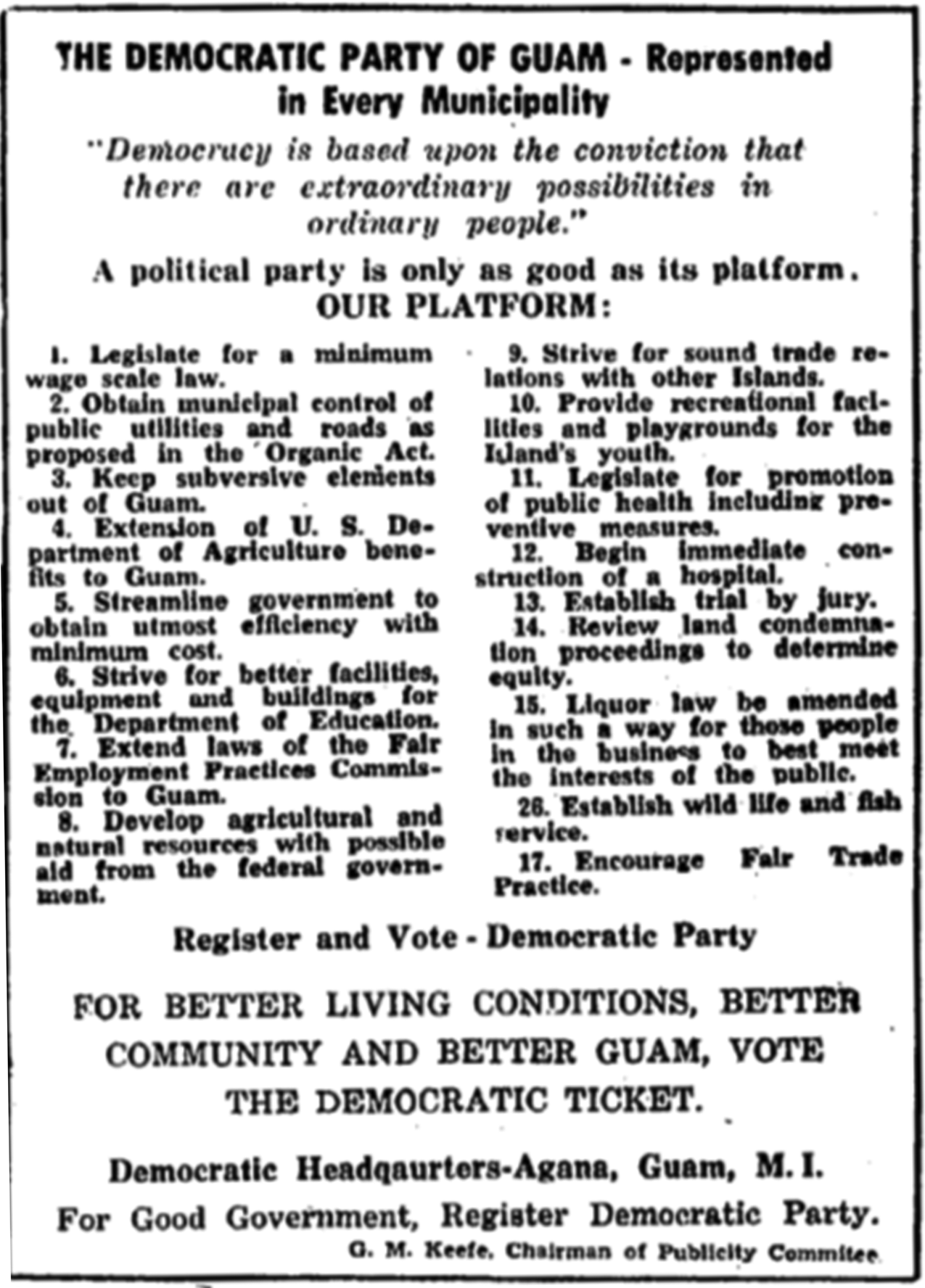
Although government reports repeatedly claimed that Guamanians did not want jury trials, the Democratic Party of Guam sent a different message. This locally run branch of the Democratic Party listed in its official 1950 platform the desire to “establish trial by jury” on the island. Although it did not specify why jury trials were advantageous for Guam, it immediately followed that demand with a call to “review land condemnation proceedings to determine equity” (Figure 1).Footnote 85
The platform of the Democratic Party of Guam, 1950. Point 13 called for the establishment of trial by jury. Source: Guam Daily News, June 14, 1950, 4.

The Guam Daily News, the largest and first locally owned newspaper on the island, also advocated jury trials. The newspaper was published by Joseph Flores, a Republican who would later become the first Chamoru governor of Guam. It repeated some of the hesitations that had historically been expressed about juries on Guam: “Are they qualified? Will the language barrier, in cases of some residents, automatically disqualify them from being appointed jurors? Remembering that family ties on Guam are closely knitted, that relationships extend to all parts of the island, will that imperil the impartial carriage of justice?” But ultimately, the newspaper came down firmly on the side of jury trials. “We say extend the jury system and let the local populace feel the duty of self-determination,” it concluded. “Let them enjoy and suffer the thrills and the pains of deciding their own fate. They can handle themselves.”Footnote 86 Jury trials were seen as a form of self-government, something that residents of Guam felt that they deserved in this post-Organic Act era.
Some Guamanians framed their lack of juries as a form of second-class citizenship and refused to accept having what they perceived as fewer rights than United States citizens on the mainland had. In a different editorial, the Guam Daily News called locals “second class citizens” for their lack of jury trials and stated that “this ridiculous situation stems from the fact that there is an ocean between Guam and the Golden Gate.”Footnote 87 Salvador Camacho, a high school student, echoed this sentiment in a speech at an oratorical contest sponsored by the Lions Club in February 1952. “Why should we be denied some of the rights which our fellow citizens are enjoying?” Camacho asked. “Are we not equally created? Or is there such a term as secondary citizenship?” He went on to list some of the rights that the people of Guam were missing. “The denial of the rights of indictment by a grand jury, and trial by jury are two excellent examples of denial of rights … to American citizens here in Guam.” Camacho went on to link the lack of jury trials to unfair land settlements.Footnote 88
Whether out of informed dissent or misunderstanding, assertions such as these challenged some of the Supreme Court's opinions in the Insular Cases. In Balzac v. Porto Rico, decided 5 years after the 1917 Jones Act granted United States citizenship to Puerto Ricans, the Supreme Court had unanimously agreed that citizenship did not automatically confer jury trial rights on the inhabitants of an unincorporated territory. Yet residents of Guam rejected that holding. The Guam Daily News framed juries as an inherent and inextricable part of being an American citizen: “The jury system is a living part of the American way of life. And primarily the local population are American citizens. When they were extended United States citizenship, they were supposed to have qualified for its role in the democratic setup. Otherwise they should not have been given it at all.”Footnote 89 Citizenship without jury trials, in other words, was not full citizenship.
Guam's appointed administrators did not welcome this opposition to the island's judicial status quo. Camacho's speech in favor of jury trials was considered disruptive, and excerpts from it eventually found their way into the United States Congressional Record as sentiments “detrimental to the government of Guam.” Randall S. Herman, the Secretary of Guam, reportedly threatened to censor the high school students’ graduation speeches after the Lions Club incident.Footnote 90 In May 1954, when Governor Elvidge was presented with the petition calling for trial by jury that was signed by more than 3,000 Guamanians, he refused to engage with the protesters.Footnote 91 Meanwhile in Washington, Adolph M. Edwards, the Interior Department's Assistant Solicitor for the Territories, made it clear that “constitutional guarantees” such as grand and petit juries “do not apply to Guam since it is an unincorporated territory.”Footnote 92
Not all locals favored a change to their judicial system. Some lawyers, who were accustomed to the judge-based courts, felt that the existing system was working fine. Prosecutors, in particular, feared that “Guamanian juries would not convict Guamanian defendants” because of kinship ties.Footnote 93 Attorney Joaquin C. Arriola, who also served in the Guam Legislature, stated that “I honestly and personally feel that we do not need to have the jury system here” because he believed that judges’ decisions were fair.Footnote 94 Notably, this opposition to jury trials was grounded in concern about the disruption that they might cause, not out of a desire for a more traditional or multicultural system of justice. Although Chamorus did call for more cultural preservation and local self-determination, there is no evidence of a movement to return to pre-Spanish judicial customs.
The lack of juries was also challenged in the courts. Guamanians had previously been unable to appeal cases beyond the island's governor, but the Organic Act allowed appeals to be made to the Court of Appeals for the Ninth Circuit in San Francisco, and from there to the Supreme Court of the United States.Footnote 95 In the first 5 years after the enactment of the Organic Act, at least five defendants from Guam protested their lack of grand or petit jury to the Ninth Circuit, and two cases were petitioned to the Supreme Court, although in both cases certiorari was denied.Footnote 96 Although these defendants were likely motivated by a desire to be released from prison rather than by political goals, locals followed their cases closely and realized the implications for Guamanians as a whole. Many of these defendants were represented by the same lawyer, Finton J. Phelan Jr., a prominent defense attorney operating out of the capital of Agana. Originally from Connecticut, Phelan would have been familiar with the workings of jury trials.Footnote 97 By the mid-1950s, there were also a few Chamoru lawyers practicing on Guam who had graduated from law schools on the mainland and would have been educated about juries.Footnote 98
In the District Court of Guam in 1951, George B. Hatchett was found guilty of the felony of involuntary manslaughter, as well as the misdemeanors of operating a vehicle under the influence of liquor and driving at excessive speed. In his appeal to the Ninth Circuit, Phelan argued that Hatchett's conviction was void, as he had been denied his Sixth Amendment right to trial by jury. Citing Balzac v. Porto Rico, the Ninth Circuit court ruled that the case “raised no constitutional question for the reason that Guam was declared an unincorporated territory of the United States. Therefore appellant's contentions based on the Sixth Amendment cannot be sustained.” The court pointed out that if Congress had required trial by jury, it would have stated so explicitly, as it had in the unincorporated territories of Puerto Rico and the United States Virgin Islands.Footnote 99
In his dissent, Chief Justice William Denman argued that there was no satisfactory reason to deny Guamanians trial by jury, as they were capable of producing good jurors:
Beginning in 1900 and continuing for the succeeding fifty-four years, save in the Japanese occupancy, they have been compelled by the military authorities to send their children to English-speaking schools from the age of 7 to 12. They are people, excepting the few aged, speaking in English and literate in English and taught in the schools the elements of American ideals… It is clear that if they are not now able to supply jurors for the jury system, they never will be.Footnote 100
When it came to indictment by a grand jury, however, the Ninth Circuit found a problem with the Organic Act. Although the Organic Act did not provide for indictment by a grand jury or trial by jury, it did state that Guam's courts would adopt the Federal Rules of Criminal Procedure, a set of procedural rules governing the federal courts of the United States. Section 7(a) of the Federal Rules stated that offenses punishable by imprisonment for more than 1 year must be “prosecuted and presented by indictment from [a] Grand Jury.”Footnote 101 This was a problem, because Guam lacked grand juries; all prosecutions were brought on the basis of an information, a written accusation of a crime that did not require a grand jury's vote. In both Hatchett v. Government of Guam, which involved the violation of the laws of Guam, and Pugh v. United States, which involved the violation of United States laws, the Ninth Circuit vacated convictions because the defendants had not been indicted by a grand jury.
Guam's Organic Act was flawed, and only the United States Congress could fix it. Congress realized that, unless it acted, the result would be “a wholesale jail delivery of Guamanian convicts.”Footnote 102 Its solution was the Saylor Bill, or Public Law 679, passed on August 27, 1954. This amended the Organic Act to read that Guam would follow the Federal Rules of Criminal Procedure “except that no provisions of any such rules which authorize or require trial by jury or the prosecution of offenses by indictment by a grand jury … shall be applicable to the District Court of Guam unless and until made so applicable by laws enacted by the Legislature of Guam.”Footnote 103 By allowing Guam's legislature to enact grand jury indictments and trial by jury, Congress was trying to pass off responsibility for a potential mass exodus of criminals from Guam's prisons. Yet, for the first time in 55 years, it was also granting the people of Guam the power to decide for themselves what type of judicial system they wanted.
Edward Putty, sentenced prior to the Saylor Act to 6 years for the theft of government property, put the new amendment to the test. In the case of Putty v. United States, his lawyers argued that the amendment to the Organic Act could not retroactively deny Putty's right to indictment by a grand jury. The Ninth Circuit Court of Appeals agreed: the Saylor Act was invalid as an ex post facto law. The court vacated Putty's conviction because, at the time of his crime, he had been entitled to indictment by a grand jury.Footnote 104 The Supreme Court declined to review the case.
The implications of the Putty ruling were far reaching, because none of the prisoners in Guam's jails had been indicted by a grand jury, nor had they waived their right to grand jury indictment. On the same day that Putty's conviction was set aside, Judge Paul D. Shriver of the District Court of Guam released five other prisoners for the same reason. Among them were Teodorico A. Penaso, Segundo L. Alcuela, and Andronico B. Bensurto, three Filipinos convicted of second-degree murder. Soon afterward, five more prisoners filed motions seeking release.Footnote 105 It was estimated that seventy felons had been given sentences of more than 1 year between the adoption of the Organic Act and the passage of the Saylor Act.Footnote 106 According to the Putty decision, all of these convictions were invalid.
Even though passing a jury bill would not solve the complications sparked by the Putty case, Guamanians were aware that these problems arose in the first place because they did not have grand and petit juries. In another editorial in the Guam Daily News, again calling for “the right to indictment and trial by jury—a right under the U.S. Constitution,” the author invoked Guamanians’ military service as a means for claiming rights. The editorial argued that the precedent that the Constitution did not follow the flag “no longer fits into the Americanism for which much blood has been shed, many lives have been sacrificed. In fact, it is an un-American concept.”Footnote 107 A few weeks later, the Guam Bar Association called an emergency meeting to discuss potential jury bills.Footnote 108
On July 6, 1955, at an hour before midnight, Guam's territorial legislature passed Public Law 42, a measure to implement trial by jury on the island. Specifically, jury trials would be guaranteed in felony criminal cases and in civil cases involving sums greater than $2,000. The final tally was fifteen in favor of the bill, zero opposed, and two abstentions.Footnote 109 The legislation did not mention grand juries, which the Saylor Act had also left to the discretion of the Guam Legislature. Shortly thereafter, Governor Elvidge signed Public Law 42 and it became effective on October 1.Footnote 110
In the debate over the bill, some legislators brought up doubts as to the feasibility and advisability of trial by jury. But they did not question the fitness of Guamanians to serve on juries. They did not challenge juries as foreign to their customs or defend the Spanish legal system. Instead, Joaquin C. Arriola, one of the congressmen who abstained from voting, simply feared that juries would be “time-consuming, cumbersome and expensive.” The other abstainer, Vicente B. Bamba, felt that district court judges were determining the market value of land fairly, and that therefore juries were not necessary.Footnote 111
The land condemnation cases were on the minds of the legislators who voted for Public Law 42.Footnote 112 Congressman Carlos P. Taitano, a member of the Judiciary Committee, reminded the Guam Legislature that the federal government “is against trial by jury in civil cases… However, don't forget that the land cases are civil cases and they are coming up this fall.” Congressman Eduardo Calvo was also motivated by the issue of land compensation. He was unmoved by District Judge Paul D. Shriver's promise to appoint an independent commission to determine the market value of the land. Instead, Calvo believed that only local juries could be trusted to make those calculations.Footnote 113
Those legislators in favor of jury trials also framed their support in the language of Americanism and rights. As newly minted United States citizens, they resented the idea that they had fewer privileges than stateside citizens. Taitano affirmed that the bill “should be enacted because this is an American community. It is customary to have jury trial in the court.” Congressman Antonio Duenas pointed out that Puerto Rico had long used juries, and that Guamanians deserved the same rights enjoyed by residents of other United States territories. Toward the end of the debate, Florencio Ramirez, who had stayed silent for most of the evening, stood up and declared that all the other matters discussed up to that point “are unimportant.” Rather, he asserted, “The only thing that is important is the RIGHT to trial by jury!”Footnote 114 The Guam Daily News published an editorial the next day celebrating the decision as a “historic step.”Footnote 115
On February 20, 1956, twelve jurors were sworn in for the first time on Guam. There were eight men and four women, a majority of them of Chamoru descent. Only one, a woman who had previously lived stateside, had ever served on a jury before. The Guam Daily News characterized it as “a novel experience and their first taste of a new responsibility of American citizens here under our judicial system.”Footnote 116 The defendants were John L. Hilton and Richard C. Harris, accused of burglarizing a café the previous October. Their lawyer was Finton J. Phelan Jr., the defense attorney who had argued for jury trials before the Ninth Circuit. After the jurors deliberated for an hour and a half, they handed down a verdict of not guilty.Footnote 117
The next month, the first Chamoru defendants to be tried by a jury were found guilty of theft of government property and sentenced to 4 years’ imprisonment.Footnote 118 The convictions of Jose Cruz Borja, Felix S. Cruz, Manuel C. Cruz, and Francisco C. Cruz were significant because some attorneys had believed that local juries would not convict Chamoru defendants. According to District Court Judge Paul D. Shriver, this case convinced some skeptics that juries on Guam would work.Footnote 119
The first civil suit to be heard by a jury began on March 19, 1956. It was a land condemnation case—the very issue that had inspired many Guamanians to push for jury trials. The land, taken by the government in 1948, was in a prime location along the Paseo de Susana in the capital of Agana. The naval appraisers valued the land in question at $4.00 per square meter, whereas the original landowners wanted between $10.00 and $15.00. Phelan, along with attorneys Joaquin C. Arriola and Vicente C. Reyes, represented the former landowners. Their argument hinged on two points: that the navy's assessment of the “free market value” of the land in 1948 was inaccurate, because the naval government had manipulated the market and restricted land transfers, and that the business potential of the land should considered when determining its value. On the stand, naval appraisers admitted that they had arrived at their figures using samples of sales from as far back as 1936. After a 2 day trial, the jury decided on compensation at a rate of $7.00 per square meter.Footnote 120 The Guam Daily News described the jury's decision as “an acceptable compromise” that “indicated what might be forthcoming in other cases.”Footnote 121
Residents of Guam perceived the juries as giving fairer restitution. One Guamanian later recalled that the monetary compensation for condemned land “jumped by multiples of 20 or so of that sort the minute there were juries.”Footnote 122 Arriola's memory of the jury awards was a bit more conservative. “When the jury system came up, that's when ‘just compensation’ increased,” he remembered, “not much, but at least a little bit more decent.”Footnote 123 In March 1957, a jury heard another land condemnation case, this time for eight tracts of land in Julale and Anigua that had been condemned by the federal government in 1947 and 1950. The government offered between $0.50 and $3.00 per square meter; the jury placed the fair market value at $3.50–$5.50.Footnote 124 Two months later, in the municipality of Piti, another jury valued a property at $90.00 per hectare; the government had offered $40.00, whereas the original landowners asked for $100.00.Footnote 125
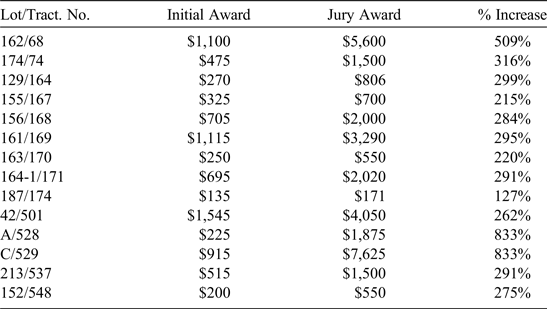
Guamanians used jury trials as a way to express their disapproval of one of the most controversial aspects of naval rule in the postwar years. The official numbers bore out the popular perception that juries awarded substantially more money in land condemnation cases than naval judges had in the past. At a jury trial on February 18, 1958, jurors assessed suburban plots in the villages of Piti and Sumay. In every case, they granted more money than the earlier government award. Most awards were roughly two-and-a-half times those of judges; in some cases, jury awards went up by more than 800%. The average increase was 361% (Table 1).Footnote 126
Jury trial awards for land compensation in the villages of Piti and Sumay, Civil Case No. 5-49, February 18, 1958. The initial awards had been determined by judges alone. Source: John A. Bohn Papers, MSS 730, Box 30, Folder 8, Richard Flores Taitano Micronesian Area Research Center, University of Guam.

***
Movements for independence in the Philippines and Puerto Rico may have been the most visible types of opposition to United States colonial rule, but Guamanian calls for juries were also a form of subversion. When residents of Guam demanded jury trials, they were resisting injustices suffered under naval rule and rejecting the legacy of the Insular Cases, which had guided colonial administration over the territories since 1901. Whether guided by principles of equality, monetary incentives, or some combination of the two, Guamanians refused to accept that they merited different rights and protections than United States citizens living in the states.
Jury trials quickly took root on Guam. From 1956 onward, local newspapers published stories about ongoing jury trials on a weekly basis. In 1969, the Guam Legislature introduced grand juries in felony cases.Footnote 127 By 1975, the attorney general of Guam referred to indictment by a grand jury and trial by jury as a “rights [that] are cherished by all Guamanians.”Footnote 128
Residents of Guam today still cannot vote for president, and their representative in Congress has no voting power. But in many other respects, they now share the same rights as stateside Americans, with one difference. Most Americans’ rights are protected by the Constitution, but on Guam they are not. The federal government retains ultimate sovereignty there, and therefore many rights are not secure. Congress has granted residents of Guam everything from their legislature to their citizenship, and it also has the power to take these things away. All laws passed by the Guam Legislature, including Public Law 42, can be invalidated by Congress—a Congress in which Guam has no vote. Jury trials may now be a right on Guam, but they are not an inalienable one.