Introduction
Freshwater snails of the Lymnaeidae family are known to be intermediate hosts for many digenean species. According to Brown (Reference Brown, Fretter and Peake1978) and Mas-Coma et al. (Reference Mas-Coma, Bargues and Valero2005), members within this family can sustain larval development of more than 70 different trematodes. As epidemiological studies made on these parasites need the accurate identification of the snail host, several methods using shell morphology and/or the anatomy of the reproductive system have been proposed over the years to classify these lymnaeids (Hubendick, Reference Hubendick1951; Burch, Reference Burch1982).
Shell characters have been used extensively, and very often exclusively, to build the systematics of molluscs. Marine shells are diversified and present a very large set of morphological characters, i.e. protoconch structure, teleoconch ornamentation, radula morphology, etc., that have proved useful in malacological taxonomy. In freshwater pulmonates these shell characters are, for the most part, absent and only shell shape has been used to describe new taxa in the 19th and 20th centuries, and even sometimes in most recent years. As a result of using the shell as diagnostic species character, a plethora of names may be found in the literature on freshwater pulmonates, many probably being synonyms. The case of the Lymnaeidae family is typical with about 1200 described species and several dozens of genera (Hubendick, Reference Hubendick1951; Burch, Reference Burch1982), whereas recent studies have suggested that the family contains approximately 100 species (Strong et al., Reference Strong, Gargominy, Ponder and Bouchet2008; Jarne et al., Reference Jarne, David, Pointier, Koene, Cordoba-Aguilar and Leonard2010).
The classification systems based on morphological characters of shell shape have rapidly generated a controversy because lymnaeids exhibited a great diversity in shell morphology linked to substantial eco-phenotypic plasticity (Samadi et al., Reference Samadi, Roumégoux, Bargues, Mas-Coma and Pointier2000; Hurtrez-Boussès et al., Reference Hurtrez-Boussès, Pendion, Bernabé, Durand, Rondelaud, Durand, Meunier, Hurtrez and Renaud2005; Schniebs et al., Reference Schniebs, Glöer, Vinarski and Hundsdoerfer2011). It is accepted that anatomical characteristics of the snail's reproductive system are more homogeneous (Pointier et al., Reference Pointier, Noya, Alarcón de Noya and Théron2009; Correa et al., Reference Correa, Escobar, Noya, Velásquez, González-Ramírez, Hurtrez-Boussès and Pointier2011), but only DNA-based analyses, i.e. phylogeny and barcoding, developed from the 2000s, could effectively solve this taxonomic problem. As these latter analyses allowed individuals to be ascribed to one species or another, several new species such as Lymnaea neotropica (Bargues et al., Reference Bargues, Artigas, Mera y Sierra, Pointier and Mas-Coma2007), Galba sp. (Correa et al., Reference Correa, Escobar, Durand, Renaud, David, Jarne, Pointier and Hurtrez-Bousse`s2010, Reference Correa, Escobar, Noya, Velásquez, González-Ramírez, Hurtrez-Boussès and Pointier2011) or Lymnaea schirazensis (Bargues et al., Reference Bargues, Artigas, Khoubbane, Flores, Glöer, Rojas-Garcia, Ashrafi, Falkner and Mas-Coma2011) have been recognized and/or described.
The conchological characteristics of Galba sp. correspond to those of several dozens of taxa reported in North America, presumably the geographic origin of this small-shelled species clade (see Hubendick, Reference Hubendick1951; Burch, Reference Burch1982; Correa et al., Reference Correa, Escobar, Durand, Renaud, David, Jarne, Pointier and Hurtrez-Bousse`s2010; Johnson et al., Reference Johnson, Bogan, Brown, Burkhead, Cordeiro, Garner, Hartfield, Lepitzki, Mackie, Pip, Tarpley, Tiemann, Whelan and Strong2013). This snail was arbitrarily identified by Bargues et al. (Reference Bargues, Artigas, Khoubbane, Flores, Glöer, Rojas-Garcia, Ashrafi, Falkner and Mas-Coma2011) as L. schirazensis, a species originally described from Shiraz by Küster in 1862. However, the original description of L. schirazensis is only based on conchological characters, i.e. three lines in Latin and 16 lines in German (see von den Busch in Küster, Reference Küster, Martini and Chemnitz1862), that have proved inadequate to ascribe any sampled lymnaeid to a given species (Samadi et al., Reference Samadi, Roumégoux, Bargues, Mas-Coma and Pointier2000; Correa et al., Reference Correa, Escobar, Noya, Velásquez, González-Ramírez, Hurtrez-Boussès and Pointier2011). Galba sp. was reported also by Correa et al. (Reference Correa, Escobar, Durand, Renaud, David, Jarne, Pointier and Hurtrez-Bousse`s2010, Reference Correa, Escobar, Noya, Velásquez, González-Ramírez, Hurtrez-Boussès and Pointier2011) as sufficiently divergent from other Galba species to be considered as a different species. Malacological surveys and subsequent molecular characterization revealed the occurrence of this taxon in the Dominican Republic, Ecuador, Egypt, Iran, Mexico and Peru (as Lymnaea schirazensis: Bargues et al., Reference Bargues, Artigas, Khoubbane, Flores, Glöer, Rojas-Garcia, Ashrafi, Falkner and Mas-Coma2011) as well as in La Reunion Island, Spain and Venezuela (as Galba sp.: Correa et al., Reference Correa, Escobar, Noya, Velásquez, González-Ramírez, Hurtrez-Boussès and Pointier2011). These two studies (Bargues et al., Reference Bargues, Artigas, Khoubbane, Flores, Glöer, Rojas-Garcia, Ashrafi, Falkner and Mas-Coma2011 and Correa et al., Reference Correa, Escobar, Noya, Velásquez, González-Ramírez, Hurtrez-Boussès and Pointier2011) clearly demonstrated that this taxon is an overlooked highly invasive species.
The snail Galba sp. apparently has a worldwide distribution (Correa et al., Reference Correa, Escobar, Durand, Renaud, David, Jarne, Pointier and Hurtrez-Bousse`s2010, Reference Correa, Escobar, Noya, Velásquez, González-Ramírez, Hurtrez-Boussès and Pointier2011; Bargues et al., Reference Bargues, Artigas, Khoubbane, Flores, Glöer, Rojas-Garcia, Ashrafi, Falkner and Mas-Coma2011), which raises the question of whether this snail is able to sustain larval development of different digeneans. Among them, the liver fluke, Fasciola hepatica, is the most well known (Torgerson & Claxton, Reference Torgerson, Claxton and Dalton1999; Hurtrez-Boussès et al., Reference Hurtrez-Boussès, Meunier, Durand and Renaud2001) and some recent papers have mentioned natural or experimental infection of South American lymnaeids with this parasite (Pointier et al., Reference Pointier, Cazzaniga, González-Salas, Gutiérrez, Arenas, Bargues and Mas-Coma2006, Reference Pointier, Noya, Alarcón de Noya and Théron2009; Bargues et al., Reference Bargues, Artigas, Mera y Sierra, Pointier and Mas-Coma2007, Reference Bargues, Artigas, Khoubbane, Ortiz, Naquira and Mas-Coma2012a, Reference Bargues, Mera y Sierra, Artigas and Mas-Comab; Mera y Sierra et al., Reference Mera y Sierra, Artigas, Cuervo, Deis, Sidoti, Mas-Coma and Bargues2009). Even if the presence of another digenean, Fascioloides magna, has not yet been reported in South America, a recent paper (Sanabria et al., Reference Sanabria, Mouzet, Pankrác, Djuikwo Teukeng, Courtioux, Novobilský, Höglund, Kašný, Vignoles, Dreyfuss, Rondelaud and Romero2013) reported successful experimental infections of L. neotropica and Lymnaea viatrix var. ventricosa with this parasite. In view of the above results, the following two questions arose: might a Colombian population of Galba sp. sustain complete larval development of F. hepatica with cercarial shedding? Was this population also a potential intermediate host for F. magna? To answer these questions, five successive generations of this snail were experimentally infected with F. hepatica or F. magna to determine whether this species is a potential intermediate host for these digeneans.
Materials and methods
Collection of snails and fluke eggs
The population of Galba sp. was collected from a farm at Finca el Ayer (6°28′9″ N, 75°22′27″ W) at altitude of 2248 m near Medellin, Department of Antioquia, Colombia. The population was identified as Galba sp. via the study of rDNA (18S, internal transcribed spacer (ITS)-1, ITS-2) and mtDNA cox1 because the sequences obtained were similar to those deposited in GenBank by Bargues et al. (Reference Bargues, Artigas, Khoubbane, Flores, Glöer, Rojas-Garcia, Ashrafi, Falkner and Mas-Coma2011) and Correa et al. (Reference Correa, Escobar, Noya, Velásquez, González-Ramírez, Hurtrez-Boussès and Pointier2011). A total of 28 adult snails were collected from this farm in May 2012 and were raised in 14-cm Petri dishes at 20°C under laboratory conditions according to Rondelaud et al. (Reference Rondelaud, Fousi, Vignoles, Moncef and Dreyfuss2007). Egg masses laid by these parent snails were collected and placed into other 14-cm Petri dishes containing oxygenated spring water and finely powdered lettuce as food for newly hatched individuals. Those that attained a shell height of 4 mm were considered as the F1 generation and were used for experiments. The protocol was similar for the F2, F3, F4 and F5 snail generations (see below). A total of 700 snails, measuring 4 ± 0.1 mm in height and belonging to the F1, F2, F3, F4 and F5 generations were used for experiments (see tables 1 and 2). To compare the characteristics of F. magna infection in Galba sp. with those found in a common intermediate host of this parasite, a wild population of Galba truncatula was selected. These snails colonized a road ditch at Chézeau Chrétien (46°40′27″ N, 1°21′21″ E), commune of Chitray, Department of Indre, central France. One hundred snails (shell height, 4 mm), belonging to the overwintering generation, were collected from this population and acclimatized for 24 h to laboratory temperature before being directly exposed to F. magna miracidia (see table 2).
Characteristics of infections in several generations of Galba sp. exposed to Fasciola hepatica and Fascioloides magna on day 50 (first experiment); 50 snails of each generation were exposed on day 1, except for 100 F2 and 150 F3 snails infected with F. hepatica.
Eggs of F. hepatica came from the gall bladders of naturally infected cattle at the slaughterhouse of Limoges, Department of Haute Vienne, central France. Those of F. magna were collected from adult flukes recovered from the livers of naturally infected red deer (Cervus elaphus) hunted near the Mirošov village, Central Bohemia, Czech Republic. These egg isolates were washed several times with spring water and were incubated for 20 days at 20°C in the dark (Ollerenshaw, Reference Ollerenshaw1971).
Experiment 1: Galba sp. as a potential host for Fasciola hepatica and Fascioloides magna
The susceptibility of Galba sp. to F. hepatica or F. magna miracidia was studied in five successive snail generations via an experimental protocol already used by Sanabria et al. (Reference Sanabria, Mouzet, Courtioux, Vignoles, Rondelaud, Dreyfuss, Cabaret and Romero2012) for F. hepatica and Vignoles et al. (Reference Vignoles, Novobilský, Höglund, Kašný, Pankrác, Dreyfuss, Pointier and Rondelaud2014) for F. magna. F2 snails originated from eggs laid by parasite-exposed individuals of the F1 generation between weeks 2 and 5 post-exposure. A similar protocol was used for the F3, F4 and F5 generations. This protocol was chosen in order that these descendants have a first (F2) or multiple contacts (F3, F4 or F5 generations) with the parasite through their parents.
The aim of the first experiment was to determine the aptitude of Galba sp. as a snail host for F. hepatica or F. magna. Five groups of Galba sp., with a variable number of snails per group, were constituted for infections with F. hepatica (table 1). In addition, four other groups of 50 snails each were constituted for the F1, F2, F3 or F4 generations of Galba sp. and were exposed to F. magna miracidia (table 1). Each snail was subjected to two miracidia of F. hepatica or a single miracidium of F. magna for 4 h at 20°C in 3.5 ml spring water. The choice of this sequence in the number of miracidia per snail was based on our experience in the production of trematode infective stages (Vignoles et al., Reference Vignoles, Novobilský, Rondelaud, Bellet, Treuil, Koudela and Dreyfuss2006; Rondelaud et al., Reference Rondelaud, Mouzet, Vignoles, Dreyfuss and Cabaret2014a). Snails were then raised for 50 days in groups of ten individuals in 14-cm Petri dishes with 60 ml spring water per dish, according to the method of Rondelaud et al. (Reference Rondelaud, Fousi, Vignoles, Moncef and Dreyfuss2007). Snail food consisted of dried leaves of pesticide-free lettuce and dead Molinia caerulea leaves, while stems of live Fontinalis sp. ensured oxygenation of the water layer. Dissolved calcium in spring water was 35 mg/l. Petri dishes were placed in an air-conditioned room under the following conditions: a temperature of 20°C, natural photoperiod of 10 h light. On day 50 post-exposure, surviving snails were dissected under a stereomicroscope to detect the presence of larval forms of F. hepatica or F. magna within their bodies and to determine the most developed stage: immature rediae, cercariae-containing rediae or free cercariae. Infected snails were counted, taking into account snail generation and each developmental stage of larval development.
Experiment 2: comparison of Fascioloides magna infection in Galba sp. and G. truncatula
As numerous free cercariae exceeding 20 per snail were only noted in the F3 and F4 generations of F. magna-infected Galba sp. (table 1), a second experiment was carried out to determine the characteristics of these F. magna infections in snails belonging to the F5 generation and compare them with those that occurred in G. truncatula. One hundred Galba sp. and 100 G. truncatula were used (see table 2). Snail exposure to miracidia and maintenance during the first 30 days were similar to those in the first experiment. On day 30, each surviving snail was isolated in a 35-mm Petri dish with pieces of dead grass, lettuce and spring moss, and placed at 20°C. Spring water and food were changed, if necessary, every day until snail death. When the first cercarial shedding occurred, surviving snails were subjected to a thermal shock every 3 days, by placing their Petri dishes at 10–13°C for 3 h, to stimulate cercarial exit (Sanabria et al., Reference Sanabria, Mouzet, Courtioux, Vignoles, Rondelaud, Dreyfuss, Cabaret and Romero2012). After their emergence, cercariae were counted and removed from Petri dishes. At the death of each infected snail, its shell was measured using callipers. Cadavers of non-shedding snails were routinely dissected under a stereomicroscope to count free rediae and free cercariae.
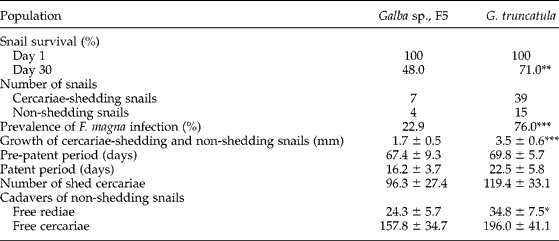
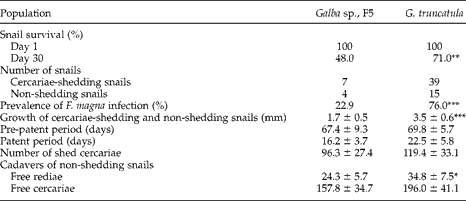
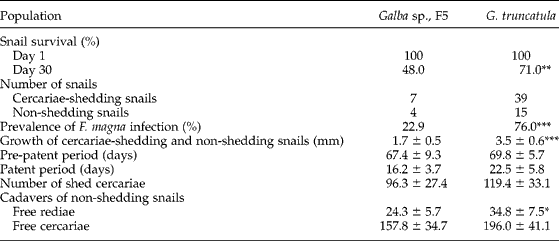
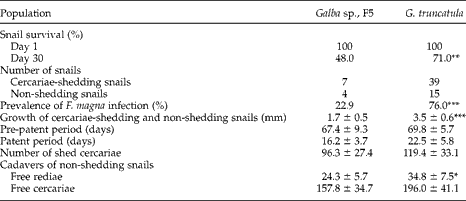
Characteristics of Fascioloides magna infection in the F5 generation of Galba sp. and in Galba truncatula subjected to single-miracidium infections and reared at 20°C (second experiment). Mean values±standard deviations are given for six parameters and levels of significance include *P<0.05, **P<0.01, ***P<0.001.
Data analysis
The first two parameters were snail survival on day 30 post-exposure and the prevalence of F. hepatica or F. magna infection calculated in relation to the number of snails surviving on day 30. In the first experiment, prevalence took into account the numbers of snails with immature rediae only, cercariae-containing rediae or with free cercariae. In the second experiment, cercariae-shedding and non-shedding snails were used for prevalence calculation. For each parameter, the differences were analysed using a χ2 test. In the second experiment, shell growth of infected snails during the experiment, the length of pre-patent and patent periods, and the total number of shed cercariae were also calculated. Free rediae and free cercariae counted in the cadavers of non-shedding snails were also considered. Individual values recorded for these last six measurements were averaged and their standard deviations were established for each snail group. One-way analysis of variance (ANOVA) was used to establish levels of statistical significance. The different analyses were performed using Statview 5.0 software (SAS Institute Inc., Cary, North Carolina, USA).
Results
Experiment 1: Galba sp. as a potential host for Fasciola hepatica and Fascioloides magna
Survival rates of F. hepatica-exposed Galba sp. on day 30 post-exposure ranged from 18.6 to 34.0% although no significant difference between these rates was found (table 1). Low prevalences of < 16% were noted in the F2–F5 generations of snails, without significant difference. However, larval development of F. hepatica was not complete in these snails because two individuals only harboured immature rediae; three, several rediae containing a few differentiating cercariae; and two others a few rediae and several free cercariae within their bodies. The number of free rediae ranged from three to six, while the numbers of free cercariae in the two snails of the F2 and F3 generations were 7 and 14, respectively (data not shown). In Galba sp. exposed to F. magna, the survival rate on day 30 was not significantly different from the F1 to F4 generations (table 1). A similar finding was also noted for prevalence of F. magna infection through each snail generation. In spite of this, the intensity of snail infection increased with increasing snail generation, ranging from two snails harbouring immature rediae in the F1, to nine infected snails in the F4 generation. In this last generation, 5 of 9 individuals contained free cercariae.
Experiment 2: comparison of Fascioloides magna infection in Galba sp. and G. truncatula
Survival of Galba sp. on day 30 post-exposure was significantly lower than for G. truncatula (table 2). Similar findings were also noted for prevalence of F. magna infection and shell growth of infected snails during the experiment. Comparison of the pre-patent periods, patent periods or the numbers of shed cercariae for both snail species revealed no significant differences. Spontaneous cercarial shedding occurred in 4 of 7 Galba sp., with 1, 2 or 3 shedding waves for 1, 2 and 4 snails, respectively (data not shown). In G. truncatula, cercarial shedding always occurred after a thermal shock and 1, 2, 3 or 4 shedding waves were noted for 9, 7, 9 and 14 snails, respectively (data not shown). In non-shedding Galba sp., the number of free rediae was significantly lower than that noted in non-shedding G. truncatula, while the numbers of free cercariae did not differ significantly.
Discussion
Low survival rates on day 30 post-exposure were noted in the ten groups of Galba sp., whatever the digenean species (tables 1 and 2). These findings may be explained mainly by the negative effect of the parasite species on the life span of the snail. However, another hypothesis, based on inadequate conditions for Galba sp. breeding in the laboratory, cannot be completely excluded. In the field, Galba sp. seems to be a more amphibious snail than G. truncatula because adult individuals of Galba sp. were often observed on the emerged soil up to a 1-m distance from the waterside.
In spite of five successive generations of Galba sp. exposed to F. hepatica miracidia, only a few snails contained several rediae with/without free cercariae in their bodies on day 50 post-exposure. This finding cannot be explained by a low infectivity of French F. hepatica miracidia used in the present study because these larvae, originating mainly from local triclabendazole-treated cattle, have shown strong infectivity since the 2000s (Dreyfuss et al., Reference Dreyfuss, Vignoles and Rondelaud2007) and experimental infections of local G. truncatula resulted in 72.1% prevalence, with 44 cercariae-shedding snails out of 61 individuals surviving on day 30 and a mean production of 222.1 shed cercariae (Sanabria et al., Reference Sanabria, Mouzet, Courtioux, Vignoles, Rondelaud, Dreyfuss, Cabaret and Romero2012). Nor can it be explained by a low development of parasite larval forms over time, because a few free cercariae were noted in the body of two dissected Galba sp. on day 50. Under these conditions, it is necessary to admit a problem of compatibility between Galba sp. and the French isolate of F. hepatica. This finding was surprising because our snails originated from the Department of Antioquia (Colombia) and this district was known to be an at-risk district for human and animal fasciolosis (Mas-Coma et al., Reference Mas-Coma, Valero and Bargues2009; Correa et al., Reference Correa, Escobar, Noya, Velásquez, González-Ramírez, Hurtrez-Boussès and Pointier2011; Valencia-López et al., Reference Valencia-López, Malone, Gómez Carmona and Velásquez2012). However, Galba sp. was not completely refractory to the parasite, because of the development of F. hepatica larval forms in several experimental snails (table 1). A similar result was obtained for L. schirazensis using an isolate of F. hepatica from Poland and a snail strain from Spain (Bargues et al., Reference Bargues, Artigas, Khoubbane, Flores, Glöer, Rojas-Garcia, Ashrafi, Falkner and Mas-Coma2011).
To explain the problem of compatibility between Galba sp. and the parasite, three hypotheses may be proposed. First, the compatibility between Galba sp. and F. hepatica might need a strong selection process among numerous successive generations of snails, as suggested for several lymnaeid species by Boray (Reference Boray1969) in his review on fasciolosis. Secondly, a snail co-infection with F. hepatica and another digenean, such as a paramphistomid, might be necessary to induce and favour larval development of F. hepatica, as demonstrated by Southgate et al. (Reference Southgate, Brown, Warlow, Knowles and Jones1989) in the model Bulinus tropicus–Schistosoma bovis and Abrous et al. (Reference Abrous, Rondelaud, Dreyfuss and Cabaret1998, Reference Abrous, Rondelaud, Dreyfuss and Cabaret1999) in the model Omphiscola glabra–F. hepatica. Thirdly, variation in compatibility between strains of snails and geographic isolates of parasites may occur. Such a strong variation has already been shown in Cuba using different combinations of F. hepatica geographic isolates and populations of Galba cubensis and Pseudosuccinea columella from different localities (Vázquez et al., Reference Vázquez, Sánchez, Pointier, Théron and Hurtrez-Boussès2014). In the latter study, infection rates of G. cubensis may vary from 0 to 100% for the Sagua and Arroz isolates of F. hepatica, respectively.
After five generations with selection of infected snails, we obtained complete larval development of F. magna under experimental conditions, even if the infection of these five successive snail generations was necessary to have a progressive increase in the intensity of F. magna infection. This finding suggests a progressive and rapid adaptation of this snail population to the parasite through several successive snail generations. The present results do not indicate any factor in favour of a particular susceptibility of Central and South American Galba species to F. magna. In our opinion, this successful infection of the Colombian Galba sp. would only result from the sole infectivity of the miracidium. An argument supporting this hypothesis is the wide range of intermediate hosts reported in North America (Dunkel et al., Reference Dunkel, Rognlie, Johnson and Knapp1996) and Europe (Huňová et al., Reference Huňová, Kašný, Hampl, Leontovyč, Kuběna, Mikeš and Horák2012; Novobilský et al., Reference Novobilský, Kašný, Pankrác, Rondelaud, Engström and Höglund2012; Rondelaud et al., Reference Rondelaud, Novobilský, Höglund, Kašný, Pankrác, Vignoles and Dreyfuss2014b) for this digenean.
Results for the F5 generation of Galba sp. and F. magna are inconclusive. Even if snail survival on day 30 and prevalence of F. magna infection were significantly lower than those noted for G. truncatula, the pre-patent period and the number of shed cercariae did not differ significantly between Galba sp. and G. truncatula, whereas the shell growth of Galba sp. during the experiment was lower: 1.7 mm compared to 3.5 mm for G. truncatula (table 2). Moreover, spontaneous cercarial shedding of F. magna occurred in 4 of 7 snails, whereas this process was scarce for G. truncatula under laboratory conditions without thermal shock (Erhardová-Kotrlá, Reference Erhardová-Kotrlá1971; Vignoles et al., Reference Vignoles, Novobilský, Rondelaud, Bellet, Treuil, Koudela and Dreyfuss2006). In spite of differences in snail survival and prevalence of infection, Galba sp. seems to be a suitable intermediate host like G. truncatula. No reliable explanation of the performance of this Colombian population of Galba sp. in larval development of F. magna can be given at the present time, and additional studies are still necessary to verify if other populations of this taxon can also sustain complete larval development of this digenean with the same performance.
In conclusion, Galba sp. can be added to the list of potential intermediate hosts of F. magna, as this species was experimentally infected. Although the susceptibility of this species of snail to infection with French miracidia of F. hepatica was very low, we noted that it was not totally refractory. Additional studies on other populations of Galba sp. are still necessary to determine if the low susceptibility to French F. hepatica and the good aptitude for larval development of F. magna only concern the Colombian population used in the present study, or if they can be generalized to other haplotypes of this species living in the Old and New Worlds (Correa et al., Reference Correa, Escobar, Noya, Velásquez, González-Ramírez, Hurtrez-Boussès and Pointier2011).
Financial support
This study was supported by the Charles University in Prague (UNCE 204017, PRVOUK P41and SVV 267210/2013) and Masaryk University Brno (MUNI/A/0888/2013 and CZ.1.07/2.4.00/31.01.55).
Conflict of interest
None.