The ski that is the subject of this note was found embedded in the sandy outwash of the moraine at Mys Triest [Cape Trieste], Ostrov Champa [Champ Island] in Zemlya Frantsa-Iosifa [Franz Josef Land] moraine in August 2006. A preliminary examination on the spot indicated that it was probably more than a century old. These factors suggested that it could have been lost or left behind during either of the turn of the century American expeditions to Franz Josef Land: the 1901–1902 Ziegler expedition led by Evelyn Briggs Baldwin (Baldwin-Ziegler expedition), or the 1903–1905 Ziegler expedition led by Anthony Fiala (Fiala-Ziegler expedition) both of which were active in the area. A search of Baldwin's papers at the Library of Congress adds weight to this possibility, suggesting that the ski could have belonged to expedition artist and surveyor Russell W. Porter, who participated in both expeditions and who, in 1906, drew the first comprehensive chart of the islands.
The ski, otherwise unremarkable for its age or single toe strap construction, was found on 10 August 2006, by Magnus Forsberg, at Mys Triest on the southeastern corner of Ostrov Champa (Fig. 1). The cape lies less than 8 km (5 miles) miles from the Krenkel research station built on Ostrov Kheysa (Hayes Island) in 1957. This wide plain consists of an area of grey sandy outwash cut with deep gullies created by glacial meltwater.
Chart of the central islands of Zemlya Frantsa-Iosifa, showing that Fiala's 1904 march to Ostrov Rudol'fa Island passed Mys Triest on the southeast corner of Ostrov Champa (from Fiala Reference Fiala1906).

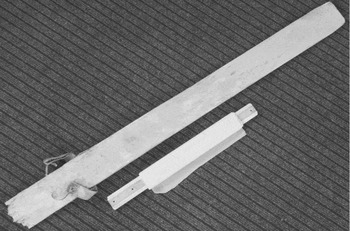
The ski is a fragment 1.09 m (3 ft 7in) long, being broken at the forward end. It is 9.53 cm (3.75 in) wide, and has a 2.22 cm (0.88 in) thick footpad beginning 60.96 cm (2 ft) from the rear edge of the ski. Cut into the sides of this footpad is a notch that is 30.5 cm (1 ft) long and 1 cm (0.4 in) wide. There is a similar notch, 1.27 cm (0.5 in) wide, cut in the middle along the length of the entire underside of the ski. There is a simple binding that consists of a double layer of 3.18 cm (1.25 in) wide leather, passed through the ski itself, with a thong strap to tie the two halves of the binding together.
Photographs (Figs. 2, 3) were sent to the Ski Museum in Oslo for inspection and the conclusion reached was that the ski is probably Norwegian dating from around 1900 or slightly later (S. Barr, personal communication, 2 October 2006). It appears to be of a type originating from northern Norway. The broadest point is at the front and it gradually narrows towards the back. It has well-preserved leather straps (and no trace of a heel strap) and has a notch or groove running the length of the underside. The wood is possibly birch.
The ski with ruler for indicating the scale.

The ski; detail of the binding.

Comparison of the routes of Julius Payer (Payer Reference Payer1876) (whose expedition named the cape at which the ski was found but who does not seem to have visited it); of Walter Wellman (Wellman Reference Wellman1899) (who never went to Champ Island); and the Duke of the Abruzzi (Savoia Reference Porter1903) (who did not operate in this part of the archipelago); leaves only the expeditions of Baldwin and Fiala as possible candidates for the ski's provenance, assuming that the age of the ski is approximately correct. As was the case in the previous expeditions, Baldwin and Fiala were both intent on reaching the North Pole, Baldwin with a largely Swedish team and Fiala with an all American team save for three Norwegians. Both expeditions visited Mys Triest, Fiala perhaps twice and Baldwin on several occasions.
In late summer, 1901, Baldwin considered Mys Triest for his base camp before settling on a site on the south shore of nearby Ostrov Aldzhera [Alger Island]. In the spring of 1902, Baldwin's teams spread ‘eighteen or nineteen’ depots between Ostrov Aldzhera and Ostrov Rudol'fa [Rudolf Island], of which three were more important than the others. These were at Ostrov Grili [Greely Island], Ostrov Koburg [Coburg Island] and Ostrov Rudol'fa [Rudolf Island] (Baldwin Reference Baldwin1903: 436). This area was visited several times by nearly 30 men, 160 dogs and more than 12 ponies. These parties included twenty Scandinavians (seventeen Swedes, two Norwegians and a Dane).
The tonnage of supplies transported and the number of times these parties would have shifted between Ostrov Aldzhera and Ostrov Rudol'fa would make it more likely that the ski is from the Baldwin-Ziegler expedition and not from the Fiala-Ziegler expedition, which did not visit the site so frequently. Yet, while it is almost certain that Baldwin's parties would have passed Cape Trieste even if they had not camped there, it is only Fiala who writes specifically that he passed a night in the locality.
Fiala (Reference Fiala1906: opposite 124) presented a map showing the route of his ‘march north, Sept. 19-Nov. 20, 1904’ from Mys Flora (Cape Flora) to Ostrov Rudol'fa. The route of this march passes directly through Mys Triest. Fiala (Reference Fiala1906: 144) only spent one night at the cape, on 5 November 1904. All six men in the party were Americans and no mention is made of the use of or loss of any ski.
Of the participants in both expeditions, perhaps only three were likely to have possessed extensive experience with ski. Of the Scandinavians on Baldwin's expedition, the boatswain John Jacobson of Tromsø would almost certainly have been one, as would the Swede Johan Menander, who was described as having been ‘with Swedish Polar Expeditions in 1898–1899’ (Baldwin n.d. [1901]: 12). The third person, and only American, would have been the artist Russell Porter.
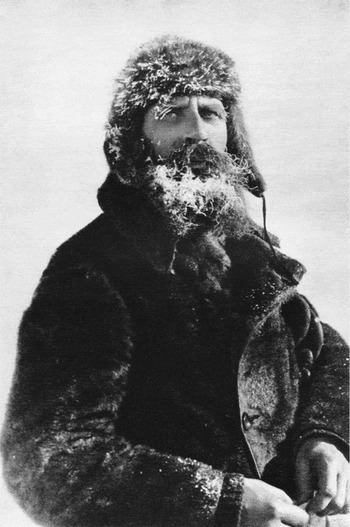
Besides their inefficient leadership, the other constant in both the Baldwin and Fiala expeditions was the presence of artist and surveyor Russell William Porter. Born in Springfield, Vermont, in 1871, Porter was a charter member of the Arctic Club and, according to a short biography he provided to Baldwin prior to his expedition, had ‘done considerable art work on four voyages to the Arctic’ (Baldwin n.d. [3qb;1901]: 4–5). These were brief visits to Greenland and Baffin Island in the 1890s as an artist with both Frederick Cook and with Robert Peary (Porter 1976).
Porter was the only member of Fiala's expedition to write of extensive experience with ‘skee’ (Fiala Reference Fiala1906: 258–281), and moreover mentions using his ski not just for travel but also as markers to indicate the location of a shelter after snowstorms. Porter journeyed from Mys Flora to Camp Abruzzi at Buhkta Teplits [Teplitz Bay] in March 1905. At one point, as a storm approached Ostrov Gukera [Hooker Island], Porter used two ski jammed into the snow near a snow cave so he could find the spot again. After the storm, however, Porter writes that both ski had disappeared under the snow. The incident and this journey obviously had an impact on Porter, since he drew several sketches of the trip (Porter 1976: 140–144). Each sketch shows only one pair of ski, of a similar type to that found on Ostrov Champa.
Later in the same spring, as the Fiala expedition made its final move southwards from Ostrov Rudol'fa, Porter and G.D. Butland made the first extensive reconnaissance of ‘Zichy Land.’ This supposed landmass they divided into several islands and straits and included Proliv Kyka [Cook Channel], which separates Ostrov Luidzhi [Luigi Island] and Ostrov Champa (Porter 1976: 148). These two islands Baldwin had sought to name after Robert F. Scott in 1902 when he thought it was a single land mass. Fiala, however, named the eastern island after William Ziegler's secretary, William S. Champ.
Another suggestion that the Champ Island ski fragment might be a loss or discard of Porter's comes in a 1902 letter to Baldwin. Here Porter describes taking his ski on a survey of the north coast of Ostrov Mak-Klintoka [McClintock Island] (Porter Reference Porter1902). Caching his ski when the snow and ice become ‘very hard and glassy,’ he continued on foot and ascended to a point on the north shore of Ostrov MakKlintoka. From the top of what he names ‘Cape C’ Porter had a clear view of the as-yet unexplored Zichy Land, and surveyed several previously undiscovered glaciers and bays. Given his line of sight, this is almost certainly the spot later named Mys Grili [Cape Greely] on the northeast corner of Ostrov MakKlintoka. Porter notes the ‘rocks on North Island. . .the Slumbering Giant Rocks almost under Cape Trieste.’
Given his travels along Baldwin's supply route from Ostrov Aldzhera to Ostrov Rudol'fa, his subsequent travels during the Fiala expedition from Mys Flora to Ostrov Rudol'fa via Ostrov Champa, and his obvious penchant for solitary exploring and recording (he almost certainly would have spent time amongst the giant round rocks of Mys Trieste, if not in 1902 then certainly in 1905), it is possible the ski was worn by Porter at any time between March 1902 and the final withdrawal of Fiala from the north three years later.
Regardless of the identity of its owner, its age and probable provenance from the expeditions of either Baldwin or Fiala implies that the ski is a small archaeological testament to the other ‘American route’ to the pole, one that ran from 1898 to 1905, not through Greenland but through Zemlya Frantsa-Iosifa. It suggests that an archaeological expedition retracing this much-used route between the camps at Ostrov Aldzhera and Ostrov Rudol'fa could well provide significant insights into the technology and techniques, conceptions and failures of the American attempts to reach the North Pole from the European side of the Arctic.
The ski has been placed in the collections of the Russian State Museum of the Arctic and Antarctic in St. Petersburg.
Acknowledgements
The author is grateful to Magnus Forsberg and to Victor Boyarsky, his colleagues on board Yamal on a North Polar expedition in 2006, for their discovery of, and stimulating discussions about, the ski. Special thanks are due to Susan Barr and to the Norwegian Ski Museum for their preliminary examination of the ski, and to anonymous referees for their informative comments. For discussions concerning Porter, many thanks are due to Heddi Vaughan Siebel.