INTRODUCTION
Psychopathic individuals frequently engage in behaviors harmful to themselves and others. Clinical accounts emphasize that poor judgment and lack of insight contribute to their repeated involvement in activities leading to negative consequences such as property damage, injury, and arrest (Cleckley, 1976). As reviewed below, two specific neuropsychological hypotheses appear to provide credible explanations for the repetitive antisocial and self-destructive behavior of psychopaths.
Lateralization-Related Hypotheses
Several early studies pointed to abnormal language processing in psychopaths (see Flor-Henry, 1990; Hare & McPherson, 1984). Consequently, Hare et al. (1988) argued that psychopaths may be characterized by reduced specialization of or difficulty accessing left hemisphere (LH) language systems. However, psychopathy is not generally associated with lower verbal intelligence or gross LH dysfunction (Hare, 1979; Smith et al., 1992).a
General left hemisphere dysfunction/low verbal intelligence has also been implicated in some theories of persistent criminality (notably, Moffitt, 1993a). However, recent studies have also contradicted this suggestion, finding evidence for poor spatial intelligence as well as poor verbal intelligence in so-called early starters (Kratzer & Hodgins, 1999).
According to the left hemisphere activation (LHA) hypothesis (Kosson, 1998; Suchy & Kosson, 2005), psychopaths are fully capable of processing linguistic stimuli under most conditions but exhibit state-dependent and relatively general cognitive dysfunction under conditions that place substantial momentary demands on LH-specific systems. According to this perspective, psychopaths exhibit erratic functioning: although they generally appreciate important contingencies and make reasonable decisions, psychopaths display dramatic deterioration in cognitive efficiency in mental states placing greater demands on LH systems. Consequently, psychopaths often appear to be cognitively intact; however, under conditions inducing LHA, they make poor decisions, exhibit impulsive antisocial behavior, and are unresponsive to social/interpersonal signals. Most studies testing this hypothesis have manipulated demands on LH and RH motor and attention systems. However, the proposal that this deterioration in general cognitive function applies to demands on other hemisphere-specific systems (Kosson, 1998) could also explain several empirical findings on psychopaths, including their deficits on demanding but not simple language tasks (Hare & Jutai, 1988).
However, because most prior tests of the LHA hypothesis were divided attention studies, which required monitoring of multiple stimulus locations and shifts of attention between stimuli, it could also be argued that psychopaths' deficits reflect executive dysfunction, which impairs their ability to control attention and manage competing task demands. Indeed, many clinical correlates of psychopathy also appear in descriptions of patients with frontal lobe injuries, including disinhibition, poor judgment, and failure to follow a life plan (Cleckley, 1976; Miller, 1987). Consequently, investigators have hypothesized executive dysfunction in antisocial and psychopathic individuals (e.g., Damasio et al., 1990; Dinn & Harris, 2000).
Executive Dysfunction Hypotheses
Several of the most well-replicated deficits of psychopathic individuals occur in paradigms such as passive avoidance learning (Lykken, 1957; Newman & Kosson, 1986) and response modulation (Newman et al., 1987, 1997) and are interpreted as reflecting orbitofrontal/ventromedial dysfunction (LaPierre et al., 1995). Indeed, activity in orbitofrontal neurons has been reported in primates (Tremblay & Schultz, 2000) and humans (Kosson et al., 2006) completing similar tasks. According to the response modulation hypothesis (Gorenstein & Newman, 1980; Patterson & Newman, 1993), psychopaths are generally responsive to immediate, salient contingencies but less responsive to subtle or peripheral contingencies; as a result, psychopaths have difficulty modifying goal-directed behavior to consider less salient information. Newman has demonstrated that psychopathic inmates are relatively unresponsive to information low in salience, including gradual changes in probability of winning (Newman et al., 1987), unattended stimulus properties (Bernstein et al., 2000), and meaning of task-irrelevant stimuli (Newman et al., 1997).
Although the evidence for response modulation deficits is relatively consistent, findings for other aspects of executive function are mixed (Morgan & Lilienfeld, 2000). There is limited evidence for executive function deficits in general (Smith et al., 1992) and on tasks associated with orbitofrontal function (LaPierre et al., 1995; Mitchell et al., 2002); however, several studies provide little evidence of frontal dysfunction in psychopaths (Hare, 1984; Hart et al., 1990; Lösel & Schmucker, 2004; Schmitt et al., 1999). Furthermore, some studies have failed to fully replicate findings of orbitofrontal dysfunction in psychopaths (Kiehl et al., 2000; Roussy & Toupin, 2000). Nevertheless, because performances on different executive function tests are sometimes weakly correlated (Duncan et al., 1997) and patients with known frontal lobe damage sometimes perform adequately on such tests (Anderson et al., 1991; Heck & Bryer, 1986; Mountain & Snow, 1993), many clinical neuropsychological tests may not be sensitive enough to reveal psychopaths' executive dysfunction.
The Current Study
Competing hypotheses about neuropsychological mechanisms in psychopathy are seldom examined in the same study. Therefore, the current study was designed to pit the LHA hypothesis against the response modulation hypothesis. To simultaneously test both hypotheses, we used a modification of the global–local processing task.
Global and local features of visual stimuli are differentially processed by the two hemispheres. Studies of patients with unilateral lesions (Delis et al., 1988; Lamb et al., 1990) and normal participants (Van Kleeck, 1989) converge in suggesting that RH systems favor holistic/global perceptual processing, whereas LH systems favor analytic/local processing (Lamb & Robertson, 1989; Martin, 1979; Van Kleeck, 1989). Event-related potential studies indicate that some right temporal–parietal areas are more activated by attention to the global level, whereas left posterior temporal areas are more activated by attention to the local level (Yamaguchi et al., 2000). Similarly, functional imaging studies report greater activation of specific LH versus RH structures during local versus global processing (Fink et al., 1997; Weber et al., 2000), especially for centrally presented stimuli (Han et al., 2002).
To simultaneously test the response modulation and LHA hypotheses, the global–local paradigm using hierarchical Navon-type visual stimuli was adapted as in Martin et al. (1995). In each trial, participants saw a large (global) letter comprised of smaller (local) letters (see Figure 1). They indicated whether the stimulus contained an “H” or an “S” at either the global or local level. Participants completed the task under conditions in which: (1) most targets were presented at the local level (local bias condition), (2) most targets were presented at the global level (global bias condition), and (3) targets were presented equally often at both levels (neutral condition).

Sample stimulus.
The LHA hypothesis suggests psychopaths are deficient in processing information in general but only when LH processing systems are substantially and differentially activated. It predicts psychopaths will respond slower than nonpsychopaths to both global and local targets in the local bias condition, because the high frequency of targets at the local level will place greater demands on LH perceptual processing systems. However, there should be no differences between groups in a right hemisphere activation (RHA; global bias) or neutral condition.
In contrast, the response modulation perspective attributes psychopaths' performance deficits to lack of responsiveness to less salient cues. It predicts poorer performance for psychopaths in processing targets at a level presented relatively infrequently. Psychopaths should display local processing deficits ONLY in the global bias condition; they should display global processing deficits (not local processing deficits) ONLY in the local bias condition. The study was designed to test each of these predictions directly using planned comparisons.
Our tests of the LHA and response modulation hypotheses also require that the local and global bias conditions are effective at modifying performance. The LHA hypothesis assumes that, if local bias conditions activate LH perceptual systems more than RH systems, participants should respond faster to local than global targets in this condition. Similarly, if global bias conditions activate RH systems more than LH systems, participants should respond faster to global than local targets. The response modulation hypothesis makes similar predictions based on the assumption that the more frequent target type becomes more salient than the other target type, and participants respond more quickly to the frequent than to the infrequent target type. For example, under local bias conditions, local targets should be salient, and participants should respond faster to local targets than to less frequent global targets. Although the response modulation hypothesis appears to predict no target type effects for the neutral condition, it must be noted that some studies have reported faster response latencies to global than local targets under neutral conditions (Navon, 1977). Evidence for such global precedence in this study would require modifications to predictions for the response modulation hypothesis. However, as reported below, global precedence was not observed in this study.
This paradigm also permitted a test of the more general LH dysfunction hypothesis, which predicts slower responses for psychopaths than nonpsychopaths to local targets in all conditions. Finally, because recent studies have demonstrated the value of dimensional perspectives on psychopathy (Miller & Lynam, 2003; Widiger & Lynam, 1998), we examined whether psychopathy scores predicted global–local task performance when treated continuously.
METHODS
Participants
Volunteers were 172 men recruited from a county jail near Chicago. Men were invited to participate if: 17–39 years old, convicted of a felony or misdemeanor, taking no psychotropic medications, and able to read English. Those providing written consent completed a semistructured interview and self-report measures assessing anxiety, handedness, and intelligence.
Based on institutional file and interview data, trained graduate students completed Hare's Psychopathy Checklist-Revised (PCL-R: Hare, 2003), the most reliable and best validated measure for assessing psychopathy (Hare et al., 1990, 2000). Although most construct validity evidence for psychopathy is based on European–Americans, the PCL-R has similar measurement properties in African–American and European–American inmates (Cooke et al., 2001). Both African–American and European–American inmates were tested, and ethnicity effects were examined in preliminary analyses.
Participants with PCL-R scores of 30 or higher were classified as psychopaths; those with PCL-R scores of 20 or lower were classified as nonpsychopaths. For participants in this study, the intraclass correlation coefficient (ICC; one-way random effects model) yielded an average intraclass r of .90 for PCL-R scores. The alpha coefficient for PCL-R scores was .84. Lifetime drug and alcohol abuse/dependence were determined using the Structured Clinical Interview for the Diagnostic and Statistical Manual of Mental Disorders, Fourth Edition (DSM-IV). An IQ estimate was derived from scores on the revised Shipley Institute of Living Scale (SILS; Zachary, 1986), a brief intelligence test composed of vocabulary and analytical reasoning items. Prior studies have reported internal consistency coefficients of .84–.92 and test–retest coefficients of .60–.82 over up to 16-week intervals (see Zachary, 1986). Previous studies also reported that SILS estimates of full-scale IQ correlated .74 to .85 with actual Wechsler Adult Intelligence Scale, Revised (WAIS-R) full-scale IQ scores (Zachary, 1986). Participants with estimated full-scale IQs below 70 and those endorsing mixed/left-handedness (Chapman & Chapman, 1987) were excluded. The final sample consisted of 55 psychopathic inmates (23 European–American and 32 African–American), 57 nonpsychopathic (35 European–American and 22 African–American) inmates, and 60 inmates with intermediate scores (28 European–Americans and 32 African–Americans).
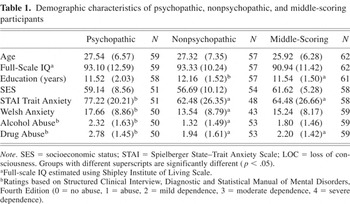
As summarized in Table 1, psychopathic and other inmates did not differ significantly in age, estimated IQ, or socioeconomic status using the Hollingshead formula (Hollingshead & Redlich, 1958). However, psychopaths exhibited greater alcohol abuse/dependence than nonpsychopaths (Mann–Whitney U = 826.5, p = .002), and greater drug abuse/dependence than nonpsychopaths (U = 915.5, p = .012), and middle-scorers (U = 1085.0, p = .044). Psychopaths reported higher trait anxiety than nonpsychopaths on the Welsh Anxiety Scale (Welsh, 1956) [t(97) = 2.22, p = .029]. Relations between demographic variables and performance are addressed in the Preliminary Analyses section.
Demographic characteristics of psychopathic, nonpsychopathic, and middle-scoring participants

Task
Participants sat 60 cm from a 14-inch Dell computer monitor and viewed hierarchical stimuli presented centrally. Hemispheric asymmetries on this paradigm are greater for central than unilateral stimulus presentation (Han et al., 2002). On each trial, a target letter (H or S) was presented at the local or global level, and a distractor letter (A or E) was presented at the opposite level (see Figure 1). Large (global) letters measured 30 mm × 45 mm (approximately 2.86° × 4.30°), and each global letter was composed of 12–14 smaller (local) letters measuring approximately 6 mm × 8.5 mm (.57° × .81°). Target duration was 150 ms, and intertrial interval was 1000 ms. Participants completed 8 practice trials and 64 trials per condition using index and middle fingers of the right hand. Performance was measured primarily via median response latencies. However, accuracy was also analyzed.
Target frequency at each level was manipulated to induce greater LH/RH processing. In the neutral condition (N), targets appeared at the global and local levels equally often. In the local bias condition (L), targets appeared at the local level 80% of the time and at the global level 20% of the time. Presenting targets at the local level four times as often as at the global level was also expected to bias participants to attend differentially to local level stimulus elements. Conversely, in the global bias condition (G), targets appeared at the global level 80% of the time and at the local level 20% of the time. Because all responses to targets were right-handed, it is likely all conditions activated LH motor systems. However, given psychopaths' generally adequate performance on cognitive tasks, it was considered unlikely that right-handed responding alone would lead to performance deficits.
Because all participants completed all three conditions, we counterbalanced the order of global bias and local bias conditions and administered the neutral bias condition second. The order was either global bias-neutral-local bias (GNL), or local bias-neutral-global bias (LNG). Preliminary analyses examined the appropriateness of collapsing across the two orders. In the event of differential carryover effects, we planned to conduct planned comparisons separately for the two orders to ensure that performance in each bias condition was evaluated under conditions in which each bias condition was administered first. The global–local task was programmed by Light Computer Consulting Company (Martinez, CA, 1995).
Procedure
All study procedures were approved by the Institutional Review Board of Rosalind Franklin University, and treatment of participants was consistent with principles of the Helsinki Declaration. The global–local study was completed on a separate day following the assessment session. Inmates providing informed consent completed the global–local task as the first or second task of this session. They were paid at least five or eight dollars for their time; payment was increased during the study commensurate with increases in minimum wage. Some participants earned additional money based on performance on subsequent tasks unrelated to this study.
RESULTS
Median response times were analyzed only for trials correctly completed. Median response latencies (and accuracy values) over 3 SDs from each group and condition mean were transformed to 1 ms (one percentage correct) beyond the most extreme value within 3 SDs to reduce their influence (Tabachnick and Fidell, 1996). All probability values are two-tailed. Where Mauchly's W indicated violations of sphericity assumptions or the Levene test indicated heterogeneous variances, degrees of freedom were adjusted.
Preliminary Analyses
Preliminary analyses examined design assumptions and addressed whether analysis strategy had to be modified due to repeated measures carryover effects or ethnicity interactions.
Testing design assumptions
As noted above (p. 269), both the LHA and response modulation hypotheses assume participants respond more quickly to local than global targets in local bias conditions and more quickly to global (than local) targets in global bias conditions. The response modulation hypothesis also predicts no target type effects for the neutral condition. Because deficits of psychopaths would complicate these patterns, assumptions were tested with nonpsychopaths. Results of paired samples t tests were consistent with assumptions. Collapsing across order, nonpsychopaths responded faster to local than global targets in the local bias condition, t(56) = 10.02, p < .001, d = 1.34, but faster to global than local targets in the global bias condition [t(56) = 4.86, p < .001, d = .65]. They displayed no advantage for either target type in the neutral condition [t(57) < 1, not significant]. Thus bias conditions were effective at altering responsiveness to target types.
Examining interactions affecting analysis strategy
To examine whether there were Group × Ethnicity interactions or differential carryover effects, a 3 × 2 × 2 × 3 × 2 (Group × Ethnicity × Order × Bias Condition × Target Type) analysis of variance (ANOVA) was conducted for response latency. There was an ethnicity effect [F(1,160) = 4.77, p = .031], but no interactions involving ethnicity. Therefore, subsequent analyses collapsed across ethnicity.
There were several interactions involving order, including Order × Bias Condition × Target Type [F(1.85,295.97) = 12.15, p < .001], indicating differential carryover effects. Independent samples t tests conducted to unpack this interaction revealed that the advantage for local (vs. global) targets in the local bias condition was greater when the local bias condition was administered before versus after the global bias condition [174 ms vs. 102 ms; t(169) = 3.94, p < .001]; the advantage for global targets under global bias was greater when the global bias condition was administered first [138 vs. 52 ms; t(153.43) = 4.30, p < .001].
Consequently, to ensure each bias condition was examined under conditions of maximum effectiveness, planned comparisons addressing local bias condition performance were restricted to participants receiving the local bias condition first (i.e., order LNG); planned comparisons addressing global bias condition performance were restricted to participants receiving the global bias condition first (order GNL). Neutral condition comparisons were examined for both orders.
Examining possible covariates
Correlations between scores on demographic variables and performance indices were examined separately for each order. Performance was uncorrelated with anxiety, socioeconomic status, education, handedness, or drug or alcohol abuse/dependence. Among participants assigned to LNG, age correlated with global and local target latencies in the local bias condition (rs = .32, .25, ps = .003, .022). Shipley-estimated IQ also correlated with global/local target latencies in the neutral condition (rs = −.23, −.23, ps = .041). Among those assigned to GNL, none of these variables correlated with performance. Because age correlated marginally with psychopathy group among participants in LNG (r = −.22, p = .05), it was not possible to control for individual differences in age without removing variance in psychopathy. Analysis of covariance (ANCOVA) is not recommended when group membership and a covariate are related (Miller & Chapman, 2001), although such analysis can still provide limited information regarding effects of covariates. Nevertheless, supplementary ANCOVAs (reported below) yielded results consistent with those of principal analyses.
Accuracy
A parallel ANOVA for accuracy revealed Order × Bias Condition [F(1.90,303.42) = 24.71, p < .001], Order × Target Type [F(1,160) = 15.83, p < .001], and Bias Condition × Target Type interactions [F(1.97,314.64) = 43.39, p < .001]. The only other significant interaction was a five-way interaction involving all independent variables [F(3.93,314.64) = 2.62, p < .04], which was not interpreted. Accuracy was above 85% for all groups/conditions.
Principal Analyses
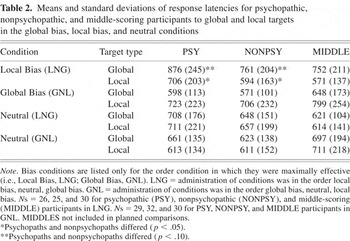
Planned comparisons for the LHA and response modulation hypotheses were t tests limited to the order in which each bias condition was most effective. Planned comparisons for the neutral condition were conducted separately for both orders. Because parallel comparisons for accuracy yielded no group differences [all Fs < 1.75, all ps ≥ .10], accuracy analyses are not discussed except to evaluate the possibility of speed–accuracy tradeoffs. Mean response latencies and SDs are in Table 2.
Means and standard deviations of response latencies for psychopathic, nonpsychopathic, and middle-scoring participants to global and local targets in the global bias, local bias, and neutral conditions

Evaluation of the left hemisphere activation hypothesis
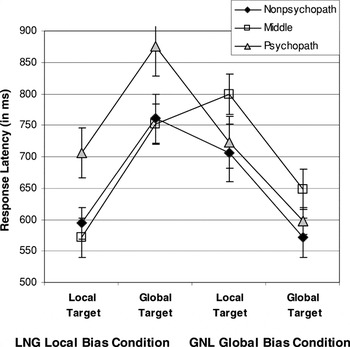
Consistent with LHA hypothesis predictions (see Figure 2), psychopaths responded slower than nonpsychopaths to local targets in the local bias condition [t(49) = 2.18, p = .03, d = .62]. Psychopaths also responded nonsignificantly more slowly to global targets in the local bias condition [t(49) = 1.82, p = .07, d = .52; see Figure 2]. Also consistent with LHA predictions, group differences were specific to the local bias condition; among those in order GNL, psychopaths' responses were no slower than those of controls to local or global targets in the global bias condition: t(59) < 1, p = .77, d = .08 for local targets, and t(59) = 1.01, p = .32, d = .26 for global targets.

Median response times and standard errors for psychopathic, middle-scoring, and nonpsychopathic inmates responding to local and global targets in the local bias and global bias conditions. Data are provided for each condition only when it was the first condition administered. LNG indicates that the conditions were presented in the order local bias, neutral, global bias; GNL, global bias, neutral, local bias.
Evaluation of the response modulation deficit hypothesis
As noted above, in the local bias condition, psychopaths' slower responses to global targets were not significant [t(49) = 1.82, p = .07, d = .52]. In the global bias condition, psychopaths' responses to local targets were no slower than those of nonpsychopaths [t(59) < 1, p = .77, d = .08; see Figure 2].
Evaluation of the overall left hemisphere dysfunction hypothesis
Planned comparisons examining latencies to local targets in the neutral condition revealed no differences between groups for those assigned to LNG [t(49) < 1, p = .26, d = .26], or GNL [t(59) < 1, p = .95, d = .02].
Dimensional analyses
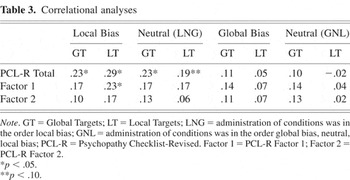
Consistent with planned comparisons (see Table 3), correlations between psychopathy and response latency in each bias condition (when administered first) and the neutral condition (both orders) revealed that PCL-R scores correlated with response latencies for both target types in the local bias condition: r(81) = .23, p = .04 for global targets, r(81) = .29, p = .01 for local targets. Among those in LNG, PCL-R scores also correlated with latencies for both target types in the neutral condition but were significant only for global targets [r(81) = .23, p = .04; r(81) = .19, p = .08 for local targets]. In contrast, among those in GNL, PCL-R scores were uncorrelated with latencies for any condition or target type (all rs < .16).
Correlational analyses

Supplementary Analyses Examining Speed–Accuracy Tradeoffs
Among participants in LNG, correlations between response latency and accuracy revealed no evidence of speed–accuracy correlations in the local bias condition. However, latency correlated with accuracy of responses to neutral condition global targets [r(81) = .31, p = .004]. Among participants in GNL, the only correlation was for responses to global targets in the global bias condition [r(91) = .29, p = .006]. Separate calculations for psychopaths and nonpsychopaths yielded no speed–accuracy correlations for psychopaths. However the aforementioned correlations proved significant for nonpsychopaths. Thus speed–accuracy relations cannot account for psychopaths' performance under local bias conditions. However, nonpsychopaths responding faster to global targets in the global bias (GNL) and neutral condition (LNG) were less accurate.
Supplementary Analyses Addressing Anxiety, Age, and Intelligence
Anxiety was unrelated to performance. However, because psychopaths were higher than nonpsychopaths in trait anxiety, and because some response modulation deficits are specific to psychopaths low in anxiety, we conducted analyses using a median split on Welsh anxiety scores. In light of the differential carryover effects noted above, two 3 × 2 × 2 × 2 (Group × Anxiety Level × Condition [Relevant Bias vs. Neutral] × Target Type) ANOVAs were conducted for response latency in LNG and GNL. Neither analysis yielded anxiety effects.
Because age and estimated intelligence correlated with performance in specific conditions (as noted in the Preliminary Analyses section), ANCOVAs repeating planned comparisons with relevant variables as covariates were conducted. An ANCOVA for the local bias condition (for those in LNG; age as covariate) yielded results similar to those reported above; however, the group difference in local target response latency only approached significance [F(1,48) = 3.80, p = .057]. Also similar to comparisons reported above, a parallel ANCOVA for the neutral condition (order LNG; intelligence as covariate) yielded no evidence of group differences [F(1,48) < 1].
DISCUSSION
Consistent with the LHA hypothesis, psychopaths exhibited deficits in processing hierarchical stimuli under conditions placing greater demands on LH perceptual systems. Psychopaths responded more slowly than nonpsychopaths to local targets in the local bias condition. Although psychopaths were not significantly slower in responding to global targets under local bias condition, this group difference approached significance, and the moderate effect size for the group difference (d = .52) appears consistent with a generalized deficit for psychopaths given LHA conditions. Moreover, correlations indicated relationships between PCL-R total scores and response latencies for both global and local targets in the local bias condition.
The absence of more general differences in responding to local level targets suggests psychopaths are not generally deficient at LH processing. Psychopaths were not slower than nonpsychopaths at responding to local targets in the neutral condition, and effect sizes for a single group difference in two different orders (ds = .26, .02). Current findings are also consistent with evidence from language studies indicating comparable performance by psychopathic and nonpsychopathic inmates on concrete semantic classification (Hare & Jutai, 1988) and verbal memory (Hare & McPherson, 1984). Although impaired verbal processing has been linked to delinquency and antisocial behavior (Moffitt, 1993b; Stevens et al., 2003), such deficits are not observed in psychopaths (Hart et al., 1990; Smith et al., 1992).
Psychopaths' performance is not easily attributed to executive dysfunction, such as difficulty responding to infrequent stimulus properties. Psychopaths were no slower than nonpsychopaths in responding to local targets in the global bias condition (d = .08). Their slower responses to both local and global targets in the local bias condition are more consistent with LHA deficits than response modulation deficits.
Although prior studies had demonstrated performance deficits for psychopaths for manipulations of stimulus location and response hand, their use of divided attention paradigms had permitted alternative explanations. In contrast, the current paradigm did not require attention to multiple stimuli, modalities, or perceptual fields. Thus, psychopaths' deficits in this study are not easily attributed to difficulty managing the allocation of attention or difficulty scanning complex stimulus arrays.
The minimal demands for language processing also suggest psychopaths' performance deficits in this study are not linguistic. Moreover, that deficits were not apparent in the neutral condition, whereas letter processing demands were equivalent across all conditions, indicates letter processing was not central to psychopaths' deficits. Because group differences were significant only for local targets (given local bias conditions), it might still be argued that results are consistent with a modified form of overall LH dysfunction. However, correlational analyses also suggest deficits for both target types when most targets were initially presented at the local level. Even so, without a noncriminal control group, we cannot rule out the possibility that psychopathic AND nonpsychopathic criminals exhibit linguistic deficits, above and beyond psychopaths' specific deficits under local bias conditions. Furthermore, although participants were screened for reading proficiency to avoid the possible confound of illiteracy, we did not assess for reading disorders or other possible confounds (e.g., attention deficit hyperactivity disorder).
Consistent with prior LHA studies, current findings suggest that the mechanism underlying psychopaths' cognitive deficits is dynamic rather than static. In particular, the finding that psychopaths were poor at responding to frequently presented local targets under some conditions (e.g., local bias) but performed adequately in other conditions can help to explain why psychological assessments often suggest psychopaths are cognitively intact. Contrary to traditional views of static neuropsychological impairment, current findings are consonant with the perspective that psychopaths' cognitive impairments are evident only under conditions that require substantial involvement of specific LH systems. This perspective can explain the erratic and dramatic nature of psychopaths' behavior. At times, psychopaths seem quite rational and reasonable; at other times, they exhibit egregiously poor judgment. According to the LHA hypothesis, psychopaths' less reasonable, more risky, and impulsive behavior reflects a regularly occurring deterioration in general cognitive efficiency, under conditions placing substantial demands on LH systems.
Moreover, this hypothesis provides clear directions for future studies of mechanisms underlying psychopaths' aberrant behavior. It predicts that psychopaths should perform as well as nonpsychopaths when assessed on basic information-processing tasks. Because several specific cognitive and affective processes have been linked to recruitment of LH systems, psychopaths should perform poorly: under local bias conditions, on demanding language processing tasks (Gabrieli et al., 1998; Smith & Jonides, 1998), when programming novel motor sequences (Kawashima et al., 1998; van Strien & Bouma, 1988), and when experiencing approach motivational states (see Davidson, 2000; Sutton & Davidson, 1997). Studies are needed that assess the performance of psychopaths given other kinds of conditions designed to activate hemisphere-specific systems.
Correlational analyses merit one additional comment. The similar results of extreme group and correlational analyses are consistent with dimensional perspectives on psychopathy. The chief difference was that correlational analyses also indicated psychopathy was associated with slower responses to global targets in the neutral condition but only when this condition immediately followed the local bias condition (see Table 3). Thus this significant correlation suggests that, among participants receiving the local bias condition first, psychopaths' poor performance under LHA may have persisted into the subsequent neutral condition. No similar correlation was evident among participants receiving the global condition first.
Several additional limitations of the study must be acknowledged. Few studies have examined LHA deficits outside dual-task situations, and replication across different experimental conditions is critical. In this context, a similar pattern of LHA deficits has recently been reported for psychopaths using a version of the global–local paradigm designed to manipulate interhemispheric integration (Lopez et al., in press). Second, although supplementary analyses provided no evidence for Psychopathy × Anxiety interactions, it remains important to test large samples of psychopaths and nonpsychopaths comparable in trait anxiety. Third, substance abuse history is another possible confound in most studies of psychopathy and may affect performance on these tasks. Finally, as noted above, the absence of a noncriminal control group limits the conclusions that can be drawn about the performance of nonpsychopathic criminals.
These limitations notwithstanding, the observation of specific deficits in global–local processing in psychopaths provides an important extension of the LHA hypothesis and illustrates the value of testing hypotheses for dynamic deficits in psychopathological syndromes. If follow-up studies continue to corroborate hypotheses for state-dependent cognitive deficits, these hypotheses may contribute in important ways to our ability to understand the dramatic fluctuations in behavior across situations often observed in psychopathic individuals.
ACKNOWLEDGMENTS
Preparation of this article was supported in part by National Institute of Mental Health Grants MH49111 and MH57714 to David S. Kosson. We thank Carolyn Abramowitz, Nick Doninger, Diane Goldstein, Seoni Llanes, and Maria Banderas for interviewing and testing participants. We also thank Yana Suchy for her comments on a previous draft of this manuscript. In addition, we wish to acknowledge the consistent help and cooperation of Larry Lesza, Chuck DeFillippo, Patrick Firman, Rick Riddle, and the staff of the Lake County Jail, Waukegan, Illinois.