INTRODUCTION
Larval trematode communities of molluscs have received considerable attention in recent years and studies have tackled a range of factors underlying their formation and structure (Kuris, Reference Kuris, Esch, Bush and Aho1991; Sousa, Reference Sousa, Esch, Bush and Aho1991; Esch and Fernández, Reference Esch and Fernández1993, Reference Esch and Fernández1994; Esch et al. Reference Esch, Curtis and Barger2001, Reference Esch, Barger and Fellis2002). A general feature of these communities is high spatial and temporal variation in species composition and infection rates of individual species (e.g. Curtis and Hurd, Reference Curtis and Hurd1983; Sousa, Reference Sousa, Esch, Bush and Aho1991; Esch and Fernández, Reference Esch and Fernández1994; Jokela and Lively, Reference Jokela and Lively1995; Curtis, Reference Curtis1997). This has been related to factors such as distribution of definitive hosts disseminating parasite eggs (Curtis and Hurd, Reference Curtis and Hurd1983; Fernández and Esch, Reference Fernández and Esch1991a, Reference Fernández and Eschb; Sousa, Reference Sousa1993; Jokela and Lively, Reference Jokela and Lively1995; Granovitch et al. Reference Granovitch, Sergievsky and Sokolova2000; Skirnisson et al. Reference Skirnisson, Galaktionov and Kozminsky2004), features of the snail hosts including their habitat preference, vagility and life-history dynamics (Rohde, Reference Rohde1981; Fernández and Esch, Reference Fernández and Esch1991b; Sousa, Reference Sousa1993; Sapp and Esch, Reference Sapp and Esch1994; Jokela and Lively, Reference Jokela and Lively1995), and interspecific interactions between parasite species (Kuris, Reference Kuris, Esch, Bush and Aho1991; Lafferty et al. Reference Lafferty, Sammond and Kuris1994; Esch et al. Reference Esch, Curtis and Barger2001). Commonly, however, these factors do not work independently but form a complex set of interactions with a specific fine tuning on their relative importance in each particular population and host-parasite interaction, which undermines the generality of these factors. Thus, unravelling general trends in trematode community organization still requires an increasing number of comprehensive investigations into structure of these communities, particularly in (i) different spatiotemporal scales and (ii) in host species which have remained largely unexplored despite their common occurrence.
In this study, we investigated the trematode community structure of the large-mouthed valve snail, Valvata macrostoma. This prosobranch hermaphroditic species is commonly found in aquatic systems in Northern and Eastern Europe inhabiting a range of ecosystems such as alluvial flats of rivers, marshy littoral areas of lakes, small water bodies with abundant aquatic vegetation and temporary waters (Glöer, Reference Glöer2002). It is a semelparous species (i.e. adults die after reproduction), but details of the life-span are currently available only from the related species, V. piscinalis piscinalis (Fretter and Graham, Reference Fretter and Graham1978; Glöer, Reference Glöer2002; Ducrot et al. Reference Ducrot, Cognat, Mons, Mouthon and Garric2006). Despite the common occurrence of V. macrostoma in some parts of Europe, surprisingly little is known about the trematode community organization. Previous studies on trematodes in Valvata spp. have described the presence of single parasite species only and have not focused on the details of spatiotemporal variability (Wesenberg-Lund, Reference Wesenberg-Lund1934; Odening et al. Reference Odening, Mattheis and Bockhardt1970; Odening and Bockhardt, Reference Odening and Bockhardt1971; Swennen et al. Reference Swennen, Heessen and Höcker1979; McCarthy, Reference McCarthy1990; Grabda-Kazubska and Kiseliene, Reference Grabda-Kazubska and Kiseliene1991; Kiseliene et al. Reference Kiseliene, Grabda-Kazubska and Moné1997; Faltýnková et al. Reference Faltýnková, Niewiadomska, Santos and Valtonen2007), although Gérard (Reference Gérard1997, Reference Gérard2001) and Gérard et al. (Reference Gérard, Carpentier and Paillisson2008) studied the impact of trematodes on mollusc host communities including V. macrostoma (syn. V. pulchella).
In the present study, we focused on the patterns of spatial and temporal variation of the trematode community structure in V. macrostoma with a particular interest in the scale in which changes in parasite community composition could take place. Essentially, we sampled 2 sites in very close proximity to each other within a lake throughout the season, which would reveal if potential spatial differences between the sites were persistent in time. We also explored the infection probability of certain parasite groups in relation to the size of the snail host as well as the overall population dynamics of this poorly studied snail species.
MATERIALS AND METHODS
Sampling of the snails
Large-mouthed valve snails, Valvata (Tropidina) macrostoma Mörch, 1864 [syn. V. pulchella Studer, 1820; the nomenclature follows that of Glöer (Reference Glöer2002) ] were sampled monthly from May to October 2007 from the large oligotrophic Lake Konnevesi (62° N 26° E), Central Finland. Two sampling sites were chosen. The first (littoral, shallow) site was located near the shore (depth 1–2 m) with a muddy bottom substrate, and benthic and floating aquatic plants (e.g. Isoëtes sp., Potamogeton sp.). The second (offshore, deep) site was in close proximity to the first one, ca. 50–70 m offshore (depth 5–6 m) and had a bottom substrate of mud and small rocks but no plants. In both sites, snails were collected by grab samples from an area of ca. 40×20 m. Because of lower snail density in the deep site, the sampling effort required for a sufficient sample size was approximately double compared to the shallow site.
Processing of snails and cercariae
After each sampling, snails were placed individually into well-plates with a small amount of lake water (15 ml) and left under a lamp for 10 h to stimulate shedding of cercariae. Afterwards, all snails were measured for width and length with callipers and the non-shedding snails were dissected under a stereomicroscope to determine pre-patent infections. For detailed observations of cercariae, snails with patent infections were kept at laboratory temperature separately in vials with 300 ml of lake water. For identification, live cercariae were observed under the light microscope with Neutral Red used for vital staining. The species identification of the cercariae was based on the studies of Wesenberg-Lund (Reference Wesenberg-Lund1934), Wikgren (Reference Wikgren1956), Odening et al. (Reference Odening, Mattheis and Bockhardt1970), Odening and Bockhardt (Reference Odening and Bockhardt1971), Combes (Reference Combes1980), Grabda-Kazubska and Kiseliene (Reference Grabda-Kazubska and Kiseliene1991), Kiseliene et al. (Reference Kiseliene, Grabda-Kazubska and Moné1997), and Faltýnková et al. (Reference Faltýnková, Niewiadomska, Santos and Valtonen2007). The species affiliation of Ichthyocotylurus pileatus was verified experimentally by exposing young Stizostedion lucioperca to the cercariae and examining the morphology of the metacercariae.
Early sporocyst and redial stages could not be identified to the species level; they were included in the total prevalence data and were categorized as developing. We also recorded the prevalence of metacercarial infections although it is possible that some snails could have gained new infections while the snails were brought to the laboratory in one container. However, this step of the sampling procedure was conducted within a narrow time-interval and thus we consider it unlikely to have an effect on the overall pattern of metacercarial infection.
Data analysis
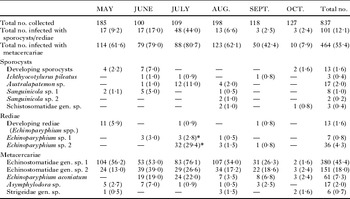
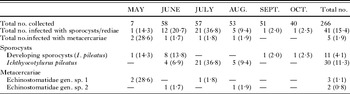
To simplify the statistical analysis, we combined all sporocyst and redial infections as 2 groups within each sampling time. We then analysed the data using stepwise logistic regression with the sampling site and sampling time as categorical and snail width as continuous dependent variables. We calculated the predicted probability of infection from the logistic regression analysis for sporocyst, redial and metacercarial infections in relation to snail size. To improve the reliability of the analysis, the infection probability of sporocysts and rediae was analysed only from the July samples which had the highest proportion of the infected cases (51·2% of the sporocyst infections in the deeper site, 35·6% of the redial infections in the shallow site) (Tables 1 and 2). Snail size distributions were compared between the sampling times using the Kolmogorov-Smirnov test.
Trematode species composition (no. of infected snails and prevalence) in Valvata macrostoma collected from the shallow littoral site (1–2 m depth) of Lake Konnevesi in 2007

* One double infection, the infected snail was counted only once for the total prevalence.
Trematode species (no. of infected snails and prevalence) in Valvata macrostoma collected from the deeper offshore site (5–6 m depth) in Lake Konnevesi in 2007

RESULTS
Dynamics of the snail population
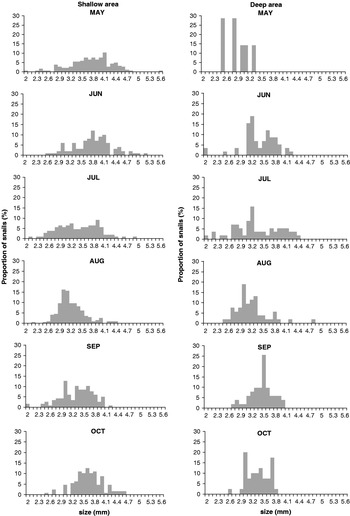
There was a significant change in the mean size (width) of the snails sampled from the shallow site during the study period (Kruskal-Wallis: χ2=174·22, D.F.=5, P<0·001). Essentially, this was because the population consisted of smaller (new cohort) snails in July (comparison between May and July, Kolmogorov-Smirnov test: Z=2·215, P<0·001) when the size distribution was characterized by a 2-peaked shape, and in August (comparison between May and August, Kolmogorov-Smirnov test: Z=5·017, P<0·001) when the proportion of smaller snails was highest (Fig. 1). In October, however, snails had grown very close to their overwintering size (Fig. 1) although there still was a statistically significant difference compared to the May sample (Mann-Whitney U-test: Z=−2·251, P=0·024). The size dynamics was similar in the deeper site (Fig. 1) although the pattern was not that clear probably because of the smaller sample sizes. Moreover, the overall mean snail size was smaller in the deeper site (Mann-Whitney U-test: Z=−4·715, P<0·001).
Frequency distribution of the width of Valvata macrostoma in the shallow littoral site (1–2 m) and deeper offshore site (5–6 m) in Lake Konnevesi in May–October 2007.

Parasite species composition
The component community of trematodes in V. macrostoma consisted of 10 species comprising cercariae of 7 species and metacercariae of 5 species, which belonged to 5 families (Echinostomatidae, Lissorchiidae, Sanguinicolidae, Schistosomatidae and Strigeidae) (Tables 1 and 2). In total, 12·9% (n=142 out of 1103) of the snails were infected with sporocysts/rediae and 42·5% (n=469) with metacercariae. Echinoparyphium sp. 2 was the most prevalent species in the shallow and Ichthyocotylurus pileatus in the deep site. We found one double infection of Echinoparyphium sp. 1 and Echinoparyphium sp. 2. All parasite species were allogenic (i.e. use birds as definitive hosts), except for Sanguinicola sp. 1 and 2 and Asymphylodora sp. which mature in fish (i.e. autogenic species). Some of the snails harboured developing infections from which the species could not be identified (Tables 1 and 2). For simplicity, we assumed that the developing sporocysts observed in snails from the deeper site belonged to I. pileatus, which was the only species with sporocyst infections in this site (see below). Developing sporocyst and redial infections from the shallow site, on the other hand, comprised more species, presumably the same ones found as cercariae. The majority of the metacercarial infections were echinostomes (96·3% of all infections with metacercariae). We assume that the metacercariae of Echinostomatidae gen. spp. belong to the 2 species of Echinoparyphium found as cercariae since the morphological characters of the metacercariae (body size, number of collar spines) correspond to those of the cercariae.
Spatiotemporal variation in infection
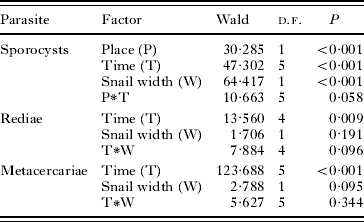
The trematode species composition differed markedly between the sampling sites. All 10 parasite species were present in the shallow site, whereas the deeper site had only 1 species with sporocyst infections (I. pileatus) (Tables 1 and 2). Redial infections (family Echinostomatidae) were found only in the shallow site. Overall, the prevalence of sporocyst infections was significantly different between the sites so that the shallow site had more species (Tables 1 and 2) but the total prevalence was higher in the deeper site (Table 3). Indeed, the total prevalence of I. pileatus in the deeper site (15·0%) was slightly higher than the total infection prevalence (sporocysts and redial infections combined) in the shallow site (12·1%) (Tables 1 and 2). The prevalence of metacercarial infections was also significantly different between the sites, being high in the shallow (55·4%) and very low in the deeper site (1·9%, Tables 1–3).
Results of backward step-wise logistic regressions conducted separately for sporocyst, redial and metacercarial infections of Valvata macrostoma in relation to sampling site (shallow/deep site in Lake Konnevesi), sampling time (May–October 2007) and snail shell width
(Because of low numbers of snails infected with rediae and metacercariae in the deeper site, these analyses were conducted only for snails collected from the shallow site.)
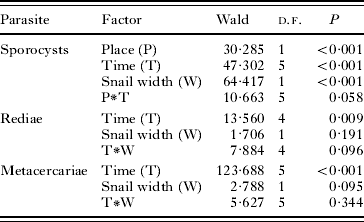
The prevalence of sporocyst and redial infections differed during the study period (Tables 1–3). In May, the combined prevalence of sporocyst and redial infections in the shallow and deep site was 9·2% and 14·3%, respectively. The prevalence increased in June (17% and 19·0%) and was highest in July (44% and 36·8%). In September and October, however, the prevalence was less than 2·5% in both sites. In the shallow site, the dominant species were Echinoparyphium sp. 1 and sp. 2 which were present at all sampling times except for October. The prevalence of most species (Echinoparyphium sp. 2, Australapatemon sp. in the shallow site and I. pileatus in the deeper site) peaked in July. The pattern of prevalence during the study period was similar for metacercarial infections although they were prevalent already in May (Tables 1 and 3). The prevalence of metacercariae in the shallow site was high from May to August, with a peak in July (80·7%, Table 1), but decreased in October (7·9%). The prevalence of patent cercarial infections (cercariae emerging spontaneously from the snails) peaked in July and August in both sites (100% and 98% patent for shallow and deeper site, respectively). In September and October, however, there were no patent infections and 2 snails were found to harbour new infections (mother sporocysts) both in the shallow and deep site.
Probability of infection in relation to snail size
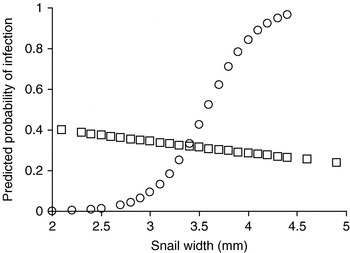
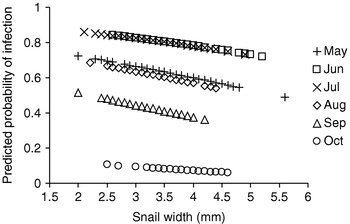
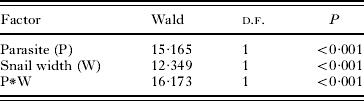
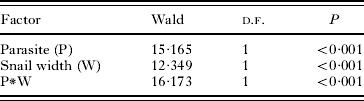
In sporocyst infections in the deeper site (I. pileatus), the probability of infection increased with snail size in a bimodal fashion, i.e. the probability was initially low but increased sharply after a snail width of 3 mm and reached the plateau in ca. 4·5 mm (Table 4, Fig. 2). In redial infections in the shallow site, on the other hand, the probability of infection was relatively high already in small snails but showed a slight linear decrease thereafter (Table 4, Fig. 2). In case of metacercarial infections in the shallow site, it was possible to compare the relationship between the infection probability and snail size between the sampling months. We found that snail width had a negative, although statistically non-significant (P=0·095), effect on the infection probability, and this pattern persisted throughout the study (Table 3, Fig. 3).
Predicted probability of sporocyst (circles) and redial (squares) infection in relation to shell width of Valvata macrostoma sampled from the shallow (redial infections) and deep site (sporocysts) of the Lake Konnevesi in July 2007. See Table 4 for the statistical analysis.

Predicted probability of metacercarial infection in relation to shell width of Valvata macrostoma sampled from the shallow site of the Lake Konnevesi in May–October 2007. See Table 3 for the statistical analysis.

Results of backward step-wise logistic regression conducted for sporocyst (from the deeper offshore site) and redial infections (from the shallow littoral site) of Valvata macrostoma in the sample from July 2007 in relation to snail shell width
(Parasite type was set as a categorical variable and shell width as a continuous variable.)
DISCUSSION
From the numerous studies on structure and formation of trematode communities of molluscs (e.g. Fernández and Esch, Reference Fernández and Esch1991a, Reference Fernández and Eschb; Esch and Fernandez, 1993, 1994; Sousa, Reference Sousa, Esch, Bush and Aho1991; Kuris and Lafferty, Reference Kuris and Lafferty1994; Esch et al. Reference Esch, Curtis and Barger2001, Reference Esch, Barger and Fellis2002) a general conclusion is that there is high spatiotemporal variation in patterns of infection. An important aspect of these patterns is the spatiotemporal scale of the study, which may have a profound effect on the result depending on e.g. motility and life-history of the mollusc host and spatial distribution of definitive host species within the system. In this paper we examined the spatiotemporal structure of the trematode community of a previously less studied snail species, the large-mouthed valve snail, Valvata macrostoma. We found that the parasite species composition was strikingly different between the two sampling sites located in very close proximity to each other (ca. 50–70 m). This pattern of infection was also highly persistent throughout the study period (May–October). Thus, although we sampled only 2 sites from the lake, the temporal repeatability of the differences supports this spatial pattern of infection.
The trematode community of V. macrostoma consisted of 10 species with cercariae of 7 and metacercariae of 5 species, which is a significantly higher number compared to earlier studies on Valvata. For example, Gérard (Reference Gérard1997, Reference Gérard2001) and Gérard et al. (Reference Gérard, Carpentier and Paillisson2008) found in their long-term studies 1 species in V. macrostoma (syn. V. pulchella) and 2 species each in V. piscinalis and V. cristata; Kiseliene et al. (Reference Kiseliene, Grabda-Kazubska and Moné1997) reported 4 species from V. piscinalis. Interestingly, the present species richness rather corresponds to that reported for other species of prosobranch snails in other ecosystems (Curtis and Hurd, Reference Curtis and Hurd1983; Lafferty et al. Reference Lafferty, Sammond and Kuris1994; Jokela and Lively, Reference Jokela and Lively1995; Curtis, Reference Curtis1997; Kube et al. Reference Kube, Kube and Bick2002a, Reference Kube, Kube and Dierschkeb; Skirnisson et al. Reference Skirnisson, Galaktionov and Kozminsky2004; Fredensborg et al. Reference Fredensborg, Mouritsen and Poulin2006). On the other hand, the trematode species composition in V. macrostoma was similar to that in other Valvata species, especially V. piscinalis, which harbours infections of the genera Echinoparyphium, Sanguinicola, Asymphylodora, Australapatemon and Ichthyocotylurus (Wesenberg-Lund, Reference Wesenberg-Lund1934; Swennen et al. Reference Swennen, Heessen and Höcker1979; Grabda-Kazubska and Kiseliene, Reference Grabda-Kazubska and Kiseliene1991; Kiseliene et al. Reference Kiseliene, Grabda-Kazubska and Moné1997; Gérard, Reference Gérard1997, Reference Gérard2001; Gérard et al. Reference Gérard, Carpentier and Paillisson2008). However, the individual species within these genera will be different for each species of Valvata. Overall, we can conclude that Valvata snails serve as hosts for a considerable range of autogenic and allogenic trematode species (see also Kuris and Lafferty, Reference Kuris and Lafferty1994).
Many studies have emphasized the importance of distribution of definitive hosts in determining the spatiotemporal patterns in trematode communities (e.g. Curtis and Hurd, Reference Curtis and Hurd1983; Fernández and Esch, Reference Fernández and Esch1991a, Reference Fernández and Eschb; Sousa, Reference Sousa1993; Jokela and Lively, Reference Jokela and Lively1995; Granovitch et al. Reference Granovitch, Sergievsky and Sokolova2000; Skirnisson et al. Reference Skirnisson, Galaktionov and Kozminsky2004). It is generally concluded that species disseminated by birds (allogenic parasites) should be more evenly distributed, i.e. essentially showing less spatial variation (e.g. Sapp and Esch, Reference Sapp and Esch1994; Esch and Fernández, Reference Esch and Fernández1994; Kube et al. Reference Kube, Kube and Dierschke2002b). However, in this study, most of the parasite species that showed differences in prevalence between the sites (e.g. I. pileatus, all echinostomes) were in fact those maturing in birds. Interestingly, the species composition changed radically within just a few tens of meters and was persistent throughout the study period, which suggests strict spatial differences in the distribution of the definitive hosts of these species (see also Smith, Reference Smith2001; Hechinger and Lafferty, Reference Hechinger and Lafferty2005). For example, Ichthyocotylurus pileatus, which is transmitted via fish second intermediate hosts to aquatic birds (Niewiadomska, Reference Niewiadomska, Gibson, Jones and Bray2002, Reference Niewiadomska2003), was the only trematode species with sporocyst infections in the deep site. Although the distribution of the potential bird host species of I. pileatus was not quantified in detail, the diving fish-eating birds such as the black-throated diver (Gavia arctica) and mergansers were observed mainly further offshore close to the deeper sampling site. Gulls and terns, on the other hand, were seen moving over both areas. Similarly, ducks (order Anseriformes), which are hosts for echinostomes (Yamaguti, Reference Yamaguti1971; Kostadinova, Reference Kostadinova, Jones, Bray and Gibson2005), were regularly observed in the shallow area where the echinostomes were most prevalent. Other factors such as physical conditions (temperature, water current, depth, pressure, light intensity, see Fernández and Esch, Reference Kuris and Lafferty1994), lower snail density in the deeper site, snail life-history parameters and interspecific interactions between parasite species may have also affected the result. However, these are still unlikely to provide a comprehensive explanation for the complete absence of most species from the deeper site. The result also does not support the role of snail movements, because of the relatively sessile nature of Valvata. Overall, regardless of the underlying mechanism, the result indicates that spatial differences in species composition may emerge in a fine spatial scale (see also Curtis and Hurd, Reference Curtis and Hurd1983; Jokela and Lively, Reference Jokela and Lively1995; Curtis, Reference Curtis1997; McCurdy et al. Reference McCurdy, Boates and Forbes2000).
We observed high temporal variability in community composition as the prevalence of individual species changed radically with time. The system was characterized by a rapid increase in prevalence of both sporocyst and redial infections particularly in July, followed by a decrease and almost complete absence of trematodes in October. This may reflect rapid exploitation of the snails by the parasites, which in the case of the small-sized Valvata, could lead to higher death rate of the infected hosts and decrease in prevalence (see below). The seasonal patterns may also be affected by host population dynamics (Kube et al. Reference Kube, Kube and Bick2002a). Our results suggest that V. macrostoma has a life-span of approximately 1–1·5 years. Thus, it is possible that the recruitment of a new, still uninfected snail cohort in July, and particularly in August, may have decreased the prevalence of infection. Interestingly, there were differences in prevalence in the shallow site between May and October samples (taken during low water temperature), which are considered to represent post- and pre-overwintering situations, respectively. Especially in cases of developing infections, the prevalence was very different between the sampling times, which suggests that seasonal patterns might be different in different years depending e.g. on yearly parasite transmission success. Thus, we emphasize that although the general seasonal pattern of infection (peak in July–August) is typically observed in trematodes in these latitudes (e.g. Karvonen et al. 2006 b), its magnitude may be shaped by the patterns in the previous years.
The probability of infection changed with snail size, but this was asymmetric so that a clear positive relationship was observed in sporocyst (I. pileatus) infections whereas in redial and metacercarial infections the relationship was slightly negative. In general, infection probability is known to increase with size of the host in many systems (e.g. Jokela and Lively, Reference Jokela and Lively1995; Sorensen and Minchella, Reference Sorensen and Minchella2001; Karvonen et al. 2006 a) although this may vary between species even within one system (McCurdy et al. Reference McCurdy, Boates and Forbes2000). The increase in infection probability with size might occur because (i) older and therefore larger snails have been exposed to the infection for a longer period of time or (ii) the infection increases growth rate of the snail (Minchella, Reference Minchella1985; Kuris and Lafferty, Reference Kuris and Lafferty1994; Sorensen and Minchella, Reference Sorensen and Minchella2001). Although we could not separate between these hypotheses, the pattern in I. pileatus indicates that once the snails become recruited into the population, the probability of infection increases significantly after the size of 3 mm. In the case of redial infections, on the other hand, the probability was high already in smaller snails and tended to decrease afterwards. This may be related to different transmission patterns or rate of host exploitation in these parasites among other traits. For example, redial infections may show higher developmental rates in snails (faster development to patency in young snails) but shorter overall duration of infection (mortality of older snails) (see also Wright, Reference Wright1971; Lim and Heyneman, Reference Lim and Heyneman1972; McCurdy et al. Reference McCurdy, Boates and Forbes2000; Kuris and Lafferty, Reference Kuris and Lafferty1994; Sorensen and Minchella, Reference Sorensen and Minchella2001). Metacercarial infections, on the other hand, showed clear seasonality in probability of infection but also, in accordance with the redial infections, a consistent decrease in probability with size. This is surprising as it could be assumed that the probability of infection will increase with size as larger (older) snails have accumulated metacercarial infections. One possible explanation is that the presence of metacercarial infections is connected to redial infections and that super-infections (re-infections of the same host) are common in this system (but see Evans and Gordon, Reference Evans and Gordon1983; McCarthy, Reference McCarthy1999a, Reference McCarthyb). In this case, a possible higher mortality of snails infected with rediae would decrease the prevalence of metacercarial infections. However, this does not explain the seasonal pattern in May, and in August–September, when metacercarial infections were common, but redial infections were rare or absent. Thus, the dynamics of these infections require further work.
To conclude, we found that the previously rarely explored V. macrostoma hosts a diverse trematode community with representatives from several major trematode groups. The results demonstrate that changes in trematode species composition may take place within a very small spatial and temporal scale, which emphasizes the importance of spatiotemporal aspects in community studies. Furthermore, we found that infection probabilities may be very different in different types of parasites, which opens questions, for example, in relation to strategies of transmission and host exploitation to be tackled with experimental approaches.
We are grateful to Aneta Kostadinova and an anonymous referee for helpful comments improving the manuscript. We acknowledge the staff of the Konnevesi Research Station of the University of Jyväskylä (Janne Koskinen, Risto Latvanen, Kari Oksanen, Jyrki Raatikainen) for help with snail sampling. This study was supported by the University of Jyväskylä, Faculty of Mathematics and Science, the Academy of Finland Centre of Excellence in Evolutionary Research and the Grant Agency of the Czech Republic (project No. 524/07/P086).