Introduction
Phase change phenomena such as icing (water to ice) and steam condensation (vapor to water) are key determinants of system level performance in many industrial applications. Control and enhancement of these phenomena have huge benefits from an efficiency and reliability viewpoint in sectors such as energy systems, transportation, and infrastructure. This article presents an overview of the fundamental and practical aspects underlying the use of passive hydrophobic materials-based solutions for preventing ice buildup and enhancing the thermal performance of steam condensers. The article highlights recent fundamental advancements in these fields and points to technology gaps that are essential for realizing the benefits of hydrophobic coatings for ice mitigation and condensation heat transfer enhancement.
Ice nucleation and adhesion on hydrophobic surfaces
Ice accretion presents long recognized problems with respect to safety, efficiency, and cost of operation in many crucial sectors, including transportation, energy, and telecommunications.Reference Laforte, Alltaire and Laflamme1,Reference Ryerson2 For instance, ice buildup on wind turbine blades in cold climates (T < –20°C) can drastically reduce the efficiency of power generation and may necessitate shutdowns.Reference Laakso, Baring-Gould, Durstewitz, Horbaty, Lacroix, Peltola, Ronsten, Tallhaug and Wallenius3 Significant ice accretion on transmission line wires and conductors can cause tremendous damage to civilian infrastructure.Reference Menini and Farzaneh4 Current active ice mitigation approaches (melting or breaking of ice), while effective, are expensive, require substantial energy inputs for their operation, and often have detrimental environmental impacts. Alternatively, the performance of low-cost passive icephobic coatings, which limit ice accretion and promote easy detachment of ice without substantial energy inputs, has often been inadequate.
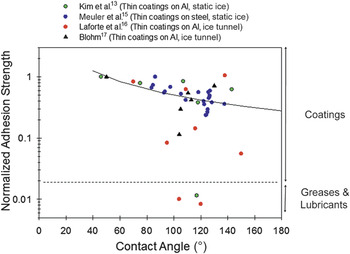
The development of icephobic coatings dates back more than five decades but has seen significant momentum in the past decade.Reference Jellinek5–Reference Stone14 Most recent efforts are based on the premise that the strength of ice adhesion decreases as the surface becomes more hydrophobic (contact angle increases to >90°). In Figure 1, the normalized ice adhesion strength for a large number of coatings is plotted as a function of their water contact angle.Reference Kim, Wong, Alvarenga, Kreder, Adorno-Martinez and Aizenberg13–Reference Laforte and Beisswenger16 The normalized ice adhesion strength can be understood as an ice reduction factor and is defined as:
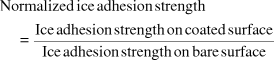 $${\rm{Normalized}}\,{\rm{ice}}\,{\rm{adhesion}}\,{\rm{strength}} = {{{\rm{Ice}}\,{\rm{adhesion}}\,{\rm{strength}}\,{\rm{on}}\,{\rm{coated}}\,{\rm{surface}}} \over {{\rm{Ice}}\,{\rm{adhesion}}\,{\rm{strength}}\,{\rm{on}}\,{\rm{bare}}\,{\rm{surface}}}}$$
Normalized ice adhesion strength as a function of the coating’s water contact angle (from various sources). Hydrophobic coatings show a modest reduction in ice adhesion. In contrast, lubricants and greases show up to two orders of magnitude of improved icephobic behavior as compared to the bare substrate. The black curve is a guide for the eye.Reference Kim, Wong, Alvarenga, Kreder, Adorno-Martinez and Aizenberg13,Reference Meuler, Smith, Varanasi, Mabry, McKinley and Cohen15–Reference Blohm17

It should be noted that ice adhesion data in Figure 1, including our own data as well as data from published literature, were obtained with widely different testing methodologies.Reference Kim, Wong, Alvarenga, Kreder, Adorno-Martinez and Aizenberg13–Reference Blohm17 Furthermore, experimental protocols with regard to removal of contaminants from the coating surface and ice buildup are not the same for all the studies. Despite these differences, we believe that the normalization process in Figure 1 allows for a reasonable comparison among the different sets of data.
The coating materials in Figure 1 encompass a broad range of organic and inorganic material compositions, from low surface energy self-assembled monolayers to polyurethanes to siloxanes to lithium grease to the newly developed slippery liquid infused porous surfaces (SLIPS).Reference Kim, Wong, Alvarenga, Kreder, Adorno-Martinez and Aizenberg13 As anticipated, more hydrophobic coatings show a more icephobic behavior; however, the increase in ice reduction factor with contact angle is rather modest even in the case of superhydrophobic (water contact angles >150°) surfaces. In contrast, coatings composed of lubricants and greases, which are used in anti-icing and de-icing applications, show superior icephobic performance with ice reduction factors of almost two orders of magnitude larger than the bare substrate. However, the use of lubricants poses considerable challenges, including the need for periodic reapplication and the potential detrimental impact on the environment.Reference Boluk, Burksoy and Haine18 Coatings containing freezing point additives have also been used in anti-icing and de-icing applications.Reference Ayres, Simendinger and Balik19 In this case, sacrificial freezing point additives may slowly be released to the surface of the coating using porous or sol-gel based systems. The freezing point depressant coatings suffer from similar problems as the lubricants (i.e., need for reapplication and negative environmental impact).
High hydrophobicity continues to be a key target in the development of low ice adhesion materials; however, the quest for truly icephobic surfaces requires an understanding of the more complex underlying mechanisms. For instance, it has been recently postulated that detachment of ice from a surface requires not only a high degree of hydrophobicity but also a relatively large initial crack size at the ice-surface interface.Reference Nosonovsky and Hejazi20 Lubricant-based coatings work in a different manner; they provide a liquid interface that allows ice to slide off easily, resulting in very low ice adhesion. The stability of surface hydrophobicity under common engineering application conditions, which often involve high velocity water droplet impact, high humidity, or variable temperatures, has also posed significant challenges in this field. For instance, an important impediment to the use of superhydrophobic coatings in ice prevention is the instability and ultimate loss of superhydrophobicity under high humidity and high velocity droplet impact conditions.Reference Mishchenko, Hatton, Bahadur, Taylor, Krupenkin and Aizenberg10–Reference Alizadeh, Yamada, Ri, Sheng, Otta, Zhong, Ge, Dhinojwala, Conway, Bahadur, Vincequerra, Stephens and Blohm12,Reference Varanasi, Deng, Smith, Hsu and Bhate21
Superhydrophobicity is often achieved by using a composite textured surface comprising low surface energy submicron features and air pockets. This composite structure is critical in minimizing water-surface contact area (the so-called Cassie state).Reference Quéré22 Under conditions of high velocity droplet impact and high relative humidity, the air pockets are easily replaced by water (the so-called Wenzel state). In this case, water-surface contact area is significantly enhanced due to surface roughness (texture). It has been suggested that SLIPS with a smooth liquid interface (lubricant in place of air) should have increased pressure stability under high velocity droplet impactReference Alizadeh, Yamada, Ri, Sheng, Otta, Zhong, Ge, Dhinojwala, Conway, Bahadur, Vincequerra, Stephens and Blohm12 (see the Introductory article in this issue). It should also be noted that hydrophobicity and low ice adhesion can be significantly influenced by other parameters such as substrate temperaturesReference Alizadeh, Bahadur, Zhong, Shang, Li, Ruud, Yamada, Ge, Dhinojwala and Sohal23 and substrate elasticity.Reference Alizadeh, Bahadur, Shang, Zhu, Buckley, Dhinojwala and Sohal24
Several recent studies have focused on the dynamics of ice nucleation on water repellent surfaces. Various techniques, including automatic lag time apparatus (ALTA) and infrared thermometry, have been used to quantitatively measure parameters such as average nucleation incubation time and average nucleation temperature. The stochastic nature of the nucleation process requires quantitative analysis of many freezing events. Significant ice nucleation delay has been reported on both textured superhydrophobicReference Alizadeh, Yamada, Ri, Sheng, Otta, Zhong, Ge, Dhinojwala, Conway, Bahadur, Vincequerra, Stephens and Blohm12,Reference Tourkine, LeMerrer and Quéré25 and lubricant-basedReference Wilson, Lu, Xu, Kim, Kreder, Alvarenga and Aizenberg26 surfaces. We have proposed that a reduction of water–surface contact area on superhydrophobic surfaces plays a dual role in delaying nucleation, first by reducing heat transfer and second by reducing the probability of heterogeneous nucleation at the water–substrate interface.Reference Alizadeh, Yamada, Ri, Sheng, Otta, Zhong, Ge, Dhinojwala, Conway, Bahadur, Vincequerra, Stephens and Blohm12 On the other hand, Wilson et al. have suggested that the ultra-smooth and chemically homogeneous interface of the lubricant-based surfaces can eliminate potential sites for ice nucleation.Reference Wilson, Lu, Xu, Kim, Kreder, Alvarenga and Aizenberg26 Using classical nucleation theory-based analysis, we estimated various homogeneous and heterogeneous nucleation rates in icing conditions as a function of surface wettability. The key finding is that the ice nucleation delay due to a reduced water–surface contact area is prominent only at moderate degrees of supercooling; closer to the homogeneous nucleation temperature of water (–40°C), bulk and air–water interface nucleation effects become equally important.Reference Alizadeh, Yamada, Ri, Sheng, Otta, Zhong, Ge, Dhinojwala, Conway, Bahadur, Vincequerra, Stephens and Blohm12
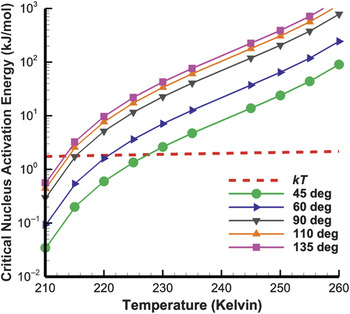
We have also studied nucleation of water droplets next to surfaces with varying wettability using supercomputer-based molecular dynamics simulations.Reference Yamada, Alizadeh and Moore27 In Figure 2, we plot the theoretical activation energy for substrate-initiated nucleation as a function of temperature and surface wettability on a semi-logarithmic scale.Reference Alizadeh, Yamada, Ri, Sheng, Otta, Zhong, Ge, Dhinojwala, Conway, Bahadur, Vincequerra, Stephens and Blohm12 The dotted line in this figure represents the thermal fluctuations. For any surface wetting conditions below the dotted line, the liquid droplets become unstable and will spontaneously freeze. Above the dotted line, formation of ice nuclei is an activation energy-determined process. Hydrophobic and superhydrophobic surfaces promote depression of spontaneous droplet freezing to deeper degrees of supercooling. Furthermore, at a given temperature, hydrophobic and superhydrophobic surfaces require higher activation energy for ice nucleation. Nonetheless, we notice that the reduction of water-substrate contact area and minimization of substrate nucleation sites does not completely inhibit ice nucleation at the substrate.
Classical nucleation-based activation energy for substrate-initiated nucleation as a function of surface wettability and temperature. At a given temperature, hydrophobic and superhydrophobic surfaces require higher activation energy for ice nucleation. Nonetheless, reduction of water-substrate contact area and minimization of substrate nucleation sites do not completely inhibit ice nucleation at the substrate.Reference Alizadeh, Yamada, Ri, Sheng, Otta, Zhong, Ge, Dhinojwala, Conway, Bahadur, Vincequerra, Stephens and Blohm12 Note: k, Boltzmann constant; T, temperature.

To summarize, there are two key messages that emerge from an analysis of existing studies on icephobic surfaces. First, ice nucleation can be reduced and delayed significantly but cannot be completely suppressed by surface-based technologies. Homogeneous nucleation is a fundamental barrier to avoiding nucleation; furthermore, low nucleation rates on superhydrophobic surfaces may not always be necessarily beneficial if nucleation events are self-propagating. The second key finding is that despite significant advances in coatings/lubricant development, sufficiently low values of ice adhesion have not yet been reached. It should be noted that in most applications, removal of ice from coatings is mediated by an external force, such as the weight of the ice layer or wind shear. This implies that the performance of coatings in low shedding force regions such as stagnation points is the critical factor that governs applicability of these coatings for ice prevention.
Many operational, durability, and manufacturing-related challenges need to be overcome to enable practical use of coatings for ice prevention. Coatings are expected to perform in very diverse environments; consequently, it is very difficult to prescribe a universal-use icephobic coating that will work in all applications. Coatings for use in marine and Arctic oil-gas drilling environments need to repel or shed saltwater ice; very little is understood about saltwater icing. Coatings for dynamic impact applications need to prevent icing under impinging supercooled liquid conditions, which often leads to rime ice.Reference Petrenko and Whitworth28 Rime ice is white in color with a comb-like, feathery or spiky appearance that forms when minute droplets precipitate on a surface, thus causing the droplets to freeze more rapidly.
On the other hand, coatings for static applications such as power lines and building infrastructure must be able to repel rime as well as glaze ice. Glaze ice is dense, smooth, and transparent and forms when large water droplets impact a surface, thus resulting in the droplets freezing relatively slowly. Ice formation mechanisms vary widely and must be factored in while designing or characterizing the coatings.
Another key area of improvement over existing icephobic coatings concerns durability and resistance to harsh environments. Sufficient mechanical, chemical, and radiation resistance are important criteria to consider while screening potential coating candidates. Improvement in coating durability often comes at the expense of deteriorating icephobicity. In this context, lubricant-based coatings, which are very icephobic, still require improvements to reach the mechanical robustness, reliability, and longevity expected for typical industrial applications. Finally, to enable widespread use of coating-based approaches, cost-effective methods for large-scale manufacturing of these surfaces require further development.
Steam condensation control on hydrophobic surfaces
Steam is a ubiquitous working fluid in industrial processes. It is the agent for converting heat to mechanical and electrical energy, and it functions as a heat exchange medium. Large inefficiencies in these systems occur at the point of interaction between steam and the solid surfaces that it contacts. Over the years, power turbines and condensers have been designed for increasingly higher efficiency. This has been achieved through incremental engineering approaches utilizing fluid dynamic design, mechanical sealing, heat transfer, and system-level design trade-offs. However, all of these incremental approaches have been bounded by a fundamental constraint of the nature of the steam-surface interaction relating to the formation of a water film that condenses on the surfaces in the steam path.
When the liquid condensate wets the hydrophilic surfaces of conventional condenser tube materials, it develops an insulating layer for heat transfer between the vapor and the solid surface. In contrast, when the surface is hydrophobic, nucleated condensate forms droplets, which upon roll-off enhance the heat transfer through condensation (see the Miljkovic and Wang article in this issue).
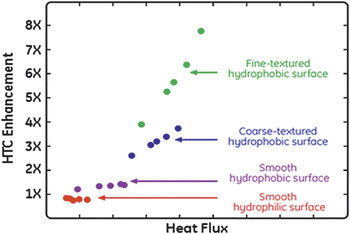
Ultra-efficient dropwise condensation (DWC) under ideal laboratory conditions can enhance heat transfer performance by a factor of ∼5–7 compared to filmwise condensation (FWC).Reference Finnicum and Westwater29–Reference Chung, Kim and Ahmadinejad31 Many approaches to fabricate hydrophobic behavior in engineered materials mimic the structures of natural surfaces, such as that of the lotus leaf (see the Introductory article in this issue). Such surfaces have been used to achieve superhydrophobicity, with contact angles in the range of 150–175° and low roll-off angles of <5°.Reference McNeil32 Such high hydrophobicity is achieved through a hierarchical structure similar to those found on a lotus leaf (micron-scale structures with nanoscale asperities). These engineered two-tiered superhydrophobic surfaces promote stable DWC formation and can shift the condenser design paradigm.Reference Chen, Cai, Tsai, Chen, Xiong, Yu and Ren33Figure 3 shows data for steam condensation heat transfer on microstructured superhydrophobic surfaces developed at General Electric (GE).Reference Ruud, Varanasi, Bhate, Gentleman and Manoharan34 The smooth hydrophilic silicon surface shows FWC; the heat transfer characteristics are well-represented by Nusselt’s FWC model.Reference Incropera and Dewitt35 By depositing a fluorosilane layer, the surface can be rendered hydrophobic, resulting in a modest heat transfer coefficient enhancement. However, by adding texture using photolithography, the hydrophobic silicon surface shows a five-fold enhancement for a coarse texture and as much as an eight-fold enhancement for a fine texture due to DWC. The superior roll-off and anti-adhesion properties of such surfaces allow for release of much smaller size droplets, creating “truly fresh” nucleation surfaces. Recently, Yin et al.Reference Yin, Zhu, Wang and Ding36 showed that condensate drops can be autonomously removed on a superhydrophobic surface without any external force. Furthermore, the use of lubricant-based surfaces that allow lower nucleation barriers coupled with release of smaller sized droplets has been shown to improve the condensation behavior.Reference Anand, Paxson, Dhiman, Smith and Varanasi37
Heat transfer coefficient (HTC) enhancement as a function of heat flux on several tested coatings developed at GE.Reference Ruud, Varanasi, Bhate, Gentleman and Manoharan34 Increasing surface hydrophobicity results in significant condensation heat transfer enhancement.

Hydrophobic and superhydrophobic surfaces therefore can have a tremendous impact on the operating efficiency of plants that rely on condensation heat transfer. While these requirements can be met using a variety of polymeric coatings, the additional requirement of operational stability in the relevant environments renders almost all of the available polymeric materials unusable. The two significant barriers to translating these interesting scientific results into practical technologies are (1) the durability in harsh industrial environments, and (2) scalability for economic manufacturing. Consequently, for successful industrialization, the coating materials need to be robust as well as inherently hydrophobic with low hysteresis.
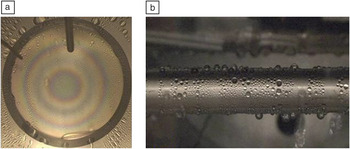
GE has developedReference Ruud, Kulkarni, Ajdelsztajn, Bahadur, Leblanc, Piao, Sanchez, Sivaramakrishnan, Soare, Yosenick, Demiroglu, Manoharan and Blohm38 novel low-surface-energy durable inorganic/organic coatings that can sustain DWC for extended periods. Figure 4 shows DWC heat transfer performance of two such coatings, which are ceramics made of rare-earth oxides,Reference Gentleman, Ruud and Manoharan39 on a flat surface and on a steel tube. The high melting temperature, hardness, strength, and erosion resistance of inorganic (such as ceramics) coatings make it possible to tailor them for durability in a variety of industrial environments. Novel oxide ceramics (with surface energies lower than 0.032 J/m2) and hybrid organic/inorganic coatings developed at GE show greater than three-fold enhancement in steam side heat transfer with respect to the hydrophilic surface under power plant condenser conditions. For combined cycle (gas turbine cycle + steam turbine bottoming cycle) plants, such an enhancement in the condensation heat transfer would result in significant reduction in fossil fuel requirements amounting to >$100 million in annual savings in the United States.40 Furthermore, for coal-fired plants, which generate 60% of the total electricity in the United States, a 5% reduction in condenser pressure due to a dropwise condensing coating would entail a reduction of >20 million tons per year of CO2 emissions. Furthermore, these coatings have been shown to sustain steam DWC for over 1,000 hours. Note that durability considerations for condenser coatings encompass mechanical damage (vibration, steam/water impingement, thermal cycling), chemical damage (steam exposure stability, boiler feedwater chemicals), and assembly damage (wear during installation, handling). However, mechanical loading and chemical exposure conditions are moderate and not expected to significantly affect the coating life. Therefore, coating stability under steam exposure is the key life-limiting factor and should be extensively monitored.
Sustained dropwise condensation on GE-developed (a) flat inorganic coating and (b) organic/inorganic hydrophobic coating on a tube. The coatings are ceramics composed of rare-earth oxides. The diameters of the coupon and the tube in (a) and (b) equal 5.08 and 1.59 cm, respectively.Reference Ruud, Kulkarni, Ajdelsztajn, Bahadur, Leblanc, Piao, Sanchez, Sivaramakrishnan, Soare, Yosenick, Demiroglu, Manoharan and Blohm38

Conclusions
In summary, hydrophobicity has emerged as a very rich area for high-quality fundamental research over the past decade; ice mitigation and condensation heat transfer enhancement continue to be very attractive application areas for this field. For both applications, a critical criterion for industrial utilization is coating robustness. The durability of existing low-surface-energy hydrophobic materials is a challenge for many harsh industrial environments. Furthermore, to enable widespread use of these coatings, cost-effective methods for large-scale manufacturing need to be developed. The development of hybrid solutions that combine coatings with active energy sources is an attractive and emerging approach for ice prevention applications. Icephobic coatings in combination with existing anti-icing systems have the potential to significantly reduce the power requirements of existing anti-icing systems. In the area of power generation, the reduced heat transfer resistance will lead to improvement in operating efficiency and reduction in CO2 emissions. The sustained performance demonstrated by the developed coatings will enable the insertion of this technology in industrially relevant applications.
Acknowledgments
The authors are very thankful to Margaret Blohm, Mohan Manoharan, Kevin McEvoy, Molly Gentleman, Nitin Bhate, Kripa Varanasi, Mike Ostrowski, Sherif Mohammed, and Scott Miller for their assistance in this work and helpful discussions. This work was performed under the support of the U.S. Department of Commerce, National Institute of Standards and Technology, Advanced Technology Program, Cooperative Agreement Number 70NANB7H7009, and the GE Advanced Technology Nanotechnology Program.