Implications
The continuously unavailability of forage in the Mediterranean area encouraged the use feed alternatives as agro-industrial by-products and aromatic plants by-products to feed animals. The use of rosemary distillation residues that represent important amounts in many regions can be valued as pellets that substitute the traditional roughages, enhance the carcass and meat qualities of Barbarine lambs without promoting their growth and could be an alternative that farmers can adopt in harsh conditions to feed livestock.
Introduction
In the South of Mediterranean area, animal feeding is mainly based on rangelands and stubble with small amounts of concentrate. However, actually the production of animal’s food is constrained by the climate changes leading to severe drought periods and the availability of feed from natural pasture is becoming limited. Consequently, sheep and goats are fed low quality forages or are grazing on degraded rangelands. The unavailability of feed was worsened by the continuously increase of imported feed prices whose have tripled over the last decades (Atti et al., Reference Atti, Bocquier and Khaldi2003; Majdoub-Mathlouthi et al., Reference Majdoub-Mathlouthi, Saïd, Say and Kraiem2013). The scarce availability of forage and the volatilizing prices of concentrate encouraged the researchers to find new alternatives that brings high energy and maintains animal’s performance with low cost (Obeidat et al., Reference Obeidat, Mahmoud, Maswadeh and Bsoul2016). During the last decades, to overcome this problem in many countries, many nonconventional foods were used as shrubs and agro-industrial by-products. However, the distillation by-products of medicinal and aromatic plants are under used in animal nutrition. In regard to potential antioxidant activity, an increasing attention was focused to the use of essential oils (EO) or residues of distillation of these plants as animal’s feed additive (Jordan et al., Reference Jordan, Monino, Martinez, Lafuente and Sotomayor2010; Smeti et al., Reference Smeti, Atti, Mahouachi and Munoz2013).
The Rosmarinus officinalis L. (Rosemary) is a plant widespread in the Mediterranean area. It occupied 346 000 ha in Tunisia where the industry distillation to produce EO generated abundant amounts of residues in form of distillated leaves (5460 T/year; APIA, 2003). Its use as alternative food for small ruminants in these semi-arid regions may be very interesting. However, none of the cited studies looked into the possibility of total replacing of conventional forage by the distillation residues of medicinal and aromatic plants. Their use to feed animals can improve animal products and enhance the carcass quality seen their richness on bioactive components.
Therefore, the aim of the current study was to determine the effects of rosemary distillation residues use as roughage, on lamb’s growth, carcass and noncarcass components and meat physico-chemical properties.
Material and methods
The trial was carried out at the National Institute of Agricultural Research of Tunisia. The animals were handled by specialized personnel who ensured their welfare.
Experimental feeds
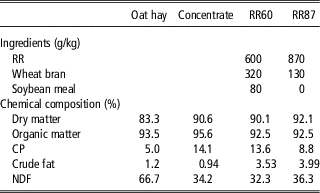
The oat hay was produced in the experimental station of INRAT and the concentrate was bought in a manufactory. The rosemary residues (RR) were collected from a forest in the Northwest of Tunisia which is characterized by a semi-arid climate and were transferred to ESA Kef, dried at the air for 1 week, then ground and mixed in the manufactory with wheat bran and soybean meal in different proportions to fabricate two types of rosemary pellets with two different RR levels (Table 1). The first type of pellets contains 60% of RR (RR60)and has similar CP content (14% of CP) as alfalfa pellets; the second type contains 87% of RR (RR87) and has similar CP content as a high quality oat hay (9% of CP).
Ingredients and chemical composition of experimental feeds

RR=distillate rosemary residues; RR60=pellets containing 60% of distillate rosemary residues; RR87=pellets containing 87% of distillate rosemary residues.
Animal management and experimental design
A total of 21 fat-tail male Barbarine lambs, 10-month old, averaged 23.7±4.4 kg of BW were used. Animals were randomly divided into three homogeneous groups (seven lambs each) according to initial BW. The lambs were housed in individual boxes and were assigned randomly to one of the following diets: a control group (C) (BW=25.2±3.8 kg) fed 600 g of oat hay, the RR87 group (BW=22.5±5.9 kg) received 600 g of RR87 pellets and the RR60 group (BW=23.2±3.1 kg) received 600 g of RR60 pellets. All lambs were supplemented by 600 g of concentrate. The offered and refused feeds were daily recorded. Lambs were weighed in the beginning of the trial and each week prior the morning feeding. Before the controlled trial, animals were allowed to an adaptation period of 15 days to the experimental regimens in which the feed amounts increased progressively as the intake increased until reaching a ration composed by 600 g of roughage (oat hay, RR87 and RR60) and 600 g of concentrate. The growth trial lasted 77 days where lambs had free access to water. Animals and feed were weighed accurately by using electronic scales (Douik Instruments; Société Douik Balance, Sousse, Tunisia). The chemical composition of the feeds is shown in Table 1. Samples of oat hay, concentrate and the two types of RR pellets were dried (75°C), ground (1-mm screen), and analyzed for DM (105°C until constant weight), Nitrogen (Kjeldahl Method) and ash according to Association of Official Analytical Chemists (AOAC) (1990). Neutral detergent fiber were analyzed using an ANKOM220 fiber analyzer (ANKOM Technology Corp., Macedon, NY, USA).
Slaughter procedure and carcass measurements
All lambs were slaughtered in the abattoir of the INRAT. Before slaughtering, lambs were fasted for 12 h with free access to water. Animals were weighed just before slaughter (slaughter BW (SBW)). The head, skin, feet, full and empty digestive tract, red organs (heart, liver, lung and trachea), internal fats (omental and mesenteric) and the hot carcasses (HCW) were weighed using an electronic scale (Société Douik Balance, Sousse, Tunisia). The gut content was determined by difference between full and empty digestive tract. The carcasses were stored at 4°C for 24 h. Then, cold carcasses were weighed (CCW). The kidneys, kidney fat, testis and the fat-tail were removed and weighed. The empty BW (EBW) was determined by difference between SBW and gut content.
The dressing percentage was calculated as:
 $${\rm DP}\equals100\times {\rm CCW/SBW}$$
Carcass cutting and dissection
Each carcass was split longitudinally into two halves which were weighed. Each left halve was cut into four joints (leg, shoulder, neck and a block composed by ribs, loin and breast). Every joint was weighed and dissected into fat, muscle, bones and waste (tendons, lymph,). The tissues of each joint were weighed individually. The sum of weights of each tissue for all joints represents the weight of tissue in the half carcass and was used for calculation of carcass tissular composition.
Meat physico-chemical properties
All meat properties were measured on the Longissimus dorsi (LD) muscle. The pH was measured 1 and 24 h after slaughter between the 12th and 13th thoracic vertebrae using a penetrating electrode connected to a portable pH-meter (HI 99163; Hanna Instruments, Romania) after calibration with two buffers (7.01 and 4.01). To determine the water cooking loss (WCL), meat samples were weighed (initial weight, W i ) using an electronic scale (Société Douik Balance, Sousse, Tunisia) and held in plastic bags and then immersed in a water-bath at 75°C and heated for 30 min until the internal temperature reached 75°C, which was monitored with thermocouple. Then, the bags were cooled under running tap water and blotted dry with paper towels. The cooked meat was weighed again (final weight, W f ). The WCL was calculated as 100×(W i −W f )/W i .
For meat color parameters, a Minolta chroma Meter CR-400 was used to measure color directly on the muscle surface, the colorimetric indices lightness (L*), redness (a*) and yellowness (b*) were recorded. For the chemical composition, meat samples were lyophilized (DM) and ground (1 mm screen). Ash content was determined by combustion at 600°C for 8 h. The nitrogen (N) was determined by the DUMAS procedure of direct combustion (AOAC, 1999), this method measures the total nitrogen as nitrogen gas after complete combustion using the Gerhardt Dumatherm Nitrogen/Protein Analyzer and then the proteins were calculated as N×6.25. Meat intramuscular fat was extracted with petroleum ether and analyzed according to the Ankom method, AOCS Official Procedure Am 5-04 using the ANKOM XT 15 Extractor. The intramuscular collagen content was determined according to the method of Bonnet and Kopp (Reference Bonnet and Kopp1984), based on the extraction of hydroxyproline by hot hydrolysis in acid medium. The myoglobin content was determined in 5 g ground muscle sample according to the method described by Hornsey (Reference Hornsey1956) and the results were read at 513 nm. Iron content was calculated from the result of myoglobin content as: iron=myoglobin content/304.
Statistical analysis
Statistical analysis was performed by ANOVA using GLM procedure of SAS (2004) to test the effects of the diet on studied parameters. Data corresponding to each parameter had normal distribution and no transformation methods were used. Differences with a level of significance below 5% were considered significant. The following contrasts were also used to compare the effects of the different diets:
C1: the effects of inclusion of RR [C v. RR60+RR87]
C2: the effects of RR pellet type [RR60 v. RR87]
Results
Feed intake, lamb’s growth parameters, carcass weight and dressing percentage
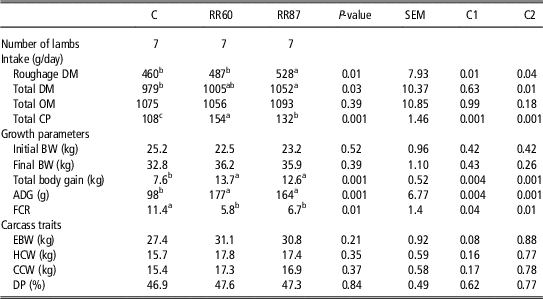
The data relative to feed intake and lamb’s growth parameters are shown in Table 2. During the trial, the total DM intake was similar for both RR groups and significantly higher than C group (P<0.05). The CP intake was higher (P<0.001) for RR60 than C group (156 v. 108 g/day), while the RR87 had an intermediate value (133 g/day). Both contrasts were significant for this parameter. Final BW (35±5 kg) was not affected by the dietary treatment. However, the total gain and the average daily gain (ADG) were similar between both groups fed RR but higher (P<0.001) than C group. The feed conversion ratio (FCR) was significantly higher for C (11.4 kg DM/kg gain) than both RR groups (5.8 and 6.7 for RR60 and RR87, respectively).
Feed intake, lamb’s growth, carcass weights and dressing percentage for Barbarine lambs fed oat hay (C) or residue rosemary pellets (RR60 and RR87)

C=control group receiving oat hay; RR60=group receiving pellets containing 60% distillate rosemary residues; RR87=group receiving pellets containing 87% distillate rosemary residues; DM=dry matter; OM=organic matter; ADG=average daily gain; FCR=feed conversion rate; EBW=empty BW; HCW=hot carcass weight; CCW=cold carcass weight.
C1: C v. RR60±RR87; C2: RR60 v. RR87.
a,b,cMeans within rows with different superscript differ significantly (P<0.05).
The SBW, EBW, HCW, CCW were not statistically affected by the diets (P>0.05, Table 2), even if the EBW was higher for RR60 and RR87 lambs (averaged 31 kg) than control ones (27.4 kg). The dressing percentage was similar among groups; both contrasts were not significant for this parameter.
Carcass composition
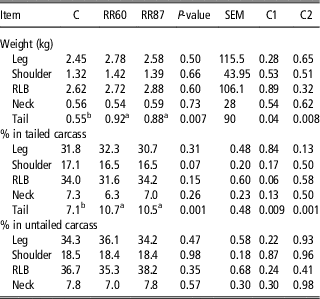
The weight of the different carcass joints and their proportions relative to the tailed and untailed carcasses are summarized in Table 3. The leg, shoulder, neck and the RLB (ribs, loin and breast) weights did not differ among groups while the tail weight was higher for groups fed RR than C. The proportions of leg, shoulder, RLB and neck were similar in the tailed carcasses, while the tail proportion was higher for RR diets. All joints’ proportions in the untailed carcass were unaffected by the diets.
Carcass joints’ weights (kg) and proportions in the tailed and untailed carcasses of Barbarine lambs fed oat hay (C) or residue rosemary pellets (RR60 and RR87)

C=control group receiving oat hay; RR60=group receiving pellets containing 60% distillate rosemary residues; RR87=group receiving pellets containing 87% distillate rosemary residues; RLB=weight (ribs±loin±breast).
C1: C v. RR60±RR87; C2: RR60 v. RR87.
a,bMeans within rows with different superscript differ significantly (P<0.05).
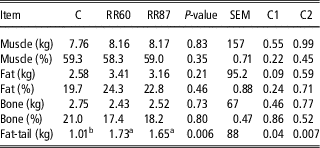
The weights and proportions of carcass tissues and fat depot are presented in Table 4. The weights of muscle, bone and adipose tissue were unaffected by the diet (P>0.05). The caudal fat was higher for both groups fed RR than C.
Weights (kg) and proportions of carcass tissues of Barbarine lambs fed oat hay (C) or residue rosemary pellets (RR60 and RR87)

C=control group receiving oat hay; RR60=group receiving pellets containing 60% distillate rosemary residues; RR87=group receiving pellets containing 87% distillate rosemary residues.
C1: C v. RR60±RR87; C2: RR60 v. RR87.
a,bMeans within rows with different superscript differ significantly (P<0.05).
Noncarcass components
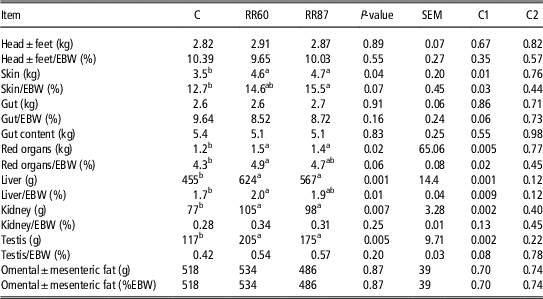
Noncarcass components’ weights and proportions are shown in Table 5. The skin weight was higher for both RR groups, but the head and feet weights and proportion in EBW were similar among groups. The weights of all red organs, liver, kidney and testis were significantly higher for groups fed RR diets than control. The gut and the digestive content weights as well as that of omental and mesenteric fat were similar among groups.
Noncarcass components’ weights and proportions in empty BW (EBW) of Barbarine lambs fed oat hay (C) or residue rosemary pellets (RR60 and RR87)

C=control group receiving oat hay; RR60=group receiving pellets containing 60% distillate rosemary residues; RR87=group receiving pellets containing 87% distillate rosemary residues.
C1: C v. RR60±RR87; C2: RR60 v. RR87.
a,bMeans within rows with different superscript differ significantly (P<0.05).
Meat physico-chemical properties
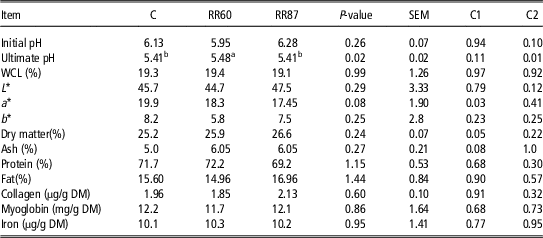
The initial meat pH was similar among regimens but the ultimate pH was higher (P=0.02) for the RR60 group (Table 6). The water cooking loss was similar among groups. The color parameters (L*, a*and b*) did not differ among diets. The meat dry matter, ash, protein, fat, myoglobin, collagen and iron contents were also unaffected by diets.
Meat physico-chemical properties of Barbarine lambs fed oat hay (C) or residue rosemary pellets (RR60 and RR87)

C=control group receiving oat hay; RR60=group receiving pellets containing 60% distillate rosemary residues; RR87=group receiving pellets containing 87% distillate rosemary residues; WCL=water cooking loss.
C1: C v. RR60±RR87; C2: RR60 v. RR87.
a,bMeans within rows with different superscript differ significantly (P<0.05).
Discussion
Feed intake, lamb’s growth, carcass weight and dressing percentage
Compared with oat hay, the higher DM intake for both RR diets may be explained by their condensed form and the appetence of rosemary. The higher CP intakes for lambs fed RR diets is associated with the higher CP content of these diets than that of oat hay (14 and 9% v. 5%, respectively). Sheep on RR60 and RR87 diets consumed the same amount of roughages and concentrate (P>0·05) suggesting that RR pellets with 9% or 14% CP had similar appetence and so the increasing CP level in RR pellets until 14 had no advantage in terms of intake.
The high ADG for lambs fed RR diets can be related to the higher DM intake and mostly to the high CP content in the RR diets. Nutrients produced by fermentation of RR-containing diets could be important factors for the increase in BW gain. Although this difference in the total and daily gain, the final BW did not differ among groups; the higher initial BW for C group would originate this similarity. The lowest ADG for lambs of C group lead to the highest feed conversion rate; it was nearly twice that of RR diets (11.4 v. 6.3). These results confirmed the principle meaning that weak growth rates lead to high FCR (Boccard, Reference Boccard1963). Similar values of FCR were reported for Awassi lambs fed Atriplex (Obeidat et al., Reference Obeidat, Mahmoud, Maswadeh and Bsoul2016). However our results are better than those of Majdoub-Mathlouthi et al. (Reference Majdoub-Mathlouthi, Saïd, Say and Kraiem2013) for Barbarine lambs fed hay and different concentrate levels, which FCR ranged between 9.3 and 15.8. Despite, the difference in the protein level in the RR roughages made by adding soybean meal for RR60, both RR diets resulted in similar ADG and similar FCR. At the experiment conception, the addition of the RR60 regimen containing 14% CP was in the thinking whether the 9% CP in the roughage is sufficient. The daily growth rate reaction approved this presumption as performance of lambs in RR60 group receiving pellets at 14% CP and those in RR87 group receiving pellets at 9% CP were similar. This performance could be explain by the fact that the extra nitrogen supply by RR60 may not be exploited by lambs for lack of appropriate level of energy, which level was similar for RR87 and RR60 diets. Consequently, the use of pellets containing more RR and less soybean (RR87) permits to reduce the cost of RR pellets. So, it can be concluded that RR-based pellets containing 9% CP is an appetizing food that can totally replace traditional roughage without altering the lamb’s feed intake and improving growth rate.
The similarity of EBW, HCW, CCW and DP among groups is the consequence of similarity of slaughter BW for all lambs, given these parameters are strongly correlated to the slaughter BW (Atti et al., Reference Atti, Bocquier and Khaldi2003). It was reported that increasing SBW above 35 kg could improve dressing percentage without having detrimental effects on carcass and meat quality (Abdullah and Qudsieh, Reference Abdullah and Qudsieh2008). However, these results are similar to the values reported (46% to 47%) for many sheep breeds (Abdullah and Qudsieh, Reference Abdullah and Qudsieh2008). In the same context, the dietary supplementation with rosemary as additive had no effects on carcass weight and dressing percentage for lambs (Smeti et al., Reference Smeti, Atti, Mahouachi and Munoz2013).
Carcass composition
The total substitution of hay by RR pellets did affect neither the carcass joints’ weights (leg, shoulder, neck and RLB) nor their proportions in the tailed or untailed carcasses expect to the tail joint. These results are on line with earlier reported results for lambs (Hajji et al., Reference Hajji, Smeti, Ben Hamouda and Atti2016b). The proportions of leg, shoulder and neck are similar to those found by Hajji et al. (Reference Hajji, Smeti, Ben Hamouda and Atti2016b) for the same breed. These results on constancy of joint’s proportion in the carcass confirm the theory of anatomic harmony reported by several works for thin tail and fat-tail breeds (Atti et al., Reference Atti, Bocquier and Khaldi2003; Obeidat et al., Reference Obeidat, Mahmoud, Maswadeh and Bsoul2016).
The constancy of bone tissue among all dietary treatments is explained by the precocity of this tissue. It had an early development in all animal species and its development is independent on nutrition but depends more on age (Hajji et al., Reference Hajji, Smeti, Ben Hamouda and Atti2016b). The lambs deposited similar amounts of muscle in the carcass regardless the diet. Moreover, the similar SBW can be at the origin of the lack of difference on muscle tissue’s importance (Atti et al., Reference Atti, Bocquier and Khaldi2003). Although without significant difference, the body fat increased in weight and proportions in the experimental groups compared with the control one. The high nutrient consumption and protein level of the RR diets could be at the origin of this difference (Atti et al., Reference Atti, Bocquier and Khaldi2003). However, the different proportions of protein in the RR diets resulted in the same amount of fat. All these lambs exceeded the puberty age and advanced the growth stage, consequently they gained more fat tissue as reported by Hajji et al. (Reference Hajji, Smeti, Ben Hamouda and Atti2016b) for the young sheep slaughtered at elevated weight and advanced age. It was reported that fat depots depend mainly on slaughter weight, nutritional level and nutrient utilization (Murphy et al., Reference Murphy, Loerch, McClure and Solomon1994).
Noncarcass components
Although the difference in diets composition, there was no difference in the weight of almost noncarcass component. These results are on line with earlier reported works which confirmed that the offal components’ weight depends more on animal slaughter weight than the intake level or diet composition (Atti et al., Reference Atti, Bocquier and Khaldi2003). Besides, Delfa (Reference Delfa1992) reported that breed, age, sex and slaughter weight are the main factors that influence the noncarcass weight while in the current study all these parameters were fixed factors. The head and feet represent the most rich organs in bone, they are relatively less affected by the regimen seen their negligible fat proportion and for being early maturing parts (Hajji et al., Reference Hajji, Smeti, Ben Hamouda and Atti2016b). However, the skin weight was higher for RR diets and this can be explained by the higher metabolic activity of this anatomic region, which is active and proportionally related to the EBW which is lower for the control group compared with the experimental ones (Atti et al., Reference Atti, Bocquier and Khaldi2003). Although that lambs receiving RR diets were heavier than lambs of control one, the gut weight was similar among group in contrast to results of Thériez et al. (Reference Thériez, Touraine, Vigneron and Prud’hon1992) who confirmed that the rumen continue to develop as animals become heavier and older. The similarity of the almost offal and gut content weights originated the similarity in the dressing percentage among lambs as reported by Majdoub-Mathlouthi et al. (Reference Majdoub-Mathlouthi, Said and Kraiem2015). The weight of liver, kidney and red organs were higher for RR-based diets, this is due to the fact that red cut-down organs are not affected by the SBW (Atti et al., Reference Atti, Rouissi and Mahouachi2004). However, the liver and kidney can be affected by the physical activity and could be higher for animals grazing on natural plants than the stall ones (Majdoub-Mathlouthi et al., Reference Majdoub-Mathlouthi, Said and Kraiem2015). This higher weight of liver for RR diets could be probably due to the richness of their diets on protein that determine the liver development as a result of nutrient produced by fermentation of RR pellets. The precursor of hepatic lipogenesis is the acetate originating from the microbial degradation of the fibers. It is worth noting that RR diets increased the testis weight. This superiority can be explained by their high growth rate compared with the control one. Indeed, the enhanced protein level in the experimental diets enhanced the testis weight. However it is interesting to investigate this path on feeding RR in different levels in the diet on the testis weight given its relationship with spermatozoa production, important criteria of ram’s reproduction.
Meat physico-chemical properties
The ultimate pH is an important parameter in meat quality. After 24 h, the glycogen reserves were exhausted and the pH was stabilized at an average value of 5.43. These ultimate pH values were unaffected by the RR presence and were within the acceptable range for lamb meat (Majdoub-Mathlouthi et al., Reference Majdoub-Mathlouthi, Saïd, Say and Kraiem2013). This result underlined the regular trend of the post mortem glycolysis in the muscle. It indicates an effective acidification of meat similar for all groups. All groups showed similar pH decrease from the slaughter until 24 h postmortem. The WCL was unaffected by the RR diet and the acceptable pH values determine the similarity in this parameter, as the water holding capacity is strongly linked to the pH. In the same context, the incorporation of rosemary essential oil as additive in Barbarine lambs diet (Smeti et al.,Reference Smeti, Atti, Mahouachi and Munoz2013) did not affect the cooking loss. The meat luminosity (L*) for all groups was above 44 indicating an acceptable meat, as a meat with a lightness value equal to or above 34 is acceptable and above 44 was acceptable by 95% of consumers (Khliji et al., Reference Khliji, Van de Ven, Lamb, Lanza and Hopkins2010). The redness (a*) and the yellowness (b*) did not differ among groups. Haak et al. (Reference Haak, Raes, Van Dyck and De Smet2008) found no difference on LD muscle color parameters after dietary intake of antioxidants as α-tocopherol acetate and rosemary extract. The diets did not affect the meat chemical composition and both contrasts were not significant. The DM, ash, protein and fat contents were similar among groups. The similarity in meat chemical components could result from the similar feeding value and comparable energy levels among the diets (Luciano et al., Reference Luciano, Pauselli, Servili, Mourvaki, Serra, Monahan, Lanza, Priolo and Mele2013). The DM, ash and protein are comparable with results of Majdoub-Mathlouthi et al. (Reference Majdoub-Mathlouthi, Said and Kraiem2015) for Barbarine lambs. However, the intramuscular fat content (15.8%) in the present study is lower than some results reported for the same breed and for other breeds (Hajji et al., Reference Hajji, Joy, Ripoll, Smeti, Mekki, Molino Gahete, Mahouachi and Atti2016a). The similarity of muscle pigment (myoglobin) among groups can be attributed to the ultimate pH, considered normal (5.5 to 5.7), which limit the consumption of oxygen by the muscle where the pigment conserved its red oxygenated form on the surface. The myoglobin reflected an objectively similar meat color among groups. This chemical result was confirmed by the instrumental measurements of meat color. Hence, the absence of difference in meat myoglobin resulted in similar iron values. The similarity in collagen content confirmed that of Serrano et al. (Reference Serrano, Prache, Chauveau-Duriot, Agabriel and Micol2007) showing that total collagen content in longissimus thoracic muscle was not influenced by the diet. However, it was shown that the collagen characteristics differ among muscles and among breeds due to the variation in the maturity of the breed (Blanco et al., Reference Blanco, Jurie, Micol, Agabriel, Picard and Garcia-Launay2013). For that, in the current study collagen did not differ among groups seen that all samples were from the same muscle and all lambs are from the same breed and had the same maturity rate.
Conclusion
Feeding sheep by RR did not affect carcass characteristics nor alter meat quality, however, it improved the growth rate and the feed conversion rate. So, these forest residues can be used as an alternative feedstuff in livestock diets without adverse effect on sheep performances. Nevertheless in the absence of an appropriate energy level, the increased nitrogen supply would not be used by the animals and engenders an economic lost. Consequently, in similar conditions as the current study, the lower CP (9%) form is sufficient to guaranty an acceptable lamb’s growth, while as a perspective research, the RR pellets with high nitrogen content could be enriched by energy supply such as molasses and tested in concentrate substitution.
Acknowledgments
The authors gratefully acknowledge ESAK staff for their collaboration and help in the conduct of this study and the ODESYPANO for their financial support. They are indebted to Z. Taghouti and J. Khlil from INRAT-PAF Laboratory and to L. Tayachi from ESAM for their technical help and meat analyses during this work.
Declaration of interest
None.
Ethics statement
All procedures employed in this study (transport and slaughtering) meet ethical guidelines and adhere to Tunisian legal requirements (The Livestock Law No. 2005-95 of 18 October 2005, Chapter II; Section 1 and Section 2 relative to the slaughter of animals).
Software and data repository resources
None.