Introduction
Paediatric anxiety disorders are extremely common (Fleitlich-Bilyk & Goodman, Reference Fleitlich-Bilyk and Goodman2004; Merikangas et al. Reference Merikangas, He, Burstein, Swanson, Avenevoli, Cui, Benjet, Georgiades and Swendsen2010) and are associated with both concurrent and future negative health outcomes (Pine et al. Reference Pine, Cohen, Gurley, Brook and Ma1998; Kim-Cohen et al. Reference Kim-Cohen, Caspi, Moffitt, Harrington, Milne and Poulton2003; Bittner et al. Reference Bittner, Egger, Erkanli, Jane Costello, Foley and Angold2007). The study of psychological processes involved in anxiety disorders vitally informs attempts to identify and treat these conditions (Pine et al. Reference Pine, Helfinstein, Bar-Haim, Nelson and Fox2009). While many processes have been implicated in both paediatric and adult anxiety disorders, biases in attention orienting are one of the most consistently observed information-processing correlates of anxiety (Guyer et al. Reference Guyer, McClure, Adler, Brotman, Rich, Kimes, Pine, Ernst and Leibenluft2007; Shechner et al. Reference Shechner, Britton, Perez-Edgar, Bar-Haim, Ernst, Fox, Leibenluft and Pine2012). Moreover, evidence from experimental studies suggests that such biases either cause or maintain anxiety (Hakamata et al. Reference Hakamata, Lissek, Bar-Haim, Britton, Fox, Leibenluft, Ernst and Pine2010; Hallion & Ruscio, Reference Hallion and Ruscio2011).
Studies in adults establish the ability of threats to uniquely influence attention orienting in anxious subjects (Mogg & Bradley, Reference Mogg and Bradley1998; Bar-Haim et al. Reference Bar-Haim, Lamy, Pergamin, Bakermans-Kranenburg and van IJzendoorn2007). Available findings suggest that the threshold for mild threats to influence orienting is lower in anxious than non-anxious adults, thereby eliciting pathological fear in inappropriate contexts (Guyer et al. Reference Guyer, McClure, Adler, Brotman, Rich, Kimes, Pine, Ernst and Leibenluft2007). While various attention paradigms have been used to demonstrate such associations, findings appear most consistent with the dot-probe attention-orienting paradigm (Bar-Haim et al. Reference Bar-Haim, Lamy, Pergamin, Bakermans-Kranenburg and van IJzendoorn2007). Imaging studies (Monk et al. Reference Monk, Nelson, McClure, Mogg, Bradley, Leibenluft, Blair, Chen, Charney, Ernst and Pine2006, Reference Monk, Telzer, Mogg, Bradley, Mai, Louro, Chen, McClure-Tone, Ernst and Pine2008) and animal models (Nelson et al. Reference Nelson, Bloom, Cameron, Amaral, Dahl and Pine2002) suggest that attention biases on the dot-probe paradigm reflect early-life perturbations in specific brain regions. These data, when coupled with longitudinal data linking paediatric and adult anxiety (Pine et al. Reference Pine, Cohen, Gurley, Brook and Ma1998), generate interest in biased orienting in paediatric anxiety disorders. While research has begun to examine this issue (Guyer et al. Reference Guyer, McClure, Adler, Brotman, Rich, Kimes, Pine, Ernst and Leibenluft2007), major questions exist concerning the available findings.
Some questions relate to diagnosis. Attention biases on the dot-probe paradigm emerge in a range of paediatric anxiety disorders, including generalized anxiety disorder (GAD) (Taghavi et al. Reference Taghavi, Dalgleish, Moradi, Neshat-Doost and Yule2003; Monk et al. Reference Monk, Nelson, McClure, Mogg, Bradley, Leibenluft, Blair, Chen, Charney, Ernst and Pine2006; Waters et al. Reference Waters, Mogg, Bradley and Pine2008), post-traumatic stress disorder (PTSD) (Dalgleish et al. Reference Dalgleish, Taghavi, Neshat-Doost, Moradi, Canterbury and Yule2003; Pine et al. Reference Pine, Mogg, Bradley, Montgomery, Monk, McClure, Guyer, Ernst, Charney and Kaufman2005), separation anxiety disorder (In-Albon et al. Reference In-Albon, Kossowsky and Schneider2010), social phobia (Waters et al. in press), anxiety disorders as a group (Roy et al. Reference Roy, Vasa, Bruck, Mogg, Bradley, Sweeney, Bergman, McClure-Tone, Pine and Team2008; Hankin et al. Reference Hankin, Gibb, Abela and Flory2010) and even non-diagnosed youth with high scores on trait-anxiety measures (Watts & Weems, Reference Watts and Weems2006; Telzer et al. Reference Telzer, Mogg, Bradley, Mai, Ernst, Pine and Monk2008; Waters et al. Reference Waters, Henry, Mogg, Bradley and Pine2010a). Hence, one set of questions concerns the degree to which attention biases relate to specific anxiety disorders, overall symptoms of anxiety irrespective of diagnostic status, or to broader categories of psychiatric diagnosis. Proposed nosological revisions recognize the distinction between fear and distress disorders within the broader anxiety disorders group based on independent evidence from twin studies showing distinct genetic and environmental contributions (Kendler et al. Reference Kendler, Prescott, Myers and Neale2003; Lahey et al. Reference Lahey, Van Hulle, Singh, Waldman and Rathouz2011), as well as distinct symptom structures (Watson, Reference Watson2005; Watson et al. Reference Watson, O'Hara and Stuart2008). When combined with other work on attention bias, this generates questions on the manner in which attention bias relates to anxiety symptoms in children with fear disorders, distress disorders, and children with other forms of psychopathology distinct from anxiety.
Beyond these diagnostic issues, other questions concern the relationships among attention bias, diagnosis, and severity of paediatric internalizing symptoms. While attention biases have been found to be associated with symptom severity, results across studies have been mixed. Thus, some studies find larger biases towards threat in children with higher ratings on internalizing symptom scales (Dalgleish et al. Reference Dalgleish, Taghavi, Neshat-Doost, Moradi, Canterbury and Yule2003; Roy et al. Reference Roy, Vasa, Bruck, Mogg, Bradley, Sweeney, Bergman, McClure-Tone, Pine and Team2008; Waters et al. Reference Waters, Mogg, Bradley and Pine2008, Reference Waters, Henry, Mogg, Bradley and Pine2010a, Reference Waters, Kokkoris, Mogg, Bradley and Pineb; Hankin et al. Reference Hankin, Gibb, Abela and Flory2010; In-Albon et al. Reference In-Albon, Kossowsky and Schneider2010), although other studies find no relationship between the attention bias and the severity of symptoms in children with anxiety disorders (Pine et al. Reference Pine, Mogg, Bradley, Montgomery, Monk, McClure, Guyer, Ernst, Charney and Kaufman2005; Monk et al. Reference Monk, Nelson, McClure, Mogg, Bradley, Leibenluft, Blair, Chen, Charney, Ernst and Pine2006). Of note, cross-study differences in diagnoses may explain these inconsistencies (Waters et al. Reference Waters, Mogg, Bradley and Pine2008). However, no study has directly examined the relationship between attention bias and symptom severity across groups of diagnoses. Thus, questions remain on the degree to which diagnosis moderates the relationship between attention biases and levels of internalizing symptoms.
A final set of questions relate to methodological issues in studies of attention orienting using the dot-probe task. For example, different threat-stimulus exposure durations can be used to examine the time-course of attention biases. While cognitive models of anxiety disorders commonly predict that anxiety is associated with increased attention bias towards threat (Mogg et al. Reference Mogg, Bradley, de Bono and Painter1997; Williams et al. Reference Williams, Watts, MacLeod and Mathews1997; Mogg & Bradley, Reference Mogg and Bradley1998), it has also been hypothesized that initial orienting of attention towards threat may be followed by subsequent attention avoidance at more protracted stimulus exposure durations (Mogg & Bradley, Reference Mogg and Bradley1998). Studies using the dot-probe task with varying stimulus exposure durations predominantly find a bias in anxious adults towards threat, with less consistent evidence of vigilant-avoidant patterns (Bar-Haim et al. Reference Bar-Haim, Lamy, Pergamin, Bakermans-Kranenburg and van IJzendoorn2007); the few studies examining this issue in paediatric populations generate inconsistent findings (Perez-Edgar et al. Reference Perez-Edgar, Bar-Haim, McDermott, Chronis-Tuscano, Pine and Fox2010; Waters et al. Reference Waters, Kokkoris, Mogg, Bradley and Pine2010b). Other methodological concerns relate to sampling issues. Existing studies on anxiety-related orienting biases remain restricted to clinically ascertained samples with high rates of co-morbidity. Research on other biomarkers reveals the potentially biased nature of findings from clinical samples and the complex role of co-morbidity in biological traits (Poustka et al. Reference Poustka, Maras, Hohm, Fellinger, Holtmann, Banaschewski, Lewicka, Schmidt, Esser and Laucht2010). Studies are needed in community-based samples.
The current study addresses these needs by examining the relationship among attention orienting, psychiatric diagnosis, and the severity of internalizing symptoms in a large school-based sample. Following the proposed nosological revisions for anxiety disorders, children were classified based on the presence or absence of distress, fear, and behaviour disorders. We used the dot-probe task to test one specific hypothesis: relative to non-disordered individuals with low levels of internalizing symptoms, high levels of internalizing symptoms predict attention bias towards threat faces among individuals with distress disorders, fear disorders, or no disorder; attention bias is not expected in individuals with behaviour disorders.
Methods and materials
High-risk cohort study
This report is part of a large community school-based study that combines standardized evaluation from a psychiatric and cognitive neuroscience perspective, as well as genetics and neuroimaging, to inform preventive strategies in developmental psychiatry. Our study population in the screening phase of the study consisted of students in public schools with more than 1000 students in the age range assessed that are located close to the research centres in Porto Alegre and São Paulo, Brazil. This study was performed in multiple steps involving several evaluation teams and research protocols. These steps, described here briefly, included: (1) screening; (2) psychiatric assessments; and (3) cognitive evaluation. This study was approved by the ethics committee of the University of São Paulo (IORG0004884, project IRB registration number: 1132/08). Written consent was obtained from all parents of participants, and verbal assent was obtained from all children. When appropriate, written assent also was obtained.
Participants
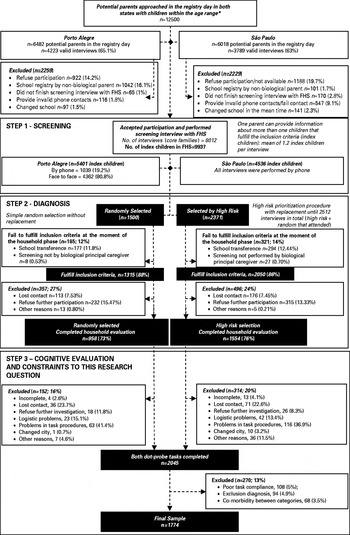
A total of 2512 children provided data on psychopathology. These subjects were also selected to complete both a short and a long version of the dot-probe task. From the 2512 subjects, 2172 performed the short task, 2082 performed the long task, and 1936 provided complete bias score data in each task format (bias scores were not calculated if >50% reaction time data were missing). The latter (n = 1936) were allocated to four diagnostic groups (fear-related, distress-related, behaviour, or no-disorder groups), leaving an additional 162 excluded subjects who did not satisfy selection criteria (see later for details, e.g. exclusion of children with any disorder from no-disorder group; or those with co-morbidity precluding placement into one diagnostic group). This yielded 1774 subjects for the main data analysis. Except for being older (mean difference = 0.39 years, s.e. = 0.09, p < 0.001), those included in the main analysis were similar to those not included regarding internalizing and externalizing symptoms and demographic variables (data not shown, all p values >0.05).
Procedures
Community screening and sampling
A total of 57 schools from two cities (22 schools in Porto Alegre and 35 schools in São Paulo) participated in screening and enrolment procedures. Eligible subjects were those: (1) registered for school by a biological parent capable of providing consent and information about the children's behaviour; (2) in the age range 6–12 years; (3) that have remained in the same school during the study period. For screening, 9937 informant interviews based on the Family History Survey (FHS) were conducted (the child's biological mother in 88% of the families).
From this pool, we selected two subgroups: random and high-risk groups. For subjects in the random-selection group, a simple randomization procedure from school directories was used, without replacement of non-available subjects. Selection for the high-risk group involved a risk-prioritization procedure, focused on individuals with a family history of a disorder and/or ongoing symptoms in one of the five targeted domains [attention deficit hyperactivity disorder (ADHD), anxiety, obsessive compulsive disorder (OCD), psychosis, and learning disorders], as detected during screening. Subjects in this second, high-risk group were oversampled and, if not available, replaced by the next subject listed in the high-risk sampling frame. From 1315 children selected in the first random group who fulfilled inclusion criteria, 958 (73%) completed the household evaluation. From the 2050 children selected in the second high-risk group who fulfilled inclusion criteria, 1554 (76%) completed the evaluation (see Fig. 1 for further details on participation rates at each stage of the study).
Flowchart of study participants.

Attention bias assessment
Attention biases were measured with a visual dot-probe paradigm similar to the paradigm used in previous studies of paediatric (Pine et al. Reference Pine, Mogg, Bradley, Montgomery, Monk, McClure, Guyer, Ernst, Charney and Kaufman2005; Monk et al. Reference Monk, Nelson, McClure, Mogg, Bradley, Leibenluft, Blair, Chen, Charney, Ernst and Pine2006; Roy et al. Reference Roy, Vasa, Bruck, Mogg, Bradley, Sweeney, Bergman, McClure-Tone, Pine and Team2008; Waters et al. Reference Waters, Mogg, Bradley and Pine2008, Reference Waters, Henry, Mogg, Bradley and Pine2010a, Reference Waters, Kokkoris, Mogg, Bradley and Pineb) and adult (Mogg & Bradley, Reference Mogg and Bradley1998, Reference Mogg and Bradley1999; Bradley et al. Reference Bradley, Mogg, White, Groom and de Bono1999; Mogg et al. Reference Mogg, Philippot and Bradley2004) anxiety disorders. Tasks were presented in Eprime 2.0 (Psychology Software Tools, USA) by testers blind to all clinical data.
Two versions of the dot-probe task were employed, one of which was shorter than the other. Both tasks used identical stimuli, which were photographs of face pairs from different actors (half of each gender). Each face pair showed an emotional face (angry or happy) presented side-by-side with a neutral face of the same actor.
In both tasks, each trial started with a central fixation cross (for 500 ms), followed by the face pair (for 500 or 1250 ms), which was replaced with an asterisk (probe) that appeared on either the left or right side of the screen (for 1100 ms) in the spatial location previously occupied by one of the faces. Participants were instructed to press one of two response keys as quickly and accurately as possible to indicate whether the asterisk appeared in the left or right hemi-field. Emotional faces and probes appeared on either the left or right side of the screen with equal frequency, so that in half the trials, the probe appeared in the same spatial location as the emotional face (congruent trials) and, in the other half of trials, the probe appeared in the opposite location to the emotional face (incongruent trials). Both tasks involved fully randomized presentation of each trial type. The inter-trial interval varied randomly from 750 to 1250 ms. This variation has been used consistently in previous studies of paediatric anxiety disorders, to facilitate subject engagement by minimizing the predictability of trial onset times. To maintain consistency with the previous research literature, the procedure is also included here. Subjects were provided with standardized instructions and also asked about their understanding of the task (e.g. ‘What you should do if the probe appears at the left side of the screen? And if it appears at the right side?’).
The short version of the dot-probe task involved 80 trials comprising 32 ‘threat-neutral’ trials (16 with probe congruent with angry face; 16 with probe incongruent with angry face), 32 ‘happy-neutral’ trials (16 congruent, 16 incongruent), and 16 neutral-neutral trials. In this short version, each face pair was presented for 500 ms. The long version of the dot-probe task involved 160 trials, half of which were the same as in the short version and used 500-ms face-cue presentations; while the other half used 1250-ms exposure duration. Each face pair appeared once per exposure duration, with trial order being fully randomized.
The two tasks generated six bias measures: threat and happy-face bias scores in each task format (500-ms short task; 500-ms long task, 1250-ms long task). Response times (RTs) were excluded as errors from trials where the response was incorrect or did not occur before probe offset. RTs less than 200 ms or more than 2 s.d. above each participant's mean were excluded as outliers (Roy et al. Reference Roy, Vasa, Bruck, Mogg, Bradley, Sweeney, Bergman, McClure-Tone, Pine and Team2008). Attention bias scores were not calculated if more than 50% RT data were missing due to errors or outliers (Roy et al. Reference Roy, Vasa, Bruck, Mogg, Bradley, Sweeney, Bergman, McClure-Tone, Pine and Team2008). Bias scores were calculated separately for each face emotion, task format and subject, using the conventional formula in which RTs from congruent trials are subtracted from RTs from incongruent trials. Positive values indicate attention bias towards threat; negative values indicate bias away from threat.
General testing procedures
The dot-probe was part of a large neuropsychological battery used in the project. Task administration was fully randomized across two blocks. As a pre-defined rule, the two dot-probe tasks occurred in different blocks. A total of 30.6% of subjects received the two dot-probe tasks in a single day and 69.4% received both tasks administered on two different days. Previous exposure did not affect bias scores (data not shown; all p values >0.05). The mean duration of sessions 1 and 2 were 64 and 62 min. Dot-probe short and long versions took approximately 5 and 10 min, respectively.
The tasks were administered by trained speech therapists on an Acer 14-inch laptop with a Intel Pentium Dual Core T4300 running in Windows 7 Premium software, set to 100% brightness. Children sat 50 cm from the screen, arranged at 90° with the base of the notebook. All task instructions were standardized.
Data quality was monitored by each tester, who noted whether administrative problems occurred, and registered their perception of the testing environment (e.g. ambient noise) and child's comprehension and cooperation, to provide an index of test quality conditions for each task. These variables were not correlated with bias scores (p > 0.20) and therefore were not considered for further analysis.
Psychiatric diagnosis and symptom severity
The psychiatric diagnoses were assessed with the Development and Well-Being Assessment (DAWBA), a structured interview administered by trained lay interviewers, and further rated by trained supervised psychiatrists. The DAWBA was administered to biological parents who indicated they could provide accurate information in accordance with previously reported procedures (Goodman et al. Reference Goodman, Ford, Richards, Gatward and Meltzer2000). All lay interviewers were extensively trained by the research team and their work was submitted to constant supervision during the entire project. Nine psychiatrists performed the rating procedures. All were trained and constantly supervised by a senior child psychiatrist.
To examine relationships between attention biases and diagnostic categories using adequately powered analysis, anxiety disorders were divided into two groups: (1) a ‘fear-disorder’ group that includes phobias and separation anxiety disorder, and (2) a ‘distress-disorder’ group, that includes GAD, depressive disorders (MD) and PTSD. Decisions on disorder groupings were guided by proposed grouping for DSM-5. In DSM-5, such groupings considered independent evidence from twin studies (Kendler et al. Reference Kendler, Prescott, Myers and Neale2003; Lahey et al. Reference Lahey, Van Hulle, Singh, Waldman and Rathouz2011), as well as from studies of symptom structure (Krueger, Reference Krueger1999; Vollebergh et al. Reference Vollebergh, Iedema, Bijl, de Graaf, Smit and Ormel2001; Watson, Reference Watson2005; Watson et al. Reference Watson, O'Hara and Stuart2008; Trosper et al. Reference Trosper, Whitton, Brown and Pincus2012). This work specifically supported the suggestion of viewing GAD as an anxiety disorder that is somewhat distinct from phobia, clustering more closely to MD. Sample sizes were too small to support analyses examining associations with more narrowly defined, specific psychiatric disorders. Diagnoses of ‘other anxiety’ (n = 37), or OCD (n = 3) were not included in these categories due to uncertainty about their classification as fear versus distress disorders (Watson, Reference Watson2005, Watson et al. Reference Watson, O'Hara and Stuart2008).
Beyond these two anxiety groups, subjects were arranged into two other groups: (3) children without any psychiatric diagnosis; (4) ‘behaviour-related’ psychiatric disorders including ADHD (the three subtypes and non-otherwise specified), oppositional defiant disorder and conduct disorder. Children with manic episodes (n = 3), pervasive developmental disorders (n = 9), tics (n = 17), eating disorders (n = 9), psychosis (n = 1) and attachment disorder (n = 2) were excluded from all groups. No cases of panic disorder, stereotypies, or selective mutism were identified. For all groupings, children who had a co-morbid disorder in one of the other diagnostic categories were excluded (n = 68), so that analyses would not be confounded by co-morbidity. Hence, none of the children in the distress disorder group had a fear or behaviour disorder; and vice versa for the other diagnostic groups. For the disorder-free group, we excluded those children who had any specific diagnosis (described above) and also those with a non-otherwise specified diagnosis (n = 16).
Severity of internalizing symptoms was assessed using the broad-band total internalizing scale score of the Child Behavior Checklist (CBCL) that has shown adequate diagnostic performance to predict both fear and distress disorders (Petty et al. Reference Petty, Rosenbaum, Hirshfeld-Becker, Henin, Hubley, LaCasse, Faraone and Biederman2008). To facilitate hypothesis-testing while accounting for dissimilarly shaped distributions of internalizing symptom scores across diagnostic groups, dichotomous groupings were made of children with ‘high’ (>18) and ‘low/moderate’ (0–18) scores. This cut-off score corresponds to the 90th percentile in the random subsample of this project. We decided to use internalizing symptoms instead of more specific measures of anxiety due to previous evidence showing that attention biases may be related broadly to aspects of negative affect (Lonigan & Vasey, Reference Lonigan and Vasey2009). Raw scores were used since there is, as yet, no normative CBCL data for the Brazilian population.
Statistical analysis
Primary hypotheses were tested in a 2 × 3×4 × 2 mixed design multivariate analysis of variance (MANOVA), which comprised two within-subject independent variables: face-emotion valence (happy/threat) and task format (500-ms short task, 500-ms long task, 1250-ms long task); and two between-subject independent variables: diagnostic status (none, fear, distress, behaviour); and level of internalizing symptom severity (low/moderate, high). To address specific hypotheses, significant results were clarified with General Linear Models (GLM), using pairwise contrasts and Least Significant Differences. We used type III sum of squares in order to account for different group sample sizes. Potential confounders were explored using zero-order correlations and ANOVA. All analyses used SPSS v. 18.0 (SPSS Inc., USA) with an alpha level of 0.05, two-tailed.
Results
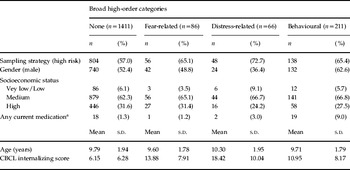
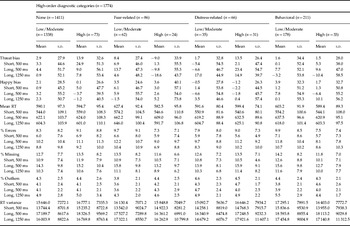
The final sample comprised 1774 children; 86 were in the fear-disorder group (specific phobia, n = 47; separation anxiety, n = 30; social phobia, n = 13; agoraphobia, n = 2); 66 in the distress-disorder group (GAD, n = 25; MD, n = 28; PTSD, n = 6; other depression, n = 4; undifferentiated anxiety/depression, n = 4); 211 in the behavioural-disorder group (ADHD, n = 165; oppositional defiant, n = 79; conduct, n = 20; other disruptive disorder, n = 6); and 1411 in the no-disorder group. Final sample characteristics and task parameters are given in Tables 1 and 2.
Sample description

CBCL, Child Behavior Checklist; s.d., standard deviation.
a Psychotropic medications in use for more than 1 month.
Description of attentional task measures as a function of diagnostic category, internalizing symptom severity, and task format (500-ms short task; 500-ms long task; 1250-ms long task)

RT, Reaction time; s.d., standard deviation.
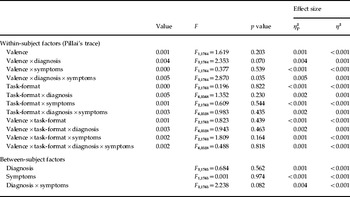
The omnibus MANOVA of bias scores showed a significant three-way interaction among face-emotion valence, diagnostic group, and internalizing symptom severity (F 3,1764 = 2.87, p = 0.035, ηp2 = 0.005, η2 = 0.001). No other significant main effects or interactions emerged (see Table 3). Since no statistically significant results emerged involving task format (task and stimulus duration; F values <2, p values >0.15), subsequent analyses used bias scores averaged across the three task formats.
Multivariate analysis of variance

Symptoms, internalizing symptoms (above or below the 90th percentile); diagnosis, diagnostic category (no psychiatric disorder, fear, distress and behaviour); valence, face-emotion valence (threat and happy); task-format (500 ms short, 500 ms long, 1250 ms long). η2p, partial eta squared; η2, eta squared.
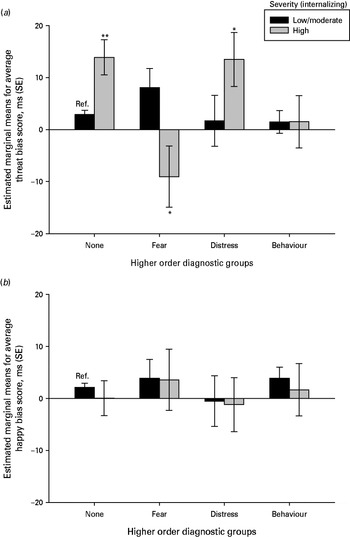
The three-way interaction included four levels of diagnostic group, two levels of symptom severity, and two levels of face-emotion valence. To decompose this complex interaction, we performed two GLMs, one for the happy-face valence and a second for the angry-threat face valence. This analysis showed that the model for angry-threat face trials revealed a two-way interaction between severity and diagnostic group (omnibus test LR χ2 = 21.10, df = 7, p = 0.004). No such interaction emerged for happy-face trials (omnibus test LR χ2 = 1.92, df = 7, p = 0.964). Thus, the findings related to diagnostic and symptom-level groups were specific to threat bias and not to happy bias.
Next, findings for threat bias only were further decomposed in post-hoc analyses. A linear model predicting threat bias revealed no effect of severity (Wald χ2 = 0.2, df = 1, p = 0.655), and a main effect of diagnosis (Wald χ2 = 7.97, df = 3, p = 0.047) which was subsumed under a significant severity × diagnosis interaction (Wald χ2 = 15.3, df = 3, p = 0.002). Post-hoc analyses showed distinct severity × bias associations in the four diagnostic groups. Relative to children in the no-disorder group with low internalizing symptoms, those with no disorder but high internalizing symptoms (mean difference = 11.03, s.e. = 3.47, df = 1, p < 0.001), and those with distress disorders with high internalizing symptoms (mean difference = 10.63, s.e. = 5.24, df = 1, p = 0.043) attended to threat stimuli. In contrast, relative to children in the no-disorder group with low symptoms, those in the fear group with high internalizing symptoms (mean difference = −11.90; s.e. = 5.94, df = 1, p = 0.045) avoid threat stimuli (Fig. 2).
Mean attention bias scores for (a) threat faces and (b) happy faces in the dot-probe task, as a function of diagnostic category and level of internalizing symptoms. Statistics: General Linear Model post-hoc tests using pairwise contrasts of the interaction term using Least Significant Differences. Error bars indicate ±1 s.e. Ref., Reference category; * p < 0.05, ** p < 0.001.

Supplementary analyses examined effects of potential confounders. There were no significant effects of face emotion, diagnostic group and symptom severity on errors, missing data or RT. There were no significant relationships between age, gender or sampling strategy (random/high-risk) and bias scores (p values >0.3). The overall three-way interaction between face emotion, diagnostic group and symptom severity remained significant when effects of age, gender and sampling strategy were controlled (F 3,1764 = 2.785, p = 0.04, η2p = 0.005, η2 = 0.001).
Discussion
We examined the effect of severity of internalizing symptoms on attention biases in children with fear, distress, and behavioural disorders, compared to children without any psychiatric disorders, in a large school-based sample. The key finding was that levels of internalizing symptoms interacted with the nature of psychopathology. Namely, high internalizing symptoms predicted a similar pattern of attention bias towards threat cues in children with no psychiatric diagnosis and in those with distress disorders; i.e. higher symptoms were associated with increased attention bias towards threat. In contrast, in children with fear-related psychiatric disorders, higher symptom severity predicted greater attention bias away from threat. Internalizing symptom severity was unrelated to attention bias in children with behavioural disorders. These findings were specific for threat stimuli (i.e. not found for happy faces) and irrespective of stimulus duration.
As hypothesized, our study replicates well-established findings of attention bias towards threats in anxious subjects, a finding central to many current cognitive models of anxiety. The findings add to an emerging paediatric literature indicating that high levels of internalizing symptoms are associated with increased attention bias towards threat in children free of psychiatric diagnosis (Waters et al. Reference Waters, Kokkoris, Mogg, Bradley and Pine2010b). Our study also extends previous findings from clinical studies (Waters et al. Reference Waters, Mogg, Bradley and Pine2008, Reference Waters, Henry, Mogg, Bradley and Pine2010a, Reference Waters, Mogg and Bradleyin press) showing that symptom severity modulates the direction of attention biases. For example, Waters and colleagues found a greater bias towards threats in severe cases of paediatric anxiety disorders, considered as a group (Waters et al. Reference Waters, Henry, Mogg, Bradley and Pine2010a) and in severe cases of GAD (Waters et al. Reference Waters, Mogg, Bradley and Pine2008). In the present study, attention bias towards threat similarly increased as a function of symptom severity in the distress disorder group, as well as in the no-disorder group.
The current study is the first to demonstrate symptom × diagnosis interactions across the categories of anxiety disorders examined here. Perhaps the most novel finding in the current study is to show that the positive relationship between emotional symptom severity and threat-related attention bias does not hold across all paediatric diagnostic groups. The novelty of our findings may reflect the relatively pure status of our samples, as there was no overlap between the main categories of psychiatric disorder. While previous research suggested that children with high levels of emotional distress sometimes show reduced attention and even avoidance to threat, relative to non-anxious children (Pine et al. Reference Pine, Mogg, Bradley, Montgomery, Monk, McClure, Guyer, Ernst, Charney and Kaufman2005; Monk et al. Reference Monk, Nelson, McClure, Mogg, Bradley, Leibenluft, Blair, Chen, Charney, Ernst and Pine2006), the specific determinants of the direction of threat bias were uncertain. Moreover, these previous studies had not convincingly identified a threat-monitoring and a threat-avoiding clinical group, as found in the current study.
The present findings indicate that the combination of high emotional distress and a fear-related disorder is associated with an attention bias away from threat. This may reflect a form of cognitive threat avoidance seen in other clinical scenarios. In such scenarios, cognitive avoidance is thought to follow from an initial, vigilance response that occurs too rapidly to be detected with methods used in the current study. Such avoidance may also represent a complement of other behaviours seen in anxious patients. For example, much like cognitive avoidance that occurs after an initial vigilance response, behavioural phobic avoidance also may occur after an initial state of enhanced reactivity to a threat.
The increasing enthusiasm for research into attention biases in paediatric anxiety is supported by recent evidence suggesting that treatments designed to modify these biases attenuate anxiety symptoms in adults (Hakamata et al. Reference Hakamata, Lissek, Bar-Haim, Britton, Fox, Leibenluft, Ernst and Pine2010) and children (Bar-Haim, Reference Bar-Haim2010; Bar-Haim et al. Reference Bar-Haim, Morag and Glickman2011). The current findings inform attempts to further refine these techniques. Virtually all available attention-related treatment trials train anxious subjects to shift their attention away from threats. Such an approach would be reasonable for children in the current study with high internalizing symptoms and either no diagnosis or a distress-related anxiety disorder. However, one can question the reasonableness of this approach for children with both fear-related disorder and high symptoms. These children manifest a bias away from threat, relative to those with low symptoms, and one might expect further training designed to accentuate such a pre-existing bias to provide few clinical benefits.
Our results should be viewed in the light of some limitations. First, we were not able to investigate each psychiatric disorder individually due to few available subjects with specific disorders, yielding insufficient statistical power. However, we were able to investigate diagnostic specificity by grouping psychiatric disorders that share common biological backgrounds (Lahey et al. Reference Lahey, Van Hulle, Singh, Waldman and Rathouz2011) and symptom structures (Watson, Reference Watson2005, Watson et al. Reference Watson, O'Hara and Stuart2008). Second, since this is a study performed in the community, heterogeneity of testing procedures may introduce noise in analyses. However, variance of bias measures were comparable to published studies using the same task with youth of a similar age range (Pine et al. Reference Pine, Mogg, Bradley, Montgomery, Monk, McClure, Guyer, Ernst, Charney and Kaufman2005; Monk et al. Reference Monk, Nelson, McClure, Mogg, Bradley, Leibenluft, Blair, Chen, Charney, Ernst and Pine2006; Roy et al. Reference Roy, Vasa, Bruck, Mogg, Bradley, Sweeney, Bergman, McClure-Tone, Pine and Team2008; Waters et al. Reference Waters, Mogg, Bradley and Pine2008, Reference Waters, Henry, Mogg, Bradley and Pine2010a, Reference Waters, Kokkoris, Mogg, Bradley and Pineb). Finally, the diagnostic evaluation relied on information of trained lay interviewers. Nevertheless, all interviews were carefully revised by psychiatrists and this procedure produced satisfactory results for other studies (Goodman et al. Reference Goodman, Ford, Richards, Gatward and Meltzer2000).
The study also has notable strengths. This is the largest study so far performed that aims to investigate attention biases in children. In addition, the large-scale community nature of the study allowed us to disentangle contributions of pure (non-overlapping) classes of psychiatric disorders to attention bias. In addition, we were able to show the importance of this neuropsychological process to emotion-related disorders, and not to behavioral disorders.
Future longitudinal studies are needed in order to investigate whether threat biases in attention orienting could predict poor outcomes considering both the form and severity of anxious manifestations. In addition, the importance of such findings to other areas, such as brain imaging, is worth noting. The role of diagnosis and symptom levels in moderating effects of the amygdala and prefrontal cortex in different anxiety disorders are of special interest for new investigations, given their associations in previous dot-probe studies (Monk et al. Reference Monk, Nelson, McClure, Mogg, Bradley, Leibenluft, Blair, Chen, Charney, Ernst and Pine2006).
In conclusion, the association between the severity of internalizing symptoms and biased orienting to threat varies with the nature of developmental psychopathology. Both the form and severity of psychopathology moderates threat-related attention biases in children, with specific relationships between symptoms and disorders. These results have potential implications to therapeutics and add to the body of evidence showing the implications of dysfunctional threat-related attention mechanisms to explain individual differences in paediatric anxiety disorders.
Acknowledgements
We thank the children and families for their participation, which made this research possible; the other members of the high-risk cohort research team (Dr Eurípedes Constantino Miguel, Dr Rodrigo Affonseca-Bressan, Dr Pedro Gomes de Alvarenga and Dr Helena Brentani); the collaborators for the neuropsychological evaluation (Bruno Sini Scarpato, Sandra Lie Ribeiro do Valle and Carolina Araújo); Dr Robert Goodman for his research support regarding the DAWBA instrument procedures and Dr Bacy Fleitlich-Bilyk for her clinical supervision. We also thank the NIMH Intramural Research Program. This work is supported by the following Brazilian government agencies: CNPq, CAPES and FAPESP.
Declaration of Interest
Giovanni Abrahão Salum has received a CNPq sandwich Ph.D. scholarship [sandwich period at National Institutes of Mental Health (NIMH)] and is currently in receipt of a CAPES doctoral scholarship. Ary Gadelha is in receipt of continuous medical education support from AstraZeneca, Eli Lilly and Janssen-Cilag. Pedro Pan is in receipt of research support from CNPq and CAPES and continuous medical education support from AstraZeneca, Eli Lilly and Janssen-Cilag. Ana Carina Tamanaha is in receipt of a post-doctoral fellowship from FAPESP. Tais Moriyama has received a CNPq Ph.D. scholarship and is in receipt of continuous medical education support from AstraZeneca, Eli Lilly and Janssen-Cilag. Ana Soledade Graeff-Martins is in receipt of a post-doctoral fellowship from CNPq. Guilherme Vanoni Polanczyk has served as a speaker and/or consultant to Eli Lilly, Novartis, and Shire Pharmaceuticals, developed educational material for Janssen-Cilag, and receives unrestricted research support from Novartis and from the National Council for Scientific and Technological Development (CNPq, Brazil). Maria Conceição do Rosário receives research support from Brazilian government institutions (CNPQ) and has worked in the last 5 years as a speaker for Novartis and Shire. Luis Augusto Rohde was on the speakers' bureau and/or acted as consultant for Eli Lilly, Janssen-Cilag, Novartis and Shire in the last 3 years (received less than US$10 000 per year, which is less than 5% of L.A.R.'s gross income per year). L.A.R. also received travel awards (air tickets and hotel costs) from Novartis and Janssen-Cilag in 2010 for participation at two child psychiatric meetings. The ADHD and Juvenile Bipolar Disorder Outpatient Programs chaired by L.A.R. received unrestricted educational and research support from the following pharmaceutical companies in the last 3 years; Abbott, Eli Lilly, Janssen-Cilag, Novartis, and Shire. Gisele Gus Manfro receives research support from Brazilian government institutions (CNPQ, FAPERGS, FIPE-HCPA).