Introduction
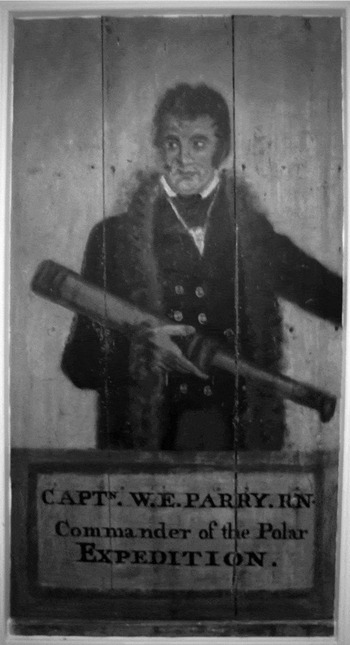
In 1954 a painting of the Arctic explorer, William Edward Parry, was discovered under layers of wallpaper and paint at Tower Hill, Crosthwaite, a village near Kendal, Cumbria, UK (Fig. 1). The discovery was extensively reported in issues of the Westmorland Gazette of that year (Westmorland Gazette 10 April 1954, 17 April 1954). This was followed by further correspondence which included some speculation as to why such a portrait had been painted in Crosthwaite and who might have painted it. However until the recent publication of Cameos of Crosthwaite and Lyth: the Damson valley, (Bownass and others Reference Bownass, Mutch, Trotter and Wilson2002) the mural remained largely forgotten. Further research now makes it possible to identify the artist responsible, to speculate with some confidence on the source for the painting, and to suggest a date for it.
The painting of Captain William Edward Parry at Tower Hill, Crosthwaite.

Who was the artist?
The painting is situated on a bulkhead overlooking the staircase at Tower Hill. It has been painted onto three vertical wooden panels that form both the bulkhead and the back of a built-in bedroom cupboard. The panels, which measure 760 mm by 1520 mm, fit perfectly into the available space and there is no reason to think that the portrait was not painted in situ. The fact that the inscription is central to the portrait certainly suggests that. The portrait omits Parry's lower left arm and hand which might suggest that there had originally been a fourth panel, but recent renovations have proved that this was not the case. The overall size of the picture, and the orientation of the panels, indicate that the wooden planks had not had an earlier use as part of a seaman's chest.
At the time of Parry's Arctic voyages (1818–1827) Tower Hill was occupied by Richard Cartmell. His obituary in the Westmorland Gazette of 2 April 1831 states that:
he was a very ingenious man, whose talents have been confined to his own immediate neighbourhood. As an artist he excelled, being self taught, and has left behind him a number of portraits sketched from memory after having seen the person, amongst whom are Lord and Col. Lowther, Lord Brougham, the late Sir Daniel le Fleming and the Rev. J. Strickland, with many others in general good likeness (Westmorland Gazette 2 April 1831).
As well as the Parry painting, there were at least two other murals in the house, one of a young boy and another of an angel like figure (Bownass and others Reference Bownass, Mutch, Trotter and Wilson2002).
Richard Cartmell was not primarily an artist. An 1829 trade directory refers to him as a yeoman and farmer, suggesting that his main source of income was from the land (Parson and White Reference Parson and White1829). The artistic quality of the Parry portrait points to the artist being ‘self taught’.
What was the source for the Crosthwaite picture?
How did Richard Cartmell know what Parry looked like? Despite his ability ‘to sketch from memory’ it is unlikely that he met the explorer as Parry only spent short periods in Britain between the beginning of his first journey in 1818 and Cartmell's death in 1831. Even when he was in the country his work kept him in London and at the ports at which his expedition ships were fitted out, although he did have family connections with the north of the country. His mother was the daughter of John Rigby of Lancaster, and he married Isabella Louisa, a daughter of Sir John Stanley of Alderley Park in Cheshire and Penrhos in north Wales in 1827. However his first visit to Cumbria and the Lake District was not until 1852, long after Cartmell's death (Parry Reference Parry1859: 322). It seems more likely that Cartmell based his painting on a picture of Parry.
Sir William Beechey, T. Phillips, William Haines and Charles Scottowe all painted portraits of Parry during his life, but it is Samuel Drummond's 1820 portrait that is most similar to Cartmell's. Drummond, a largely self-taught London artist, was able to ‘produce a portrait in a single sitting lasting an hour and a half, and charged eight guineas for a three quarter length’ (Quilley Reference Quilley2004–2009) There are two versions of this picture. One has remained with the Parry family, while the other was originally owned by John Barrow (1808–1898), the son of Sir John Barrow, the second secretary of the Admiralty and supporter of all of Parry's Arctic expeditions. He gave it to the United Services Institute in 1850, from where it was purchased by the National Portrait Gallery in 1975 (Drummond Reference Drummond1820). However, despite one version being exhibited at the Royal Academy in London in 1821, and the other being owned by the Barrow family who were connected to Ulverston in Furness, Cumbria, it is unlikely that Cartmell would have seen either of these originals.
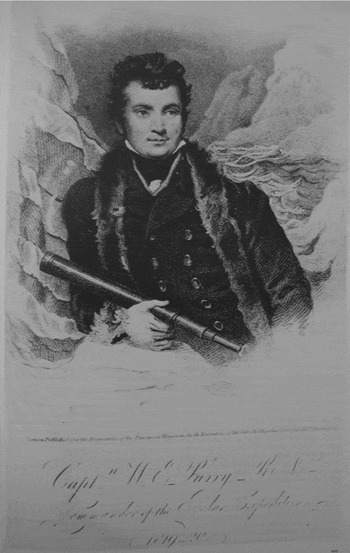
It is more likely that Cartmell saw an engraving based on Drummond's picture. Several engravings were created, such as those published by Limbird, Jaques and Wright, and Wright in the years after 1820, but the one most likely to have been the prototype for the Crosthwaite painting was published in the February 1821 edition of The European Magazine and London Review (Fig. 2). J. Thomson, the engraver, included a title beneath the portrait that, except for the inclusion of dates in the last line, is identical to that on the Crosthwaite painting:
Captn. W. E. Parry R N
Commander of the Polar Expedition
(1819–20)
Engraving of Captain William Edward Parry by J. Thomson, for the The European Magazine and London Review (1821b).

The engraving was published before Parry was raised to the rank of Captain. At that time Parry's rank was commander, rather than captain, but the distinction was often overlooked and the term ‘captain’ used. This seems to have been the case on this occasion.
Cartmell may have seen the engraving through subscribing to the journal, or he may have seen a copy in the house of an acquaintance, or read it at a local reading room or through his membership of a subscription library, such as that operating in New Street, Kendal, since 1794 (Bingham 1995). Even if he had only seen the monochrome engraving, given that Parry is in naval uniform, blue was an obvious choice of colour so the similarity to Drummond's portrait is therefore not surprising. It is more difficult to explain Cartmell's reversal of Parry's head and coat fastening unless he was painting from memory or from a rather inadequate sketch. However Cartmell's omission of Parry's left arm and hand, as in the engraving, as well as his depiction of fur on the right cuff, which is clearer on the engraving than in the original painting, strengthens the probability that Thomson's engraving was the primary source.
When and why was the picture painted?
If the engraving in the journal is the source, then the Crosthwaite portrait post dates its publication in February 1821. Parry's 1819–1820 expedition was widely reported, and best selling narrative accounts were published during 1821 (Fisher Reference Fisher1821; Parry Reference Parry1821). Cartmell could have read an account in The European Magazine and London Review issue of January 1821 (The European Magazine and London Review 1821a: 45–47). Thomson's engraving that appeared in the following number of the journal was accompanied by a eulogy in praise of ‘our deserving countryman, Captain Parry, who has on two successive occasions distinguished himself by the display of talents and energies, which have excited the admiration of the country’ (The European Magazine and London Review 1821b: 95–102). Taken together, the account, the engraving and the eulogy could have prompted Cartmell to paint a picture of a national hero. During 1823 the book of John Franklin's 1819–1822 expedition to the Mackenzie district of northern Canada was published and proved popular (Franklin Reference Franklin1823). Thereafter it was Franklin, rather than Parry whose later expeditions in 1821–1823 and 1824–1825 were less newsworthy, who caught the public imagination. It is therefore more likely that Cartmell's picture dates from between 1821 and 1823, rather than from the middle of the decade.
The publicity associated with Parry's fifth and final Arctic voyage in 1827 which aimed for the North Pole and achieved the furthest north (82°40′23″N) then reached, and John Franklin's return from his successful second journey to the shores of the polar sea, resulted in a revival of interest in arctic exploration, as well as knighthoods and university honours for both explorers. The publicity surrounding Parry in 1828 and 1829 might have prompted Cartmell to paint the picture at that time, using the 1821 engraving. However had Cartmell painted the picture after Parry had been knighted, he would probably have referred to the honour in the inscription. Parry departed for Australia in 1829, and Cartmell's death in March 1831 provides a terminus ante quem for the portrait.
If, however, Cartmell was not the artist then the painting could have been done after 1831. The most obvious date would then be 1852 when Parry retired from being captain-superintendent of Haslar Royal Naval Hospital in Hampshire and came to Keswick for a holiday, ‘where he derived much enjoyment from his first acquaintance with the beautiful scenery of the English lakes’ (Parry Reference Parry1859). This visit was reported locally and might have provided the impetus for someone to paint the Crosthwaite picture based on a surviving copy of the 1821 engraving.
The Crosthwaite painting is a curiosity. Although it is of little artistic merit, the fact that someone, probably Richard Cartmell, chose to paint a picture of the person who would become Rear-Admiral Sir William Edward Parry on the wall of a Crosthwaite farmhouse, both reflects the significance for the nation of the nineteenth century quest for the northwest passage and is indicative of the increasing reach of the media, written and pictorial. As such the picture's continued survival will be of interest to those concerned with polar history. It is therefore fortunate that its current owners enjoy the picture as a feature of their stairwell, and are interested in the history of the mural they have inherited.
Acknowledgements
The author is grateful to the department of history, Lancaster University for the facilities made available to their Honorary Research Fellows. Thanks to John and Caroline Holmes, the owners of Tower Hill, Crosthwaite, for their interest and hospitality; and to Desmond Holmes, Ann Savours, and The National Portrait Gallery, London for additional information.