


Introduction
Clinical supervision is increasingly recognized as a core competency (APA, 2015) and now enjoys international acceptance as an essential requirement for clinical training: ‘We are fast becoming a world committed to supervision and its enhancement’ (Watkins & Milne, Reference Watkins, Milne, Watkins and Milne2014, p. 673). To illustrate, over the past 10 years, frameworks for supervision competencies have been developed and promulgated in several countries, notably the UK, the USA and Australia (Falender et al. Reference Falender, Erickson Cornish, Goodyear, Hatcher, Kaslow, Leventhal, Shafranske, Sigmon, Stoltenberg and Grus2004; Roth & Pilling, Reference Roth and Pilling2008; Gonsalvez & Milne, Reference Gonsalvez and Milne2010; McHugh & Barlow, Reference McHugh and Barlow2010; Layard & Clark, Reference Layard and Clark2014). At the same time, guidelines on clinical supervision are becoming more numerous: in the last 10 years at least 10 international organizations have published guidance documents (APA, 2015). Furthermore, these guidelines are becoming ever more sophisticated statements, being increasingly based on replicable procedures for building expert consensus (e.g. Falender et al. Reference Falender, Erickson Cornish, Goodyear, Hatcher, Kaslow, Leventhal, Shafranske, Sigmon, Stoltenberg and Grus2004; Kaslow et al. Reference Kaslow, Borden, Collins, Forrest, Illfelder-Kaye, Nelson, Rallo, Vasquez and Willmuth2004). Also at this point there have been substantial national efforts to pilot a more systematic approach to the training of supervisors (e.g. Milne, Reference Milne and Dunkerley2010), with the Improving Access to Psychological Treatment programme (IAPT, 2011) the most prominent, organizationally coherent, and large-scale implementation of evidence-based clinical supervision to date (for an organizational summary, see Turpin, Reference Turpin, Fleming and Steen2012). IAPT supervision is intended to ensure that supervisees adhere closely to the therapeutic methods used in the critical evidence base (i.e. the key clinical trials). Achieving ‘fidelity to the model’ is pursued by combining systematically, and for the first time, several state-of-the-art supervision methods. These include adherence to supervision standards, reference to clinical and supervisory competence frameworks, routine clinical outcome monitoring (within weekly, clinical case management supervision), collaborative care, relatively extensive training in supervision (for both supervisors and supervisees), and the routine use of therapy recordings within supervision (Turpin, Reference Turpin, Fleming and Steen2012; Richards, Reference Richards, Watkins and Milne2014). Furthermore, supervisor accreditation has latterly been linked to this improved training and recognition of supervision as a complex set of competencies, entailing specific knowledge, skills and values (Watkins & Wang, Reference Watkins, Wang CD, Watkins and Milne2014). This is not to assume that such recent progress necessarily translates into improved practice. Recent data from the IAPT programme suggest that implementation sites differ significantly in terms of their clinical outcomes, based on differences in training, the expertise of supervisors, the provision of regular supervision, and the fidelity of regional programmes to the IAPT model (Gyani et al. Reference Gyani, Shafran, Layard and Clark2013).
These pragmatic service developments have been guided and supported by recent systematic reviews that have attempted to identify the ‘active ingredients’ of supervision (Rakovshik & McManus, Reference Rakovshik and McManus2010), to clarify methods used within key clinical trials (Roth et al. Reference Roth, Pilling and Turner2010), and to summarize effective supervisor training methods (Milne et al. Reference Milne, Sheikh, Pattison and Wilkinson2011). Roth et al. (Reference Roth, Pilling and Turner2010) identified consistent practices across multiple studies in high-quality clinical trials, as follows: ‘Therapists are invariably carefully selected, trained in a specific and well-specified set of interventions, supervised intensively, and monitored closely, usually on the basis of tape recordings’ (p. 296). In summary, consistent with the above practice developments, the knowledge base underpinning supervision has developed substantially during the past decade (Watkins & Milne, Reference Watkins, Milne, Watkins and Milne2014).
How does this international progress relate to CBT supervision in the UK? In addition to the above-noted IAPT programme, initially based on CBT, competencies have been developed for CBT and for CBT supervision (Pilling & Roth, Reference Pilling, Roth, Watkins and Milne2014); expert consensus has been used to develop CBT supervision guidelines (Milne & Dunkerley, Reference Milne and Dunkerley2010); evidence-based approaches have been piloted for supervisor training (Culloty et al. Reference Culloty, Milne and Sheikh2010); and the British Association for Behavioural and Cognitive Psychotherapy (BABCP) has taken a lead in accrediting supervisors. These developments suggest that progress within CBT supervision parallels international progress, particularly with respect to evidence-based practice.
However, despite these developments and the established emphasis within CBT on direct observation and on data, we have surprisingly limited information about the actual practice of CBT supervision under routine conditions (e.g. are guidelines followed? Is training transferred?). In general, the effective dissemination of guidelines is challenging, although CBT practitioners are relatively good at implementing guidelines (Carroll & Nuro, Reference Carroll and Nuro2002; Grol & Grimshaw, Reference Grol and Grimshaw2003). Similarly, prior surveys have suggested that CBT supervisors are only minimally adherent to supervision guidelines and competency frameworks (Klejnak, Reference Klejnak2012), with no trend towards improved practice over a 5-year interval (Townend et al. Reference Townend, Iannetta and Freeston2002, Reference Townend, Iannetta, Freeston and Hayes2007). These observational studies suggest the possibility of continuing poor implementation of CBT supervision developments. For example, there may be low levels of fidelity to the CBT supervision competency frameworks (e.g. Roth & Pilling, Reference Roth and Pilling2008). The possibility of sketchy implementation or low fidelity is suggested by the low frequencies of experiential methods (such as educational role-plays, tape review or feedback) within observational studies of CBT supervision (Milne, Reference Milne2008; Milne et al. Reference Milne, Reiser and Cliffe2013). In short, whilst in general there are grounds for optimism, CBT supervision may not have developed in keeping with international progress, and additionally supervisors (and others involved in their development, like the supervisor trainers) may perceive barriers to development. We therefore pose these questions: What is the current state of CBT supervision practice?, and how might we best maintain any forward momentum (e.g. in terms of promoting adherence to competency frameworks)?
Method
Design
A cross-sectional design was used, with a self-report questionnaire administered online once in autumn 2014. The survey was part of a collaborative, action-research project with the BABCP, the UK's primary CBT practitioner organization, and was intended primarily to help to develop a CBT supervision manual (i.e. the survey was intended as an educational needs assessment, justifying and guiding the development of the indicated training resources).
Instrument
The questionnaire asked about current supervision practice and ways to develop more effective training resources. The survey included basic demographic data items (see Results section). In addition, the survey assessed the methods currently used in the participants’ CBT supervision (‘Supervision methods’), satisfaction with the supervisory role, satisfaction with the training resources available, and assessed the need for additional resources (‘Supervision resources’) for training supervisors. Items regarding supervision methods were generated from frequently cited descriptions of CBT supervision (Padesky, Reference Padesky and Salkovskis1996; Liese & Beck, Reference Liese, Beck and Watkins1997), from supervision competency frameworks (Roth & Pilling, Reference Roth and Pilling2008; Olds & Hawkins, Reference Olds and Hawkins2014), and from the most relevant prior surveys of CBT supervision (Townend et al. Reference Townend, Iannetta and Freeston2002, Reference Townend, Iannetta, Freeston and Hayes2007). As we wished to be able to develop data comparable to past surveys (Townend et al. Reference Townend, Iannetta and Freeston2002, Reference Townend, Iannetta, Freeston and Hayes2007) and to give some content validity, we used 10 items taken directly from a past survey by Townend et al. (Reference Townend, Iannetta and Freeston2002). We supplemented these original items on supervision methods with 38 additional items based on a review of competency frameworks for supervision (see above). In addition, we utilized feedback from the BABCP Working Party (hereafter the ‘Working Party’) to enhance content validity, to clarify items, and to simplify the final item pool. To these basic items were added ad hoc pragmatic items regarding satisfaction with the current supervisor, training resources, and suggestions for new resources.
The Working Party was multidisciplinary in nature, including a counsellor, clinical psychologist, psychiatrist, nurse practitioner, occupational therapist, as well as Master's-level CBT therapists. The Working Party provided substantial technical assistance in terms of developing survey items and content. Specifically, multiple comments were received from Working Party members over a three month period, resulting in several iterations and revisions to the survey. This helped to clarify items, identify ambiguous or overlapping items, improve the coherence of the survey, and increase the likelihood of response. In terms of procedure, after an initial draft of the survey was distributed to the Working Party, further input included a conference call and multiple follow-up emails on survey items. As a result, three iterative draft revisions of the survey were developed and circulated to Working Party members, until all comments and responses had been satisfactorily assimilated to the final questionnaire.
The final survey included a total of 29 items, with both open-ended questions and closed-ended items, coded on a 1–4 frequency scale (e.g. frequency of supervision methods was rated: 1 = never, 2 = rarely, 3 = sometimes, 4 = often). This scale was used in order to enable us to make direct comparisons with the Townend et al. (Reference Townend, Iannetta and Freeston2002, Reference Townend, Iannetta, Freeston and Hayes2007) survey data. Responses to the two key closed- ended questionnaire items involving frequency of ‘Supervision methods’ used and ‘Supervision resources’ were examined for consistency and internal reliability of the scale items. Using SPSS v. 22 software (SPSS Inc., USA), it was determined that the ‘Supervision methods’ items had a Cronbach's α = 0.912, suggesting a coherent set of scale items with high levels of internal consistency. The ‘Supervision resources’ items had an acceptable Cronbach's α = 0.816, indicating sufficient internal levels of consistency. It has been suggested that α = 0.70 is the minimum acceptable level for internal consistency and reliability for newly developed exploratory scales, prior to factor analytic reduction (Hinkin, Reference Hinkin1998). This indicates that key scales on our survey had adequate internal consistency and reliability, in terms of the constructs we were attempting to measure.
We further used an exploratory factor analysis (EFA) to analyse the items comprising ‘Supervision resources’. EFA has been recommended as a procedure when ‘The primary purpose of EFA is to arrive at a more parsimonious conceptual understanding of a set of measured variables by determining the number and nature of common factors needed to account for the pattern’ (Fabrigar et al. Reference Fabrigar, Wegener, MacCallum and Strahan1999, p. 274). We used a maximum-likelihood, oblique oblimin type factor analysis (SPSS v. 22) which is recommended for EFA (Costello & Osborne, Reference Costello and Osborne2005). Visual inspection of the Scree plot indicated a five-factor solution, with a factor structure including the following factors: audio and video materials, standard supervision training methods, internet-based methods, guidelines, and classes, which together accounted for 66.6% of the total scale variance. This analysis provides support for the view that ‘Supervision resources’ comprises a coherent set of scale items with clear factors accounting for a significant portion of the overall scale variance. Qualitative responses were coded into major categories by the first author using Survey Monkey software (https://www.surveymonkey.com/), and this categorization was then reviewed by the second author for reliability. The final questionnaire and survey received ethical approval through Palo Alto University in Palo Alto, California. A copy of the survey is available from the first author.
Procedure and participants
As detailed above, the survey was drafted and piloted with the help of a BABCP Working Party, being ethically approved and then administered once that group was satisfied with the form. This was an internet-based survey, distributed through the BABCP listserv to accredited BABCP supervisors, trainers, and Supervision Special Interest Group (SIG) members in 2014. Respondents were targeted as part of a purposive survey, as they were thought to represent the UK's leaders and experts in CBT supervision, given that they appeared to be the individuals most closely involved in supervisor development. The purposive sampling technique is an approach in which respondents are selected because of their particular knowledge or valuable experience (i.e. quota-based, non-random sampling). Specifically, we employed ‘extreme purposive sampling’ (also known as ‘outlier sampling’) because we selected respondents assumed to be near the upper end of the supervision expertise distribution (Teddlie & Yu, Reference Teddlie and Yu2007). Our logic was to conduct an educational needs assessment, informed by a sample of experts in CBT supervision, as this sub-sample of CBT supervisors were expected to be especially well-informed about issues such as supervisor training. These sampled respondents were assumed to have expertise or special knowledge about supervision because of their roles, such as CBT training directors and BABCP-accredited supervisors. Two weeks after an initial listserv email notice, participants received a follow-up reminder to encourage participation, with a 2-week deadline for close of the survey. A total of 110 BABCP members responded out of an estimated subgroup of 250, resulting in an estimated 44% response rate. Response rates for previously published comparable surveys of practitioners have ranged from 40% (Gabbay et al. Reference Gabbay, Kiemle and Maguire1999) to 61% (Townend et al. Reference Townend, Iannetta and Freeston2002).
Results
Participants’ demographics
Respondents tended to be highly trained and experienced practitioners, with over 20 years of clinical experience (14 of these years in CBT) and over 12 years of supervisory experience, 73% of whom were BABCP-accredited supervisors. On average, they reported currently supervising 5.2 supervisees. The respondents mean age was 48.8 years, and 75% were female. This was a multidisciplinary group, primarily consisting of self-identified CBT therapists (32%), nurses (29%), clinical psychologists (24%) and counsellors (6%), with a small residual number of psychiatrists and teacher/lecturers (4%). The responding group was not culturally diverse, with less than 5% of respondents identifying themselves as non-Caucasian. Respondents had typically completed over 87 hours of supervisory training, with 43% having completed an IAPT supervision workshop.
Methods used in supervision
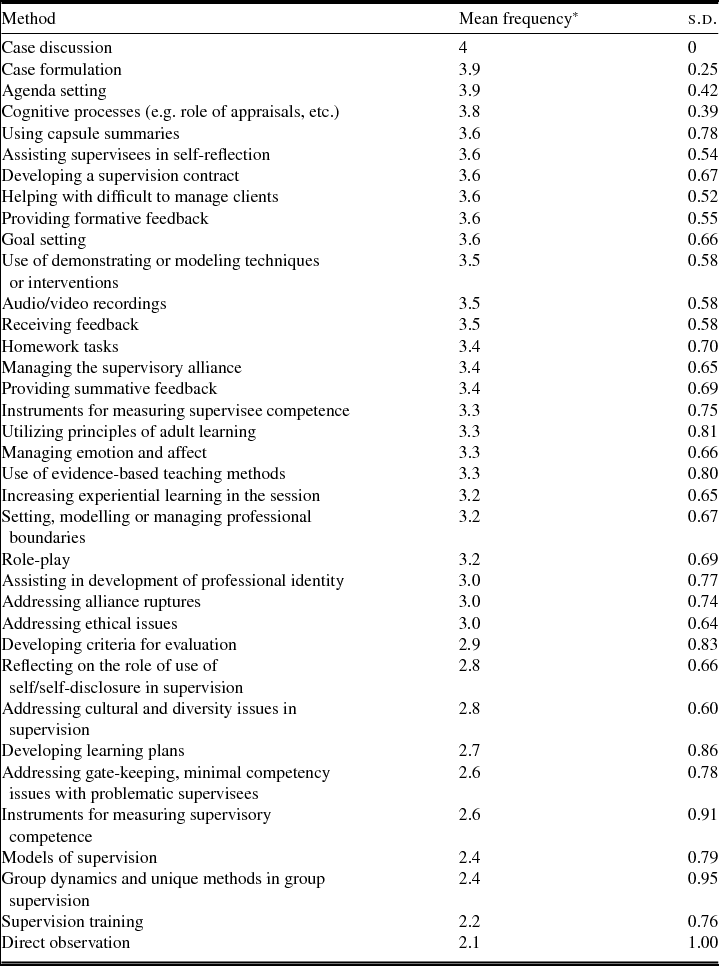
In a finding quite similar to the Townend et al. (Reference Townend, Iannetta and Freeston2002) survey, the ten most frequently reported supervision methods were based on didactic (symbolic) techniques: case discussion, case formulation, agenda setting, etc. Table 1 summarizes this information, indicating that all 110 survey respondents’ utilized case discussion, with the other ‘top ten’ methods used effectively at least 90% of the time in supervision. By contrast, the methods with the lowest reported frequency of use were: instruments for measuring supervisory competence, discussing models of supervision, group dynamics and unique methods in group supervision, supervision training, and direct observation. As Table 1 indicates, the reported use of iconic and enactive (i.e. experiential) methods matches recommended levels. Iconic techniques like demonstrating, modelling and reviewing recordings figure strongly, with an average frequency approximating to 88% of supervisory occasions. Similarly, enactive methods are also prominent (i.e. homework tasks, measuring supervisee competence, experiential learning, role-play), with a mean frequency of 3.3, equating to a point between ‘sometimes’ and ‘often’ used (82% equivalent).
Methods reported by CBT supervision experts (n = 110) in their current CBT supervision

* Frequency of using supervision methods rated on a 1–4 scale: 1 = never, 2 = rarely, 3 = sometimes, 4 = often.
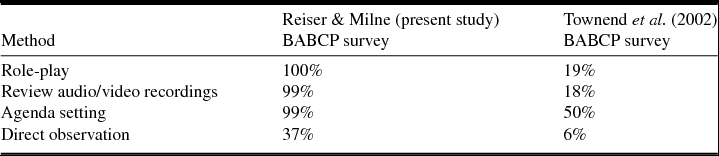
The data within Tables 1 and 2 indicate that CBT supervisors are utilizing evidence-based supervision and training strategies, including audio/video observation, role-play, and agenda setting. This survey result suggests that practice matches recommendations and relevant theory at least for this selected sample of supervision leaders. So, in terms of our first question (‘what is the state of current supervision practice in the UK?’), we can conclude that, for our selected sample, the reported supervision appears consistent with best practice frameworks and competency statements. By comparison, albeit for a more representative sample of BABCP members, in the Townend et al. (Reference Townend, Iannetta and Freeston2002) survey the corresponding frequencies were much lower. Table 2 summarizes the main contrasts with the 2002 survey findings.
A comparison of the reported use of experiential supervision methods that were used ‘sometimes’ or ‘frequently’ in two similar surveys

In keeping with the data in Tables 1 and 2, the 110 survey participants also reported high levels of satisfaction with their experience of providing supervision: over 93% of them reported that they were ‘satisfied’ or ‘very satisfied’. Townend et al. (Reference Townend, Iannetta and Freeston2002) reported a satisfaction rate in comparable categories of 77%. However, satisfaction with the training received in supervision among the present sample of supervision leaders was considerably lower, with only 66% reporting that they were ‘satisfied’ or ‘very satisfied’. Linked to this, only 36% of these leaders reported that they were ‘satisfied’ or ‘very satisfied’ with the available training resources.
Resources needed to maintain this momentum?
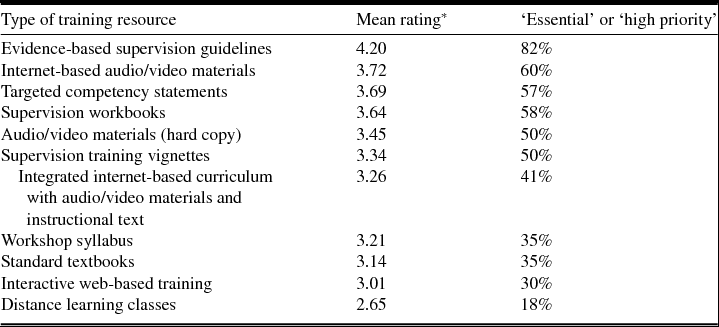
Sixty-seven supervisors commented on their current supervisor training resources. Prominently mentioned were the use of the CTS-R (Blackburn et al. Reference Blackburn, James, Milne, Baker, Standart, Garland and Reichelt2001), which was noted by 55% of the respondents, followed in frequency by the use of audio and video recordings (28%), ‘Other (unspecified) research’ (24%), the use of SAGE or the evidence-based clinical supervision model (16%), (EBCS: Milne, Reference Milne2009; SAGE: Milne & Reiser, Reference Milne, Sheikh, Pattison and Wilkinson2014), the use of record sheets or other notes/recording forms (15%), and the Newcastle Cake-stand supervision model (10%; Armstrong & Freeston, Reference Armstrong, Freeston and Tarrier2006). A number of other suggestions were referenced at a very low rate (i.e. by less than 3% of respondent items). In terms of enhancing these training resources, 51 individuals identified specific suggestions for needed resources (see Table 3). A majority of respondents rated as ‘essential’ or ‘high priority’ the development of evidence-based supervision guidelines, internet-based audio/video materials, targeted competency statements, and supervision workbooks.
Survey respondents’ priorities for CBT supervisor training resources

*Rated on a 1–5 scale: 1 = not a priority; 2 = low priority; 3 = medium priority; 4 = high priority, 5 = essential.
Discussion
In the context of the improved status of clinical supervision internationally, we set out to address these questions: What is the current situation of CBT supervision practice in the UK?; and how might we best maintain any forward momentum? (e.g. in terms of the integration of competency frameworks). From our survey of a small, purposively selected sample of 110 CBT supervision leaders in the UK, it appears that the current state of practice for CBT supervisors is consistent with international progress across various supervision models. Also, it seems that CBT supervision is being practiced in keeping with recommendations, at least by this select sample. However, there is an identified need for improved supervisor training resources to maintain this momentum.
In some respects the survey indicated little change over the past decade or more, in that some striking similarities were found in the most commonly used methods of supervision, as compared to the Townend et al. (Reference Townend, Iannetta and Freeston2002) survey, particularly in relation to the didactic methods (case discussion, case formulation and discussion of cognitive processes). This is consistent with the traditional emphasis within CBT supervision, where supervision is supposed to mirror therapy, and to revolve around case formulation (Liese & Beck, Reference Liese, Beck and Watkins1997). By contrast, data within the present survey indicate a greater use of experiential methods than reported in the Townend et al. (Reference Townend, Iannetta and Freeston2002) survey, a use that is consistent with recent recommendations (Roth & Pilling, Reference Roth and Pilling2008; Beidas & Kendall, Reference Beidas and Kendall2010 ; Reiser & Milne, Reference Reiser and Milne2012; Reiser, Reference Reiser, Watkins and Milne2014).
However, we can only speculate on the reasons for the better current profile of CBT supervision methods. The presence of standardized recommendations alone (e.g. the IAPT programme) is not a promising explanation, based on long-standing barriers to the dissemination of guidelines and related central initiatives (Carroll & Nuro, Reference Carroll and Nuro2002; Grol & Grimshaw, Reference Grol and Grimshaw2003). More likely, the favourable supervision profile reported by the present sample of CBT supervisors could be explained by the purposive sampling strategy, in that we deliberately selected those who occupied leadership roles within CBT supervision in the UK. Moreover, as far as we are aware, these supervisors only operated within this theoretical modality. This sampling strategy confounds any direct comparisons with surveys based on random, representative sampling (e.g. Townend et al. Reference Townend, Iannetta and Freeston2002, Reference Townend, Iannetta, Freeston and Hayes2007). Other possible explanations include the implementation of a national competency framework (Roth & Pilling, Reference Roth and Pilling2008), the advent of the IAPT programme, the improved supervisory training since the Townend et al. (Reference Townend, Iannetta, Freeston and Hayes2007) survey, and the recent BABCP (2012a , b) standards on supervisor accreditation (which have become quite prescriptive in term of the use of direct observation and audio/video recordings).
However, against some of these possible explanations, when we conducted sub-analyses we found no significant differences in the reported use of methods by IAPT-trained or BABCP-accredited supervisors, compared with non-accredited supervisors. For example, 98% of respondents who identified themselves as BABCP-accredited supervisors reported that they used audio/video observation in their supervision sessions ‘sometimes’ or ‘often’, compared to 90% of non-accredited supervisors [χ2(2, N = 76) = 2.42, p = 0.25]. In addition, there were also non-significant differences between these groups on the survey items concerned with the use of role-play [χ2(3, N = 76) = 4.766, p = 0.19], agenda setting [χ2(2, N = 76) = 2.92, p = 0.23], instruments to measure supervisory competence [χ2(2, N = 76) = 2.57, p = 0.46], and instruments to measure therapist competence [χ2(3, N = 76) = 3.09, p = 0.38]. There were also no significant differences between IAPT-trained supervisors and those not IAPT trained once we applied the Bonferroni correction (Bonferroni, Reference Bonferroni1936) to account for multiple tests of significance. This surprising lack of a difference may be due to a ceiling effect, in that survey participants were highly trained and experienced supervisors, presumably also well-motivated to develop their practice (as indicated by their completing the survey). It is also possible that our sample size was underpowered to detect significant differences between these relatively small subgroups. Based on these considerations, we assume that these various environmental ‘boosters’ to best supervisory practice (e.g. BABCP accreditation criteria and IAPT implementation) created a favourable organizational culture, one that probably interacted with a relatively motivated sample to yield the present positive findings.
Limitations of the study
We have already noted that our purposive sampling strategy, while enabling us to conduct a well-informed educational needs assessment, ruled out direct comparisons with the findings from the random samples used in the Townend (Reference Townend, Iannetta and Freeston2002, Reference Townend, Iannetta, Freeston and Hayes2007) surveys. In addition, we had no way of verifying the assumed ‘outlier’ status of our sample, at best relying on job titles, such as CBT training director. It is possible, therefore, that our sample of participants was not as distinctive or expert as we assumed.
Second, there are also some significant limitations to our study in terms of overall response rates and the difficulty in characterizing non-responders. Response rates for previously published comparable surveys of practitioners have ranged from 40% (Gabbay et al. Reference Gabbay, Kiemle and Maguire1999) to 61% (Townend et al. Reference Townend, Iannetta and Freeston2002). Lower response rates strengthen the view that we should use caution in attempting to generalize our findings (e.g. concluding that the findings are representative of all supervisors within the BABCP). Similarly, because this survey exclusively targeted BABCP members, we cannot generalize our results to the overall population of CBT supervisors. Because this was an anonymous, internet-based survey it was not possible to compare responders with non-responders in order to rule out significant differences between these groups.
A third limitation of the study was our reliance on self-report, and we acknowledge that asking supervisors to assess their satisfaction with supervision (for example) does not equate to an objective assessment of the effectiveness of supervision. Indeed, whatever the explanation for the findings, we cannot infer that this represents an improvement over the situation reported by Townend et al. (Reference Townend, Iannetta and Freeston2002, Reference Townend, Iannetta, Freeston and Hayes2007). This is because the use of different sampling strategies confounds a direct comparison. Whereas Townend et al. (Reference Townend, Iannetta and Freeston2002, Reference Townend, Iannetta, Freeston and Hayes2007) recruited a cross-sectional and fairly representative sample of BABCP members, our present respondents represent a deliberately selected, unrepresentative sample of what we assumed to be the leading experts on CBT supervision practice in the UK. Although our purposive sampling strategy enabled us to obtain the best-possible picture of what may be necessary for progress (i.e. the educational needs assessment), unfortunately we paid a price in being unable to make such direct comparisons (e.g. comments on progress) with the findings from Townend et al. (Reference Townend, Iannetta and Freeston2002, Reference Townend, Iannetta, Freeston and Hayes2007). Future research could replicate the sampling method used in Townend et al. (Reference Townend, Iannetta and Freeston2002, Reference Townend, Iannetta, Freeston and Hayes2007) to seek a fair, unconfounded comparison.
Maintaining momentum
Of course, we chose to sample these experts because our overall aim was to clarify how best to support the training of CBT supervisors. In responding to our survey, these experts indicated that they already made considerable use of the CTS-R, of audio and video recordings and of feedback forms, reviewed with supervisees. In future, they prioritized the development of evidence-based supervision guidelines, internet-based audio/video materials, targeted competency statements, and supervision workbooks. In summary, these recommendations agree with the shift towards the increased use of experiential methods reported above (see Table 1), and with an emphasis on user-friendly, accessible materials (e.g. operationalizing competency frameworks). We assume that continuation of the collaborative, action-research approach used with the present survey will contribute to the success of any such development work.
In conclusion, whether or not CBT supervision has improved amongst BABCP members, it is heartening to note the reportedly high level of current adherence to recent recommendations. Although this may well be limited to expert CBT supervisors in the UK, frequency ratings of methods used in supervision indicate the successful implementation of a more experiential model, one that theory and research suggests will be more effective than the traditional approach (Milne et al. Reference Milne, Reiser and Cliffe2013). In particular, greater use of an empirical approach heralds progress (e.g. direct observation of supervisees, linked to standardized scales to rate specific clinical competencies, furnishing corrective feedback). Presumably the advent of improved training materials as identified in our survey would enhance the position of CBT supervision as a full member of a thriving international community of clinical supervisors (Watkins & Milne, Reference Watkins, Milne, Watkins and Milne2014).
Recommendations for future research
Future research on supervision practices will need to focus on developing more representative samples so that findings can be generalized to the larger population of CBT supervisors. For example, comparative surveys of past supervisors from the Townsend et al. (Reference Townend, Iannetta and Freeston2002) era and the present would provide invaluable information about trends in terms of actual practices and processes from a less biased sampling strategy. Finally, international comparisons would add a very attractive dimension to this research on clinical supervision, offering a glimpse of how regional and national variations in supervision might continue to be a factor that needs to be addressed.
Acknowledgements
We recognize the BABCP Working Party for its ongoing support and assistance in developing and implementing this survey of BABCP members (members: Amanda Cole, Anne Garland, Sarah Goff, Mark Latham, Linda Mathews, Mark McCartney, Stirling Moorey, and Lucy Nicholas). We thank them for their assistance. We also thank Michael Townend for use of his 2001 and 2006 surveys (published in 2002 and 2007), and for his general support.
Declaration of Interest
None.
-
• Readers will be able to identify common methods of CBT supervision, as reported by a sample of BABCP members in the UK.
-
• Readers will be able to recount at least three progress indicators within clinical supervision internationally.
-
• Readers will be able to list the main materials used currently within supervisor training, and will be able to summarize at least three recommendations for the development of new training materials.



Comments
No Comments have been published for this article.