Heavy rain and floods have occurred frequently in recent years. 1 , Reference Hirano 2 To ensure the safety of patients and staff, vertical evacuation within buildings or evacuation to other medical facilities is required. However, such measures tend to pose greater challenges during actual disasters than anticipated.Reference Iwanaga, Shoko and Adachi 3 Hospitals must prepare for the potential impacts of flooding. To this end, it is crucial to evaluate disaster risk accurately and formulate and practice hospital evacuation. However, the detailed factors of such plans and drills are unclear. Thus, in this questionnaire survey targeting disaster base hospitals (DBHs) in Japan, factors to promote (or prevent) the implementation of hospital preparedness for floods were analyzed by using Bayesian network (BN) analysis.
Methods
Participants
This study focused on 765 DBHs in Japan, established in 1996 to provide initial emergency medical care during disasters. 4 Recently, the Japanese government mandated formulating a business continuity plan to be certified as a DBH. The evacuation plan should be a part of the business continuity plan (BCP).
The study protocol was approved by the Ethical Review Board at the Self-Defense Force Central Hospital on July 3, 2023.
Data
An Internet survey was conducted between March 24 and April 20, 2022. The respondents were hospital staff responsible for disaster risk management. The questionnaire included items related to the region, number of hospital beds, hospital preparedness for flooding (i.e., planning and drills of hospital evacuation), experiences with floods or landslides in the last 10 years, access to a website providing information on anti-inundation measures for medical facilities, 5 and awareness of geographical hazard risk of flood and landslides. 6 , 7
Statistical Analysis
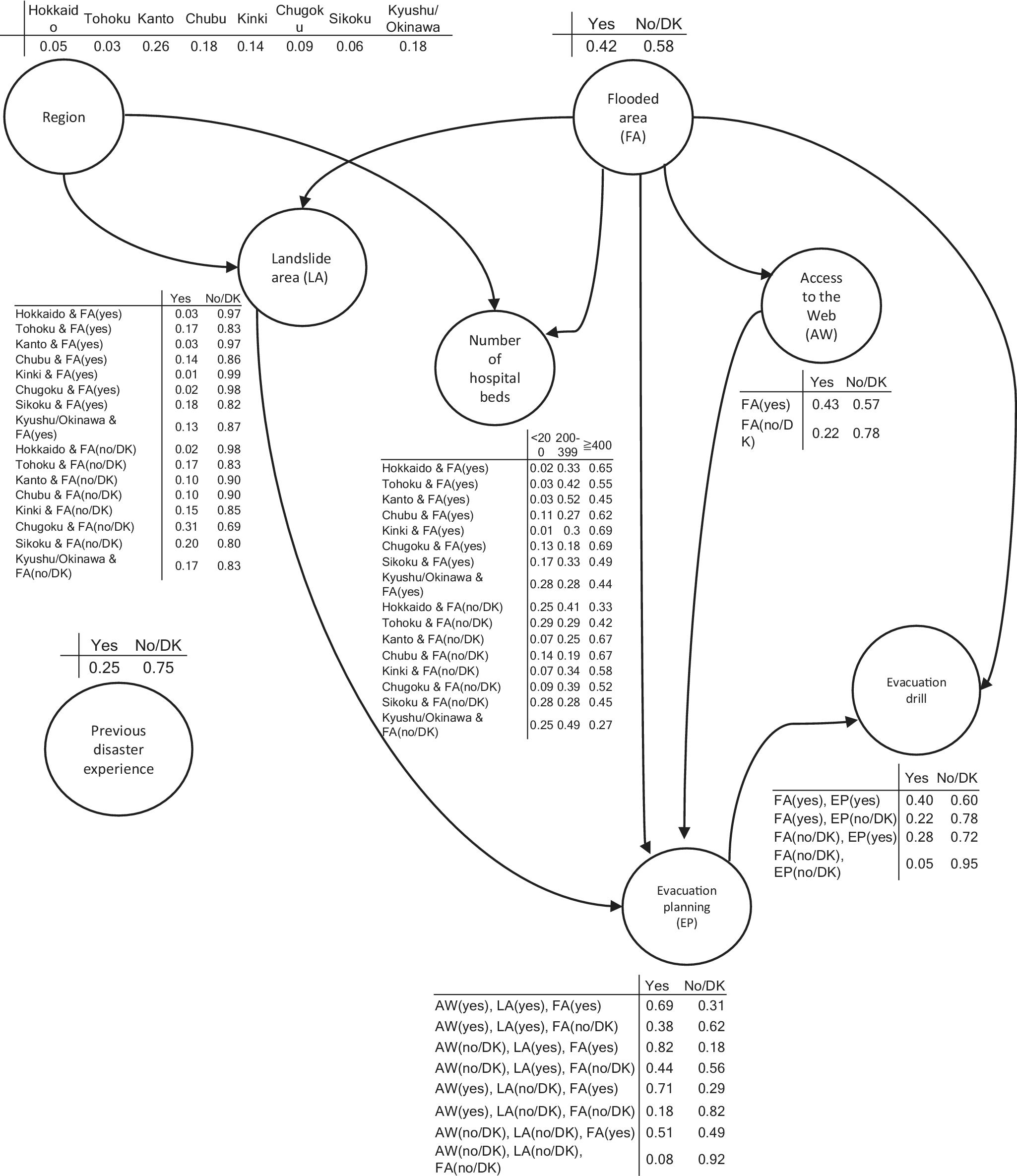
BN analysis determined how study variables in Table 1 are related. BN consists of nodes and arcs that represent variables and their interrelationships.Reference Scutari and Denis 8 Our BN model was developed following multiple steps. First, an initial data-driven model with the best fit to the data and maximum network modeling score was constructed using Max-Min Hill Climbing algorithms. Then, all investigators assessed the model adequacy and addressed an issue related to the configuration of variables with slight adjustments. All theoretically possible arcs linking nodes were added to the BN model. The conditional dependency of relationships among variables was tested using log-likelihood G2.Reference Scutari and Denis 8 Finally, after removing nonsignificant arcs, the final model with conditionally dependent nodes was specified (Figure 1). The accuracy of the final BN model was validated through 10-fold cross-validation.Reference Scutari and Denis 8 The stability of the final model was also confirmed. R software (v. 4.1.2, 2021-11-01; R Foundation for Statistical Computing, Vienna, Austria) was used for statistical analysis. Two-tailed P < 0.05 was considered indicative of statistical significance.
Characteristics of disaster base hospitals in Japan (n = 430)

Note.
1. DK: don’t know.
2. Abbreviations of study variables in parentheses are used in Figure 1 as labels of the study variables.
3. Percent of categories does not add up to 100% due to rounding to whole numbers in certain categories.
The final BN model (directed acyclic graph: DAG) with conditional probability tables. A path leading from one variable to the other is single-directed and acyclic. The DAG represents the dependence relationships of the linked variables. The BN consisting of discrete variables estimated conditional probabilities as the model parameters. The corresponding conditional probability tables are reported below each variable. “Flood area (FA)” indicates “Hospital in flood hazard area.” “Landslide area (LA)” indicates “Hospital in landslide hazard area.” “Previous disaster experience” indicates “Previous disaster experience in the last 10 years. “Access to the Web” indicates “Access to the website providing information on anti-inundation measures for medical facilities.” “Evacuation planning (EP)” indicates “Planning of hospital evacuation due to flooding.” “Evacuation drill” indicates “Drills of hospital evacuation due to flooding.”

Results
We sent the questionnaires to 765 DBHs in Japan, of which 555 responded to the questionnaire (response rate: 72.6%). Of the responses, 430 (56.2%) with complete information were included in the analyses (Table 1). One-third (33.7%) and one-fifth (17.9%) had plans and drills for evacuation, respectively. Notably, one-fourth (24.0%) had experienced flooding or a landslide in the prior 10 years.
In BN model development, the data-driven and best-fit model with the maximum network score (i.e., −2590.75) was constructed. Then, we revised the model and decided on the final model with a network score of −2685.97 (Figure 1). The final model accurately represents reality and aligns well with expert opinions. We detected no issues during the stability evaluation. According to the model, hospital location within a landslide or flood hazard area and access to the website providing information on anti-inundation measures were related to evacuation planning for flooding. Additionally, hospital location within a designated flood area and evacuation planning for flooding were related to evacuation drills. Notably, previous experience with a disaster was unrelated to evacuation planning or drills.
Figure 1 also reports conditional probabilities in a Bayesian setting estimated using their posterior distributions. The probability of evacuation planning was higher for hospitals within flood and landslide hazard areas. Conversely, the probability of not having the plan was higher for hospitals outside the flood and landslide hazard areas. The probability of running evacuation drills was higher for hospitals within flood hazard areas and with evacuation plans.
Discussion
This study analyzed factors of hospital preparedness for floods due to heavy rain in Japan. Identifying and marking areas with potential risks for flooding and landslides in the case of heavy rain promotes hospital evacuation planning and drills. Thus, when local and central governments raise awareness of such dangers, it effectively boosts hospital preparedness for flooding due to heavy rain. Several weaknesses in hospital preparedness were also identified. First, curiously, previous experience with such disasters in the last 10 years did not lead to evacuation planning or drills. Thus, it may be advisable to make evacuation plans and drills mandatory for hospitals that have experienced flooding or landslides. Several studies have also demonstrated the importance of pre-training and education for health care workers.Reference AI-Wathinani, Alakeel and Alani 9
One-tenth of DBHs are in landslide zones, which suggests that the authorities concerned should create a website related to anti-landslide measures for medical facilities. We observed a mismatch between previous disaster experiences and areas identified and designated as flood, landslide, or both hazard areas by the government. To enhance hospital flood preparedness, it might be necessary to increase public awareness that flooding caused by linear rainbands can result in similar damage to all hospitals, regardless of location. 10
There are several limitations to our study. First, although landslides posed a big threat to hospitals on steep land, hospital preparedness for landslides was not examined due to the lack of data. Second, the number of study variables was limited. Third, the response rate was not high. Finally, the study did not control for differences in respondents at each hospital (i.e., physicians, nurses, clerical staff).
Finally, the BN revealed that marking flood and landslide hazard areas relate to better hospital evacuation planning and drills. Previous experience with such disasters does not relate to disaster preparedness. Although the causal relationship is not validated, the findings have practical implications.
Competing interests
The authors declare none.