

Introduction
UK Government support to business during the COVID-19 pandemic was consistently justified on the basis of common interests: ‘protecting jobs and livelihoods’ (Sunak, Reference Sunak2020) and helping to ‘ease the financial burden for businesses and the UK population’ (HM Revenue and Customs, 2020). But such indefinite, universal goals potentially gloss over deeper questions about how monetary and in-kind support passed through the companies that received it. One of the most important of such questions is how the pay of companies’ most senior executives was affected.
An answer to this question seems particularly important given the relatively weak protections afforded to workers in some schemes, and the way others baked in existing inequalities between participants. The Coronavirus Job Retention Scheme (CJRS), for instance, which provided support to companies that furloughed workers, covered only 80 per cent of wages up to a gross cap of £2,500 a month (Fooks et al., Reference Fooks, Mullan, Willmott, Yates, Mills and Davis2023). Low-paid, part-time, and young workers – those least able to afford it – were significantly more likely to be furloughed with reduced pay. In April 2020, more than half of employees in the lowest decile of hourly earnings (less than £8.72 per hour) were on furlough with reduced pay. In the same month, 1.3 million furloughed employees were paid below the minimum wage, including a third of people working in the accommodation and food sector (Office for National Statistics, 2021). By contrast, government-supported loan schemes awarded millions of pounds to major banks in what were effectively subsidies, whilst creating debt servitude for many smaller businesses and their employees (Bank of England, 2021a, 2021b; Fooks et al., Reference Fooks, Mullan, Willmott, Yates, Mills and Davis2023). Analysis by the Bank of England published towards the end of 2021 found that 33 per cent of small and medium-sized enterprises (SME) had debt levels more than 10 times their cash balance or were in overdraft (up from 14 per cent before the pandemic) (Bank of England, 2021a, 2021b). Much of this was driven by government-backed loan schemes, with many SMEs taking out bank loans for the first time (Bank of England, 2021a, 2021b).
Given these effects, examining how government support to business benefited senior executives in larger companies is a key question, which has largely been ignored in public debates on government support. This reflects a general disinterest in ‘corporate welfare’ in social policy scholarship, first noted by Farnsworth in 2012 (Farnsworth, Reference Farnsworth2012, Reference Farnsworth2013), but just as true today. Yet the same neglect also extends to research on corporate welfare, where the primary unit of analysis is the corporation (Bulfone et al., Reference Bulfone, Ergen and Kalaitzake2023; Farnsworth, Reference Farnsworth2012, Reference Farnsworth2013). We consider this an important omission. Questions that centre on beneficiaries who are strategically well-placed to extract value from corporations in receipt of government support direct attention to the role of corporate welfare in supporting the welfare of elites – an ignored, but important, phenomenon which substantiates deeper shifts in how the political economy of advanced capitalist economies affects economic justice and inequalities.
We define elite welfare as elite income generated through activities, opportunities and relationships that are (1) largely free from competitive restraints and either unmoored from value-producing activities or derived from assets that are scarce or artificially made scarce, and (2) have been directly or indirectly facilitated by policy decision-making or public expenditure, whether by design, through tolerated omission, or as an unintended effect. The phenomenon is a kissing cousin of middle-class advantage in public service provision (Goodin & Le Grand, Reference Goodin and Le Grand2018; Hastings & Matthews, Reference Hastings and Matthews2015), but raises qualitatively different issues. The literature on middle-class advantage examines how those in the middle-class position themselves within the field of public service provision, the alignment between their habitus and the competitive struggles characteristic of public service provision, and the importance of social and cultural capital within these struggles (Hastings & Matthews, Reference Hastings and Matthews2015). By contrast, elite welfare as epiphenomenal to corporate welfare is a form of ‘welfare by other means’ (Stebbing & Spies-Butcher, Reference Stebbing and Spies-Butcher2010), which asks us to think instead in terms of how elites are positioned in relation to the allocation of capital characteristic of ‘rent’ (Christophers, Reference Christophers2019). Elite welfare therefore depends on a very different form of privilege. Insofar as corporate executives derive windfall benefits from corporate welfare, there is no need for them to act or compete in a field shared with the hoi polloi. There is no struggle, no requirement to leverage social or cultural capital. Advantage accrues by virtue of just being there – in the right role, in the right place, at the right time.
In this paper, we do two things. First, adapting a ‘follow-the-money’ approach (Hughes-McLure, Reference Hughes-McLure2022), we examine the relationship between receipt of government grants by the UK’s largest publicly owned companies under the CJRS and changes in executive pay. Specifically, we estimate difference-in-differences regression models to test whether receipt of grants under CJRS had an impact on changes in executive pay before and after the height of the pandemic. We find that receipt of furlough support had a significant positive short-term impact on executive pay. Second, we seek to explain our findings using the novel concept of elite welfare, tying the phenomenon to the idea of rent, and thinking through its relevance to longer-standing forms of policy-enabled rent capture largely ignored within social policy, involving phenomena such as ‘fiscal welfare’ for economic elites, political cronyism and asset transfers to elites at a discount. In these respects, the paper belongs to a tradition of enquiry that seeks to expand the boundaries of social policy analysis (Farnsworth, Reference Farnsworth2013) and answers Orton and Rowlingson’s appeal for a research agenda in social policy that considers the social contribution, responsibilities and hidden benefits of the rich in producing and sustaining contemporary economic inequalities (Orton & Rowlingson, Reference Orton and Rowlingson2007). In doing so, we seek to progress Advani and colleagues’ recent efforts to open up a much-needed dialogue between social policy and the recent resurgence of interest in elites in sociology and political economy (Advani et al., Reference Advani, Ooms and Summers2022; Korsnes et al., Reference Korsnes, Heilbron, Hjellbrekke, Bühlmann and Savage2017).
The paper is divided into three sections. In the first section, we outline the sample for our empirical analysis, data sources, approach to data collation and method of analysis. The second section presents our results. In the third section, we discuss the relevance of our results to the study of elites, elite welfare and social policy analysis. Here, we examine the relationship between elite welfare and rent, set the concept within social policy analysis using the ‘functional equivalent’ approach developed by Seelkopf and Starke (Reference Seelkopf and Starke2019), and explain the importance of examining the welfare of elites to contemporary social policy analysis.
Methods/research design
Sample
Our sample of companies (n = 246) is based on the FTSE 350 as of 31st December 2021, which published data on executive pay consistently from March 2019. Excluded companies (n = 104) were those without firm financial data for at least a year prior to March 2020 (e.g. companies subject to an initial public offering post March 2019) and companies that did not otherwise report executive remuneration data consistently post March 2019, reflecting exceptions to remuneration reporting obligations outlined in relevant laws and regulations (see Fooks et al., Reference Fooks, Mullan, Willmott, Yates, Mills and Davis2023 for a summary). Excluded companies under this second criterion primarily included: real estate investment trusts; other collective investment vehicles; companies with no operations in the UK; and companies with fewer than 250 employees.
Data sources and collation
Data were collated between January 2021 and April 2024 and cover chief executive officer (CEO) and chief financial officer (CFO) remuneration (hereafter executive pay unless otherwise specified), data relating to the receipt of government funds to support furlough and firm financial data.
Executive pay data
Pay data for board executives (CEOs and CFOs or equivalents) between 2015/16 and 2023/24 were collated from directors’ remuneration reports contained in company annual reports downloaded from company websites. Presently, these include a single figure for total pay for each director and its components (basic salary and fees, taxable benefits, person-related benefits and two elements of performance-related pay – an annual bonus and long-term incentive awards). These components were collated separately along with ‘other’ payments (such as ‘Golden hellos’), ‘All Employee’ share plans, awards for initial public offerings (IPOs), ‘malus’ or ‘clawback’. Changes in directors during reporting years were also recorded, along with start and end dates of their appointments. Where directors moved between different roles within the company, remuneration data for each role were collated from annual reports and recalibrated according to the number of days in office.
Figure 1 shows trends in the average total remuneration paid to CEOs and CFOs between 2015–16 and 2023–24 (each annual period running from 1st April-31st March, reflecting the timing of the first lockdown and introduction of furlough).Footnote 1 In the lead-up to the pandemic, executive pay had been falling steadily from a peak of £3.54m and £1.94m in 2017/18 for CEOs and CFOs, respectively (Figure 1 and Fooks et al., Reference Fooks, Mullan, Willmott, Yates, Mills and Davis2023). Between 2018/19 and 2019/20, the 12-month period prior to lockdown, average total pay for CEOs and CFOs dropped from £3.28m/£1.78m to £2.95m/£1.58m, but then fell sharply to £2.37m/£1.27m in 2020/21 as pandemic-related restrictions came into effect (shaded area in Figure 1). As the economy came out of lockdown, executive pay recovered quickly, increasing to £3.15m/£1.76m in 2021/22 and then £3.45m/£1.89m in 2022/23 before effectively levelling off to £3.44m/£1.82m in 2023/24, comparable to its pre-pandemic peak.
Trends in average total remuneration (£m) paid to CEOs and CFOs: 2015–16 to 2023–24.

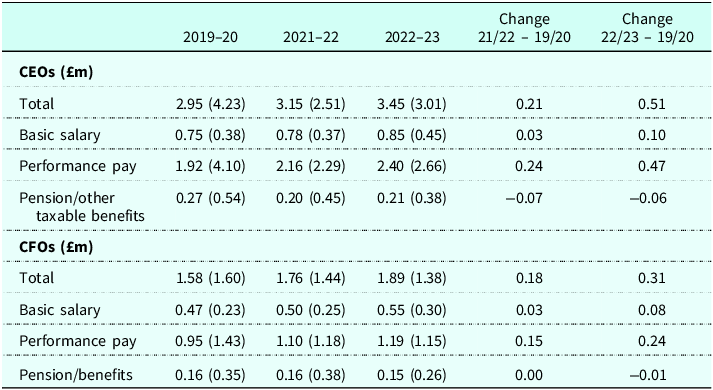
Further descriptive statistics for specific components of executive remuneration are reported in Table 2.
CJRS support data
Data relating to support under the CJRS were obtained in the first instance from group consolidated financial statements, using search terms associated with the scheme (e.g. furlough) and general search terms associated with government support (e.g. grant). Where the type of support was not sufficiently disaggregated or otherwise ambiguous in consolidated financial statements, we searched first-tier UK subsidiaries’ financial statements downloaded from the Companies House website using the same search strategy.
The direct beneficiaries of the CJRS were furloughed employees who, for the duration of the scheme, were protected from being laid off. However, the scheme also benefited participating businesses by helping them to avoid the costs associated with redundancies, including redundancy payments, rehiring costs, induction and training costs, higher staff turnover and lower productivity due to reduced staff morale and disengagement of ‘survivor’ employees. In 2009, the Chartered Institute of Personnel and Development estimated the average direct cost to employers of making redundancies (i.e. not including lower productivity, etc. associated with redundancies) at £16,375 (Taylor, Reference Taylor2009).
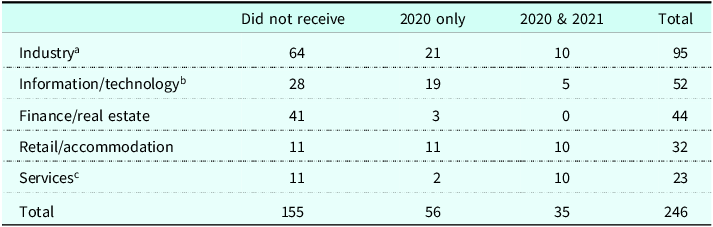
Table 1 shows the total number of firms in broad industry groupings (based on first line standard industry classification codes) that did and did not receive funds under the CJRS (hereafter ‘furlough’) during the pandemic. A total of fifty-six of our 246 firms received financial support to furlough staff solely in 2020 (22.8 per cent), with a further thirty-five receiving this support in both 2020 and 2021 (14.2 per cent). Overall, 37 per cent of firms (n = 91) reported receiving this support at the peak of the pandemic in 2020. A majority of companies in industrial, finance/real estate and information/technology sectors received furlough support in 2020 only, whereas firms in retail and accommodation sectors receiving furlough support were split evenly between those receiving support in 2020 only and in 2020 and 2021. Most firms in the service sector received furlough support in 2020 and 2021.
Number of companies in major industries receiving CJRS (Furlough) in 2020 and 2021

Table 1. Long description
The table presents data on the number of firms in different industry sectors that received financial support under the CJRS during the pandemic. It includes five rows and four columns. The columns are labeled ‘Did not receive’, ‘2020 only’, ‘2020 & 2021’, and ‘Total’. The row labels are ‘Industry’, ‘Information/technology’, ‘Finance/real estate’, ‘Retail/accommodation’, and ‘Services’. Row 1: Industry, 64, 21, 10, 95. Row 2: Information/technology, 28, 19, 5, 52. Row 3: Finance/real estate, 41, 3, 0, 44. Row 4: Retail/accommodation, 11, 11, 10, 32. Row 5: Services, 11, 2, 10, 23. Row 6: Total, 155, 56, 35, 246.
Notes:
a Includes Mining, Manufacture, Utilities, Construction, Transportation & Storage.
b Includes Information, Communication, Profession, Science and Technology Services.
c Includes Administrative and Support Services, Public Administration and Defence Services, Health and Social Care, Arts, Entertainment and Recreation Services and Other Services.
Data analysis
Because the onset of the pandemic and the introduction of the CJRS were external to firms’ prior pay-setting decisions, they are treated as an exogenous shock to the conditions under which executive remuneration was determined (Fooks et al., Reference Fooks, Mullan, Willmott, Yates, Mills and Davis2023). To identify an effect of receipt of furlough support on executive remuneration, we employ a difference-in-differences regression research design. With this approach, we observe companies that received furlough support and those that did not, at two time points: i) before the support was available (pre-pandemic); and ii) after receipt of support. This allows for the estimation of the difference in remuneration before and after receipt of support, and critically to identify any difference in this difference between companies receiving support and those that did not. A key assumption of the difference-in-differences approach is that trends in the outcome prior to an intervention are parallel for treated and untreated groups. Analysis of trends in remuneration for CEOs and CFOs prior to the onset of the pandemic revealed no significant divergence between treated and untreated firms (see Figures S.2 and S.3 and Tables S.1 and S.2 in the supplementary file).
The first national lockdown and the introduction of furlough both came into effect towards the end of March 2020. In our analysis, therefore, the pre-support period is the twelve months leading up to and including March 2020 (1 April 2019 – 31 March 2020). We conduct analysis separately for two post-support periods. We analyse change between 2019–20 and 2021–22 in a first set of models, and in a second set of models we analyse change between 2019–20 and 2022–23. This allows us to consider whether there were sustained effects or whether there were delayed effects.
Dependent variables
The dependent variables are measures of executive remuneration (CEO and CFO separately) including the total (single figure) amount, and its constituent components: basic salary, pension, performance pay (annual bonus plus actualised awards under long-term incentive plans), benefits and other payments. Table 2 reports averages for remuneration paid to CEOs and CFOs in 2019–20 (pre-support) and 2021–22 and 2022–23. The average total remuneration paid to both CEOs and CFOs increased between 2019–20 and 2021–22, and further again between 2019–20 and 2022–23. This was mainly concentrated in increased performance-related pay, which comprises around two-thirds of executives’ remuneration packages. CEO total remuneration and performance-related pay is around double the amount awarded to CFOs, who have also seen greater increases, particularly in performance pay over the period. Following the financial economics literature on executive pay, these measures are log-transformed prior to estimating the models, adding a constant of 1 prior to transformation to ensure zero values are not excluded from the analysis (Banker et al., Reference Banker, Darrough, Huang and Plehn-Dujowich2013).
Average executive remuneration (£m) in 2019–20, 2021–22, and 2022–23

Table 2. Long description
A table comparing executive remuneration in GBP millions for the years 2019-20, 2021-22, and 2022-23. The table is divided into two main sections: CEOs and CFOs, each with subcategories for Total, Basic salary, Performance pay, and Pension/other taxable benefits for CEOs and Pension/benefits for CFOs. The table also includes columns for the change in remuneration from 2021-22 to 2019-20 and from 2022-23 to 2019-20. Row 1: CEOs Total, 2.95 (4.23), 3.15 (2.51), 3.45 (3.01), 0.21, 0.51. Row 2: CEOs Basic salary, 0.75 (0.38), 0.78 (0.37), 0.85 (0.45), 0.03, 0.10. Row 3: CEOs Performance pay, 1.92 (4.10), 2.16 (2.29), 2.40 (2.66), 0.24, 0.47. Row 4: CEOs Pension/other taxable benefits, 0.27 (0.54), 0.20 (0.45), 0.21 (0.38), -0.07, -0.06. Row 5: CFOs Total, 1.58 (1.60), 1.76 (1.44), 1.89 (1.38), 0.18, 0.31. Row 6: CFOs Basic salary, 0.47 (0.23), 0.50 (0.25), 0.55 (0.30), 0.03, 0.08. Row 7: CFOs Performance pay, 0.95 (1.43), 1.10 (1.18), 1.19 (1.15), 0.15, 0.24. Row 8: CFOs Pension/benefits, 0.16 (0.35), 0.16 (0.38), 0.15 (0.26), 0.00, -0.01.
Notes: Standard deviations in parentheses.
Independent variables
The key independent variables in the fixed-effects difference-in-differences models are a variable indicating the post-support period (reference: 2019–20), indicating whether a company received furlough support (reference: did not receive furlough), and an interaction variable between period and receipt of furlough support, which provides an estimate of the difference-in-differences effect of receiving support. Firms receiving support are split into two groups depending on whether they received furlough support over one or two years (see Table 1). We therefore employ a generalised difference-in-differences approach to account for more than one treatment group (Wing et al., Reference Wing, Simon and Bello-Gomez2018). In addition, the models control for several factors associated with executive pay (Anderson et al., Reference Anderson, Bhattacharyya, Morrill and Roberts2020; Blanes et al., Reference Blanes, de Fuentes and Porcuna2020; Wang & Yang, Reference Wang and Yang2022), namely the number of employees, log of sales, return on assets (ROA), leverage ratio (total debt/total assets) and a variable indicating if there was a change in any executive roles in the period.
The first set of models (comparing change between 2019–20 and 2021–22) excludes nineteen firms with missing data on one or more control variables, leaving 227 firms with complete data for CEOs and 216 firms with complete data for CFOs in the final analysis sample (three companies also had incomplete data for CFO remuneration). The second set of models (comparing change between 2019–20 and 2022–23) excludes twenty-four firms with missing data for one or more control variables. In addition, we exclude three firms with incomplete remuneration data for CEOs and five firms with incomplete remuneration data for CFOs, leaving 207 and 198 firms for CEO and CFO models, respectively. Given the very small samples in specific sectors (see Table 1), sector-specific analyses are unfeasible. We therefore estimate models for all firms combined, allowing us to identify effects across a broad cross-section of the FTSE 350. Full model results are available in a supplementary file (Tables S.3–S.6).
Results
Figure 2 shows difference-in-difference coefficients with 95 per cent confidence intervals focusing on change between 2019–20 and 2021–22. The upper panel shows results from models of CEO remuneration and the lower panel from models of CFO remuneration (see Tables S.3 and S.4 in the supplementary file for full regression results). Looking first at the results for CEOs in firms that received furlough support in 2020 only (see Figure 2, top-left panel), there was a positive significant difference-in-difference effect in the model for total remuneration. In the models for specific components of total remuneration, there was a significant positive effect for performance-related pay. There were no significant effects found in the models for basic salary, pension or benefits/other. For CEOs in firms receiving furlough support in 2020 and 2021, there were no significant effects on any component of remuneration (see Figure 2, top-right panel).
Difference-in-difference coefficients and 95% confidence intervals from models of executive remuneration (logged): Change between 2019–20 and 2021–22.

Turning now to CFO remuneration, no significant effects were found for any component of CFO remuneration linked to receipt of furlough support in 2020 only (see Figure 2, bottom-left panel). There was a significant positive effect, however, on basic salary for CFOs in firms receiving furlough support both in 2020 and 2021 (see Figure 2, bottom-right panel).
As shown in Table 2, there was a substantial increase in performance-related pay in 2021–22 compared with 2019–20, especially for CEOs, which almost entirely accounted for the increase in total remuneration, and the regression results here indicate that CEOs in firms receiving furlough support in 2020–21 received a significantly higher increase in performance pay in the period after receipt of support compared with their counterparts in firms that did not receive furlough support.
To examine whether effects were sustained into a second year following receipt of support or if there were delayed effects, a second set of models was estimated testing change between 2019–20 and 2022–23. Results are reported in Tables S.5 and S.6 in the supplementary file. Overall, no statistically significant effects of receiving support were found, indicating that effects were limited to the year immediately following the introduction of the supports, and that there were no delayed effects, including among those firms receiving support for two years.
Discussion: elite welfare, rent extraction and social policy analysis
Looking generally at trends in executive remuneration before, during and immediately after the pandemic provides an instructive example of how economic elites in the modern era seem to easily shake off the worst effects of economic shocks. Granted, executive pay fell substantially during the height of the pandemic. But it recovered rapidly, and soon exceeded the levels enjoyed immediately prior to the pandemic.
This effect arguably reinforces recurrent criticism of executive pay as excessive and is symptomatic of broader trends in economic inequality (Machell, Reference Machell2023; Piketty, Reference Piketty2014; Thomas, Reference Thomas2022). Claims of excess – particularly in the U.S. – have sat alongside sustained efforts to characterise executive pay as a flagrant example of rent where executives largely self-determine the level and structure of their remuneration (Bebchuk et al., Reference Bebchuk, Fried and Walker2002; Bivens & Mishel, Reference Bivens and Mishel2013; Edmans et al., Reference Edmans, Gabaix, Jenter, Hermalin and Weisbach2017). This view is not without its critics who, among other things, point to the difficulties in quantifying the proportion of pay that represents rent extraction (Edmans et al., Reference Edmans, Gabaix, Jenter, Hermalin and Weisbach2017). But, on the face of it, our finding of a significant positive effect of receipt of furlough support on overall CEO pay reveals an unambiguous extraction of rent. Put another way, the results are consistent with the idea that CEOs at companies that accepted government support – in the first year only of the pandemic, at least – received ‘something for nothing’; their pay packages having outperformed executives of comparable, non-supported companies, taking into account obvious factors that affect executive compensation such as firm size and performance.
Our design, of course, does not directly observe the board-level mechanisms behind the differential. In some cases, remuneration committees tweaked performance-related formulae to bump up CEO pay packages in response to concerns that a significant drop in pay might induce them to explore employment elsewhere (Fooks et al., Reference Fooks, Mullan, Willmott, Yates, Mills and Davis2023). In other cases, remuneration committees may have regarded some CEOs at firms in receipt of furlough support as having successfully steered firms through an exceptional period of uncertainty and rewarded them accordingly. Either way, however well-reasoned or well-founded the justification, weakly conditional public support appears to have created the conditions under which furlough support could be translated into higher CEO pay, while many workers experienced reduced earnings (Fooks et al., Reference Fooks, Mullan, Willmott, Yates, Mills and Davis2023).
There are, as such, various ways we can seek to explain this ‘something for nothing’ effect. One is to think in terms of policy design. As we show elsewhere, many support schemes, including the CJRS, failed to include conditions restricting executive pay, which might have moderated executive compensation (Fooks et al., Reference Fooks, Mullan, Willmott, Yates, Mills and Davis2023). Weak conditionality, in combination with existing models that seek to understand the disconnect between executive compensation and firm performance (Bebchuk et al., Reference Bebchuk, Fried and Walker2002; Bivens & Mishel, Reference Bivens and Mishel2013; Chalmers et al., Reference Chalmers, Koh and Stapledon2006; Godechot et al., Reference Godechot, Horton and Millo2022), constitutes a useful avenue of further inquiry, relevant both to shaping future government support to business and the governance of executive pay. However, focusing solely on the absence of effective scheme conditions arguably misses the broader significance of the findings: namely, that public policy and expenditure can create opportune conditions for the extraction of rent – an observation that raises fundamental questions about the redistributive bearing of modern welfare states.
We seek to address this issue by introducing the concept of elite welfare – a concept predicated on the observation that economies in general and the UK economy in particular are characterised not only by high levels of economic inequality (Piketty, Reference Piketty2014), but also increasing rentierism (Christophers, Reference Christophers2020). By elites we refer to individuals who exercise ‘vastly disproportionate control over or access to a resource’ that has some transferable value (Khan, Reference Khan2012). In general, such a resource might include educational and professional credentials, specialist skills, knowledge and expertise, or various forms of cultural or symbolic ‘capital’. In the present context, however, we are concerned with economic elites; those with disproportionate control over and access to economic resources. Whilst welfare has historically referred to economic transfers concerned with the ‘abatement of class differences’ (Briggs, Reference Briggs1961), we argue here for a broader conceptualisation that considers the role of welfare in widening experiences of insecurity, and grounds the concept in the extraction of rent (Christophers, Reference Christophers2020) facilitated by policy decision-making or public expenditure. By elite welfare, we therefore refer to elite income generated through activities, opportunities and relationships (hereafter just activities) that are largely free from competitive restraints, and either unmoored from value-producing activities or derived from assets that are scarce or artificially made scarce, which have been directly or indirectly facilitated by policy decision-making or public expenditure, whether by design, through tolerated omission or as an unintended effect.
We propose that a focus on the welfare of elites is imperative for two reasons. First, to take account of their growing economic, political and cultural importance. In societies characterised by high levels of inequality, elites are, axiomatically, those who are most able to condition political and social institutions and processes (Savage, Reference Savage2021), which extends to shaping the political and economic governance of rent extraction (McCaffery & Jones, Reference McCaffery and Jones2024). Second, in recognition of the fact that many forms of rent are effectively annexed or solely accessible by elites (see later in this article). These two considerations guide the remainder of our discussion, which seeks to explain our definition of elite welfare and situate it within social policy analysis. We organise our thinking around three simple questions. What do we mean by rent? Why should we conceive of elite income derived from the extraction of rents as a form of welfare? Why is examining the welfare of elites important to contemporary social policy analysis?
Rent and elite welfare
A clear, settled and widely agreed-upon definition of rent has proved elusive (Stratford, Reference Stratford2023). Often used in the present to describe ‘any undue or unjustified income’ (Piketty, Reference Piketty2014), rent has been ‘invested with all manner of different meanings’ (Christophers, Reference Christophers2019), ranging from income in excess of opportunity costs, to income in excess of competitive price, to income extracted from the ownership and control of a particular resource or asset (Sayer, Reference Sayer2023; Stratford, Reference Stratford2023).
From this stew of different definitions, Christophers has isolated two underlying understandings, which broadly map onto the use of rent within orthodox and heterodox economics (Christophers, Reference Christophers2019) and which constitute a basis for developing a lucid definition of elite welfare. In orthodox economics, rent covers ‘unearned’ income generated through unproductive activities aimed at redistributing, rather than creating wealth, with a key focus on how the levers of public policy are used to generate excess returns under conditions of limited competition (hereafter orthodox rents) (Congleton et al., Reference Congleton, Hillman, Konrad, Congleton, Konrad and Hillman2008). Typically applied to practices such as tariffs, import quotas and anti-competitive regulation (Krueger, Reference Krueger2008; McChesney, Reference McChesney1987), the principles underlying rent and rent-seeking within the orthodox canon also apply to a range of other practices more directly relevant to the welfare of elites, such as preferential treatment or ‘padding’ in government procurement processes (Lambsdorff, Reference Lambsdorff2002), political cronyism (Aligica & Tarko, Reference Aligica and Tarko2014),Footnote 2 tax avoidance (Chirinko & Wilson, Reference Chirinko and Wilson2010) and, under certain conditions, the transfer of publicly owned assets at a discount (Kaufmann & Siegelbaum, Reference Kaufmann and Siegelbaum1997).
In respect of the latter, not all public asset sales below market value inevitability involve rent extraction and, by implication, elite welfare. Public authorities commonly dispose of assets at an undervalue in order to secure wider social, economic or environmental benefits. The critical questions are who captures the discounted value and under what conditions. Where the discount is tied to enforceable public obligations that secure commensurate public benefit, we regard the transfer as a policy decision that does not involve the extraction of rents. Where, however, the undervalue allows private actors to retain the value generated or secured by public action, and that foregone value is not matched by commensurate and enforceable public benefit, the discount operates as rent, as a subsidy in the stronger redistributive sense, and, where the (direct or indirect) beneficiaries are elites, as elite welfare (Department for Business and Trade, 2025). Much the same distinction applies to industrial policy and business subsidies. These may form part of a legitimate developmental strategy – particularly where they are tied to enforceable obligations that secure commensurate public return in the form of innovation, employment, decarbonisation, regional development or some other public benefit (Farnsworth, Reference Farnsworth2012, Reference Farnsworth2013). However, the threshold of rent extraction is crossed where support confers an economic advantage on terms unavailable in the market, is weakly conditional, and gains created or secured by public intervention are retained by owners, executives or other elite actors without commensurate public return (Bulfone et al., Reference Bulfone, Ergen and Kalaitzake2023; Mazzucato & Rodrik, Reference Mazzucato and Rodrik2024).
In contrast to orthodox economists, heterodox economists place their emphasis on monopoly control over resources ‘that others lack and need or want’ (Sayer, Reference Sayer2023) – assets, in other words, ‘that are scarce or artificially made scarce’ (hereafter heterodox rents) (Christophers, Reference Christophers2019). In practice, monopoly control is interpreted loosely. Sayer, for instance, rejects the ‘fallacy of continuum’, according to which the absence of a clear division between monopolies, oligopolies and competitive markets must mean the absence of any difference and, instead, implores that we simply concern ourselves with ‘the most egregious forms’ (Sayer, Reference Sayer2023). Implicated in weak productivity and increasing economic inequalities, the growth of heterodox rents is increasingly pitched as one of the most important economic developments of the last half a century (Christophers, Reference Christophers2020, Reference Christophers2023; Piketty, Reference Piketty2014). This is reflected in the wide range of rent-deriving assets encompassed within the heterodox concept, which include assets that have been constructed, such as energy and water infrastructure, purely legal assets, such as patents and outsourcing contracts, and assets that simply exist, such as land (Christophers, Reference Christophers2020). In practice, heterodox rents primarily materialise as corporate rents (Christophers Reference Christophers2020). Elites therefore tend to profit from them indirectly, and, importantly, on a different scale to non-elites as a result of asymmetries in the ownership of public and private companies (Board of Governors of the Federal Reserve System (US), 2024; Kuhn et al., Reference Kuhn, Schularick and Steins2020; Medina et al., Reference Medina, de la Cruz and Tang2022).
We capture the two understandings of rent within our definition of elite welfare by highlighting elite income unmoored from value-producing activities (orthodox rents) and derived from assets that are scarce or artificially made scarce (heterodox rents) through activities that are largely free of competitive restraint. But this still leaves the question of why we should conceive of elite income derived from the extraction of rents as a form of welfare. To address this question, we can start by thinking through how elite welfare measures up to existing efforts to demarcate the boundaries of welfare and social policy. An important precursor here is Titmuss’s (Reference Titmuss1958) account of the social division of welfare, later developed by Sinfield (Reference Sinfield1978) and Mann (Reference Mann2009), which widened welfare analysis beyond visible public provision to include fiscal and occupational channels of advantage (Mann, Reference Mann2009; Sinfield, Reference Sinfield1978; Titmuss, Reference Titmuss1958). This broader conceptualisation of welfare has been revisited, from a different angle, in later work on the mixed, and, latterly, whole economy of welfare, which directs attention to the distributive significance of actors, transfers and supports beyond conventional statutory provision (Farnsworth, Reference Farnsworth2019). Here, however, we draw most directly on Seelkopf and Starke’s (Reference Seelkopf and Starke2019) adaptation of Asa Briggs’ (Reference Briggs1961) definition of the welfare state, which defines social policy (hereafter welfare) as the ‘deliberate use of organised power (through politics and administration) in an effort to shape market processes and modify outcomes of market forces to (a) guarantee a minimum income, to (b) provide an insurance against life contingencies such as unemployment or illness for (c) all citizens without distinction of status’ (Seelkopf & Starke, Reference Seelkopf and Starke2019, p. 220).
The third limb of this definition is plainly at odds with the exclusive quality of elite welfare. Elite welfare effectively comprises a shadow system of advantage that inverts conventional norms of distribution and is largely closed to non-elites. This exclusivity is especially pronounced in the case of elite welfare obtained through orthodox rents. By way of illustration, political cronyism takes effect through, and is confined to, elite networks, whereas an ability to exploit shell companies, trusts and other contrivances of tax avoidance is contingent on buying power. The form and degree of the effect may vary – relational and absolute for political cronyism, wealth-based and relative for many forms of tax avoidance – but the exclusive element is constant. In this sense, elite welfare neither aspires to ‘equality of treatment’ (Briggs, Reference Briggs1961, p. 228) nor seeks to support ‘all citizens without distinction of status’ (Seelkopf & Starke, Reference Seelkopf and Starke2019, p. 220).
But what weight should we attach to this disparity? Neither welfare nor social policy are fixed categories. Both have indistinct, evolving edges. One is a resourceful tool, the other an inventive home for boundary-pushing ideas that traverse and assimilate the logics of multiple social practices and policy-related fields (Greve, Reference Greve2008; Farnsworth, Reference Farnsworth2019). These elastic qualities, as Seelkopf and Starke note, have encouraged a steady expansion of activities incorporated within social policy analysis – different kinds of welfare state ‘exceptionalism’ that rely strongly on ‘functional equivalents’ to formal public provision, which use different means to achieve broadly the same social policy aims (Reference Seelkopf and Starke2019, p. 220).
In this spirit of functional equivalents, elite welfare shares two elemental similarities with existing forms of welfare, which make a compelling case for bringing the concept within the welfare-social policy oeuvre. The first relates to the effects of elite welfare on elite wellbeing. Clearly, rent-derived elite income works to augment rather than ‘guarantee a minimum income’. Nonetheless, by constituting a generous rider to existing fortunes, elite welfare, in effect, accords elites premium insurance ‘against life contingencies’ – in many cases, quite literally, the best that money can buy. The second, more important similarity, relates to the fact that elite welfare centres on activities facilitated by policy decision-making or public expenditure that are largely free from competitive restraints. In practice, most types of elite welfare side-step market forces entirely. For example, the tax advantages that accrue from the treatment of ‘carried interest’ (income flowing to the general partner of a private investment fund) as a capital gain rather than income (McCaffery & Jones, Reference McCaffery and Jones2024; Neidle, Reference Neidle2023) or buying UK property through an offshore vehicle (Bomare & Herry, Reference Bomare and Herry2022) are a conceit of tax rules that preferentially favour economic elites, rather than income hard won in the commercial broil of private markets. Clearly, this capacity to elude – either fully or partially – ‘market discipline’ derived through some measure of policy decision-making or public expenditure resonates powerfully with Seelkopf and Starke’s characterisation of social policy as practices that involve the use of politics and administration to ‘shape market processes and modify outcomes of market forces’ (Seelkopf & Starke, Reference Seelkopf and Starke2019).
Whether policy-expedited rents are intended by policy actors is, ultimately, irrelevant to whether they constitute elite welfare. In the present case, weakly conditional corporate support created an opportunity structure within which value was, in effect, appropriated upwards by senior executives. Across the wider range of phenomena encompassed by elite welfare, the role of policy in enabling rent extraction may vary from purposive design, to producing foreseeable but weakly constrained opportunities for private gain, or genuinely unintended windfalls. What makes these cases analytically cognate is not a common intention on the part of policy-makers, but the fact that policy decision-making or public expenditure creates or preserves opportunities for elites to secure advantage relatively free from competitive restraint. In some cases, including the CJRS, elite welfare may appear as a secondary appropriation of corporate welfare. In others, such as ‘fiscal welfare’, the relevant advantage accrues more directly. Of course, foresight, intention, ambivalence, complacency and design are important policy and scholarly questions, which require closer attention to the political and cultural assumptions that are attendant on areas of policy-making where elites may economically benefit, as well as intuitively, to the leverage elites possess in low-salience policy settings (Culpepper, Reference Culpepper2011; Schneider & Ingram, Reference Schneider and Ingram1993). But these important questions are, for now, best left to future research.
In summary, elite welfare may not seek to support all citizens. Nonetheless, the phenomenon involves capital transfers (e.g. the transfer of public assets at a discount), fiscal welfare (e.g. approved tax avoidance) and security of labour (e.g. political cronyism) to and for elites facilitated by ‘organised power’, which exists apart from the competitive constraints of markets. The convention may be to think of these phenomena in terms of elite advantage, or how elites become and remain so, but they also bear the elemental characteristics of welfare – public assistance that ensures ‘life contingencies’ such as ill-health or unemployment are relatively trifling inconveniences across the elite life course, or, better still, averted outright.
Elite welfare and social policy analysis
Our last question asks why examining elite welfare is important to contemporary social policy analysis. Perhaps the most obvious and compelling reason is that elite welfare based on orthodox rents reduces the stock of public revenue for more conventional forms of welfare by reducing tax revenue or inefficiently allocating resources. Padding in public procurement, for instance, can raise the costs of government expenditure on fixed capital costs and services (Catalão et al., Reference Catalão, Cruz and Sarmento2023). Equally, the institutional engineering which underpins tax avoidance – such as the law of trusts – reduces public funds available for more conventional forms of welfare by facilitating legal tax avoidance (Alstadsæter et al., Reference Alstadsæter, Johannesen and Zucman2018; Christensen, Reference Christensen2011).
Second, elevating the salience of elite welfare in civic dialogue can strengthen the defence of the welfare state as a whole (Farnsworth, Reference Farnsworth2019). Elite welfare brings together ostensibly distinct social practices and forms of governance that augment elite incomes and wealth. Laying out the existence of what is in effect a parallel, but ulterior, welfare state for elites represents a powerful corrective to claims that welfare constitutes a coerced transfer of wealth from the relatively rich to the relatively poor (Nozick, Reference Nozick1974). More generally, elite welfare can deepen public understanding of the ‘competition for resources’ that often characterises public debate on contemporary welfare provision (Artiles & Meardi, Reference Artiles and Meardi2014). Consider for a moment the redevelopment of the former Redcar steelworks in Teesside, UK – one of the largest brownfield remediation projects in Europe (Ridgwell et al., Reference Ridgwell, Baker and Paver2024). The site was acquired by Teesworks Limited, described as a joint venture partnership between the South Tees Development Corporation (a statutory body with powers to buy and develop land and infrastructure, chaired by Tees Valley’s directly elected mayor) and private developers. Initially, the venture gave the developers a 50 per cent stake in value derived from the regeneration and an option to buy the land at market value, when the land was redeveloped. But then, in 2021, to accelerate the redevelopment and exploit tax concessions associated with the Teesside Freeport, the Development Corporation board agreed for ownership of Teesworks to be split 90/10 in favour of the private partners (Ridgwell et al., Reference Ridgwell, Baker and Paver2024). In addition, the option for private partners to buy the land after redevelopment was reduced from market value to a fixed value of £1 per acre. Put another way, private developers were gifted 90 per cent ownership of the commercial vehicle, which will profit from the redevelopment for no cash consideration. Three years into the project – with limited private finance invested – developers had received £45 million in direct dividends, whilst public liabilities exceeded half a billion pounds (£560 million) (Ridgwell et al., Reference Ridgwell, Baker and Paver2024). Casting this and similar transfers as elite welfare – as a pattern of seemingly unrelated activity that feathers the beds of elites whilst weakening public finances – can help to disrupt tired deliberations on how best to allocate scarce public resources that centre on pitting the needs of vulnerable groups against one another.
Third, rent extraction – particularly heterodox rent extraction – is likely to explain a large part of the demand for conventional forms of welfare. This is the implication of a growing body of research linking the rentierisation of economies to increasing economic inequalities (Eggertsson et al., Reference Eggertsson, Robbins and Wold2021; Stiglitz, Reference Stiglitz2015a, Reference Stiglitz2015b, Reference Stiglitz2015c). Rent and elite welfare, although related, are ultimately different concepts. Nonetheless, the fact that the same engine powering elite welfare seems to condition conventional welfare needs constitutes a persuasive case for bringing their analysis together.
Fourth, elite welfare, underpinned methodologically by a follow-the-money approach (Hughes-McLure, Reference Hughes-McLure2022) as adopted here, can deepen understanding of the impact of changing ownership structures within welfare delivery by centring analysis on the redistribution of resources. Innovations such as the private finance initiative in the UK (Pollock et al., Reference Pollock, Dunnigan, Gaffney, Price and Shaoul1999) or private equity buyouts of hospitals, physician practices, care and children’s homes (Borsa et al., Reference Borsa, Bejarano, Ellen and Bruch2023; Patwardhan et al., Reference Patwardhan, Sutton and Morciano2022; Simon et al., Reference Simon, Shah, Quy and Owen2024) have increasingly placed conventional welfare in a zero-sum game with elite welfare. The significance of this is not consistently spelt out in existing research examining private sector involvement in welfare delivery. And although some recent studies on the financialisation of early childhood care and education and care homes (Burns et al., Reference Burns, Cowie, Earle, Folkman, Froud, Hyde, Johal, Jones, Killett and Williams2016; Simon et al., Reference Simon, Shah, Quy and Owen2024) have partially addressed this lapse by analysing the accounts of private companies, the concept of elite welfare goes further still by asking who ultimately benefits from changing ownership structures, at whose expense, and by how much.
Conclusion
Elite welfare creates a conceptual bridge between the growth of income derived from rent and elite wealth and privilege, encapsulating a wide range of practices, which invert the redistributive norm that underpins what we commonly understand as welfare. By foregrounding elite rent extraction as a relatively covert distributive function of government policy and treating state-enabled rent extraction as a form of social support for political and economic elites, elite welfare creates a new analytical terrain for examining governments’ dual role in managing both precarity and privilege. More generally, elite welfare opens up social policy enquiry to new and important questions relevant to the relationship between the various capitals of elites, allocative inefficiencies in public policy and spending and economic inequalities. These questions range from the scope and qualities of elite welfare (e.g. how does conditionality differ between elite and more conventional forms of welfare, and what does this tell us about cultural assumptions around class, social and economic value and privilege) to the relationship between elite advantage and elite welfare (e.g. what proportion of elite fortunes is attributable to elite welfare, and how are elites who benefit from elite welfare implicated in driving the broader rentierisation of economies) to the effects of elite welfare on public spending and more conventional forms of welfare (e.g. to what extent does elite welfare weaken the states’ capacity to meet the broader needs of its citizens). Addressing them is likely to be challenging. How elites benefit from public policy tends to be epiphenomenal and takes effect under conditions of low visibility. Still, social policy seems like a natural home for a research agenda that centres on wellbeing (of elites) and redistribution (to elites). Put simply, elite welfare provides an analytically bounded space within which to understand how contemporary political and economic governance works to bring together otherwise unconnected practices to lock in and compound wealth and income inequalities.
Supplementary material
The supplementary material for this article can be found at https://doi.org/10.1017/S004727942610169X
Funding statement
The work was funded by the Joseph Rowntree Charitable Trust, grant number 3928.
Competing interests
The authors have no competing interests.



 Open access

