Introduction
Healthy older adults oftentimes experience subtle declines in their independent management of instrumental activities of daily living (IADL; e.g., Tucker-Drob, Reference Tucker-Drob2011). Although the rates of IADL dependence have fallen among older adults in recent years (Freedman, Martin, & Schoeni, Reference Freedman, Martin and Schoeni2002), the prevalence of such declines and their adverse impact on individuals, caregivers, and the healthcare system is, nevertheless, considerable and underscores the importance of identifying clinically useful predictors of everyday functioning that may inform psychological interventions (Kiosses & Alexopoulos, Reference Kiosses and Alexopoulos2005). Established risk factors for IADL disability among healthy older adults include demographics (e.g., sex), depression, medical comorbidities, and certain psychosocial factors (e.g., Kiosses & Alexopoulos, Reference Kiosses and Alexopoulos2005). Neurocognitive impairment is also an independent risk factor for concurrent IADL problems (e.g., Cahn-Weiner, Malloy, Boyle, Marran, & Salloway, Reference Cahn-Weiner, Malloy, Boyle, Marran and Salloway2000) and functional declines (e.g., Tucker-Drob, Reference Tucker-Drob2011) among older adults. Deficits in episodic memory and various executive functions (e.g., complex attention, verbal fluency, and planning) are among the strongest and most reliable cognitive predictors of IADL problems in older adults (e.g., Koehler et al., Reference Koehler, Kliegel, Wiese, Bickel, Kaduszkiewicz and van den Bussche2011).
Accordingly, one might postulate that age-related declines in prospective memory (PM) would also increase the risk of IADL problems. PM is the complex cognitive process of accurately executing a delayed intention, or “remembering to remember” (McDaniel & Einstein, Reference McDaniel and Einstein2000). Older adults can experience mild-to-moderate declines on laboratory tests of PM when compared with their younger counterparts (e.g., Henry et al., Reference Henry, MacLeod, Phillips and Crawford2004). PM may be particularly vulnerable to the effects of aging because of the former's strong reliance on internal control mechanisms (i.e., self-initiated retrieval), which depend heavily on prefrontal systems (Einstein, McDaniel, Richardson, Guynn, & Cunfer, Reference Einstein, McDaniel, Richardson, Guynn and Cunfer1995) that are often affected in older adults (e.g., Rajah & D'Esposito, Reference Rajah and D'Esposito2005). In fact, the relationship between PM deficits and aging may be moderated by the level of controlled/strategic (cf. automatic) processing imposed by the task (McDaniel & Einstein, Reference McDaniel and Einstein2000). One classic example is whether the cue to retrieve and enact the intention is based on the passage of time (i.e., time-based cue) or the occurrence of an event (i.e., event-based cue). Specifically, age effects are typically larger for time-based tasks, which place greater demands on self-initiated executive processes (e.g., Einstein et al., Reference Einstein, McDaniel, Richardson, Guynn and Cunfer1995), but also for some event-based tasks that impose heavy strategic encoding, monitoring, and cue detection demands (e.g., Henry et al., Reference Henry, MacLeod, Phillips and Crawford2004).
The potential relevance of PM to optimal everyday functioning has been theorized for many years (e.g., Einstein et al., Reference Einstein, McDaniel, Richardson, Guynn and Cunfer1995), but empirical support for the ecological value of PM has only recently surfaced in some clinical samples (e.g., HIV infection; Woods, Iudicello, et al., Reference Woods, Iudicello, Moran, Carey, Dawson and Grant2008a). Although PM places demands on retrospective memory, attention, and executive functions, it nevertheless captures a unique aspect of cognition that is ubiquitous in day-to-day life and is not entirely explained by its component cognitive processes; in other words, the whole of PM functioning may be greater than the sum of its parts. Deficits in PM are predictive of a range of functional outcomes, including medication nonadherence (see Zogg, Woods, Sauceda, Wiebe, & Simoni, Reference Zogg, Woods, Sauceda, Wiebe and Simoni2011) and IADL declines (e.g., Woods, Iudicello, et al., Reference Woods, Iudicello, Moran, Carey, Dawson and Grant2008). Both time- and event-based PM may be incrementally predictive of everyday functioning outcomes in clinical samples, above and beyond general cognitive impairment, disease severity, demographic and psychosocial factors, and psychiatric comorbidity (e.g., Woods, Iudicello, 2008). Yet, we are aware of only one prior study that specifically examined the association between PM and functional status in healthy older adults. Smits, Deeg, and Jonker (Reference Smits, Deeg and Jonker1997) reported that a four-item semi-naturalistic event-based PM task was associated with IADLs in a sample of 100 healthy older adults. This association was independent of demographics, general medical status, and other neurocognitive domains (i.e., retrospective memory, IQ, and processing speed). Extending this early work, the primary aim of the current study was to delineate the associations between IADL functioning and time- and event-based PM in healthy older adults. It was hypothesized that both self-report and performance-based PM would relate to IADL function across both highly strategic (i.e., time-based) and relatively automatic (i.e., event-based) PM cues, independent of demographics, affective distress, medical comorbidity, and other neurocognitive functions.
Method
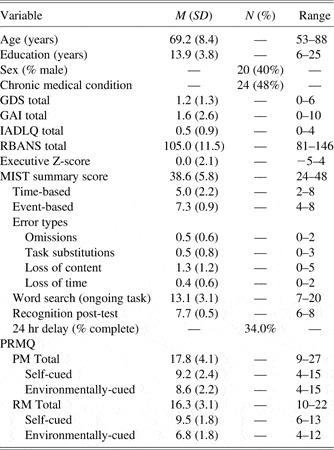
Study participants were 50 healthy older adults (≥50 years of age) who were recruited from the Western Australian Participant Pool (RAB, director). Participants were excluded if they scored <24 on the MMSE or reported histories of neuromedical (e.g., seizure disorder, stroke, traumatic brain injury) or psychiatric (e.g., depression, anxiety, psychosis) disorders that might affect cognition. The demographic characteristics of the study participants are provided in Table 1.
Basic descriptive data for the study sample (N = 50)
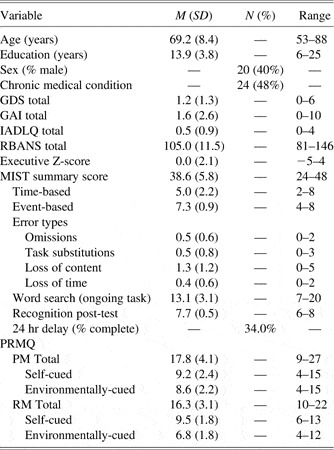
Note. GDS = Geriatric Depression Scale; GAI = Geriatric Anxiety Inventory; IADLQ = Instrumental Activities of Daily Living Questionnaire (derived from the ADLQ); PRMQ = Prospective and Retrospective Memory Questionnaire; MIST = Memory for Intentions Screening Test; RBANS = Repeatable Battery for the Assessment of Neuropsychological Status.
The human research ethics office of the University of Western Australia approved this study. All participants provided written, informed consent and were offered $15 in reimbursement of their travel expenses. All participants completed a brief neurobehavioral screening questionnaire, the 15-item short form of the Geriatric Depression Scale (GDS) and the Geriatric Anxiety Inventory (GAI).
The primary criterion of interest was the Activities of Daily Living Questionnaire (ADLQ; Johnson, Barion, Rademaker, Rehkemper, & Weintraub, Reference Johnson, Barion, Rademaker, Rehkemper and Weintraub2004). This 28-item questionnaire assesses a wide array of ADLs using a 4-level rating scale to indicate the severity of dependence (e.g., “Taking Pills or Medicine”, range 0 “remembers without help” – 3 “must be given medicine by others”). For the present study, we extracted the 11 items measuring higher-level instrumental ADLs across the functional domains of medication management, housekeeping, home maintenance, shopping, transportation, and communication. Consistent with prior research (e.g., Smits et al., Reference Smits, Deeg and Jonker1997; Woods, Iudicello, et al., Reference Woods, Iudicello, Moran, Carey, Dawson and Grant2008), we generated a summary scale (IADLQ; range = 0–11) of the total items on which participants reported experiencing functional difficulties (i.e., item scores >0). As expected in a healthy sample, the distribution of this variable was skewed, such that 66% of participants reported no functional difficulties, 22% reported one functional difficulty, and the remaining 12% reported two or more functional problems.
All participants completed the Prospective and Retrospective Memory Questionnaire (PRMQ; Smith, Della Sala, Logie, & Maylor, Reference Smith, Della Sala, Logie and Maylor2000) and the research version of the Memory for Intentions Screening Test (MIST; Woods, Moran, et al., Reference Woods, Moran, Dawson, Carey and Grant2008). The PRMQ is a 16-item, self-report scale assessing the frequency of everyday PM (e.g., forgetting appointments if not reminded by someone else) and retrospective memory (RM; e.g., forgetting something you were told a few minutes before) failures. Items are rated on a 5-point Likert-type scale ranging from 1 (never) to 5 (very often) and are summed to derive separate eight-item PM and RM scales (range = 0–40), which can be divided into self- and environmentally-cued tasks (range = 0–20). The MIST includes eight PM trials that are completed in the context of an ongoing word search puzzle. There are four cues based on time (e.g., “In 15 min, tell me it is time to take a break.”) and four based on events (e.g., “When I show you a postcard, self address it.”). The primary indices derived from the MIST include a Summary Score, time- and event-based subscales, and the following error types: (1) no response (i.e., omission errors), (2) task substitution (e.g., perseverations or intrusions), (3) loss of content (e.g., acknowledging that a response is required, but failing to recall the particulars), and (4) loss of time (i.e., performing the correct response at the wrong time). Participants are also administered an eight-item, three-choice recognition post-test.
Finally, participants also completed a neurocognitive test battery that included the Repeatable Battery for the Assessment of Neuropsychological Status (RBANS), Trailmaking Test (TMT, Parts A and B), Action Fluency, and the Executive Clock-Drawing Task (CLOX). A composite executive functions score was derived by converting raw scores on TMT B, Action Fluency, and CLOX to population-based Z-scores (where higher scores correspond to better performance), which were then averaged.
Results
The IADLQ was significantly correlated with the MIST Summary (r = −.40; p = .004) and Event-based (EB) (r = −.53; p < .002) scales, as well as Task Substitution (r = .32; p = .025) and Loss of Content errors (r = .32; p = .024). The Total (r = .51; p < .001), self-cued (r = .40; p = .005), and environmentally-cued (r = .54; p < .001) PM subscales of the PRMQ were all significantly associated with the IADLQ, as were the PRMQ RM Total (r = .39; p = .005) and environmentally-cued (r = .48; p < .001) scales. No other MIST or PRMQ correlations with the IADLQ reached statistical significance (all rs < .20; ps > .10). Although the majority of variables were non-normally distributed, the associations observed above were unchanged if we instead used nonparametric Spearman's rho correlations or analyzed the IADLQ in a categorical manner using a nonparametric Wilcoxon Rank Sums test by classifying participants with 0 (N = 33) versus ≥ 1 (N = 17) IADL problem.
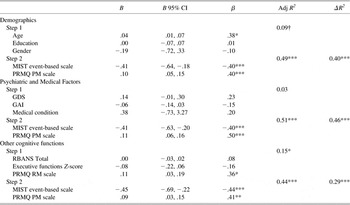
Table 2 displays the results of three, separate, hypothesis-driven hierarchical linear regressions to concurrently predict the IADLQ from the MIST EB score and PRMQ PM subscale after accounting for the potential influence of: (1) demographics (i.e., age, education, and gender); (2) medical and psychiatric factors (i.e., medical conditions, GDS, and GAI); and (3) other neurocognitive abilities (i.e., RBANS Total, executive functions Z-score, and PRMQ RM). In all three regressions, the inclusion of the PM variables in second step of the model significantly increased in the proportion of IADLQ variance explained (ps < .001). The MIST EB (ps < .01) and PRMQ PM (ps < .01) scales each independently accounted for significant variance in IADLQ in all of the models. As noted above, many of these variables had skewed distributions; however, the distributions of the regression residuals were normally distributed and therefore this analytic approach was deemed appropriate. Moreover, the independent effects of the MIST EB and PRMQ PM scales on the dichotomized IADL outcome (ps < .05) were confirmed in a series of logistic regression analyses that included the same covariates used in the hierarchical regressions.
Hierarchical regressions concurrently predicting IADLQ from PM after controlling for demographics, psychiatric/medical, and cognitive factors (N = 50)
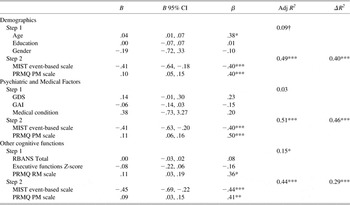
Note. †p < .10; * p < .05; ** p < .01; *** p < .001.
Δ = change; Adj = adjusted; B = beta weight; β = standardized beta weight; CI = confidence interval; GAI = Geriatric Anxiety Inventory; GDS = Geriatric Depression Scale; IADLQ = Instrumental Activities of Daily Living Questionnaire; PM = prospective memory; PRMQ = Prospective and Retrospective Memory Questionnaire; RBANS = Repeatable Battery for the Assessment of Neuropsychological Status; RM = retrospective memory.
Discussion
Healthy older adults commonly experience a moderate deterioration in PM ability (Henry et al., Reference Henry, MacLeod, Phillips and Crawford2004), but whether such declines adversely impact normal everyday functioning is not well understood. The current study demonstrated a strong association between PM and IADLs in a sample of healthy older Australians. Specifically, lower performance on the EB scale of the MIST and more frequent complaints on the PM scale of the PRMQ were independently and highly correlated with greater self-reported dependence in IADL functions. These findings extend the work of Smits et al. (Reference Smits, Deeg and Jonker1997) by using a well-validated, performance-based clinical measure of PM, by including self-reported PM (and RM) complaints in daily life. This is relevant because self-reported and performance-based PM are generally weakly correlated with one another (r = −.16 in this study), suggesting that they may be capturing relatively independent aspects of PM that are essential to everyday functioning (e.g., Woods, Iudicello, et al., Reference Woods, Iudicello, Moran, Carey, Dawson and Grant2008).
We also extend Smits et al. (Reference Smits, Deeg and Jonker1997) by incorporating comparison tests of executive functions, which prior studies show are among the most reliable cognitive predictors of IADL in older adults (e.g., Lewis & Miller, Reference Lewis and Miller2007). Importantly, PM was predictive of IADL above and beyond executive dysfunction (e.g., complex attention, verbal fluency, and cognitive control), as well as a widely used cognitive screening battery. These data complement a growing literature on the incremental ecological relevance of PM in clinical samples (e.g., Woods, Iudicello, et al., Reference Woods, Iudicello, Moran, Carey, Dawson and Grant2008). It has been argued that PM is ubiquitous in daily life and therefore captures aspects of functionally essential cognition that are not assessed by traditional tests. To this end, a handful of studies now demonstrate that consideration of PM yields incremental value in predicting a range of functional outcomes (e.g., medication management, functional skills, unemployment), even after consideration of such robust predictors as demographics, psychiatric comorbidity, medical complications, and global (and domain-specific) cognition (e.g., Woods et al., Reference Woods, Dawson, Weber, Gibson, Grant and Atkinson2009).
One somewhat surprising finding from the current study was that the association between PM and IADLs was larger for event- versus time-based items on the MIST. Of interest, a parallel pattern emerged on the PRMQ, such that a slightly stronger correlation was observed for environmentally versus self-cued daily PM failures. This runs contrary to expectations derived from the clinical literature in which stronger (or at least comparable) relationships between time-based PM and functional outcomes (e.g., Woods, Iudicello, et al., Reference Woods, Iudicello, Moran, Carey, Dawson and Grant2008) are typically observed, which is normally attributed to the stronger self-initiated cue detection and retrieval aspects of time- versus event-based PM (e.g., Woods et al., Reference Woods, Dawson, Weber, Gibson, Grant and Atkinson2009). A caveat to this interpretation is that the event-based cues on the MIST are non-focal, which tend to place greater demands on self-initiated monitoring processes than focal cues (Kliegel, Phillips, & Jager, Reference Kliegel, Phillips and Jager2008). However, event-based PM scales from the MIST have been closely tied to RM (e.g., Raskin et al., Reference Raskin, Woods, Poquette, McTaggart, Sethna, Williams and Tröster2011), raising the possibility that the present findings are explained by deficits in RM rather than PM. Indeed, error analyses showed that elevated rates of task substitutions (e.g., intrusions and perseverations) and loss of content errors (e.g., “I know that I am supposed to do something now, but I cannot remember what it is”), but not omissions or loss of time errors, underlies the primary event-based PM association with IADL. Arguing against this interpretation is the non-significant association between IADL and the post-test recognition scale, suggesting that RM alone could not fully explain the relationship. Moreover, a post hoc, multiple regression showed that the MIST EB scale and PRMQ PM scale were the sole predictors of IADL scores (ps < .01) in a model including the RBANS Delayed Memory Index and PRMQ RM scale (ps > .10). These data coalesce with Smits et al. (Reference Smits, Deeg and Jonker1997), who also found an association between event-based PM and IADLs in older adults that was independent of clinical RM measures. Thus, the subtle IADL declines observed in healthy older adults may be secondary to failures of the RM component of PM; that is, despite accurate PM cue detection, they experience difficulties with ‘online’ retrieval of the cue-intention pairing from RM.
Findings from this study should be interpreted in the context of its limitations, most notably the use of a cross-sectional design, which prohibits us from drawing temporal or causal inferences about PM and IADLs. Indeed, there may be other unmeasured factors that mediate or moderate the observed relationships (e.g., physical limitations, compensatory strategies, socioeconomic status, social support, etc.). In addition the self-report IADL and PM measures may be subject to response bias. Future studies on this topic may benefit from the inclusion of proxy-report, performance-based, and direct observational functional outcomes. Relatedly, the ADLQ and MIST event-based scores had restricted ranges of variability, which although not unexpected in a healthy sample, nevertheless represents a psychometric weakness of the study. Another limitation is the omission of tests of abstraction and planning, as prior research suggests that these constructs are predictive of IADL in older adults (e.g., Lewis & Miller, Reference Lewis and Miller2007). Despite these limitations, the strength of the associations observed between PM and IADL in this study clearly merits investigation into the potentially moderating effects (and even protective value) of cognitive (e.g., strategic encoding) and behavioral (e.g., text reminders) compensatory strategies to improve everyday functioning outcomes in older adults. Such investigations are of particular value in light of recent findings suggesting that PM may be a harbinger of incident dementia (e.g., Blanco-Campal, Coen, Lawlor, Walsh, & Burke, Reference Blanco-Campal, Coen, Lawlor, Walsh and Burke2009).
Acknowledgments
The authors report no conflicts of interest. This research was supported in part by National Institute of Mental Health grant R01-MH073419 to Dr. Woods. The views expressed in this article are those of the authors and do not reflect the official policy or position of the Department of the Navy, Department of Defense, nor the United States Government. Data were collected as part of the Doctor of Psychology thesis project of Aimee Velnoweth. Aspects of these data were presented at the 31st Annual Conference of the National Academy of Neuropsychology in Marco Island, Florida. The authors thank the study volunteers for their participation, Anya Umlauf for her assistance with statistical analyses, and Dr. Sarah Raskin for providing us with the MIST.