Introduction
The nasal process of the maxilla is a descriptive term for the medial lip of maxillary bone which forms the bony lateral border of the skull's nasal or pyriform aperture, and which can often be observed as a prominent, bony ridge on rhinoscopy. The nasal valve itself is formed medially by the septum, laterally by the caudal end of the upper lateral cartilage and the nasal process of the maxilla, and more posteriorly by the anterior tip of the inferior turbinate. We have found that resection of the nasal process of the maxilla can be performed safely and is effective in maximising the nasal airway anteriorly, especially in cases in which the airflow remains restricted despite a straight nasal septum.
In this paper, we describe what is, to our knowledge, a new surgical technique to improve the nasal airway in the region of the pyriform aperture. We also discuss the application of this technique as a novel intranasal approach in endoscopic medial maxillectomy for recurrent inverted papilloma.
Procedure
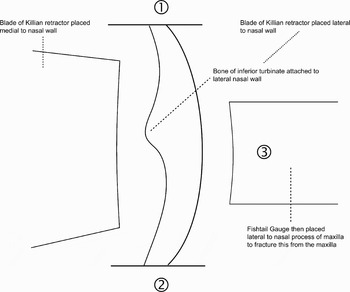
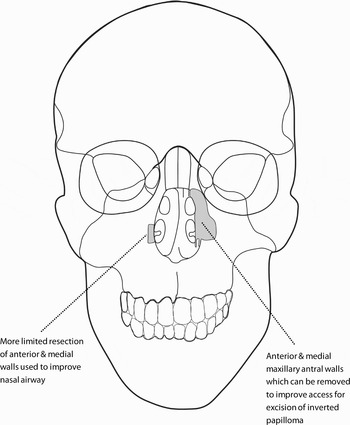
With the patient under general anaesthesia, Moffett's solution is applied (i.e. 2 ml cocaine 10 per cent, 1 ml adrenaline 1 in 1000, 2 ml sodium bicarbonate 8 per cent and water added to 10 ml). Lidocaine 2 per cent with adrenaline 1 in 80 000 is used to infiltrate the mucosa and deep tissues over the nasal aperture superior to the attachment of the inferior turbinate. An incision is then made, as shown in Figure 1, and deepened to the nasal aperture. A Freer's dissector is used to dissect the soft tissue from the nasal process of the maxilla. Using a hammer and gauge, the bone is removed by making superior, inferior and then lateral to medial cuts (Figure 2). In the case of resection for inverted papilloma, extensive removal of bone from the anterior and medial maxillary walls is possible (Figure 3), providing excellent access for visualising the maxillary sinus and enabling the removal of inverted papilloma. This is achieved by altering the angulation of endoscopes and instruments as they are passed in via the ‘pocket’ created by the mucosa medially and the soft tissues surrounding the maxilla laterally. The nasal mucosa in the anterior lateral nasal wall is fully preserved and the incision closed with two absorbable vicryl sutures.
Incision for intranasal medial maxillectomy.

Resection of the nasal process of maxilla using a hammer and gauge.

Resection of the pyriform aperture can be limited to improve the nasal airways, or more extensive with resection of the medial and anterior walls of the maxillary sinus.

Results
Over 40 patients underwent this procedure. It was well tolerated, with only a few patients reporting mild bruising which quickly resolved. All patients reported a dramatic subjective improvement in the nasal airway, even in those whom traditional septal and/or turbinate surgery had previously failed. Alar collapse, when present pre-operatively, also improved following the procedure.
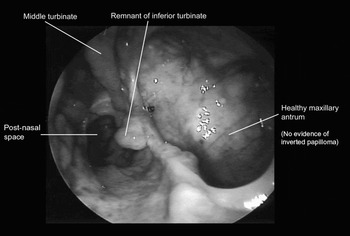
The two patients with recurrent inverted papilloma who underwent intranasal medial maxillectomy using the described approach attended for close follow up. At one year post-operatively, they remained disease-free, and the resection had greatly facilitated inspection of the maxillary antrum in the clinic setting (Figure 4).
Appearance of the left maxillary sinus six months' post-operatively, demonstrating the excellent visualisation of the whole maxillary sinus achieved endoscopically in the clinic.

Discussion
The management of patients with narrowed airways despite a straight septum and small inferior turbinates, and of those who demonstrate alar collapse, presents a surgical challenge. A number of procedures have been employed, including diathermy to the alar nasi, skin and cartilage grafts, and split rib grafts, with limited success and a range of complications.Reference Woodhead1 Although WoodheadReference Woodhead1 described a similar technique for widening the pyriform aperture for treatment of alar collapse, we have successfully used the approach for more extensive removal of the maxillary bone in the treatment of inverted papillomas. The previously described z-plasty is a more complicated soft tissue technique, but we have not found webbing to be a problem with the described simple incision and closure technique.
The treatment of inverted papillomas also presents a challenge for the surgeon, since they have a propensity to recur and are associated with squamous cell carcinoma.Reference Wormald, Ooi, van Hasselt and Nair2 Medial maxillectomy, using either a lateral rhinotomy or a midfacial degloving approach, has been seen as the ‘gold standard’; however, the endoscopic approach, when confined to the sinonasal region,Reference Han, Smith, Loehri, Toohill and Smith3 is more popular since it avoids the scars and morbidity associated with traditional techniques. No difference in recurrence rates was observed between the endoscopic and external approach groups, although this may be biased by the fact that those treated endoscopically had less extensive lesions.Reference Waitz and Wigand4, Reference Lawson5 Indeed, a systematic review of the literature by Busquets and HwangReference Busquets and Hwang6 found a significantly lower recurrence rate in patients treated endoscopically compared with those treated non-endoscopically, for the period 1992 to 2004 (12 vs 20 per cent, respectively; p = 0.02). Interestingly, the recurrence rate for non-endoscopically treated patients over this period was significantly lower compared with that of a group treated between 1970 and 1995 (15 vs 20 per cent, respectively; p = 0.02). Although the patients treated endoscopically may have had less extensive inverted papillomas, another explanation for the lower recurrence rate in this group is improved visualisation (through endoscopic magnification) of the disease, enabling more thorough clearance of disease.
It appears that primary surgery should be as complete as possible, since Han et al. found that recurrence rates were lower in patients undergoing primary resection compared with secondary resection, regardless of the surgical approach.Reference Han, Smith, Loehri, Toohill and Smith3 This may however reflect more aggressive tumours in patients with recurrent inverted papilloma. Further studies are required to determine whether the surgical approach used in revision surgery affects the rate of further recurrence.
The described intranasal approach to the lateral wall of the nose, with lateralisation of the soft tissues of the anterolateral nasal cavity, was essential in order to enable excellent visualisation of the maxilla and access for disease removal. This was achieved by altering the angulation of the endoscopes and instruments as they were passed in via the ‘pocket’ created by the mucosa medially and the soft tissues surrounding the maxilla laterally. This method is a viable alternative to the lateral rhinotomy and midfacial degloving approaches, since we feel that the alternative techniques would not have improved the surgical access; furthermore, in using this technique we avoided the morbidity associated with external and intra-oral incisions.
Conclusion
Patients undergoing the described procedure reported a subjective improvement in their nasal airway patency. However, we would recommend further studies in order to measure objectively the improvement in nasal airflow following use of this novel surgical technique as an adjunct to traditional septal and turbinate surgery. Its application in the intranasal clearance of inverted papilloma should also be further evaluated.
Acknowledgement
The authors would like to acknowledge the assistance of Mr Peter Murray from the Medical Illustration Department, Peterborough and Stamford NHS Trust.