Introduction
In European dry mountain areas, the harsh climate imposes long winter-housing periods for suckler cattle farms (Casasús et al., Reference Casasús, Sanz, Villalba, Ferrer and Revilla2002). In the Spanish Pyrenees, autumn-born calves are traditionally reared indoors with their dams and they are weaned at the start of the spring season (aged 5 months). Thereafter, calves are fed intensive diets while cows are turned out to forest pastures. In these conditions, the reduction of winter feed costs by outwintering the dams and weaning the calves earlier could be an efficient strategy, provided this management does not impair calf performance in the whole production cycle. However, a report of the Scientific Committee on Animal Health and Animal Welfare (SCAHAW) (2001) recommends a more careful management of the early-weaned calves than the late-weaned calves.
The human–animal relationship is important for animal production and welfare (Krohn et al., Reference Krohn, Boivin and Jago2003). According to Grandin (Reference Grandin1997), the management of an animal early in life will have an effect on its physiological response to stressors later in life. Previous studies indicate that breaking the maternal bond is stressful to the calf (Phillips et al., Reference Phillips, Juniewicz, Zavy and Von Tungeln1989). A newly weaned calf is prevented from suckling and having social contact with its dam and other adult cattle (Stookey et al., Reference Stookey, Schwartzkopf-Genswein, Waltz and Watts1997). A primary socialization with the dam prevents a secondary socialization developing with humans, until the calf is isolated from the dam (Krohn et al., Reference Krohn, Boivin and Jago2003). In fact, Boissy and Bouissou (Reference Boissy and Bouissou1988) suggested that the period between 3 and 6 months could be critical in determining human–animal relationships in cattle. Therefore, age at weaning in this period might affect the calves’ temperament, which can be measured with the flight speed test (Burrow et al., 1988).
Age at weaning affects the subsequent growth, feed intake and efficiency of calves (Myers et al., Reference Myers, Faulkner, Ireland and Parrett1999). Moreover, age at weaning and level of nutrition affect the cellular (Pollock et al., Reference Pollock, Rowan, Dixon, Carter, Spiller and Warenius1993) and humoral immune responses of young calves (Pollock et al., Reference Pollock, Rowan, Dixon and Carter1994) and may influence their general stress response. In fact, early-weaned calves were more tolerant to stressors associated with transport and feedlot entry than their traditionally weaned counterparts (Arthington et al., Reference Arthington, Spears and Miller2005). Stress response may also be influenced by breed, because genetic factors can be important in the neuroendocrine and metabolic adaptation to stressing conditions (García-Belenguer et al., Reference García-Belenguer, Palacio, Gascón, Aceña, Revilla and Mormède1996). Pirenaica and Parda de Montaña breeds have similar mature weight but different milk production, calf growth (Villalba et al., Reference Villalba, Casasus, Sanz, Estany and Revilla2000; Casasús et al., Reference Casasús, Sanz, Villalba, Ferrer and Revilla2002) and sensitivity to stress (Palacio, 2000). The objective of this study was to assess the effect of age at weaning on the physiological response, immune function, temperament and performance in calves of Parda de Montaña and Pirenaica, two Spanish beef cattle breeds.
Material and methods
Animal care, handling and diet
This study was conducted in La Garcipollera Research Station (CITA-Aragón), in the mountain area of the central Pyrenees (Spain, 42°37′N, 0°30′W; altitude 945 m). All procedures were conducted according to the guidelines of the European Union (European Union Directive 86/609/EEC, 1986) on the protection of animals used for experimental and other scientific purposes.
The cows and calves involved in this experiment were selected from a larger experimental suckler cattle herd, composed of two of the more widespread cattle breeds in the Spanish Pyrenees: Parda de Montaña and Pirenaica. Twenty-eight autumn-born male calves were used in a 2 × 2 factorial design to determine the effects of breed and age at weaning on stress response, performance and temperament. At birth (average birth date 20 October), calves of both breeds were randomly assigned to 1 of 2 ages at weaning: early weaning (EW, 90 ± 2.2 days post partum) or traditional weaning (TW, 150 ± 1.8 days post partum). Resulting treatments were EW-Parda de Montaña, EW-Pirenaica, TW-Parda de Montaña and TW-Pirenaica, with seven calves per treatment.
Cows and calves remained the entire lactation period loose-housed. During the lactation period, calves were managed according to the traditional management in the Pyrenees (Sanz et al., Reference Sanz, Casasús, Villalba and Revilla2003). The calves were kept in cubicles adjacent to their dams and were allowed to suckle twice daily for 30 min at 0800 and 1600 h. A week after birth, calves were disbudded by cautery with local anaesthesia. When calves were 75 days old, they were vaccinated against RSV, PI3 and Mannheimia (Pasteurella) haemolytica (Bovipast RSP®, Intervet, Milton Keynes, UK), IBR (Ibraxion®, Merial, Lyon, France) and Chlostridium perfringens (Polibascol®, Schering-Plough, Kenilworth, USA).
After weaning, at 90 or 150 days, calves walked to an adjacent barn without any physical access, eye or ear contact with their dams. Calves from both breeds were mixed in the same pen, where they remained for 7 days. On day 8 after weaning, they were transported in a commercial livestock trailer to a feedlot facility in CITA Research Station (41° 43′ N, 0° 48′ W; altitude 225 m). During the feedlot phase, calves were randomly assigned to 1 of 2 pens equipped with individual ALPRO feeding stations (Alfa Laval Agri, Tumba, Sweden), with 14 calves per feeding station, until they reached the target slaughter weight of 450 kg.
From weaning, at either age, until calves reached 350 kg live weight, they received on an ad libitum basis a concentrate with maize (30%), barley (27.3%), soybean meal (24%) and gluten feed (10%) as the main feedstuffs (11.47 MJ ME/kg DM, 14.9% CP, 0.76% Ca, 0.87% P). From 350 kg to slaughter, the composition of the concentrate fed to the calves was mainly maize (32%), barley (23.5%), gluten feed (12%) and sugar beet pulp (10%) (11.65 MJ ME/kg DM, 13.7% CP, 0.80% Ca, 0.78% P). Both concentrates had mineral and vitamin supplements. Barley straw and water were offered ad libitum.
Over the course of the whole experiment, calves were regularly exposed to human handling. The health status of the calves was checked daily by experienced stockmen. Calves were weighed weekly during the whole production cycle, at 0800 h without previous withdrawal of feed and water. Average daily gain (ADG) in the feedlot was calculated from these data by linear regression of weight on date.
Sample collection
To evaluate the stress response of calves, blood samples were obtained by jugular venipuncture 168 h before weaning (baseline concentration, hereafter noted as −168 h), 6, 24, 48 and 168 h after weaning, following the procedures of Hickey et al. (Reference Hickey, Drennan and Earley2003). Calves were restrained and bled in their cubicles by the same two experienced stockmen. A total of three blood samples per calf were taken each time for cortisol, fibrinogen and haematology determination. The total procedure usually lasted no more than a minute.
Cortisol determination
Each sample was collected into a test tube containing potassium-ethylenediaminetetraacetic acid (EDTA). Blood samples were held on ice, and centrifuged for 12 min at 3000 × g in a cooled centrifuge (4°C). Plasma was extracted and stored in aliquots at −20°C for subsequent cortisol assay. Cortisol concentrations in plasma were determined by an EIA validated for bovine (Chacón et al., Reference Chacón, García-Belenguer, Illera and Palacio2004), with inter- and intra-assay coefficients of variation of 7.3% and 9.8%, respectively. All samples were run in duplicate.
Fibrinogen determination
Each sample was collected into a test tube containing sodium citrate as the anticoagulant. Blood samples were held on ice, and centrifuged for 12 min at 3000 × g in a cooled centrifuge (4°C). Citrated plasma was harvested and stored in aliquots at −20°C for subsequent fibrinogen analysis. Plasma fibrinogen concentrations were determined in duplicate using a fibrinogen assay set from Pacific Hemostasis (Cape Town, South Africa) in a coagulometer Clot-SP® (RAL, Barcelona, Spain). Results were expressed as mg of fibrinogen per dl of plasma.
Haematology
Each sample was collected into a test tube containing potassium-EDTA. Blood samples were maintained at 4°C until the following day for the analysis. White blood cell (WBC) number, differential WBC (neutrophils, lymphocytes, monocytes, eosinophils and basophils), red blood cells (RBC), haematocrit (HCT) and haemoglobin (Hb) were determined for unclotted (EDTA) whole-blood samples using a cell counter (Hemavet® 850 automated multispecies haematology system, CDC Technologies, Inc., Centerville, USA). The neutrophil : lymphocyte (N : L) ratio was calculated.
Flight speed test
The flight speed of individual calves was determined by the method of Burrow et al. (1988) at 90 and 180 days after weaning. This test imposed conditions of close human contact, social isolation and physical restraint on the calf. All calves were previously exposed to experimental conditions, which included a weighing scale, while undergoing common cattle management handling routines (e.g. weighing or vaccination). Measurements were taken between 0930 h and 1100 h. Calves were moved as a group from their pen to the chute in a calm manner by the same experienced stock people each time, who were wearing working clothes. Immediately after the entry into the chute, the calves were identified from their ear tag and the order of entry to the chute was noted. Calves stayed in the weighing scale for 30 s until an unknown person for the calves opened the chute. The calves proceeded at their own pace along a single straight alley without seeing other calves. Flight time was the time, measured with a stopwatch by the same person, taken by a calf from the opening of the weighing scale until the two front extremities crossed 1.7 m. Duplicates were carried out in the same location on 2 consecutive days. The average of both values was used to calculate flight speed, expressed in m/s.
Statistical analysis
Statistical analysis of calf performance (weight and ADG) was achieved by ANOVA using the GLM procedure (SAS, 1990) including age at weaning (EW v. TW), breed (Parda de Montaña v. Pirenaica) and their interaction as fixed effects. Haematological parameters, cortisol, fibrinogen and flight speed test data were analysed using the MIXED procedure of SAS for repeated measures including age at weaning, breed, sampling time and their interactions as fixed effects and animal as the random effect, with an unstructured covariance matrix within animal. Least square means (LS Means) were estimated and differences between LS Means were tested with a t-test. When a fixed effect was not significant, it was removed from the model. Spearman’s rank correlation coefficients were used to test the relationships between flight speed score and ADG, the order of entry into the chute at each occasion when flight speed was measured, as well as repeatability of the flight speed test, and to identify the consistency of temperament between days of test (90 and 180 days post weaning). For all tests, level of significance was 0.05. P values less than 0.10 are discussed as trends.
Results
There were breed and weaning effects on some of the outcome variables measured, but there were no interactions between these independent variables.
Cortisol concentration
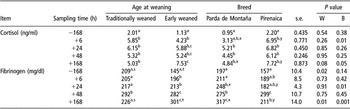
Plasma cortisol concentrations were lower than 8 ng/ml in all calves at all sampling times (Table 1). Cortisol concentrations increased significantly after weaning (6 h) in both EW (P = 0.02) and TW calves (P = 0.01) and did not recover baseline values by 168 h post weaning in either of them. There was no effect of age at weaning on cortisol concentrations at any sampling time. Concerning the breed effect, Pirenaica calves had higher concentrations than Parda de Montaña calves at 6 and 168 h post weaning.
Effect of age at weaning (W) and breed (B) on plasma cortisol and fibrinogen concentrations around weaning

a,b,cMeans with different superscript letters within a column differ among sampling time, P < 0.05.
s,tMeans with different superscript letters within a row differ between age at weaning, P < 0.05.
x,yMeans with different superscript letters within a row differ between breed, P < 0.05.
Fibrinogen concentration
Pre-weaning plasma fibrinogen concentrations were low, indicating that there were minimal underlying inflammatory conditions in the calves (reference values 100 to 400 mg/dl) (Table 1). The pattern of evolution of fibrinogen concentrations in time was different according to age at weaning: TW calves had higher fibrinogen concentration than EW calves before weaning, it increased markedly at 48 h, and concentration returned to baseline values after 168 h in TW calves, while it remained elevated in EW calves. When the increment at 48 h from baseline values was studied, EW calves had a greater increment than TW calves (127 v. 56 mg/dl, respectively; s.e. = 39.2, P = 0.02). Calves of Pirenaica breed had lower fibrinogen concentrations than Parda de Montaña calves at 24 h and 168 h after weaning, and slightly greater increments at 48 h (118 v. 65 mg/dl; s.e. = 39.2, P = 0.07).
Leucocyte population
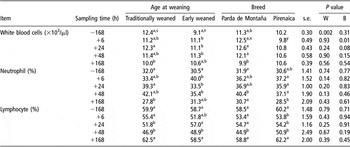
Age at weaning and breed had minor effects on the pattern of change in WBC concentration over time (Table 2). The youngest calves (EW) had less total WBC concentration at the baseline sample, but thereafter this parameter was unaffected by age at weaning. Weaning increased total WBC more clearly in EW calves at 6 h (P = 0.04), but concentrations declined at 168 h to similar values as the ones obtained at the baseline conditions. Concerning the breed effect, Parda de Montaña calves showed a slight increase in total WBC at 6, 24 and 48 h, which decreased at 168 h post weaning, whereas concentrations of Pirenaica calves were not affected by weaning and remained constant throughout the study.
Effect of age at weaning (W) and breed (B) on measures of the leukocyte population around weaning

a,b,cMeans with different superscript letters within a column differ among sampling time, P < 0.05.
s,tMeans with different superscript letters within a row differ between age at weaning, P < 0.05.
x,yMeans with different superscript letters within a row differ between breed, P < 0.05.
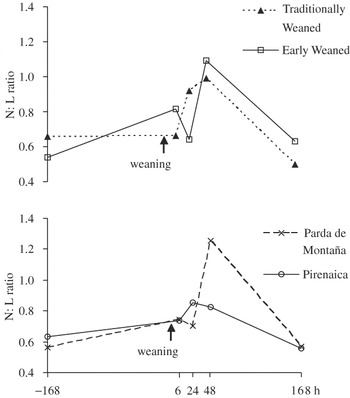
There was no effect of age at weaning or breed on neutrophil and lymphocyte proportion (Table 2) and in the N : L ratio (Figure 1) at any sampling time, but their patterns of change throughout the study were different. Concerning the neutrophil proportion, EW calves showed a clear neutrophilia after weaning (6 h), recovering baseline values at 168 h, whereas the change was less evident in TW calves. Lymphocyte proportion decreased in TW calves 24 and 48 h after weaning, whereas in EW calves this occurred 48 h after weaning. The N : L ratio reached a maximum at 48 h both in EW and in TW calves. Parda de Montaña calves had an increase in the N : L ratio 48 h after weaning, when it tended to be different between breeds (P = 0.08), whereas Pirenaica calves had no change in this ratio. In general, all leucograms returned towards baseline values 168 h after weaning.
Effect of age at weaning and breed on the N : L ratio. No significant differences (P > 0.10) between effects at any sampling time.

Erythrocyte population
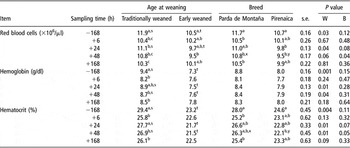
Age at weaning affected some red cell parameters irrespective of breed (Table 3). TW calves presented higher baseline values of RBC, Hb and HCT than EW calves. Significant differences also appeared 24 h after weaning, younger calves (EW group) showing lower values than TW calves. The characteristic erythrocytosis of an acute stress response was not observed.
Effect of age at weaning (W) and breed (B) on the measures of the erythrocyte population around weaning

a,b,cMeans with different superscript letters within a column differ among sampling time, P < 0.05.
s,tMeans with different superscript letters within a row differ between age at weaning, P < 0.05.
x,yMeans with different superscript letters within a row differ between breed, P < 0.05.
Flight speed test
There was no effect of age at weaning on flight speed values recorded at 90 and 180 days after weaning (Table 4). Exit velocities of Pirenaica calves tended to be higher than those of Parda de Montaña calves at 90 days post weaning, and were significantly higher at 180 days (P < 0.05). Entry order of individual calves in duplicate sessions was significantly correlated (90 days: R s = 0.77, P < 0.001; 180 days: R s = 0.82, P < 0.001); however, no significant correlations were observed between entry order and speed values at each session. Repeatability of flight speed measures obtained through correlation between repetitions of the test showed significant coefficients at 90 days (R s = 0.67, P < 0.001) and 180 days (R s = 0.45, P < 0.05). Paired t-test for 90 and 180 days did not show any significant difference between both speed values (P = 0.50). There were no correlations between flight speed values and ADG in the feedlot phase.
Effect of age at weaning (W) and breed (B) on flight speed test results performed at 90 and 180 days post weaning

x,yMeans with different superscript letters within a row differ between breed, P < 0.05.
Feedlot performance
Calf performance in the feedlot (from weaning to slaughter) is reported in Table 5. As EW calves were 50 kg lighter at weaning than TW calves and had similar ADG during the feedlot phase, they needed an additional 40 days compared to TW calves to attain the target slaughter weight (450 kg) at a similar age (307 v. 324 days for EW and TW, respectively; s.e. = 20.2, P = 0.41). Concerning the breed effect, Parda de Montaña calves were slightly heavier than Pirenaica calves at weaning, but ADG was not affected by breed; therefore, Parda de Montaña and Pirenaica calves needed similar days at the feedlot to reach 450 kg at a similar age (309 and 322 days, respectively; s.e. = 20.2, P = 0.10).
Effect of age at weaning (W) and breed (B) on feedlot performance

s,tMeans with different superscript letters within a row differ between age at weaning, P < 0.05.
Discussion
Natural weaning is a gradual process during which the young animal receives decreasing amounts of milk while solid food intake increases, and in cattle it takes place when calves are around 8 to 9 months of age (Scientific report of the European Food Safety Authority (EFSA, 2006)). In beef cattle herds, calves are generally abruptly weaned between 5 and 10 months of age depending on the calving season, which is a stressful event for the calf (Bueno et al., Reference Bueno, Rasby and Clemens2003) and the dam. Moreover, other events often take place around the same time, increasing the stress of the calves (the separation from the mother, transport, mixing with new animals, changes in diet and environment, dehorning or castration). However, newly weaned calves in the current experiment did not suffer additional stress due to transport, dehorning or castration because they had already been disbudded, they were transported but a week after weaning and castration did not occur.
Factors known to influence stress response, including gender (Hickey et al., Reference Hickey, Drennan and Earley2003), nutrition (Pollock et al., Reference Pollock, Rowan, Dixon, Carter, Spiller and Warenius1993) and previous management experiences (Phillips, Reference Phillips1984), were kept as similar as possible to make a more accurate comparison of how calves respond to weaning on the basis of age and genotype.
Cortisol concentration
In the current study, plasma cortisol concentration increased for all calves up to 168 h after weaning. Hickey et al. (Reference Hickey, Drennan and Earley2003) reported an increase in cortisol concentration up to 168 h due to social group disruption but not to weaning. Discrepancies between the findings of Hickey et al. (Reference Hickey, Drennan and Earley2003) and the present study may be attributed to differences in age at separation, breed or calf management, as calves in our study were subjected to restricted suckling. Previous management of the animals can have a great impact on the perception of and response to stress (Phillips, Reference Phillips1984; Grandin, Reference Grandin1997). In fact, calves that had been on pasture for 6 to 7 months before weaning had a greater cortisol response, above 10 ng/ml (Fell et al., Reference Fell, Colditz, Walker and Watson1999; Hickey et al., Reference Hickey, Drennan and Earley2003), than the ones in the current study (increase around weaning: 3 to 4 ng/ml). Cortisol values reported in the current experiment are in the range of the baseline values reported in cattle, which indicate that a procedure caused low stress (Grandin, Reference Grandin1997). The restricted suckling in our study (twice daily) compared with ad libitum suckling in others that involve abrupt and absolute removal of the offspring (Lefcourt and Elsasser, Reference Lefcourt and Elsasser1995) allowed a minor perception of separation from the dam as a stressful situation. Small increases in cortisol due to weaning were also described by Lefcourt and Elsasser (Reference Lefcourt and Elsasser1995).
Furthermore, the lack of a greater cortisol response could be attributed to the fact that cortisol concentrations had peaked between baseline and 6 h samples, and could not have been detected. In addition, Henry (Reference Henry1993) stated that differing perceptions of stress result in different patterns of neuroendocrine activation in animals. In this study, the pre-weaning nutritional and environmental management may have allowed the habituation of calves to post weaning conditions. Therefore, calves may have reacted with a coping pattern that did not involve a loss of control over the situation, resulting in little change in corticoid release. Another mechanism for the lack of a greater cortisol response is an age-dependent mechanism. According to the results of Bueno et al. (Reference Bueno, Rasby and Clemens2003), who studied the cortisol response to weaning in 150-, 210- and 270-day-old heifers, weaning at 150 days failed to elicit a measurable difference in plasma cortisol values between weaned and non-weaned groups, whereas older calves are more capable of initiating favourable short-term stress response mechanisms.
Fell et al. (Reference Fell, Colditz, Walker and Watson1999) studied the correlation between temperament, evaluated with flight speed at weaning and 21 days post weaning, and cortisol concentrations in beef calves. Nervous temperament was related to increased cortisol concentrations. However, in the current experiment there were no correlations, partially because our breeds, according to flight speed values, were calmer than the ones of the study cited above. Moreover, flight speed test was performed 3 and 6 months after weaning, probably too far away from weaning to be related to cortisol values around weaning.
Breed affected cortisol concentration in certain moments (at 6 and 168 h), when Pirenaica calves had higher concentrations than Parda de Montaña calves. Zavy et al. (Reference Zavy, Juniewicz, Phillips and Von Tungeln1992) reported that genotype had a significant effect on baseline cortisol values in beef calves. Moreover, previous studies in calves of these breeds showed no differences in baseline values between breeds, but Pirenaica calves had higher cortisol concentrations than Parda de Montaña calves in the recovery period after exercise (13.45 v. 8.15 ng/ml, respectively), which was attributed to differences in the hypothalamic–pituitary–adrenal (HPA) axis reactivity (García-Belenguer et al., Reference García-Belenguer, Palacio, Gascón, Aceña, Revilla and Mormède1996).
Fibrinogen concentration
Physical and psychological stress elevates acute phase proteins (APP) concentrations, and therefore assessment of APP may be a useful indicator of stress responses in calves under common handling procedures, such as weaning, transportation or co-mingling (Arthington et al., Reference Arthington, Eicher, Kunkle and Martin2003). Wittum et al. (Reference Wittum, Young, Stanker, Griffin, Perino and Littledike1996) reported that weaning did not affect haptoglobin, which is a major APP that increases 100-fold upon stimulation in cattle, but Hickey et al. (Reference Hickey, Drennan and Earley2003) stated weaning altered fibrinogen concentrations. Specifically, fibrinogen is involved in homoeostasis and in tissue repair. Changes in plasma fibrinogen concentration reflect the magnitude and duration of activity of the adrenal gland; thus they may be an indicator of the extent and persistence of stress (Phillips, Reference Phillips1984). In addition, according to the aforementioned study, there is a delay between the imposition of a stress and the response of fibrinogen synthesis, so that changes in plasma cortisol concentration occur more rapidly than changes in plasma fibrinogen concentration.
In the current study, fibrinogen concentrations showed higher baseline values in calves weaned at 150 days than those weaned at 90 days of age. This result could be due to the fact that plasma total proteins in cattle increase with age (Bueno et al., Reference Bueno, Rasby and Clemens2003). On the other hand, similar to the results reported in calves weaned at 7 and 8 months (Phillips et al., Reference Phillips, Juniewicz, Zavy and Von Tungeln1989; Hickey et al., Reference Hickey, Drennan and Earley2003), fibrinogen concentration of TW calves was elevated at 48 h and declined at 168 h compared to pre-weaning values. Younger calves, however, did not recover their baseline values at this time, which could be due to the greater increment shown by this group at 48 h.
Increases reported here could be classified as minor. Fibrinogen is used in cattle and sheep as a reliable indicator of the presence of inflammation, bacterial infection or surgical trauma. According to Earley and Crowe (Reference Earley and Crowe2002), fibrinogen concentrations increased by 949 mg/dl 3 days after surgical castration in bull calves, whereas the mean peak in the current experiment was 299 mg/dl 2 days after weaning. Fibrinogen concentration could also increase as a result of haemoconcentration. However, HCT was determined at the same time as fibrinogen concentration and did not show any increase due to stress of weaning or dehydration.
The measured range of fibrinogen did not differ greatly from ranges reported by Earley and Crowe (Reference Earley and Crowe2002) in unstressed Friesian calves aged 5.5 months. Therefore, there were no subclinical signs of poor health up to 7 days post weaning.
Concerning breed, our data showed significant differences at 24 and 168 h, Pirenaica calves had the lowest concentrations, but at 48 h, Pirenaica calves showed greater peaks than Parda de Montaña calves. In the same sense, Phillips et al. (Reference Phillips, Juniewicz, Zavy and Von Tungeln1989) reported breed differences in fibrinogen concentration at weaning, calves with Brahman breeding presenting higher values than Angus × Hereford calves.
Leucocyte population
Weaning has been regarded as influencing immunity via stress-related mechanisms (Griffin, Reference Griffin1989). In this study, weaning was a stressful experience as evidenced by the increase in neutrophils and the decrease in lymphocytes compared with baseline conditions. Hickey et al. (Reference Hickey, Drennan and Earley2003) reported a similar response to weaning in 7-month-old calves. These changes in leucocyte population are associated with acute stress (Duncan and Prasse, Reference Duncan and Prasse1986; Fell et al., Reference Fell, Colditz, Walker and Watson1999) and may increase the susceptibility to disease and reflect a reduced capacity of calves to cope with stressors of the feedlot environment. However, no differences were found due to age at weaning, confirming the results reported by Smith et al. (Reference Smith, Wiggers, Wilson, Comerford, Harpster and Cash2003) and Bueno et al. (Reference Bueno, Rasby and Clemens2003). On the contrary, age at weaning affected cellular-mediated immune responses in calves weaned at 5, 9 and 13 weeks of age (Pollock et al., Reference Pollock, Rowan, Dixon, Carter, Spiller and Warenius1993). For these authors, early weaning effects are essentially nutritional.
All leucocyte parameters returned to baseline concentrations by 168 h after weaning. This finding agrees with other studies where circulating leucocyte returned to baseline concentrations within 48 h following a single intravenous injection of adrenocorticotropin (Paape et al., Reference Paape, Dejardins, Guidry, Müler and Smith1977). When calves were not habituated to handling, reacting to the collection and sampling procedure, a longer period was needed to return to baseline concentrations (Bueno et al., Reference Bueno, Rasby and Clemens2003).
As a result of the decrease in the lymphocyte proportion and increase in the neutrophil proportion until 48 h after weaning, the N : L ratio had a maximum at this sampling time, as did fibrinogen concentrations. Gwazdauskas et al. (Reference Gwazdauskas, Paape, Peery and McGilliard1980) described that leucocyte peaked on day 2 after adrenocorticotropin injection. The N : L ratio returned to baseline values 168 h after weaning. The glucocorticoids may be the contributing factor to the alteration of the N : L ratio (Hickey et al., Reference Hickey, Drennan and Earley2003). On the other hand, in the current study the N : L ratio did not differ with age at weaning, as in the study of Smith et al. (Reference Smith, Wiggers, Wilson, Comerford, Harpster and Cash2003), who stated that there was no immunosupression or increased predisposition to illness associated with age at weaning.
Specifically, EW calves had an increase in total WBC numbers and the N : L ratio 48 h after weaning, showing similar values as those described by Fisher et al. (Reference Fisher, Crowe, O’Nuallain, Monaghan, Prendiville, O’Kiely and Enright1997) in 5-month-old bull calves following surgical castration. This increase in WBC numbers was largely due to increased numbers of neutrophils, which is the result of their decreased adhesion to the epithelial cells of the blood vessels, and increases neutrophil circulation as a guard against an infection.
Concerning the breed effect, Parda de Montaña and Pirenaica calves had similar leucocyte values. García-Belenguer et al. (Reference García-Belenguer, Palacio, Gascón, Aceña, Revilla and Mormède1996) also reported no breed differences in calves, whereas Pirenaica cows presented higher baseline WBC counts than Parda de Montaña cows.
Erythrocyte population
The characteristic erythrocytosis of an acute stress response was not observed. In fact, EW calves always presented the lowest mean values for Hb and HCT and they had marginal anaemia, as suggested by the Hb values, below the threshold of 8 g/dl (Schwartz, Reference Schwartz1990). A transient dietary iron deficiency that can lead to a mild anaemia occurs primarily in the rapidly growing young of many species (Duncan and Prasse, Reference Duncan and Prasse1986), and it is usually associated with milk diets. In fact, daily protein requirements calculated according to their weight and ADG at weaning were 348 and 374 g digestible protein in the intestine for EW and TW calves, respectively (INRA, 1981). The estimated protein intake was 60% to 72% of their requirements, considering their energy-corrected milk (ECM) intake (8.0 and 6.7 kg/day at weaning for EW and TW calves, respectively) (M. Blanco, unpublished data) and the milk protein digestibility (97%) (INRA, 1981). Actually, due to changes in protein intake or availability, a pronounced seasonal effect occurs with Hb and HCT, usually decreasing in winter (Payne and Payne, Reference Payne and Payne1987). In this sense, spring-born Parda de Montaña calves had an ECM intake of 10.8 kg/day (Sanz et al., Reference Sanz, Casasús, Villalba and Revilla2003), meeting the protein requirements, and Hb would be expected to be higher than the values obtained in the current experiment. However, no clinical sign of anaemia was observed during the suckling or the feedlot period.
Baseline values of the erythrocyte population were similar between both breeds, as García-Belenguer et al. (Reference García-Belenguer, Palacio, Gascón, Aceña, Revilla and Mormède1996) had reported in spring-born calves of these breeds. But baselines Hb values in the current experiment, irrespective of the breed, were lower than the values reported by these authors (12.1 and 11.7 g/dl for 2- to 4-month-old Parda de Montaña and Pirenaica calves, respectively).
Flight speed test
Many experimental protocols have been designed to study the behavioural and physiological aspects of fear (Boissy, Reference Boissy1995). In general, tests that measure animal’s fear responses to man or handling by man are time-consuming and labour-intensive. In fact, flight speed test was used to examine the effect of age at weaning on the fear response of the calf to being handled by humans, because this method is objective, safe, quick and very simple to perform in on-farm conditions (Müller and von Keyserlingk, Reference Müller and von Keyserlingk2006). Temperament, considered as animal’s behavioural response to handling by humans, could be affected by age at weaning, so that calves isolated earlier from the dam might develop a better socialization to humans. However, speed values tested both at 90 and at 180 days post weaning were unaffected by age at weaning, which highlights the importance of a good handling in the periods before and around weaning on later temperament. Tests were repeatedly performed between 90 and 180 days after weaning to examine the long-term consistency of individual differences.
Concerning the breed effect, Pirenaica calves had higher speed values both at 90 and at 180 days post weaning than Parda de Montaña calves, which agreed well with previous studies on reactivity in the same breeds (García-Belenguer et al., Reference García-Belenguer, Palacio, Gascón, Aceña, Revilla and Mormède1996; Palacio, 2000). These authors reported that Pirenaica breed was more excitable and had a greater difficulty to adapt to repeated non-painful handling procedures than Parda de Montaña breed. However, both Parda de Montaña and Pirenaica breeds would be classified as calm breeds when compared to values obtained by Fell et al. (Reference Fell, Colditz, Walker and Watson1999), who classified Hereford and Hereford × Angus calves according to their flight speed values as nervous (1.9 to 2.8 m/s) or calm calves (0.6 to 1.4 m/s).
Studies on temperament of cattle indicate that lower growth rates are associated with the greater reactivity of Hereford and Hereford × Angus steers (Fell et al., Reference Fell, Colditz, Walker and Watson1999) and Aberdeen Angus heifers (Müller and von Keyserlingk, Reference Müller and von Keyserlingk2006) during handling, as indicated by faster flight speed. Our study did not show any correlation between flight speed values and ADG in the feedlot phase, which could be related to the lower flight speed values of our calves, compared to those reported by the aforementioned authors.
Feedlot performance
The feedlot phase was also studied because calf management at weaning may have an impact on weight gain and health for several months after weaning (SCAHAW, 2001). As expected, the younger calves were lighter than the older ones at weaning, but during the feedlot period, they had similar ADG. Similarly, Myers et al. (Reference Myers, Faulkner, Ireland and Parrett1999) reported that weaning calves at either 90 or 152 days had little or no influence on weight gains during the feedlot period. Therefore, early weaning increased the days on feed to attain a target weight, with a concomitant increase in feed costs and yardage expenses in the feedlot (Casasús et al., Reference Casasús, Blanco, Sanz, Bernués and Revilla2006).
According to breed, Parda de Montaña calves tended to be heavier than Pirenaica calves at weaning. Parda de Montaña calves have been reported to be heavier than Pirenaica calves at 90 days (Sanz et al., Reference Sanz, Casasús, Villalba and Revilla2003) and at 150 days (Villalba et al., Reference Villalba, Casasus, Sanz, Estany and Revilla2000), which was attributed to the higher milk yield of Parda de Montaña dams when compared with their Pirenaica counterparts. During the feedlot period, breed had no influence on weight gains, as Albertí et al. (Reference Albertí, Sañudo, Campo, Franco, Lahoz and Olleta1997) reported in bull calves intensively fed to 460 kg.
In conclusion, the results suggest that weaning of restricted-suckled beef calves at 90 or 150 days following the same procedures and avoiding accumulative stressing factors resulted in similar physiological and immune responses and performance in the feedlot, without affecting their temperament. Alterations in haematological values were minimal and most of the variables had recovered baseline values 1 week after weaning. Weaning performed in this study can be considered as abrupt, as it included maternal separation and social group disruption. However, restricted suckling could be similar to the two-stage weaning methods (Haley et al., Reference Haley, Bailey and Stookey2005), which involve a period where nursing is prevented before the complete separation of dam and calf, and have been explored as a means to reduce stress levels in calves at weaning. A restricted suckling system could contribute to a gradual separation from the dam, which is more similar to natural weaning conditions.
Acknowledgements
The authors recognize the farm staff working at La Garcipollera and Montañana Research Stations for their technical support. Authors would like to acknowledge the contribution in the laboratory analysis of cortisol from Dra. Chacón. This research was funded by project AGL 2002-00027 of the Spanish Ministry of Science and Technology, and Consolidated Groups A11 and A17 of the Government of Aragón (Spain). M. Blanco received a grant from INIA.