Significant outcomes
• The first clinical recordation of the antidepressant effect of exogenous agmatine in depressed subjects with major depressive disorder, that is neither mediated by nor dependent on serotonergic mechanisms, confirming preclinical findings from predictive animal models.
• Support for the proposed use of glutamatergic modulators as rational biomarkers for new antidepressant drug development; agmatine is a unique, distinguished by its absence of adverse side effects characteristically associated with the use of other investigational NMDA antagonists.
• Agmatine's antidepressant effect together with its recognised central role as inhibitory modulator of central excitatory glutamatergic neurotransmission via antagonism of the NMDA/Ca2+–NOS–NO cascade, converge with a ripening of data in moving towards a more robust recognition of a glutamatergic molecular biology of depression. [Nitric Oxide Synthase (NOS); Nitric Oxide (NO)].
Limitations
• The use of a research paradigm that benefits from using each subject as his/her own control notwithstanding, the subject n is limited: well controlled clinical trials with larger subject n are needed to determine agmatine's potential as a treatment for clinical depression.
• Although readily passing through the BBB, and concentrating in the hippocampus/cortex, the brain levels of agmatine are unknown, and cerebrospinal fluid or blood levels were not obtained.
• Subject refusal to temporarily discontinue agmatine after PCPA challenge.
Introduction
Agmatine is an endogenous polyamine intermediary derived from the biosynthesis of the proteinogenic amino acid l‐arginine through the enzyme arginine decarboxylase (ADC) and inactivated by agmatinase Reference Sastre, Regunathan, Galea and Reis1. Highly expressed in brain, especially in the hippocampus and cortex, synthesis of agmatine occurs primarily in glial astrocytes but also in microglia Reference Regunathan, Feinstein, Raasch and Reis2. Agmatine is also dietary derived, readily crossing the blood brain barrier where endogenous levels in the hippocampus can increase several folds. Synthesised or exogenously derived, astrocyte agmatine is packaged and stored in synaptic vesicles where reports suggest that it may be co‐localised with glutamine for release by depolarisation into the extracellular space and uptake by neurons where glutamine is converted to glutamate. The neuronal glutamate released is cleared from the extracellular space along with agmatine through uptake by astrocytes and microglia, where glutamate is converted back to glutamine completing the highly regulated glial and neuronal cell compartmentation of glutamate metabolism through this critical glutamine–glutamate cycling that maintains glutamatergic homeostasis. Tightly regulated itself (agmatine homeostasis), agmatine plays a key role along with d‐serine in these plasticity‐related processes of glutamatergic homeostasis that keeps the brain far from excitation Reference Yang and Reis3, Reference Wang, Iyo, Miguel‐Hidalgo, Regunathan and Zhu4, Reference Feng, LeBlanc and Regunathan5. In delightful reciprocity, glutamatergic homeostasis contributes to the regulation of agmatine synthesis and homeostasis.
Early findings of imidazolidine binding notwithstanding, it is now recognised that agmatine's role in brain is as an inhibitory modulator of excitatory glutamatergic neurogliotransmitter events, the putative consequence of antagonist activity of NMDA receptors and their Ca2+ ion channels, (followed by) the essential inhibition of NOS, thus inhibiting the induction of the free radical proinflammatory mediator NO and oxidative stress Reference Wegener and Mathé6, Reference Abe, Abe and Saito7, Reference Qiu and Zheng8, Reference Ahn, Hong, Park, Lee, Park and Lee9. Agmatine is unique to date among endogenous biogenic amines, as selectively exhibiting antagonist activity at non‐glycine β sites of NMDA receptors Reference Yang and Reis3. Astrocyte derived d‐serine is a co‐agonist modulator of glutamate neurotransmission as an endogenous ligand for the glycine site of NMDA receptors. These agmatine induced inhibitory effects lead to the downstream inhibitory modulation of glutamate/Ca2+ and NO expression in glial/neuronal cells of the hippocampus, as well as the essential lowering of extracellular glutamate, the combined effects of which downregulates excitatory brain activity Reference Wegener and Mathé6, Reference Abe, Abe and Saito7, Reference Qiu and Zheng8, Reference Ahn, Hong, Park, Lee, Park and Lee9. This, thus, is the putative molecular basis of agmatine's central neuroprotective and anti‐inflammatory action that keeps the complex biological system of brain far from excitation, neuronoglial cyotoxicity, enhanced apoptotic signalling and cell death that characterise the gamut of neuropathic brain disorders that range from Multiple Sclerosis (MS), Amyotropic Lateral Sclerosis (ALS), Huntington's and Parkinson's disease to Alzheimer's and clinical depression, among others.
In addition to its inhibition of both intracellular and extracellular glutamate and Ca2+‐induced cytotoxicity, there exists an ever ripening body of data to suggest that agmatine's more critical protection against cytotoxicity is related to its inhibition of NOS, with consequent downregulation in production of proinflammatory mediators, such as NO and oxidative stress, downregulating genes associated with microglial activation Reference Abe, Abe and Saito7, Reference Ahn, Hong, Park, Lee, Park and Lee9, recognised as a primary cause of neurological pathogenicity in the brain, oxidative cytotoxicity induces destabilisation of astrocyte lysosomes with leakage into the cytosol, decreased mitochondrial ability/capacity and damage with the release of mitochondrial cytochrome c. More ominous, oxidative toxicity may advantageously lead to protein misfolding and neurodegeneration. It is, thus, that agmatine's impressive neuroprotective repertoire includes the essential safeguarding of neurons by stabilising astrocytes and mitochondria, achieved through stabilisation of lysosomes, peroxisosomes and ubiquitin–proteosome function in astrocyte mitochondria. While providing such abundant layers of neuroprotection, agmatine's central inhibitory modulation of excitatory glutamatergic transmission participates in the brain plasticity‐related modulation of synaptic plasticity and the Long term Potentiation (LTP) linked processes of learning and memory‐cognition. Agmatine also induces release of peptide hormones and antizyme Reference Gorbatyuk, Milner, Wang, Regunathan and Reis10.
Among a host of others, agmatine's antidepressant and antinociceptive effects in predictive animal models have long since been established. The author herein records the results of the first small clinical pilot trial to date examining (a) the antidepressant effects of exogenous agmatine in subjects diagnosed with an acute recurrence of a major depressive episode, as well as (b) the effects of PCPA, the synthesis inhibitor of serotonin, in those depressed subjects showing a therapeutic response to agmatine. The clinical application of this readily available ADC pathway derived polyamine with bountiful, well‐defined neuropharmacological effects can provide a more coherent mental mapping of the molecular biology of clinical depressions in man, thus serving to inform and refine the search for newer and better antidepressant drug development, which is delayed and long overdue as consequence of the reluctance by the research community to cuckold serotonin and consort with the future.
Methods
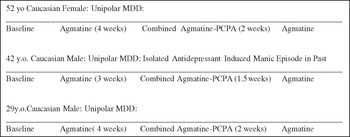
A clinical research stratagem using a pharmacotherapeutic study design paradigm with synthesis inhibitor challenge in treatment responders to a standard or investigational molecule with well‐defined central neuropharmacological action is a methodologically sound approach to surgically delineate pharmacologically, to the extent feasible, a specific central aminergic neurotransmitter system accountable for the therapeutic effects of the molecule. Using each subject as their own control, the clinical research stratagem proved successful in a previous study by the author Reference Shopsin, Friedman and Gershon11, in delineating a more intimate role for serotonergic mechanisms in mediating the antidepressant effects of the MAO inhibitor tranylcypromine that displaced the stubbornly entrenched but data insupportable theories promoting norepinephrine. All procedures were accepted by an independent ethical committee. It is thus, that in accordance with the ethical standards of the Helsinki Declaraction, exogenous agmatine was ingested daily in divided doses totalling 2–3 gm by endogenously depressed individuals ages 29 to 52 in excellent physical health meeting DSM‐IV criteria for major depressive disorder (MDD) and unipolar/bipolar distinctions (see Fig. 1). Existing or previous history of substance abuse (alcohol or drug) was immutably exclusionary as were pregnant females. All subjects had experienced previous acute episodes of MDD, and remarkably, none included in the study had yet taken an antidepressant drug during this index recurrence of 6–8 weeks duration. All had been treated with antidepressant drugs for an acute MDD episode in the past: none had a history of treatment resistance. A 42 years old male had a history of mania four years earlier for which he was briefly hospitalised but it is likely that it was drug induced by the antidepressant polypharmacy; he was receiving for an acute depressive episode at the time prophylactic maintenance treatment upon discharge with an antiepileptic and an antidepressant was unilaterally stopped without an acute manic relapse despite antidepressant drug treatment for an acute depressive relapse 18 months later. None of the patients were compliant with antidepressant drug maintenance against depressive relapse because of troubling side effects.
Longitudinal study paradigm for the three subjects ingesting combined agmatine‐PCPA expressed as horizontal lines and weeks of medication.

Clinical assessments were carried out at baseline and weekly throughout the period of drug ingestion using the same clinical ratings previously described Reference Shopsin, Friedman and Gershon11 that included a CGI, BPRS and a 21 item HAM‐D. Only those individuals showing an incontrovertible antidepressant response to agmatine were asked to volunteer under conditions of informed consent for concomitant treatment with PCPA for which the purpose and procedures had been coherently explained to them beforehand, including expected duration of involvement, potential benefits and risks, confidentiality, the voluntary nature of participation and their right to withdraw at any time without prior notice. Starting at doses of 250 mg on day 1, BID day 2 then TID day 3, PCPA was gradually increased thereafter in accordance with the pharmacological rule of thumb to a maximum of 1250 mg/day taken in QID dosing, the occurrence of mitigating side‐effects or a depressive relapse whichever came first. Maximum PCPA dosage was set at 1250 mg/day based on the highest daily dosage required to induce a depressive relapse in treatment responders to tranylcypromine in the author's 1976 study. Under the same conditions of informed consent, all subjects were informed beforehand that they would be asked to temporarily discontinue agmatine if they did not relapse with the addition of PCPA.
Results
Three endogenously depressed individuals, two males [one bipolar (42 years old) and one unipolar (29 years old)] and one female (unipolar, 52 years old), in the throes of an acute recurrent MDD episode of 6–8 weeks duration showed total/incontrovertible remission of depression. As in the authors previous synthesis inhibitor studies, improvement was based on the overall level of improvement and total level of psychopathology that included in addition to a total absence of depression, the mandatory absence of anhedonia and daytime fatigue as well as the restoration ad integrum of self‐esteem, ability to function and social competence. As seen in Fig. 2, agmatine was effective in the relief of both psychomotor agitation and psychomotor retardation. Similar results were also obtained with the two other patients (results not shown). The antidepressant effects were ‘clean’, free of apparent physical or behavioural side‐effects and accompanied by expressed feelings of well‐being, mild temporary GI discomfort and loose stools in the female resolved spontaneously and was elicited only upon questioning. None of these three individuals showing a therapeutic response to agmatine relapsed or showed attenuated or otherwise altered antidepressant response under concomitant agmatine‐PCPA conditions. None experienced any untoward adverse physical or behavioural events under combined PCPA‐agmatine conditions or with discontinuation of PCPA. After stopping PCPA, all three agmatine responders decided not to risk illness relapse by volunteering to temporarily stop agmatine, as their collective previous experience with unilaterally stopping other antidepressant drugs prematurely after treatment response did not guarantee the anticipated therapeutic response after restarting the drug if they relapsed. They were confident that the therapeutic remission of depression was agmatine induced because their previous depressive bouts traditionally lasted for 6 months to a year without drug treatment and sometimes for months with drugs.
HAM‐D Depression scores for 52 y.o. depressed female diagnosed in a recurrent episode of MDD.
Discussion
Studies have long since documented antidepressant‐like behavioural effects with the administration of exogenous agmatine in predictive animal models of depression. This is the first known clinical trial to date to record the therapeutic antidepressant effects of exogenous agmatine in clinically depressed individuals showing total clinical remission who did not relapse when PCPA was concommittantly added. Animal studies by Krass et al. Reference Krass, Wegener, Vasar and Volke12 demonstrated that massive PCPA‐induced depletion of brain serotonin and its metabolites does not block/inhibit the behavioural antidepressant‐like effects of agmatine in predictive animal models of depression, nor does pretreatment with agmatine block the PCPA‐induced depletion of serotonin Reference Krass, Wegener, Vasar and Volke12. Furthermore, Shutoh et al. Reference Shutoh, Hamada and Shibata13 reported that NMDA receptor binding is unaltered by PCPA treatment. The inability of both standard and SSRI class antidepressant molecules to block the serotonin depleting effects of PCPA in animals has been reported by the author's group in the early 1970s Reference Shopsin, Friedman and Gershon11, Reference Sierralta, Pinardi and Miranda14.
Given that agmatine's antidepressant effect is not mediated by or dependent on brain serotonin/serotonergic mechanisms Reference Krass, Wegener, Vasar and Volke12, the evidentiary documentation of agmatine's central effects as a central inhibitory modulator of excitatory glutamatergic transmission serves as (a) needed first step clinical proof of principle for the role of glutamatergic mechanisms as accountable for agmatine's antidepressant effect, thus contributing (b) unique proof of concept in support of the proposed use of glutamatergic modulators [e.g. ketamine and riluzole, Reference Diazgranados, Ibrahim and Brutsche15, Reference Zarate, Singh and Carlson16, Reference Ibrahim, Diazgranados, Franco‐Chaves and Kronstein17, Reference Zarate and Manji18, Reference Zarate, Payne and Quiroz19] as rational heuristic biomarkers for future antidepressant development: agmatine is distinguished from other NMDA receptor antagonists as a clinically attractive, readily available amino acid derived polyamine whose clinical therapeutic effects are clean, free of any untoward side‐effects. Agmatine's singular absence of serious adverse/events that plague the clinical use of other NMDA antagonists examined is in all likelihood due to the fact that it does not exert inhibitory effects under physiological conditions of normal receptor function and synaptic transmission; others do. Finally, the most important implications of the data from this small pilot trial are that (c) it serves, to the extent clinically feasible, as clinical proof of concept towards the ripening of a glutamatergic molecular biology of clinical depression. Excessive expression of brain glutamate, the quintessential excitatory amino acid transmitter and excessive excitatory glutamatergic receptor activation, able to evade self‐regulatory brain plasticity, represent the primum movens for the dysfunctional pathophysiological central events phenotypically expressed as clinical depression. Given the importance of the NMDA–NOS–NO cascade of agmatine's protective effects against neuropathic changes in brain that characterise the neurodegenerative diseases, it is not at all unreasonable to consider endogenous clinical depression a psychiatric manifestation of a neurological disorder.
Acknowledgements
The authors declare that he has no conflict of interest.