Introduction
Recent years have seen a surge of interest in a diverse host of cultural border crossers and traveling dissimulators in the field of early modern history. Whether it be Leo Africanus—the “Trickster Traveler” depicted by Natalie Zemon Davis—the “trans-imperial brokers” described in the research of Natalie Rothman, or the cast of liminal “aliens” that we read about in the rich biographical vignettes of Sanjay Subrahmanyam, it seems that in our contemporary world of mass mobility so characterized by cultural alienation and physical displacement, we are drawn to historical parallels from early modernity, when peoples, goods, and ideas began to circumnavigate globally for the first time in human history.Footnote 1
Some historians have criticized this literature on early modern travelers. For example, Francesca Trivellato has questioned the way that these studies—which are essentially micro-historical—have departed from the anthropological concerns and methodology of the original practitioners of Italian microhistory.Footnote 2 Likewise, John-Paul Ghobrial has noted how these life stories have been used to create images of “faceless globetrotters” brought back to life to elucidate global connections, when in reality it may be that local roots and conditions are at the heart of their tales, which provide the opportunity for the construction of “a deep, local history.”Footnote 3 Nonetheless even critical voices ultimately see great utility in this growing genre of “global microhistory,” which Sebouh David Aslanian has used to shed light on a wide array of debates in early modern history, from modes of interaction between trade networks, to the cultural history of law, to early modern French perceptions of the “Orient.”Footnote 4
This article provides the story of a traveler who was active during the first half of the eighteenth century, and it builds on these aforementioned scholars’ work by using global microhistory as a window into the dynamic of connectivity and disconnectivity in the early modern Islamic world. Miriam Eliav-Feldon has described the early modern period as being one “teeming with imposters,” prompting states and religious authorities to devise new ways to verify identity.Footnote 5 But despite the opportunities for fraud created by increased global mobility in the early modern period, this traveler was not a “chameleon” or “trickster.” Rather, he thrived as long as his local cultural currency had value in the Turko-Persian ecumene of the early modern Islamic world, but he was destroyed when his global ties and access to trans-imperial networks swept him into a game of international diplomacy and statecraft that was over his head. His life embodied the tension between the opportunities afforded by global connectivity in the early modern period, and the comforts of cultural rootedness.
The traveler under discussion was named Eḷia of Erzurum (1689–1750?). A product of the “Ottoman Age of Confessionalization,”Footnote 6 Eḷia was a merchant who converted to Roman Catholicism with Jesuits during his youth and later settled in Persia, where his linguistic skills and contacts with European merchants, diplomats, and clergy enabled him to become a man of influence at the late Safavid court. By 1724 Eḷia had earned sufficient trust at court that the last Safavid shah, Tahmāsb II (1704?–40), sent him as an envoy to the Russian Empire. This mission is unknown to western-language secondary literature on Safavid history, and thus Eḷia’s biography brings a new but ill-fated chapter to Persian diplomatic history. Much to Eḷia’s misfortune, the mission ended in disaster, as Russian officials imprisoned him for twelve years and confiscated his documents, letters, and notebooks, all of which are preserved in the State Archive of the Foreign Policy of the Russian Empire in Moscow.Footnote 7 These documents include rich materials for reconstructing Eḷia’s biography and for understanding the literary cultures and diplomacy of the late Safavid court during the reigns of the last two Safavid shahs, Shah Husayn (1668–1726) and Tahmāsb II (1704?–40). They also provide a rich non-western perspective on Catholic missions in the early modern Ottoman and Safavid empires.
After his release from prison in Russia, Eḷia spent many years traveling in Europe in search of patronage and employment, only to meet with great disappointment. At life’s end, he returned to his hometown in the Ottoman Empire and composed a 600-page chronicle in Armenian which survives unpublished to this day in the Mkhit‘arean Monastery Manuscript Library in Vienna.Footnote 8 In his final years of suffering and poverty, Eḷia uses this text to narrate his life-story, to vehemently renounce Roman Catholicism, and to offer a stinging critique of Catholic Europe and missionary activity in the Near East. The work is a rich example of early modern “self-fashioning”Footnote 9 in which Eḷia depicts himself as an innocent man who was betrayed by Catholic clergy. His last known act is to discard Catholicism and warn his fellow-Armenians about the supposedly malignant intentions of the Latin Catholics towards Christians of the Near East.
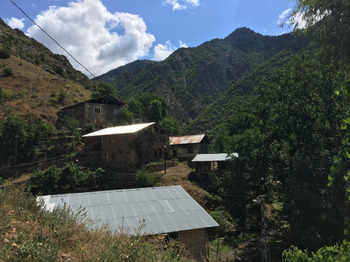
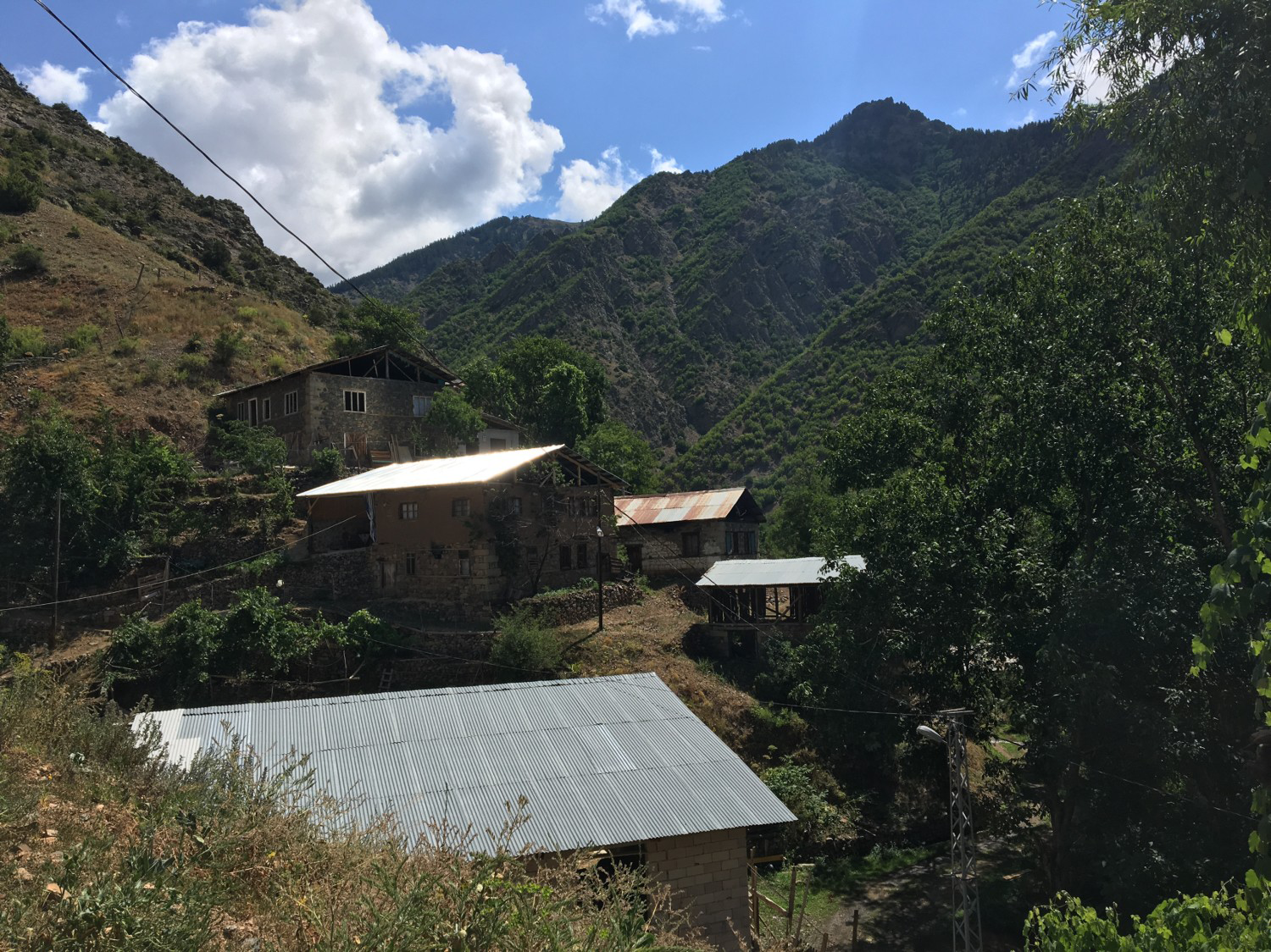
Krman Village (July 2017).
Source: the author.
Drawing on these unpublished sources in Armenian, Armeno-Turkish (Turkish written in the Armenian alphabet), and Persian, this article provides a biographical vignette of Eḷia. His life can be divided in four major stages: his youthful years as a merchant based in the Erzurum Province of the Ottoman Empire (1689–1718); his time as a cross-cultural broker and man of influence in late Safavid Persia (1718–24); his period in Russian captivity (1724–36); and his final years of European travels and ultimate penury (1736–50?). Each of these life epochs centered around localities in the Ottoman, Safavid, and Russian empires, namely Erzurum, Tabriz, and Astrakhan, and local conditions in each of these cities and empires played critical roles in directing the course of Eḷia’s life. I will follow this periodization in organizing Eḷia’s biography and show how his literary and documentary corpus enhances our understanding of the tension between global and local forces in the early modern Islamic empires. On the one hand, Eḷia was a friend of Europeans at a time when western powers were unique in their abilities to move men and goods on a truly global scale, pulling countless men like Eḷia into their networks of faith and trade. On the other hand, he lived before the encroaching process of cultural homogenization of the modern period, a time when crossing borders was difficult and required either the skills of Davis’ famed early modern “tricksters,” or perhaps also the false credentials of Eliav-Feldon’s “imposters.” Sadly for Eḷia, he wasn’t quite adaptive enough.
Erzurum: 1689–1718
Eḷia was born in 1689 in a small village named Krman in the Erzurum Province of the Ottoman Empire into a family of Armenian merchants.Footnote 10 Krman is one settlement in a cluster of villages in a hollow called Khotorjur (present-day Sırakonaklar) located along a river bank on the southern face of the Kaçkar mountains which separate the Anatolian plateau from the Black Sea. Khotorjur would come to be known as “Little Rome” in the late eighteenth century because of its Catholic population. This association of the hollow with Catholics seems to go back to just before Eḷia’s time, as research on the local lore of the region conveys that in 1660 a native of Khotorjur traveled to Rome, converted to Catholicism, and then returned home and began converting some of his townspeople.Footnote 11
Eḷia’s village of Krman is relatively remote, located approximately 125 kilometers north of Erzurum. The present author has visited it and spent time there with the villagers. Many of the village’s current homes were built by Armenians before 1915, as evidenced by extensive stone inscriptions which remain extant in Armenian. Even the hollow’s mosque was built by the Armenians: in fact, it was formerly a church and is still decorated with stone crucifixes. It is worth noting that Eḷia was not born into urbanity; rather he was a rustic from a village whose present-day subsistence is based largely on animal husbandry.
Although born in a rustic environment, Eḷia’s father and uncle were wide-ranging merchants, and Erzurum served as the central node of their trade expeditions. In his chronicle, Eḷia describes how he fell under the influence of Roman Catholic missionaries active in Erzurum. He writes that “my father was always praising the nation of the Franks, [saying] that they don’t tell lies, nor do they take oaths, nor do they deceive [anybody].”Footnote 12 Eḷia imbibed his father’s Francophilia, and on multiple occasions in his chronicle he describes these sentiments with the language of romantic love:
[…] my love would not let me separate from them, with such love was I adoring them. Not only was I adoring them, but also their nation, their people, their beloveds and friends. I was loving their beloveds so much, more than them, and I was hating what they hated, more than them.Footnote 13
Elsewhere Eḷia confesses that “I loved the nation of the Franks and their clergy (padres) more than God.”Footnote 14
After his father’s death in 1705, Eḷia began to study the Catholic confession with Jesuits in Erzurum, and he became a Catholic.Footnote 15 Jesuit and Capuchin missionaries had begun to arrive in Istanbul at the end of the sixteenth century,Footnote 16 a phenomenon which would in time bring post-Tridentine global Catholicism into the lives of countless Ottoman-Armenian subjects in the seventeenth and eighteenth centuries. That is to say, Eḷia’s conversion exemplified a much broader trend, namely the conversion of a substantial proportion of Ottoman-Armenians to Catholicism in the early modern period. Tijana Krstic, a pioneer in the study of “the Ottoman Age of Confessionalization,” has described the early modern period in the Ottoman Empire as being characterized by the “confessionalization initiatives of various sociopolitical groups jockeying for power.”Footnote 17 In the Ottoman Empire, this “jockeying” seems to have had two major waves: Sunnization efforts which took place among Muslims as a response to the Ottoman–-Safavid rivalry, and conversions and conflicts which broke out among Ottoman Christians in response to Catholic missionary activities which accelerated after the Council of Trent.Footnote 18 Eḷia’s turn to Catholicism was part of this second wave of confessionalization in the Ottoman Empire, and it undoubtedly represented a significant victory for the Catholic missionaries, given that Eḷia came from a family of wealth and local influence. Eḷia’s decision to become a Catholic would have a momentous impact on his life trajectory.
While Eḷia may have learned to speak some French at that time, it is noteworthy that throughout his youth he would exchange letters with Europeans in Armenian. It seems that he only began developing his French writing skills much later: a French language workbook—filled with stock phrases in French and Armenian—is extant in the Moscow cache and includes a colophon which explicitly states that he started working on it on 11 January 1722.Footnote 19 Apparently, Eḷia wanted to start writing to Europeans in French instead of Armenian at that time, and many of the phrases are those of formal epistolary, along with exercises in the most basic aspects of penmanship (the alphabet). The notebook implies that the enhanced social mobility that Eḷia achieved in his youth among Europeans was a direct consequence of his Catholicism, and not necessarily a product of a proper French education, something Eḷia was still working to acquire at the apex of his career. For Christians of the Near East like Eḷia, conversion to Catholicism could potentially open doors both locally and globally.
Eḷia wrote the above anecdotes about his turn to Catholicism late in life, in the 1740s, but much contemporary information is preserved about his youthful travels with his family’s merchant operation thanks to a trade notebook which survives among his effects in Moscow.Footnote 20 At the beginning of the seventeenth century, we see a proliferation of trade notebooks kept by wide-ranging Armenian merchants. The most famous example is the journal of Zak‘aria of Agulis.Footnote 21 Eḷia kept a similar journal in which it is possible to trace his movements. It is clear that Eḷia and his family traveled on a northern circuit from Erzurum to Shmakhi (in present-day Azerbaijan) to Astrakhan, the early modern border outpost of the Russian Empire, as well as on a southern circuit from Erzurum to Tabriz to Qazvin to Kashan and finally to Isfahan, the capital of Safavid Persia. The journal includes many mundane and trivial minutiae, like a home shopping list from a trip to Istanbul which includes basic items like “shirts,” “blue saggy trousers (şalvar),” and “purple knee-breeches (dizlik).”Footnote 22 In addition to being able to follow Eḷia’s movements and financial dealings, we also see the gradual broadening of his social circles among Safavid Persian officialdom. For instance, in early 1713, we find him traveling in Safavid Persia, and he notes in his journal that “By God, Najaf Quli Beg of Kashan, the captain (yüzbaşı), brother of Ramazan Beg, became my friend.”Footnote 23
In 1718 Eḷia’s career took a major turn, as we find him shifting away from his family business and beginning to work for European interests in Safavid Persia,Footnote 24 a result, no doubt, of his Catholicism and growing popularity among European and Persian officialdom alike. It is in that year that the center of gravity of Eḷia’s life shifted from Erzurum in the Ottoman Empire to northern Persia, and that this country lad from the mountains of Eastern Anatolia became a man of influence in the Safavid Empire. It was unfortunate for him that the Persia which embraced him and where he had his moment of fame and fortune was about to enter one of the most tumultuous and troubled periods in all of Persian history. In 1722 Afghan forces besieged Isfahan and took it after a siege lasting several months, leading to the capture of the penultimate Safavid shah, Shah Husayn. Safavid collapse precipitated decades of chaos which only really ended late in the eighteenth century, with the rise of the Qajar Dynasty (1789–1925).Footnote 25 Eḷia’s misfortunes were, in many regards, a direct result of the weakness of the Safavid state after 1722, led by Shah Husayn’s ill-fated son Tahmāsb II, who successfully fled Isfahan before its fall and became the last Savafid shah.
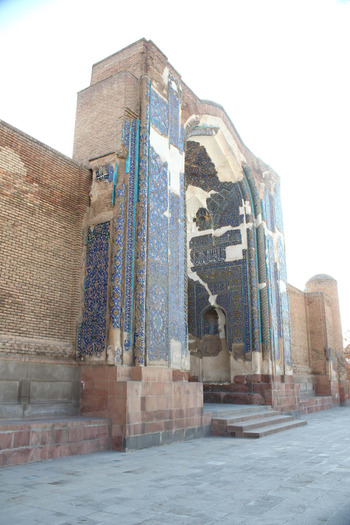
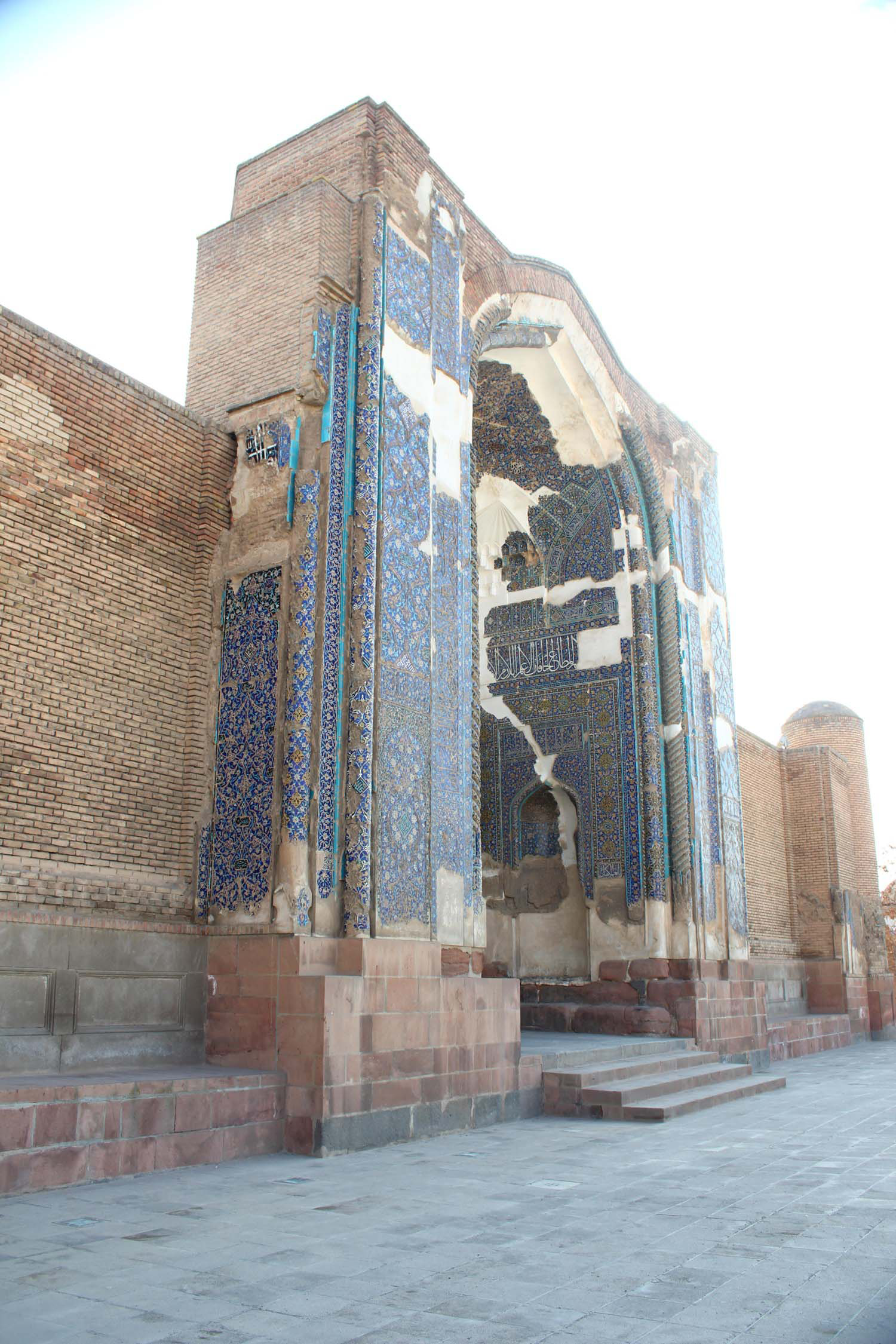
Grand Blue Mosque, Tabriz (January 2019).
Source: Sara Haji Nezhad. Note: The mosque entrance was severely damaged by earthquakes in Tabriz in the early modern period.
Tabriz: 1718–24
While most information about Eḷia’s early life can be found in his retrospective chronicle and contemporary trade journal, details about his time in Persia derive from a combination of his chronicle’s reminiscences and a variety of contemporary documents and notebooks in Persian, Armenian, and Armeno-Turkish. Through his Persian and Armenian documents we can infer the exact nature of his business relations in Persia. His notebooks in Armeno-Turkish, in contrast, provide a unique view into modes of socialization in late Safavid Persia.
After resettling in Persia in 1718, Eḷia periodically worked for both the English and Dutch East India companies.Footnote 26 At the time of his arrest by the Russians in 1724 he was still carrying old documentation in Persian about English trade privileges among his papers.Footnote 27 He was in Isfahan during the Afghan siege of 1722, and on 31 March he wrote a letter which describes the Persians’ major defeat at the Battle of Gulnābād:
On 3 March all of the Persian forces, the grand vizier (Iʿtimād al-Dawleh), and all the military commanders (umarāʾ) went out of the city, such that none of the Persian troops remained in Isfahan. [Thus] the residents of the city came to protect the gate of the shah at the night watch. More peasant infantry came, and they gathered at the outskirts of the city, all of them [numbering] up to 80,000 men. They went against the Afghans on 8 March. After half a day, they waged battle, and the race of the Persians was defeated and fled. They came and entered the city by night, filled with shame, and they blocked the road to the city and settled [inside it].Footnote 28
Later in the letter Eḷia describes how prices skyrocketed in Isfahan and how he got stranded there and could not leave. Like Tahmāsb, he was ultimately able to flee, however, and by summertime we find Eḷia safe in northern Persia, long before Isfahan’s fall in October.
After his escape from Isfahan, Eḷia began to work for French state officialdom, a logical consequence of his Francophilia and Catholicism. A bundle of Persian documents in the Russian Archives provide a clear glimpse into the nature of his duties for his French patrons. It seems that Eḷia served as an intermediary between the French officials and Safavid elites, lobbying on behalf of French interests.Footnote 29 While it is clear that he did not personally write Persian documents issued in his name—as they are written in multiple different handwritings—it is likely that Eḷia could speak some Persian. It is certain that he was fluent in Turkish, which was probably his usual language of discourse with Persian officials. Tabriz is, after all, a city of Azeri Turkish-speakers, and the mother tongue of the Safavid Dynasty itself was Turkish, not Persian (members of the dynasty would have all been bilingual). It is important to remember that behind a façade of Persian official chronicles and documents, the history of Persia from the eleventh century to the nineteenth is to a large extent the history of Turkish-speaking rulers and soldiers, more so than of Persian-speaking ones.
One of the main tasks assigned to Eḷia by the French during his years in their service was the retrieval of French goods lost in the Tabriz earthquake of 1721. Two Persian documents in the bundle are representative of the whole. The first of them is a petition issued in Eḷia’s own name on 16 April 1723 that was addressed to the surviving apparatus of the Safavid state. Like most documents in the collection, it begins with the lines, “Petition of the lowest of servants, Yahyā the Frank, deputy of the bailo [ambassador], deputy of his excellency the lofty king (pādshāh) of France.”Footnote 30 Intriguingly, Eḷia refers to himself as “Yahyā the Frank,” Arabicizing his name while simultaneously also identifying himself with the Europeans in Persia. Though Yahyā is not the equivalent of Eḷia, in his Armenian writings too he makes it unambiguously clear that he went by that name in Islamicate circles.Footnote 31 The letter goes on to explain how at the time of the earthquake (dar ayyām-e zalzaleh) French goods were deposited with a servant named Naqi who never returned them. The letter summarizes attempts to recover them and emphasizes that they are “the possessions of the lofty king (pādshāh) of France.”Footnote 32 On several occasions Eḷia “presented these affairs to the exalted chief justice (divānbegi),”Footnote 33 but as far as this author can tell, the French never recovered their goods. Included in the Persian document bundle is a detailed list of those goods which had been entrusted to Naqi. They included valuables of local origin, such as a “big curtain [with] Qarabagh stitching”Footnote 34 and “a Qizilbash sword with a bejeweled hilt,”Footnote 35 alongside products from Europe, like a “Frankish skewer with a silver handle.”Footnote 36
Diverse financial ledgers in Armenian provide another perspective on Eḷia’s work for the French in Persia.Footnote 37 They list the values of promissory notes (sanad) for debts owed by various late Safavid elites. In one document dated 7 July 1723 in Tabriz, Eḷia describes how he listed all of the loans “one by one” and provided the list to the grand vizier (Iʿtimād al-Dawleh), expecting assistance in their recollection from the Safavid state.Footnote 38 Debtors seem to include the names of some of the highest Safavid officials in the land, such as Muhammad Husayn, who owed seven tomāns.Footnote 39 This Muhammad Husayn was most likely Shah Husayn’s influential chief cleric (mullābashi), a major figure who remained active throughout Tahmāsb II’s ill-fated reign.Footnote 40
While the debt list itself does not explicitly state that the money owed was French, other documents in Eḷia’s cache provide evidence that it was lent by the French state. For example, among Eḷia’s personal letters are instructions given on 13 December 1723 to a servant tasked with helping him with debt collection: the letter explicitly mentions that “this is the money of the king.”Footnote 41 Undoubtedly, the reference is to the king of France, given that the instructions were issued in Eḷia’s capacity as deputy of the French bailo, with Eḷia’s previously mentioned Persian title translated into Armenian.Footnote 42 While I have not yet been able to identify contemporary documentation to substantiate Eḷia’s claims, in his chronicle he states repeatedly that his money-lending efforts were not only on behalf of the French, but that he also lent out some of his own personal fortune. If we are to take Eḷia’s words at face value—and they are substantiated in all instances where contemporary documentation is available for comparison—then even the shah of Persia himself, Tahmāsb II, owed Eḷia the substantial sum of 432 tomāns.Footnote 43
From such Persian sources and Armenian financial ledgers preserved in Moscow, we gain a clear image of the substance of Eḷia’s work with the Persians: he was, in essence, a broker who met frequently with high-ranking Safavid officials in order to push the men of state to fulfill promises and requests emanating from the French, whether it be in the collection of money owed or in the retrieval of lost property. It is important not to exaggerate French influence in early eighteenth-century Persia, which was undoubtedly more aspirational than effective, but with Eḷia’s documents it is possible to chart French efforts to realize their diplomatic aspirations and even to observe some small victories.Footnote 44 These documents do not, however, provide any significant insight into Eḷia’s mode of interaction with Safavid statesmen. Why was it that Eḷia—a foreigner from the Ottoman Empire—was so popular among the Safavids when the French could have relied on any number of local Armenians who would have spoken much better Persian? The reason for Eḷia’s popularity seems to have derived in part from his status as a fluent Turkish-speaker from the Ottoman Empire.
As noted above, Tabriz is located in a Turkish-speaking region of Persia. Moreover, the native language of the Safavid dynasty was Azeri Turkish, not Persian, and the dynasty continued to speak Azeri and to patronize Turkic literature until the end of their rule.Footnote 45 While local Armenians would have spoken better Persian than Eḷia, it seems that he spoke better Turkish, and that this proved to be an invaluable skill when dealing with Safavid officials in Tabriz. Included among his effects surviving in Moscow are two notebooks written in the hybrid language of Armeno-TurkishFootnote 46 which offer a rare glimpse beyond official tasks and formal language into the modes of socialization between Turkish-speaking officials of late Safavid Persia and an Ottoman Armenian working on behalf of a powerful European state.
One of Eḷia’s two Armeno-Turkish notebooks contains the work of only one author, Alican Qövsi of Tabriz, an Azeri poet who lived in the late sixteenth and early seventeenth centuries.Footnote 47 Eḷia prepared the notebook in October 1719 in Tabriz and transcribed Qövsi’s Turkish corpus into Armeno-Turkish, probably copying and transcribing from a written manuscript in the Arabic alphabet or asking a friend to slowly recite it for him.Footnote 48 The second notebook is a compilation, far more diverse in nature, which Eḷia began to compose on 25 January 1721 in Tabriz. In its opening, Eḷia states that “[this is a] book of musical songs arranged by various men” and that “I wanted … to write [the things] which I have heard at the worldly festivities of brothers.”Footnote 49 To put it more clearly, Eḷia was keeping minutes at social gatherings and writing down the songs and poems that he heard in his notebook.
Scholarship has devoted much attention to the social importance of the Persian “textual corpus … whose encapsulated meanings also lived and circulated orally, in stories and verse, to broader audiences.”Footnote 50 Elite Persians aspired to a literary and social ideal called “adab”: mastery of a corpus of texts and high command of language, complemented by “a kind of proper conduct that was virtuous because it was part of an individual’s moral cultivation.”Footnote 51 The learning and the manners were interrelated because the former offered literary models and guidance for the latter. In the words of Mana Kia, “the attainment of literary adab is indistinguishable from the acquisition of social adab.”Footnote 52 In her research on Persianate adab, Kia writes,
There was … an aesthetic of word and gesture, a set of skills, which were universally valued in this society as signs of virtuous learning and moral refinement. Its purveyors were the adībs, who as the beneficiaries and teachers of khans, and often as officeholders themselves, spread its sensibilities to the corridors of power. The obligations and privileges of this reciprocal relationship were articulated in the language of friendship, though this was not the private relationship between peers that the modern use of the term implies.Footnote 53
Eḷia was certainly not an adīb in the Persian literary tradition, but he was fluent in Turkish and seems to have been adept in the “Persianate” Turkish poetic tradition of the troubadour-like aşıks. As was the case for Persian literature, knowledge of this Persianate poetic form would have gone hand in hand with expected modes of conduct and conventions of recitation and use of poetry as a means of socialization. In Eḷia’s Armeno-Turkish notebook we have a rare glimpse into the moment of the oral recitation of Turkish song and verse in a Persianate cultural setting,Footnote 54 and clear evidence that Turkish poetry served an important role in Eḷia’s relations and socialization with Late Safavid elites in Tabriz and northern Persia.
In its basic format, the notebook corresponds to a kind of Ottoman Turkish literary collection called “cönk,” which consists of diverse literary samples, often though not exclusively of poetry.Footnote 55 The diversity of themes and poetic forms in Eḷia’s Armeno-Turkish cönk notebook is nothing less than staggering. It is evident that Eḷia was not attending the most high-brow of Safavid social gatherings. Several pages of Eḷia’s notebook contain verses like the following:
Strike (tokhmakhlasana) a piece of linen with a mallet (tokhmakhla).
If I strike (tokhmakhlasam), what’s it to you? If I don’t strike (tokhmakhlamasam), what’s it to him?
If you’re going to strike (tokhmakhlarsan), take the strike (tokhmakhla).
If you won’t strike (tokhmakhlamazsan), give it to [your] comrade, let him take a hit (tokhmakhlasun).Footnote 56
At first glance, this poem seems to be sheer gibberish, and, indeed, it is nonsensical as regards its meaning. But it is gibberish with an organizing principle: it is a Turkish tongue-twister—called a tekerleme in modern Turkish—which is built out of a diversity of verbal forms based on one root, in this instance the word tokhmakh (tokmak in modern Turkish spelling), which means both “mallet” and also serves as the root of a verb meaning “to strike.” Such word games are usually the purview of small children, though I imagine that they may have been amusing to an adult audience that was drunk enough to be slurring their speech.
Eḷia also collected material that would be of interest to a sober audience, including songs, folktales, and poems on contemporary themes. For example, he includes a lament about the so-called Edirne Event of 1703,Footnote 57 when the Ottoman Sultan Mustafa II (1664–1703) was deposed in favor of his brother, Sultan Ahmed III (1673–1736).Footnote 58 He also includes a poem about a “neo-martyr,”Footnote 59 a Turkish Muslim from Aleppo who converted to Christianity and was executed for apostasy from Islam.Footnote 60 His compilation contains a lament about the Tabriz earthquake of 1721, the one in which the French consulate in Safavid Persia lost so many precious goods. The lament’s sad verses include the line, “The mountain [and] earth of Tabriz abounded in crimson blood.”Footnote 61 Fınally, the compilation includes several versions of the famous Turkish Köroğlu tales,Footnote 62 fantastic stories about a rebel who lived during the times of the Ottoman Empire’s Celali Revolts.Footnote 63 These are probably the oldest preserved versions of the tales, and thus they carry importance for Turkish literary history. The tales were published in 1954 as a testament to Armenian and Azeri common cultural heritage.Footnote 64
Eḷia’s compilation also contains poetic gazels and Turkish folk songs (türkü) written by a wide range of authors whom Eḷia seems to have known personally. One türkü must have been the work of a woman, as the song is listed as the “türkü of Lady Ṙzvan.”Footnote 65 Eḷia explicitly notes that he jotted down some gazels in the city of Rasht on 30 January 1723, which had been recited by “our scribe Mirza Ali Akbar of Shamakhi.”Footnote 66 Perhaps it was this Mirza Ali who had written some of Eḷia’s Persian letters. Eḷia recorded other Turkish gazels as being the work of a certain Safi Quli Beg Shah Quli.Footnote 67 They come directly after his scribe’s poems and were likely performed on the same night.
It seems that Eḷia’s fluency in Turkish, poetry and its conventions of recitation, and his knowledge of historical anecdotes and folktales from the Ottoman Empire, lent him novelty and currency at Safavid social gatherings in Tabriz which many Armenians of Persia, like the New Julfa merchants, may have lacked. The New Julfa Armenians were a community that had originated in the forced migration policies of Shah ‘Abbās (1571–1629) at the beginning of the seventeenth century and that went on to flourish as global traders.Footnote 68 There were distinguished Roman Catholic New Julfan families in Safavid history, such as the Shahrimanian family,Footnote 69 and many Julfa merchants were known to have embraced Catholicism in the course of their travels.Footnote 70 But by the time of Eḷia’s arrival in Safavid Persia in the early eighteenth century, Catholic missionary activities in Persia had seen harsh setbacks, having been repressed with particular effect by the policies and political maneuvers of the Armenian Catholicos Alek‘sandr I. of Julfa.Footnote 71 In fact, the majority of Julfans had always been at least formally Apostolic. Whereas the Julfans had once played a role in representing Safavid interests abroad,Footnote 72 the last Safavid shah would look elsewhere for assistance in international relations, particularly with Catholic Europe.
While his poetic gifts and knowledge of social convention may have gotten Eḷia invited to parties, his Catholicism, close ties to French officials and Catholic missionaries, and his knowledge of the French language, were probably more important in convincing Shah Tahmāsb II and his court that Eḷia was fit to become a Safavid diplomat. In 1724 the shah asked Eḷia and some associates to personally convey and deliver official Safavid state documents to Catholic European rulers on an embassy. Eḷia’s choice as a diplomat may be seen as a sign of the Julfans’ weakened position in early eighteenth-century Persia.Footnote 73
One of these documents that Tahmāsb entrusted to Eḷia in 1724 was a personal letter addressed to the Holy Roman Emperor Charles VI (1685–1740). When the Safavid officials in Tabriz had their drinking parties, it seems that Turkish was often the language of choice. But when it came time for official diplomacy, the façade of high Persian prose had to be re-erected, and thus Tahmāsb’s letter was written in the florid Persian style of the official chancery. Its contents are worthy of careful scrutiny.
Tahmāsb—or, more likely, one of his scribes—begins the letter with extensive praise of “that brother Carlos, the sixth and the Roman.”Footnote 74 He explains that Tahmāsb and his troops had departed from the imperial capital of Isfahan and settled in Qazvin, where “by the custom of the heaven-dwelling sultans and the ancestors adorned with magnificence, [Tahmāsb II] made an auspicious ascension (julūs) upon the victorious throne of kingly fortune and the high seat of the sultanate and of renown.”Footnote 75 We know from other sources that Tahmāsb had coins struck in his name at this time.Footnote 76
The letter goes on to describe a military confrontation with the Afghan forces—which had previously captured the Safavid capital of Isfahan as well as Tahmāsb’s father, Shah Husayn—in which the young Safavid shah’s forces supposedly won a major victory. It states that after his ascension to the Safavid throne, Tahmāsb left Qazvin and traveled north to Azerbaijan. While en route, Tahmāsb heard the news that a division of Afghans troops led by a commander named Amānullah had moved on Qazvin. Thus, “a group of [Tahmāsb’s] victorious soldiers who were present at the imperial stirrup were dispatched to hastily eradicate and suppress those dark-minded ones [the Afghans].”Footnote 77 When the Safavid troops engaged the Afghans in Qazvin, Tahmāsb’s letter describes a total rout for the Afghans: “Many [Afghans] were killed, [while] those who survived fled from the battlefield with their commander, Amānullah, wounded. They dispersed completely.”Footnote 78
Tahmāsb’s letter is a good piece of propaganda, but the story about his troops’ military prowess diverges significantly from the historical record preserved in other sources, in which Tahmāsb and his entourage were far better known for their drinking than for their bravery.Footnote 79 Persian historians of the period agree that he and his father “lacked adequate leadership skills and military ability to govern their domains effectively”Footnote 80 and that their “incompetence … led directly to the collapse of Safavid power.”Footnote 81 More objective sources than Tahmāsb’s scribes describe how he neglected to collect an army after his flight from Isfahan. They also mention that he and his coterie did not hear news of Amānullah’s move on Qazvin after having already set off for the north, but rather that this news was what prompted them to run for their lives from Qazvin. The actual story of Amānullah’s defeat was that the residents of Qazvin—not the Safavid army—rose up in rebellion against Amānullah because of attempts to over-tax them. It was they who wounded the Afghan commander and drove the Afghans out of the city.Footnote 82 Persian accounts of the incident are substantiated by independent Armenian sources as well, one of which describes in detail the Afghans’ demands for girls in addition to money, and their insulting mistreatment of the populace which prompted a fight that led to full-scale insurrection.Footnote 83 It was this urban riot that Tahmāsb’s scribes rhetorically transformed into a victory “by the order of the powerful one who is adored [i.e. God]”Footnote 84 and bogus evidence of Safavid military prowess invented for Charles VI.
After announcing his ascension to the throne and conjuring up this largely fabricated demonstration of Persian military capacity, Tahmāsb and his scribes proceed to explain how they thought of writing to Charles. They explain that
After arriving in Azerbaijan and considering the disposition of the holy warriors (gazis)—marked by victory—the world-adorning [shah] realized that [every] side and quarter was [full of] every kind of enemy who always vaunt their friendship to the brimful [but] await the opportunity to reveal to him secret enmity.Footnote 85
These musings supposedly prompted Tahmāsb to seek reaffirmation of friendship between the scattered remnants of Safavid Persia and the Holy Roman Emperor, a friendship that Tahmāsb’s ancestor the great Shah ʿAbbās—who is explicitly cited in the letter—had once nourished.Footnote 86
To achieve this rekindling of affection, Tahmāsb decided to send a delegation to Europe which included a Persian, a Capuchin friarFootnote 87 named Johannes (whose French name was Jean Baptiste de RochefortFootnote 88), and Eḷia, with concrete topics for negotiation no doubt conveyed orally, as specifics are not included in the document. Though it is not mentioned in the letter to the Holy Roman Emperor, they would travel first to the Russian Empire, then proceed to Catholic Europe. The authoritative narrative historian of this period of Persian history, Laurence Lockhart, seems to have been unaware of Eḷia’s delegation, though he describes another envoy to Russia that Tahmāsb sent in 1726, long after Eḷia’s imprisonment.Footnote 89 Thus the story of Eḷia’s mission is a new discovery in the secondary literature on eighteenth-century Persian history.
To understand this motley delegation, some background history as well as comments from Eḷia’s chronicle are critical. Firstly, it is important to note that Tahmāsb had already dispatched an envoy to the Russian Empire, a certain Ismaʿil Beg. Tahmāsb had granted Ismaʿil Beg full authority to negotiate with Peter the Great before learning about the landing of Russian troops in Gilan, on the Caspian shore, but after hearing the news about the Russian incursion he ordered Ismaʿil Beg to be recalled.Footnote 90 Ismaʿil Beg had already been whisked away by the Russians, and in September 1723 he signed a treaty granting Russia extensive territories in Persia in exchange for assistance with the war against the Afghans. Tahmāsb never ratified the treaty, and he considered Ismaʿil Beg to be a traitor.Footnote 91
Eḷia’s primary task was not to visit the Russian Empire, but rather to travel to western Europe. He would have preferred to bypass Russia entirely and to reach Europe via the Ottoman Empire, but he was forced to take a northern route via Russia for fear of the Ottoman authorities,Footnote 92 an awkward task, given the dispute about Ismaʿil Beg’s treaty. Of the three members of the delegation, Eḷia barely mentions the Persian in his writings, and it is not at all clear that he even participated in the expedition. With regard to the Capuchin Johannes’ inclusion in the delegation, Eḷia writes the following in his chronicle:
In those days, it was truly disclosed to me that they would send me in an embassy, having as a friend for me the Capuchin Ovanēs Mkrtich‘ [meaning, the baptizer], on account of two reasons: Firstly … so that he be a benefactor to the Persians and that there be indelible [and] perpetual memory, [and] by this the Capuchins might always boast, [saying] that in a time of straits we helped and served you [the Safavid shah], [so that] in this way they might always be powerful over their opponents. And the second [reason] that I promised to bring him with me, because one day he had a quarrel with his friend Fr. Be nartos.Footnote 93
Just as the Capuchins wanted to be seen as useful servants of the Persian state in order to preserve their prerogatives, likewise Tahmāsb boasts in his letter about his good relationship with the Catholic “padres,” thereby seeking to please European potentates by kind treatment of the Christian missionaries. Later in the passage, Eḷia complains that his name was written last in the imperial letters, although he was the lead member of the delegation. His claims to diplomatic precedence over Johannes are, in fact, substantiated by the fact that he was the possessor of Tahmāsb’s letter to Charles VI.
With Tahmāsb’s letter to Charles VI—and many other documents, financial registers, and notebooks—in his possession, and in the company of the Capuchin Johannes, Eḷia left his charmed life in turbulent Safavid Persia and set off for the Russian Empire. There his life would take a tragic turn for the worse.
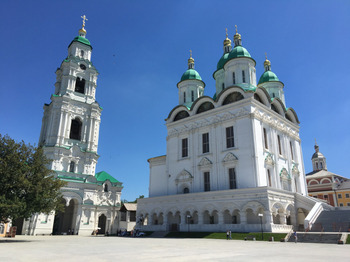
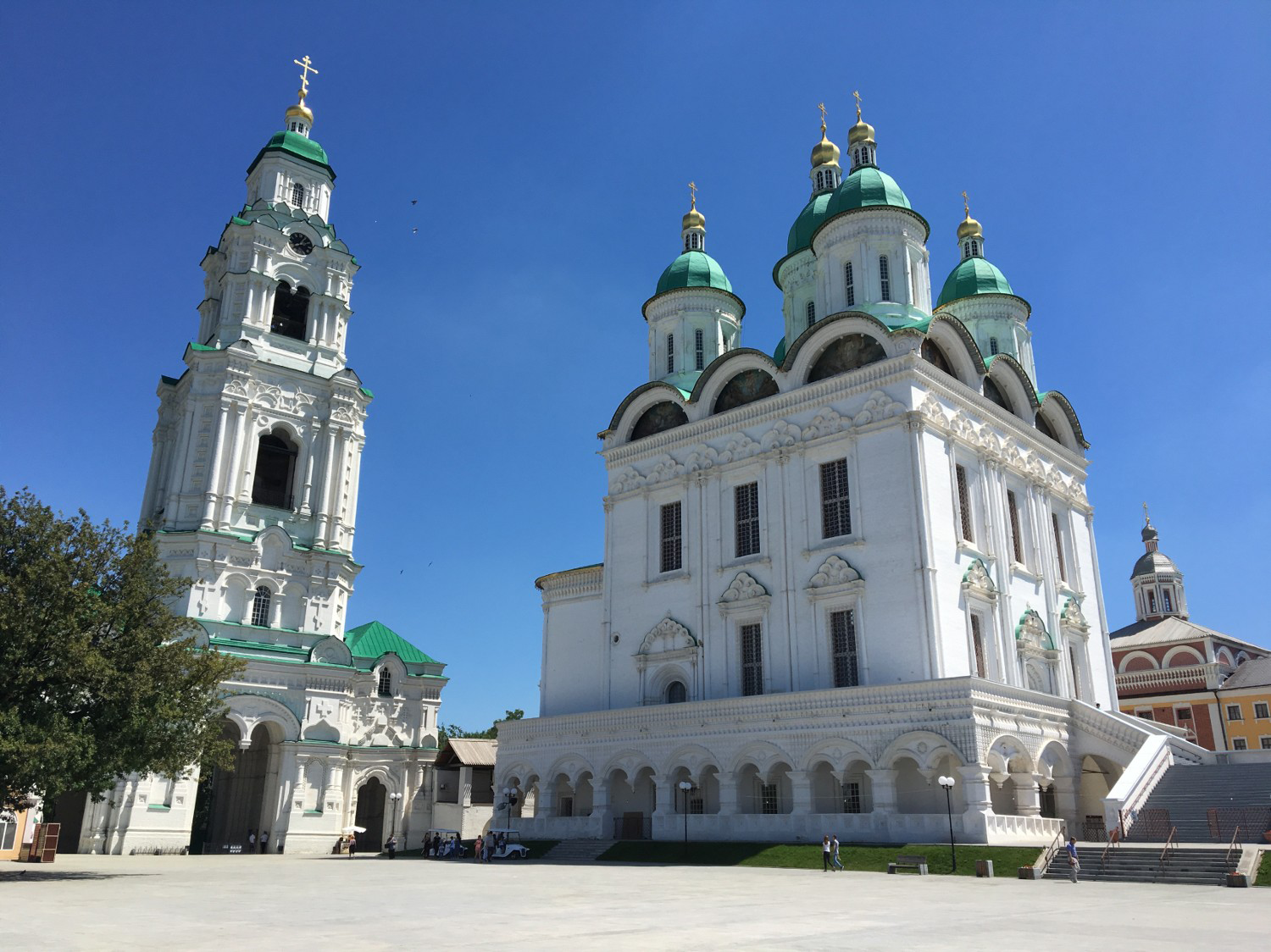
Kremlin of Astrakhan (June 2017).
Source: the author. Note: The Assumption Cathedral at the Kremlin of Astrakhan would have been newly constructed when Eḷia arrived in Astrakhan in 1724.
Astrakhan: 1724–36
At the beginning of the eighteenth century Astrakhan—located slightly inland from the northern shore of the Caspian at the head of a large delta created by the Volga River—was the border outpost between the Russian Empire and Safavid Persia. The city had great significance as a major center of trade between the Middle East and Russia, as a military stronghold, for its customs house, and for its famous fisheries. With the full incorporation of the northern Caucasus into the Russian Empire in the nineteenth century, Astrakhan lost much of its past geopolitical significance, though the Volga Delta’s fisheries continue to produce some of Russia’s best sturgeon caviar.Footnote 94
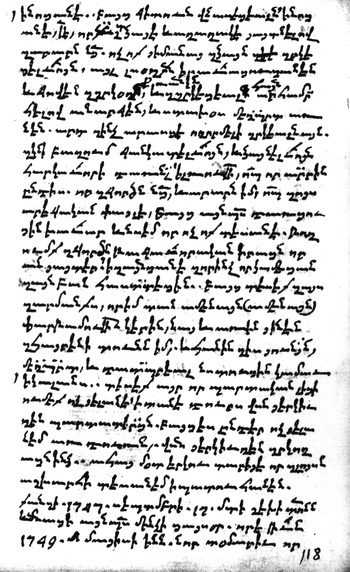
Sample of Eḷia’s handwriting, page 118a of the Chronicle.
Source: Vienna MS 980, 118a. Permission for reproduction kindly granted by the Abbot of the Mkhit‘arean Congregation of Vienna, Father Boghos Kodjanian.

We know from his youthful merchant notebook that Eḷia had extensive experience traveling and trading in Astrakhan. Indeed, Armenian merchants were not a rare sight in the cosmopolitan outpost.Footnote 95 The same wave of conversions to Catholicism—like Eḷia’s—that caused controversies among Armenian communities throughout the Ottoman Empire was also affecting the Armenians of Astrakhan. In his cache Eḷia carried a Latin document dated 30 June 1724 from the Capuchin mission in Persia directed to the Russian authorities in Astrakhan. Therein, they describe how “the Armenian heretics [i.e. Apostolic Armenians] keep continually harassing the Armenian Catholics, who are easily seceding from the Right Faith because of fear.”Footnote 96 The Capuchins requested that the Armenian Catholics be exempt from oversight by the Apostolic Armenian’s legal and communal structures and that the Russian state protect the Armenian Catholics.
Elizabet‘ Tajirean published a letter sent by the Armenian Catholics of Astrakhan in 1723—just before Eḷia’s arrival—to the Pope in Rome which substantiates the description presented in Eḷia’s cache. It also describes how the Apostolic Armenians of Astrakhan were persecuting the Catholic families “on account of the holy faith.”Footnote 97 Moreover, it provides interesting insight into the makeup of the Armenian Catholic community of Astrakhan. They consisted of twelve households, or about one-tenth of the total Armenian population. A great many of them were Istanbul Armenians and Armenians from other Ottoman urban centers—including Erzurum—who had fled the Ottoman Empire because of anti-Catholic persecution.Footnote 98 Confessional infighting among Ottoman-Armenians was, in short, spilling over into the Russian Empire.
No doubt it was Eḷia’s work on behalf of Safavid Persia, not the Capuchin friars, which led to his twelve years of captivity in the Russian Empire. Later in his life, Eḷia would place the full blame on Johannes the Capuchin. In his chronicle he writes that after his arrival in Russia,
[Johannes] began to write often to the Russians, [saying] that I am not an ambassador, but rather a spy for the Persians, that he has come to you to spy and later to return [to Persia]. Not only was he himself writing, but he also had others write, because he rose against me all the race of the Armenians. From the beginning he was an enemy to the Armenians. In order to destroy me, he united with them [and] thus deceived them, [claiming] “Behold, the Russian king has risen to deliver you, [but] this one [i.e. Eḷia] does not want it. If he remains alive, there will be no deliverance for you.”Footnote 99
Later in his chronicle, Eḷia claims that Johannes had four reasons for betraying him. Firstly, the French discerned in Eḷia Russophilic sentiments which were incompatible with his service to the French state. Secondly, Eḷia had quarreled with a Capuchin friar in Persia, thus obliging other Capuchins—including Johannes—to side with their own against a foreign convert. Thirdly, Eḷia claims that the Capuchins sought to appear loyal to the Russians so as to ingratiate themselves with the authorities and to protect their interests in the Russian Empire. Finally, Johannes wanted to return to Persia without Eḷia, so that he and not Eḷia would win glory in the eyes of the Safavids.Footnote 100
What is this reference to the Russians’ intention to “deliver” the Armenians? Abrahamyan, the editor of a selection of Eḷia’s Armenian letters, believed that Eḷia went to Russia with a proto-nationalist objective of convincing the Russian Empire to help with the establishment of an Armenian protectorate in the Caucasus,Footnote 101 based in large part on claims to this effect made in Eḷia’s chronicle.Footnote 102 This may or may not have been foremost in Eḷia’s mind in 1724, but without doubt there is evidence of previous negotiations along those lines, most famously the mission of Israyel Ōri (1658–1711) at the very beginning of the eighteenth century.Footnote 103 More recently, in 1723, Peter the Great had issued a “Declaration to the Armenian People” in which he assured them that “With God’s help We shall soon be able to help the Armenians and rescue them from the Muslim yoke.”Footnote 104 In a most unlikely twist in the story, Eḷia claims that Johannes was spreading rumors that Eḷia’s mission would somehow prevent Peter the Great from helping the Armenian cause.
Association of Eḷia with efforts to negotiate about Russian aid for an Armenian kingdom is based largely on much later documentation, primarily Eḷia’s chronicle, and such a motive would not have offended the Russians if indeed it had been Eḷia’s top priority. While Johannes’ betrayal of Eḷia is almost certainly factual, it is likewise unnecessary for us to look to French slander to find the cause of Eḷia’s imprisonment. On May 29, 1724 in Astrakhan, Eḷia had a letter written in Georgian which describes his precarious situation immediately before his arrest. He notes that he has been delayed in Astrakhan, and he explains that “The reason for our staying in Astrakhan is Ismaʿil Beg, who has told the local authorities that if they let us go, all the work and effort that was done before would be ruined.”Footnote 105 Laying aside the full complexities of Eḷia’s motivations and French attitudes towards him, from the local Russian perspective, it seems that their desire to preserve their treaty with Ismaʿil Beg would be reason enough to put a brutal end to Eḷia’s mission and career, even if Eḷia had not actually intended to change the treaty.Footnote 106 The Russians arrested Eḷia, and in his chronicle Eḷia explicitly complains that “the Russians took all of my books,”Footnote 107 namely, those books currently housed at the State Archive of the Foreign Policy of the Russian Empire in Moscow and which served as the basis for much of the research for this article.
In the final analysis, it seems that the roots of Eḷia’s misfortune lay in his appearance as a double or even triple agent. To the French, he seemed Russophilic; to the Russians, he seemed to be a Persian agent intent on undoing their treaty with Ismaʿil Beg; to the Persians, he called himself “Yahyā the Frank.” Was Eḷia cunningly trying to manipulate all sides? Or was he, perhaps, an earnest provincial who lived in genuine awe of French, Russian, and Persian power alike? Whatever the case may be, when the Russians arrested Eḷia in 1724, no one came to his aid, and he languished in captivity for the following twelve years, until 1736.Footnote 108
Travels, Homecoming, and Chronicle: 1736–49
While extensive contemporary and independent documentation exists for Eḷia’s early life, until his arrest at around the age of thirty-five, pending further research in European archives of France and the Vatican, the main source for Eḷia’s later years between his release from Russian captivity and his death around the year 1750 is his own chronicle. Eḷia penned this chronicle at the end of his life, with a final date of record in May 1749, when he was almost sixty years old, and it describes his extensive efforts to rebuild his career after his release from Russian captivity.
After gaining his freedom in 1736, Eḷia immediately set off for Paris, traveling via Polish territory with high hopes of resuming his service to the French state. In Poland, Eḷia was very well received. He writes that the Poles were telling him, “Wherever you want to go, behold you’ve been delivered of your bonds. Stay here, eat with us, drink, and be joyful. Let us give to you a wife from a great family and a land of dwelling, wherever you might wish.”Footnote 109 It probably would have been best if Eḷia had remained among the Poles, as his stories of his time in France and Italy were not to include such kind offers.
Throughout his life Eḷia was an avid letter-writer, and he tried to apply his pen to building a new life for himself in Europe, writing letters to the king of France, the pope, and the Holy Roman Emperor.Footnote 110 Eḷia was such a persistent petitioner that for many years he even sent letters to the Russian state demanding that they return his notebooks and documents.Footnote 111 None of these petitions had much effect, so he also tried his hardest to gain assistance in person. In Paris he sought a personal audience with the French king, Louis XV (1710–74). Somehow he had enough social capital to get into the French palace, but not enough to actually gain audience with the king, as royal servants supposedly tricked Eḷia into waiting for the king to pass at the wrong door. He went to the same church as the king and even saw him from afar, but was never able to explain his plight in person.Footnote 112
After meeting with disappointment in Paris, Eḷia continued his travels to Rome, seeking assistance from the Pope Clement XII (1652–1740). Again, he made it into the same building without actually gaining an audience, as the guards turned him away, supposedly because of his shoes.Footnote 113 Eḷia complains of repeated harassment during his time in Europe. In France, he writes, “They were continually coming to me and spying on me. They were interrogating me by various means and in diverse ways, because they believed I was a spy [sent] from the Turks, as they had just begun to wage war with the Turks.”Footnote 114 Throughout his travels, he tried to stay with and gain help from the Capuchins, still unaware that they had betrayed him in Russia.
When Eḷia had exhausted all of his hopes in Europe, he returned to Persia, where he remained from 1740 until 1744.Footnote 115 Apparently, he was running low on money by that stage of his travels, as he claimed that his goal in Persia was to retrieve from the state treasury the 432 tomāns which he had once lent Shah Tahmāsb.Footnote 116 If this was, indeed, his goal, then Eḷia could not have returned to Persia at a worse time. When he arrived, Nader Shah Afshar (1688–1747) was the new power in Persia, and he was away on campaign in the Mughal Empire. Eḷia’s old friend Shah Tahmāsb was murdered by strangulation that same year. It is safe to assume that Eḷia would have been more than happy to switch sides and develop a relationship with Nader, but as happened in Paris and Rome, he was never able to gain an audience with the new king. Eḷia describes his time in Persia as one of hardship, as his past relationship with Tahmāsb made him persona non grata in the Afsharid period, and even the allies of the deceased Tahmāsb had supposedly been convinced that Eḷia had hurt the Safavid cause. In his chronicle Eḷia writes that “Those who were the friends of the native Shah Tahmāsb, [Eḷia’s enemies] were telling them that I was the reason that the shah had fallen, been seized, and perished.”Footnote 117
With his coffers empty and all of his ambitions thwarted, Eḷia was forced to endure the nightmare of all ambitious provincials who flock to grand cities and capitals to make their careers: he had to retreat to his hometown. This was problematic because it seems that Eḷia was quite fearful of the Ottoman authorities, allegedly being known to them as a “Frank” and for his embassy on behalf of the Persians. He repeatedly requested a letter of protection from the French, which they refused to provide.Footnote 118 Finally, on 5 June 1745, Eḷia arrived in Erzurum only to find that his family home there had been put up for rent.Footnote 119 His brother had recently died, and he had no one to care for him. Yet again he had to retreat even further, up into his mountain homeland of Krman. But even there he found no peace, claiming that he was harassed by financial lawsuits. Finally, on 17 September 1747, Eḷia took refuge in the home of a Muslim sheikh who provided him with safe quarters from aggressive debt-collectors and harassers.Footnote 120 According to his chronicle, Eḷia spent his last years hiding in misery and poverty. The last date we can associate with him is 9 May 1749, when he completed his chronicle in the house of the sheikh.Footnote 121
In all worldly senses, Eḷia died a defeated man, profoundly lamenting the trust he had placed in the Capuchins and the French, and regretting his embassy to Russia. He thought—perhaps improbably given his friend Tahmāsb’s sad fate—that “I would have lived like a king”Footnote 122 had he remained in Persia and not traveled to Astrakhan. But to the bitter end Eḷia was a stubborn and proud man, and even in poverty and defeat he sought some vehicle for giving meaning to his life. Ever loquacious, he found that means in his reed: he wrote a chronicle in Armenian consisting of about 290 folios, almost 600 pages, which remain unpublished to this day.
What was the nature of this chronicle? So far, in this article, I have gleaned biographical information from it about Eḷia’s life and activities, but in format and essence it is not a memoir, though it includes many autobiographical sections, nor is it a travelogue, though it includes descriptions of travel. Rather, in addition to being an account of his own personal suffering, Eḷia’s chronicle constitutes a long and vehement rejection of Roman Catholicism and a warning to Armenians about the dangers of trusting western Catholics. His target audience was the Armenian people, and the object of his fiercest criticisms was Catholic Europe in general, and the Capuchins and Catholic missionaries in particular. It was Eḷia’s hope that the chronicle “be printed and disseminated to all peoples and to all lineages of Adam.”Footnote 123 These were hopes that never came to fruition, and rather than Eḷia it was his acquaintance the Polish Jesuit Father Krusinski whose memoirs about the fall of Safavid Persia would be printed and gain wide circulation.Footnote 124
On multiple occasions in the chronicle, Eḷia writes that he served the Catholics for forty years,Footnote 125 from the time of his conversion in 1705, until his ultimate disillusionment, when he arrived back in Erzurum after his long disappointing journeys to Europe and Persia. In many ways, Eḷia’s chronicle is a testament to his disappointment and heartbreak. He writes, “I served them for forty years; I placed my hopes in them, I took refuge with them spiritually and physically. In the end, behold what I found from them.”Footnote 126 Eḷia chooses an interesting system for organizing the first part of his chronicle: he begins with the story of his devoted and generous service to the French and the CatholicsFootnote 127 and then proceeds to offer accounts of the abuse he suffered from various groups and people, organized according to their ethnicity. He complains of the terrible treatment meted out to him by Frenchmen and Catholics,Footnote 128 and then he moves on to sections on the Armenians,Footnote 129 Turks and Persians,Footnote 130 and a short note on the Russians,Footnote 131 offering detailed stories and specific names of his harassers.
The second half of Eḷia’s chronicle changes entirely in tone, moving on to extensive discussion of theology,Footnote 132 before concluding with a long dialogue between Eḷia and an imaginary Frank.Footnote 133 After forty years of service to the Catholics, Eḷia seeks to warn Armenians of Catholic Europe’s true intentions. He claims that the Catholic missionaries’ objectives in the Ottoman Empire and Safavid Persia are not really what they claim. Eḷia writes,
Their coming [East] is not for us [the Armenians], but on account of three reasons, namely, that you [his imaginary Frankish interlocutor] amass treasure for the Pope; you spy for the kings [of Europe]; for their comforts and to commit adultery with our [Armenian] women.Footnote 134
Eḷia claims that there was justice to be found among Turks and Persians, but not among the Catholics.Footnote 135 As a final word in a long life of petitions, note-taking, and story-telling, Eḷia warns the Armenians that “there is no truth among them [the Catholics], so you be careful and avoid them.”Footnote 136 On that note, Eḷia ends his chronicle, thus disappearing into the shadows of history, and it was probably not long afterwards that he departed from this world.
Conclusions
This article is the first western-language account of Eḷia’s life and career. The narrative is replete with human tragedy and pathos, but how does it contribute to early modern scholarly debate? First, the data and stories contained in Eḷia’s chronicle and cache have clear significance for debates in early modern Persian history. Rudi Matthee has emphasized late Safavid economic problems as a key cause of the military weakness and, ultimately, the collapse of Safavid Persia.Footnote 137 Eḷia’s financial notebooks and debt lists give a far more personalized view of these problems than does analysis of monetary policy, and the information about French state loans demonstrates efforts by a European state to gain political leverage by taking advantage of Persia’s weak finances in the early eighteenth century, a topic which is usually discussed in historiography on the nineteenth and twentieth centuries. Moreover, the study of Persian history—especially cultural history—tends to be too linguistically Persian,Footnote 138 and Eḷia’s Armeno-Turkish notebooks are treasures that both preserve Safavid cultural production in Turkish, and also show how Turkish poetry and song could be a vehicle of interaction and exchange between Muslim elites, like the late Safavid statesmen in the time of Shah Tahmāsb II, and a Christian one, like Eḷia,Footnote 139 facilitating his service to the French kingdom.
But I would like to conclude by reflecting on the tension between the local and the global alluded to at the beginning of this article. It seems clear that Eḷia’s conversion to Catholicism was connected to his early work as a merchant and thus to his career: just as the European networks of faith, politics, and trade did not operate independently of one another, it was unlikely that an Ottoman-Armenian merchant’s choice to become a Catholic would be entirely independent of his worldly pursuits. For a while Eḷia succeeded in using his connections with Europeans to build a thriving career in Persia, but he does not seem to have been up to the task of reinventing himself at the crossing of a border. Rather than being able to seamlessly transform himself for different audiences, he thrived while relying on his native cultural cache—when socializing in Turkish with late Safavid officials, for instance—but failed to manage the impression he made on the Russians and French as soon as he left his comfort zone. He was a country lad in awe of Persian, French, and Russian elites alike, but he did not know how to play them off one another. Michael C. Meeker, an anthropologist of the Turkish Black Sea region where Eḷia was born, offers the following comments on the people of the region during the Ottoman Period which seem quite pertinent to Eḷia’s story:
There were … two contradictory sides to the rural societies of this segment of the [Black Sea] coastal region. Their homelands served as isolated refuges where archaic traits and dialects were preserved. And yet, their homelands, while isolated refuges, were also connected with the outside world … The two opposed tendencies explain why the residents of the coastal region have more or less consistently had the reputation of hicks since the medieval period. They issued from their remote valleys with outlandish accents, manners, and dress, but, unlike other rural peoples, they were nonetheless consistently present and active in provincial centers. What is significant is not that they were dismissed as rustics, but rather that they were always on the scene in the towns and cities of Asia Minor, ready and available to be designated as countrified interlopers. The peoples of the coastal region were always striving to integrate themselves into a larger state society, even as they could rarely achieve urbanity and sophistication, since most of them retained contact with their rural homelands as refuges and hideouts.Footnote 140
In sum, the story of Eḷia is, of course, simultaneously a tale of both global and local history, and the interaction between the two. Eḷia lived at the intersection of early modern connectivity and disconnectivity, succeeding as a regional broker in a zone of cultural commensurability with his homeland. His is the story of a country merchant who yearned for fortune and fame and briefly won it by relying on the benefits afforded to friends of Europeans who could access their global networks, while simultaneously using his local cultural fluency in language, folklore, and geography to serve their interests in a particular local setting, in this case, the Turkish-speaking region of northern Persia. The moment Eḷia moved out of this space and arrived in Russia, he ceased to be useful. Besides all the popular accounts of successful globetrotters and trans-imperial brokers—exemplars of early modern mobility—we might posit another even more typical category for Eḷia: he was an “anti-trickster” who lacked the capacity to reinvent himself successfully and was ultimately socially rejected by those by whom he so yearned to be accepted. When this rejection was complete, he had no choice but to seek his “isolated refuge,” where he cast off his Catholic faith out of bitterness about his temporal failures and spent his last days warning his fellow Armenians in the Ottoman Empire of the deep potential danger European global networks posed to those who were swept into their powerful currents. Had Eḷia succeeded in finding employment in Paris and thus consummating his “love,” his final work would probably have looked quite different, and perhaps he may have even written it in French rather than Armenian. Instead, he offers us a tale of heartbreak.
 ia of Erzurum’s unpublished corpus from a conversation with Sebouh Aslanian at the Matenadaran Manuscript Library in Yerevan, Armenia in 2015, and is very grateful to him for his consistent encouragement of this project and for an invitation to present preliminary findings at a conference at UCLA, entitled “Armeno-Iranica Conference: A Shared History,” in January 2019. Funding for research in Moscow in summer 2017 was generously provided by the Sharmin and Bijan Mossavar-Rahmani Center for Iran and Persian Gulf Studies at Princeton University. Thanks are due both to the Center and to Igor Fedyukin of the Higher School of Economics, Moscow, for facilitating my research in Russia. Finally, diverse feedback about this project has been provided by generous colleagues, including Jeremy Adelman, Jonathan Brack, Michael Cook, John-Paul Ghobrial, Dennis Halft, Jan Hennings, Elahesadat Naghib, Marc Nichanian, Michael Stone, and the anonymous readers at Iranian Studies. Hearty thanks to them all.
 ia’s life and literary corpus, the first step in what it is hoped will become a larger project.
 a Karnetsʻu Divanə, xiii.
 a Karnetsʻu Divanə, xiv.
 a Karnetsʻu Divanə, xiv.
 a Karnetsʻu Divanə, 121. “Մարտի 3 յելին քաղաքէս ամենայն զօրքն պարսից, Էհտիմալ Դօվլէն և ամենայն օմարէք, մինչ զի ոչ ոք մնաց Սպահան զօրաց պարսից, մինչ որ քաղաքացիք եկին պահել շահի դուռն պահպանութիւն գիշերո, և յաւել եկին գեղականք հետևակաց և ժողովեցան եզր քաղաքին, ամենեքեանն՝ մինչև զի ՁՌ (80,000) արանց։ Եւ գնացին աղուանից վրայ մարտի 8։ Յետ կէս աւուր պատերազմեցան, և կոտրվեցաւ ազգն պարսից, եղեն փախըստական, և լի ամօթօվ եկին և մտին քաղաք գիշերօվ և կապեցին ճանապարհն քաղաքին և նստան:” See also Lockhart, Fall of the Safavid Empire, 130–43.
 a Karnetsʻu Divanə, 289. “Էս թագաւորի փողն է.”
 ir keh dar rekāb-e humāyūn ḥāżir budand ʿijāleh ba-qalʿ va qamʿ-e ān tireh-żamīrān maʾmūr.”
 īr maqtūl va baqiyyat al-sayf bā Amānullah sarkardeh-ye īshān az maʿrakeh-ye nabard zakhmdār firār namūdeh tamāman mutafarriq gardīdand.”
 a Karnetsʻu Divanə, 206, and Eḷia Karnets‘i entry in “Correspondence Consulare, Petrograd, 1720–1724” in French National Archives, Paris, A.N. Correspondance des consuls de France à Saint-Pétersbourg (1713–1792) (1720–24) (AE/B/I/1983), folios 365r–368v.
 a Karnetsʻu Divanə, xvi.
 a Karnetsʻu Divanə, v.
 a Karnetsʻu Divanə, xx.