Infection control research is frequently focused on multidrug-resistant organism (MDRO) incidence rates as the outcome.Reference Harris, Pineles and Belton1–Reference Huskins, Huckabee and O’Grady3 Specifically, when implementing an intervention designed to decrease healthcare-associated MDRO transmission, change in incidence rates between postintervention and preintervention periods, or between intervention and control groups are used to evaluate the effectiveness of the intervention.
The choice of the ideal MDRO outcome is often difficult. Ideally, accurate measurement of acquisition or transmission rates of a given MDRO in the hospital requires knowledge of the existence of colonization at admission and identification of new colonization as close as possible to the time that it occurs. Because clinical cultures represent only a fraction of all colonization and are obtained only when infection is suspected in symptomatic individuals, accurate estimates of MDRO acquisition ideally require active surveillance culturing (ASC) to detect asymptomatic colonization. However, ASC is costly and resource intensive for healthcare personnel and laboratories; therefore, clinical-culture–based incidence estimates are often used as surrogates for true surveillance-based estimates of MDRO colonization acquisition.
Two previous studies have shown that MRSA incidence rates based on surveillance and clinical cultures are correlated.Reference Huang, Yokoe and Hinrichsen4, Reference Feng, Kallen, Ellingson, Muder, Jain and Jernigan5 Feng et alReference Feng, Kallen, Ellingson, Muder, Jain and Jernigan5 showed that incidence rates both with and without ASC may be helpful in evaluating trends over time, but to our knowledge, the similarity or difference in the perceived impact of infection control interventions using clinical culture-based MDRO incidence rates compared to ASC-based MDRO incidence rates has not been previously studied.
The overall objective of this study was to evaluate whether MDRO incidence, as defined by clinical cultures alone, represents an appropriate surrogate end point for the more optimal measure of MDRO incidence, as defined by surveillance cultures. Specifically, we aimed (1) to measure the correlation between ASC-based and clinical-culture–based incidence rates for methicillin-resistant Staphylococcus aureus (MRSA) and vancomycin-resistant Enterococcus (VRE) and (2) to evaluate the impact of specific infection control interventions on both ASC-based and clinical-culture–based incidence rates of MRSA and VRE.
Methods
We utilized existing patient cohorts in 2 intensive care units (ICUs), a medical ICU (MICU) and a surgical ICU (SICU), to perform 2 separate analyses. First, we assessed the correlation between the clinical-culture–based and ASC-based incidence densities of MRSA and VRE, separately for the MICU and SICU. Second, we used a quasi-experimental design to evaluate the effect of real-world infection control interventions during the study period on the incidence density estimates of MRSA and VRE using clinical-culture–based and ASC-based data.
Patients admitted between January 1, 2002, and June 30, 2011, to the MICU and SICU at a single, large, tertiary-care hospital in the United States were routinely prospectively screened using active surveillance cultures for MRSA (via nasal swab) and VRE (via perirectal swab) at both admission and discharge. Swabs were processed for growth of MRSA and VRE in culture using previously described methods.Reference Furuno, Harris and Wright6, Reference Jackson, Harris and Magder7
Incidence density calculation
For surveillance cultures, the at-risk population consisted of patients with ICU stays ≥48 hours, admission and discharge ASC data available, and ASC negative on admission. An ASC obtained between 48 hours before and 48 hours after ICU admission was considered an admission ASC. An ASC obtained between 48 hours before and 72 hours after discharge was considered a discharge ASC. An ASC-based incident case was a patient with a negative admission ASC and a positive discharge ASC for the specific organism. Patients contributed to the denominator until discharge or a positive ASC or clinical culture for the specific organism.
For clinical cultures, the population at risk comprised all patients with ICU stay ≥48 hours, and no clinical culture positive for that organism within 48 hours of admission. A clinical culture-based incident case was defined as a patient with a positive clinical culture >48 hours after admission. Patients contributed to the denominator until discharge or a positive clinical culture for the specific organism.
Cases were counted in the numerator for the month in which the patient had been admitted. Monthly incidence density rates were calculated as the number of incident cases (surveillance or clinical culture-based) divided by patient days at risk, expressed per 1,000 patient days.
Key interventions during the study period
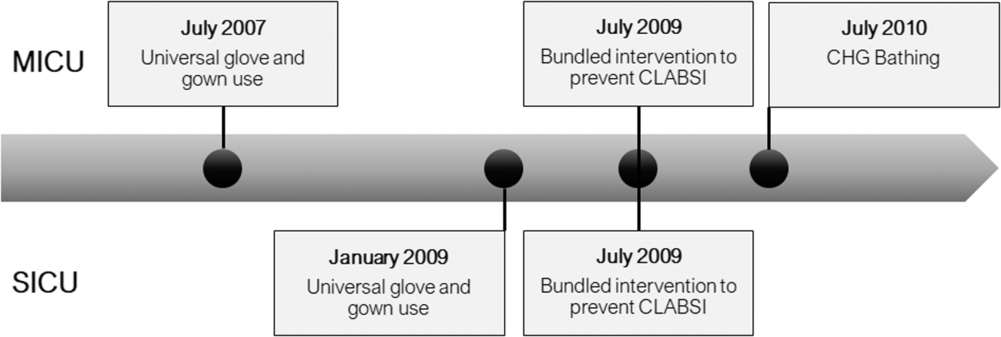
The following interventions were instituted at different time points in the MICU and SICU (Fig. 1): (1) Universal glove and gown use (ie, routine use of gloves and gowns for each care encounter for all patients on the unit) began July 2007 in the MICU and January 2009 in the SICU. (2) We introduced bundled intervention to prevent central-line–associated bloodstream infection (CLABSI). The CLABSI bundle included use of evidence-based central line insertion practices using checklists, chlorhexidine dressings at exit sites, rifampin-minocycline catheters, education on appropriate blood culture methodology, emphasis on aseptic central line maintenance, and removal of unnecessary central lines. This bundle was introduced in both the MICU and SICU in July 2009. (3). Daily chlorhexidine gluconate (CHG) bathing of all patients using CHG solution was implemented only in the MICU in July 2010.
Statistical methods
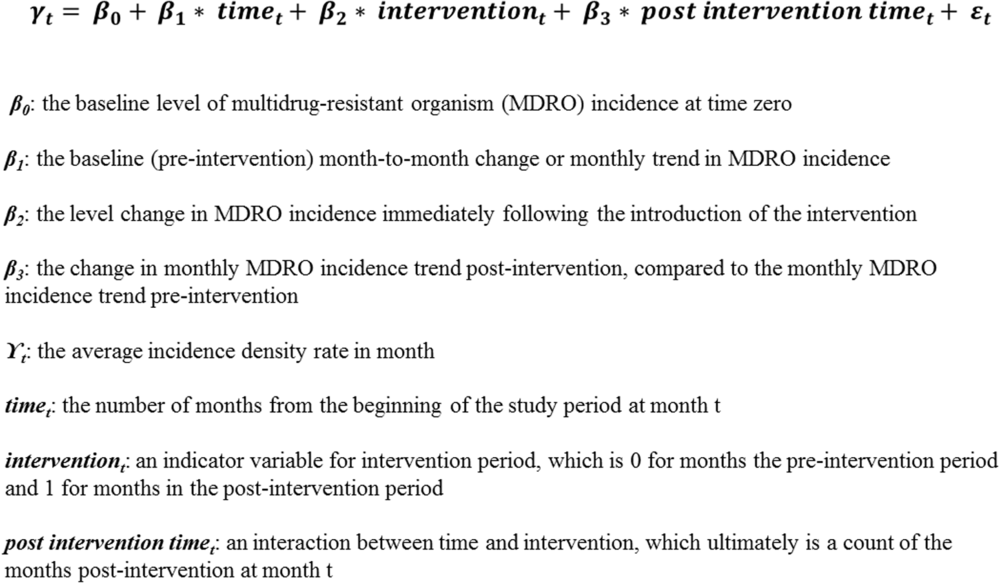
Correlation between monthly surveillance culture-based and clinical culture-based incidence densities was calculated using the Spearman correlation coefficient, separately for MRSA and VRE in the MICU and the SICU. Interrupted time-series analysis using quasi-Poisson regression was used to compare the preintervention and postintervention periods with a change point at the start of each intervention, offset by the log of contributing patient daysReference Wagner, Soumerai, Zhang and Ross-Degnan8 in separate models for each intervention in the MICU and SICU, and for MRSA and VRE. Models allowed for variation in the baseline trend in the monthly MDRO incidence, the level change in MDRO incidence immediately following the introduction of the intervention, and the trend in monthly MDRO incidence following the introduction of the intervention (Fig. 2). Assuming that the impact of each intervention would be gradual following introduction of the intervention, the primary estimate was the postintervention change in the month-to-month MDRO incidence trend (β3) relative to the preintervention incidence rate.
Timeline of infection control interventions in the medical intensive care unit (MICU) and surgical intensive care unit (SICU).

Depiction of interrupted time series analysis used to evaluate the impact of infection control interventions.

Because of the high collinearity of the interventions, the effect of each intervention was evaluated individually using separate regression models. Changes between the post- and preintervention periods were considered significant at α = 0.05 and were considered marginally significant for an α between 0.05 and 0.1. All analyses were performed in R statistical software (R Foundation for Statistical Computing, Vienna, Austria).
Notably, this study was not specifically designed to evaluate whether these interventions were effective (ie, power and sample size), and as confounding variable considerations were not included. Instead, we focused on comparing the trends derived from ACS-based and clinical-culture–based incidence rate estimates relative to different interventions.
Results
MRSA in the MICU and SICU
Between January 1, 2002, and June 30, 2011, there were 11,480 admissions to the MICU, of which 7,118 had ICU length of stay >48 h. Of these, 5,402 (76%) had both admission and discharge cultures obtained for MRSA surveillance. After excluding those with positive MRSA admission cultures (n = 978), 4,424 admissions contributed 34,087 patient days at risk for MRSA acquisition based on surveillance cultures. For clinical-culture–based outcomes (assuming that no ASCs were available), after excluding those with positive MRSA clinical cultures <48 h after admission (n = 320), 6,798 admissions contributed 55,251 patient days at risk for MRSA acquisition based on clinical cultures.
There were 9,043 admissions to the SICU in the same time period, of which 5,808 had an ICU length of stay >48 h. Of these, 4,075 (70%) had both admission and discharge cultures obtained for MRSA surveillance. After excluding those with positive MRSA admission cultures (n = 525), 3,549 admissions contributed 31,531 patient days at risk for MRSA acquisition based on surveillance cultures. Assuming no surveillance cultures available, after excluding those with positive MRSA clinical cultures <48 h after admission (n = 113), 5,695 admissions contributed 51,050 patient days at risk for MRSA acquisition based on clinical cultures.
For MRSA, the numbers of incident cases based on surveillance cultures was 191 in the MICU and 132 in the SICU; these numbers were lower than incident cases based on clinical cultures, which were 12 and 182 cases in the MICU and SICU, respectively. When considering the denominator for clinical-culture–based incidence compared to ASC-based incidence, there were 62% more patient days at risk for MRSA incidence estimates for both MICU and SICU. During the study period, the mean MRSA incidence rate using surveillance cultures was 6.7 (SD, 6.0) in the MICU and 4.3 (SD, 4.3) in the SICU. The mean MRSA incidence rate using clinical cultures was 4.5 (SD, 3.9) in the MICU and 3.9 (SD, 3.6) in the SICU. We detected a significant correlation between the ASC-based and clinical-culture–based incidence rates of MRSA: 0.32 in the MICU (P < .001) and 0.37 in the SICU (P < .001).
VRE in the MICU and SICU
Similar to MRSA, 5,900 of 7,118 MICU admissions (83%) had both admission and discharge cultures obtained for VRE surveillance. After excluding those with positive admission cultures (n = 2,008), 3,892 admissions contributed 28,753 patient days at risk for VRE acquisition based on surveillance cultures. Assuming no surveillance cultures available, after excluding those with positive VRE clinical cultures <48 h after admission (n = 193), 6,925 ICU admissions contributed 55,557 patient days at risk for VRE acquisition based on clinical cultures.
During the study period, 4,201 of 5,808 SICU admissions with length of stay >48 h (72%) had both admission and discharge cultures obtained for VRE surveillance. After excluding those with positive admission culture (n = 923), 3,278 admissions contributed 28,345 patient days at risk for VRE acquisition based on surveillance cultures. Assuming no surveillance cultures available, after excluding those with positive VRE clinical cultures <48 h after admission (n = 81), 5,727 ICU admissions contributed 49,658 patient days at risk for VRE acquisition based on clinical cultures.
For VRE, the total number of incident cases based on surveillance cultures was 622 in the MICU and 368 in the SICU, which were greater than the incident cases based on clinical cultures (252 in the MICU and 251 in the SICU). Similar to MRSA, more at-risk patient days were based on clinical cultures than on surveillance cultures. The mean VRE incidence rate using surveillance cultures was 20.9 (SD, 11.2) in the MICU and 13.5 (SD, 8.1) in the SICU during the study period. The mean VRE incidence rate using clinical cultures was 4.7 (SD, 3.6) in the MICU and 5.2 (SD, 3.4) in the SICU during the study period. We did not detect a statistically significant correlation between ASC-based and clinical-culture–based incidence rates of VRE in either the MICU (0.16; P = .11) or the SICU (0.15; P = .12).
Interventions to reduce MRSA and VRE
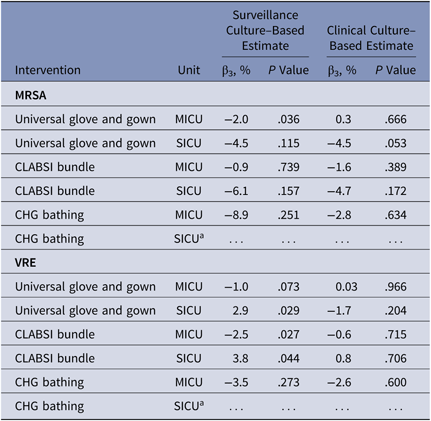
The monthly changes in postintervention incidence relative to preintervention incidence (β3) following the implementation of universal glove and gown use, CLABSI bundle, and CHG bathing are presented in Table 1 separately for MRSA and VRE. The relative mean monthly changes estimated based on ASC-based and clinical-culture–based incidence rates differed by intervention, organism, and by type of unit (Table 1). For example, the intervention of universal glove and gown use was associated with significant decreases in both MRSA and VRE in the MICU based on surveillance cultures but not on clinical-culture–based estimates.
Estimated Relative Changes in Monthly Incidence Rates of MRSA and VRE in the Postintervention Period Compared to the Preintervention Period in the MICU and SICU

Note. MRSA, methicillin-resistant Staphylococcus aureus; VRE, vancomycin-resistant Enterococcus; MICU, medical intensive care unit; SICU, surgical intensive care unit.
a Intervention not implemented in the SICU.
Discussion
We detected a small, statistically significant correlation between the clinical culture- and ASC-based monthly incidence rates of MRSA, but not for VRE. When using these 2 types of incidence rates to evaluate the impact of infection prevention interventions, the measures occasionally provided disparate results that would lead to different conclusions about the impact of these interventions on MRSA and VRE incidence. This disparity was particularly apparent for the intervention of universal glove and gown use, and more so for VRE than for MRSA. Compared to MRSA, there was also a greater difference in the magnitude of VRE incidence density rate estimates based on surveillance cultures (which were higher) than clinical cultures. These results suggest that these 2 methods cannot always be used interchangeably. Specifically, when feasible, and after considering the prevalence of a given MDRO and cost of surveillance cultures, surveillance cultures should preferentially be used when MDRO acquisition is the outcome of interest, because clinical cultures are not always an appropriate surrogate.
In the infection control literature, hospital-acquired MDRO incidence has variably been measured using either surveillance cultures or clinical cultures. Surveillance cultures are performed on all patients, or occasionally on high-risk patients, to detect colonization with an organism regardless of presence of symptoms; therefore, they provide a true and complete measure of organism burden.Reference Bonten, Slaughter and Ambergen9 The disadvantages of using surveillance cultures include costs, variable sensitivity of the screening methods, and poor compliance with screening.
Clinical cultures are performed on selected patients on the basis of specific clinical indications. The main advantage of using clinical cultures is that they do not require additional resources. However, the outcome based on clinical cultures has potential biases. First, clinical cultures are triggered by symptoms of infection and thus may represent confounding by indication and provider threshold for obtaining cultures. Second, clinical cultures represent a small proportion of those who are colonized with an MDRO. For example, the incidence estimate of MDRO acquisition based on surveillance cultures is much larger than the incidence estimate based on positive clinical cultures.Reference Calfee, Giannetta and Durbin10, Reference Farr11 Lastly, the occurrence and timing of progression from colonization to infection may depend on both the specific organism and patient related factors,Reference Kontopoulou, Iosifidis and Antoniadou12–Reference Cattaneo, Di Blasi and Skert15 and it is difficult to ascertain whether a positive clinical culture at any given point in time is the result of a recent or prior acquisition. For example, in the case of MRSA, ~30% of patients who are colonized (ie, surveillance culture positive) with MRSA will develop an MRSA infection,Reference Huang, Hinrichsen and Datta16, Reference Harris, Furuno and Roghmann17 and 80% of these infections occur within 60 days of MRSA acquisition.Reference Balm, Lover, Salmon, Tambyah and Fisher18
In some instances clinical-culture–based end points are the true or desirable outcome of interest (eg, when studying the impact of chlorhexidine bathing on bloodstream infections). At other times, clinical-culture–based outcomes have been used as surrogates for ASCs when the more appropriate end point is transmission or acquisition (eg, impact of the ASC and contact precautions on MRSA bacteremia).Reference Feng, Kallen, Ellingson, Muder, Jain and Jernigan5 This issue is magnified further when the intent of the study is to show that stopping or withdrawing certain interventions does not lead to a change in the incidence rate of MDROs. In recent years, several small studies have proposed that removal of contact precautions for endemic MRSA or VRE does not lead to change in incidence of MRSA and/or VRE.Reference Morgan, Murthy and Munoz-Price19–Reference Marra, Edmond, Schweizer, Ryan and Diekema22 However, most of these studies have used clinical culture-based outcomes as surrogates for transmission and do not consider the potential “lag” period between ASC-based and clinical-culture–based incidence rates. For MRSA, most clinical infections have been shown to occur within 60 days of acquisition.Reference Giacobbe, Del Bono and Bruzzi13 Therefore, theoretically, a decrease in transmission might not be detected in clinical-culture–based MRSA incidence rates for up to 2–3 months after ASC-based incidence, and it may not be detected at all if those patients are identified at institutions different from the source of acquisition.
Our study has several limitations. First, we considered several interventions as starting at distinct time points, whereas practically, the effect of one intervention could be ongoing at the time another intervention was introduced, making it difficult to tease apart the respective impacts of the individual interventions. Second, compliance with surveillance cultures was variable (70%–82%). An interesting and somewhat surprising observation in this study was that the number of incident cases based on ASC was lower than those based on clinical cultures for MRSA. This finding is likely related to 2 issues: (1) patients found to be positive for MRSA on admission ASC and, thus, excluded from the population at risk and (2) relatively low compliance with ASC. This finding underscores the point that for ASC-based incidence estimates to be accurate, a high compliance, particularly for discharge cultures, is necessary. We also did not account for previous colonization, as was done in a prior studyReference Feng, Kallen, Ellingson, Muder, Jain and Jernigan5; however, most colonization would be detected on admission surveillance cultures. Given that colonization may sometimes be transient, it is possible that by including those with history of colonization, but not necessarily with active colonization at present, patients at risk for acquisition could be unnecessarily excluded from being considered at risk. Finally, these analyses were likely underpowered with large variance around the effect estimates.
In summary, these findings suggest that ASC-based versus clinical-culture–based outcomes have the potential to provide different results and conclusions for infection control intervention studies. Therefore, appropriate end points for infection control interventions should be carefully selected keeping in mind the conceptual model or pathway from acquisition or colonization to infection and where a specific intervention might have its most causal effect. Future studies should explore specifically which outcome is more appropriate based on the specific intervention under study and not the outcome that is easier or less costly to obtain.
Financial support
This work was supported by the National Institutes of Health National Institute of Allergy and Infectious Diseases (grant no. R01 AI121146-01) to A.D.H.
Conflict of interest
All authors report no conflict of interest related to this work.