Significant outcomes
Neurological soft signs (NSS) and obstetric complications (OCs) show higher incidence in schizophrenic male patients. We used a homogeneous sample of male patients.
This study suggests a role of OCs in neurodevelopment alterations.
The results suggest the meaning of NSS as markers of the neurodevelopment impairment.
Limitations
We used a small sample of schizophrenic patients.
The sample was not antipsychotic naïve.
We relied on maternal recall to retrospectively ascertain a history of OCs.
Introduction
Schizophrenia is a loose and complex neuropsychiatric syndrome characterised by a range of cognitive (Reference Heinrichs and Zakzanis1,Reference Cocchi, Bosisio and Berchtold2) and psychophysiological deficits (Reference De Wilde, Bour, Dingermans, Koelman and Linszen3,Reference Yamada, Yukawa, Taketani, Matsuura and Hara4). Even if the full physiopathology of schizophrenia is still unknown, the study of NSS has provided an additional and increasingly important perspective on the illness. NSS involve observable defects in sensorial integration, motor coordination and inhibition. NSS are present in approximately 60% of schizophrenic patients (Reference Buchanan and Heinrichs5) and they are considered a neurodysfunctional correlation of schizophrenia (Reference Ota, Obu, Sato, Mizukami and Asada6). NSS have also been described in children at risk of schizophrenia (Reference Marcus, Hans, Lewow, Wilkinson and Burack7), in drug-naïve patients at first psychotic episode (Reference Gupta, Andreasen and Arndt8) and appear to be related to cognitive impairment (Reference Bersani, Clemente, Gherardelli and Pancheri9). The role of NSS in schizophrenia is still unclear: Tsuang et al. (Reference Tsuang, Gilberson and Faraone10,Reference Tsuang and Faraone11) have argued that these defects reflect genetic and non-genetic processes underpinning the predisposition to psychotic illness. On the other hand, current views consider these signs as covariates of attention (Reference Mohr, Hubmann and Cohen12,Reference Cuesta, Peralta and De Leon13), verbal ability (Reference Merriam, Kay, Opler, Kushner and Van Praag14,Reference Flashman, Flaum, Gupta and Andreasen15) and visual-spatial memory (Reference Arango, Bartko, Gold and Buchannan16,Reference Sanders, Schuepbach, Goldstein, Haas, Sweeney and Keshavan17).
OCs constitute an early environmental factor that is a well-known source of neurological and behavioural abnormalities in non-psychotic populations (Reference Breslau, Chilcoat, Johnson, Andreski and Lucia18,Reference Hediger, Overpeck, Ruan and Troendle19). OCs have been considered possible risk factors of schizophrenia (Reference Lewis and Murray20,Reference Bersani, Taddei and Manuali21): there is considerable evidence that exposure to OCs is associated with an increased risk of developing schizophrenia in later life (Reference Cannon, Jones and Murray22–Reference Verdoux, Geddes and Takei24). Nevertheless, it remains unclear whether OCs represent an independent risk factor for schizophrenia, interact with genetic risk to increase liability, are themselves a manifestation of genetic liability for schizophrenia or are epiphenomena of developmental compromise in individuals who are already on a trajectory towards psychotic illness in adult life.
Despite evidences about the association between OCs and neurological abnormalities in the non-psychotic population, few studies explored the possible role of OCs in the expression of NSS in schizophrenia (Reference Mrad, Mechri, Slama, Mokni, Letaief and Gha25) and these studies gave controversial results. Moreover, NSS and OCs show higher incidence in male patients with schizophrenia (Reference Boks, Selten, Leask, Castelein and Van Den Bosch26,Reference O'Callaghan, Gibson and Colohan27), providing the hypothesis that males are more sensitive to environmental factors and more prone to a neurodevelopmental subtype of schizophrenia.
For these reasons, the aim of the study is to investigate the relationship between NSS and OCs in male patients with schizophrenia.
Materials and methods
Patients
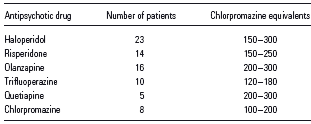
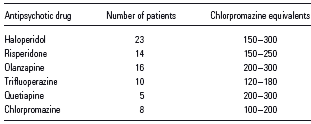
Sixty-three male inpatients meeting diagnostic and statistical manual of mental disorders IV text revision (DSM-IV-TR) diagnostic criteria for Schizophrenia (28) were consented and enrolled in the study (Table 1). Seventeen patients had schizophrenia of paranoid type, 14 of disorganised type, 3 of catatonic type, 15 of undifferentiated type and 14 of residual type. All the patients had been treated with the same antipsychotic drugs for at least 6 months. Fifty patients were treated with one antipsychotic medication while 13 patients with two. More details about the antipsychotic treatments are given in Table 1. The following exclusion criteria were applied: history of alcohol or drug abuse, neurological disorders and meaningful somatic disease.
Antipsychotic treatment of enrolled patients
Clinical measures
Schizophrenia diagnosis was made according to DSM-IV-TR criteria and confirmed through the Structured Clinical Interview (SCID-I and SCID-II) for DSM-IV-TR criteria (Reference First, Donovan and Frances29), during which patients' demographic and clinical characteristics were collected.
NSS were assessed through the Neurological Evaluation Scale (NES) (Reference Buchanan and Heinrichs30) by a unique senior psychiatrist blind to the results of the mother's interview. The NES includes 28 items listing the more frequent and significant soft neurological signs; the results are expressed as total score and as three main subscale scores (sensorial integration, motor coordination and sequencing of complex motor acts), that we considered in the statistical analysis.
The OCs were assessed interviewing the patients' biological mothers. The interviewer was blind to neurological evaluation.
The Lewis–Murray Scale (LMS) (Reference Lewis and Murray31) and the Midwife Protocol (MP) (Reference Parnas, Schulsinger, Teasdale, Schulsinger, Feldman and Mednick32) were used for a comprehensive evaluation of both prevalence and severity of OCs. The LMS rates 24 potential OCs in order to examine their absence or presence (definite-14 or equivocal-10); it describes patients with presence or absence of OCs. The MP is a semistructured interview that examines a wide set of OC scored, according to the severity, from 0 (none) to 4, providing a total score that represents the sum of the scores of the items describing the single complications. There is not a complete overlapping between the OCs listed in the LMS and in the MP.
Study design
The research protocol was approved by the Ethics Committee of Policlinico Umberto I Hospital, Sapienza University of Rome, and it was conform to the Declaration of Helsinki. All the patients gave their voluntary informed consent.
The sample was divided into two subgroups on the basis of the absence or presence of OCs as evaluated by the LMS. A compared analysis between the NES scores of the two subgroups was performed through the t-test. After that, a Pearson's correlation test between NES scores and MP scores was performed in the group of patients with OCs to explore the correlation between NSS and OCs severity. Even if there is a known relationship between age and NSS (Reference Chen, Lam, Chen and Nguyen33), we did not consider the age in comparing the two subgroups because the mean ages of both were very similar.
Results
The mean age of patients was 31.11 ± 9.21, the mean duration of illness was 10.19 ± 7.77 years and the mean educational level was 10.9 ± 3.26 years of school.
Patients mothers' age was comprise between 41 and 65. They did not present any psychiatric or cognitive disorder and they were considered reliable in providing the requested information.
Thirty-seven subjects did not show OCs and 26 subjects showed OCs, both definite (19 subjects) and equivocal (7 subjects). In particular, 37 patients scored 0 to LMS, 7 patients scored 1 (equivocal) and 19 patients scored 2 (definite).
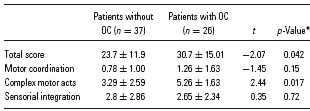
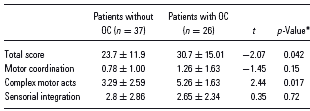
The results of the comparison analysis showed that the group characterised by history of OCs exhibited more NSS: the differences were significant in the NES total score and in the Complex Motor Acts subscale score (Table 2).
NES scores in groups of patients without OC and with OC
* p≤ 0.05.
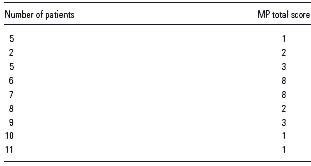
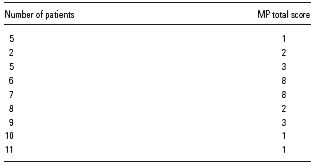
MP total score was 0 in non-OCs group; the results of MP total score in the patients of OCs group are given in Table 3. No significant relationship emerged between NES and MP scores.
MP total scores
Discussion
Some studies already explored the relationship between OCs and NSS in Schizophrenia, reporting controversial results. Lane et al. assessed that male schizophrenic patients whose mothers experienced OCs had higher NSS scores (Reference Lane, Colgan and Moynihan34); Cantor-Graae et al. demonstrated that the degree of neurological impairment in the well-discordant monozygotic twins was significantly positively related to history of both neonatal and total OCs (Reference Cantor-Graae, Mcneil and Rickler35); Boks et al. found significantly more NSS in the group of patients without a history of OCs (Reference Boks, Selten, Leask, Castelein and Van Den Bosch36). The use of not clinically homogeneous samples, the use of different NSS assessment scales and the use of mixed samples (male and female patients) could potentially have confounding effects. For example, NSS and OCs showed a higher incidence in schizophrenic male patients (Reference O'Callaghan, Gibson and Colohan37,Reference Boks, Selten, Leask, Castelein and Van Den Bosch38), confirming the hypothesis that males are more sensitive to environmental factors and more prone to a neurodevelopment subtype of schizophrenia, for which OCs are believed to play an aetiologic role (Reference Goldstein, Seidman, Santangelo, Knapp and Tsuang39). To our knowledge, this work is the first exploring the relationship between NSS and OCs in a sample of only male patients with schizophrenia.
The results of this study confirm the association of the presence of OCs history and NSS in schizophrenic patients. Neurodevelopment alterations such as those probably induced by OCs, in fact, can contribute to a premorbid brain dysfunctional state expressed by NSS (Reference Peralta, De Jalon, Campos, Basterra, Sanchez-Torres and Cuesta40,Reference Heuser, Thomann, Essig, Bachmann and Schröder41), associated to an increased risk of adult schizophrenia. From this point of view, NSS can be seen as early markers of the neurofunctional impairment.
Although OCs seem to act as a factor of overall increased brain developmental abnormalities and disease risk, it seems that various brain regions can be differently involved in the consequences of different type or severity of OCs; this fact can contribute to the heterogeneous expression of NSS. The prevalence in our sample of the Sequence of Motor Act subscale impairment can be intended in this sense.
The absence of a significant increase of motor coordination and sensorial integration subscales in the group with OCs respect to the group without OCs shows that OCs represent a group of factors very heterogeneous and variable in terms of typology and intensity. This variability can affect very deeply the brain organisation and the connected neurological manifestations such as NSS. For this reason, a negative result cannot exclude definitively that in groups of patients with different distribution of OCs may exist a relationship between these and the scores of the two subscales.
The association between OCs history and NSS is in agreement with the general neurodevelopmental hypothesis of schizophrenia and can shed some light on the heterogeneity of neurologic and clinical features of the illness.
On the other hand, the lack of a proportional relationship between the severity of OCs and NSS suggests that any OCs, apart from their typology and severity, could unspecifically impair the early physiologic neurodevelopment, resulting in expression of NSS. Other factors, both genetically determined and related to post-natal environmental events, probably concur to NSS etiopathogenesis and they should be further considered for a more comprehensive view of the etiopathogenetic mechanisms of Schizophrenia.
Some potential limitations of our study should be considered. First, the sample was not antipsychotic naïve. It is possible to assume, however, the independence of NSS from antipsychotic treatment or side effects: NSS are also present in neuroleptic-naïve patients (Reference Gupta, Andreasen and Arndt42) and it is well established in literature that they are not associated to antipsychotic type or dosage (Reference Bersani, Gherardelli and Clemente43). Second, we relied on maternal recall to ascertain a history of OCs; this method has proved to be reliable in several studies (Reference Walshe, Mcdonald and Boydell44,Reference Hidalgo, Zandio and Zarzuela45).