Introduction
The negative consequences of caring for a relative with cognitive impairment are now well-established (Schulz et al., Reference Schulz, O'Brien, Bookwala and Fleissner1995). For example, caring for a relative with dementia has been associated with a higher risk of developing anxiety in comparison to the general population (Joling et al., Reference Joling2010). The demands of caring for a relative with dementia are often grouped under the term “caregiver burden,” with a number of studies consistently finding that the amount of burden experienced by dementia caregivers is higher than that experienced by other groups of carers (Gonzalez-Salvador et al., Reference Gonzalez-Salvador, Arango, Lyketsos and Barba1999).
Contemporary theoretical models, such as the Stress-Process Model (SPM, Pearlin et al., Reference Pearlin, Mullan, Semple and Skaff1990), propose multiple stress factors contributing to negative outcomes for dementia caregivers. These stressors can be “primary,” referring to hardships stemming directly from providing care, or “secondary,” referring to hardships in other aspects of the caregiver's life. Primary and secondary stressors lead to the experience of caregiver burden and negative mental health outcomes (Dilworth-Anderson et al., Reference Dilworth-Anderson, Goodwin and Williams2004). Although evidence supports the relationship between both primary and secondary stressors and dementia caregiver outcomes (Black and Almeida, Reference Black and Almeida2004; Skaff and Pearlin, Reference Skaff and Pearlin1992), there is considerable variability in outcomes for caregivers experiencing similar stressors (Schulz and Martire, Reference Schulz and Martire2004).
To account for this variability, the SPM suggests that background characteristics of the caregiver and the context surrounding caregiving may influence outcomes for carers (Pearlin et al., Reference Pearlin, Mullan, Semple and Skaff1990). This is supported by research that has consistently demonstrated poorer mental health outcomes and higher burden for female caregivers (Covinsky et al., Reference Covinsky2003; Gallicchio et al., Reference Gallicchio, Siddiqi, Langenberg and Baumgarten2002; Mahoney et al., Reference Mahoney, Regan, Katona and Livingston2005), those less educated (Allegri et al., Reference Allegri2006; Schulz et al., Reference Schulz2008), of a lower income (Andren and Elmstahl, Reference Andren and Elmstahl2007; Covinsky et al., Reference Covinsky2003), caring for a spouse (Baumgarten et al., Reference Baumgarten, Battista, Infante-Rivard, Hanley, Becker and Gauthier1992; Hong and Kim, Reference Hong and Kim2008), or providing care for a long period of time (Joling et al., Reference Joling2012; Tremont, Reference Tremont2011). Recent work also suggests that some background characteristics not originally specified in the SPM may also be important for predicting variability, including carer's ethnicity (Connell and Gibson, Reference Connell and Gibson1997) and self-reported health status (Gallicchio et al., Reference Gallicchio, Siddiqi, Langenberg and Baumgarten2002; Mahoney et al., Reference Mahoney, Regan, Katona and Livingston2005).
In addition to these factors, the SPM further suggests that the resources available to the caregiver, such as coping strategy use, may also influence outcomes for dementia caregivers. This is supported by a recent meta-analysis, which found that the use of dysfunctional coping strategies was associated with higher levels of anxiety and depression in dementia caregivers, whereas emotion-focused strategies were associated with lower levels of anxiety and depression (Li et al., Reference Li, Cooper, Bradley, Shulman and Livingston2012). There is a vast amount of support for the SPM and its influence in explaining variability in dementia caregiver outcomes (Mark and Smith, Reference Mark, Smith, Houdmont and Leka2008). However, an alternative model proposed in the literature, known as the Stress-Diathesis Model (Vitaliano et al., Reference Vitaliano, Russo, Young, Teri and Maiuro1991b), suggests that caregivers with certain underlying personality dispositions have vulnerabilities towards more negative outcomes in response to caregiving stressors.
Only a few studies have examined whether personality traits predict psychosocial outcomes in carers, with the majority of these examining higher order traits (Costa and McCrae, Reference Costa and McCrae1997). These studies have shown that personality traits like neuroticism are positively related to perceived burden and inversely related to mental health in dementia family caregivers (Lockenhoff et al., Reference Lockenhoff, Duberstein, Friedman and Costa2011; Nordtug et al., Reference Nordtug, Krokstad and Holen2011). Although neuroticism is amongst the personality dimensions that has received most of the research attention (Campbell et al., Reference Campbell2008; Gallant and Connell, Reference Gallant and Connell2003; Shurgot and Knight, Reference Shurgot and Knight2005), extraversion and agreeableness have also been studied (Gonzalez-Abraldes et al., Reference Gonzalez-Abraldes, Millan-Calenti, Lorenzo-Lopez and Maseda2013; Melo et al., Reference Melo, Maroco and de Mendonca2011). Overall, the evidence indicates that highly neurotic caregivers experience greater stress and depressive symptoms (Helmes et al., Reference Helmes, Green and Almeida2005; Hooker et al., Reference Hooker, Frazier and Monahan1994), whereas those reporting high levels of agreeableness and extraversion are more likely to experience personal gains and benefits associated with caregiving, and lower levels of burden (Koerner et al., Reference Koerner, Kenyon and Shirai2009; Melo et al., Reference Melo, Maroco and de Mendonca2011). These findings, therefore, suggest that several dimensions of personality are implicated in the determination of caregiver outcomes.
Trait emotional intelligence (trait EI or trait emotional self-efficacy) refers to a constellation of emotion-based personality dispositions located at the lower levels of personality hierarchies (Petrides et al., Reference Petrides, Pita and Kokkinaki2007). Essentially, the construct is concerned with people's perceptions of their emotional abilities. Meta-analytic studies of cross-sectional findings suggest that trait EI is negatively related to anxiety and depression in the general population (Martins et al., Reference Martins, Ramalho and Morin2010; Schutte et al., Reference Schutte, Malouff, Thorsteinsson, Bhullar and Rooke2007), such that individuals with higher trait EI are less prone to experiencing both psychological and physiological responses to stress (Arora et al., Reference Arora2011; Mikolajczak et al., Reference Mikolajczak, Menil and Luminet2007).
Trait EI has emerged as a personality characteristic that affects the perception of emotional and stressful situations. For example, individuals with high trait EI show greater self-efficacy in coping with stress and are more likely to view stressful situations as challenging as opposed to threatening (Mikolajczak and Luminet, Reference Mikolajczak and Luminet2008; Mikolajczak et al., Reference Mikolajczak, Luminet and Menil2006). Although caring for a relative with dementia has been associated with higher levels of anxiety (Mahoney et al., Reference Mahoney, Regan, Katona and Livingston2005), little research has focused on the factors affecting individual differences in experiencing anxiety in dementia caregivers. For example, a systematic review on correlates of anxiety symptoms in dementia caregivers suggests that, although further high quality studies are needed, neuroticism predicts caregiver anxiety in both cross-sectional and longitudinal studies (Cooper et al., Reference Cooper, Balamurali and Livingston2007). To our knowledge, there has been no research on the relationship between trait EI and anxiety symptoms in dementia caregivers.
The main aim of the present study was to examine the predictive validity of trait EI in explaining anxiety in family carers of people with dementia (PwD). The secondary aim was to examine whether trait EI is a significant predictor of anxiety after controlling for factors identified as influencing outcomes in the SPM (specifically, burden, depression, physical health, and coping style). On the basis of prior studies showing that trait EI moderates individuals’ responses to stress (Mikolajczak et al., Reference Mikolajczak, Menil and Luminet2007; Mikolajczak et al., Reference Mikolajczak, Luminet and Menil2006), we hypothesized that carers with lower trait EI would experience higher levels of anxiety, and that trait EI would make an independent contribution in explaining anxiety symptoms, after controlling for burden, depression, physical health, and coping strategies.
Method
Participants
The data for this study came from a convenience sample of family caregivers, recruited from Voluntary Sector Organizations providing support to PwD in several regions of the UK. The survey papers consisted of a letter, a consent form, the questionnaires, a stamped addressed envelope, and an information brochure with details of the study. Out of the 500 questionnaires sent to the organizations, 205 were returned, giving a healthy response rate of 40.6%. It should be noted that this response rate is based on the questionnaires that were sent to the relevant organizations, not on those that actually reached family caregivers. Two participants who were no longer providing care or had no regular contact with their relative were excluded from the analyses, leaving a total of 203 dementia caregivers as the final sample for this study. Inclusion criteria for carers included providing direct support to a relative with dementia, being directly involved in the PwD's care, and sufficient understanding of the English language. All participants provided informed consent and completed the questionnaires.
Procedure
All participants completed the survey at home, and were asked to return this at their earliest convenience. We collected information on age, gender, level of education, relationship to the PwD, marital status, and number of years providing care. In the second part, carers were asked to complete the measures.
Measures
Trait emotional intelligence
The Trait Emotional Intelligence Questionnaire – Short Form (Petrides and Furnham, Reference Petrides and Furnham2006) is designed as a global measure of trait EI. It is a 30-item questionnaire comprising statements such as “I'm usually able to find ways to control my emotions when I want to”. Participants are required to respond to each item on a 7-point Likert-type scale, ranging from 1 (“completely disagree”) to 7 (“completely agree”). The TEIQue-SF has extensive construct validity (Cooper and Petrides, Reference Petrides and Furnham2010). In line with previous research, the internal consistency of the global score in the present study was high (Cronbach's α = 0.88).
Coping strategies
The Brief Coping Orientations to Problems Experienced scale (Brief COPE; Carver, Reference Carver1997) was used to measure caregivers’ use of coping strategies. This is a 28-item measure including statements such as “I've been taking action to try to make the situation better.” It is based on a Likert-type scale ranging from 1 (“I haven't been doing this at all”) to 4 (“I have been doing this a lot”). Composite subscales assess the use of three different coping strategies: emotion-focused, problem-focused, and dysfunctional (Coolidge et al., Reference Coolidge, Segal, Hook and Stewart2000). The Brief COPE has good content validity (Carver et al., Reference Carver, Scheier and Weintraub1989) and has been previously used in research with dementia caregivers (Cooper et al., Reference Cooper, Katona, Orrell and Livingston2006). The internal consistency was acceptable for all three subscales (Cronbach's α = 0.72 – emotion-focused, α = 0.82 – problem-focused, α = 0.73 – dysfunctional coping).
Health status
The EQ-5D Visual Analogue Scale (EQ-5D VAS; EuroQoL, 1990) is a 20 cm visual analogue scale, measuring overall self-rated health. The end-points of the scale range from 0 (“best imaginable health state”) to 100 (“worst imaginable health state”). Participants indicate the point on the scale that best describes how good or bad their health state is on the day. The EQ-5D VAS has been used in samples of elderly caregivers in previous research (McCullagh et al., Reference McCullagh, Brigstocke, Donaldson and Kalra2005) and has strong correlations with well-established measures of physical health, such as the Physical Component Summary of the SF-12 (Haywood et al., Reference Haywood, Garratt, Dziedzic and Dawes2003). Test-retest reliability was also high over a three-month period (Macran et al., Reference Macran, Weatherly and Kind2003).
Perceived burden
The Relatives’ Stress Scale (RSS; Greene et al., Reference Greene, Smith, Gardiner and Timbury1982) is a 15-item instrument, designed to measure stress specific to caregiving for PwD living in the community. Participants respond to items such as “Do you ever feel that you need a holiday?” using a 5-point Likert-type scale, ranging from 0 “not at all” to 4 “considerably.” The scale has good content validity and takes into account three important factors that contribute to the burden experienced by dementia caregivers (personal distress, life upset, and negative feelings). The internal consistency of the measure in the present sample was 0.84.
Anxiety and depressive symptoms
The Hospital Anxiety and Depression Scale (HADS; Zigmond and Snaith, Reference Zigmond and Snaith1983) was used to measure symptoms of anxiety (HADS-AS) and depression (HADS-DS). Its two subscales use seven items each (e.g., “I get a sort of frightened feeling as if something awful is about to happen” and “I look forward with enjoyment to things”) scored from 0–3. The scale's bidimensional structure, reliability, and concurrent validity are well established (Bjelland et al., Reference Bjelland, Dahl, Haug and Neckelmann2002). In the present study, Cronbach's α = 0.88 for HADS-A and Cronbach's α = 0.83 for the HADS-D subscale.
Statistical analysis
SPSS 20 was used for all analyses. Descriptive statistics (means and standard deviations) were calculated for all variables including demographic and clinical characteristics for both PwD and their caregivers. Distribution checks for continuous variables were performed using Kolmogorov-Smirnov tests. The relationships between caregiver and PwD characteristics and caregiver trait EI scores were investigated via ANOVA or two-tailed t-tests. For correlations between continuous variables, Pearson's r was used. To determine the unique contribution of each independent variable in predicting anxiety (the dependent variable), a standard multiple regression model was built. This model predicted carer anxiety by adjusting for the variables found to be significant in the correlation analyses (self-rated health, perceived burden, depression, problem-focused, emotion-focused and dysfunctional coping, and trait EI). The level of statistical significance was set at p = 0.05.
Results
Descriptive characteristics of the sample
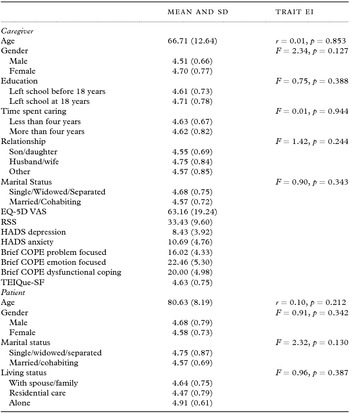
A total of 69.8% of the caregiver sample were female, 61.5% were spouses of the PwD, 33.5% were sons or daughters, whereas the remaining 5.0% were other relatives or friends or partners. A total of 63.3% had left school before 18 years of age, and 56.9% had been providing care to their relatives for four years or more. Of the 203 carers, 37.6% were married or cohabiting, and the remaining were either single, divorced or widowed. Most were White European (98.5%). Of the 203 PwD, 57.3% were females, 68.2% were married, and the remaining were single, divorced or widowed. Most of the sample was living with a spouse or other family members (83.2%), 12.4% lived in residential care, and 4.5% lived alone. Most were White European (98.5%).
Separate ANOVAs tested the relationship between the background characteristics of caregivers and PwD and caregivers’ trait EI scores. These analyses showed that trait EI scores did not differ by gender, education, or marital status of carers or PwD. Neither time spent caring nor type of caregiving relationship was associated with trait EI in carers (see Table 1). A total of 49.2% of caregivers reported clinically significant symptoms of anxiety and 26.1% reported clinically significant symptoms of depression, based on HADS scores of ≥11 (Mahoney et al., Reference Mahoney, Regan, Katona and Livingston2005).
Background variables and their relationship with trait EI scores

Note. EQ-5D VAS, EQ-5D visual analog scale (EuroQoL, 1990); RSS, the relative stress scale (Greene et al., Reference Greene, Smith, Gardiner and Timbury1982); HADS, the hospital anxiety and depression scale (Zigmond and Snaith, Reference Zigmond and Snaith1983); brief COPE, coping orientations to problems experienced scale (Carver, Reference Carver1997); TEIQue-SF, trait emotional intelligence questionnaire-short form (Petrides and Furnham, Reference Petrides and Furnham2006).
Correlations between trait EI, burden, coping style, anxiety, depression, and self-rated health in carers
Trait EI was negatively associated with perceived burden (r = −0.42, p < 0.001), anxiety (r = −0.44, p < 0.001), depression (r = −0.46, p < 0.001), and use of dysfunctional coping strategies (r = −0.31, p < 0.001). Higher scores on trait EI were associated with higher levels of self-reported health (r = 0.20, p < 0.01), and greater use of emotion-focused (r = 0.24, p < 0.01) and problem-focused coping in carers (r = 0.25, p < 0.01).
Regression analysis
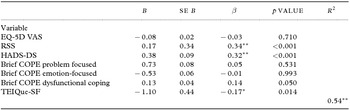
Scores on the anxiety subscale of the HADS were modeled as the dependent variable, while self-rated health (EQ-5D VAS), perceived burden (RSS), depression (HADS-DS), problem-focused, emotion-focused coping, dysfunctional coping (COPE), and trait EI (TEIQue-SF), were simultaneously entered as independent variables. Results showed that nearly 54% of the variance in caregiver anxiety was accounted for by the seven predictors, F(8,132) = 24.11, p < 0.001. Depression, perceived burden, and trait EI were significant predictors in the equation. These results are summarized in Table 2.
Carer anxiety symptoms regressed on self-rated health, burden, depression, coping style, and trait EI

Note. EQ-5D VAS, EQ-5D visual analog scale (EuroQoL, 1990); RSS, the relative stress scale (Greene et al., Reference Greene, Smith, Gardiner and Timbury1982); HADS, the hospital anxiety and depression scale (Zigmond and Snaith, Reference Zigmond and Snaith1983); brief COPE, coping orientations to problems experienced scale (Carver, Reference Carver1997); TEIQue-SF, trait emotional intelligence questionnaire-short form (Petrides and Furnham, Reference Petrides and Furnham2006).
*p < 0.05; **p < 0.01.
Discussion
Despite evidence of the increasing prevalence of anxiety in dementia caregivers (Schulz et al., Reference Schulz, O'Brien, Bookwala and Fleissner1995), very little research has examined the factors affecting individual differences in the experience of anxiety in this population. Consequently, the primary aim of the present study was to examine the predictive validity of trait EI in explaining anxiety in family carers of PwD. In line with the study's first hypothesis, we found that caregivers with lower trait EI reported more symptoms of anxiety compared to carers with higher trait EI. We also found that lower trait EI was associated with higher levels of depression, higher perceived burden, and poorer self-rated health.
These findings are consistent with meta-analyses of cross-sectional studies showing that trait EI is negatively correlated with physical and mental health outcomes in noncaregiving populations (Martins et al., Reference Martins, Ramalho and Morin2010; Schutte et al., Reference Schutte, Malouff, Thorsteinsson, Bhullar and Rooke2007). Our findings are in line with studies showing that the amount of stress experienced by individuals is greater for those with lower trait EI (Mikolajczak et al., Reference Mikolajczak, Petrides, Coumans and Luminet2009; Smith et al., Reference Smith, Turner, Pati, Petrides, Sevdalis and Green2012). Consistent with previous cross-sectional evidence (Gonzalez-Abraldes et al., Reference Gonzalez-Abraldes, Millan-Calenti, Lorenzo-Lopez and Maseda2013), we found that personality traits are related to mental health outcomes as well as to the level of burden in dementia caregivers (Lockenhoff et al., Reference Lockenhoff, Duberstein, Friedman and Costa2011; Nordtug et al., Reference Nordtug, Krokstad and Holen2011).
The secondary aim of our study was to examine whether trait EI would predict anxiety symptoms in dementia caregivers after controlling for factors previously identified as important according to caregiving theory and research (the SPM; Pearlin et al., Reference Pearlin, Mullan, Semple and Skaff1990). We found that trait EI was a significant predictor of anxiety after controlling for depression, caregiver burden, coping style, and self-rated health. These findings lend support to the Stress-Diathesis Model in terms of understanding variability in caregivers’ response to caring. In line with this model, we found that aspects of the caregiver's personality, especially low trait EI, render them more vulnerable towards experiencing negative outcomes in response to caregiving stressors (Vitaliano et al., Reference Vitaliano, Young and Russo1991a). Although our results suggest that trait EI influences carers’ anxiety, it is important to consider that caring for a PwD is associated with high levels of anxiety. It is likely, therefore, that caregivers’ personality traits are affected by caring, making them more prone to experiencing heightened psychological distress within the context of a stressful situation like caring.
However, it is likely that trait EI does not simply predispose caregivers to high levels of anxiety but may additionally act as a moderator in perceiving the caregiving situation as highly stressful. Experimental evidence demonstrates that when anticipating stressful events, individuals with high trait EI exhibit greater self-efficacy to cope and are more likely to evaluate stressors as a challenge than as a threat (Mikolajczak and Luminet, Reference Mikolajczak and Luminet2008). Therefore, the negative relationship observed between trait EI and anxiety may reflect a pathway of less effective stress adaptation to caring. It is important, however, to consider that current findings cannot distinguish between state versus trait anxiety and its association with trait EI. State anxiety reflects a transitory emotional state characterized by subjective, consciously perceived feelings that may fluctuate and vary in intensity, whereas trait anxiety refers to a general tendency to respond with anxiety to perceived threats in the environment, considered a relatively stable characteristic (Spielberger et al., Reference Spielberger, Gorsuch, Lushene, Vagg and Jacobs1983). Our findings therefore may reflect the relationship between trait EI and trait anxiety, rather than a causal pathway via state anxiety. Future research should examine this suggestion using measures that separate between state and trait anxiety (e.g., Spielberger State-Trait Anxiety Inventory, Spielberger et al., Reference Spielberger, Gorsuch, Lushene, Vagg and Jacobs1983).
Limitations
Firstly, the cross-sectional nature of our study limits our ability to propose causal attributions with confidence. Longitudinal studies are needed to investigate whether high trait EI scores at baseline can protect caregivers from anxiety. Secondly, other unmeasured variables may be influencing the relationships observed. For example, the level of social support available to caregivers was not included as a predictor variable even though it has previously been related to caregiver outcomes (Fortinsky et al., Reference Fortinsky, Kercher and Burant2002; Hayslip et al., Reference Hayslip, Han and Anderson2008). Thirdly, the use of a convenience sample limits the generalizability of our results, as it is unlikely to be representative of the general population of dementia caregivers. For example, the results cannot be generalized to ethnically diverse populations of dementia caregivers, since the majority of the sample was White European. This is an important limitation because ethnicity is strongly related to caregiver outcomes (Pinquart and Sorensen, Reference Pinquart and Sorensen2005). In addition, caregivers were recruited from voluntary organizations and as such the sample is not representative of those caregivers who had not sought support from these organizations. Although most PwD lived in the community, a small percentage lived in residential care, therefore, the use of the RSS may be limited, and instruments such as the Zarit Burden Interview (Zarit et al., Reference Zarit, Reever and Bach-Peterson1980) may have been more suitable in this context.
Conclusion
The challenges of caring for a family member with dementia can result in high levels of anxiety and psychological morbidity in carers. The present study shows that trait EI is strongly associated with anxiety in carers and that it independently predicts anxiety after controlling for variables known to influence carer outcomes, including burden, self-rated health, and coping. Developing a thorough understanding of the factors that determine well-being in dementia carers is an important priority for current research. The present study suggests that trait EI is an aspect of personality that should be included in current conceptual and empirical models of dementia caregiving.
The associations of trait EI with caregiver outcomes in the present study support the utility of the concept, and of the TEIQue-SF as its measurement vehicle, in predicting psychological distress in carers of people with dementia. It will be important for future work to investigate anxiety as a separate outcome (Spielberger State-Trait Anxiety Inventory, Spielberger et al., Reference Spielberger, Gorsuch, Lushene, Vagg and Jacobs1983), and to test the usefulness of trait EI in larger and more diverse populations of dementia caregivers, including clinical settings, where carers are at risk of experiencing psychological distress.
Conflicts of interest
None.
Description of authors’ roles
Jessica Weaving, Vasiliki Orgeta, Martin Orrell and K. V. Petrides designed the study. Jessica Weaving wrote the research proposal and contributed to data collection. Jessica Weaving and Vasiliki Orgeta performed the literature searches, and undertook the statistical analysis. All authors contributed to and have approved the final manuscript.
Acknowledgments
Jessica Weaving, Vasiliki Orgeta, Martin Orrell, and K. V. Petrides, Division of Psychiatry, and Research Department of Clinical, Educational, and Health Psychology, University College London. We would like to thank those who kindly volunteered to participate in the study.