Introduction
Highbush blueberry is an important small fruit crop in North America. More than 30,000 ha are cultivated in the United States, and an additional 11,000 ha in Canada (USDA 2021). About 30% of the U.S. blueberry hectarage is located in the Pacific Northwest (PNW) region, mainly in Oregon and Washington. In the PNW region, blueberries are irrigated by overhead sprinkler or drip irrigation systems; the latter is gaining popularity (Bryla et al. Reference Bryla, Gartung and Strik2011). Irrigation is essential for the commercial production of blueberries because the crop is sensitive to water deficits, probably associated with its shallow root system located primarily in the top 0.4 m of soil (Bryla and Strik Reference Bryla and Strik2007). Plants are spaced at 3 m between rows and from 0.9 to 1.2 m within the row to allow ample sunlight into the canopy (Strik Reference Strik2007). Sawdust mulches are usually applied to the soil surface in a 3-m band at 18 cm depth after planting and reapplied when needed to maintain a depth of at least 12 cm, and the soil within the planting rows is never disturbed (Strik Reference Strik2007). PNW blueberry growers have identified field bindweed as a difficult-to-control weed species (DeFrancesco and Murray Reference DeFrancesco and Murray2011).
Field bindweed is a perennial vining weed with vigorous growth and a deep root system that thrives in undisturbed soil and abundant light (Weaver and Riley Reference Weaver and Riley1982). This weed infests perennial and annual cropping systems and natural areas (Sosnoskie et al. Reference Sosnoskie, Hanson and Steckel2020), and is distributed throughout the United States and Canada (Mitich Reference Mitich1991). Field bindweed dispersal occurs by seeds and root fragments (Buhler and Burnside Reference Buhler and Burnside1987). In the PNW region, field bindweed growth is observed between April and November or until the first frost occurs. Field bindweed control in blueberry is limited to chemical control because cultivation equipment cannot be used without damaging blueberry plants. The current management strategy is to repeatedly apply postemergence herbicides such as carfentrazone or glufosinate during the season (Peachey and Moretti, personal observation) followed by hand removal. An herbicide that would provide season-long control of field bindweed would reduce herbicide drift, labor needs, and improve weed control and fruit yield and quality. Systemic herbicides such as glyphosate and 2,4-D can effectively control field bindweed, but multiple applications are required (Sosnoskie et al. Reference Sosnoskie, Hanson and Steckel2020), and these herbicides can injure blueberry if crop foliage is exposed (Hanson Reference Hanson2009). Current herbicide labels for 2,4-D confine use to row middles to minimize potential crop injury. Also, glyphosate and 2,4-D provide inconsistent control of field bindweed in fallow areas (Enloe et al. Reference Enloe, Westra, Nissen, Miller and Stahlman1999b), thus reducing the value of these herbicides to manage bindweed in this crop.
Quinclorac is an herbicide that has been shown to effectively control field bindweed (Enloe et al. Reference Enloe, Westra, Nissen, Miller and Stahlman1999b), but blueberry tolerance to quinclorac has not being reported to date. Quinclorac is a Weed Science Society of America Group 4 auxin-mimic herbicide that belongs to the quinoline-carboxylates family (Grossmann Reference Grossmann1998). Quinclorac is active in preemergence and postemergence applications on dicot and monocot species including barnyardgrass [Echinocloa cruss-galli (L.) P. Beauv.; Grossmann Reference Grossmann1998]. Quinclorac is commonly applied postemergence to control bindweed, and growers are most familiar with this use-pattern in agronomic crops. However, quinclorac also is reported to control bindweed when applied preemergence under field conditions, and it has been suggested that bindweed control could be improved if applied before or shortly after field bindweed emerges in spring (Enloe et al. Reference Enloe, Nissen and Westra1999a). Quinclorac remains active because of its long persistence in the soil, with a half-life of 18 to 176 d (Shaner Reference Shaner and Shaner2014). The objective of this study was to evaluate the effect of timing and rate on response of blueberry to quinclorac and evaluate field bindweed control with quinclorac in different mixtures.
Material and Methods
Field studies were conducted between 2014 and 2020 in the Willamette Valley, OR, to evaluate quinclorac and other herbicides as control for field bindweed in highbush blueberry. Information on herbicide formulation and adjuvants used are provided in Table 1. Three groups of experiments were designed to assess single-application control of field bindweed, use of sequential treatments to control field bindweed, and long-term impact of quinclorac on field bindweed. Studies conducted on commercial blueberry fields farms planted at 0.75- by 3-m were selected based on the presence of field bindweed. In all studies, treatments were applied with a CO2-pressurized backpack sprayer connected to a three-nozzle boom. Experiments in 2018 to 2020 were equipped with AI11002 nozzles (TeeJet®, Spraying Systems, Co., Wheaton IL) calibrated to deliver 187 L ha−1 at 275 kPa at 4.8 km h−1. The 2014 study was applied with a flat-fan XR8002 nozzle. The nozzles were oriented to the base of the blueberry plants covering 1.5-m band from the center of the planting row to the side of the plants. Treatments were applied to both sides of the plants covering a total 3 m. Nozzles were positioned so that the spray pattern overlapped in the middle of the row, thus spray contacted blueberry leaves and shoots at the lower 10 cm of the plants.
Herbicides for field bindweed control in blueberry field studies.

a Abbreviations: NIS, nonionic surfactant added at 0.25% vol/vol; AMS, ammonium sulfate added at 1% vol/vol; COC, crop oil concentrate added to all treatments at 1% vol/vol.
Single-Application Studies
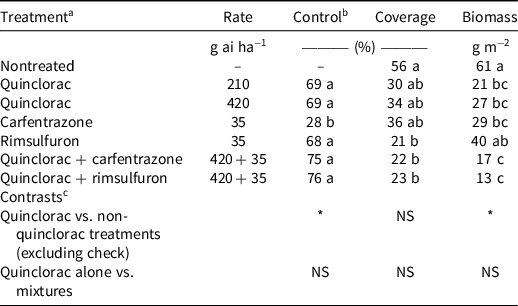
The current management of field bindweed relies on repeated use of postemergence herbicide with contact activity that needs to be applied every 14 to 30 d. Studies were conducted to compare the preemergence efficacy of quinclorac treatments to one of the standard treatments, carfentrazone. A common practice is to apply carfentrazone at 14- to 28-d intervals up until the day of harvest (up to four times), then follow with hand pulling and hoeing as needed through harvest. Three commercial blueberry fields with field bindweed were selected, two were located near Independence, OR (44.87°N, 123.17°W and 44.89°N, 123.15°W) in 2018, and one near Albany, OR (44.71°N, 123.10°W) in 2020. Each study was conducted for 30 d duration. Soil type at all sites was a Chehalis silty clay loam. Northern highbush blueberry ‘Duke’ cultivar was planted in Independence and ‘Draper’ cultivar was planted in Albany. Irrigation was provided by drip irrigation in Independence and by overhead irrigation in Albany. Treatments included quinclorac (210 and 420 g ae ha−1) with crop oil concentrate (Mor-act Crop Oil; Wilbur Ellis, Aurora, CO) at 1% vol/vol, carfentrazone (35 g ai ha−1) with nonionic surfactant (NIS; Ranier, Wilbur Ellis) at 0.25% vol/vol plus ammonium sulfate (AMS; BroncMax, Wilbur Ellis), and rimsulfuron (35 g ae ha−1) with NIS and AMS. The herbicides were tested alone or tank mixed together, and a nontreated check was included (Table 2). Treatments were applied on May 15 and 18, 2018, and May 7, 2020, when field bindweed shoots were approximately 10 cm in length. Data collected included visual estimates of crop injury, weed control, and weed coverage on a scale of 0% to 100% for absence and complete injury, control, or coverage, respectively. Field bindweed aboveground biomass was collected 30 d after treatment (DAT) from a 0.25 m−2 quadrat per plot, dried and then weighed. Experimental plots were 3 by 4.5 m and included six blueberry plants. The experiments were conducted as a randomized complete block design with four replicates in 2018 and six replicates in 2020. Experimental blocks were placed on individual planting rows. No crop injury was observed, and the data is not presented.
Field bindweed control, ground coverage, and biomass 30 d after treatment with quinclorac alone and in tank mixtures in highbush blueberry fields in 2018 and 2020.

a Treatment means of three field studies (n = 14). Ammonium sulfate and crop oil concentrate were added to all treatments at 1% vol/vol.
b Means within a column followed by the same letter are not different based on Sidak’s significance test (P ≤ 0.05). Coverage and biomass are presented as percent reduction relative to nontreated control.
c Contrast was adjusted by applying the Bonferroni test (P < 0.05).
Sequential Treatments
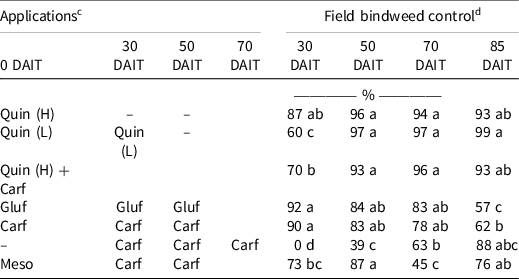
Two experiments were conducted to evaluate the impact of sequential herbicide applications on field bindweed. The first study was conducted in Albany, OR (44.72°N, 123.05°W) on a silt loam with a 3-yr-old blueberry planting of c.v. ‘Draper’ drip and overhead irrigation systems in the entire area. The study was initiated on April 18, 2014, after field bindweed had begun to emerge. Treatments included quinclorac applied in early spring (420 g ai ha−1) or in a split application (210 g ai ha−1 followed by 210 g ai ha−1) compared to the standard practices of sequential carfentrazone or glufosinate (Table 3). Visual estimates of weed control were recorded 25, 50, 67, and 83 d after initial treatment (DAIT). Another study was conducted in Independence, OR (44.87°N, 123.17°W) in a mature blueberry planting of the cultivar ‘Duke’ under drip irrigation. The experiment was initiated on May 10, 2017. At approximately 30 and 60 DAIT of quinclorac (210 g ai ha−1), all plots except the nontreated control received an application of carfentrazone (35 g ai ha−1). Visual estimates of weed control were performed at 30, 60, and 90 DAIT. Plant yield was recorded from all plants, and the average size of berries was estimated as described in the previous experiment. The experiments were conducted as a randomized complete block design with four replicates. The experimental plots were 3 by 4.5 m and included six blueberry plants in the first experiment and 2 by 2.3 m including three blueberry plants per plot.
Field bindweed control with quinclorac and other sequential postemergence treatments in 2014. a, b

a Commercial harvest commenced on July 8, 81 DAIT.
b Abbreviations: DAIT, days after initial gtreatment; Quin (L), quinclorac at 210 g ai ha−1; Quin (H), quinclorac at 420 g ai ha−1; carf, carfentrazone at 35 g ai ha−1; gluf, glufosinate at 1,680 g ai ha−1; meso, mesotrione at 211 g ai ha−1.
c Application dates were April 18, May 16, June 6, and July 24, 2014, for the 0, 25, 50, and 68 DAIT ± 3 d applications, respectively. Ammonium sulfate was added to all treatments. Crop oil concentrate was added to all treatments at 1% vol/vol to quinclorac, carfentrazone, and mesotrione treatments.
d Treatment means of one field study (n = 4). Means within a column followed by the same letter are not different based on Sidak’s significance test (P ≤ 0.05).
Long-Term Study
A field study was conducted in 2019 and 2020 at the Oregon State University Lewis Brown Research Farm in Corvallis, OR (45.54°N, 123.21°W) on a Chehalis silty loam soil. The field was naturally infested with field bindweed and had been maintained as fallow the previous season. Plots measured 3 by 7.6 m. The area was sprinkler irrigated to promote weed growth. The experiment was initiated on May 3, 2019, when bindweed shoots were 5 to 10 cm in length, and reapplied on May 29, 2020, when bindweed shoots were 15 to 20 cm. Treatments consisted of quinclorac, quinclorac plus carfentrazone, quinclorac plus rimsulfuron, and a nontreated control. Plots were treated once in 2019, and treatments were reapplied in 2020. The treatments were applied on May 3, June 3, or July 3, 2019, and repeated on May 29, June 29, or July 31, 2020. Visual estimates of weed control were performed monthly. Aboveground biomass was collected in September-October from two 0.25 m2 quadrats per plot. Field bindweed biomass was recorded separately from other weeds. Biomass reduction was calculated as the difference between treated and nontreated plots divided by the nontreated plot biomass. The experiment was conducted as a randomized complete block design with four replicates.
Statistical Analysis
All data were subjected to ANOVA using RStudio 1.4.1103 software (RStudio Team 2021). The percent control, coverage, and biomass reduction were analyzed using a generalized linear mixed model with the package glmmTMB version 1.0.2.1 (Brooks et al. Reference Brooks, Kristensen, van Benthem, Magnusson, Berg, Nielsen, Skaug, Machler and Bolker2017) with beta error distribution. Data from the three single application studies were combined for analysis. Herbicide treatments were considered fixed factors, and experimental block and sites were considered random factors. The sequential treatment studies were analyzed independently because of difference in treatment structures. On each analysis, an experimental block was treated as a random factor and treatments as fixed factors. In the long-term study, treatments and experimental year were treated as fixed factors and experimental block as a random factor. Data were analyzed by year because of the significant effect of year. Bindweed biomass and blueberry yield were log (x+1) transformed and analyzed in linear mixed-effect model with lmer function in the package lme4 1.1-26 (Kniss and Streibig Reference Kniss and Streibig2020). Treatment mean separation was performed using emmeans package v1.5.4 and the cld function with Sidak’s test at P < 0.05 (Kniss and Streibig Reference Kniss and Streibig2020; Lenth Reference Lenth2019; Šidák Reference Šidák1967). Contrasts were developed for the “single application” and “sequential” studies to compare the impact of quinclorac against treatments without quinclorac, and quinclorac alone versus quinclorac in mixtures. In the long-term study, contrasts were designed to compare application timing. Statistical significance was corrected with Bonferroni adjustment in all cases.
Results and Discussion
Single-Application Study
Quinclorac-containing treatments provided 69% to 76% control of field bindweed 30 d after treatment with quinclorac at 210 or 420 g ai ha−1 providing a similar response (Table 2). Rimsulfuron (68%) performed as well as quinclorac, and in a mixture, quinclorac and rimsulfuron provided greater control (76%) than carfentrazone alone (28%). Quinclorac improved control of field bindweed compared to treatments without quinclorac based on contrast (P < 0.05), and mixes performed equally to quinclorac alone. Field bindweed coverage was reduced to 30% or less compared with 56% coverage in the nontreated control. Quinclorac application reduced field bindweed biomass (P < 0.05) from 13 to 27 g m−2, whereas on average the nontreated control was 61 g m−2.
Sequential Treatments
In the 2014 field study, a single application of quinclorac (420 g ai ha−1) provided 93% field bindweed control when harvest began in mid-July and provided better control of field bindweed than three sequential applications of glufosinate and three applications of carfentrazone if the first application was made at the same time quinclorac was applied (Table 3). Delaying the first of three carfentrazone applications may have improved bindweed control compared with the earlier sequence. Sequential applications of quinclorac performed similarly to that of a single application of quinclorac at 50, 70, and 85 DAIT, but as expected, at 30 DAIT the single application of quinclorac applied April 18th at 420 ai ha−1 performed better. The sequential application of quinclorac may have improved bindweed control compared with the single application, but the difference was not statistically significant. Tank mixing carfentrazone with quinclorac did not improve bindweed control in this study. This result indicates that an early spring application of quinclorac to control field bindweed will reduce or eliminate the need for subsequent applications compared to the standard method of multiple applications of carfentrazone or glufosinate postemergence.
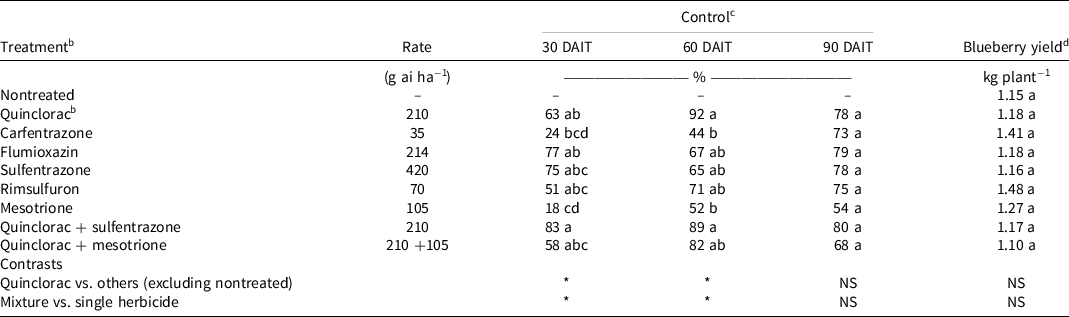
The 2017 study also showed that a single application of quinclorac postemergence controls bindweed (Table 4). Treatments including quinclorac provided 58% to 92% control of field bindweed and improved control of field bindweed compared to treatments without quinclorac based on contrast (P < 0.05; Table 4). All treatments received a subsequent application of carfentrazone. Blueberry yield was not affected by any of the treatments.
Field bindweed control and blueberry yield in response to quinclorac and other herbicides in a field experiment in 2017. a

a All treatments were followed by two carfentrazone applications every 30 d except the nontreated plots.
b All treatments were followed by carfentrazone (35 g ai ha−1) application at 30 d and a second application at 60 d after initial treatment. Ammonium sulfate was added to all treatments. Crop oil concentrate was added to all treatments at 1% vol/vol to quinclorac and carfentrazone treatments followed by application again 30 d after initial application.
c Means within a column followed by the same letter are not different based on Sidak’s significance test (P ≤ 0.05).
d Yield was collected from four plants per plot. Dashes (-) indicate data not included in the analysis.
Long-Term Study
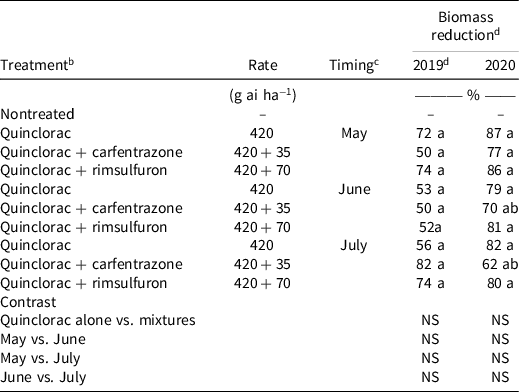
A single application of quinclorac in the spring or summer of 2019 reduced field bindweed biomass by 50% to 82% at 60 to 120 DAIT depending on application timing (Table 5). Biomass reduction by quinclorac alone or in mixture was similar (P > 0.05) and not affected by the application timing from May to July. When treatments were reapplied in 2020, field bindweed biomass was reduced from 62% to 87% (Table 5). Field bindweed growth was reduced in all treated plots in 2020 compared to 2019, but not in the nontreated plots, suggesting plant stunting or death because of the treatments.
Field bindweed biomass reduction at the end of summer after treatment with quinclorac alone or in mixture with carfentrazone or rimsulfuron. a

a Herbicides were applied in May, June, or July in 2019 and 2020 in a fallow field at the research farm in Corvallis, OR.
b Treatment means of one field study (n = 4). Ammonium sulfate was added to all treatments. Crop oil concentrate was added to all treatments at 1% vol/vol to quinclorac and carfentrazone treatments.
c First application occurred when bindweed shoots were 3 to 5 cm in length in first week of May of 2019 and 2020. Treatments applied in June and July were made at 30 and 60 d after initial applications, each year.
d Means within a column followed by the same letter are not different based on Sidak’s significance test (P ≤ 0.05). Biomass were collected in October of each year, and biomass reduction are presented as percent reduction relative to nontreated control.
These results indicate that quinclorac at 420 g ai ha−1 controlled field bindweed (Table 2), and these findings agree with those reported by Enloe et al. (Reference Enloe, Westra, Nissen, Miller and Stahlman1999b). This study also demonstrates that quinclorac does not affect highbush blueberry yield at rates of up to 420 g ai ha−1. It is important to emphasize that these results were observed on silt-loam and clay soils characteristic of the Willamette Valley. Because quinclorac is soil-active and can be absorbed by roots (Enloe et al. Reference Enloe, Nissen and Westra1999a), the tolerance of bindweed to quinclorac must be examined before using it in sandier soils. Quinclorac provided season-long control of field bindweed; a single application of quinclorac outperformed four applications of carfentrazone (Table 3). By reducing the need for repeated applications, quinclorac can reduce chances of spray drift damaging the crop.
Field bindweed control was not improved when quinclorac was mixed with carfentrazone or rimsulfuron. However, bindweed control with rimsulfuron alone was similar to the control provided by quinclorac at several sites only when evaluated for a short period (Tables 2) or when rimsulfuron was followed by carfentrazone applications (Table 4). Reports of field bindweed control with rimsulfuron are variable. Rimsulfuron was reported to improve control of field bindweed in processing tomatoes when applied following an application of trifluralin (Sosnoskie and Hanson Reference Sosnoskie and Hanson2015), whereas when used in corn fields, rimsulfuron suppressed field bindweed up to 6 wk after treatment and reduced biomass by 2% to 58% compared to nontreated crops (Zaremohazabieh and Ghadiri Reference Zaremohazabieh and Ghadiri2011). In this study, rimsulfuron controlled field bindweed up to 28 d, but it would not provide long-term suppression of field bindweed (personal observation). Tank mixes with rimsulfuron would significantly broaden the control spectrum, as has been noted when quinclorac has been mixed in other cropping systems (Norsworthy et al. Reference Norsworthy, Bangarwa, Scott, Still and Griffith2010). Although quinclorac is very effective against field bindweed, its activity is limited on other weed species that may be present in the field, including prostrate knotweed (Polygonum aviculare L.) and sharppoint fluvellin (Kickxia elatine L. Dumort). The use of herbicides with different modes of action also may delay selection of herbicide-resistant biotypes, as proposed elsewhere (Evans et al. Reference Evans, Tranel, Hager, Schutte, Wu, Chatham and Davis2016).
We propose that growers control field bindweed in early spring, even though quinclorac applied postemergence in the fall to actively growing bindweed is most effective (Anonymous 2020). First, early spring applications may reduce or eliminate the need for subsequent applications to control field bindweed. Second, weed control in early spring is likely to reduce weed competition at the time and may improve soil activity of quinclorac to control field bindweed because of greater rainfall and soil moisture (Enloe et al. Reference Enloe, Nissen and Westra1999a). Field bindweed may have inconsistent growth stages during mid-summer or later depending on rainfall or irrigation type. Under drip-irrigation, plants growing away from the irrigation lines are often water stressed by mid-summer, which may reduce herbicide uptake and efficacy. Quinclorac preharvest interval restrictions are 30 d in blueberry, and mid-summer applications may coincide with or be too close to harvest. In conclusion, this research confirms that quinclorac is effective for field bindweed control in blueberry and that early spring applications can reduce or eliminate the need for subsequent herbicide applications to control field bindweed in that season.
Acknowledgments
This work was supported by the Oregon Blueberry Commission. No conflicts of interest have been declared. We thank the IR-4 program and Albaugh LLC for assistance in the registration of quinclorac for use in blueberry.