Nowadays consumers are more demanding and are constantly looking for higher quality foods. Their expectations are that such quality will be maintained during the period between purchase and consumption and for this reason one of the major issues facing food manufacturers is an increasing need to extend the shelf life of food products. In terms of cheese, mozzarella is one of the most appreciated products worldwide but due to its composition it has a relatively short shelf life.
One of the most critical factors affecting the shelf life of this fresh product is the proliferation of spoilage bacteria. Characteristics of the mozzarella cheese, such as its spun soft dough nature, its high moisture content (50–60%) and the fact that its soft texture is preserved by storing in trays or bags with brine at 4 °C are all factors which provide an environment which is well suited to the growth of spoilage bacteria. In general this product is very perishable and very susceptible to degradation processes in particular to the growth of Pseudomonas spp. and some members of the Enterobacteriaceae family (Cantoni et al. Reference Cantoni, Stella and Cozzi2003; Haouet et al. Reference Haouet, Altissimi, Scuota and Cenci2008; Mastromatteo et al. Reference Mastromatteo, Conte, Lucera, Saccotelli, Buonocore, Zambrini and Del Nobile2015). The proper combination of storage time and temperature creates an ideal growth environment for these psychrophilic microorganisms with the result that they become the dominant non-lactic bacteria population in cheese (Morales et al. Reference Morales, Garcia and Nunez2005; De Jonghe et al. Reference De Jonghe, Coorevits, Van Hoorde, Messens, Van Landschoot, De Vos and Heyndrickx2011; Franciosi et al. Reference Franciosi, Settanni, Cologna, Cavazza and Poznanski2011; Martin et al. Reference Martin, Murphy, Ralyea, Wiedmann and Boor2011). The presence of very high loads of Pseudomonas spp. and Enterobacteriaceae allow us to consider those bacteria as being the main species responsible for casein hydrolysis, exfoliation of the outer surface, anomalous discoloration and in general alteration of odour and taste during storage (Cantoni et al. Reference Cantoni, Stella and Cozzi2003; Martin et al. Reference Martin, Murphy, Ralyea, Wiedmann and Boor2011; Baruzzi et al. Reference Baruzzi, Lagonigro, Quintieri, Morea and Caputo2012).
Several strategies have been proposed to preserve mozzarella cheese. For example the use of different modified atmosphere packaging and bio-based active coatings are both proposed as valid approaches to control microbial proliferation and minimise sensory changes during storage (Gammariello et al. Reference Gammariello, Conte, Attanasio and Del Nobile2010; Incoronato et al. Reference Incoronato, Conte, Buonocore and Del Nobile2011; Angiolillo et al. Reference Angiolillo, Conte, Faccia, Zambrini and Del Nobile2014; Mastromatteo et al. Reference Mastromatteo, Conte, Lucera, Saccotelli, Buonocore, Zambrini and Del Nobile2015).
Recently, non-thermal novel technologies have been introduced as physical alternative methods to control microbial proliferation and preserve food quality (Arroyo et al. Reference Arroyo, Cebrián, Pagán and Condón2012; Huo et al. Reference Huo, Bai, Guo and Zhao2013; Sharma et al. Reference Sharma, Bremer, Oey and Everett2013; Manzocco et al. Reference Manzocco, Plazzotta, Maifreni, Calligaris, Anese and Nicoli2015; Lacivita et al. Reference Lacivita, Conte, Manzocco, Plazzotta, Zambrini, Del Nobile and Nicoli2016). High Intensity Light Pulses (HILP) is one such technology, its mode of action being non-thermal, and it has considerable potential in the decontamination of food surfaces (Marquenie et al. Reference Marquenie, Geeraerd, Lammertyn, Soontjens, Van Impe, Michiels and Nicolai2003; Ferrario et al. Reference Ferrario, Alzamora and Guerrero2013). It uses short light pulses (pulse width of 100–400 µs) with wavelength distributed in the ranges from 180 to 1100 nm, including UV (180–380 nm), visible light (380–700 nm) and infrared (700–1100 nm). The effects of HILP on microorganisms are mostly due to three mechanisms. The photophysical effect, the photochemical action of the UV-C component of the light spectrum and to a lesser extent due to photo-thermal effects of the infrared component. These mechanisms can cause an instantaneous heat generation inside the product, rupture of the cell wall and membrane, inactivation of bacteria due to DNA damage by UV photons absorption with eventual cell death (Gómez-López et al. Reference Gómez-López, Ragaert, Debevere and Devlieghere2007; Miller et al. Reference Miller, Sauer and Moraru2012). Studies on HILP treatments have been reported for fruit and vegetable (Oms-Oliu et al. Reference Oms-Oliu, Aguiló-Aguayo, Martín-Belloso and Soliva-Fortuny2010a; Izquier, & Gómez-López, Reference Izquier and Gómez-López2011; Ramos-Villarroel et al. Reference Ramos-Villarroel, Martín-Belloso and Soliva-Fortuny2011, Reference Ramos-Villarroel, Aron-Maftei, Martín-Belloso and Soliva-Fortuny2012), beverages such as fruit juice and milk (Palgan et al. Reference Palgan, Caminiti, Muñoz, Noci, Whyte, Morgan, Cronin and Lyng2011; Caminiti et al. Reference Caminiti, Noci, Muñoz, Whyte, Morgan, Cronin and Lyng2011, Reference Caminiti, Noci, Morgan, Cronin and Lyng2012), but the technique has received limited attention in terms of its application to dairy products, particularly cheeses.
On the base of these considerations, the aim of the present work was to evaluate the surface decontamination effect of HILP on mozzarella cheese. The criteria were to achieve significant reduction without damage to this fresh cheese. First the susceptibility of Pseudomonas fluorescens and Enterobacteriaceae to treatment in a transparent liquid (Maximum Recovery Diluent, MRD) was evaluated. Afterwards, the decontamination efficacy of HILP on inoculated mozzarella cheese was assessed. Subsequently, the effectiveness of HILP treatment on naturally contaminated mozzarella cheese, during storage at 10 °C for 2 weeks, was evaluated.
Materials and methods
Microbial groups for sample inoculation
For preliminary in-vitro tests the experiments were conducted using P. fluorescens (DSM 50090) and Enterobacteriaceae microorganisms in a Maximum Recovery Diluent (MRD, Oxoid). The P. fluorescens strain was grown overnight at 25 °C in Plate Count Broth (PCB Oxoid) and then grown on Plate Count Agar (PCA Oxoid) for 24 h at 25 °C. The Enterobacteriaceae were previously isolated from chicken skin, were grown overnight at 37 °C in Violet Red Bile Glucose Agar (VRBGA, Oxoid) and then grown on Plate Count Agar (PCA Oxoid) for 24 h at 25 °C. Following, the colonies were taken from the surface of the Petri dish by adding 3 ml of sterile MRD. With a sterile spatula the colonies were suspended in the liquid. Then the suspension was used as initial microbial inoculum and was subjected to serial dilutions in the MRD, depending on the microbial concentration to be reached. 15 ml of both P. fluorescens and Enterobacteriaceae suspensions (108 cfu/ml) were placed in sterile petri dishes of 90 mm diameter (Sterilin Limited, UK), resulting in a liquid depth of 2 mm. These samples were then exposed to HILP for various exposure times.
In terms of treating the cheese samples, mozzarella (30 g pieces) were purchased at a Dublin local market and preserved at 4 °C. Prior to treatment, cheese was inoculated with a 150 µl of each microbial suspension, which was directly spread onto the sample surface (final concentration of 104–105 cfu/g). Mozzarella cheeses were then stored under refrigerated conditions at 4 °C for 2 h before HILP treatment in order to allow microorganisms to attach to the cheese surface.
To carry out the antimicrobial test of HILP during cheese storage, untreated controls and HILP treated samples without any inoculation were packaged in commercial plastic trays (PP, thickness 69 mm) with 50 ml brine (0·6% NaCl solution) and stored at 10 °C for 2 weeks. Periodically, the microbial quality and pH were monitored, according to details reported below.
High intensity light pulses (HILP) technology
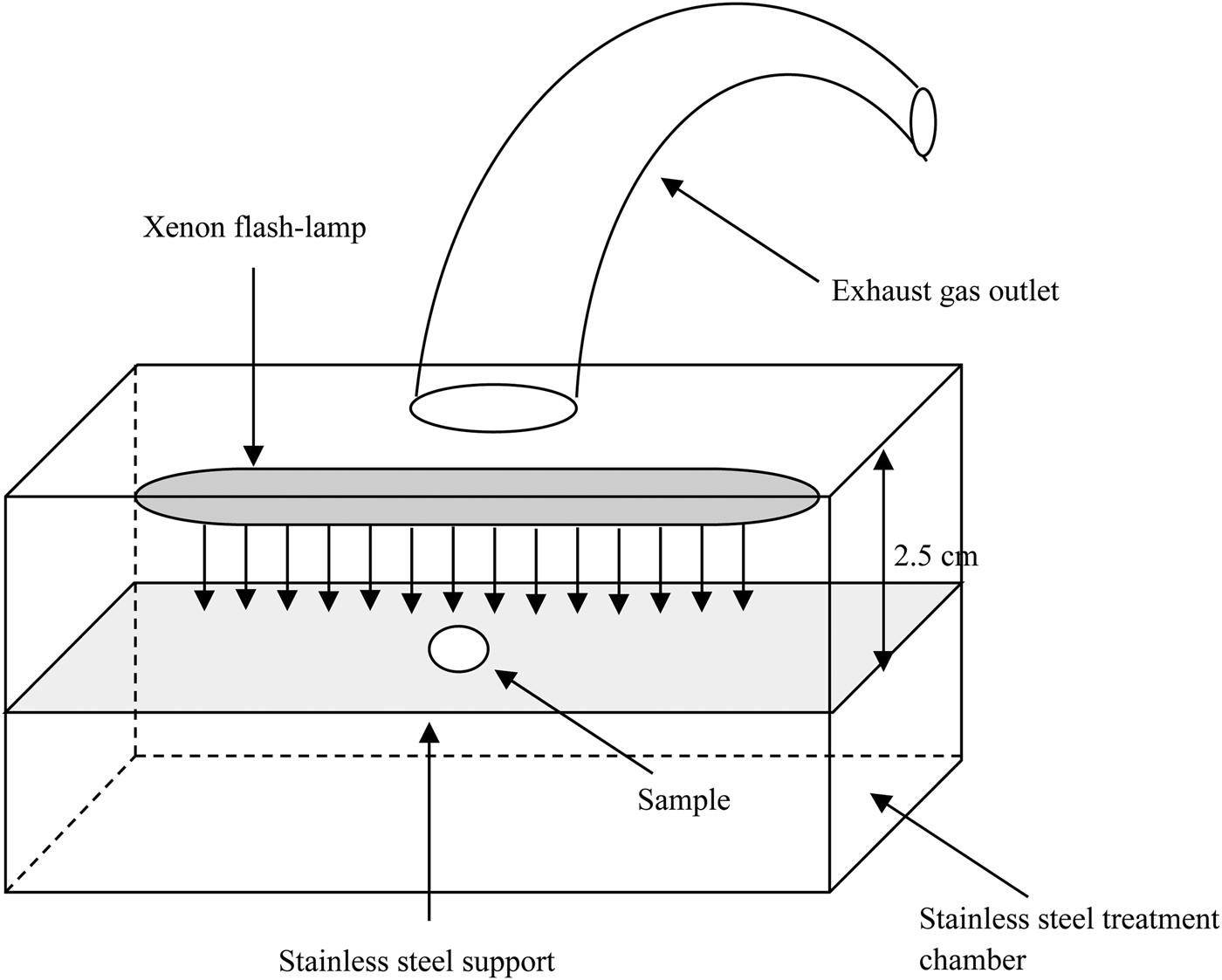
HILP treatments were performed using the Steri-Pulse XL3000 Pulsed Light Sterilization System (Xenon Corporation, MA, USA). It consists of a stainless steel sterilisation chamber (Fig. 1) with a lamp housing mounted on top and a control module (Model No. RC 747, Xenon). The xenon lamp emits high intensity light in the wavelength between 200 and 1100 nm, with a maximum emission in the UV range. All samples were placed at a distance of 2·5 cm from the light source and exposed to HILP (frequency 3 Hz; pulse width of 360 µs; fluence 1·17 J/cm2/pulse).
Schematic representation of High Intensity Light Pulses (HILP) treatment of mozzarella cheese.

Specifically, the study was organised in two phases. In the first one, the susceptibility of microorganisms (108 cfu/ml) to the treatment in a transparent liquid (MRD) was evaluated (in-vitro tests). Petri dishes with microbial inoculums (15 ml) were exposed to increasing treatment times from less than 1 to 8 s, in order to receive total energy doses ranging from 1·17 to 28 J/cm2, respectively. Subsequently, the surface decontamination efficacy of HILP on inoculated mozzarella samples (i.e. 104–105 cfu/g) was investigated. In this case treatment times from 1 to 8 s were chosen for treatments. On the second phase, the effect of HILP on normal samples (samples without inoculated microorganisms) was evaluated. Treatment times of 2 and 4 s were chosen for treatments with corresponding fluence of 7·02 and 14·04 J/cm2, respectively. After the treatment, untreated and HILP treated samples were packaged and stored. Microbial quality and pH were monitored.
Microbiological analyses
For P. fluorescens detection, 0·1 ml of dilution was spread plated in duplicate onto Pseudomonas Agar Based (PAB, Oxoid) properly modified by adding Pseudomonas C-F-C SR103 (Oxoid) selective supplement. For enumeration of Enterobacteriaceae 1 ml of dilution was plated in duplicate onto Violet Red Bile Glucose Agar (VRBGA, Oxoid). The plates were incubated at 25 °C for 48 h and 37 °C for 24 h, respectively. For the mozzarella cheese samples 10 g were aseptically removed and immediately transferred to sterile stomacher bags, diluted with 90 ml of MRD (Oxoid) and homogenised with a Stomacher LAB Blender 400. Subsequently, decimal dilutions of homogenates were made using the same diluent (MRD) and the dilutions (0·1 or 1 ml) were plated on appropriate media as described above, for enumeration of Pseudomonas spp. and Enterobacteriaceae. Colony forming units were counted and expressed as log cfu/g (Isohanni & Lyhs, Reference Isohanni and Lyhs2009). Microbial thresholds of 106 and 105 cfu/g were set for Pseudomonas spp. and Enterobacteriaceae, respectively (Mastromatteo et al. Reference Mastromatteo, Conte, Lucera, Saccotelli, Buonocore, Zambrini and Del Nobile2015).
pH measurements
pH was evaluated on homogenates of cheese as prepared for microbiological analyses and on brine in duplicate with a pH meter (Crison, Barcelona, Spain) after appropriate calibration.
Statistical analysis
Results are reported as mean value ± sd. The statistical analysis was performed by one-way ANOVA test. A Duncan's multiple range test, with the option of homogeneous groups (P < 0·05), was used to determine significance among differences. To this aim, STATISTICA v. 7.1 for Windows (StatSoft Inc., Tulsa, OK, USA) was used.
Results and discussion
Inactivation of P. fluorescens and Enterobacteriaceae in transparent liquid
The preliminary experiments with HILP were performed on inoculated MRD with a microbial concentration of 108 cfu/ml. The log cycles reduction was evaluated. Table 1 shows the behaviour of P. fluorescens and Enterobacteriaceae populations in MRD. These results showed that the microbial count for both microorganisms decreased with the increase in light fluence (Palgan et al. Reference Palgan, Caminiti, Muñoz, Noci, Whyte, Morgan, Cronin and Lyng2011; Miller et al. Reference Miller, Sauer and Moraru2012). In particular, with a treatment time of 0·4 s corresponding to a HILP treatment with 1 pulse and a fluence of 1·17 J/cm2, microbial reduction of P. fluorescens and Enterobacteriaceae of 2·54 and 2·12 log cycles, respectively, were observed. In contrast, a treatment time of 1 s corresponding to a fluence of 3·51 J/cm2 reduced the microbial loads by 5·27 and 5·21 log cycles for P. fluorescens and Enterobacteriaceae, respectively. The microbial loads for both microorganisms were inactivated below the detection limit (<10 cfu/ml for Pseudomonas fluorescens and <1 cfu/ml for Enterobacteriaceae) after 2 s exposure to HILP treatment with a maximum fluence of 7·02 J/cm2. These results showed that in a transparent liquid , there was a significant microbial inactivation using this novel non-thermal technology, with just a few seconds of treatment (2 s). This finding is in agreement with what was observed in the study carried out on different liquid foods inoculated with different microbial strains (Palgan et al. Reference Palgan, Caminiti, Muñoz, Noci, Whyte, Morgan, Cronin and Lyng2011). Documented studies suggest that the ultraviolet (UV) portion of the spectrum is the most important for microbial inactivation (Gómez-López et al. Reference Gómez-López, Ragaert, Debevere and Devlieghere2007; Innocente et al. Reference Innocente, Segat, Manzocco, Marino, Maifreni, Bortolomeoli, Ignat and Nicoli2014). In fact the lethal effect of pulsed light on microorganisms is mostly attributed to the photochemical action of the UV portion (180–380 nm) of the spectrum emitted by the xenon flash lamp (Bintsis, et al. Reference Bintsis, Litopoulou-Tzanetaki and Robinson2000; Oms-Oliu et al. Reference Oms-Oliu, Martín-Belloso and Soliva-Fortuny2010b; Innocente et al. Reference Innocente, Segat, Manzocco, Marino, Maifreni, Bortolomeoli, Ignat and Nicoli2014; Ignat et al. Reference Ignat, Manzocco, Maifreni, Bartolomeoli and Nicoli2014). This leads to a microbial DNA absorption of UV light that induces chemical modifications, with impairment of cell replication and ultimately cell death (Gómez-López et al. Reference Gómez-López, Ragaert, Debevere and Devlieghere2007; Palgan et al. Reference Palgan, Caminiti, Muñoz, Noci, Whyte, Morgan, Cronin and Lyng2011; Miller et al. Reference Miller, Sauer and Moraru2012; Ignat et al. Reference Ignat, Manzocco, Maifreni, Bartolomeoli and Nicoli2014; Innocente et al. Reference Innocente, Segat, Manzocco, Marino, Maifreni, Bortolomeoli, Ignat and Nicoli2014).
Inactivation of Pseudomonas fluorescens (DSM 50090) and Enterobacteriaceae in Maximum Recovery Diluent (MRD) by High Intensity Light Pulses (HILP)

DL, Detection limit for Pseudomonas fluorescens: 10 cfu/ml and Enterobacteriaceae: 1 cfu/ml in MRD, placed to 2·5 cm from the high intensity light source
a-dData with different superscript letters within a column are significantly different (P < 0·05)
Surface decontamination of inoculated mozzarella cheese by HILP treatment
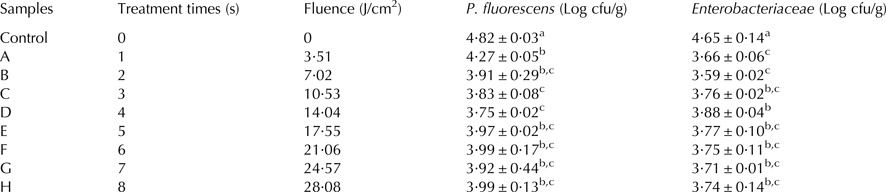
To investigate the effectiveness of HILP treatment as a surface decontamination system, the inoculated mozzarella cheeses were exposed to HILP treatment at increasing times of up to 8 s. Table 2 shows the microbial counts of P. fluorescens and Enterobacteriaceae inoculated on the product surface. There was a greater reduction for both microbial strains until 4 s exposures but then, as the dose increased, the population maintained approximately constant, without significant differences in general. In particular, significant reductions of 1·07 and 1·06 log cycles were achieved for P. fluorescens and Enterobacteriaceae with a fluence of 14·04 and 7·02 J/cm2, respectively. Similar results were obtained by Dunn et al. (Reference Dunn, Ott and Clark1995) in a study on curds inoculated with Pseudomonas spp. and treated with pulsed light (fluence of 16 J/cm2), resulting in a 1·5 log reduction of microbial population after the treatment. These observations are also in agreement with another study where reductions up to 1·69 log cycles for different microbial strains on chicken exposed to HILP have been achieved (Haughton et al. Reference Haughton, Lyng, Morgan, Cronin, Fanning and Whyte2011). Other treatment times did not result in a significant reduction compared to untreated control, the reduction was less than 1 log cycle, which could be attributed to a non effective access of the radiation due to the irregular cheese surface. Of the two organisms studied Enterobacteriaceae appear slightly more sensitive to HILP treatment. At the same treatment conditions (fluence of 3·5 J/cm2) there was a 0·99 and a 0·55 log cycle reduction in Enterobacteriaceae and P. fluorescens samples respectively. The microbial reduction observed on mozzarella was not as high as that detected in the preliminary study conducted on transparent liquid (MRD). This is probably due to the protective effect of the cheese composition vs. a liquid buffer and to the fact that the cheese surface is rough and has pores or crevices where microorganisms will hide from light (Guerrero-Beltrán & Barbosa-Cánovas, Reference Guerrero-Beltrán and Barbosa-Cánovas2004; Palgan et al. Reference Palgan, Caminiti, Muñoz, Noci, Whyte, Morgan, Cronin and Lyng2011; Choudhary & Bandla, Reference Choudhary and Bandla2012; Innocente et al. Reference Innocente, Segat, Manzocco, Marino, Maifreni, Bortolomeoli, Ignat and Nicoli2014).
Microbial counts of Pseudomonas fluorescens (DSM 50090) and Enterobacteriaceae inoculated on mozzarella cheese exposed to increasing fluence of High Intensity Light Pulses

a-cData with different superscript letters within a column are significantly different (P < 0·05)
HILP effect on normal mozzarella cheese
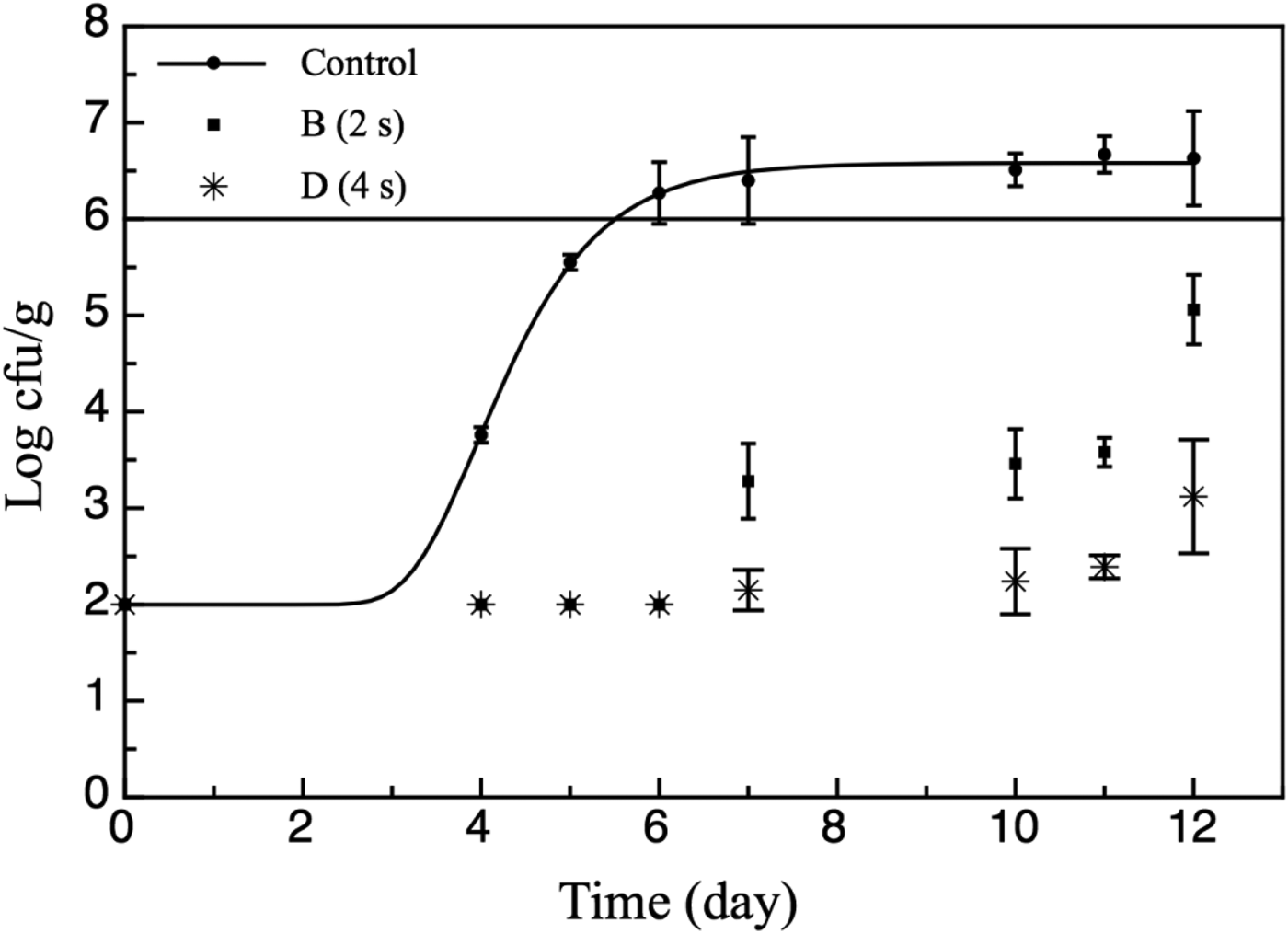
On the basis of the work on liquid and inoculated cheese samples, in the second phase of this study the effectiveness of HILP treatments on the native flora of mozzarella cheese was investigated without any preliminary contamination. Treatment parameters chosen were 2 s (sample B, Fig. 2) and 4 s (sample D, Fig. 2), corresponding to fluences 7·02 and 14·04 J/cm2, respectively. For Enterobacteriaceae, no proliferation has been found in both control and treated samples. The absence of this microbial group allows us to hypothesise that good hygienic conditions were adopted during cheese making process (Gammariello et al. Reference Gammariello, Conte, Buonocore and Del Nobile2011). Fig. 2 shows the evolution of Pseudomonas spp. during refrigerated storage in mozzarella exposed to two different HILP treatments compared to untreated control. The horizontal line at 106 cfu/g indicates the microbial limit above which changes to the quality parameters generally begin to appear (Cantoni et al. Reference Cantoni, Stella and Cozzi2003; Angiolillo et al. Reference Angiolillo, Conte, Faccia, Zambrini and Del Nobile2014; Mastromatteo et al. Reference Mastromatteo, Conte, Lucera, Saccotelli, Buonocore, Zambrini and Del Nobile2015). The initial microbial load for all samples was below the detection limit (<102 cfu/g). After a few days of storage (4 d), an increase of Pseudomonas spp. population was observed in the control samples, and the microbiological limit was exceeded after 5·5 d. By contrast, for the HILP treated samples the microbial load remained below the detection limit until the 6th storage day. After this storage period a different trend was observed. In sample B (Fig. 2) a gradual increase of microbial load was noted, although the load did not reach the microbiological acceptability limit during up to 12 d storage. A slight increase of microbial count was also observed in the sample D (Fig. 2), reaching a maximum value of 3·12 log cfu/g1 at the end of the 12-day observation period.
Evolution of Pseudomonas spp. population during the refrigerated storage of mozzarella cheese exposed to two different High Intensity Light Pulses (HILP) treatments. Symbols: experimental data. Lines: best fits estimates. Control = untreated Mozzarella cheese; B = Mozzarella cheese treated for 2 s; D = Mozzarella cheese treated for 4 s.

The pH of all samples (both cheese and brine) remained almost constant (around 6·0–6·5) during the microbial testing, expect for the control brine that reached values around 5·9–5·5, thus confirming the degradation process beginning to occur.
Conclusions
The current study investigated for the first time the effect of HILP on mozzarella cheese. The efficacy of this treatment is very interesting because a microbial reduction was observed in treated samples. From the preliminary test it was observed that in a transparent liquid (Maximum recovery diluent, MRD) there was a significant microbial inactivation with just 2 s of treatment (fluence 7·02 J/cm2). These results show that transparency of the media allowed successful microbial inactivation using this technology. In the case of inoculated mozzarella, a considerable microbial reduction was observed until 4 s of exposures, even if a lower microbial inactivation was noticed compared to that obtained in the transparent liquid. HILP treatment is able to control the microbial growth and may be considered a promising way to decontaminate the surface of mozzarella cheese. The short treatment time lends itself to application in high volume production lines. Further research is still necessary to optimise the application of HILP and also to investigate the effect of the technique on sensory parameters.