Introduction
There is a growing consensus that addressing the spiritual dimension is a key part of holistic, patient-centered care (Puchalski, Reference Puchalski2013; Sulmasy, Reference Sulmasy2002). This is especially true in the palliative setting, where the Clinical Practice Guidelines for Quality Palliative Care of the National Consensus Project directed the interdisciplinary team to assess and address “spiritual, religious, and existential dimensions of care” (Guideline 5.1-5.2) (National Consensus Project, 2013).
The interdisciplinary team often includes a professional spiritual care provider, sometimes called a chaplain. At the same time, all members of the interdisciplinary team can and should provide a basic level of spiritual care (Puchalski et al., Reference Puchalski, Ferrell and Virani2009; Vanderwerker et al., Reference Vanderwerker, Flannelly and Galek2008). A model has been suggested for how spiritual care provision can be shared among members of the interdisciplinary team (Puchalski et al., Reference Puchalski, Ferrell and Virani2009), and several studies report how spiritual care is currently being provided by physicians and nurses in practice (Epstein-Peterson et al., Reference Epstein-Peterson, Sullivan and Enzinger2015; King et al., Reference King, Dimmers and Langer2013; Tanyi et al., Reference Tanyi, McKenzie and Chapek2009).
Patients in the United States overwhelmingly state that they would like their doctors and nurses to include spiritual care as part of the care they provide (77–94%) (Ehman et al., Reference Ehman, Ott and Short1999; McCord et al., Reference McCord, Gilchrist and Grossman2004; Phelps et al., Reference Phelps, Lauderdale and Alcorn2012). Most doctors and nurses thought they should be providing spiritual care at least occasionally (Balboni et al., Reference Balboni, Sullivan and Amobi2013; Gallison et al., Reference Gallison, Xu and Jurgens2013; McBrien, Reference McBrien2010), but doctors and nurses actually provide spiritual care infrequently (Balboni et al., Reference Balboni, Sullivan and Amobi2013; Ehman et al., Reference Ehman, Ott and Short1999; Epstein-Peterson et al., Reference Epstein-Peterson, Sullivan and Enzinger2015; Gallison et al., Reference Gallison, Xu and Jurgens2013; Turan and Yavuz Karamanoglu, Reference Turan and Yavuz Karamanoğlu2013).
Why do doctors and nurses who value the provision of spiritual care not do so? The self-perceived barrier commonly found to be most significant is lack of time (Balboni et al., Reference Balboni, Sullivan and Enzinger2014; Ronaldson et al., Reference Ronaldson, Hayes and Aggar2012), whereas the strongest demonstrated barrier is lack of training (Balboni et al., Reference Balboni, Sullivan and Amobi2013; Epstein-Peterson et al., Reference Epstein-Peterson, Sullivan and Enzinger2015). Several studies around the world have examined the characteristics of medical staff more positively inclined toward or more likely to provide spiritual care, as well as the perceived and actual barriers to their doing so (Balboni et al., Reference Balboni, Sullivan and Enzinger2014; Chibnall et al., Reference Chibnall, Bennett and Videen2004; Gallison et al., Reference Gallison, Xu and Jurgens2013; King et al., Reference King, Dimmers and Langer2013; Lundmark, Reference Lundmark2006; McBrien, Reference McBrien2010; Phelps et al., Reference Phelps, Lauderdale and Alcorn2012).
In these studies, self-reported spirituality had a significant impact on staff attitudes toward spiritual care, but did not demonstrably affect their spiritual care provision in practice. Training programs designed to expand and improve staff spiritual care provision have increasingly included elements that aim to engage participants with their own spirituality and demystify this element of the human experience (Anandarajah et al., Reference Anandarajah, Roseman and Lee2016; Baldacchino, Reference Baldacchino2015; Heydari et al., Reference Heydari, Meshkinyazd and Soudmand2017; Mitchell et al., Reference Mitchell, Epstein-Peterson and Bandini2016; Paal et al., Reference Paal, Helo and Frick2015; Vlasblom et al., Reference Vlasblom, van der Steen and Knol2011; Zollfrank et al., Reference Zollfrank, Trevino and Cadge2015). A few of these programs measured their impact on patient care and found that they led to an increase in staff spiritual care provision (Van de Geer et al., Reference van de Geer, Groot and Andela2017; Vlasblom et al., Reference Vlasblom, van der Steen and Knol2011; Zollfrank et al., Reference Zollfrank, Trevino and Cadge2015).
The definition of spirituality adopted by an international consensus conference and used in the present study is as follows: “Spirituality is a dynamic and intrinsic aspect of humanity through which persons seek ultimate meaning, purpose, and transcendence, and experience relationship to self, family, others, community, society, nature, and the significant or sacred. Spirituality is expressed through beliefs, values, traditions, and practices” (Puchalski et al., Reference Puchalski, Vitillo and Hull2014).
The most thorough study of oncology physicians' and nurses' attitudes toward spiritual care provision and actual practice of spiritual care provision was the Religion and Spirituality in Cancer Care study (RSCC) from the oncology departments of four Boston-area hospitals (Balboni et al., Reference Balboni, Sullivan and Amobi2013, Reference Balboni, Sullivan and Enzinger2014; Epstein-Peterson et al., Reference Epstein-Peterson, Sullivan and Enzinger2015; Phelps et al., Reference Phelps, Lauderdale and Alcorn2012), to which 204 physicians and 118 nurses treating patients with advanced cancer responded. In that study, a majority of physicians (80%) and nurses (87%) thought that staff should provide spiritual care to such patients at least occasionally, yet 40% of staff reported providing spiritual care less often than they desired to do so, with the biggest barrier to spiritual care provision being lack of training. The present study aimed to replicate that study among oncology physicians and nurses in the Middle East. Healthcare provision recognizes that spirituality varies across cultures (Abu-Ras and Laird, Reference Abu-Ras and Laird2011; Selman et al., Reference Selman, Harding and Gysels2011), and it is worth examining whether the attitudes of medical staff vary as well or are consistent worldwide. We hypothesized that Middle Eastern oncology staff might have less familiarity with professional spiritual care and, as a result, might have a less positive attitude regarding the idea of staff providing spiritual care, and that, because of different cultural norms, the barriers to spiritual care provision would substantially differ from those identified in Boston. The present study aimed to examine the extent of actual spiritual care provision by staff and also staff attitudes toward spiritual care, including perceived barriers. In particular, in addition to analyzing the sample as a whole, we looked at the subset that has a positive attitude toward spiritual care in theory, yet does not provide it in practice. This subset could be considered the group with greatest “unrealized potential” for spiritual care provision. In this way, we hoped to identify key barriers to spiritual care provision in practice that could then be addressed by focused interventions.
Methods
Sample
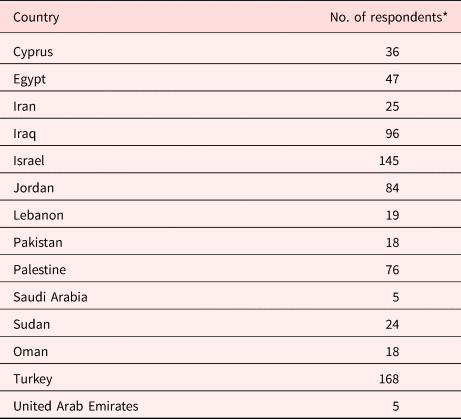
The Middle East Cancer Consortium (MECC) connects oncology staff from 14 countries to advance cancer research and treatment in our region. The questionnaire was distributed to all individual MECC members; those members who chose to join in the study (the study coauthors) then distributed the questionnaire by their institutional mail to all the oncology physicians and nurses in the institutions where they work. Thus, to obtain a diverse sampling of a large number of Middle Eastern oncology staff, this convenience sample draws nonselectively from all relevant staff in self-selecting institutions from a broad range of Middle Eastern countries. The large sample size was in part intended to compensate for potential response bias. We further attempted to reduce response bias by sending two reminders to potential respondents over the course of the 5 months from the time the survey was distributed to the final date for returning completed questionnaires (July–November 2015). After that period, the participating members each reported their response rates. We received 834 completed questionnaires from 14 countries, with a response rate of 79% for nurses and 63% for doctors. The original questionnaire underwent a process of translation and reverse translation by academic hospital staff to identify and correct any introduced changes in meaning. Questionnaires were distributed in Arabic, Persian, Turkish, and Hebrew. The inclusion criterion was caring for patients with advanced cancer. Of the 834, 21 were excluded because they did not answer the key study question regarding treatment of respondents' three most recent terminal cancer patients. The questionnaire also contained an inclusion test question: “What percent of your patients have advanced cancer?” Respondents answering “none” were excluded, leaving a total of 770 respondents (59% nurses, 39% physicians, 2% missing), listed by country in Table 1. The study was reviewed and approved by the institutional review board of the first author's hospital.
Respondents by country

*Missing = 4.
Measures
Items taken from the RSCC study included a definition and examples of spiritual care for respondents to read, followed by Likert-type questions regarding how often they think nurses and physicians should provide at least some form of spiritual care and how often they do so themselves. Where questions referred to nurses and physicians, they were asked to respond regarding their own profession. Respondents were then asked the key study question, as had been asked in the RSCC study: “Think back to the past three advanced, incurable cancer patients you saw. To how many of those patients did you provide ANY type of spiritual care during the course of their treatment?” A 13-item Likert-type question assessed their sense of those barriers limiting the respondent from providing spiritual care him or herself. Last, two yes/no questions ascertained whether or not respondents had undergone any spiritual care training and whether or not they would be interested in undergoing such training.
Demographic and professional items included gender, religion, religiosity, spirituality, and city and country of residence; institutional work setting, profession, field of oncology; and number of years of experience. Respondents were also asked two Likert-type questions regarding the extent to which their religious/spiritual (r/s) beliefs affect their practice of medicine and the extent to which they judge spiritual wellbeing to contribute to patients' quality of life.
Statistical analysis
In a bivariate analysis, most of the demographic and professional items as well as the items regarding the significance of spirituality were significantly associated with nonprovision of spiritual care. We took those significantly associated items, as well as all the items relating to barriers to spiritual care provision, and entered them into a multivariable forward stepwise regression analysis of the association of these variables with the nonprovision of spiritual care. We also tested for interaction effects in the bivariate analysis. The area under the receiver operating characteristic (ROC) curve was used as a measure of multivariable model discrimination. We used the chi-square test to compare distributions between responses, grouped by human development index (HDI), in terms of respondent demographic and professional characteristics and attitudes regarding spiritual care. Two-tailed p values ≤ 0.05 were considered as statistically significant.
Statistical analyses were performed with SPSS (Statistics Products Solutions Services), version 21.0, software for Windows.
Results
Sample characteristics
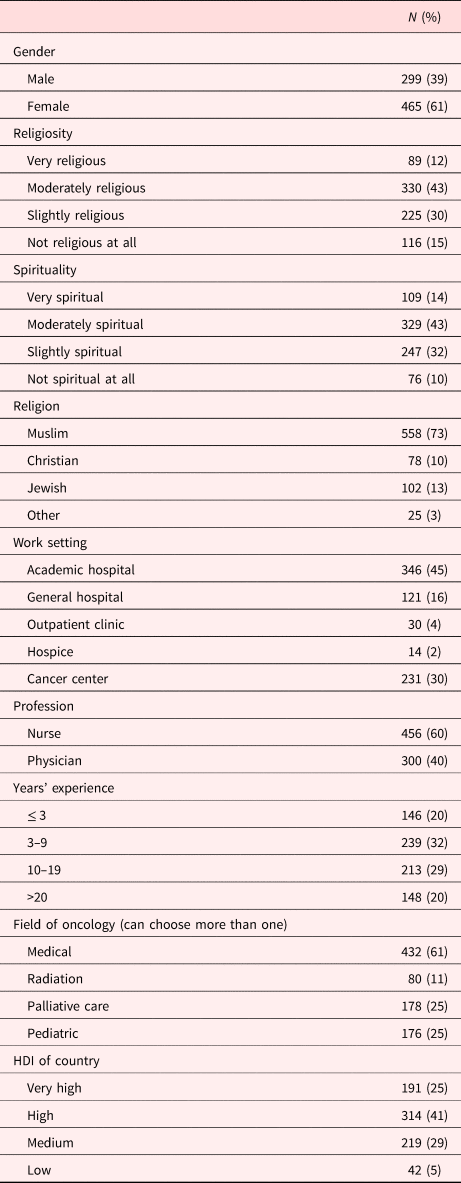
Sixty percent of respondents were female; 39% were physicians and 59% nurses; 72% of respondents were Muslim, 10% Christian, and 13% Jewish; 54% of respondents self-described as religious and 57% as spiritual; 45% work at an academic hospital; 50% had fewer than 10 years of work experience; and 23% work in palliative care (Table 2).
Sample characteristics

HDI, Human Development Index. Percentages exclude missing response values.
Frequency
When asked how often oncology nurses or physicians should provide any type of spiritual care at any point in their care for advanced cancer patients, 7% responded “never” or “rarely,” 11% responded “seldom,” 21% responded “occasionally,” 28% responded “frequently,” and 32% responded “almost always” or “always” (missing = 4). Comparing these results with responses regarding how often they themselves provide any type of spiritual care at any point in their care, we found that 44% do so less often than they think nurses or physicians should generally do so, whereas 21% do so more often than they think it should generally be done.
Actual recent care provision
Testing these responses against recent experience, the next question enquired about spiritual care provision at any point in caring for respondents' three most recent advanced, incurable cancer patients. It was found that 31% did not provide any spiritual care to any of them; 24% to one; 20% to two; and 26% to all three. After transforming these results into an absolute tally, we find that respondents provided some form of spiritual care to 47% of their patients. Of those who provided no spiritual care to any of their last three patients, 34% had said that staff should provide spiritual care frequently, almost always, or always; another 33% had said that staff should do so occasionally (Table 3).
Respondents' views regarding how commonly staff should provide some kind of spiritual care, as a percentage of those respondents who actually provided spiritual care to 0, 1, 2, or 3 of their last three advanced cancer patients

Frequently, almost always, or always corresponded with 5, 6, and 7, respectively, on a 7-point Likert scale. Occasionally corresponded with 4 on the 7-point scale.
HDI
The HDI is a more robust measure of a country's level of development than economic growth alone. Grouping respondents by the HDI of their home country (low, medium, high, very high), we found a significant (p < 0.001) difference between respondents from countries with medium HDI and those from either high or very high HDI (only 5.4% of respondents came from low HDI countries, and the difference between that small group and the other groups was not significant). Respondents from a medium HDI country were much more likely to desire to provide (p < 0.001) and actually provide spiritual care (p = 0.037) than those from a high or very high HDI country. This result consistently persisted, even when testing for interaction effects with other demographic and professional items.
Training
Seventy-seven percent of respondents had not received any training in spiritual care provision. When asked whether they would want such a course, 77% said that they would. We examined the factors that were significantly associated with having received such training. Findings included desired (p = 0.003) and actual (p < 0.001) frequency of spiritual care provision and personally providing it more often than one thinks it generally should be provided (p = 0.001), being more religious (p = 0.01) or more spiritual (p = 0.04), working in hospice (p = 0.003) or in palliative care (p < 0.001), having more than 3 years of experience (p = 0.005), and higher HDI (p = 0.002).
Perceived barriers
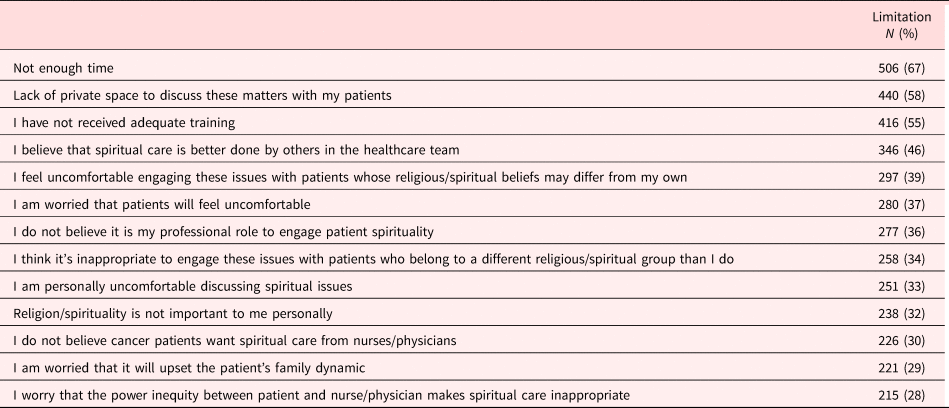
Respondents stated how important they think various factors are in limiting their own provision of spiritual care, summarized in Table 4. Three items were cited by more than one-half the respondents: lack of time (66%), lack of private space (58%), and inadequate training (54%). Items regarding perceived barriers showed good reliability (Cronbach's alpha = 0.86).
Self-reported significance of various factors potentially limiting respondents’ own spiritual care provision

Responses dichotomized to “not significant/slightly significant” versus “moderately significant/very significant.” Percentages exclude missing response values.
Barriers to actual spiritual care provision
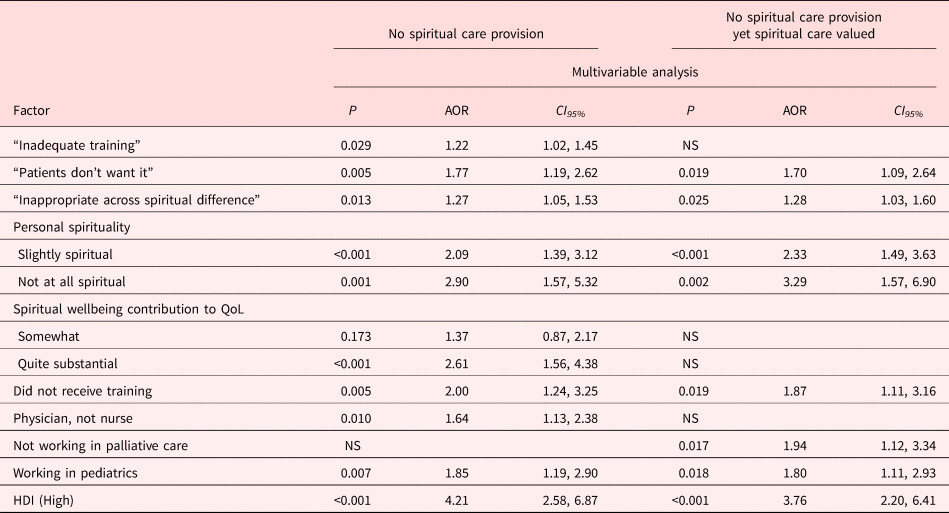
In trying to understand the predictors of not actually providing spiritual care (i.e., the barriers to spiritual care provision), we examined two groups. The first analysis examined those who provided any spiritual care to at least one of their last three terminal patients (69%) versus those who did not (31%). The second analysis focused on those who thought that spiritual care should be provided by staff at least occasionally (81% of the whole sample) and compared those who actually did so with at least one patient versus those who did not. This latter group (21% of the whole sample), which has a positive outlook toward spiritual care provision yet does not provide it in practice, could perhaps better be considered the group with “unrealized potential” for spiritual care provision. We carried out multivariable analyses with the whole sample and with this subset to see which factors were predictors of not actually providing spiritual care, with the resulting models presented in Table 5.
Multivariable analysis of factors significantly correlating with actual nonspiritual care provision among all respondents and among those respondents who responded that spiritual care should generally be provided at least occasionally

CI 95%, 95% confidence interval; HDI, Human Development Index; NS, not significant; QoL, quality of life.
Actual care provision dichotomized to no patients versus one or more patients. The first three items are shorthand for the study items “I have not received adequate training,” “I do not believe cancer patients want spiritual care from nurses/physicians,” and “I think it's inappropriate to engage these issues with patients who belong to a different religious/spiritual group than I do.” Reference point for personal spirituality item was a response of either “very spiritual” or “moderately spiritual.” Answer options regarding spiritual wellbeing's contribution to QoL were “not at all” (reference point), “somewhat,” “substantially,” and “quite a lot,” where the latter two were combined into the previous “quite substantial.” HDI was dichotomized to medium versus high (all other options). Items in the multivariable analysis included all 13 perceived barriers to spiritual care provision, religiosity, spirituality, impact of religion/spirituality on medical practice, attitude toward spiritual wellbeing's contribution to patient QoL; receipt of spiritual care training, profession, and field of oncology; gender, country, and HDI.
In the multivariable analysis, demographic factors including personal spirituality, not having received training, and HDI, as well as self-identified barriers to care provision, including the perception that patients do not want spiritual care and it being inappropriate across spiritual difference, were significant in both the full study sample and the group with “unrealized potential.” Field of oncology and professional role were each significant in one of the groups. The full study model, presented in the first half of Table 5, was a robust predictor of not providing spiritual care, with a ROC area under the curve of 0.764 (p < 0.001, 95% confidence interval [CI 95%] = 0.724, 0.799). The “unrealized potential” model in the second half of Table 5 was also quite strong, with a ROC area under the curve of 0.713 (p < 0.001, CI 95% = 0.665, 0.761).
Given the significance of the perceived barrier of spiritual care being inappropriate across staff-patient r/s difference, and to identify cross-cultural differences, we examined which countries' respondents were more likely to share the sense that this is a barrier. The countries most likely to perceive it as a barrier were Iraq (51.0%), Jordan (49.4%), Iran (44.0%), and Palestine (40.0%). The countries least likely to identify it as a barrier were Israel (9.0%), Cyprus (19.4%), and Sudan (20.8%).
Discussion
The provision of spiritual care by the whole medical team is not only part of the guidelines for palliative care, but it has proven benefits, being associated with lowered end-of-life costs, greater use of hospice (Balboni et al., Reference Balboni, Balboni and Paulk2011), increased patient quality of life at the end of life (Balboni et al., Reference Balboni, Paulk and Balboni2010), and increased patient satisfaction (Astrow et al., Reference Astrow, Wexler and Texeira2007; Williams et al., Reference Williams, Meltzer and Arora2011). Yet in practice spiritual care continues to be provided less frequently than patients would desire (Balboni et al., Reference Balboni, Sullivan and Amobi2013) and even less frequently than staff themselves think it should be provided.
In this Middle Eastern study, as in other parts of the world, staff affirmed the positive contribution of spiritual care appropriately delivered by physicians and nurses (Balboni et al., Reference Balboni, Sullivan and Amobi2013; King et al., Reference King, Dimmers and Langer2013). Yet, as elsewhere, although the large majority of physicians and nurses think that they should provide some spiritual care at least occasionally, in practice there is a large gap between desired and actual spiritual care provision (Balboni et al., Reference Balboni, Sullivan and Enzinger2014).
We analyzed the data in two different groups. The first analysis aimed to understand the factors relating to the nonprovision of spiritual care in general, across the entire sample. The second analysis focused on those respondents, 81% of the sample, who showed a positive disposition toward spiritual care provision by responding that staff should provide some spiritual care at least occasionally and comparing those who actually did do so and those who did not. Those who are positively inclined toward spiritual care provision yet do not do so themselves, 21% of the sample, could be considered the highest priority “target” group for efforts to break down the barriers to increase spiritual care provision.
What can be done to improve rates of actual spiritual care provision among those who already presuppose the value of spiritual care? In our findings, the strongest factor that could potentially be addressed is personal spirituality, distinct from religiosity (HDI, although a stronger factor, is not subject to intervention). Spirituality is a universal part of human experience (Puchalski et al., Reference Puchalski, Ferrell and Virani2009), but many people are not comfortable speaking about spirituality. Awareness of one's own spirituality makes staff more sensitive to understanding patients' spirituality and more comfortable speaking with patients about it (Lemmer, Reference Lemmer2010; Mitchell et al., Reference Mitchell, Epstein-Peterson and Bandini2016; Paal et al., Reference Paal, Helo and Frick2015; Rassoulian et al., Reference Rassoulian, Seidman and Löffler-Stastka2016; Selby et al., Reference Selby, Seccaraccia and Huth2016). Recent surveys of medical students suggest that engaging their spirituality in the context of their studies and their work is something that students desire and that they expect will help them provide spiritual care to their patients (Mitchell et al., Reference Mitchell, Epstein-Peterson and Bandini2016; Rassoulian et al., Reference Rassoulian, Seidman and Löffler-Stastka2016).
Several recent studies reporting on educational programs for healthcare providers (Baldacchino, Reference Baldacchino2015; Heydark et al., Reference Heydari, Meshkinyazd and Soudmand2017; Marom, Reference Marom2015; Paal et al., Reference Paal, Helo and Frick2015; van de Geer et al., Reference van de Geer, Groot and Andela2017; Vlasblom et al., Reference Vlasblom, van der Steen and Knol2011; Zollfrank et al., Reference Zollfrank, Trevino and Cadge2015) and students (Anandarajah et al., Reference Anandarajah, Roseman and Lee2016; Mitchell et al., Reference Mitchell, Bennett and Manfrin-Ledet2006, Reference Mitchell, Epstein-Peterson and Bandini2016) included an element designed to help participants understand and articulate their spiritual approach and attend to their own spiritual needs. A few of these studies also report on the effect this training had on patient care, including an increase in spiritual care provision (van de Geer et al., Reference van de Geer, Groot and Andela2017; Zollfrank et al., Reference Zollfrank, Trevino and Cadge2015) and in spiritual screening and making referrals to the spiritual care provider (Vlasblom et al., Reference Vlasblom, van der Steen and Knol2011).
However, those educational interventions included a number of elements, only one of which focused on spiritual self-awareness, and they were mostly provided to a small, self-selecting group of healthcare professionals. Our findings provide an empirical basis with a large study set of respondents across professions, cultures, and countries for demonstrating that how one relates to one's own spirituality is a key factor affecting actual patient spiritual care provision, further justifying the inclusion of this element in staff training programs. From an international, cross-cultural perspective, the results relating to the HDI suggest that these efforts are particularly important in countries with a higher HDI.
In comparing the perceived and actual barriers to spiritual care provision, our results closely mirrored those of the RSCC study in the United States, showing remarkable similarity across cultural differences. We examined 13 possible perceived reasons that would limit staff provision of spiritual care; the top three results, the only ones identified by more than one-half the respondents, were identical in both studies: lack of time, lack of private space, and insufficient training (Balboni et al., Reference Balboni, Sullivan and Amobi2013, Reference Balboni, Sullivan and Enzinger2014). When comparing those results with actual care provision, both studies discovered that perceiving lack of time or lack of private space as a barrier to spiritual care provision did not actually correlate with the nonprovision of spiritual care. Rather, the barrier rated highest by respondents actually correlated with not providing spiritual care is inadequate training, a result that persists in the multivariable analysis in both studies. Thus, we find remarkable consistency across cultures in examining the actual barriers to spiritual care provision.
In our analysis, actual receipt of training was an even stronger factor than respondents' perception of the significance of having received training. We did not enquire as to the content of their training, and there may be significant variation. Undergoing training correlated in our study with a more positive attitude toward the provision of spiritual care, but even within the subgroup of those who think spiritual care should be provided (Table 5), training is a key factor in determining actual care provision. Thus, it seems not to be the case that those positively predisposed to spiritual care are more likely both to undergo training and to provide care, but rather that training is a cause of greater spiritual care provision. Given that only 22% of respondents reported having received any such training, this area seems highly significant in attempts to increase staff spiritual care provision, particularly if the training model used also engages staff regarding their own spirituality.
Aside from inadequate training, the other two self-identified barriers that persisted in at least one of the multivariable analyses were not believing that patients want staff to provide spiritual care and worrying that it would be inappropriate to do so with patients coming from a different religious/spiritual group.
The first of these was also significant in the RSCC study and elsewhere (Balboni et al., Reference Balboni, Sullivan and Enzinger2014; King et al., Reference King, Dimmers and Langer2013). Patient attitudes toward spiritual care provision have not been as well-studied in the Middle East as in the United States, but the existing findings suggest that Middle Eastern patients (Ben-Arye et al., Reference Ben-Arye, Bar-Sela and Frenkel2006), as with American patients (Ehman et al., Reference Ehman, Ott and Short1999; McCord et al., Reference McCord, Gilchrist and Grossman2004; Phelps et al., Reference Phelps, Lauderdale and Alcorn2012), do indeed want spiritual care from their medical team.
The second item, inappropriateness across r/s difference, was added specifically for this study, given the significant and, at times, violent tensions in our region between different religious groups, even within the same country. Indeed, our results show that staff members have real concerns about raising the topic of religion or spirituality with patients coming from a different background than theirs, perhaps feeling it could lead to negative interactions. Although this was a significant factor, it was true even in countries that are nearly homogenous religiously.
Future study should consider further refining the items relating to personal spirituality to identify particular elements most worth targeting in educational programs for staff so as to reduce the barriers to staff spiritual care provision.
A notable limitation to the study is some self-selection bias inherent to the study design. Oncology physicians and nurses who choose to join MECC, and even more so the subset who chose to help lead this study, are self-selecting in their desire to collaborate and in their positive views of palliative care. Even though questionnaires were then distributed to the entire staff of physicians and nurses in their oncology departments to mitigate against this bias, it is likely that there is a qualitative difference within a given country between those institutions working with MECC and those in which no MECC members work. An additional limitation is that this study was conducted among oncology staff and thus the results may not carry over to other clinical areas.
Conclusions
In the Middle East, as elsewhere, nearly one-half the staff members say that they would like to provide spiritual care more often than they actually do. In considering how best to increase the percentage of staff providing spiritual care, as mandated by palliative care guidelines, it is worth focusing on the “unrealized potential” group, those who think staff should be providing spiritual care, yet themselves do not do so. The most commonly perceived barrier shown to actually reduce care provision is insufficient training and, in fact, 77% of respondents lacked such training. However, the single strongest predictor of not providing spiritual care was not personally relating to spirituality. Thus, efforts to encourage spiritual care provision should consider how to bridge the gap to reach those who do not see themselves as being spiritual. Training programs and other efforts can help staff personally connect to the idea of spirituality, such as by helping staff to find the personal points of connection to spirituality in their work.
Acknowledgments
The authors thank the Middle East Cancer Consortium and the Technion–Israel Institute of Technology in Haifa for their generous support, Mrs. Genoveba Breitstein for her meticulous administrative work throughout, and Dr. Tracy Balboni for her permission to use the questions she developed for the Religion and Spirituality in Cancer Care study.
Conflicts of interest
The authors declare no conflicts of interest exist for any author.