INTRODUCTION
Austrominius modestus (Darwin, Reference Darwin1854), formerly known as Elminius modestus Darwin, Reference Darwin1854, is an Australasian species of barnacle, which was accidentally introduced to Britain in the 1940s, whence it spread to continental Europe and Ireland. On coasts of continental Europe, its current invasive range is from Denmark (where it is thought to be close to its northern continental limit; Jensen & Knudsen, Reference Jensen and Knudsen2005) to southern Portugal (Southward, Reference Southward2008; Buckeridge & Newman, Reference Buckeridge and Newman2010), as well at two sites in the Mediterranean: Thau Lagoon, Marseilles (Zibrowius, personal communication, cited in O'Riordan & Ramsay, Reference O'Riordan and Ramsay1999); and in the lagoon of Venice (Casellato et al., Reference Casellato, Masiero, Sichirollo and Soresi2007; www1, http://www.cabi.org/isc/?compid=5&dsid=109096&loadmodule=datasheet&page=481&site=144-last accessed 22 October 2013). The authors are unaware of any records of this species occurring on the North African coast, where the native intertidal chthamalid barnacles Chthamalus montagui Southward, Reference Southward1976 and Chthamalus stellatus (Poli, Reference Poli1795) occur, with which Austrominius may compete.
Field surveys carried out between 2001 and 2007 showed that A. modestus had increased in abundance at a number of locations in Europe where it had previously been surveyed (e.g. see Lawson et al., Reference Lawson, Davenport and Whitaker2004; Simkanin et al., Reference Simkanin, Power, Myers, McGrath, Southward, Mieszkowska, Leaper and O'Riordan2005; O'Riordan et al., Reference O'Riordan, Culloty, Davenport and McAllen2009; Gomes-Filho et al., Reference Gomes-Filho, Hawkins, Aquino-Souza and Thompson2010; Witte et al., Reference Witte, Buschbaum, van Beusekom and Reise2010), including in a marine nature reserve, where it had started to dominate the intertidal (Lawson et al., Reference Lawson, Davenport and Whitaker2004). Witte et al. (Reference Witte, Buschbaum, van Beusekom and Reise2010) suggested that, towards the northern limits of its invasive range in Europe, climatic warming may have allowed an exponential population growth of this species, in effect the awakening of an ecological ‘sleeper’. However, the cold winters of 2009–2010 and 2010–2011 appeared to have adversely affected A. modestus, relative to other intertidal native barnacles on some shores (O'Riordan et al., in preparation). Crisp (Reference Crisp1964a, Reference Crisp and Crispb) and Harms & Anger (Reference Harms, Anger and Ros1989) suggested that A. modestus may suffer high mortality during cold winters, while it has been suggested that successive extreme years may limit the spread of certain non-indigenous species (Firth et al., Reference Firth, Knights and Bell2011; Urian et al., Reference Urian, Hate and Gilg2011). In comparison to A. modestus, Wethey et al. (Reference Wethey, Woodin, Hilbish, Jones, Lima and Brannock2011) reported an expansion of the range of the native arcto-boreal barnacle Semibalanus balanoides (Linnaeus, Reference Linnaeus1767) in both France and Iberia, due to enhanced recruitment, following the 2009–2010 severely cold winter, while two Lusitanian barnacle species, Chthamalus stellatus (Poli, Reference Poli1795) and Chthamalus montagui Southward, Reference Southward1976, showed recruitment failure at their northern limit in continental Europe.
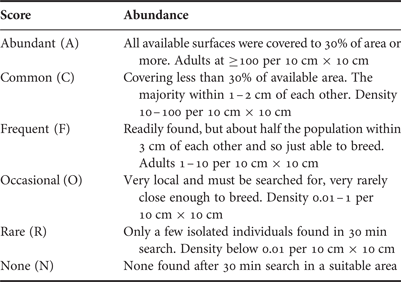
In spring 1998, O'Riordan & Ramsay (Reference O'Riordan and Ramsay1999) had recorded the then most southerly limit of A. modestus in continental Europe, at Praia de Faro, in the Algarve, Portugal. At that time at Praia de Faro, the species was found to be ‘occasional’ (very local and must be searched for, very rarely close enough to breed; density 0.01-1 per 10 cm × 10 cm). The objective of the present re-surveys was to assess the current abundance at that site and also to examine two other sites, one where it had previously been recorded as absent and another site which had not been checked previously. The authors believe that it is worthwhile to monitor the distribution and abundance of this non-indigenous species, in the context of the variable climate being experienced in this last decade in Europe, which may have implications for the balance of native and non-indigenous species on intertidal shores.
MATERIALS AND METHODS
Two shores on the southern coast of Portugal were examined for the presence of the non-indigenous barnacle Austrominius modestus on 31 March 2011 (Praia de Faro; GPS: 37°00′28.2″N 07°59′39.8″W) and 1 April 2011 (Praia da Oura, near Albufeira: GPS: 37°05′4.8″N 08°13′0.9″W) and 29 March 2012 (both shores). At the first site, Praia de Faro, which is located in a coastal lagoon and is estuarine, the bridge pillars, mussels and rocks were examined. The second site, Praia da Oura, is oceanic and consists of rocky outcrops amongst a predominantly sandy shore and was examined since it has been the location of an undergraduate field course for the last 18 years. This shore is exposed enough to have the presence of honeycomb worms Sabellaria species in the intertidal. A third site (Alvor Harbour GPS: 37°07′40.6″N 08°35′45.5″W) was examined on 14 April 2013 only. At this site the walls of the pier, two slipways, pillars supporting two jetty walkways, as well mussels and rocks were examined. Abundance at the three sites was assessed, during low water (at a height of ~1 m above chart datum), utilizing the abundance scale (see Table 1) used previously by O'Riordan & Ramsay (Reference O'Riordan and Ramsay1999). In the field, a small number of individuals were examined for the presence of embryo masses and the isopod parasite Hemioniscus balani.
Scale for scoring the abundance of Austrominius modestus, modified from Crisp (Reference Crisp1958).

RESULTS
Praia de Faro
On 31 March 2011, Austrominius modestus was scored as frequent at Praia de Faro, where it was found on the bridge pillars, mussels and stones, where two other species of barnacle were recorded: Chthamalus montagui; and Amphibalanus amphitrite (Darwin, Reference Darwin1854). Six out of 20 Austrominius modestus examined had fertilized embryos and young metamorphs and attached cyprids (confirmed based on length and carapace shape (Al-Yahya, Reference Al-Yahya1991; Southward, Reference Southward2008), by examination under a microscope in the laboratory) were found. When the same site was examined on 29 March 2012, Austrominius's abundance according to the SACFOR scale was still frequent (adults 1–10 per 10 cm × 10 cm), but it had increased in abundance within this category. Three out of five animals examined contained fertilized embryos. No isopod parasites were found on either date.
Praia da Oura, near Albufeira
On 1 April 2011, no A. modestus were found on the rocky outcrops at Praia da Oura. On 29 March 2012, within the 30 min search time, four A. modestus were found attached to a loose rock, amongst the rocky outcrops, so they were recorded as rare. Two of the four were close enough to breed, but were not sacrificed to check for fertilized embryos or parasites. The dominant intertidal barnacle species recorded on this shore in 2012 was C. montagui.
Alvor Harbour
On 14 April 2013 A. modestus was scored as occasional at Alvor Harbour, being found mostly on the jetty pillars, but also on some rocks on the lower shore. Chthamalus montagui and Amphibalanus amphitrite were also present. A third balanid species also occurred. Its external appearance resembled Amphibalanus improvisus (Darwin, Reference Darwin1854), but its identity would need to be confirmed in the laboratory.
DISCUSSION
The first published record of the Australasian species of barnacle Austrominius modestus in Europe was in 1945, in Chichester Harbour, UK (Bishop, Reference Bishop1947). During the subsequent 20 years it spread around the UK, to mainland Europe, as well as to Ireland, by a combination of marginal (e.g. by larval dispersal) and remote dispersal, by vectors such as shipping, movement of species associated with aquaculture etc. (Crisp, Reference Crisp1958; www1, http://www.cabi.org/isc/?compid=5&dsid=109096&loadmodule=datasheet&page=481&site=144-last accessed 22 October 2013). The rate of secondary spread was estimated as 20–70 km per year (Bishop & Crisp, Reference Bishop and Crisp1958; Geller, Reference Geller1994). The remarkable fecundity of A. modestus, its extended settlement period, short generation time, and the fact that it is euryhaline and eurythermal, were thought to be responsible for its rapid colonization of new shores in the UK and Europe (Crisp & Chipperfield, Reference Crisp and Chipperfield1948; Crisp & Davies, Reference Crisp and Davies1955; Barnes & Barnes, Reference Barnes, Barnes and Barnes1966; O'Riordan & Murphy, Reference O'Riordan and Murphy2000; Allen et al., Reference Allen, Power, O'Riordan, Myers and McGrath2006). However, one of the factors that limited the spread of this species is that it is an obligatory cross-fertilizing hermaphrodite (Crisp, Reference Crisp1958). Crisp (Reference Crisp1958) pointed out that the density of the initial population is of critical importance. Unless introduced cyprids, or those produced in the lifetime of the introduced individuals, can settle at such a density that a sufficient number are within 5 cm of each other, the colony will never establish itself, i.e. a critical breeding density is needed.
Previous surveys of the Portuguese coast (see O'Riordan & Ramsay, Reference O'Riordan and Ramsay1999 and references therein, as well as Cruz & Castro, Reference Cruz and Castro2011) have found Austrominius occurring mostly in habours, ports and estuaries. The present survey found that at the coastal lagoon site at Praia de Faro, where this species had been first recorded in 1998, this species had increased in abundance, over the 13 years to 2011, but only from occasional to frequent. Cruz & Castro (Reference Cruz and Castro2011) also sampled this shore in their 2010/2011 survey, as part of the 24 shores that they surveyed for this barnacle during the INSPECT project. At Praia de Faro they recorded A. modestus as frequent (attached to rocks) or occasional (attached to mussels). This species is well established at this site, as evidenced by its increase in abundance in 2012, albeit still being scored as frequent. One limiting factor at this site may be the abundance of other barnacle species, which may be competing for space.
The first record of this species at Praia da Oura in 2012 is interesting, as it is an oceanic shore, but considering that only four specimens were found, albeit two of them being close enough to breed, it is unlikely to become established, unless new colonizers arrive. Although this shore was formally surveyed in 1998, 2011 and 2012 only, it has been checked in most years in March/April between these dates and no A. modestus had previously been recorded, despite searching the shore for many hours on each occasion. Cruz & Castro (Reference Cruz and Castro2011) did not survey oceanic shoes on the Algarve coast, but have found A. modestus on oceanic shores on the western Portuguese continental coast (J. Castro & T. Cruz, personal communications).
The third site examined in the present survey, at Alvor, had not previously been examined by the authors, but the presence of A. modestus was not surprising, considering its harbour location and the proximity of the estuary.
It would be of interest to continue monitoring these shores, but also shores further south towards the Mediterranean, as well as the two Mediterranean populations (Thau Lagoon, Marseilles, France and in the lagoon of Venice, Italy) and shores nearby them. Although currently Faro is the most southerly published confirmed record of its occurrence in the northern hemisphere, it would be worth investigating whether this eurythermal species occurs and can survive further south towards the strait of Gibraltar or on the North African coast.