

Background
Day-surgery operation numbers have increased considerably within the last 20 years and there is a possibility for further expansion [Mattila, Reference Mattila2010]. In Finland, in 2010, from all the elective operations, 56% surgeries were performed as day surgery [National Institute for Health and Welfare, Stakes, 2010]. In Great Britain, the National Health Service Plan (Department of Health) set the target at 75% for all non-urgent operations should be performed as a day surgery by the year 2010 [Coll et al, Reference Coll, Ameen and Moseley2004]. Technological advances have made it possible for day surgery to increase. There are now more sophisticated anaesthetic agents and techniques and careful post-operative pain relief [Heino, Reference Heino2005; Gilmartin, Reference Gilmartin2007]. The whole day-surgery care process should be planned with care, so that economical benefits – cost-effectiveness and increased patient satisfaction, together with low infection rates – are materialised. [Haapakoski and Annila, Reference Haapakoski and Annila2006; Gilmartin, Reference Gilmartin2007].
The counselling concept can be defined as the goal-directed activity between the client and the nurse, which is tied to their background and takes a form of interactive mentorship [Kääriäinen and Kyngäs, Reference Kääriäinen and Kyngäs2005]. Patient counselling is the central part of care and it has importance in achieving a positive outcome in the day-surgery setting, by increasing patients’ survival during the day-surgery procedure and postoperatively at home. [Gilmartin and Wright, Reference Gilmartin and Wright2007; Mitchell, Reference Mitchell2010]. Most patients feel that they need help at home, for a minimum of the first three post-operative days [Young et al, Reference Young, O'Connell and McGregor2000]. Patients find the home care counselling inadequate and it does not always match expectations. In addition, staff's counselling attitudes have shown to be partially negative. [Mordiffi et al, Reference Mordiffi, Tan and Wong2003; Heino, Reference Heino2005; Gilmartin, Reference Gilmartin2007; Heikkinen et al, Reference Heikkinen, Leino-Kilpi, Hiltunen, Johansson and Rankinen2007; Kääriäinen, Reference Kääriäinen2007]. Another challenge for counselling is the increasing educational level of the population and increased use of information technology. Patients look for information and know how to utilise it. Their role as the subject of their own care and the ability to focus and taking responsibility of their own care is strengthening, which has to be considered when delivering counselling. [Young et al, Reference Young, O'Connell and McGregor2000].
Reported shoulder pain has tripled in Great Britain in the past 40 years [Harkness et al, Reference Harkness, Macfarlane, Silman and McBeth2005], and the shoulder operations as day surgery are more common. In 2008 shoulder arthroscopies, rotator cuff repairs or re-attachments were the most common day-surgery procedures in Finnish Central Hospitals [Peltokorpi et al, Reference Peltokorpi, Torkki and Tan2010]. To achieve a successful day surgery in shoulder operation requires good operative technique, successful pain relief together with planned continuous follow-up rehabilitation, involving the whole care team. [Järvelä, Reference Järvelä2004]. Counselling of a patient who has undergone a shoulder operation is challenging. The patient contact is short and various professional groups participate in counselling. This investigation is topical as day-surgery shoulder operations are on the increase and there are challenges and deficiencies, which have arisen within patient counselling.
In this study, the day-surgery care assessment process includes the patient's pre-, intra- and post-operative care periods. It includes target-oriented discussions and written instructions. With this counselling, the patient receives cognitive and emotional support during the day-surgery process.
The purpose of the study
The purpose of the study was to describe the shoulder operation counselling in day surgery from the patients’ perspective. The aim was to produce information for patient counselling on the day-surgery unit.
The research function question is:
Does counselling improve the experience of patients undergoing day shoulder surgery?
Material and methods
The data were collected in spring 2012 using thematic interviews. To understand the phenomena, there is need for individual descriptions, where the experiences, events and individual cases are in focus. [Burns and Grove, Reference Burns and Grove2009; Kankkunen and Vehviläinen-Julkunen, Reference Kankkunen and Vehviläinen-Julkunen2009].
The study focused on adult patients undergoing shoulder operation in Central Hospital day-surgery unit (n = 9). Patients were contacted by letter before the operation, to ask their willingness to participate. Willing participants gave informed consent. The thematic interviews took place in participants’ homes, approximately one week after the operation. Interview themes arose from day-surgery care process: the pre-operative, intra-operative and post-operative phases. Interview themes were:
1. the counselling on the day of the surgery, before transferring into operating theatre (OT);
2. the counselling at the intra-operative period;
3. post-operative period, the time of discharge and managing at home.
The duration of the interviews was about an hour. All the participants gave their permission to record the interviews.
Data analysis
The data analysis was used throughout the study, starting from interviews, where the researcher noted events and their frequency, repetition and special cases [Hirsjärvi and Hurme, Reference Hirsjärvi and Hurme2008]. The data were analysed using inductive content analysis process. The data were transcribed and coded after the interviews. The researcher read the transcribed data repeatedly, generating thoughts, questions and general view. The statements and thoughts corresponding to research questions were collected from the data. Contextually, similar plain expressions were grouped under same subcategories, saving the codes. Subcategories were re-grouped into categories and again main categories, using Microsoft Word® word processor [Kylmä and Juvakka, Reference Kylmä and Juvakka2007; Hirsjärvi and Hurme, Reference Hirsjärvi and Hurme2008; Kankkunen and Vehviläinen-Julkunen, Reference Kankkunen and Vehviläinen-Julkunen2009].
Ethical issues
When choosing the subject for investigation, it is important to research its justification, benefits and sensitivity [Holloway and Wheeler, Reference Holloway and Wheeler2000; Kylmä and Juvakka, Reference Kylmä and Juvakka2007]. The subject of this study was considered from many different viewpoints before deciding on it, also utilising the suggestions from the care environment. There are no national research results regarding this particular subject group. The result benefits of this study are justified because it follows current trends and includes the legal aspects of patients’ rights, together with the benefits to nursing care, to patients, care staff and to the health-care system as a whole.
Analytical accuracy strengthens the clarity of the analytical process and ensures the logicality of the groupings or categories [Kankkunen and Vehviläinen-Julkunen, Reference Kankkunen and Vehviläinen-Julkunen2009]. Thus, the processes in the content analysis are presented as accurately as possible and direct citations were used in the study results to increase trustworthiness.
The researcher has a long experience of day-surgery nursing and counselling and has genuine interest for the research phenomena, which increases the trustworthiness of the research [Tuomi and Sarajärvi, Reference Tuomi and Sarajärvi2002; Kankkunen and Vehviläinen-Julkunen, Reference Kankkunen and Vehviläinen-Julkunen2009]. Conversely, knowing the research subject may weaken the trustworthiness as the researcher might have prejudices towards the results that can cause misinterpretations in the results [Leino-Kilpi, Reference Leino-Kilpi2008]. To prevent this, the researcher strives knowingly for objectivity during the whole research process avoiding prejudices.
Results
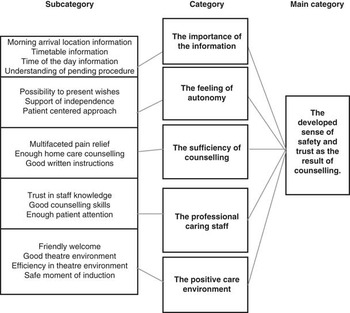
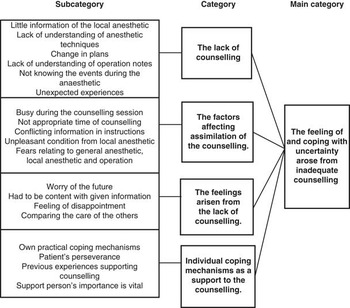
Content analysis produced nine categories in total for experiences and the feelings evoked in the patients during the day-surgery process. The two main categories were composed of the nine categories (Figs 1 and 2).
The developed sense of safety and trust as result of counselling.

The feeling and coping with uncertainty arose from inadequate counselling.

The developed sense of safety and trust as the result of counselling
As a result of the analysis, the first main category was composed of the developed sense of safety and trust as a result of counselling (Fig. 1).
The importance of the information
The patients experienced arrival into the day-surgery unit as being safe, as they had prior knowledge of where to report. The patients who had visited the unit before were particularly relieved that they knew the unit's location. The pre-operative counselling concerning the daily routine given by doctors and nurses gave comprehension about the forthcoming events. The patients found it important to be informed about timetable changes. The information about where to wait created a feeling of safety for the patients:
Afterwards they told me clearly that please sit down to wait and we will come and collect you from here. This information was a relief (H3)
The information of the time of the day in post-anaesthesia care unit (PACU) was considered important, especially immediately after recovering from anaesthesia. Patients were satisfied when the staff told them of the approximate time relating to recovery, for example, when one can get up and when the discharge will take place:
In the PACU in front of me there was a clock, it was good that I could see the time of day (H2)
The feeling of autonomy
Being able to walk into the OT and positioning oneself on the operating table was considered important. Checking the patients’ identity and the side of operation in the OT door was an important aspect that supported their feeling of safety. The operating table used in shoulder surgery caused confusion in the patients; however, the positioning was guided well by the nurses. Responsibility of the patients’ own recovery was given to them according to their own feelings in the PACU.
The sufficiency of counselling
The pain relief counselling was experienced as good. The patients considered diverse pain relief counselling as important, as they understood the challenges that it holds. The patients received instructions on pain medication dosage, information of the side effects and combined effects and prospective pain. Accurate written instructions when prescribing pain medication was considered important. Using the cold compress on the shoulder had been beneficial. The patients considered counselling at the OT as sufficient, as the staff had explained about the monitoring devices, asked frequently how patients felt and kept the patients with local anaesthetic well informed during the operation. The patients considered it important to be informed about the normal recovery aspects, for example, when the anaesthesia in the arm ceases, how does it feel and how one can take care of the wound. Accurate instructions gave the patients confidence, which increased their feelings of safety:
Really well was said about the pain medication, what can be used at the same time, what you can't and what can be taken as addition and when you can take. Very clear instructions were received (H3)
The patients were satisfied with the written instructions. Rehabilitation guidance was considered useful, as they included instructions about physical exercises. Patients found the contact numbers in follow-up treatment booklet important:
In the follow-up treatment paper the nurse actually highlighted in yellow, that this is the number you call, if there are problems (H9)
The professional care staff
The patients valued the staff's educational attainments. They felt counselling was performed focusing on patient's needs. Practising the exercise instructions together with the physiotherapist was considered important. Patients trusted the nursing staff's skills and knowledge concerning counselling. Patients experienced the counselling as being undertaken in a professional manner, as the nurses sat next to the patient and gave their full attention to the patient during the session. The nurses encouraged the patients to ask questions and repeated the instructions if required. The patients also appreciated when they were left in peace if they so wished.
The positive care environment
A friendly environment and the feeling that they were welcome were considered important by the patients. They felt that the OT environment was pleasant and the staff were effective. The staff created a relaxed atmosphere in the OT, which patients felt reassuring. The general anaesthesia patients experienced the anaesthetic induction as safe and described it with detail. The patients felt that they were in safe hands and trusted the staff's professional skills. Staff did listen to the patients’ views and consideration was given to the patients’ opinions. Some of the patients undergoing local anaesthesia wanted to follow the procedure from the monitor:
I felt really good in there (OT) maybe the senses were already a little numb (laughter) (H7)
The feeling of and coping with uncertainty arose from inadequate counselling
As a result of the analysis, the second main category was formulated from the patients’ feelings of uncertainty that arose from inadequate counselling (Fig. 2).
Lack of counselling
Patients wished for more counselling regarding local anaesthetic techniques before and during the administration of the local injection. Patients experienced the need for more information about length of the procedure and frequency of the injections. Unawareness about the type of anaesthesia and whether it will change from the original plan outlined by the anaesthetic team created uncertainty:
They said that either local or general anaesthetic and I found out only when entering the theatre that I was to have a general anaesthetic (H8)
The patients wanted more information about the events during the operation and anaesthetic. Not knowing about the way they were treated during the general anaesthetic made them thoughtful. There was confusion regarding how they had returned to their hospital bed and whether their dignity was maintained during the operation. They did not understand what type of shoulder surgery had been performed and they did not understand the surgical notes.
Some patients had unexpected experiences. Hoarse voice, ear numbness and throat pain after anaesthesia confused the patients. The recovery in PACU took longer than expected. One could not get up even if they wanted to. Nausea and pain especially during first post-operative night surprised patients, together with total numbness of the arm that lasted for a long time.
Having an arm in a sling was thought to be complicated. Patients were not sure about how long they had to use it. Patients were confused about being unable to dress themselves while the arm was in the sling. Information about what type of clothing to be worn to allow easier access with a sling in situ was requested to be included in the ‘to be called in’ (TCI) letter.
Factors affecting assimilation of the counselling
Patients’ experience of counselling was affected if they felt rushed. Counselling periods were quick and the patients did not want to disturb the staff with additional questions when sensing they were busy. Patients in PACU who felt ‘washed out’, groggy and, on occasions, nauseous experienced the receiving and retaining of the discharge instructions as challenging. Thus, the time of the counselling was considered poor if the discharge instructions were given too soon after the operation:
But at that point when the nurse came to give discharge instructions, I can't quite remember, so I now said, please give the kidney dish again and I vomited every now and again and then I said, so now we can continue (H8)
The inconsistency of the discharge instructions, such as how to perform the arm exercises, booking further physiotherapy appointments and the length of the sick leave, created insecurity:
I nearly fell off the chair; I said what did you say? So, 3-months sick leave? That was what I was not prepared for and I heard this just before the operation, when the doctor interviewed me (H8)
Some patients had negative feelings, which affected their assimilation of the counselling. The patients had fears before the operation and in the OT. Previous bad experiences and unawareness of how pre-existing illnesses could affect the anaesthesia and operation gave rise to concerns. The local anaesthetic caused unpleasant feelings to the arm, which affected the patient's concentration, and the OT smell and coldness were experienced as unpleasant. Thus, a relaxed atmosphere among the staff during counselling reduced the patients’ fears and actions such as supplying a warm blanket gave the patients a pleasant feeling.
The feelings arisen from lack of counselling
Patients’ feelings of safety were affected by worries about the forthcoming events. They worried about the arm's incorrect manipulation after the operation and its effect on the outcome of the operation. They were scared of possible strong pain at home and wondered how they would manage at home.
Patients waited to meet the surgeon and felt disappointed if the visit did not take place. They expected definitive information about the operation and the recovery, and confirmation about the necessity of the operation:
The surgeon did not visit, they said the surgeon is coming, but he never came (H3)
Patients compared their own operation and counselling experiences with other patients and this had influenced expectations and assumptions about their own care:
I wondered, when the patient next to me was informed, that tomorrow they will phone and ask about the pain state. I thought let's see, if they phone me. But nobody called (H3)
Individual coping mechanisms as a support to the counselling
Patients had their own practical coping mechanism when recovering from the procedure. Perseverance appeared to be a way of tolerating pain and was utilised because of their reluctance to ask for help. Patients discovered pain medication's side effects and information about shoulder operations from the internet, comparing these with their own diagnoses and procedures. They adjusted pain medication instructions according to their own needs.
Patients discovered the way to dress and use the arm sling by experiments. Pillows were positioned under the arm to find the suitable resting position. To prevent armpit overheating, talcum powder and strips of cotton were used. The support persons played a pronounced role. At home, they gave concrete help and reassurance that the patients understood and followed discharge instructions:
…then the psychological side, that ‘argh’, when you are in pain, so then someone comforts… (H5)
Discussion
The results of the study demonstrated the significance of information regarding timescales. Information about the operating schedule and location of the waiting room was considered important. Patients wished to know the time when they woke up and they expected to be given the estimated time to be able to get out of bed and be discharged. Rhodes et al [Reference Rhodes, Miles and Pearson2006] and Renholm et al [Reference Renholm, Suominen, Turtiainen and Leino-Kilpi2009] have concluded that the patients wished for clear schedules at every phase of the care.
A positive nursing environment and patient-centred staff were considered as important factors affecting the counselling experience. Patients were pleased when they could walk to the OT and position themselves on to the operating table. Anaesthetised patients wondered afterwards how they were treated during this period and whether the patient's dignity was preserved. The results support the previous research knowledge, as it has been concluded that during the day-surgery process patients are worried constantly that their individuality is preserved [Rhodes et al, Reference Rhodes, Miles and Pearson2006] and they also find the degree of control important [Costa, Reference Costa2001]. It is justified to give the patients more information about the operation, what happens during the anaesthetic and to take this into consideration during pre-operative counselling. In addition, supporting the patients’ self-control during the counselling gives the patients the feeling that they can have an effect on their care.
The study also showed that patients felt that they had received enough counselling regarding pain relief and in coping with daily functions. However, the challenges in pain relief worried (some) patients, and thus it is recommended that there should be more emphasis in encouraging the patients to use pain medication regularly. Susilahti et al [Reference Susilahti, Suominen and Leino-Kilpi2004] noticed that it is important to counsel patients about using alternative pain relief methods. Thus, it is also recommended that the pain nurses’ skills be utilised when training the nurses who provide counselling.
The study reinforces the need for staff to use a range of counselling skills for the interactions to be successful. The patients feel that the allocated time, the calm approach, the ‘just being there’ and the encouragement are the pivotal positive part of the nurse's time [Rhodes et al, Reference Rhodes, Miles and Pearson2006; Gilmartin, Reference Gilmartin and Wright2008]. In addition, the study highlighted that the patients felt it was important that the nurses sit next to them during the counselling session.
It is clear that written instructions were important. In the patients’ opinion, it was important that the instructions were studied together with the nurses. Patients were satisfied with written physiotherapy instructions because of the inclusion of clear pictures. Salminen-Tuomaala et al [Reference Salminen-Tuomaala, Kaappola, Kurikka and Leikkola2010] reported that written instructions have a major part in ensuring that the patients’ continue their discharge care. It is recommended that to ensure that the instructions have been understood, the nurse would go through the written instructions together with the patient and the accompanying support person.
The study demonstrated that the patients experience that rushing and giving counselling too soon after the operation created insecurity and a failure to comprehend the information because of tiredness or nausea. Thus, effective timing of the counselling and presence of the support person is recommended.
Patients had surprising experiences post-operatively, for which they could not prepare themselves. For example, the hoarseness of the voice, long-lasting grogginess and nausea caused concerns in the patients. To dress using just one hand was difficult. It is recommended that, in the pre-operative counselling situation, we inform the patient of the possible effects caused by the procedures or the anaesthetic, so that the patients could prepare themselves better. In the TCI letter, it is advised that the information regarding wearing clothes that can be easily put on after the procedure is included. Nurses should offer help to the patients in changing their clothes and to guide the support person to do this.
The study highlighted that to meet the surgeon afterwards and to discuss the procedure gives the patient a positive experience of the care [Renholm et al, Reference Renholm, Suominen, Turtiainen and Leino-Kilpi2009]. The patients expect it to be part of the surgeon's responsibility to explain how the procedure progressed and the risks associated with it [Moore et al, Reference Moore, Ziebland and Kennedy2002]. The patients would have liked to meet the surgeon after the operation. Often, this did not materialise and the patients felt disappointed. They would have wanted information, what type of problem was found in the shoulder and whether the operation was necessary. They considered it important to thank the surgeon in person. In Lunnela's [Reference Lunnela2011] study, the patients reported that the surgeon was the most important person to give the counselling, but the patients also found the nurse's counselling important. Barthelsson et al [Reference Barthelsson, Lutzen, Anderberg and Nordström2003] reported that the patients could not remember anything from the surgeon's visit, because it was done too soon after the anaesthesia. Therefore, it would be justified to programme the surgeon's patient visit at the correct time after the operation to guarantee a more varied counselling experience.
During the clinical day, there are time and activity pressures for staff. However, an increase in emphasis on the resources for counselling would be beneficial to the patient's experience. Calm counselling interactions in an appropriate location pre- and post-operatively benefits the patient and creates a good starting point for the whole day-surgery process and for coping at home. Shoulder surgery patient's counselling is a multidisciplinary process. To educate all professionals together would give a new perspective to the counselling and would eliminate possible duplication. The nurses who familiarise themselves with the latest research results, recommendations and systematically assess the process aids in developing high-standard and quality day-surgery care [Swan et al, Reference Swan, Mc Ginley and Lang2002]. When developing the counselling process, it is important to regard and acknowledge suggestions from the patients’ own experiences [Rhodes et al, Reference Rhodes, Miles and Pearson2006] to ensure their well-being.