Introduction
Acute kidney injury after paediatric cardiac surgery has been reported previously in paediatric patients, including patients with single ventricle circulation. Reference Kwiatkowski, Menon and Krawczeski1,Reference Garcia, Natarajan, Walters, Delius and Aggarwal2 Moreover, systemic inflammation and fluid retention are common side effects of cardiopulmonary bypass associated with increased morbidity and mortality in this population. Reference Kwiatkowski, Menon and Krawczeski1–Reference Sasser, Dabal and Askenazi3 These factors get accentuated in the neonatal population due to the higher prevalence of complex operations and immature myocardium. The use of prophylactic postoperative peritoneal dialysis as a method to counteract these undesired side effects has been reported before in the literature with diverse outcomes. Reference Kwiatkowski, Goldstein, Cooper, Nelson, Morales and Krawczeski4–Reference Ryerson, Mackie and Atallah7 Given these variable reported outcomes, our institutional practice since 2015 has been a mixed approach to deploy prophylactic postoperative peritoneal dialysis, driven by faculty preference over the years. The main aim of the study was to describe our large patient cohort and compare the prevalence of postoperative severe acute kidney injury between patients who received prophylactic postoperative peritoneal dialysis and those that did not.
Materials and methods
We performed a single-centre, retrospective matched-cohort study of patients aged 0 to 30 days old admitted to our paediatric cardiac intensive care unit after cardiac surgery from January 2015 to May 2022 in whom prophylactic postoperative peritoneal dialysis was initiated after cardiac surgery. We then matched the exposed group 1:1 with those who were not exposed to prophylactic postoperative peritoneal dialysis by age, sex, and the recently updated Society of Thoracic Surgeons-European Association for Cardio-Thoracic Surgery score. Reference Jacobs, Jacobs and Thibault8 Patients who required extracorporeal membrane oxygenation prior to or during cardiac surgery were excluded. The Children’s Healthcare of Atlanta Institutional Review Board reviewed and approved the study. Informed consent was waived.
Data definitions
We collected data on several perioperative variables, including hourly urinary output, hourly fluid balance, vasoactive requirement, kidney function tests (blood urea nitrogen, serum creatinine before surgery), postoperative arrhythmias (haemodynamically significant tachyarrhythmia or bradyarrhythmia that required intensive care intervention in the form of drug therapy or temporary pacing), postoperative transesophageal echocardiogram, initial postoperative transthoracic echocardiogram (performed between cardiac intensive care unit admission and postoperative day 3), values of serum creatinine within the first 72 postoperative hours, length of mechanical ventilation, mortality (survival to discharge), cardiac intensive care unit length of stay, hospital length of stay, and other perioperative variables. In single-ventricle patients, only the function assessment of the dominant ventricle by echocardiogram was considered in the analysis. The primary objective was to determine a difference in the prevalence of severe acute kidney injury in the early postoperative period using the neonatal Kidney Disease Improving Global Outcomes criteria Reference Ricci and Romagnoli9 between the patients exposed to prophylactic postoperative peritoneal dialysis and the ones not exposed. The highest Kidney Disease Improving Global Outcomes stage attained by a patient during the first 72 postoperative hours was used for the study calculations. Intraoperative conventional ultrafiltration was hospital standard and used similarly for all patients in the cohort. Secondary outcomes were to compare time to achieve negative hourly fluid balance, urinary output, cardiac intensive care unit length of stay and hospital length of stay, time to extubation, duration and intensity of inotropic support using the vasoactive inotropic score, Reference Garcia, Walters, Delius and Aggarwal10 and survival to discharge between the two groups. Moreover, we divided the cohort between the group with no acute kidney injury or stage 1 acute kidney injury by Kidney Disease Improving Global Outcomes and the group with severe acute kidney injury (i.e., stages 2 and 3). In addition, we performed a surgical Endometrial Receptivity analysis (ERA) by dividing the cohort into 3 groups by surgery years: 2015 to mid-2017, mid-2017 to 2019 and 2020 to 2022 to account for relevant medical staff changes during the years of the study in our institution.
Postoperative fluid management
In the cardiac intensive care unit, as per institutional protocol, inputs were restricted to two-thirds maintenance volume during the first 2 postoperative days. Medication administration and ventilator support were at the discretion of the cardiac intensive care unit clinical team. For standard (non-prophylactic postoperative peritoneal dialysis), typical diuretic management began with furosemide 1 mg/kg every 6 hours or continuous infusion of furosemide 0.1–0.3 mg/kg/hour, initiated 6–8 hours following cardiac intensive care unit admission. Chlorothiazide was added intermittently as deemed necessary by the clinical team. Moreover, during the study period, rarely did a peritoneal catheter to only drain peritoneal fluids get placed in our institution. In patients undergoing prophylactic postoperative peritoneal dialysis, the catheter was open to drainage for the first 4 hours after arrival at the cardiac intensive care unit. Afterwards, manual peritoneal dialysis was initiated in hourly cycles (fill time 5 minutes, dwell time 40 minutes, drain time 15 minutes) with a fill volume of 10 ml/kg using 2.5% Dianeal (Baxter Healthcare, McGaw Park, III) with 1 u/ml heparin and 2 mEq/L potassium chloride added. There was no change in Dianeal concentration as per protocol, and in a few patients where drain volume was low (hourly net negative ultrafiltrate not attained for 2 consecutive cycles), prophylactic postoperative peritoneal dialysis was stopped, the catheter placed to drain, and intravenous diuretics were started. The duration of prophylactic postoperative peritoneal dialysis was 48–72 hours per protocol, then the catheter was open to drainage and intravenous diuretics were started at the discretion of the cardiac intensive care unit clinical team. In efforts to minimise infection, the peritoneal dialysis system was a closed circuit, with handling of the circuit only by trained intensive care nurses.
Statistical analysis
Data analyses were conducted in SAS v9.4 (SAS Institute Inc., Cary, NC), and statistical significance was assessed at the 0.05 significance level. Demographics and clinical characteristics were summarised for the exposed and unexposed groups using medians and interquartile ranges and frequencies and percentages and were compared for statistical differences using the Wilcoxon signed rank sum test for continuous variables with non-normal distribution and chi-square tests of independence or Fisher’s exact tests as appropriate for categorical variables. Age, Sex, and Society of Thoracic Surgeons-European Association for Cardio-Thoracic Surgery score categories were treated as covariates to conduct 1:1 greedy-nearest neighbour matches, without replacement, using propensity scores. Observations for prophylactic postoperative peritoneal dialysis (exposed) were individually matched to no prophylactic postoperative peritoneal dialysis (unexposed) observations without replacement. For greedy matching, the maximum allowable difference for the propensity score between two candidate observations (exposed and unexposed) was set to 0.25 times the standard deviation of the logit of the propensity score. Reference Austin11
Outcome analysis
Logistic regression analysis was performed to examine the association between the matched exposed variable (prophylactic postoperative peritoneal dialysis) versus the unexposed variable (no prophylactic postoperative peritoneal dialysis) and our main outcome: development of postoperative severe acute kidney injury. Variables with p < 0.10 in the bivariable analysis were selected as potential covariates for inclusion in the multivariable logistic regression model. The final multivariable logistic regression model included the selected covariates and adjusted ORs with their respective 95% CIs and p-values where estimated.
Results
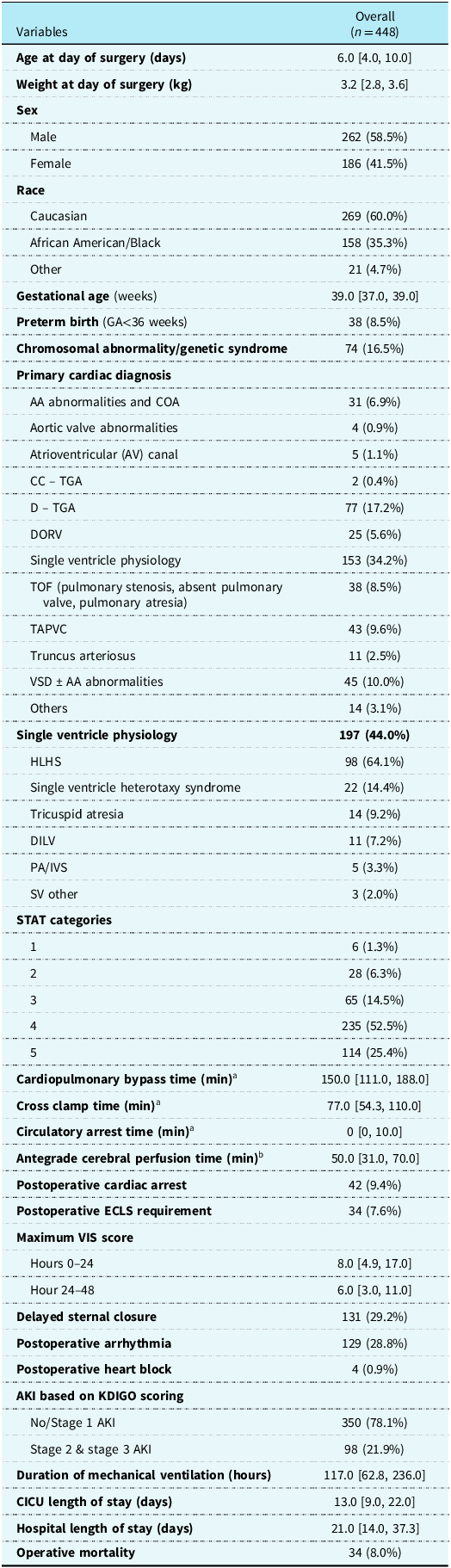
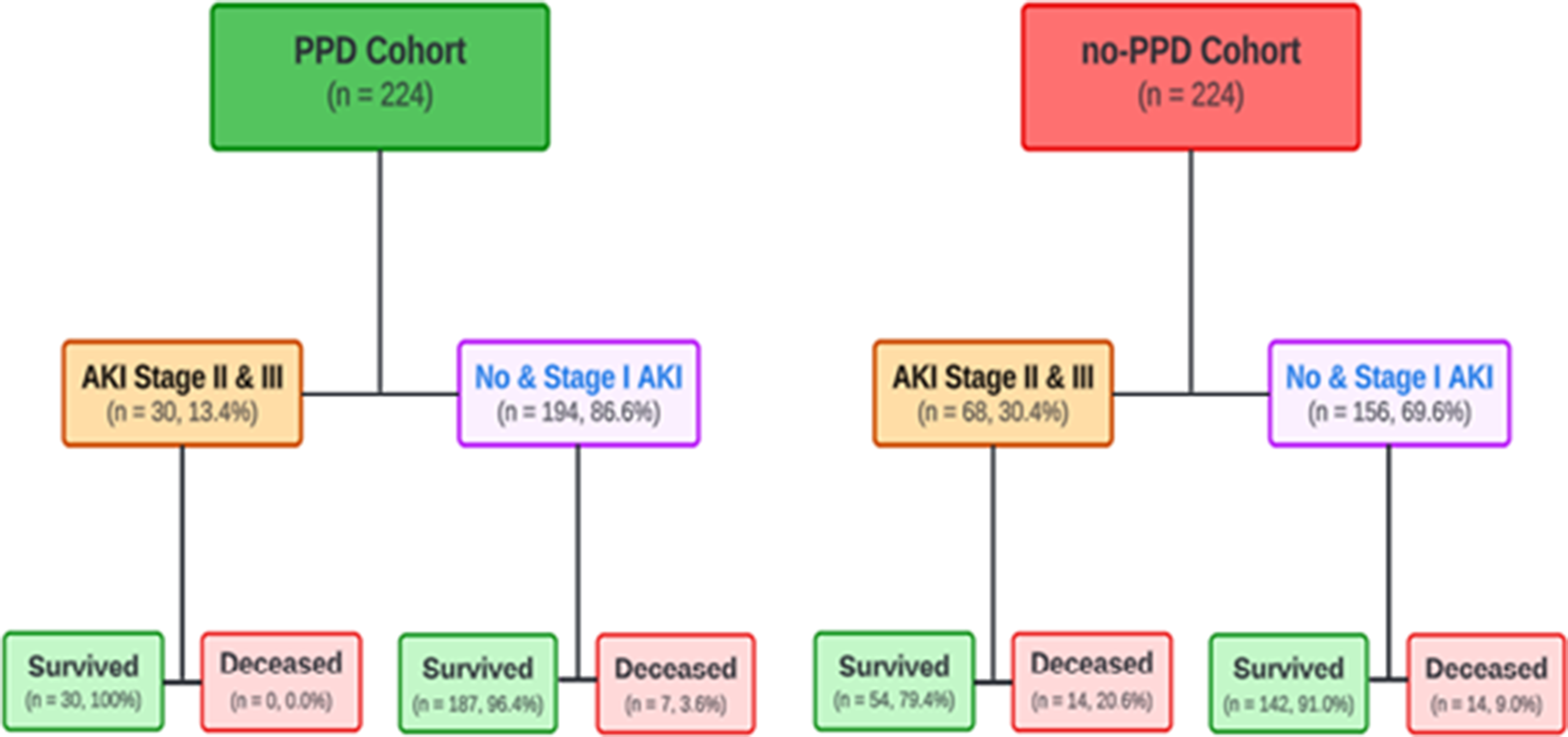
During the study period there were 224 patients who underwent prophylactic postoperative peritoneal dialysis and were designated as cases. We then matched 224 control cases, giving us a total cohort of 448 patients. The total cohort demographics, characteristics, and overall description are presented in Table 1 and Figure 1. Patients in the prophylactic postoperative peritoneal dialysis group had a lower incidence of stage 2 or 3 acute kidney injury (13.4% versus 30.4%, p < 0.001). Then the overall cohort of patients was divided into 2 groups utilising the Kidney Disease Improving Global Outcomes criteria: those who had no or stage 1 acute kidney injury (n = 350) and those who developed stage 2 or stage 3 acute kidney injury (n = 98). Patients who developed stage 2 or stage 3 acute kidney injury were older (median age 7 days, IQR 5–14, versus 6 days, IQR 4–10, p = 0.002), had lower preoperative serum creatinine (0.3 mg/dl, IQR 0.2–0.4 versus 0.5, IQR 0.4–0.6, p < 0.001), and had higher rates of postoperative cardiac arrest (18.4% versus 6.9%, p < 0.001). Furthermore, 194 (55.4%) of patients in the no acute kidney injury or stage 1 acute kidney injury group received prophylactic postoperative peritoneal dialysis vs. 30 (30.6%) in the acute kidney injury stage 2 and 3 group (Supplementary Table S1). In addition, after controlling for other variables, we report no association between the use of prophylactic postoperative peritoneal dialysis and the development of stage 2 or 3 acute kidney injury utilising adjusted multivariable logistic regression (aOR: 1.32 [0.59–3.11]; p = 0.504).
Patient demographics and clinical characteristics of the overall cohort

Table 1. Long description
The table presents patient demographics and clinical characteristics of a cohort of 448 patients. It includes variables such as age at day of surgery, weight at day of surgery, sex, race, gestational age, preterm birth, chromosomal abnormality/genetic syndrome, primary cardiac diagnosis, single ventricle physiology, STAT categories, cardiopulmonary bypass time, cross clamp time, circulatory arrest time, antegrade cerebral perfusion time, postoperative cardiac arrest, postoperative ECLS requirement, maximum VIS score, delayed sternal closure, postoperative arrhythmia, postoperative heart block, AKI based on KDIGO scoring, duration of mechanical ventilation, ICU length of stay, hospital length of stay, and operative mortality. The table has 44 rows and 2 columns. The first column lists the variables, and the second column provides the overall statistics for the cohort. Each row provides specific data points for each variable, such as median values, percentages, and counts. Notable trends include the distribution of sex, race, primary cardiac diagnosis, and the incidence of various postoperative complications.
Results depicted in n (percent), median (interquartile range/IQR).
PD: Peritoneal Dialysis; GA: Gestational Age; AA: Aortic Arch; COA: Coarctation of the Aorta; CC-TGA: Congenitally Corrected Transposition of the Great Arteries; D-TGA: Dextro-Transposition of the Great Arteries; TOF: Tetralogy of Fallot; DORV: Double Outlet Right Ventricle; TAPVC: Total Anomalous Pulmonary Venous Connection; VSD: Ventricular Septal Defect; SV: Single Ventricle; HLHS: Hypoplastic Left Heart Syndrome; DILV: Double Inlet Left Ventricle; PA/IVS: Pulmonary Atresia/Intact Ventricular Septum; ECLS: Extracorporeal Life Support; VIS: Vasoactive Inotropic Score; AKI: Acute Kidney Injury; KDIGO: Kidney Disease Improved Global Outcome.
a (n = 382).
b (n = 164).
Study Cohort.

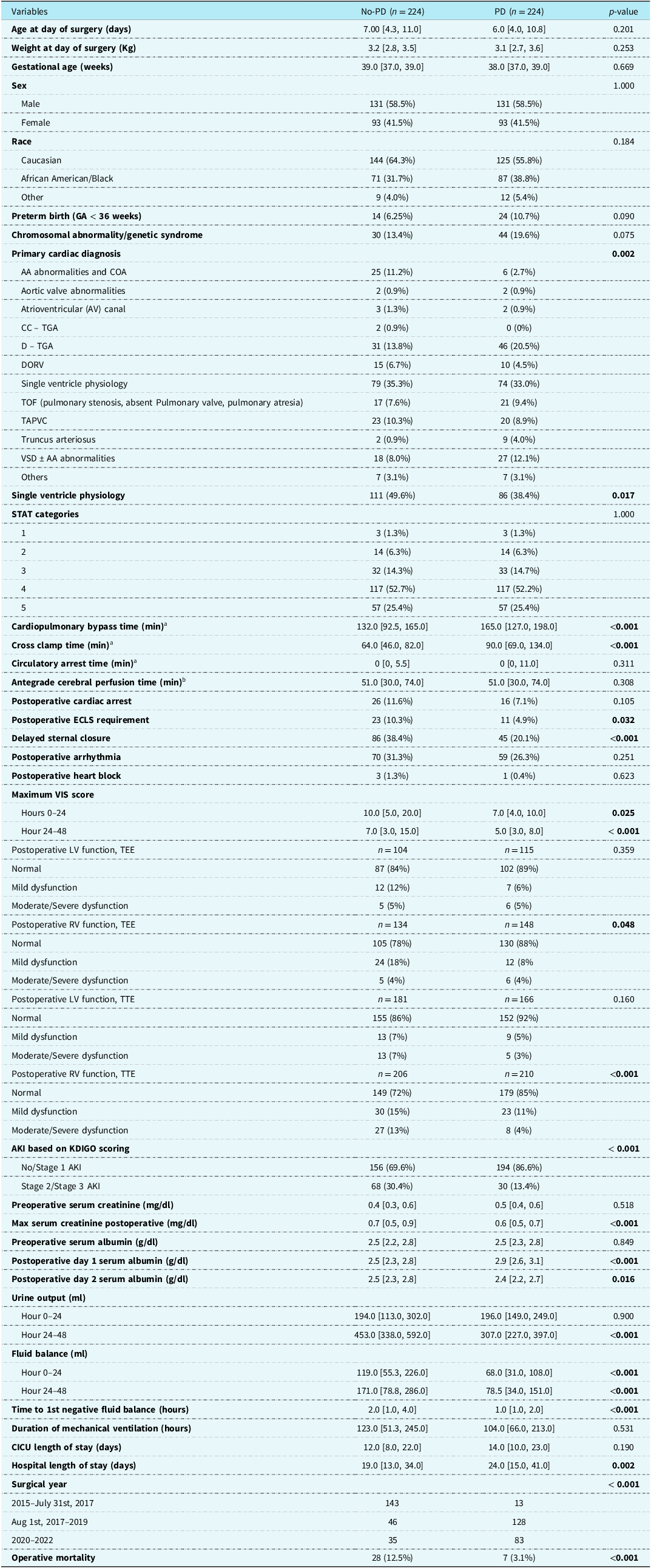
Patients in the prophylactic postoperative peritoneal dialysis group had longer median cardiopulmonary bypass and cross-clamp times, respectively [165 min (IQR 127, 198) versus 132 min (IQR 92.5, 165), p < 0.001] and [90 min (IQR 69, 134) versus 64 (IQR 46, 82), p < 0.001] compared to the non-prophylactic postoperative peritoneal dialysis group. Moreover, patients who underwent prophylactic postoperative peritoneal dialysis required less postoperative extracorporeal life support (4.9% versus 10.3%, p = 0.032), had less incidence of delayed sternal closure (20.1% versus 38.4%, p < 0.001), and had lower median vasoactive inotropic scores at hours 24–48 [5 (IQR 3, 8) versus 7 (IQR 3, 15), p < 0.001]. In addition, patients who underwent prophylactic postoperative peritoneal dialysis had better fluid balance in the first 24 hours (68 ml, [31–108] versus 119 ml [55–226]; p < 0.001) and from 24 to 48 hours (78.5 ml [34–151] versus 171 ml [78.8–286]; p < 0.001) postoperatively. Furthermore, urinary output decreased in the group who underwent prophylactic postoperative peritoneal dialysis in the 24–48 postoperative hours (307 ml [227–397] versus 453 ml [338–592; p < 0.001]. There was no difference in left ventricular function by postoperative transesophageal echocardiogram (p = 0.359) between the groups. Moreover, the prophylactic postoperative peritoneal dialysis group had a lower occurrence of patients with mild right ventricular dysfunction by postoperative transesophageal echocardiogram (8% versus 18%, p = 0.048), although moderate to severe right ventricular dysfunction remained equal between the groups (4% versus 4%). In addition, the initial cardiac intensive care unit transthoracic echocardiogram continued to reveal no difference in left ventricular function between the groups (0.160). Furthermore, the control group had more patients with moderate/severe right ventricular dysfunction compared to the prophylactic postoperative peritoneal dialysis group by initial transthoracic echocardiogram (13% versus 4%, p < 0.001) in the cardiac intensive care unit. Fluid balance in the first 24 hours and 48 hours postoperatively was significantly lower in the prophylactic postoperative peritoneal dialysis group (p < 0.001), and the time to 1st postoperative negative fluid balance was shorter in the prophylactic postoperative peritoneal dialysis group at a median of 1 hour versus 2 hours (p < 0.001) from cardiac intensive care unit arrival. Patients who underwent prophylactic postoperative peritoneal dialysis were more likely to survive to discharge (96.9% versus 87.5%, p < 0.001). Patients with significant left ventricular and right ventricular dysfunction were more prevalent in the group that did not survive (p < 0.001). There were no adverse effects in the group that had peritoneal catheter placement: no bleeding from the catheter site, no peritoneal infection, and no peritoneal catheters were removed due to complications within 72 hours after admission to the cardiac intensive care unit (Table 2).
Patient demographics and clinical characteristics of the overall cohort stratified by peritoneal dialysis group (exposed versus unexposed)

Table 2. Long description
The table presents patient demographics and clinical characteristics of a cohort stratified by peritoneal dialysis group, with 224 patients in the no-PD group and 224 patients in the PD group. The table includes 40 rows and 10 columns, with column headers: Variables, No-PD (n = 224), PD (n = 224), and p-value. Row labels include Age at day of surgery (days), Weight at day of surgery (kg), Gestational age (weeks), Sex, Race, Preterm birth (< 36 weeks), Chromosomal abnormality/genetic syndrome, Primary cardiac diagnosis, Single ventricle physiology, STAT categories, Cardiopulmonary bypass time (min), Cross clamp time (min), Anticipated central perfusion time (min), Postoperative cardiac arrest, Postoperative ECMO requirement, Delayed sternal closure, Postoperative arrhythmia, Postoperative heart block, Maximum VIS score, Postoperative LV function, TEE, Postoperative RV function, TEE, All band on KIDGO scoring, Preoperative serum creatinine (mg/dl), Preoperative serum albumin (g/dl), Postoperative day 2 serum albumin (g/dl), Urine output (ml), Fluid balance (ml), Time to 1st negative fluid balance (hours), Duration of mechanical ventilation (hours), CCU length of stay (days), Hospital length of stay (days), Surgical year, and Operative mortality. Each row provides specific data for the No-PO and PO groups, along with p-values indicating statistical significance. Notable trends include longer median cardiopulmonary bypass and cross-clamp times in the PO group, lower incidence of postoperative extracorporeal life support and delayed sternal closure, and better fluid balance in the first 24 and 48 hours postoperatively. The table also shows differences in right ventricular dysfunction and survival to discharge between the groups.
Results Depicted in n (percent), median (Interquartile Range/IQR).
PD: Peritoneal Dialysis; GA: Gestational Age; AA: Aortic Arch; COA: Coarctation of the Aorta; CC-TGA: Congenitally Corrected Transposition of the Great Arteries; D-TGA: Dextro-Transposition of the Great Arteries; TOF: Tetralogy of Fallot; DORV: Double Outlet Right Ventricle; TAPVC: Total Anomalous Pulmonary Venous Connection; VSD: Ventricular Septal Defect; ECLS: Extracorporeal Life Support; VIS: Vasoactive Inotropic Score; AKI: Acute Kidney Injury; KDIGO: Kidney Disease Improved Global Outcome.
a (n = 382).
b (n = 164).
Surgical ERA analysis
We then divided the cohort into 3 groups by surgery years: 2015 to mid-2017, mid-2017 to 2019 and 2020 to mid-2022. There were 156, 174, and 118 patients in each group, respectively. In this lapse of time, the use of prophylactic postoperative peritoneal dialysis increased, the incidence of acute kidney injury decreased, and the maximum vasoactive inotropic score in the first 48 hours decreased. There was no difference in weight, age of surgery, or STAT categories of the surgeries between the groups. On the other hand, there was a difference in cardiopulmonary bypass time (p < 0.001), aortic cross-clamp time (p < 0.001), development of acute kidney injury (p < 0.001), max postoperative creatinine (p < 0.001), urinary output (p < 0.001), postoperative transesophageal echocardiogram RV function (p = 0.013), and initial transthoracic echocardiogram right ventricular function (p = 0.015) through the years (Supplementary Table S2).
Discussion
We report a large cohort of paediatric patients who received prophylactic postoperative peritoneal dialysis after cardiac surgery in the United States. Despite initial univariate analysis revealing a positive association between prophylactic postoperative peritoneal dialysis and postoperative onset of acute kidney injury, further statistical elaboration demonstrated no association when controlling for other perioperative variables. Similarly, Kwiatkowski et al. delineated no difference in the prevalence of Stage 2 acute kidney injury or more in their cohort of patients who received prophylactic postoperative peritoneal dialysis. In their cohort of 177 patients, acute kidney injury stage 2 or more was seen in 16% of cases with standard management, 11% of patients with passive peritoneal drainage, and 14% of patients who received prophylactic postoperative peritoneal dialysis. Reference Kwiatkowski, Alten and Raymond12 We postulate that despite proposed benefits of prophylactic postoperative peritoneal dialysis, like improving overall fluid management and aiding in clearing the postoperative inflammatory cascade, patients with decreased ventricular function and low cardiac output remain at higher risk of postoperative acute kidney injury despite the use of prophylactic postoperative peritoneal dialysis.
Among patients receiving prophylactic postoperative peritoneal dialysis, despite having longer cardiopulmonary bypass times and longer cross-clamp times during the index operation, we report less morbidity (postoperative cardiac arrest and postoperative extracorporeal support requirement) compared to patients that did not receive prophylactic postoperative peritoneal dialysis. Similarly, Sasser et al. (n = 25) and Kwiatkowski et al. (n = 42) performed smaller retrospective single-centre studies that revealed a benefit of prophylactic postoperative peritoneal dialysis in morbidity during the early postoperative period. Reference Sasser, Dabal and Askenazi3,Reference Kwiatkowski, Goldstein, Cooper, Nelson, Morales and Krawczeski4 On the other hand, Ryerson et al. reported that prophylactic postoperative peritoneal dialysis was not associated with improved morbidity and was associated with more severe adverse events. Reference Ryerson, Mackie and Atallah7 We propose that the decreased morbidity can be related to the improved perioperative fluid management that we reported in our cohort since the importance of adequate fluid balance and its relationship to perioperative morbidity has been previously studied. Reference Delpachitra, Namachivayam and Millar13
Regarding fluid management, our cohort had a shorter time to negative fluid balance and improved fluid balance at 24 and 48 hours in the group who received prophylactic postoperative peritoneal dialysis compared to the one who did not. These findings are similar to a retrospective data review of the neonatal and paediatric renal outcomes network that reported non-inferiority with respect to acute kidney injury and fluid overload metrics in the group utilising prophylactic postoperative peritoneal dialysis despite the group being a higher-risk cohort. Reference Kwiatkowski, Alten and Raymond12 Furthermore, Gist et al. outlined in a retrospective cohort of 41 consecutive patients who underwent the arterial switch operation that prophylactic postoperative peritoneal dialysis was associated with an improved fluid balance during the first 7 postoperative days, a 42% reduction in hours of mechanical ventilation (p < 0.01), and a 34% reduction in ICU lenght of stay (p = 0.02). In addition, prophylactic postoperative peritoneal dialysis was associated with lower hospital costs (p < 0.01). Reference Gist, Henry and Borasino14 In contrast, Flores et al. performed a metanalysis including 204 patients who underwent prophylactic postoperative peritoneal dialysis and described no difference in terms of negative fluid balance by postoperative day 1 or ICU lenght of stay. Reference Flores, Loomba and Elhoff6 In a similar fashion, Ryerson et al. reported no difference in time to achieve negative fluid balance or time to extubation between the group that underwent prophylactic postoperative peritoneal dialysis and the group that did not in patients born with hypoplastic left heart syndrome who underwent the Norwood operation Reference Ryerson, Mackie and Atallah7 We postulate these reported mixed results could reflect the wide variation that exists regarding postoperative fluid management between different institutions, making retrospective studies and meta-analysis difficult to interpret. Being our cohort larger and more homogeneous in comparison to previous studies, including meta-analysis or database reviews, encourages us to validate the beneficial effect of prophylactic postoperative peritoneal dialysis in early postoperative fluid management and morbidity, although the reduction in duration of mechanical ventilation trended lower but did not achieve statistical significance in our cohort.
We reported a statistical association between prophylactic postoperative peritoneal dialysis and survival to discharge. Likewise, a small study that included 12 paediatric patients in Italy with a median weight of 3.46 kg reported reduced mortality with the use of prophylactic postoperative peritoneal dialysis after cardiac surgery. Reference Gianoglio, Amore and Bonaudo15 Although given the retrospective nature of the study, we suspect that mortality is inflated in the no prophylactic postoperative peritoneal dialysis group due to immortal time bias. Because if a patient who did not receive prophylactic postoperative peritoneal dialysis based on surgeon preference did not survive to discharge for any given reason, then now that death is inside the no prophylactic postoperative peritoneal dialysis control group, falsely elevating those numbers. Due to the very few death events (7) that occurred in the prophylactic postoperative peritoneal dialysis group, we were unable to run further reliable univariable or multivariable statistical models. Furthermore, we compared the mortality rate for our study cohort (prophylactic postoperative peritoneal dialysis group) with our overall year institutional mortality, and they were similar around 3%. This is similar to previous studies that have shown no difference in mortality in patients exposed to prophylactic postoperative peritoneal dialysis versus standard management. Reference Sasser, Dabal and Askenazi3,Reference Kwiatkowski, Goldstein, Cooper, Nelson, Morales and Krawczeski4,Reference Kwiatkowski, Alten and Raymond12,Reference Gist, Henry and Borasino14 We propose that although improving fluid balance in the early postoperative period is beneficial, there are other variables associated with mortality after paediatric cardiac surgery unaltered in the group receiving prophylactic postoperative peritoneal dialysis. In addition, we reported an association between longer cardiac intensive care and hospital length of stay and the group who received prophylactic postoperative peritoneal dialysis. We suspect that similarly, this is due to immortal time bias.
Despite the large number of patients, we have acknowledged the limitations of this retrospective study previously. In addition, the decision to initiate prophylactic postoperative peritoneal dialysis was solely based on surgeon preference through study time, which could have introduced surgeon selection, skill, or technique bias in the cohort. Despite the control cases matched by surgical complexity, there were fewer single-ventricle patients in the group who received prophylactic postoperative peritoneal dialysis; this could have introduced selection bias in the study. In addition, we could not perform additional logistic regression analysis with other perioperative variables due to sample size. Moreover, the performance of perioperative echocardiograms was inconsistent in the cohort. Furthermore, a direct cause-to-effect relationship cannot be established in a retrospective study.
In this large cohort of patients, we report that patients who underwent prophylactic postoperative peritoneal dialysis, although they had an improved fluid balance during the first 48 postoperative hours, did not have a lower prevalence of severe acute kidney injury compared to those who did not receive prophylactic postoperative peritoneal dialysis. These findings suggest that prophylactic postoperative peritoneal dialysis may be associated with improved short-term morbidity in this patient population. However, future prospective multicentre randomised studies are required to further investigate these findings.
Supplementary material
The supplementary material for this article can be found at https://doi.org/10.1017/S1047951126123518.
Acknowledgements
None.
Financial support
This research received no specific grant from any funding agency, commercial or not-for-profit sectors.
Competing interests
The authors declare none.
Ethical standard
The authors assert that all procedures contributing to this work comply with the ethical standards of the Helsinki Declaration of 1975, as revised in 2008, and have been approved by Children’s Healthcare of Atlanta Institutional Review Board: Study ID No. (IRB# 00001432). Informed consent was waived.