Formed in the aftermath of the May 2014 military coup, the National Council for Peace and Order (NCPO) set out to implement far-reaching political and social reform in Thailand. In the midst of a stream of policy initiatives, the NCPO quickly turned its attention to questions of national and cultural identity. ‘The Twelve Values for Thai People’, purportedly devised by the coup leader, Prime Minister and Chief of the NCPO General Prayut Chan-o-cha, was a prominent feature of a reformed nationwide curriculum.Footnote 1 The policy stated that all Thai school students would be expected to rote-learn the Twelve Values and to collectively chant them each day after the National Anthem ceremony.
Responding to this new policy, the Secretary of the Department of Cultural Promotion announced the publication of a cartoon book on good manners and Thai values. Interestingly, this was to be based upon Marayat ngam, an award-winning etiquette manual originally published in 1966 by Pagawadee Uttamoth.Footnote 2 In a newspaper interview, the Secretary reasoned that this new manners book was necessary:
Abiding by Thai values and Thai uniqueness is nothing to be ashamed of. It is a good practice that should be commended. At the same time, it will make society condemn those who violate the traditional framework which more often than not deprecates Thai values […] if we allow Thai people to become accustomed to wrong practices, they will never be phatthana to be khondi, so we must work together.Footnote 3
This statement is not atypical. In fact, it represents a view shared by many who believe in the uniqueness of Thai values. From this perspective, Thai manners are the distinctive outward expression of moral authority and political legitimacy, and they figure positively against the negative ground of the behavioural norms of non-Thai others. Leaving it to his audience to imagine the nature and origin of these non-Thai values and practices, the Secretary argues that they pose a serious threat to Thai values, and thus may act as obstacles for Thai people on the path to becoming phatthana (developed) and khondi (good people).
Why have manners been given such prominence? Why does the post-coup regime believe that a manners book written nearly sixty years earlier will provide appropriate guidance for young people growing up in twenty-first century Thailand? And, what is at stake in selecting this particular text and not another from the same — or a different — period?
Kritsana son nong: Naenam marayat thi ngam haeng araya samai,Footnote 4 for example, was a popular etiquette manual from the same period as Marayat ngam. The text first appeared as a serialised column in 1953 in the woman's magazine Kunlasattri (Genteel lady).Footnote 5 It was first published as a book in the early 1960s and was reprinted several times until the mid-1970s.Footnote 6
This book is interesting for a number of reasons. To begin with, the author of Kritsana son nong, writing under the pseudonym Kritsana Thewarak, did not disguise the fact that the book was based on an American text, Manners made easy.Footnote 7 In so doing, Kritsana recognised possible conflicts arising from the adoption of Western manners. Rather than avoiding these by labelling the book as Western, American or International, in the vein of other, later non-Thai etiquette manuals written for a Thai audience, the author of Kritsana son nong chose literary mechanisms to address and deal with such conflicts. Furthermore, in its title, subtitle and contents, Kritsana son nong openly addressed the issue of samai (period) and drew attention to competition and conflict between liberal conceptions of aspiration, progress and siwilai that characterised araya samai (the civilised period) and traditional notions based upon heredity.Footnote 8 Last, but not least, whilst Manners made easy was written for young people of both genders, Kritsana son nong specifically addressed young women. This suggests that, for the author at least, appropriate forms of social behaviour were a question of particular importance for women during this period.
Whilst Kritsana son nong's shelf life spanned three military dictatorships,Footnote 9 it is especially relevant to the transitional period between the final years of Field Marshall Phibun Songkhram's regime and the consolidation of power by Field Marshall Sarit Thanarat, that is, the late 1950s to early 1960s. During this time Thailand underwent profound social and economic change. Sarit himself referred to the period under his government as ‘the development era’ (yuk phatthana). Such development, however, was possible largely due to the United States' extensive financial aid and influence. Benedict Anderson consequently referred to this period as ‘the American Era’.Footnote 10 Both aspects, the extensive national development and the growing American influence in Thailand, formed an important backdrop to the fundamental changes in Thai society and everyday life.
This study of Kritsana son nong and its historical context reminds us that manners are a cultural artefact and that the adoption or rejection of foreign practices in Thai people's everyday lives has never been as straightforward as many wished it to be. After all, the everyday is an arena where different social meanings compete with one another. Seen from this perspective, a mundane and overlooked artefact such as Kritsana son nong might give insight into the history and meaning of manners in Thai society.
Manners and etiquette in modern Thai society
In The history of manners, Norbert Elias noted that the concept of civilisation gains currency during the eighteenth century. Central to this concept is the consciousness of the West, specifically Western superiority over earlier societies and more primitive contemporary ones.Footnote 11 In the Thai context, ‘civilised’ was among the earliest English terms to be transliterated, becoming siwilai in Thai. By the final decade of the nineteenth century, the term was widely used and discussed by Thai intellectuals.Footnote 12 These accounts help to ground the origins of what Scot Barmé terms ‘occidental socio-cultural values and practices' in Thai society.Footnote 13 To put it crudely, both the nineteenth-century Western concept and the practice of civilisation were from the outset alien to Thai society. Yet siwilai came to acquire different social status and meaning, albeit very subtly, as the result of socio-political changes in Thailand.
Adoption of Western lifestyle and material culture
Maurizio Peleggi traces the adoption of Western lifestyles and material culture in Thailand to the royal court of King Mongkut (1851–68). This process increased tremendously during the reign of King Chulalongkorn (1868–1910).Footnote 14 Based on numerous examples, Peleggi argues that King Chulalongkorn's adoption of Western lifestyles, patterns of entertainment and consumption was an important means to ‘refashion the public image of the monarchy as a modern, civilized and civilizing institution’.Footnote 15 Peleggi's discussion of the relations between the conspicuous consumption of the royal court and their public identity draws attention to the fact that manners and etiquette have always been a project of performance and display. For example, Western forms of socialising such as balls, receptions, and dinners played an important role in the court of King Vajiravudh (1910–15) and for the early-twentieth-century elites.Footnote 16 For a period, the royal palace maintained its status as the major — if not the sole — institution qualified to teach such knowledge and skills, along with other forms of traditional court culture, even when independent authors began to write and publish about the subject. In one of the earliest books on how to entertain, Khun Satholsathanpithak refers to his former education at the Royal Page School and his service in the southern precincts to validate the sources of his expertise and experience.Footnote 17
The availability of manuals on how to entertain and socialise according to occidental values and practices indicated a growing need for this form of knowledge outside the royal court. Yet in 1931 when Major General Phraya Damrongphaetthayakhun published Khamnaenam samrap kansamakhom, he asserted:
The forms of socialising which have shifted towards the Western are common only among those familiar with the noble classes or who have studied in Europe. For those who do not know how to socialise correctly, socialising can be intimidating and a person who is not able to behave appropriately can be regarded as lacking in education somewhat.Footnote 18
The shift towards Western manners and etiquette in the everyday lives of Thai people, or to be more exact, of educated Thais, was observed by Phraya Anuphaptraiphop in his manual on socialising, in which he proposed the term ‘mixed customs', reasoning that:
Customs and traditions we practice in Thai society today do not follow any longer those which have become outdated. Instead, we are adopting a mixed way. That is, we are now mixing customs and traditions which we have continually practised from the old days with customs and traditions which we have received from the West, the latter have gradually taken root in Thailand over many decades. They have become widely adopted and firmly established among the educated Thais and we cannot give up one or another.Footnote 19
If such practices had been adopted in Thai society for some time, Anuphaptraiphop's acknowledgement recognised them officially and at the national level. This book was first published in 1935, three years after the 1932 revolution that overthrew the absolute monarchy. The second edition, with some revisions, came on the eve of the hard-line cultural mandates issued by Phibun's first government from 1941 to 1944.Footnote 20 The book's introduction was written by Chaophraya Thammasak Montri (Sanan Thephasadin na Ayudhya), then Minister of Religious Affairs, who agreed that ‘the old and the new, the East and the West, [these] will integrate to become ours in the future’.Footnote 21 The book was made a set text in the national school curriculum.
It is interesting that ‘mixed customs' were proposed amidst a nation-building programme in which the concept of the Thai nation replaced that of Siam. This contradiction was highlighted in Phibun's own assertion that:
A possessor of Thai culture is a true Thai at heart who will give true love to Thailand and render true devotion to the prosperity and greatness of Thailand, most importantly, so that Thailand progresses to be equal to other civilised countries.Footnote 22
Yet, on another occasion he argued that:
nevertheless regarding certain conditions, Thailand has not yet achieved the standard which we deem acceptable for our citizens. We must, together, help to build this so that it becomes better than ever, and help improve it to our satisfaction or at least to the level of other civilised nations.Footnote 23
From the mid-1930s to the late 1940s a plethora of books on manners were published, including manuals for the military and police on how to socialise. Interestingly the latter were based entirely on Western etiquette.Footnote 24
Phibun's imposition of Western manners and material culture on Thailand reflects important aspects of his radical strategy, in particular, his concern to make a decisive break with the past. In order to begin a new chapter for the new nation, traditional elements of court etiquette such as prostration and crawling before the royals were terminated, along with other rituals which were deemed outdated.Footnote 25 At the same time, a whole range of Thai manners and etiquette were being updated. Amongst other changes, a new set of Western material artefacts and forms of social interaction were adopted as customary. For example, in 1941 the government issued a new national dress regulation for women and men. The women were requested to wear their hair long, and dress in either long skirts or phathung, a traditional Thai skirt in the form of an ankle-length, seamless sarong-like garment. Accessories such as hats, shoes and socks became part of Thai araya culture.Footnote 26 The two most active government organisations in these matters were the Cultural Council and Department of Public Relations. Both were attached to the Office of the Prime Minister and under the direct control of Phibun himself. Conjugal social relations were also prescribed, as can be seen in the Cultural Council's guide for couples, ‘Husband and wife culture’, and the royal decree ‘Conduct of husband and wife’, both issued in 1944.Footnote 27 These and other policies, including speeches by Phibun concerning the social role and status of Thai women, have led Nitaya Onozawa to conclude that in comparison to Phibun, Sarit's policy, ‘totally ignored the issues of family values and women's social activities'.Footnote 28
Phibun's nation-building programme was short-lived and ended with his parliamentary defeat at the end of the Second World War. Nevertheless, it had a major impact on all aspects of Thai life and many social customs instigated then remain in practice.Footnote 29 Charn Nakphong's Lakkan samakhom (The principles of socialising), first published in 1946, reported that Western manners and social skills were an index of civilised self and society. The book's publication coincided with the disarming of the Japanese Army in Thailand by British troops. In post-war Thailand, Charn argued that following international behavioural norms was crucial so that others would not ‘look down on the Thai people’.Footnote 30
Revival of Thai manners
Thak Chaloemtiarana argues that Sarit and his followers sought to legitimise their rule partly through restoring the monarchy as the symbolic centre of the Thai political system.Footnote 31 From the late 1950s onward, there was a proliferation of literature and projects dedicated to the restitution of Thai manners. These were targeted especially at the younger generation and included manuals, books, speeches, radio broadcasts and manners competitions, many of these drawing substantially on court etiquette. Dutsadi Malakul na Ayudhya, author of one of these books, wrote that such literature and the knowledge it promoted had been absent from Thai society for 28 years — in other words, since the 1932 revolution.Footnote 32
Patrick Jory has observed that the reintroduction of Thai manners from the late 1950s to the early 1960s coincided with a conservative political turn that had submission as its guiding principle.Footnote 33 These manners were largely about cultivating bodily propriety which corresponded to one's status. Those who were younger or in a lower social position had to be physically submissive, recognising their place, ideally and spatially. According to Jory, the key text here is Sombat khong phudi (Qualities of the gentleman), originally composed by Chaophraya Phrasadet Surentharathipbodi (M.R. Pia Malakul) in 1911.Footnote 34 Phrasadet was an important figure in the educational reforms initiated during the reign of King Chulalongkorn.
Sombat khong phudi was reprinted in the 1960s. However, Jory notes that it did not have the same audience nor address its new audience in the same way as it did in the early twentieth century.Footnote 35 When the text was first published, it was aimed at the future class of royal officials. In early-twentieth-century Thailand phudi literally referred to men from good families. From the 1960s onwards, the book — and sometimes merely its title — symbolised a long tradition of Thai manners and morals, a proper mould to form a desirable public Thai youth.
The revised 1960s edition of Sombat khong phudi succeeded in providing a conceptual grounding in and practical advice about Thai manners. Yet the need remained for more detailed instruction about appropriate comportment in various social situations, especially when interacting with seniors and members of the royal family. The latter topic was, in fact, given extensive attention during this revival period. From 1957 onwards, King Bhumibol and Queen Sirikit made themselves more accessible to the public.Footnote 36 Accordingly, Thai court etiquette and manners were greatly revived through manners competitions and the work of M.R. Taweewongse Tawalayasak and Phrasadet's nephew, M.L. Pi Malakul.Footnote 37 Through these, the Thai public came to re-learn traditional ways of self-presentation. In part at least, the desire to revive and promote Thai manners appeared to respond to a perceived threat of Western influence. In the introduction to Regulations on deportment in Thai manners, Pi wrote:
Today modern civilisation has swallowed up Thai manners. It is difficult to see proper manners being performed today. When it is the appropriate time to show their manners people do not know how to perform them correctly. Take even simple gestures of deportment such as showing respect: people do not know to whom they should show respect, or when or even how they should show their respect. Since they do not know the proper forms of demonstrating respect they fear embarrassment if they do it incorrectly — so they fail to show any respect at all. So we can see that Thai people today lack refinement, despite the fact that gentility and submission are general characteristics of the Thai people.Footnote 38
Dutsadi, Phrasadet's daughter-in-law, voices similar concerns. Her book, Marayat lem noi (Little book on manners), which was also based on Sombat khong phudi, was a textbook at the Triam-udom Suksa School.Footnote 39 In the introduction, she wrote:
I have often felt that in the last twenty-eight years although we have experienced much material progress we need much more progress in the cultivation of our spiritual life. The reason is that in general we do not have a true understanding of the meaning of ‘freedom’. Another reason might be the changes that have taken place around us. For example, there has been political change, and then the War started. After the War the Thais came into contact with Westerners and started to imitate the West more and more. The older generation who knew our customs and traditions have gone. The new generation which has grown up in the last twenty-eight years has been affected by these great social changes to the extent that they have almost no foundations on which to stand.Footnote 40
Whilst both authors opted for different forms of expression, Pi's ‘modern civilisation’ and Dutsadi's ‘material progress' referred to very much the same thing. Both belonged to ‘others' who did nothing to improve the morals or the behaviours of Thai people. Worse still, they appeared to be the cause of degradation in those realms.
Both statements adopted a similar rhetorical approach, bemoaning the loss of traditional Thai values and, at the same time, demarcating these dangerous others as ‘modernity’, ‘materialism’, and ‘the West’. These concepts were set up in binary opposition to ‘the traditional’, ‘the spiritual’, and ‘the essentially Thai’. As Thongchai Winichakul argues, this form of negative identification is a powerful force that has been deployed repeatedly in modern Siamese and Thai history.Footnote 41 Here it was used as part of a nationalist project that had already been established under Phibun and was now being recuperated in response to the new challenges facing the military dictatorship of Sarit. In particular, considering Dutsadi's allusion to the gap of 28 years, Jory suggests that this is a veiled criticism of the 1932 revolution. Later Dutsadi went further still, dismissing the adoption of non-Thai cultural practices, particularly in relation to manners, ‘Only an inferior nation would adopt another nation's culture as one's own, especially in terms of manners. This is truly an act of ignorance’.Footnote 42
From the late 1960s to the 1970s, a new type of manners literature appeared. What made this distinctive was an approach that Jory describes as a ‘hybrid between the manners of the bureaucratic bourgeoisie and the Palace courtier’,Footnote 43 with an emphasis on the uniqueness of Thai manners. These were mostly written by authors of high social status, including noticeably more women. Their main audience tended to be young people. Marayat ngam, discussed briefly in the introduction, is a typical example of the hybrid model of manners literature. Its author, Pagawadee Uttamoth, was not only a respected novelist and publisher, but also a granddaughter of Thammasak Montri.
Marayat ngam comprised fifty-eight short chapters originally written as articles and serialised in two magazines. Six chapters were dedicated to uniquely Thai and royal court etiquette, combining elements of the new editions of Sombat khong phudi and Marayat Thai. Footnote 44 Others discussed similar aspects of modern urban civility as Kritsana son nong, but without reference to sources. In each chapter, Pagawadee introduced a particular social situation — for example, dining out, visiting friends, going to the cinema — in the form of a dramatic scenario. Within these, correct and incorrect manners were introduced and discussed through dialogue between fictional characters. For example, in the chapter ‘Kha khong marayat’ (The value of fine manners), one character explained that her reason for not inviting a mutual friend to lunch was because of the embarrassing way the friend held her fork and spoon. Later, the author remarked that this, ‘sounds like a trivial reason’. Yet such seemingly trivial matters amount to a book of more than four hundred pages.
Sarit's political project sought to combine progress and development with unique Thai values, an approach often termed ‘Thai-style democracy’. Arguably, the revival of Thai manners represented by hybrid manuals supported his ideal by helping to develop and educate Thai people within the framework of Thai values. Non-Thai etiquette manuals were clearly signalled, for example, as French manners or International manners. Whilst Sarit's regime could not ignore American influence to the extent originally envisaged, at least Western influence on manners and etiquette could be literally set aside.
From Manners made easy to Kritsana son nong
Kritsana son nong was based upon the American textbook, Manners made easy, by Mary Beery. Beery wrote this manual for a social conduct course which she taught at South High School, Ohio, in 1943. In style, the book is instructional yet informal and personal. It comprises fifteen chapters divided into five broad themes: ‘Home ground’, ‘School spirit’, ‘As others see you’, ‘Table talk’ and ‘Stepping out’. The chapters are divided further into several shorter topics and at the end of each chapter there is a ‘Rate yourself’ multiple-choice section for readers to test their understanding.
The Thai version took a very different form, however. Rather than thematic chapters, it consisted of 52 letters written from Kritsana to her younger sibling, Kritika (thus the name of the book, ‘Kritsana's instructions to Little Sister’). Kritsana son nong covered only chapters one to eleven of Beery's book. The author did not explain why the others were omitted.Footnote 45 Significantly, Kritsana stresses to her sister the importance of adopting only what was appropriate to Thai geography, weather, and traditions.Footnote 46
The following comparison of Kritsana son nong with Manners made easy will focus on the Thai author's attempts to domesticate ideas and practices from the original American text and thus negotiate potential contemporary conflicts. These show up in three major areas of difference between the books: fictionalisation, graphic treatment, and a focus on women.
Fictionalisation
Both the title and the author's pseudonym are a direct reference to the old didactic poem, Kritsana son nong khamchan. Footnote 47 In the poem, the main character, Princess Kritsana converses with her sister, teaching her how to be a good wife. The poem is one of the pillars of Thai literature, and an essential source for traditional Thai views on proper behaviour for women.Footnote 48
Kritsana son nong borrowed this theme of sisterly communication, but replaced face-to-face conversation with a series of letters. The epistolary form enabled a range of realist narrative techniques. Novels were a familiar literary form by the early 1960s and thus an appropriate means to ground new manners in the Thai context. Kritsana son nong's well-rounded fictional characters allowed readers to identify with the story and the sisters' social status. This can be seen in the following example taken from the second paragraph of the first letter, which functions as an introduction and sets the tone of the book:
Lukkai noi khong phi kha! The necessity of earning a living forced me to wander from home to become a teacher in Nakhonsawan. Busy with work and battling with the kids, I hardly had time to send news to you or father and mother. However from now on, I take it as my duty to send a letter to you every week because, importantly, you have asked what makes [one] a kunlasattri.Footnote 49
Through this paragraph we learn about the characters as well as the motivation for the correspondence. The endearing phrase Lukkai noi khong phi kha (Oh! My dear little chick) suggests intimacy between the sisters and creates an atmosphere of sincerity and goodwill. The letter imbues the messages with a sense of secrets shared. Given that the Thai book concentrates on women rather than men, this use of sororal dialogue plays an important role in producing a coherent and convincing text.
Noticeably, the main character is portrayed working away from home as a teacher. In a series of articles on Thai women and modernisation, Nitaya Onozawa notes that during Phibun's rule a growing number of women from upper class and well-to-do families began to work outside the home. Education was considered to be one of the proper careers for these women because of its high social status.Footnote 50 Interestingly, many of the non-elite women entering the job market during this period rose to high social status and became models for younger women in Sarit's and Thanom's time.Footnote 51 The fictionalisation of the original Western text helps ground the story in this changing Thai social context.
Graphic treatment
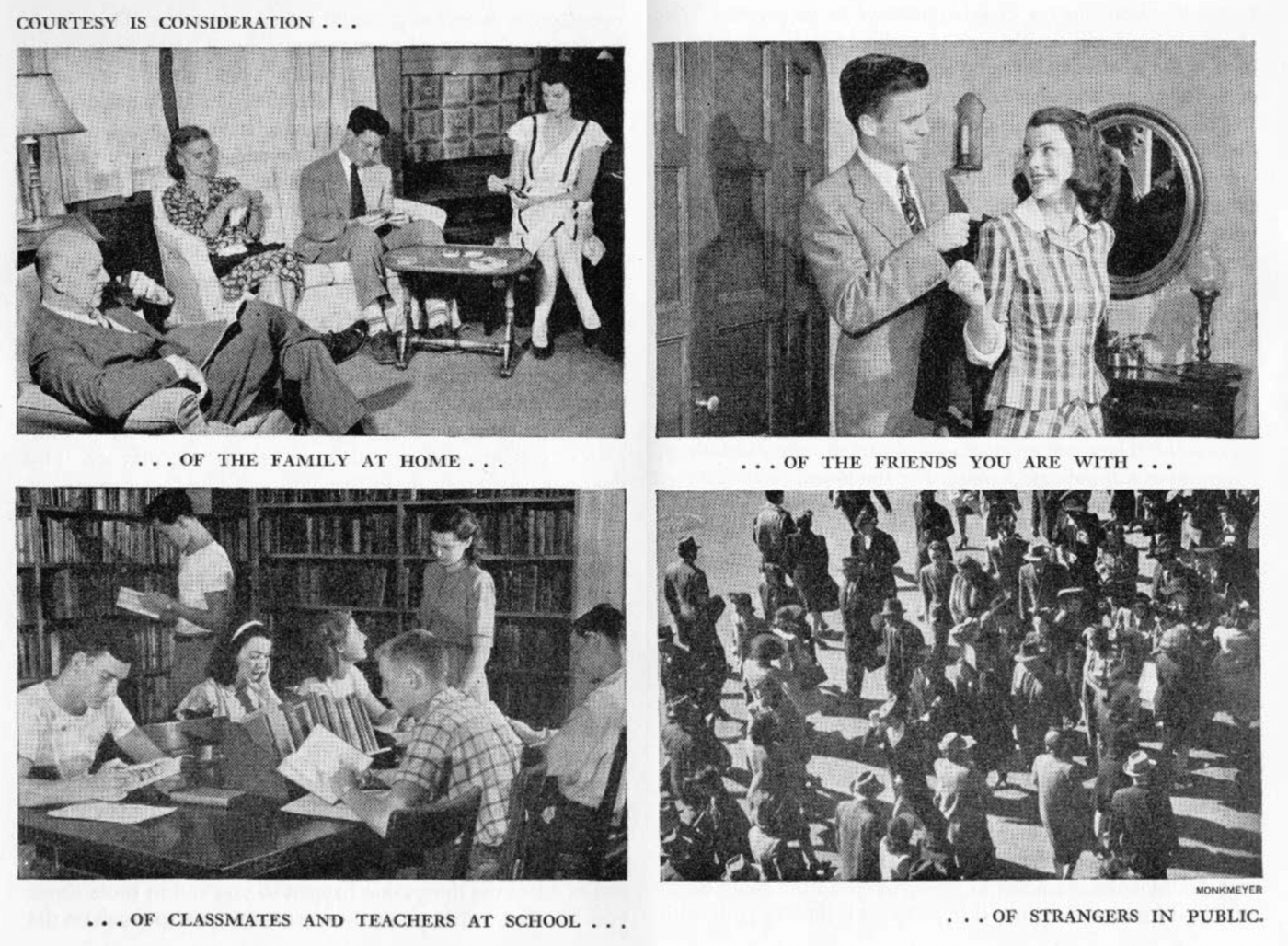
Photographic illustration plays an important role in Manners made easy. The publisher, McGraw-Hill, produced short films to accompany every chapter of the book. Stills from these were inserted throughout the text (see fig. 1).
A spread from Mary Beery, Manners made easy (New York: McGraw-Hill, 1949), chap. 1.

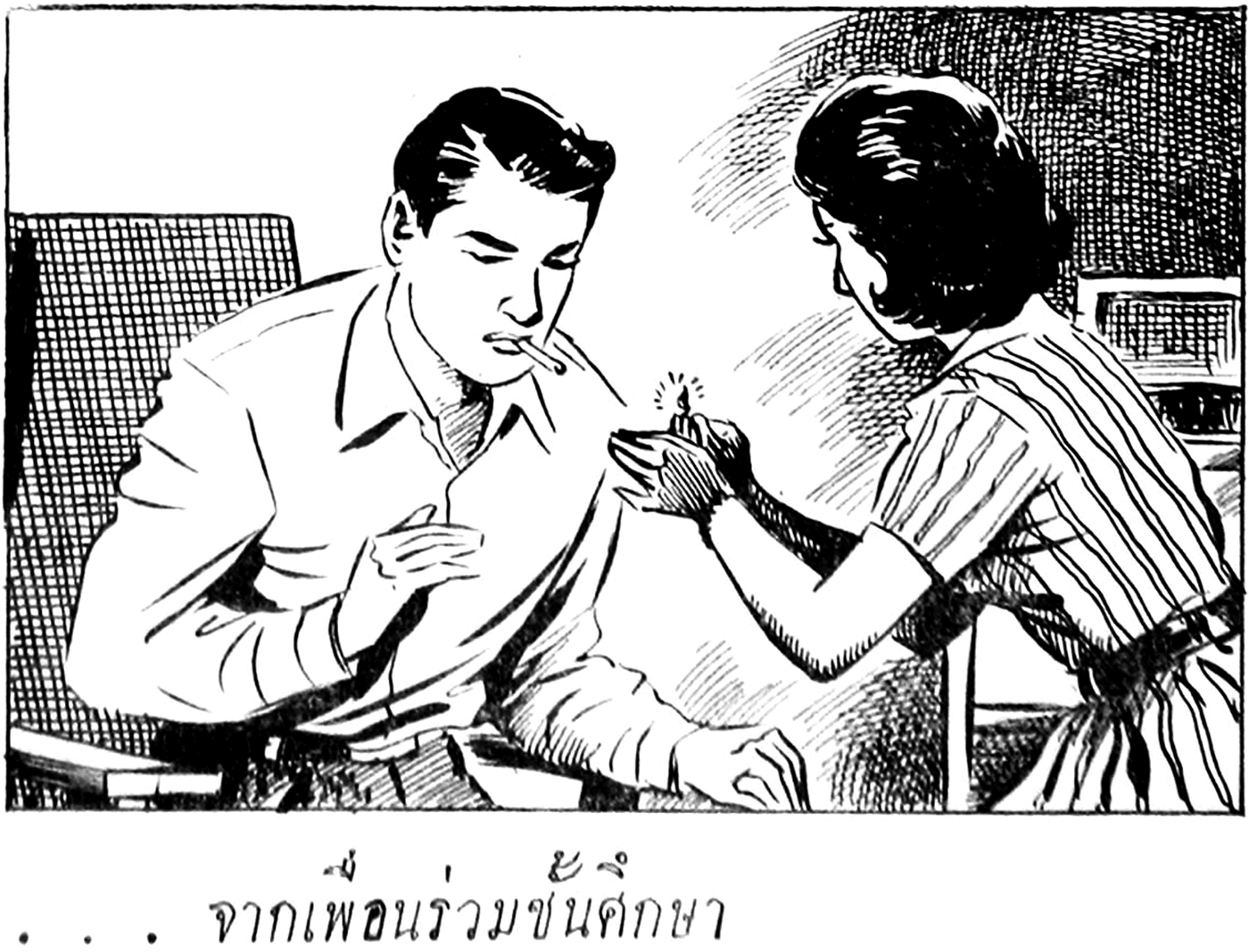
A similar use of illustration was also adopted in Kritsana son nong. Forty-eight stills (out of a hundred and thirty-six) from the original were reproduced as line drawings. These drawings and another twelve of the original photographs were inserted close to related texts. In most cases, these repeat the compositional approach of the original text. They simply retell the same story via another medium. In some cases, however, the reproduced drawing differs significantly from the original. Below I consider one of these pairs and discuss the significance of the transformation.
The original photograph in fig. 2 depicts a young man and woman in a domestic setting. According to Gunther Kress and Theo van Leeuwen, this image is an example of a narrative representation.Footnote 52 The participants are connected by visual vectors, in this case their hand gestures and the directions of their glances. Kress and van Leeuwen argue that ‘narrative patterns serve to present unfolding actions and events, processes of change, transitory spatial arrangements'.Footnote 53 This image is reinforced by a single caption: ‘Courtesy is consideration […] of the friends you are with, …’.Footnote 54
‘Courtesy is consideration […] of the friends you are with, …’; Beery, Manners made easy, chap. 1.
The corresponding drawing in Kritsana son nong (fig. 3) can also be seen as a narrative pattern. There are also two participants, a man and a woman. The vectors that connect them are their postures and hand gestures rather than their gazes, however. The objects in this picture, a cigarette and a lighter, also play an important role in the transaction between the two participants. The image of a woman lighting a cigarette for a man is accompanied by the caption, ‘Politeness will earn you praise … from your classmates'.Footnote 55
‘Politeness will earn you praise … from your classmates'; Kritsana son nong: Naenam marayat thi ngam haeng araya samai (1961), p. 12.
Both images illustrate the concept introduced in the text: being considerate to others. However, the captions are quite different in implication. Whilst the original caption emphasises the importance of courtesy, the Thai translation shifts focus to the benefits of being perceived as a polite person. By depicting politeness as a way to earn praise from others, the author — consciously or otherwise — highlighted manners and etiquette as forms of cultural and symbolic capital.Footnote 56 I will return to this point later on.
The commissioning of a local artist to re-draw the images from Manners made easy played a similar role to the introduction of fictional forms and devices such as character, setting and narration. Through the illustrations, the author deployed visual representations to help clarify potentially ambivalent aspects of the text and vice versa. As Roland Barthes notes, this is a widely used strategy for resolving potentially ambiguous readings of text and image.Footnote 57 In the above example, while the texts in both books merely stated that one should be considerate towards others, the Thai author chose to represent a woman performing a service to a man who does not even meet her eye or show any appreciation.
Special emphasis on women
Whilst the original text aimed at young American men and women, the Thai version — from the title down to the contents — mainly addresses women. The concentration on women reflects a perceived need to control and regulate female social interaction especially with and in comparison to their male counterparts. Interestingly this assumed truth about how Thai women should behave often ties with traditional notions, marking anything that is different from such culturally legitimate practices as ‘modern’ or ‘Western’, and thus suspicious. This need to regulate women's behaviour is still apparent in contemporary Thai society.
The tension between traditional and modern gender roles among middle-class Thai women is evident as early as the beginning of the twentieth century. Barmé notes contradictory views among men and women on gender roles at that time.Footnote 58 Issues debated included female education, work, and the role of a wife. In other words, the question then was about whether or not women should have access to social roles reserved thus far for men and a selected group of aristocratic women. More than thirty years later, in a period of rapid and profound socioeconomic change, the question had become: How would the growing number of middle-class women living modern lives be able to maintain traditionally appropriate social conduct?
An example of this tension is found in a 1948 reader's letter to the editor of the prominent women's magazine Sattrisan (1948–96):
I finished reading the first issue of Sattrisan with delight and admiration at your achievement, which was brought about by teamwork amongst Thai women. My favourite part had to be the issue of women's morality. […] For one thing, the women who conducted themselves appropriately would be reassured of their righteousness and their virtue and encouraged to continue on the right path. For another, the women who perhaps had too much fun and forgot about their honour, [this is the time] to redeem themselves, to become good women, and be worthy of the status ‘flowers of the nation’.Footnote 59
The term ‘flowers of the nation’, dok mai khong chat, refers to Phibun's saying that ‘Thai women are flowers of the nation’. Its purpose was to urge women to beautify themselves in the Western fashion.Footnote 60 It was often used, however, as in the quotation above, to limit women's social roles and promote the gendered representation of good women.
In the above letter, it is also clear that women's virtue is a contested area, particularly with regard to social behaviour and relationships with men. In a critical analysis of modern Thai novels, the Thai feminist writer Kam Paga suggests that between 1932 and 1957 various models of the Thai woman were in circulation. Kam Paga saw these competing models as healthy in diversifying the ideal of a Thai woman. Sadly, these complex and often problematic characters disappeared after 1957, leaving only two choices available: to be mae phra (angel) or dao yua (femme fatale).Footnote 61
Whilst the subtitle of Kritsana son nong refers to the era as the civilised period, the author still chose to promote patriarchal notions of women's behaviour despite their changing roles. The issue of female virtue, which was not mentioned in the American text, was foregrounded in Kritsana son nong. The first letter concludes with a verse from another traditional didactic poem, Suphasit son ying by Sunthon Phu, poet laureate appointed by kings Rama II and IV:
Here female virtue is the most important aspect of a women's identity and as valuable to her as a precious stone. In Pen and sail, Nidhi Eoseewong discusses the differences between the poems Suphasit son ying and Kritsana son nong khamchan. In particular, he argues that, like other works by Sunthon Phu, Suphasit son ying supported an emerging bourgeois way of life, unlike Kritsana son nong khamchan whose aim was to instruct girls from sakdina (aristocratic) families. Nidhi also notes that the major parts of Suphasit son ying teach bourgeois women to maintain their virtue. This point is often neglected in other studies of these texts. In the book Kritsana son nong verses from Suphasit son ying are used to emphasise manners and decorum which, according to Nidhi, are only a minor part of Suphasit son ying.Footnote 63
Even though Nidhi does not use the term ‘cultural capital’, Pierre Bourdieu's concept offers a useful framework within which to consider the notion of a woman's virtue. Since Nidhi also recognises that a bourgeois marriage is for ‘financial and political advantage’, chastity then can be considered a form of female cultural capital in Thai society. Together with other forms of cultural capital such as education and manners, chastity would enable a woman to marry well and thus access security, financial gain, prestige or political status. By using verses from Suphasit son ying, the author of Kritsana son nong positions Western manners and etiquette as a welcome complement to cultural capital based on Thai tradition rather than as a challenge. The term kunlasattri was redefined via the voice of the elder sister:
The dictionary defines kunlasattri as ‘a woman with sakun and good manners'. For this translation, I fear that I know too little to pass judgment whether if it is correct or not. But if you were to ask my personal view, I firmly believe that a woman who has good manners, even without [good] sakun, can undoubtedly be a kunlasattri. However, if it should be translated for the benefit of all, since kun means sakun or trakun, all human beings have sakun or trakun. Whether one is of a higher or lower rank than others is not within our control, therefore, all women in this world are kunlasattri. Yet to be a perfect kunlasattri, is conditional on having good manners.Footnote 64
Given that the text was first published in a magazine titled Kunlasattri, the attempt to redefine the term is significant. Both sakun and trakun connote a well-established or wealthy family in contradistinction to the families of commoners. For example, a phrase such as luk phudi mi trakun refers to children of significant lineage and is often used in opposition to phuak maimi sakun run chat or phuak maimi huanon plaithao. The latter literally means those without head and toes, in other words, nobodies. The meaning as revised by Kritsana would, therefore, make it easier for many more readers of the magazine to identify with the term kunlasattri. Such a proposal also reflects the meritocratic dimensions of the discourse of progress and siwilai adopted by journalists from the 1920s onwards. This formed one of the grounds for the rejection of absolutism and royalist interpretations of nationalism.Footnote 65
The emphasis on women in Kritsana son nong contrasts strongly with the absence of well-rounded male characters. The sisters' father and brothers appear briefly in the text, but as ciphers or types rather than individual protagonists. In one way this reinforces the notion of distinct gendered social realms. In another, it further emphasises the idea that appropriate manners are of particular importance for women. Both factors take on further significance when one considers that the author, Santa T. Komolabutra, is in fact a man. This information was, however, not disclosed to the readers in the book. Chie Ikeya points out that this authorial strategy was also present in Burmese and Filipino literature where it served to disguise and prescribe patriarchal framing of women's roles and behaviours.Footnote 66 Something similar is clearly at work in Kritsana son nong.
All of this reflects Onozawa's discussion of the normative social roles for women, especially government officers and wives of male officers during Phibun's first period in office.Footnote 67 Manners and etiquette manuals such as Kritsana son nong then can be seen as one element in a broader project to promote conservative expectations of modern Thai women and circumscribe their modes of self-presentation.
Among the ‘hybrid’ manuals discussed earlier was also one entitled Kritsana son nong. This appears to be an early 1970s revision of the 1960s edition of Santa's text.Footnote 68 Again, written as a series of letters from a sister to her younger sibling, the book is a heavily edited version of Santa's and Beery's content, without illustrations. The author's pseudonym Kritsana-Jiraprapa combines the names of the two sisters from the poem Kritsana son nong kamchan. The introduction states:
Even though human society is advancing everyday, our morals and behaviours, especially manners, are degrading more and more. In general, young people, men and women, tend to be interested in adopting changes from the West and forgot nearly all the good manners of our Thai ancestors. This is a big issue for mothers and fathers, guardians and teachers as well as the leaders of the country, who now have to work very hard to resolve this matter.Footnote 69
The tone resonates with Pi's and Dutsadi's manuals, deploying similar rhetorical figures that dramatise the waning of the old and good and the waxing of the new and suspect, especially among young people.Footnote 70 The West was, again, positioned as the threatening ‘other’, the source of corrupted traditions and corrupting practices. Like other ‘hybrid’ manuals, the book simply rehashed Kritsana son nong by Santa, with no reference to Manners made easy; an admission of Western influence on the content would have fatally wounded the argument. Instead, the author integrated traditional didactic poems such as Kritsana son nong kamchan to legitimate the manual and ground it in Thai traditions. Tellingly, the book's additional contents look back to the period before the 1932 revolution and emphasise practices such as how to present oneself in audience with the royal family and how to choose a spouse, largely repeating the work of Anuphaptraiphop.
The author
Kritsana Thewarak was one of the many pseudonyms used by Santa T. Komolabutra (1908–78) or Santa Thewarak.Footnote 71 He wrote more than five hundred novels and short stories, ten non-fiction works and thirty Thai translations of foreign books, including historical documents commissioned by Thailand's Royal Fine Arts Department.Footnote 72 Using the pseudonym Kritsana Thewarak, Santa wrote non-fiction books on women's beauty and manners.Footnote 73 Along with Kritsana son nong, Santa wrote Phuying (Women) and Dok mai khong chat, both published in 1967. Santa regarded these three books as belonging to his Marayat lae kansamakhom (Manners and socialising) series. Within this, there is another set of texts titled Khumue sangkhom (Socialising manual), a collection of Western-based manners books emphasising table manners and social etiquette. Initially serialised in Bodaeng magazine during the late 1940s these were later published as a two-part book in the 1960s.Footnote 74
Unfortunately, a critical and thorough study of Santa's works does not exist and is beyond the scope of this article. Nevertheless, Santa did give us some clues to his attitudes and beliefs; and these provide important context:
The writing composed within any certain period would naturally record the language, events, culture and places of the time, and how, through time, they have changed. It would also act as a measuring device through which one could gauge the level of public morality in a clear light.Footnote 75
This quotation was taken from Santa's memoir, a reflection on his journalistic career. Santa was a member of Khana Suphapburut (Gentlemen's Party), and worked alongside Kulap Saipradit (Sriburapha) at Prachachat, a newspaper set up by Prince Wan Waithayakorn in 1932.Footnote 76Bandai haeng khwam rak — the novel that made him famous — was first serialised here. Given Santa's belief that writers express the spirit of their times, it is reasonable to read this book as an attempt to make sense of the 1932 revolution. In the novel the main female protagonist, Juang-jan, writes to Wara, the main male character who lives outside Bangkok, to inform him about the events of 1932. In his response Wara writes:
I rather admire the way the promoters operated. It went well and without any blood loss among the civilians. Their Six Principles provide great comfort to a poor person like myself. Most importantly, they adopt the name Khana Ratsadon [The People's Party]. This combined term is rather odd to hear, perhaps because it has been unheard of until now and it is a union of the two words no one has expected to come together this soon.Footnote 77
Along with her letters, readers learn of Juang-jan's intimate thoughts through her diary. Here she records various social conflicts, including between the world of aristocrats and capitalists, the old and new generation, and between the sexes. Being a romantic novel, these conflicts tend to be resolved through compromise rather than confrontation. For example, when her aristocratic aunt asserts that a woman receives the highest praise when she was not spoken of at all, Juang-jan admits in her diary that it was, ‘the most ridiculous praise ever heard of in the year of 1932’.Footnote 78 Juang-jan, however, chooses not to respond, agreeing with her aunt's advice to correspond with Wara only through her male cousin. Nevertheless, there are occasions when she writes directly to Wara without her aunt's knowledge.
The letter from Wara — who appears to have shared many characteristics and qualities with Santa himself — to Juang-jan reveals a generally positive attitude to the 1932 revolution and sympathy with its principles. Yet, his letters also exhibit caution about Thai politicians' claims and concern over the generally poor understanding of the concepts of liberty and freedom among the Thai people. Perhaps this unease about conflicts arising from the 1932 project reflected Santa's own position.
In writing the introduction to the novel's 1952 reprint, Santa dismissed the work as a romantic tale, an entertainment, to use Graham Greene's distinction between serious and diverting fiction.Footnote 79 In his memoir written in the same year, Santa reflected upon the difficulties facing Thai intellectuals and artists during the Phibun dictatorship. Phibun, of course, was one of the promoters of the 1932 revolution. Santa wrote:
Writing can be a career, but only if one settles on seeing the written word as an emotional comforter, whose aim is to entertain readers in their spare time. […] However, if a writer wants to see his writing as more than pure entertainment, perhaps with the aim to improve this world, to get rid of parasitic insects which are seen living on the blood of the citizens; she or he would find it hard to survive. Since, most likely, the characters in their stories would resemble powerful people, in which case no publisher would ever want to see their printing press being chained because of our petty novels.Footnote 80
In the year that Santa published his memoir, Phibun's government launched a campaign against Thai intellectuals who did not agree with the government's policies, particularly Thailand's participation in the Korean War. This campaign was known by various names including the Peace Rebellion due to the fact that many members of the Thailand Peace Committee (TPC) were arrested. According to the memoir of an arrested TPC member, Jaruek Chomphuphol, over two hundred people, among them writers, journalists and politicians, were apprehended. Jaruek and other prisoners were charged with treason and jailed without a fair trial. Some died while imprisoned. Others were not released until 1957.Footnote 81 While Santa himself was not jailed, many of his colleagues were. These included Sriburapha, who was then the secretary of the TPC and whose works had always been overtly political.
Santa published his memoir in March 1952, nearly eight months before the raid took place. Nevertheless, this was a tense period for Thai intellectuals. From this point onwards Santa wrote fewer novels, devoting himself instead to non-fiction and historical translations. In comparison to his reflection on writing novels, his introduction to the 1966 socialising manual, quoted below, appears much more assertive:
I aim to present this work not to the people of any particular class but to the people of all classes.
For the social wall which has been standing between the citizens of this nation is getting thinner. It is presently possible for people from one group to make it to the stage upon which they would come to socialise and integrate with another group. A person no one has ever heard of may suddenly rise to high position. Vice versa, someone in a high position may fall to the lowest pit, it may depend on wisdom, achievements, fate or — to say it bluntly — chance.
Therefore I would like to present this work to the people of all classes, for those in a high position who do not wish to fall to the lower rank, and to those still in the low rank who have the determination to rise to the same level as others in the society.Footnote 82
Kritsana son nong was first serialised in 1953, approximately a year after he published his memoir. If Santa was ever an enthusiast for the changes set in motion by the 1932 revolution, by 1953 he would have seen how the promise of a more open and meritocratic society had given way to authoritarianism. He would also have lived through Phibun's ratthaniyom (cultural mandates) and wartime nation-building programme (1941–45). Moreover, he would also have been aware that while the Second World War caused the Thai economy in general to suffer, groups of businessmen seized the opportunity presented by the conflict and became enormously wealthy during the war.Footnote 83 The war profiteers, impoverished aristocrats and idealistic middle classes portrayed in K. Surangkhanang's 1955 novel Chua chiwit nueng (In one's life), reflects the upheavals in Thai society at the time.Footnote 84
Ironically, in 1957 Phibun himself also fell, ousted by his erstwhile subordinate. Among major ‘reforms' under Sarit's government was a reconfiguration of the economy. Under the new liberal economic system, capitalist social relations bloomed.Footnote 85 In the midst of a process of profound and rapid change, new social actors — entrepreneurs and technocrats, for example — and a new, predominantly urban, educated middle-class expanded massively. The close and long-term tie between education and deportment meant that manners became an index to the social identity of this new class. Interestingly, Santa's commitment to manners was more to do with cultural capital and self-cultivation than moral authority.
Conclusion
In Kritsana son nong, Santa T. Komolabutra attempted to negotiate conflicts in the process of domesticating occidental manners. Through the authorial voice of Kritsana Thewarak, various narrative devices and the manipulation of visual elements, Santa hoped to convince readers that Western manners and etiquette were, in fact, congruent with traditional Thai teachings. In doing so, he argued that if properly interpreted Western social practices did not have to threaten Thai traditions. In this respect Kritsana son nong differed from official edicts that sought to impose Western bodily practices. Yet unlike later etiquette manuals, it did not seek to obscure the Western origins of the forms of urban civility it promoted. Nevertheless, it is important to note that, despite its progressive claims, the book championed a limited and patriarchal vision of manners for modern Thai women.
In some respects, Kritsana son nong also championed the meritocratic ideals of the People's Party. The redefinition of kunlasattri in the first letter, for example, was strikingly similar to Sriburapha's redefinition of suphapburut given in 1929.Footnote 86 That one might aspire and come to better oneself, regardless of one's birth, reflected a belief in social mobility that was central to the Party's promoters in 1932. In this respect, the model of appropriate behaviour described in Kritsana son nong was irreconcilable with Sarit's political system which, according to Thak, wanted ‘to overthrow a whole political system inherited from the 1932 and to create one that could be described as “Thai” in nature’.Footnote 87
Nevertheless, Kritsana son nong shared with Sarit's political project the notion that Thai cultural identity was not irreconcilable with material progress and internationalisation. The deployment of quotations from traditional didactic literature reassured readers that, even though manners might follow Western norms, these practices were congruent with traditional Thai teachings, particularly with regard to women. To this extent, Kritsana son nong did more than simply provide practical advice on the worldly and the material. It helped to establish behavioural norms and forge a particular gendered subjectivity for an increasingly important social group: educated middle-class women. Rereading Kritsana son nong today, it is unnerving to see that these issues are still being promoted and challenged.
In Kritsana son nong, Santa Komolabutra attempted to reconcile Western ideas about manners with Thai concepts and practices. In this respect the book represents one response to the challenges facing a rapidly changing society that was increasingly open to international products, ideas and practices. The cosmopolitan transformation of Thailand has, of course, continued apace, especially but not exclusively in the urban areas. In this context one might ask where and how does one begin to peel away manners and etiquette belonging to the non-Thai others? And, if one succeeds in doing so, what would be left?
The recent revival of Marayat ngam discussed in the introduction is one response to these troubled and troubling questions. Whether this attempt to rewire the present with the ideals of 1960s paternalistic nationalism will succeed remains to be seen. What is revealed by it, however, is that manners in general are a cultural artefact whose meanings are always open to contest especially at moments of political conflict. Because of its links to values, moral authority and political legitimacy, for the time being at least, manners have served and will serve ‘Thai-style democracy’ well.