Hospitals are vital assets for society, playing a crucial role in delivering high quality health care securing reliable emergency medical services. In the case of sudden onset disasters, the number of patients to be rapidly treated increases significantly and the disruption of health care ordinary services would result into more severe consequences for the population. Reference Arboleda, Abraham and Lubitz1
The aim of this study is to advance the knowledge and practice on hospital resilience and hospital business continuity management (BCM), by identifying potential resource trade-offs in disaster situations and assessing different resource allocation strategies, oriented to preserve the continuity of ordinary and urgent medical services while securing responsiveness to the demand surge of emergency medical service. In recent years, the concept of system resilience has been widely adopted to enhance to coping capacity against traditional and emerging threats to society. Reference Guinet and Faccincani2–Reference McDaniels, Chang and Cole7
The effectiveness of different resource allocation strategies in response to a mass casualty incident (MCI) is investigated through a simulation approach, taking into consideration disaster, critical and elective care delivery processes. The context is that of PEMAF (Piano di Emergenza per il Massiccio Afflusso di Feriti, according to the current Italian nomenclature) implementation in Ospedale San Raffaele (OSR), a large Italian hospital located in the Milan metropolitan area, taken as the empirical case. The PEMAF is a setting of organizational and procedural provisions that allows a hospital to cope with an MCI, maintaining a standard of treatment of patients comparable to the one granted to the single patient. 8
Hospital’s Response Strategy to an MCI: Current Practice and Possible Alternatives
According with the Società Italiana di Chirurgia d’Urgenza (SICUT) guidelines, 8 PEMAF is activated following a different procedure under daytime and night/holiday scenarios. During normal operating hours, in the case of an MCI alarm, a predefined portion of hospital staff, beyond the emergency department (ED) staff, is rapidly alerted and relocated to the ED.
The activation procedure of the PEMAF is radically different during night or holiday times, when the specialized trauma resources (general surgeons, anesthesiologists, and the operating room [OR] staff), are at home on call and should be called in to create 4 different trauma teams in less than 30 min. Besides the activation of additional resources, the PEMAF establishes procedural modifications at both the ED level and in other hospital wards (Figure 1).
Reconfiguration of processes at OSR Hospital during an MCI.
Note: Wild patients are patients who bypass the EMS filter and report spontaneously to hospitals closest to scene.

Note that “hot room” is the Italian way to call the ambulance bay of the ED.
The PEMAF clearly states that its activation requires the interruption of all ordinary activities (scheduled surgeries, outpatient activities, hospitalizations, etc.), at least in the daytime scenario.
The Pioltello train derailment Reference Faccincani, Stucchi and Carlucci9 incident has been used as reference to set the scenario for the simulation of this study.
Alternative Resource Allocation Strategies for a Daytime Scenario
Regarding the daytime scenario, 2 alternative resource allocation strategies were explored and compared against the current one (named As-Is): they are named Steps On-Off and Steps Off. The logic applied by researchers in designing these alternatives is grounded on the resilience principle of dynamic adaptation to changing demand or operating conditions. In particular, the aim was to determine whether a more gradual release of additional resources to the ED and restoration of normal operating conditions might limit the disruption of ordinary activities without worsening the capacity of the ED to promptly and fully respond to the MCI. A belt shaped arrival rate of MCI patients is the underlying assumption (Figure 2). Figure 2 shows the current strategy suggested by the PEMAF, as well as alternative strategies.
Time profile of resource reallocation in case of MCI: PEMAF strategy (baseline) (A), Steps On-Off strategy (B), and Steps Off strategy (C).

According to the Steps On-Off strategy, ordinary activities (in particular the ORs’ activity and admissions to wards) are gradually interrupted, in more than 1 step. Consequently, resources, in particular medical staff, are switched from ordinary to MCI activities in a gradual manner. In the recovery phase, as long as the number of patients arriving in the ED decreases over time, ordinary activities are resumed gradually as well.
According to the Steps Off strategy, ordinary activities (in particular the ORs’ activity and admissions to wards) are suddenly interrupted, similarly to the current PEMAF strategy. In the recovery phase, ordinary activities are resumed gradually, similarly to the Steps On-Off strategy. The underlining logic is that the maximum number of available resources is allocated to the ED as soon as possible to respond to the sudden inflow of patients.
Alternative Resource Allocation Strategies for the Night/Holiday Scenario
The night/holiday scenario is the most critical one because of the limited available resources to sustain the hospital trauma capacity, either already on shift or that can be mobilized in few minutes; the OSR’s PEMAF is mainly built considering this worst-case scenario.
In the present study, a detailed analysis was carried out on the maximum capacity for high priority disaster patients (red and yellow codes) the ED is able to accept without reducing the level of care to ordinary patients, with the available resources once the plan is activated. The aim is identifying the most critical resources and the best option for increasing the ED capacity.
Study Methodology
Modeling Approach and Method
Model boundaries were set around the core processes related to the treatment of critical (red code) patients, because these require the highest number of resources. Starting from activities, procedures, and resources involved in the ED, the focus was expanded modularly to those hospital areas that interact with the ED and generate synergies or trade-offs. The ED, the ORs, as well as the critical wards were all set within the scope of the analysis.
Table 1 accounts for the main process parameters and the resources allocated to the ED and ORs, respectively, under normal operating conditions.
Main operational parameters and resources allocated to the ED and ORs

The operating block, includes 28 ORs, where general and specialized surgeries are performed from 8:00 am to 8:00 pm. Among the 28 ORs, there is also 1 OR specifically dedicated to emergencies (24/7 logic). Each OR was modeled including the induction room (presurgery) and the recovery room (postsurgery), because it was considered as the appropriate level of detail for the aim of the study.
Other medical wards were modeled as a unique “black box,” where hospitalized patients, outpatients in day hospital, or those who entered the hospital through the ED, spend a certain period and then are discharged. Incoming patients are: patients from ORs; patients from the intensive care unit (ICU); red code patients from the ED shock room; yellow and green code patients from the MCI and ordinary patients. The overall balance between the hourly inflow and outflow determines the level of saturation of wards beds that are subdivided into nonsurgical and surgical.
Information regarding OSR activities was collected through a series of in-field visits and meetings with the medical officer responsible for the PEMAF. A flowchart representing the main processes of each unit was the main output in this phase.
Discrete event simulation (DES) Reference Zhang10 technique was selected to model the ED and the ORs, to secure the full-time tracking of each single patient. Other wards were modeled by means of system dynamics (SD) Reference Samuel, Gonapa and Chaudhary11 to represent the required balance between admitted patients and resources (beds and personnel). The 2 models were implemented into a unique integrated simulation model within AnyLogic® suite. The data presented in this study are completely anonymous. OSR Ethical Committee authorized the publication of the study’s data on 10.06.2020.
Performance Measurement of Different Resource Allocation Strategies
When it comes to quantitative studies of emergency medical service management, quality of care and time-related performance metrics are typically used. Time-related performance metrics reported in the literature are mainly of 2 types: the number of patients treated per time unit (eg, Alsubaie et al. Reference Alsubaie, Alutaibi and Marti12; Lubyansky Reference Lubyansky13), and the patient’s waiting time (WT). Bayram and Zuabi Reference Bayram and Zuabi14 proposed the injury to hospital interval (IHI) indicator, which is the time interval from the occurrence of the injury to the completion of care of critical (red) and moderate (yellow) patients.
Patient WT is largely used in resilience studies to measure an ED’s ability to provide care to all the injured during an MCI (eg, Cimellaro et al. Reference Cimellaro, Malavisi and Mahin15,Reference Cimellaro, Reinhorn and Bruneau16 ). Coherently, in the present study, the patient’s WT parameter was selected as the key performance indicator. To account for different patients’ critical conditions, weights of WTs in different phases of the care path were assigned by means of experts’ judgement elicitation using the analytical hierarchical process (AHP) method, Reference Saaty17 a robust and widely used multi-criteria assessment method based on pairwise comparisons. In this way, priorities for WT minimization were set, as reported in Table 2.
Relative importance of waiting times for different patient categories during a MCI

The importance of red code patients’ WT before being admitted to shock room was considered incomparable to any other waiting condition. As it will be illustrated in the next paragraph, those patients who are not admitted in shock room in a sufficiently short time (less than 15 min), potentially leading to a catastrophic adverse event, have been considered as a patient-at-risk (PAR) and counted through a specific performance parameter. Normalized weights of the remaining 6 categories were used to create the weighted waiting time index (WTI) indicator. WTI is computed as the weighted average of the WT of the last patient in queue for each patient class, that is:
 $$WTI = {\left(\sum \nolimits_{i = 1}^n({w_i}*W{T_i})\right)_t}\forall t$$
where: i = patient class, that is green, yellow, and red code; t = minute of the simulation run; WT i = waiting time of the last patient in queue of class i-th; w i = relative importance (priority) of patient i-th (see Table 4).
Consequently, the WTI is expected to give a representation of the overall hospital performance dynamics along the simulation timespan: the lower WTI the better the ED performance. Grounding on WTI, 2 resilience indicators were developed:
HRk = Hospital resilience under different resource allocation strategies (k) or the baseline:
 $$H{R_k} = \int_{First\;MCI\;patient}^{Return\;to\;normal\;operations} {} WTI\left( t \right)dt$$
which provides a quantification of the hospital’s overall performance: the lower the value of HRk the better the performance, provided the lower the peak of WT or the shorter the time to normal operations, or both.
HRIk = Hospital resilience improvement under different resource allocation strategies (k) against the baseline:
 $$HR{I_k} = {{H{R_{Baseline}}} \over {H{R_k}}}$$
The higher HRIk the better the considered response strategy in comparison to the baseline (ie, the current PEMAF resource allocation strategy in the present study).
Considering the peculiar hospital’s operational setting under the night scenario, performance was evaluated by means of 3 indexes: (1) red code PAR; (2) patients assigned to an incomplete team, so resulting in a lower level of care (LLoC), that is, it refers to the possibility of reducing the standard quality of care, in terms of staff assigned to a single patient, to face a sudden increase of incoming patients at the ED, which is above the available resources; (3) maximum WT of red code patients to be admitted in the shock room (MaxWT).
Characteristics of the Simulated MCI
The MCI assumed for all the simulation campaigns was conceived as a sudden onset MCI external to OSR, characterized by peak demand soon after the alarm but limited in time.
To consider a severe MCI, a sequence of patients was generated stochastically departing from the dynamics of a real event, a rail derailment incident that directly involved OSR on January 25, 2008. Reference Faccincani, Stucchi and Carlucci9 On that date, a 5-car train, with approximately 300 passengers aboard, derailed in the eastern suburbs of Milan resulting in a total of 133 patients managed by the EMS. In accordance with Simple Triage and Rapid Treatment (START) triage (the triage routinely used by EMS in Lombardy in the case of an MCI), 3 patients (2.25%) were dead at the time of access to scene by medics (black START code), 5 (3.75%) were red (highest START code priority for evacuation), 9 (6.76%) yellow (intermediate START code priority), and 116 (87.24%) were green (low START code priority). Of 133 patients, 78 (58,64%) were hospitalized. OSR represented the trauma center nearest to the scene of incident and received the most severe patients.
The generated sequence was recorded and replicated deterministically in every simulation, so as to simulate always the same event, which comprised 18 red code patients and 27 yellow code patients entering the ED in approximately 6 h triggering time of the event were set when simulating the daytime (Tuesday, September 17 at 11:00 am) and at night (Wednesday, September 18 at 02:00 am) scenarios.
Calibration and Validation
Two different methods were applied to validate the simulation model against the available data and the experience of the medical officer responsible for the PEMAF.
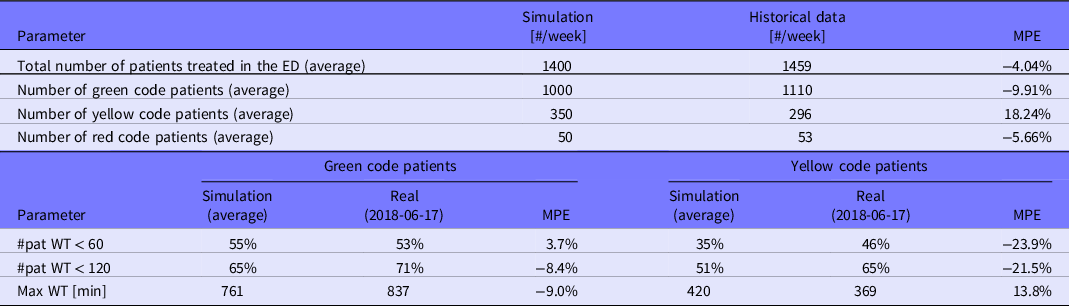
For what concerns the green and yellow code ordinary patients’ WTs in the ED, a comparison of simulated data with real historical data under normal operating conditions was performed, using data recorded in the ED database in the period June 2017 to June 2018 (total number of records: 70,012). Table 3 reports the simulated demand profile and WT distributions for green and yellow patients. OSR PEMAF medical officer considered the simulated data satisfactory and adequate to capture and assess the real behavior of the ED, as the simulated demand falls in the 0.75 percentile of registered peak demand.
Simulated vs real case demand parameters for the OSR ED: average number of patients by type; average waiting times of green and yellow code patients

A focus group of experienced doctors and nurses from different OSR departments (ED, OR, wards) was involved in the validation of the simulation data generated by the remaining part of the hospital model, that is, OR procedures and hospitalization in wards, under the guidance OSR medical officer responsible for the PEMAF.
Results
Baseline Scenario
Under stable normal operating conditions, OSR performance results into an average WTI of 32.11 min (95% confidence interval = ± 4.7 min). Only 1 patient at risk (PAR) was recorded in the baseline night scenario in 9 simulations, therefore, baseline PAR is 0.11 on average.
Daytime Scenario
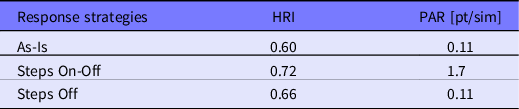
Table 4 summarizes the results of the first simulation campaign. For each 1 of the 3 response strategies, the HRIk and PAR indexes were computed. HRIk equal or close to 1 means that Hospital’s performance loss is limited during an MCI and that the corresponding strategy proves to be effective. At the same time, PAR should remain as low as possible and close to the baseline.
Results of the daytime scenario simulation: Values of the three different resource allocation strategies are reported in lines

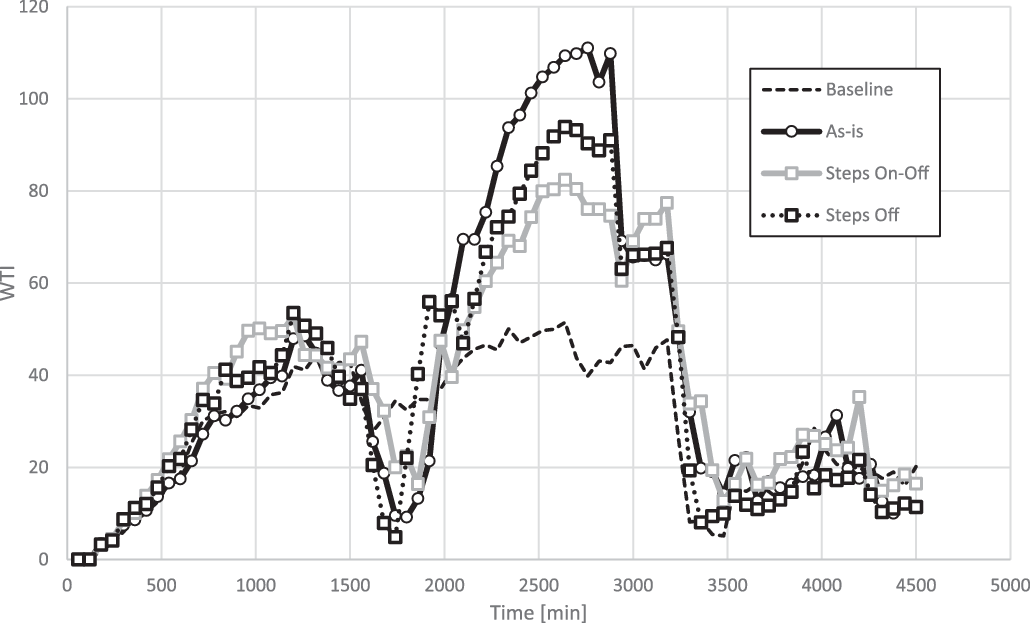
The graph reported in Figure 3 compares the WTI trends of the 3 alternative strategies.
Results of the daytime scenario simulation. Average hourly WTI of different resource allocation strategies vs the baseline.

Figure 4 depicts the time variability of the average WTI standard deviation of the As-Is and the Steps-Off strategies, respectively.
Results of the daytime scenario simulation. Average WTI standard deviation of: As-Is strategy (A) and Steps-Off strategy (B).

Night Scenario
Overall, 9 different resource configurations were generated and 10 simulations were run for each. An additional time-based analysis was performed to compare the PEMAF configuration against the best alternative resource configuration, that is, adding 1 anesthesiologist and 1 general surgeon (avg. PAR = 3.90 patients; avg. MaxWT = 28.10 min; avg. LLoC = 3.00 patients). The aim was to better evaluate the capability of the ED to dynamically respond to the MCI over time. The temporal development of the MCI was analyzed looking at the occurrence of situations in which red code patients are exposed to risk (number of red code PARs) or treated at a level of care lower than the standard (number of LLoC patients), as reported in Figure 5 – Simulation results of the Night Scenario - Temporal development of performance indexes: a) As-Is strategy; b) improved strategy (additional resources: 1 anesthesiologist, 1 general surgeon).
Results of the Night Scenario simulation - Temporal development of performance indexes: As-Is strategy (A), and improved strategy (B) (additional resources: 1 anesthesiologist, 1 general surgeon).

Analysis of Results
Daytime and night/holiday scenarios are radically different in terms of resource configuration and possible hospital’s resource mobilization in case of an MCI is declared, which cannot be generalized across scenarios; they have been investigated accordingly and now will be discussed separately.
As for the daytime scenario, when it comes to the WTI, the proposed alternative resource allocation strategies (Steps On-Off and Steps Off) perform better than the current PEMAF As-Is strategy. Indeed, the HRI value of As-Is scenario is the lowest, whereas Steps On-Off returns the highest HRI value. However, its PAR (1.7 on average) is unacceptable, because it is much higher than the threshold (0.11 on average). It can be argued that the Steps Off strategy is the best compromise, granting a relatively better HRI (0.66 > 0.60 on average) and the same PAR value (0.11 on average) of the As-Is strategy. In other words, a gradual release of resources to the ED from ordinary activities, at the early stages of an MCI, is not able to grant an adequate priority and quick treatment to red code patients (higher PAR), even though it returns the lowest WTI.
On the contrary, the Steps Off strategy shows some marginal improvement when shifting resources gradually back from the urgent to the ordinary activities. Particularly relevant is the possibility to reallocate some ORs to the most urgent and already scheduled elective surgical interventions. The possibility of limiting the disruption of pre-existing waiting lists for elective surgeries and of limiting time delays before hospitalization of noncritical patients, without worsening the capability of the system to absorb the demand induced by the disaster is coherent with the general criteria of PEMAF and the common health-care management policies. Reference Achour, Miyajima and Pascale18–Reference Faccincani, Pascucci and Lennquist20
As for the night/holiday scenario, our simulation campaign returned a clear indication on the most critical resources and improving the operational capacity of the ED to properly treat red code patients. Adding 1 anesthesiologist and 1 general surgeon to the current configuration of a night shift (As-Is strategy) is sufficient to significantly reduce the number of PARs, from 8.20 to 3.90, as well as the number of patients treated at a lower level of care than the standard (LLoC), from 5.40 to 3.00. Adding 1 entire trauma team would grant similar results (PAR = 3.50; LLoC = 3.20) but at a much higher cost.
A more aggregate assessment of the absorption capacity of the ED, and of the shock rooms in particular, can be achieved by looking at the time delay between the first arrival of a red code patient linked to the MCI and the first PAR within the ED, which represents a degraded care delivery condition. Under the As-Is strategy, the ED is able to absorb the demand spike with limited decrease in performance (few LLOC patients) for approximately 1 h (first 4-5 red code patients), whereas under the improved strategy, the time delay expands up to 1.5 h (first 6-7 red code patients). According to OSR experts, the second one is perfectly compatible with the time needed to activate the PEMAF and then mobilize additional staff during a night shift.
Limitations
The present study has some limitations. First, it involved only 1 hospital; for the sake of generalization of results, it is desirable to test the proposed strategies over a wider set of hospital’s characteristics and MCI response plans. Second, the validation process of simulation data was conducted involving some experienced doctors and nurses from different OSR departments and largely relied on the experience of the medical officer responsible for the PEMAF; different and more robust validation protocols could be proposed in the future.
It has to be noticed also that modeling the resources to be mobilized in case of PEMAF activation only the specialized trauma staff has been taken into account: this makes a lot of sense considering how in case of an MCI this is the most significant limiting factor to actual as well as surge capacity. Reference Faccincani, Della Corte and Sesana21
Despite this, it cannot be silenced that other bottlenecks should be considered: even remaining in the staff domain: support personnel (porters) as the flow of patients from the ED to the next destination (radiology suite, OR, ward, etc.) cannot exist without transport staff. Well-known MCI response bottlenecks are to be considered but not studied under the “stuff” domain (ventilators, surgical sets, blood, etc.) and the “structure” domain (information technology, space for stretchers if hallways or the weather precludes use of outside space, etc.).
Discussion
The COVID-19 pandemic extended pressure on hospitals and health systems is showing how the response to an emerging infectious disease MCI inevitably reduces the quality of hospitalized and outpatient care. Reference Garcia, Albaghdadi and Meraj22–Reference Coimbra, Edwards and Kurihara26 This phenomenon, of competition for resources, is detailed in the literature addressing hospitals’ response to an MCI. Reference Parpia, Ndeffo-Mbah and Wenzel27–30 In the present study, a novel view was taken, trying to address at the same time the persisting needs of the other hospitalized patients, thus extending the investigation of a resilient response to a wider spectrum of hospital’s health-care delivery processes.
Specifically, the study considered the possibility to develop alternatives to the strategy stated in the PEMAF (also referred as the As-Is strategy), that is, in 1 single step. The logic guiding such an approach is that of guaranteeing the sudden mobilization of all the available resources for a matter of prudence. It is in fact considered unacceptable to put the conditions of urgent disaster patients at risk while continuing ordinary nonemergencies procedures. On the other hand, when considering ordinary patients, in particular those scheduled for a surgery, the heterogeneity of the procedures and of treatments cannot be neglected. There are cases in which a delay represents a significant issue, beyond the revenue loss for the hospital, such as an increase in morbidity and mortality and a decrease in the patient’s functional outcome, loss of personal income, or other socially relevant consequences.
Along this line, the proved effectiveness of a dynamic resource allocation approach, able to better fit the intrinsic dynamism of an incident, may help in closing the existing knowledge and practical gaps when it comes to leveraging on BCM principles and practices Reference Zhong, Clark and Hou31–Reference Labaka, Hernantes and Sarriegi35 for enhancing hospital resilience in response to a disaster. Indeed, thanks to a more effective use of resources, a wider spectrum of care processes can be supported even during the disaster and shorter but realistic recovery time objectives can be set as well.
However, the dynamics of the hospital’s performance during an MCI shows a common pattern: 2 waves of performance loss are observable, under any resource allocation strategy, which degrades the quality of care compared with normal operating conditions. The first wave translates the increasing saturation of resources at the ED that is later mitigated by the allocation of additional resources. Whereas, the second wave of performance loss is mainly due to the interruption of elective activities in the ORs and other wards and is always worse than the first. This dynamic clearly shows that there is a time delay before the hospital system enters a status of performance instability generated by the MCI demand. Of interest, the time frame of this dynamic is invariant to different internal resources reconfigurations transients; thus, it is of more structural nature, depending on the health-care process configuration and on the overall amount of available resources at hospital level. It can be concluded that further improvements could be only achieved by orchestrating resources between different hospitals in the area where the MCI occurred. Reference Lim, Li and Fang36 Further investigations are advisable to verify to what extent the adaptive resource allocation logics tested in the present study are still valid for orchestrating resources within a network of hospitals.
Conclusions
The study contributes to the advancement of research on resilience and BCM in health care proposing a set of metrics to account for different objectives and priorities in the management of an MCI, along with a multi-method simulation approach enabling a suitable modeling of all the relevant hospital departments and functions.
The study provides relevant insights for practitioners as well. Simulation campaigns confirmed the general suitability of the current hospital approach toward the reconfiguration of resources to cope with an MCI (the PEMAF plan), which is primarily intended to guarantee the maximum care delivery capacity of the ED in the early stages of the event. On the other hand, it was demonstrated that a gradual reallocation of resources to ordinary activities in OR and wards minimizes the disservice to elective surgical patients without any significant impact on red code patients. This alternative strategy proved to enable better hospital resilience both in terms of reduced WTI and in terms of PARs. In the night scenario case, when resource constraints are tougher, an efficient resource allocation and configuration strategy was identified that grants the minimum time delay needed for the mobilization (call on duty) of additional professional resources.
Considering the different phases and waves of the on-going COVID-19 pandemic and the need for the hospitals to be very flexible in resources allocation, a clear message of this study is that the anticipation of the needs should always be respected to avoid being unprepared when the surge in demand will arrive, but at the same time it is necessary to develop strategies alternative to the on-off one to re-allocate resources to the ordinary patients as soon as possible.
Future research should be directed toward network level analysis and simulation, along with the testing of alternative response strategies against MCI of different nature, with different time patterns and demand profiles.