Introduction
One in four older patients treated in the community have severe emotional problems, predominantly anxiety and/or depression, which are often under detected (Olafsdottir et al., Reference Olafsdottir, Marcusson and Skoog2001). A cost-effective way to improve detection is to facilitate early identification of those elderly individuals at risk of mental health deterioration. This would allow us to target vulnerable groups with preventive strategies and early treatment to minimize burgeoning mental health difficulties. Well-established risk factors for depression and anxiety include female gender, somatic illness, cognitive impairment, functional impairment, lack or loss of close social contacts, and a previous history of depression or anxiety (Vink, Reference Vink2008). A number of studies have also identified links between chronic diseases, the medically unwell and mental disorders (Jones et al., Reference Jones, Macias, Barreira, Fisher, Hargreaves and Harding2004).
Within the current literature, there is increasing interest in and focus on the concept of physical frailty in older populations as measured by a phenotypic definition, the biological syndrome of frailty (Fried et al., Reference Fried2001). There is increasing consensus that this frailty phenotype is a definable clinical state that exhibits associations consistent with a syndromal presentation (Fleg and Lakatta, Reference Fleg and Lakatta1988; Evans, Reference Evans1995; Leibel, Reference Leibel1995; Tseng et al., Reference Tseng, Marsh, Hamilton and Booth1995; Buchner et al., Reference Buchner, Larson, Wagner, Koepsell and de Lateur1996; Morley, Reference Morley1997; Bandeen-Roche et al., Reference Bandeen-Roche2006). It is a multidimensional construct of age-related reduction in physiologic reserve and resistance to stressors, associated with adverse health outcomes, which may be reversible at an early stage (Fried et al., Reference Fried2001). A frailty phenotype has been operationalized, with a critical mass of core “frail” elements: weakness, poor endurance, weight loss, low physical activity and slow gait speed. The use of this frailty phenotype to assess and measure frailty provides us with evidence of frailty as a medical syndrome. This allows us to characterize frailty in individual older adults in a way that supports early assessment and screening for the syndrome. It seems necessary then as frailty research progresses to better understand the strength of association between emotional health disturbance and phenotypic frailty as measured by the biological syndrome.
To date the biological syndrome of frailty has been associated with increased depressive symptomatology in those not using antidepressant medications (Fried et al., Reference Fried2001). However, no further studies have specifically evaluated the association between clinically significant depressive symptoms and the frailty syndrome, controlling for other known risk factors such as age, gender and a history of previous depressive illness. More surprisingly, to date, to the best of our knowledge no studies have specifically investigated the association between generalized anxiety in older adults and the frailty phenotype in any capacity. Clarifying any association between the frailty phenotype and elderly individuals who are emotionally vulnerable is worthwhile not least because of the known adverse health outcomes linked to both. Understanding the points of onset of frailty and/or emotional disturbance is vital to early identification of at-risk individuals and intervention in those components that are first affected, when reversal may be most possible. An important factor to consider is the potential reversibility of frailty at an early stage (Fried et al., Reference Fried, Ferrucci, Darer, Williamson and Anderson2004). If its association with deteriorating mental health persists even in the presence of other known risk factors for emotional disturbance then it may represent a key target for intervention that we are under-utilizing.
The primary aims of this study were (i) to characterize the frailty phenotype in a group of community-dwelling elderly; (ii) to evaluate the relationship, if any, between frailty and emotional disturbance as reflected by quantified depression and anxiety within the group; and (iii) to investigate the strength of any association identified between frailty and emotional disturbance in the presence of other well-established risk factors for anxiety and depression in an older population
Methods
This study had a cross-sectional design. A convienience sample of 567 participants was assessed at the Technology Research for Independent Living (TRIL) Clinic in St James's Hospital, Dublin (http://www.trilcentre.org/). Exclusion criteria were: Parkinson's disease, a dementia diagnosis, and previous stroke. The TRIL Clinic offers a comprehensive geriatric assessment to community-dwelling people aged >60 years incorporating the use of various technologies. The clinic has a national scope and encourages referrals from all over Ireland, including self-referrals. Local research ethics committee approval was obtained.
Frailty
Frailty was measured using the Biological Syndrome Model originally described by Fried which includes five frailty criteria: reduced walking speed, impaired grip strength, minimal physical activity, subjective exhaustion, and weight loss (Fried et al., Reference Fried2001). The presence of 1–2 frail criteria indicates a state of pre-frailty, the presence of ≥3 criteria indicates complete frailty. The criteria of subjective exhaustion in the Fried model is determined by two questions – “I felt that everything I did was an effort” and “I could not get going” – taken from the Center for the Epidemiological Studies-Depression Scale (CESD). Respondents answering “yes” to either question for much of the time (≥3 days) during the previous week are defined as having subjective exhaustion. Given that we utilized the same CESD scale to measure depressive symptoms, the use of the exhaustion criteria was thought to be a potential confounder in our analysis as it was associated with both our exposure (i.e. frailty grouping) and one of our primary outcomes (i.e. clinically significant depression). We therefore omitted the “exhaustion” criterion and our measure of frailty consisted solely of the four other frailty criteria, with cut-offs for determining pre-frailty and frailty remaining the same. The effect of this exclusion would have only been to underestimate the extent of frailty within the group. We were able to maintain the cut-offs for determining pre-frailty and frailty as it is merely the cumulative presence of two or more of any of the frailty criteria that determines the pre-frail or frail syndrome. Our only futher adaptation of the frailty criteria was our definition of weight loss which was assessed objectively as a body mass index (BMI) of less than 18.5 kg/m2, rather than a subjective report of weight loss of more than 10 pounds (4.5 kg). This was reflective of similar adaptations for the weight loss criterion from other large population-based studies validating the biological syndrome model of frailty (Cigolle et al., Reference Cigolle, Ofstedal, Tian and Blaum2009). Slowness was defined in terms of walking speed using the cut-points from the Cardiovascular Health Study (CHS), after adjusting for distance (Fried et al., Reference Fried2001).Weakness was defined by assessing grip strength, again using the same cut-points as the CHS dependent on gender and BMI. Low activity was defined in terms of kilocalories expended per week, calculated using the Minnesota Leisure Time Activity questionnaire. Participants were categorized into three groups: robust (non-frail) with no criteria present, those with one or two criteria were pre-frail, and those with three or more criteria were frail.
Anxiety
Anxiety was measured using the seven-item subscale from the Hospital Anxiety and Depression Scale (HADS-A) (Zigmond and Snaith, Reference Zigmond and Snaith1983). Scores ≥11 are indicative of a case of clinical anxiety, scores in the 8–10 range represent borderline cases.
Depression
Depression was measured using a shortened form (eight items) of the 20-item Center for the Epidemiological Studies-Depression (CES-D-20) scale (Turvey et al., Reference Turvey, Wallace and Herzog1999). A cut-off of 4 or more has been used on the CESD-8 item to determine case-level depression.
Additional measures
Cognition was measured using the Mini-Mental State Examination (MMSE; Folstein et al., Reference Folstein, Folstein and McHugh1975). Any patient currently prescribed a selective serotonin re-uptake inhibitor (SSRI) or any other antidepressant regardless of class was grouped as having a potential history of depressive or anxiety disorder. Loneliness was measured using the short-item de Jong Gierveld Loneliness Scale (de Jong-Gierveld and van Tilburg, Reference de Jong-Gierveld and van Tilburg2008) and adverse life events using the Geriatric Adverse Life Event Scale (GALES) (Devanand et al., Reference Devanand, Kim, Paykina and Sackeim2002). Comorbid illnesses were measured using the Age-adjusted Charlson Co-morbidity Index (AACI; Charlson et al., Reference Charlson, Szatrowski, Peterson and Gold1994) and functional level using the Lawton Instrumental Activities of Daily Living Scale (IADL; Lawton and Brody, Reference Lawton and Brody1969).
Statistical analyses
The collected data were analyzed using the Statistical Package for the Social Sciences (SPSS) version 16.0. χ2 tests were used to compare demographic categorical variables. The difference between means was compared using one-way and three-way factorial ANOVA. Odds ratio was used to describe the risk of clinically significant depression and anxiety using the established cut-off points described in the methodology. A multiple logistic regression model was built using a stepwise method; variables other than frailty entered into the regression model were based on known predictors of anxiety and depression in older populations to include age, gender and a history of anxiety or depression requiring pharmacotherapy. The critical value for significance in all analyses was p<0.05.
Results
Of the 567 participants, 166 (29.3%) were male and 401 (70.7%) were female; the mean age was 73±7.4 years; the mean MMSE score was 27 ± 2, social class I and II accounted for 32% of the cohort; almost 50% had received primary level education only; 90% were retired; and 40% lived alone. On application of the Fried frailty criteria using the modified frailty index where the criteria of exhaustion was excluded, 309 (49.5%) were classified as robust, 289 (46.3%) were classified as pre-frail, and 26 (4.2%) were completely frail. Had the exhaustion criteria been included, 283 (49.8%) would have been classified as robust or non-frail, 247 (43.5%) as being pre-frail, and 38 (6.7%) as completely frail. Using the already established cut-off scores for our assessment instruments the HADS-A and CESD-8, we established that 92 (16.2%) participants fulfilled criteria for clinically significant depression and 44 (7.7%) fulfilled criteria for clinically significant anxiety.
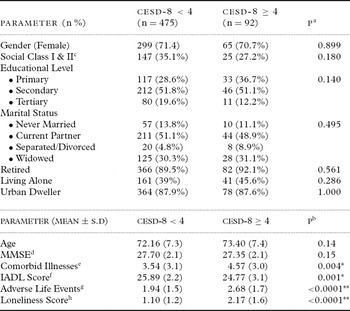
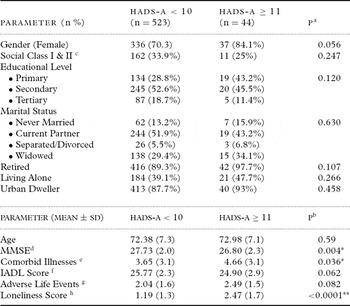
Demographic, lifestyle, and clinical characteristics of participants with and without clinically meaningful depression and anxiety scores are displayed in Tables 1 and 2. There was no significant difference in gender, social class, educational level, marital, working or residential status between participants with and without clinically meaningful depression or anxiety scores. Those who were depressed were more likely to have a higher number of comorbid illnesses (Student-t test: p = 0.004), to have lower scores on the independent ADL scale (Student-t test: p = 0.001), a higher occurrence of adverse life events (Student-t test: p<0.0001) and higher self-reported loneliness scores (Student-t test: p<0.0001). Those who had clinically significant anxiety scores had lower mean MMSE scores (Student-t test: p = 0.004), had a higher number of comorbid illnesses (Student-t test: p<0.0001) and higher self-reported loneliness scores.
Population characteristics according to presence of clinically significant (case-level) depressive symptoms (CESD-8 ≥4)

*Statistically significant p<0.05, ** p<0.001.
a χ2 test, b Student t-test, c Higher social class, d Cognition as measured by the Mini-Mental State Examination, e Age-Adjusted Charleson Comorbidity Index, f Lawton Instrumental Activities of Daily Living Scale, g Geriatric Adverse Life Events Scale,h de Jong Loneliness Scale.
Population characteristics according to presence of clinically significant (case-level) anxiety symptoms (HADS-A ≥11)

*Statistically significant p<0.05, ** p<0.001.
a χ2 test, b Student t-test, c Higher social class, d Cognition as measured by the Mini-Mental State Examination, e Age-Adjusted Charleson Comorbidity Index, f Lawton Instrumental Activities of Daily Living Scale, g Geriatric Adverse Life Events Scale,h de Jong Loneliness Scale.
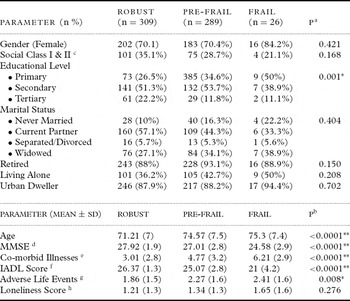
Demographic, lifestyle, and clinical characteristics of participants according to frailty groups are displayed in Table 3. There was no significant difference in gender, social class, marital, working or living status between frailty groups. The frailest group, however, had a higher proportion of participants who had only completed primary level education when compared to other groups (χ2-test, linear by linear association: p = 0.001). There was also a significant difference in mean age between groups, with the frailer participants being older (one-way ANOVA, p<0.0001) and having a higher burden of comorbidity (one-way ANOVA, p<0.0001). Frailer groups also had significantly lower mean MMSE scores (one-way ANOVA, p<0.0001), mean independent ADL scores and a higher incidence of adverse life events (one-way ANOVA, p = 0.008).
Population characteristics according to frailty categories

*Statistically significant p<0.05, ** p<0.001.
a χ2 test, b One-way ANOVA, c Higher social class, d Cognition as measured by the Mini-Mental State Examination, e Age-Adjusted Charleson Comorbidity Index, f Lawton Instrumental Activities of Daily Living Scale, g Geriatric Adverse Life Events Scale, h de Jong Loneliness Scale.
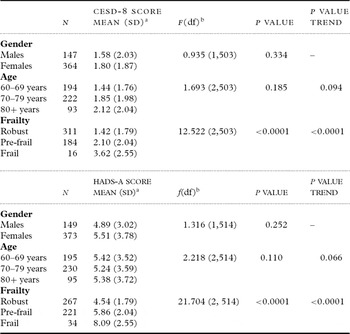
The unadjusted mean depression scores by frailty group are displayed in Table 4. The F and P values were derived from a three-way ANOVA. There was a significant difference in depressive symptoms according to frailty groups showing higher depression scores with increasing frailty. This difference was not apparent between groups defined according to either gender or age. A polynomial contrast indicated that the linear trend for depression scores to increase with frailty was significant at p<0.0001. Pairwise contrasts showed that the difference in marginal means between robust and pre-frail groups was statistically significant at 0.59 points (95% CI 0.23, 0.94; p = 0.001). The difference in marginal means was also significant between robust and frail groups at 2.1 points (95% CI 1.12, 3.02; p<0.0001) as well as between pre-frail and frail groups at 1.5 points (95% CI 0.53, 2.44; p<0.002).Profile plots indicated there was no interaction between frailty, age and gender in the analysis of depression scores.
Mean depression and anxiety scores according to age, gender and frailty status

a One-way ANOVA.
b Three-way factorial ANOVA model.
Table 4 also shows the unadjusted mean anxiety scores by groups; again the F and P values were derived from a three-way ANOVA. There was a significant difference in anxiety symptoms according to frailty groups showing higher anxiety scores with increasing frailty. This difference was not apparent between groups defined according to either gender or age. A polynomial contrast indicated that the linear trend for anxiety scores to increase with frailty was significant at p<0.0001. Pairwise contrasts showed that the difference in marginal means between robust and pre-frail groups was statistically significant at 1.4 points (95% CI 0.80, 2.08; p<0.0001). The difference in marginal means was also significant between robust and frail groups at 3.8 points (95% CI 2.53, 5.06; p<0.0001) as well as between pre-frail and frail groups at 2.4 points (95% CI 1.10, 3.62; p<0.0001).Profile plots indicated there was no interaction between frailty, age and gender in the analysis of anxiety scores.
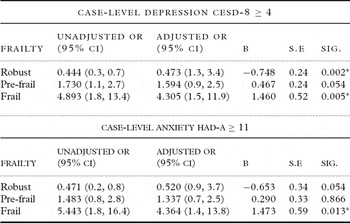
To determine if frailty grouping was associated with clinically significant depressive and anxiety symptoms we conducted logistic regression analysis using a score equal to and above the established cut-off points on the CESD-8 (≥4) and HADS-A (≥11) questionnaires as our outcome measure. We also adjusted for the effect of other potential risk factors such as age, gender, and a history of depression or anxiety requiring pharmacotherapy within the regression models (Table 5). The adjusted odds ratio displayed in Table 5 shows that those participants falling within the robust group were less likely to have clinically meaningful depression scores and so being in the robust category represented a protective factor against depressive symptoms (OR = 0.47; 95% CI 1.3, 3.4; p = 0.002). The odds ratio for pre-frailty did not quite reach statistical significance; however, the odds ratio for frailty showed a significantly higher likelihood of clinically meaningful depressive symptoms even controlling for age, gender, and a history of depression or anxiety requiring pharmacotherapy (OR = 4.3; 95% CI 1.5, 11.9; p = 0.005). Using clinically meaningful anxiety scores as our outcome measure (HADS-A ≥11), no association was found for robust or pre-frail groups. However, participants falling within the fully frail group had a significantly higher likelihood of anxiety (OR = 4.36; 95% CI 1.4, 13.8; p = 0.013).
Multiple regression analysis of frailty and case-level depression and anxiety adjusting for age, gender and past history of depression or anxiety requiring pharmacotherapy

* p<0.05 ** p<0.001, S.E = Standard Error, Sig. = Significance, OR = Odds Ratio.
Discussion
We have found that both pre-frail and frail elderly people experience more symptoms of anxiety and depression than those who are robust. Older persons with established frailty, fulfilling three or more frail criteria, were an at-risk population more likely to have clinically significant anxiety and depression even when risk factors such as age, gender, and a previous history of anxiety or depression requiring pharmacotherapy were accounted for. Our findings suggest that older persons who are becoming increasingly frail according to the frailty phenotype could also be considered psychologically frail with an increased likelihood of emotional disturbance.
Little previous research has systematically examined anxiety and depression and their association with the biological syndrome model of frailty using well-validated psychological measures. One previous study looked at self-reported psychiatric illness in older people and found that for each additional deficit defining frailty, odds of psychiatric illness increased (Andrew and Rockwood, Reference Andrew and Rockwood2007). A further large epidemiological study also identified a relationship between depressive symptoms and incident frailty (Woods et al., Reference Woods2005). This study utilized a measure for depression, however, that includes exhaustion as a symptom, which was also a key feature within their frailty measurement and may represent a confounding factor given its potential association with both exposure and outcome. To avoid this we ensured the exhaustion criteria for frailty was not included in our analysis. Whilst this may have underestimated the level of frailty associated with anxiety and depressive symptoms it ensured exhaustion was not a confounding factor in our results.
The current consensus to include a measure of exhaustion as a criteria for the frailty phenotype may in fact reflect the likelihood that there is a psychobiological component to the fraity syndrome as suggested by our findings. Mental fatigue could be described as a symptom of depressive illness. It may in part explain our finding of an association between increasing depressive symptoms and frailty at both a pre-frail and fully frail stage, as well as our finding that participants who were classified robust were significantly less likely to be depressed whereas those with full-blown frailty had a higher likelihood of clinically significant depression. Those who are depressed may be more likely to become frail secondary to disengagement from daily activities, psychomotor retardation, and poor nutritional intake. Or those who are frail may be more likely to develop depressive symptoms due to impairment of their functional abilities and social withdrawal. Drawing the conclusion as to which comes first – frailty or depression – is not possible in the context of this paper; however, given our findings this certainly warrants investigation within the context of a longitudinal study.
There is an even greater paucity of literature evaluating the relationship between frailty and quantified levels of anxiety in older persons. One recent study did examine health anxiety specifically and its correlation with varying degrees of frailty in a small sample of community-dwelling elders (Bourgault-Fagnou and Hadjistavropoulos, Reference Bourgault-Fagnou and Hadjistavropoulos2009). They identified that seniors with high levels of frailty experienced greater levels of health anxiety. The authors of this paper called for further studies investigating the association between frailty and generalized anxiety in older adults. Most cases of anxiety disorder in late life remain undiagnosed and untreated despite the fact they often have increased contact with medical services (Kennedy and Schwab, Reference Kennedy and Schwab1997). Inadequately treated anxiety leads to distress, functional impairment, and increased medical morbidity and mortality (Jones et al., Reference Jones, Macias, Barreira, Fisher, Hargreaves and Harding2004). In combination with increasing physical frailty anxiety is potentially an additional risk factor for poorer outcomes.
Within our study we have identified an association between increasing symptoms of anxiety as measured by the HADS-A and frailty at both the pre-frail and frail stages. We have also found an increased likelihood of clinically significant levels of anxiety in those who can be classified as completely frail fulfilling three or more frailty criteria. The use of the HADS-A scale may in part explain the strength of association found between frailty and symptoms of anxiety. The HADS is designed to be adept at picking up symptoms of anxiety in those with underlying physical comorbidities as it has been purposely designed with the omission of somatic indicators of anxiety and depression. In this way it may be particularly attuned to identifying anxious symptoms in those with a higher burden of comorbid illness such as our frailer participants. There is likely a complex interplay between anxiety and physical health decline, such as that seen in increasingly frail states. Real worry and pathologic anxiety could be consequences of comorbid physical illness, or chronic anxiety might itself contribute to deteriorating health and increasing medical morbidity or mortality and act as a driver for frailty. Unfortunately it is beyond the scope of this paper to determine cause and effect; however future work in the form of a prospective study is required to validate our findings and may enable us to disentangle why frailty is related to anxiety and to determine causality.
Limitations of our study include its cross-sectional design and the use of a convenience sample, which may have introduced a selection bias making the external validity of our findings questionable. Our sample included those who self-referred to the study; these participants may have certain characteristics that were over-represented. For example, many participants were independently mobile, healthy, and fell within a “younger old” age group. Therefore we may have failed to capture a higher level of frailty and so lack the ability to generalize. This is reflected in the lower level of full-blown frailty evident in our population and a significant proportion of participants who were defined as pre-frail rather than frail, again representing a somewhat “healthier” study population. Despite this the proportion of pre-frail individuals we identified is consistent with findings from the large Cardiovascular Health Study where up to 46% of the total cohort at baseline were considered to be intermediately frail (Fried et al., Reference Fried2001). A further limitation potentially contributing to a failure to capture a higher level of frailty is our use of a modified version of the frailty index with the exclusion of the “exhaustion” criteria in order to facilitate the analysis of frailty and symptoms of anxiety and depression. This led to an underestimation of frailty as reflected in our results and may have influenced our findings relating to frailty and our emotional health outcomes. We must also point to the limitation of our use of a proxy outcome measure (i.e. cut-points on an assessment scale) for the identification of clinically significant depressive and anxiety symptoms, rather than the use of a structured clinical assessment.
Despite these limitations our work provides preliminary cross-sectional results that suggest an association between frailty and the mental health of older people. Increasing symptoms of anxiety and depression were associated with the stages of pre-frailty and frailty independent of age and gender. In addition, full-blown frailty was associated with a higher likelihood of clinically significant anxiety and depression independent of age, gender, and a history of depression or anxiety requiring pharmacotherapy. Our findings suggest that even at the earliest stage of pre-frailty, there is an association with increased symptoms of emotional distress and, once frailty develops, a higher likelihood of clinically significant depression and anxiety. Frailty may be relevant in identifying older people at risk of deteriorating mental health.
Our study increases awareness of the potential links between frailty and emotional disturbance in older adults. It suggests that healthcare professionals who work with frail elderly people should consider the possible co-existence of depression and anxiety. We contribute further support to a possible psychosocial or psychobiological component of the frailty syndrome. In scenarios that predict future health service delivery in the Western world, the rapid increase in the frail elderly population is seen as one of the major challenges of healthcare (Bergman et al., Reference Bergman2007). Further prospective research is needed to clarify causality and to determine if frailty may be a potential interventional target for those with symptoms of depression and/or anxiety who are at risk of the development of case-level disorders. In the context of a comprehensive geriatric assessment the psychological correlates of frailty could be easily screened for. Timely identification and appropriate intervention for anxiety and depression in frailer individuals may then translate to improved outcomes for this vulnerable group of older people.
Conflict of interest
None.
Description of authors’ roles
Dr Aine M. Ní Mhaoláin was the primary author, established the specific study hypothesis and design, completed all analyses and interpretation of data, and prepared the paper in full. Dr Chie Wei Fan was involved with the set up and design of the research project, reviewed the analysis and interpretation of data, and undertook critical analysis of the final paper. Dr Roman Romero-Ortuno and Dr Lisa Cogan, who were contributing authors, were involved in the recruitment of all study participants, completed comprehensive geriatric assessments for all participants and were involved in the interpretation of all study data. Ms Clodagh Cunningham was responsible for direct liaison with all study participants, and was involved in the recruitment and assessment of participants. Professor Rose-Anne Kenny had a supervisory role and was involved in approving the study concept and design, reviewing the analysis and interpretation of data as well as critical analysis of the completed paper. Professor Brian A. Lawlor took on the primary supervisory role and was involved in approving the study concept and design, reviewing the analysis and interpretation of data as well as critical analysis of the project at all stages, from initial data analysis to completion of the final paper.
Acknowledgments
The Technology Research for Independent Living Centre focuses on the research of new technologies to enable people to live independent lives for as long as possible in the environment of their choosing. The Centre is a joint initiative between Intel and the Industrial Development Agency Ireland. The Centre is an active research collaboration between industry and academic partners including Intel, Trinity College Dublin, University College Dublin and the National University of Ireland Galway, and represents a multidisciplinary team of up to 70 researchers including ethnographers, designers, clinicians, economists and a range of scientists and technologists.