INTRODUCTION
Women throughout sub-Saharan Africa may be at risk from widow dispossession when their husbands pass away.Footnote 1 The term “widow dispossession” in this article describes the physical removal of property from a widow's possession, including ransacking dwellings, seizing movables, taking farms and chasing widows from family homes. While studies have documented the occurrence of widow dispossession, the scale is uncertain; in Namibia, for example, Robert Gordon suggests that hearsay has caused a few cases to gain wide publicity, making the problem seem more common than it is, whereas Margaret Owen claims that the problem is prevalent and global.Footnote 2 To widen understanding about the prevalence of widow dispossession, and when and why it may occur, the author designed a comparative study of widow dispossession in anglophone and francophone Cameroon.
Multifaceted norms in Cameroon make widow dispossession a complex process to examine. Countless customary systems govern succession throughout sub-Saharan Africa, and hundreds of groups display diverse histories and practices, upon which legal systems transplanted from colonial times operate. Within Cameroon, for example, there are over 250 ethnic groups with distinct languages and customs.Footnote 3 In addition, French and English colonialism had installed civil law in the francophone regions of Cameroon, and common law in the anglophone areas. Such an environment is ripe for comparative study.
Accordingly, this research is aimed at a better understanding of the phenomenon of widow dispossession by examining the issues in francophone and anglophone areas of Cameroon. Adopting a comparative method, the dataset includes 34 transcribed focus group discussions, a survey of 180 participants, interviews with 34 widows and 12 interviews with legal professionals. Analysis of the data indicates that widows in Cameroon are indeed at risk of dispossession, and widows in anglophone, common law regions of Cameroon may be at greater risk than widows in francophone, civil law regions.
The article begins by outlining the research design and methods. It then presents the findings from the study in four sections. In the first of these sections, the prevalence of widow dispossession in francophone and anglophone areas is assessed by analysing focus group data recorded from women's and men's group discussions of a vignette. The focus group data therefore records perceptions of widow dispossession, rather than the actual occurrence of widow dispossession. It seems that anglophone participants were considerably more aware of the risk of widow dispossession than were the francophone participants. The article then moves on to examine whether widow dispossession forms part of customary practices. It shows how exceptions to widows’ inheritance under customary rules of succession are vulnerable to being invoked more frequently in the modern socioeconomic context. The next section examines the legal protection afforded to widows under civil and common law. While both civil law and common law protect widows from dispossession, in Cameroon this only seems to apply to widows with registered (legally recognized) marriages.Footnote 4 Since, per the survey data, more women have registered marriages in the francophone sample (approximately 60 per cent of marriages were registered among the francophone groups, compared to fewer than 20 per cent in the anglophone collection), more women in francophone areas could be protected by the state legal system. This may account for lower awareness of widow dispossession in the francophone focus group sample.
In the next section, the author theorizes why more marriages in the dataset are registered in francophone Cameroon. She considers styles of colonialism, influences of religion, and differences between civil and common law, with greatest weight given to the influence of civil law and common law legal systems. The author proposes that more couples have registered their marriage in francophone, rather than anglophone, regions of Cameroon because inheritance under the civil law provides for usufruct (joint ownership) rights, which are more in line with traditional forms of communal ownership. In contrast, the common law emphasises individualized property rights, which contravene traditional forms of joint ownership. Such individualization of property rights may have led to fewer anglophone residents opting into the formal common law system through marriage registration. Consequently, fewer widows from anglophone regions can access legal protection from dispossession under the common law. Such findings are significant when considering the drive of international development institutions to promote an agenda of women's access to land in sub-Saharan Africa.Footnote 5
To conclude, the author proposes that, instead of advocating for individualized land rights for women, programmes permitting collective ownership that complements traditional forms of landholding may be more effective and fairer for all.
RESEARCH METHODS
This research is built upon two years of legal work undertaken in the North West Region of Cameroon. The research itself took place a year later, over a six week period. To compare differences in the civil law and common law legal systems, the author carefully researched and selected comparable ethnic groups in anglophone and francophone areas. The sample area was the Cameroonian Grassfields, a mountainous agricultural expanse spanning the francophone West Region and the anglophone North West Region of Cameroon. The West Region is home to the Bamiléké people, one of Cameroon's largest ethnic groups, while the largest ethnic group in the North West Region is the Tikar. Although distinct, these groups are said to “have a complex history of migration and counter-migration”,Footnote 6 and both groups were traditionally organized as “centralized” hierarchical societies,Footnote 7 making them suitable comparators against which the impact of the civil law and common law could be assessed. In addition to concentrating on environmental and group features, the author also selected comparable urban and rural localities to ensure consistency between the francophone and anglophone samples.
Before the data collection stage of the research, the author initially planned to work in two anglophone and two francophone villages of comparable size. However, to strengthen the results, the study was extended to include two additional villages during the data collection phase. This was because a particularly low perceived rate of widow dispossession was reported by focus group participants in the francophone Bamiléké village of Bafou, while an especially high instance was reported in the anglophone Tikar village of Njinikom. Whereas all the other sampled groups were classified as patrilineal, the anglophone Njinikom sample was part of the so-called matrilineal Kom group, a subset of the Tikar people. For this reason, a further patrilineal sample was selected from the Tikar. A counterpart sample was needed from a francophone region and the Beti village of Mbalmayo from the Centre Region was chosen accordingly. Although the Beti are from a traditionally decentralized society,Footnote 8 while the other villages covered by the study were traditionally centralized societies, the Beti sample was selected to assess how far the civil law system (as opposed to the Bamiléké tradition) impacted on the results. The total sample size was therefore six localities: three francophone (Bafou and Bafoussam II in the West Region and Mbalmayo in the Centre Region) and three anglophone (Njinikom, Mankon and Nso’, all in the North West Region).
Two workshops were held in each sampled area. Approximately 30 women participated in the first and approximately 20 men participated in the second, held separately. These focus groups were organized through local contacts the author had established during previous work in Cameroon.Footnote 9 The workshop participants were then divided into smaller groups of around ten people, so that participants had a greater opportunity to speak. Pidgin English was used in the anglophone groups and French in the francophone groups; translators were available to help participants communicate in their local dialects when required.
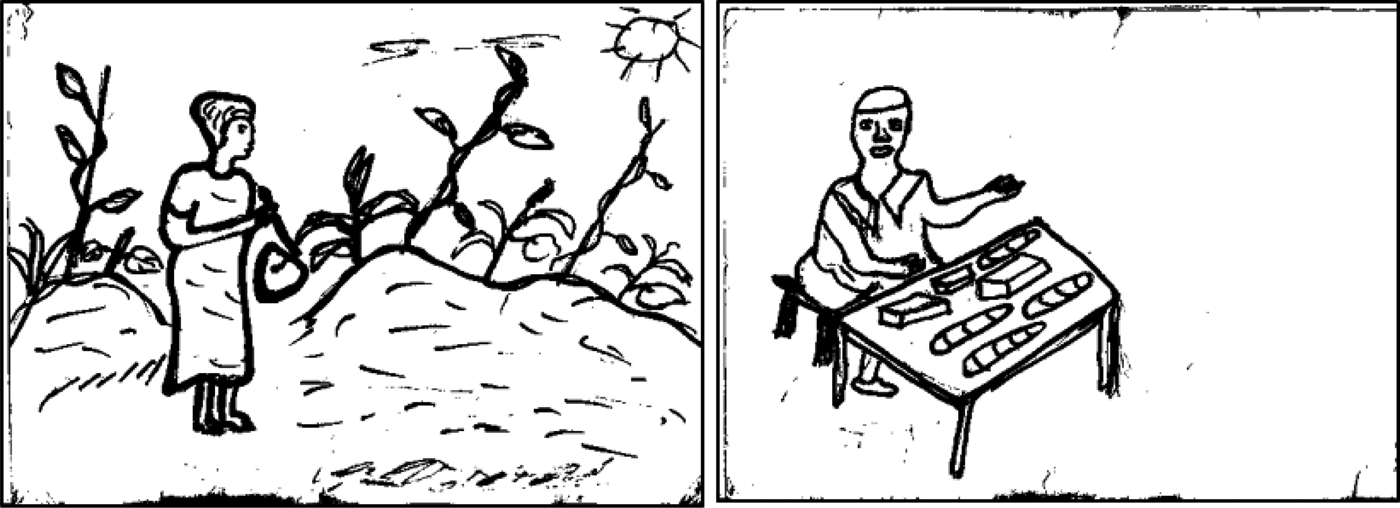
The focus group method was employed to assess how participants perceived the frequency of widow dispossession in their villages and to provide space for participants’ views. Each session lasted approximately one hour. The following vignette was read out to the participants by research assistants, accompanied by locally drawn illustrations of the story (shown in Figure 1): “Madam Grace Ngafor is married to Pa Nde Matthew. They had one wedding – an unregistered traditional wedding in the village. They have four children together. Their eldest son, Kingsley, is seven years old. Pa Nde Matthew sells bread. Madam Grace works the farm and runs a small mimbo house where she sells palm wine. Pa Matthew dies. What happens?” After this, discussion was left to flow, with prompt questions asked as necessary.Footnote 10
Sample Picture Cards – Madam Grace in the farm and Pa Matthew selling bread

Although participants were informed that the research involved comparing marriage and succession in anglophone and francophone Cameroon, terms such as “widow” and “dispossession” were purposefully avoided in the first instance to prevent the prejudicing of participant responses. The focus group method was particularly well-suited for this study, because decisions in the local context about the treatment of widows are often made by groups, such as during family meetings. Furthermore, the usual problems with the focus group approach (such as dominant or elder members leading the discussion) gave an authentic feel to how such decisions about widows’ fates might be made in the village setting. Conclusions nevertheless tended to be made as a group, while individual (often younger) participants occasionally expressed divergent views. Therefore, when one member of the group made a comment, which was uncontested by others, this was recorded as the group's response, with divergent opinions highlighted when relevant. In total, 18 women's focus groups and 12 men's focus groups were conducted and interpreted in this way.
A survey was undertaken alongside the focus group sessions to compile a dataset of marriage statistics. A total of 180 women were surveyed, including 96 anglophone women and 84 francophone women. Although this was a modest sample size, it gives an indication of trends and can help to shape future research. Where possible, the data was reviewed against existing datasets, such as the demographic and health surveys (DHS) carried out by USAID.Footnote 11
A further impromptu workshop was held with a group of 37 anglophone widows, from the already identified Mankon locality. This resulted from a chance meeting with a personal contact who works with widows’ groups throughout the North West Region. Participants from widows’ groups in four areas of Mankon were invited to the workshop, selected on the basis of their availability. There were then four further focus groups, as well as semi-structured interviews with 34 of the widows, that sought to provide the participants with an opportunity to outline their experiences of widowhood and express any problems they encountered. These interviews gave an indication of the actual frequency of dispossession in an anglophone area and drew attention to other factors involved in such cases.
In addition to the focus groups and questionnaires, 12 legal professionals were interviewed. The six legal professionals in the francophone areas were a male university lecturer, three male lawyers from the West Region and two female lawyers from the Centre Region. The six legal professionals from anglophone areas comprised one female lawyer, one male High Court judge and four male lawyers, all from the North West Region. The same vignette was used during these interviews for consistency, but they were conducted as one-to-one interviews.
The data collection outlined informs the comparative analysis of widow dispossession in Cameroon. Results of the comparative analysis are presented in the following sections. The analysis begins with an examination of the occurrence of widow dispossession and an assessment of its prevalence.
ASSESSING THE PREVALENCE OF WIDOW DISPOSSESSION
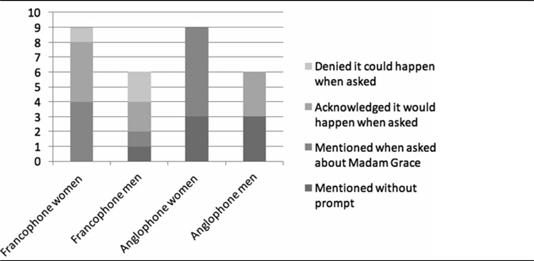
The incidence of widow dispossession is disputed in the literature.Footnote 12 Recording actual incidents of widow dispossession would necessitate a large-scale quantitative study, requiring considerable resources. Instead, this study used the focus group approach and the author sought to gauge the frequency of widow dispossession by speaking with groups in Cameroonian villages about how prevalent they felt it to be. This was achieved by reading the vignette quoted above and recording groups’ responses about what would happen next. Four different responses were noted. Some focus groups immediately mentioned the risk of widow dispossession without being prompted. Others mentioned the risk of widow dispossession in response to the question, “what happens to Madam Grace?” Some groups acknowledged that widow dispossession was a possibility when directly asked about it. Other groups denied that widow dispossession could occur. The first response was analysed as the highest perception of widow dispossession, followed by the second. The third response indicated a low perception and the fourth response indicated no recognition of widow dispossession.
The results are shown in table 1. This table incorporates data from the 30 village focus groups. To maintain comparability of the anglophone and francophone samples, data from the four focus groups with the Mankon widows in the anglophone region are not included. Women's and men's responses were analysed separately, since widow dispossession affects women and men differently, which may alter their view of it.
Perceived frequency of widow dispossession

The data indicate that anglophone women may more readily identify the occurrence of widow dispossession than do women in francophone regions. All nine anglophone women's groups mentioned the possibility of widow dispossession either without a prompt (the first response) or when asked what happens to Madam Grace (the second response). As one Njinikom woman explained: “there are plenty of cases where the woman suffers. Plenty of cases where you find your husband dies and the brother drives you out, takes the farm where you work … They take only the ones they like, and send away the ones they don't love.” A Mankon woman described the extent of the problem as, “[t]hey take even the clothes from your skin”, and a Nso’ woman stated that “[t]hey treat you like an animal, send your things out and chase you like a dog”. A recurring word the anglophone women's groups used to describe the widows’ situation was “suffering”. For example, an Nso’ woman stoically summarized the situation as: “[a] woman is made to suffer to carry children. Then as a widow you continue suffering”.
None of the francophone women's groups mentioned the possibility of widow dispossession without being prompted (response one). When asked about Madam Grace, four groups noted that widow dispossession-like practices could occur (response two). Four francophone women's groups acknowledged widow dispossession could occur, but only when specifically asked about it (response three). Finally, one francophone group denied widow dispossession could happen when directly asked about it (response four). While some francophone groups acknowledged that a widow could be forced to leave, a more common response was that the widow might be mistreated to such an extent that she would eventually leave of her own accord. A woman in Bafousam, for example, commented in response to the vignette: “[t]hey will likely mistreat and disturb Madam Grace. Sometimes it happens where a woman is chased out of the house, though there are times when the family will not send the woman away but will put pressure on her to such a degree that she will coerced into leaving”. This was affirmed by other francophone women, such as a Beti participant who explained that, “[e]ven though they don't drive you away, the way they treat you is like telling you to go”. Widows being mistreated until they opted to leave was also a recurring theme in the anglophone women's discussions, as well as the threat of being chased away.Footnote 13
Mirroring the women's responses, anglophone men indicated a higher instance of widow dispossession than did the francophone men. Of the six anglophone men's focus groups, three acknowledged widow dispossession without being prompted (first response) and three acknowledged it when asked (second response). One Njonikom male participant expressed that: “[s]ome men are responsible and take care. But some, they only care about land, they don't care about the woman and children”.
Of the six francophone focus groups, only one group mentioned widow dispossession without being prompted (first response) and one mentioned widow dispossession practices when asked about Madam Grace (second response). Two of the francophone men's groups acknowledged that widow dispossession could happen when directly asked about it (third response) and two groups denied it could happen (fourth response).
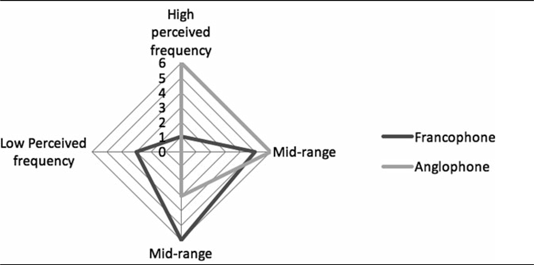
Accordingly, there is what can be described as a “high to medium” perceived frequency of widow dispossession in the anglophone sample, compared to a “medium to low” perception in the francophone groups, illustrated in table 2. While the prospect of dispossession was acknowledged by all anglophone groups, albeit with some variation in opinion as to the frequency of such cases,Footnote 14 three groups in the francophone sample did not acknowledge that dispossession could occur and, in the francophone groups that did recognize it could happen, the majority emphasized that such an outcome was “rare” or “exceptional”.Footnote 15 The data therefore indicate that perceptions of widow dispossession are higher in the anglophone sample than in the francophone sample.
Scaled perceived frequency of widow dispossession

As well as the focus group data, the study recorded a dataset of experiences of 34 widows in the Mankon area of anglophone Cameroon, which further informs the analysis. Of the 34 widows interviewed, five reported being dispossessed. Veronica was one such case.Footnote 16 When Veronica's husband died, the family sent her and her children away. Her husband's cousin seized the children's birth certificates and refused to return them; she does not know why he did this. Veronica now lives with her children in her family's compound, where she grows and sells cassava and breeds fowl (chickens) to pay her children's school fees. Although Veronica is no longer in touch with the husband's family, they still greet her in the village, which she described as “absurd”.Footnote 17 Another widow in a similar situation proclaimed: “[w]e have no voice. We can only cry for help”.
In addition to the widows who were dispossessed, four widows reported being partially dispossessed of their personal property and farmland, while permitted to remain in the family compound. Three widows reported the family-in-law as having unsuccessfully attempted dispossession when their husbands passed away. A further two widows reported being mistreated by the family-in-law, which led them to leave the family home. One widow in this situation rationalized: “[y]ou save your life and vanity and you leave everything”. Of the 34 widows interviewed, 20 reported having a good relationship with their family-in-law; thus, just under 60 per cent of widows in the sample did not experience family problems in widowhood.
This section has shown that most participants who took part in the study recognize the phenomenon of widow dispossession. Moreover, the data from the interviews with widows indicate that women in Cameroon do have first hand experience of being dispossessed. This article now examines the potential reasons why widow dispossession may occur. First, it considers whether widow dispossession stems from customary practices. Since the perception of widow dispossession is higher in anglophone regions compared to francophone areas, it then examines whether the different colonial-sourced legal systems affect the frequency of widow dispossession.
WIDOW DISPOSSESSION UNDER CUSTOMARY SYSTEMS
Variant customary practices may affect rates of widow dispossession. The highest instance of widow dispossession in the dataset was noted by the anglophone Njinikom focus groups, who traditionally practise matrilineal succession (where the widow's brother or nephew inherits).Footnote 18 Indeed, one Njinikom participant suggested that widow dispossession was part of their tradition. In addition, a further francophone woman, from the Beti village, also suggested that widow dispossession was part of her tradition: “[t]hey can send you away if they want, or they can keep you if they want”. Notably, however, all other focus groups in the sample firmly denied that widow dispossession was part of their tradition. Several anglophone focus groups suggested that the problem of widow dispossession was more prevalent among other ethnic groups, such as Njinikom and Wum, rather than part of their own tradition. In contrast to the high incidence of widow dispossession among the anglophone Njinikom groups, the francophone Bamiléké groups in Bafou noted the lowest perception of widow dispossession.Footnote 19 Since the Bamiléké are locally renowned for economic success, there may be less financial pressure among this community to dispossess widows. Thus, Bamiléké customs may affect the likelihood of widow dispossession arising.
To examine the role of tradition in the occurrence of widow dispossession, the author reviewed anthropological studies related to customary rules of succession. Due to the limited availability of studies on the specific groups under examination, customary practices of various ethnic groups in sub-Saharan Africa, especially those with links to Cameroon, were analysed in aggregate. Since some of the studies built on are historical, the author reflected on the changed socioeconomic environment following colonialism and how this impacts on the application of customary rules. Interwoven within the analysis are findings from the focus groups. Here, the aim is to examine to what extent widow dispossession is permitted under customary systems and how this may affect the incidence of widow dispossession.
Before the advent of colonialism, land was inalienable in many parts of sub-Saharan Africa.Footnote 20 Consequently, widows’ inheritance rights developed in a starkly different context to that of the present day. On the intestate death of a family head, the position would often be succeeded by people in certain categories, such as elder sons, brothers, wives’ brothers or nephews, depending on the traditions of the group concerned.Footnote 21 As women relocated for marriage, more often than not the post of family head was bestowed upon males, which ensured ancestral land stayed within the family patrilineal line.Footnote 22 Occasionally, where no male heir could be found, a daughter would succeed until she raised a son able to take over the role.Footnote 23 While widows for the most part appeared to be excluded from succeeding to the position of family head, widows were nevertheless afforded substantial care from the husband's family after he died.
Since land was already tied up in group members who were using it, land was historically an insignificant part of inheritance. Of greater significance was the care that successors owed to family members.Footnote 24 As such, several options were open to widows to secure their access to land, depending on the group concerned. For one, a widow could remain in the home and continue working farms as she had done during her husband's lifetime, while the deceased's family was obliged to support her.Footnote 25 Some widows would choose to live with their sons; alternatively, widows could return to their natal family where their father or brother would offer them a room and land to farm.Footnote 26 Widows of a childbearing age could choose to remarry, either within the deceased's lineage or external to it. The practice of “remarrying” within the lineage, referred to as levirate, secured a widow's use of land and safeguarded her children's rights to inherit.Footnote 27 If a widow remarried outside the lineage, she surrendered her access to the house and farm she was entitled to use as a member of the deceased's lineage, but acquired fresh rights as a result of her new marriage.Footnote 28 In accordance with the “wealth in people” thesis, widows were highly valued as primary producers in predominantly subsistent agricultural landscapes, which meant widows had significant bargaining power to secure access to land.Footnote 29
In the present day, however, the emphasis is no longer on the successor's duty of care, but on land rights acquired as part of the inheritance, which weakens a widow's ability to secure land claims. Most land in Cameroon remains unregistered; however, due to national laws that make the state the owner of all unoccupied land, groups are restricted to using land already within family possession, causing traditional regimes to be delimited by territory rather than by the number of people within a lineage as had been the case in pre-colonial times.Footnote 30 Thus land, rather than people, is now a scarce and valued asset. As one Njinikom man in the sample explained, “[l]and used to be plenty so it was easy to give out lands. But now it is different, land is difficult to obtain”. The only way to acquire additional land is through purchase, hence traditionally “owned” land has become alienable.Footnote 31 These changes have drastically altered the nature of customary land rights, resulting in family heads, who previously managed land on behalf of an entire family, exercising quasi-absolute ownership and able to profit from family landholdings.Footnote 32 Consequently, previously secure usufruct-like rights of other family members have diminished, creating a disproportionately negative impact on women's access to land.Footnote 33 Rather than being valued for their role as farmers, widows might now be seen as impediments to successors’ full enjoyment of their inheritance.Footnote 34
Levirate and widowhood rituals are traditional institutions that could provide a way for unregistered widows to secure inheritance rights; however, in the modern day, such practices are discouraged. For example, Christian beliefs that levirate is immoral and amounts to treating women as property, as well as opposing campaigns by non-governmental organizations (NGOs) concerned by the prevalence of HIV, have contributed to its decline.Footnote 35 However, as an anglophone Banso man noted, “[b]ecause she refused to get married to the in-law the family will want to punish her”. Similarly, current drives by an assortment of NGOs to discourage widows’ rituals (such as widows being forced to shave their heads, strip naked and/or sit by their husband's corpse)Footnote 36 on grounds of moral reprehensibility, may also reduce such practices. Yet, as Goody explains, widows’ rituals are intended to test whether a widow was complicit in her husband's death and, by coming through such ordeals, widows are exonerated from accusations of murder.Footnote 37 This was affirmed by the dataset, when a male focus group in anglophone Mankon discussed the traditional widow rituals, where a widow will go for days without washing and move around barefoot to show she is mourning. When asked what happens if a widow does not do this, the men agreed in unison, “she killed him”. So a situation arises where, in a changed economic environment, there is greater financial incentive to deny widows their inheritance rights, while widows are simultaneously discouraged from engaging in customary practices that could secure their succession claims.
The data indicate that, for the most part, male members of the sampled groups believed that widows were owed a duty of care, in accordance with customary practices. For some of the male focus groups, however, this was dependent on widows submitting to levirate.Footnote 38 This is highlighted in the comments of an anglophone male participant from Mankon: “[i]n some families, the successor will come in to control the children. He will need to take control of the wife, and try to go to bed with the wife. If they refuse, they are chased away and all the property is taken. But this is an exception”.
Female participants agreed with this claim. One Njinikom anglophone woman, for example, explained that, “[t]he successor comes and pressurizes you to sleep with him. Some women agree, but if you don't you go back to your family”. Another anglophone Nso’ woman asserted that, “[n]ow no woman would accept to be inherited. But when you refuse, they hate you. This is why they send you away”. Related to the idea of levirate, a recurring observation among all participants was the idea that “[w]omen are treated like property, like they have a transaction value”.Footnote 39 This was claimed by some men to be a reason why women could not inherit, because “property cannot own property”.
It was only in exceptional cases that the men in the focus groups acknowledged that widows should be denied traditional inheritance rights altogether, if they “misbehaved”.Footnote 40 A Banso man, from the anglophone sample, explained the potential to dispossess a widow for misbehaviour in the following way: “[i]t can happen if the woman is misbehaving. If traditionally married, then the wife becomes the property of the family. If she misbehaves, it warrants her to be dismissed by the family. But if she does not misbehave, they cannot send her away … in most cases now, some of them turn to misbehave, some turn to prostitution. The family becomes angry and will not want to see her”.
A francophone participant, from a Beti man's group, expressed similar views about widows’ misbehaviour: “[w]e need to put sense in the head of the women. Some of them are maltreated because of their behaviour … there are many widows who want to take advantage of their widowhood to destabilize families. The moment trouble comes, they cry ‘I am a widow’. They listen to her because she is a widow. She is wicked”.
In response to treatment such as this, a Mankon women lamented that: “[t]hey maltreat the widow. They threaten her. You stand from afar and watch how she suffers. The sisters in law threaten her. They accuse her of killing the husband, bringing concubines into the house, prostitution. When the woman gets over angry, she decides to pack. When it gets too much, she decides to leave”. Here the line between dispossession and a widow being forced to leave is again present.
Accusations of widows having murdered their husbands were also widespread throughout the dataset, occasionally attributed to witchcraft.Footnote 41 Childless widows appeared the most vulnerable under customary rules. An anglophone participant, for example, explained, “[t]here are plenty of cases where she hasn't born children; this is very different. Tradition means they can take everything from her. She can stay but she gets no rights”. An anglophone woman from Mankon went even further to suggest that, “[i]f she doesn't have children, she is sent out of the house. Some are even drowned”. In the francophone Beti village, an elderly childless widow was described as having remained in the family home once the husband passed away, which notably caused confusion in the village. Whereas some people in the village claimed the woman must leave because there were no children, others said she should stay, because “she worked hard and helped the husband get what he could”.
Exceptions aside, the overwhelming consensus of most focus group participants was that widow dispossession was not part of their tradition. Instead, it was frequently associated with “wicked” or “bad” families. An anglophone widow, for instance, suggested that, “[i]t's not in every family. Some families are good and some are bad. But in all villages, it can happen”. In trying to explain the “wickedness” of some families, an elderly Nso’ man, from the anglophone sample, shared a view that, “[t]his thing has come from materialism … people have travelled to Doula and Bamenda and want to be like rich people … Many changes are strange for us. They come with the wind”. Therefore, in the present economic environment, where land rights have greater economic importance, exceptions that enable family members to deny widows inheritance rights and duties of care (such as a widow declining levirate or accusations that she killed her husband or misbehaved) are vulnerable to manipulation. There is more economic incentive to deny a widow land rights when land has a resale value, than there once was when land was inalienable and workers were of greater value. Thus, what were once exceptions to deny widows access to land rights risk, in the present context are becoming more commonly invoked.
Even though widow dispossession may not be part of tradition, there appears to be limited redress for widows who are accused of misbehaviour and denied their traditional inheritance rights. This is aptly put by an anglophone Nso’ woman, “[t]he widow leaving is not part of the tradition but the tradition does not protect”. While some anglophone women described Fons [village kings], supporting them to remain, many others felt helpless when problems arose. In response to the limited protection afforded under the tradition, a Njinikom woman felt that “the tradition don fail we” [the tradition has failed us]. Widows without protection under traditional customs may seek protection from dispossession elsewhere. The state legal system is one such place.
WIDOW DISPOSSESSION UNDER CIVIL LAW AND COMMON LAW
This article has so far suggested that widow dispossession does occur in Cameroon and that the perceived frequency of widow dispossession is higher in the anglophone sample than in the francophone one. It then examined whether widow dispossession stemmed from customary systems. Although widow dispossession does not seem to be part of custom, many customary systems permit exceptions to widows continuing to use land on the loss of their husband. While in earlier times raising these exceptions may have been rare, in the current economic climate there is more incentive for these exceptions to be invoked. This may account for the occurrence of widow dispossession when it arises. The article now examines whether there are any differences in legal protections afforded to widows under the common law, applicable in the anglophone Cameroon, and the civil law, applicable in francophone areas.
Widow dispossession is essentially prohibited under both civil law and common law in Cameroon; yet, the data indicate that only registered marriage seems legally to safeguard against it. Marriage registration is guided by harmonized legislation in Cameroon, under the Civil Status Ordinance of 1981 (CSO 1981). However, because CSO 1981 is silent on the distribution of property, inheritance rights are governed by French and English colonial-sourced laws in the respective regions of Cameroon.Footnote 42 Francophone succession law is contained in chapter III of the Civil Code 1804, which is an amended version of the French Napoleonic Civil Code of 1804.Footnote 43 In accordance with article 731 of the Civil Code 1804, blood relatives (the children, descendants, ascendants and collateral relations) and the spouse succeed to the property in undivided shares, meaning that the surviving spouse is granted usufruct rights in the estate.Footnote 44 In accordance with the French-sourced law, only in the absence of blood relatives of a degree capable of succeeding will the surviving spouse be permitted to inherit the deceased's estate.Footnote 45 Conversely, under English-sourced law, the surviving spouse is first in line to succeed, followed by any children, and the spouse is able to inherit ownership of the whole or a share of the property, depending on whether property was held “jointly” or “separately”.Footnote 46 Both sources of law make provisions for testamentary succession.Footnote 47 In addition to widows’ protection from dispossession under common law and civil law, CSO 1981 also explicitly prohibits this practice.Footnote 48
The study data suggest that the courts in Cameroon may only be willing to protect widows from dispossession if the marriage was officially registered and provided the widow was in possession of a marriage certificate. Hence, the legal professionals who were interviewed held that a traditional marriage (ie a marriage in accordance with group customs) that has not been registered is insufficient for widows’ inheritance claims in law. For example, all 12 legal professionals asserted that, without a marriage certificate (or children who have been legally recognized by the father), there is little redress in law against widow dispossession. One anglophone lawyer stated this in the following absolute way: “[i]f there are no children and no certificate, there is no way to claim, no compensation, nothing”. While the anglophone lawyers highlighted the absence of written proof as the reason why the courts will not entertain the matter, five out of the six francophone legal professionals went even further by stating that, in law, the unregistered spouse is not even considered a wife but a “concubine”. One of the francophone interviewees continued by explaining that “while traditionally the woman is recognized as a true wife, from the legal point of view she is not considered a widow”.
The conclusions reached by the interviewed legal professionals were supported by the views of the focus group participants. Out of 34 focus groups, 29 believed that the fictional widow in the vignette could be dispossessed in such a situation. This further aligned with data collected from the 34 widows interviewed in anglophone Mankon. None of the five widows who were dispossessed had a marriage certificate. Of the four widows who were partially dispossessed (having farms and/or property taken), only one had a marriage certificate. Moreover, the two widows who left of their own accord, following what they described as mistreatment by the husband's family, did not have marriage certificates. Of the remaining 23 widows who were not dispossessed, 14 had registered marriages and seven of the nine widows who did not have registered marriages nevertheless had children who were legally registered by the father. Thus, widows without marriage certificates appear at greater risk of losing inheritance rights than those with legal documentation. As one francophone woman explained, “[h]ere in Beti it's the paper that talks”.
This lacuna, in which widows without legal documents are at greater risk of dispossession, may result from an interpretation of CSO 1981. Article 4(1) of CSO 1981 states that, “[e]very Cameroonian residing in Cameroon shall, under pain of the penalties provided for in section 370 of the Penal Code, be bound to declare to the competent civil status registrar of his area births, deaths and marriages concerning him and taking place or celebrated in Cameroon”. Consequently, since penalties can be invoked for failure to register traditional marriages (ie those conducted under customary rules alone), having a non-registered traditional marriage becomes an offence, theoretically punishable by law.Footnote 49 This appears to have been interpreted by legal professionals as requiring all holders of traditional marriages to opt into the state registration system in order to benefit from state privileges and rights in law, including protection against widow dispossession.Footnote 50 Similarly, in order to safeguard children's inheritance rights, children also need to be legally recognized by the father either at birth or through subsequent registration.Footnote 51
CSO 1981 thus appears to have been interpreted in Cameroon as requiring widows to have registered marriages to inherit property in law. For this reason, widows in Cameroon without registered marriages (or registered children) are expected to be most at risk from dispossession. Accordingly, areas with lower rates of marriage registration may experience higher instances of widow dispossession.
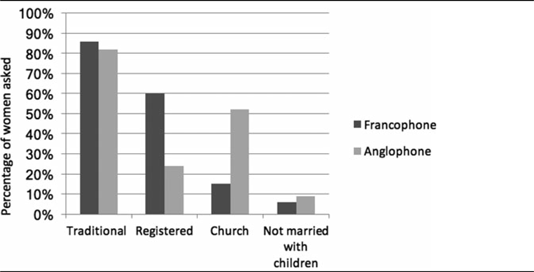
Interestingly, the data suggest that married partners in the sampled francophone regions are more likely to have registered their marriages, than have married partners in the anglophone areas. Table 3 shows the types of marriages entered by women in the questionnaire sample. Whereas 60 per cent of the francophone women reported to have entered registered unions, only 24 per cent of women in the anglophone sample had. The francophone sample of the Beti people had the highest instance of registered marriages, where 74 per cent of women said they had registered their marriages. These figures are double those of Guyer's wider survey of marriages among the Beti in 1988, which recorded 35 per cent with registered marriages.Footnote 52 This may indicate an increase in the number of Beti couples registering their marriage, though the small sample size in the present study would require further research to affirm this. The number of registered anglophone marriages, just above 20 per cent, is in line with estimates made by the anglophone legal professionals interviewed, one of whom suggested that fewer than 20 per cent of the anglophone population had marriage certificates and another proposed that 75 per cent were without marriage certificates.
Accumulated types of marriage

Of further interest is the prevalence of traditional marriages in both francophone and anglophone samples. Despite the importance of registered marriages for safeguarding widows’ rights, an overwhelming majority of the anglophone and francophone focus group participants expressed an opinion that unregistered traditional marriages were still genuine marriages, whereas registered marriages without the traditional dowry payment were not. The focus groups were asked the following question: “[i]f two people have a traditional wedding but do not register their marriage, are they married?” In response, 85 per cent of the focus groups concluded that the couple were marriedFootnote 53 and 26 per cent specified further that the marriage would be “traditional”.Footnote 54 The 15 per cent who felt that this type of union was not a marriage were primarily female participants, with 60 per cent clarifying that such marriages used to be recognized “at first”.Footnote 55 The groups were then asked the converse question: “[i]f two people have a registered civil status wedding but do not perform traditional marriage rites, are they married?” In response, 65 per cent of the focus groups decided outright that this was not marriage.Footnote 56 Of the 35 per cent that recognized this could be marriage, half nevertheless asserted that dowry must be paid for the marriage to be valid.Footnote 57
Language used among the focus group participants further highlighted the significance of traditional marriages. For example, in francophone Bafoussam, traditional marriage was described as the “real” marriage, having more “value” than a legal one.Footnote 58 Similarly, in anglophone Mankon and Njinikom, some groups expressed that the “country marriage” was more important than a legal one.Footnote 59 In anglophone Nso’, one men's group described traditional marriage as “the only marriage recognized as valid” and an Nso’ women's group affirmed that it was “more binding than the court marriage”. Moreover, some groups appeared particularly passionate about these questions, with one anglophone Mankon men's group cheering that the traditional marriage was “the base, the base!” and a Mankon women's group similarly exclaiming, “no dowry, no marriage!”
Despite apparently higher rates of marriage registration in the francophone sample, both francophone and anglophone participants attached less importance to registered marriages. For example, some participants explained that “we do not trust the force of legal marriage”, “the council is simply for today, but it holds no sway in our tradition” and claimed that a registered marriage without payment of dowry “doesn't work”.Footnote 60 While one female participant in a Beti francophone group confided that, although she had a traditional wedding, without civil registration she does not feel married, some of the male participants conveyed the opposite: that civil registration is “provisional” until the dowry is paid and that, without traditional marriage, even if the couple had a registered marriage, they would still be considered as living in concubinage.Footnote 61 This contrasts with the legal professionals interviewed, who saw couples in non-registered unions as living in concubinage and registered marriages as the most valid form.
CSO 1981 does not require the payment of dowry for a civil status marriage to come into being; so long as the spouses-to-be consent and the witnesses are above the age of 21 years, a registered marriage can go ahead.Footnote 62 Nevertheless, focus groups from four out of six villages reported that their local councils required traditional marriages to be completed before registration of state marriages could take place,Footnote 63 as explained by one female participant in a francophone group: “[i]f someone goes to the council without paying the dowry, they write it on the marriage certificate. If you then bring a problem they will tell you that she is not your wife. The mayor himself tells you it is not marriage and what he is writing has no value. If you want him to write it he will write, but it has no force”.Footnote 64
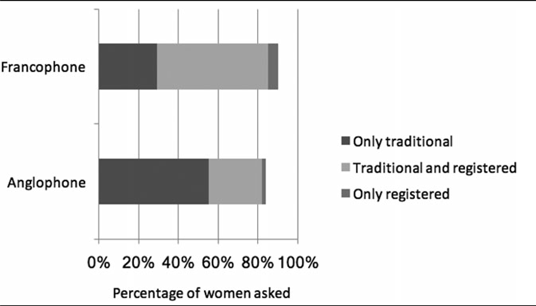
For some people, therefore, a valid marriage requires both traditional rites and legal registration. For others, a religious marriage might also be necessary. Focus group data indicate that traditional marriage is backed by the support of the community, in contrast to registered marriages alone. This point was highlighted by a francophone participant: “[t]he security of community enforcement that accompanies a traditional marriage is lacking [in lone registered marriages]”.Footnote 65 These findings are reinforced by the survey data illustrated in table 4.
Lone “traditional”, “traditional and registered” and “registered” only marriages

Over 80 per cent of the women surveyed, in both francophone and anglophone samples, had traditional marriages. Of the anglophone sample, 55 per cent had only traditional marriages, compared to 29 per cent of the francophone sample. Interestingly, in Guyer's 1984 study, 29 per cent of women were also documented in the sampled francophone group to be “married by bridewealth alone”.Footnote 66 Subject to variables (such as sampled age-range and conditions of data collection), the data in the current study indicate that the number of people entering lone traditional marriages has not radically decreased in the past 30 years. The number of people entering only registered marriages, however, was low, at 5 per cent in the francophone dataset and 2 per cent in the anglophone sample.
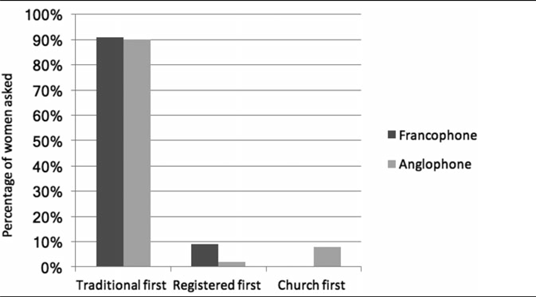
Thus, lone traditional marriages are much more prevalent than lone registered marriages in the sample. The trend in the francophone sample points towards a combination of the two marriage types, whereas the trend in the anglophone sample is for lone traditional marriages. Nevertheless, as shown in table 5, an overwhelming majority (more than 90 per cent of those married) in both the francophone and anglophone samples entered a traditional marriage first and foremost before any other marriage, which again emphasizes the importance to the participants of traditional marriage.
Order of marriage

Despite the seeming importance of marriage registration to safeguard widows from dispossession when their husbands pass away, marriage registration does not appear to be treated as being as significant as traditional marriages in Cameroon. Whereas both traditional and registered marriages appear common in the francophone sample, the lower rates of marriage registration in the anglophone sample may result in widows being more vulnerable to widow dispossession in these areas, without protection from the state legal system or from tradition. This worry accords with the focus group data, which indicate that participants in the anglophone sample were more attuned to the risk of widow dispossession than francophone participants were. Although perceived rates of widow dispossession are different to actual occurrences, these findings do indicate that further research in this area is warranted.
THEORIZING WHY MARRIAGE REGISTRATION APPEARS LOWER IN COMMON LAW AREAS
The analysis of this study has indicated that widow dispossession is perceived to be more prevalent in anglophone parts of Cameroon than in francophone areas, which may correspond to lower rates of marriage registration in the anglophone sample. Moreover, traditional marriage seems to be important in both the francophone and anglophone samples. This section reflects on reasons for these results. First, it suggests that the higher rate of marriage registration in the francophone sample might be explained by the greater capacity of civil law to reflect the traditions and customs of local groups, in contrast to the common law. While greatest weight is given to this first explanation, two alternative reasons for the results are also considered. One alternative explanation is colonialism: the French colonial policy of assimilation may have resulted in more francophone Cameroonians feeling connected to the French state and laws, and hence more readily registering marriages with the Cameroonian state. The second alternative explanation is religion: the influence of religion is seemingly higher in anglophone areas, which might correlate with a reduction in widowhood practices, and thus provide greater scope for successors to deny widows inheritance rights under the customary laws. These three reasons are now explored in greater depth.
Participants in both anglophone and francophone groups emphasised the significance of tradition in their communities. Since succession under the francophone civil law appears to be in better harmony with customary rules than succession under the anglophone common law, more couples may have opted into marriage registration under the civil law system. For example, francophone civil law allows for collective ownership, in which several individuals can have usufruct rights in property held indivision, until severance is applied for and permitted by a court order.Footnote 67 This aspect of the system tallies with traditional ideas of inalienable land rights and family members’ usufruct rights in property. The civil law also recognizes a wider class of beneficiaries to succeed to the estate of the deceased, reflecting the importance of family for communities in Cameroon.Footnote 68 Moreover, civil law recognizes the role of the family council in decision making, an institution prevalent among many family groups in Cameroon.Footnote 69 French-sourced legal provisions also mirror particular customary rules, such as the idea that a widow can be denied inheritance rights if she had a part to play in her husband's death.Footnote 70
While aspects of civil law appear to reflect local customs, common law in many respects could not depart further from it. Common law emphasizes individual ownership rights, which enable widows to inherit not only over and above wider family members, but in fact in some instances to trump their claims to succeed.Footnote 71 This effectively means that, by entering into a registered marriage, the widow under English-sourced law could be granted property rights to alienate part of the deceased's estate, which would be stronger than the rights the deceased had under the customary system. As one male Nso’ participant from the anglophone sample passionately explained when asked if a widow could sell family property, “[n]o-one can sell the compound. It is for the whole family. These selling things and money have just come. Selling property is very bad … No-one can sell. Not woman, not child. Here, selling has never been the practice. Now it is changing, but we don't want it to go that way. Early man reasoned about property and riches. And now land is of such high price, you cannot get it. We need land. Where can the children go?”
Considering this desire for ancestral property to remain within the family, marriage partners are understandably hesitant to enter registered unions in the anglophone regions than in the francophone ones. Therefore, while the common law is often found to be more suitable than the civil law because of the enhanced property rights it provides investors,Footnote 72 the knock-on effect of such laws may provide greater insecurity and hardship for other groups. That is, under the common law either family members must be excluded from inheritance in the case of a registered marriage or the widow is at risk from dispossession in the case of an unregistered marriage. Furthermore, since unregistered marriages in anglophone Cameroon appear to constitute the norm, dispossession may arise more often in these regions.
Styles of colonialism could provide an alternative explanation for these results, the French implementing a colonial policy of assimilation compared with the British policy of indirect rule.Footnote 73 The French assimilation model of colonialism disregarded local structures in favour of French culture and ways, so the colonised were encouraged to identify themselves as French. Such emphasis on a French identity may have fostered a greater internal motivation for those in francophone areas to register their marriages and hence become part of the French system. Britain's policy of indirect rule, on the other hand, permitted the coexistence of traditional legal institutions, police forces and so forth; hence, the British Empire ruled through existing traditional institutions. This British model of colonialism may have maintained community alliance to traditional systems, and fostered indifference to integrate and register with the state. Although of some explanatory power, both models of colonialism were said eventually to incorporate elements of the other's approaches and hence did not form such a dichotomy.Footnote 74 Moreover, the Cameroonian state and various NGOs have been promoting marriage registration during over 50 years of independence. It is, therefore, unclear to what extent colonial policy continues to affect rates of marriage registration today. Additional research that accounts for a wider scope of laws could shine a light on this.
A further explanation for the higher perceived levels of widow dispossession in anglophone Cameroon could relate to the Christian influence, which is seemingly greater in the anglophone sample as indicated by the number of church marriages shown in table 3 above. The data also indicate that rates of polygamy are lower in anglophone regions than in francophone regions, especially in anglophone areas that have the highest rates of church marriages. Just under a third of women in Cameroon live in polygamous unions; 32 per cent of women in the survey reported being one of two or more wives, which aligns with DHS figures.Footnote 75 The survey data indicate, however, that 26 per cent of women had polygamous marriages in the anglophone regions, compared to 42 per cent in the francophone regions. Polygamy was lowest in the villages where religious marriages were most frequent. For example, in the francophone village where there were no recorded church weddings, 58 per cent were in polygamous unions. In the anglophone village where 73 per cent had a church wedding, the highest of any group sampled, the rate of polygamy was at a low of 8 per cent. These figures indicate that Christianity may have greater influence and importance in anglophone areas.
Higher rates of Christian influence may result in lower rates of discouraged practices such as widowhood rituals and levirate. For example, a missionary-led drive against levirate in colonised countries has been documented.Footnote 76 Therefore, populations with a higher prevalence of Christianity, such as anglophone parts of Cameroon, might be less inclined to accept a levir. The current sample provides limited support for this explanation. While a participant from one female anglophone group made reference to the “weakness” of women who accept levirateFootnote 77 and one male anglophone group directly referred to Christianity as a reason for people no longer engaging in this practice (“Christianity has come, things are changing”),Footnote 78 for the most part, the francophone and anglophone groups expressed similar attitudes towards levirate: that it is part of the tradition, but infrequently practised.Footnote 79 In Bafou, a village with no recorded church marriages, two out of the five focus groups referred to the prevalence of HIV leading to the decline of levirate.Footnote 80 Christian influence, and the disapproval of the levirate customary practice, may accordingly impact on widow dispossession, but it is unclear whether Christian influence has reduced levirate more than any other external factor. Again, this is an area that would benefit from further research.
CONCLUDING REMARKS
The analysis began by examining perceptions of widow dispossession in francophone and anglophone areas of Cameroon. This revealed that research participants in the anglophone areas were more aware of the issue of widow dispossession than francophone participants in the study. Since widow dispossession was raised as a concern by many participants, particularly women, the author sought to understand better both how and why widow dispossession occurred, and reasons for the apparent higher awareness of widow dispossession among anglophone groups.
First, the article examined the impact of tradition and custom on widow dispossession. Although widow dispossession does not seem to form part of customary practices in Cameroon, there are customary exceptions which prevent a widow from inheriting. Historically, these exceptions were indeed exceptional but, in the modern climate, where land has become a scarce and valued resource, such exceptions risk being more frequently invoked. When widows are accused of killing their husbands or misbehaving, which might justify denial of their traditional inheritance rights, there is limited recourse under customary systems. Protections afforded to widows under customary systems, such as widows’ rituals and levirate, are becoming less common in the modern environment; however, alternative protection for widows has not emerged. Under traditional rules that now operate in a modern context, widows appear more vulnerable than ever to widow dispossession.
The article then moved on to assess the legal protection for widows under civil law and common law. While both civil law and common law protect widows from dispossession, widows only appear to qualify for protection when they have registered marriages. Since the study data indicate that more women have registered marriages in francophone areas of Cameroon, compared to anglophone areas, more widows are likely to be protected under the civil law than the common law. On theorizing why marriage registration may be more common in francophone Cameroon, the author suggested that, since civil law property rights are more in tune with customary land rights, the civil law rights may have been adopted more widely by local populations. Common law property rights, on the other hand, encourage individualized notions of land ownership, which run counter to notions of family land-holding under traditional systems. This may account for the seeming reluctance of anglophone participants to enter formal marriage registration under these systems. While the article also considered colonial and religious influences, civil law and common law differences may provide greater explanatory power.
These findings highlight the complexity of land rights in post-colonized countries and the need for states and development agencies to take a holistic view when instigating land reform. The author proposes that encouraging individualized rights fails to account for multiple interests in land. If individuals resist opting into formal systems altogether, then promotion of such land rights could ultimately result in laws with limited reach.Footnote 81 However, if land policies are designed with respect for communal interests, more people may opt into formal systems, which would ensure effective safeguards for women and men alike. While this is a small-scale investigation, the findings hint at interesting trends. Further research in this area would be of value.