Arterial switch operation has become the standard of care for d-loop transposition of great arteries and has excellent short- and long-term outcomes.Reference Brown, Park and Turrentine 1 The arterial switch operation procedure includes translocation of the aorta and pulmonary arteries above their respective sinuses as well as transfer of the coronary arteries from the native aorta to neo aorta. Distortion of the coronary arteries, in the presence of an anatomical abnormality, is a major cause of early mortality.Reference Metton, Calvaruso and Gaudin 2 We report the case of a neonate with d-transposition of great arteries with intact ventricular septum and a low-risk coronary artery distribution of left circumflex coronary artery arising from the right coronary artery. During arterial switch operation, she had coronary artery vasospasm and required extracorporeal membranous oxygenation and, subsequently, heart transplantation.
Case report
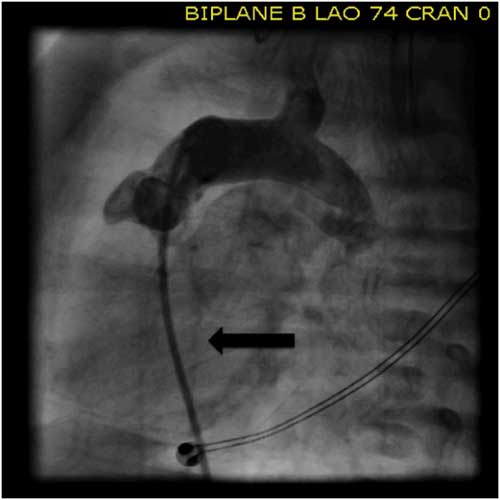
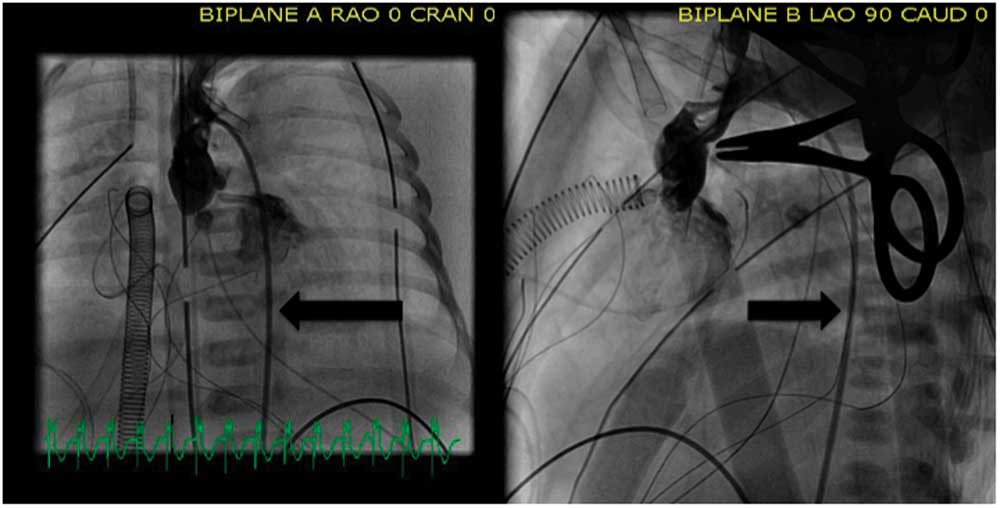
We report the case of a newborn girl born at term – that is, at 39 5/7 weeks of gestation – with a prenatal diagnosis of d-transposition of great arteries with intact ventricular septum. The pregnancy was uncomplicated; there was no maternal history of diabetes, hypertension, or of medication or drug consumption. The infant was born by caesarean section secondary to fetal bradycardia and fetal distress. Apgar scores were 8 at 1 minute and 5 minutes of life. Birth weight was 2.6 kg with saturations ranging from 75 to 80% on room air. An intravenous infusion of prostaglandin was started soon after birth. A postnatal echocardiogram confirmed the diagnosis of d-transposition of great arteries with an intact ventricular septum and a small atrial septal defect. She was considered a low-risk candidate for the arterial switch operation: full term, d-transposition of great arteries with intact ventricular septum, and possible repair within the first week.Reference Castaneda, Trusler, Paul, Blackstone and Kirklin 3 The echocardiogram showed evidence of the left circumflex coronary artery arising from the right coronary artery and of an arching course of the artery. On day 2 of life, the baby had desaturations and was taken to the cardiac catheterisation lab for balloon atrial septostomy as well as for further delineation of the coronary artery anatomy. The injection in the ascending aorta revealed faint coronary artery filling confirming the origin of the left circumflex coronary artery from the right coronary artery. There were no electrocardiographic changes during contrast injection. Because of the unsatisfactory, faint delineation of the coronary artery anatomy observed in the ascending aortogram, selective coronary angiographies were attempted; however, the selective coronary arteries could not be entered even using different catheters and through multiple attempts (Fig 1). On day 5 of life she underwent the arterial switch operation. After sternotomy, it was noted that the left anterior descending artery originated from the left sinus and the second coronary artery originated from the right sinus and gave rise to the circumflex and right coronary arteries. The proximal portion of the left anterior descending artery was noted to be quite tortuous. The arterial switch operation procedure was performed as per the standard technique. The pulmonary arteries were mobilised and the patent ductus arteriosus was ligated. After the Lecompte manoeuvre, buttons of the coronary arteries were cut and mobilised. The coronary artery was mobilised at a few mm from its origin. Needlepoint cautery was used at a low setting for this purpose. The coronary arteries were transferred with a U-shaped incision for the left anterior descending button, as it was easily mobilised, and with a trapdoor-type incision for the right coronary artery, because of the circumflex orginating from the right coronary artery. The buttons were above the level of the sinotubular junction, and a 1 mm probe was easily passed down both the coronary ostia. After anastomosing the great arteries, the cross-clamp was removed. All parts of the coronary arteries filled briskly and the patient regained normal sinus rhythm as she was being warmed. The patient was placed under infusions of milrinone, epinephrine, dobutamine, and nitroglycerin to initially wean from bypass. During weaning off bypass, there was a sudden decrease in blood pressure and a low cardiac output, and the biventricular function deteriorated. In conjunction with this observation, her transoesophageal echocardiographic findings documented that with progressive filling of the ventricle while weaning off bypass, the left ventricular function deteriorated further and mitral insufficiency became progressively severe. The left anterior descending artery in particular looked unusually small and there was dusky discolouration of the myocardium around the distribution of the left anterior descending coronary artery. The surgeon in the operating room visualised the coronary spasm. Intraoperative heart examination initially showed fully filled coronary arteries and a pink myocardium, followed by the observation of flat coronary arteries and a dusky-coloured heart. It involved the entire heart and was not regional. The left coronary button was re-implanted a little more distally, above the aortic suture line, to remove all the tortuosity from the left anterior descending artery even though the ostium was wide open. Careful measures were taken to deliver cardioplegia directly into the coronary artery using a hand-held cannula to avoid any further myocardial injury. As the ventricle function continued to be severely decreased, the infant was placed on extracorporeal membranous oxygenation support. About 45 minutes after going on the support, the electrocardiogram showed ST wave changes consistent with acute myocardial infarction. Both the left and right coronary arteries appeared small and were better filled when a vasodilator agent, papaverine, was infused locally in the coronary arteries. This suggested that both the coronary arteries had coronary vasospasm. The patient underwent an additional catheterisation 24 hours after this surgery, which documented faint filling of both coronary arteries on ascending aorta aortography. (Fig 2). This suggested a diffuse coronary artery spasm, which did not improve despite the use of high doses of nitroglycerin and the use of topical papaverine as well as of localised lidocaine spray, intraoperatively. Routine use of nitroglycerin at 0.5 mcg/kg/minute is used for arterial switch operations at our centre; however, in this particular case, the maximum dose used was as high as 4 mcg/kg/minute. The patient continued to be on extracorporeal membranous oxygenation support with no improvement in the left ventricle function and underwent cardiac transplantation on day 8 of the support. The explanted heart was closely examined and it weighed 22 gm, with dilated left and right ventricles. The right ventricle measured 0.6 cm in thickness and the cut surface was dusky red with focal areas of softening. The left ventricle was dilated with the wall measuring from 0.2 cm to a maximum of 0.4 cm in thickness. The cut sections of both ventricles showed extensive infarction consisting of large areas of eosinophilic coagulation necrosis without significant associated inflammation. The two surgical “buttons” showed all sutures to be intact and the coronary ostei to be patent. The cut sections of both the coronary arteries did not reveal any thrombi. There was, however, no comment on the thickness of the coronary arteries or any lesions observed microscopically.
A lateral view of the chest with an angiogram in the ascending aorta showing extremely faint filling of the coronary arteries indicated with the arrow.

An anteroposterior and lateral view of the chest with an angiogram in the ascending aorta showing no filling of the coronary arteries: pigtail catheter in the aorta indicated with arrows.

Discussion
Arterial switch operation is now the preferred surgical option for infants with d-transposition of great arteries.Reference Brown, Park and Turrentine 1 The first operation was performed by Jatene et alReference Jatene, Fontes and Paulista 4 , giving the procedure its other name – Jatene procedure. This procedure involves translocating the great arteries above their sinuses along with re-implantation of the coronary arteries in the neo-aorta. The main pulmonary artery bifurcation is placed in front of the ascending aorta using a procedure known as Lecompte manoeuvre.Reference Lecompte, Zannini and Hazan 5 The left ventricle remains the systemic ventricle after repair, in contrast to the atrial switch operation. Over the last few decades, there has been progressive improvement in surgical techniques leading to a substantial improvement in the surgical morbidity and mortality after this procedure.Reference Brown, Park and Turrentine 1 , Reference Blume, Altmann, Mayer, Colan, Gauvreau and Geva 6 , Reference Kirklin, Blackstone, Tchervenkov and Castaneda 7 The reported risk factors for early mortality after the arterial switch operation are previous aortic arch repair, pulmonary artery banding, longer circulatory arrest time, lower gestational age and weight, as well as coronary artery anomalies.Reference Blume, Altmann, Mayer, Colan, Gauvreau and Geva 6 , Reference Kirklin, Blackstone, Tchervenkov and Castaneda 7 In one study, the coronary pattern found in our patient, in which the left circumflex artery arises from the right coronary artery, was found in 18% of all patients (n=400) with d-transposition of great arteries.Reference Khairy, Clair and Fernandes 8 Blume et alReference Blume, Altmann, Mayer, Colan, Gauvreau and Geva 6 concluded that coronary artery anomalies were not a risk factor for early mortality in a cohort of 223 patients, even though they influenced delay in sternal closure and prolonged mechanical ventilation. Another study by Qamar et al found that coronary anatomy did not affect survival in 168 patients undergoing arterial switch operation at a single institution;Reference Qamar, Goldberg, Devaney, Bove and Ohye 9 however, coronary artery anatomy and anomalies still remains a concern in a patient with d-transposition of great arteries before the arterial switch operation. Patients with intramural coronary pattern continue to remain at a higher mortality risk after arterial switch operation, even in the current era.Reference Metton, Calvaruso and Gaudin 2 There is, however, no reported case of surgical complications due to coronary artery vasospasm in patients with d-transposition of great arteries.
Our patient had evidence of coronary artery vasospasm in contrast to an air embolus or thrombus formation. First, the cardiovascular surgeon visualised the spasm in both the coronary arteries at the same time, which improved with papaverine infusion and localised lidocaine spray. Second, the transoesophageal echocardiogram showed significant simultaneous biventricular dysfunction. Third, postsurgical cardiac catheterisation with angiography confirmed widely patent coronary arteries with vasospasm on contrast injection. Finally, the pathology report of the explanted heart confirmed changes consistent with myocardial infarction in both ventricles with patent coronary arteries with no evidence of a thrombus. Embolic occlusion of the coronary arteries after the arterial switch operation has been reported;Reference Bacha, Quinones, Kahana, Baron and Hijazi 10 however, spontaneous resolution of the thrombus in our patient cannot be ruled out. If a thrombus was indeed the true cause of the myocardial infarction and dysfunction, it would have affected a single coronary artery in contrast to affecting both the coronary arteries at the same time as in our patient.
There are some case reports in adults describing coronary spasm leading to angina at rest. Prinzmetal et al first described the anginal attack at rest, not induced by increased myocardial oxygen demand but secondary to spasm, in the epicardial coronary arteries.Reference Prinzmetal, Kennamer, Merliss, Wada and Bor 11 Vasospasm of the coronary arteries leading to rapid diminution of the blood supply to the myocardium seems to be the predominant mechanism for the pain and electrographic changes. Typically, the coronary artery spasm occurs at rest without any apparent triggering factor; however, it may also be induced by stressful conditions. The duration of these spasms is variable, often short, and they are responsive to nitrates. They can, however, be long enough to cause severe transmural ischaemia causing life-threatening arrhythmia and even death. Prinzemetal angina is usually reported in adults with some case reports in adolescents.Reference Jefferies and Treistman 12 , Reference Ivy, Kaye, Flitter and Wiggins 13 There are a few case reports of coronary vasospasm in children associated with marijuana use,Reference Basnet, Mander and Nicolas 14 Kounis Syndrome,Reference Parent, Wearden, Kounis and Chrysostomou 15 Lupus,Reference Jasmin, Ng, Sockalingam, Yahya, Cheah and Sadiq 16 and Kawasaki disease.Reference Tsuda, Yasuda and Naito 17 Coronary artery spasm has been reported after cardiac transplantation.Reference Dalzell, Jackson, Petrie and Hogg 18 Ivy et al. reported a case of variant angina in a 11-year-old boy without any risk factors.Reference Ivy, Kaye, Flitter and Wiggins 13 The aetiology of coronary artery vasospam in adults may be secondary to endothelial dysfunction caused by athelerosclerosis, aging, smoking, hypertension, hyperlipidaemia, and diabetes mellitus. In children with Kawasaki disease, endothelial dysfunction in the absence of overt coronary abnormalities can lead to vasospasm.Reference Tsuda, Yasuda and Naito 17 Our patient had no such risk factors. Some case reports suggest that myocarditis could initiate a coronary artery vasospasm.Reference Ferguson, Farwell, Bradley and Rollings 19 In our case, we were unable to find the specific cause of the coronary artery spasm. Our case is a newborn with a normal coronary angiogram. Preoperative and intraoperative transoesophageal echocardiograms revealed normal biventricular function; therefore, myocarditis is not a possibility. Cases of vasospastic angina have been reported in families with a history of coronary artery disease.Reference Kobayashi, Kouzuma, Tsutsui, Okazaki, Tasaki and Nakashima 20 Gene defects in endothelial nitric oxide synthase gene or the human leukocyte antigen have been postulated as causes for genetic predisposition in some patients.Reference Yoshimura, Yasue and Nakayama 21 , Reference Kawata, Mizutani and Shimizu 22 Thus, we speculate that, in our case, the patient had a predisposition for coronary vasospasm, which was accentuated in the presence of stressors like cardiac catheterisation and surgical bypass. This is the first reported case in a patient with congenital heart disease in whom spasm of both coronary arteries led to catastrophic changes in the myocardium, ultimately requiring a heart transplant. We tried topical papaverine in our patient to assist with the vasospasm, which did not help; however, direct infusion of papverine in the coronary arteries did lead to some improvement in the filling of coronary arteries. Although this ultimately did not change the outcome in our patient, we believe there may be a role for topical papaverine or papaverine infusion in patients who have evidence of coronary spasm on preoperative catheterisation and who may be at a high risk for coronary vasospasm intraoperatively. We speculate that early identification of patients who are at a high risk for coronary vasospasm and prophylactic or timely infusion of papaverine directly into the coronary arteries may be beneficial in this condition.
Acknowledgement
None.
Financial Support
This research received no specific grant from any funding agency, commercial, or not-for-profit sectors.
Conflicts of Interest
None.