INTRODUCTION
Development of deep-water oil and gas production technology will enable more and more deep-water oil fields to be accessible for exploitation by the industry. This will increase the demand for environmental research and monitoring at great depths. Bio-monitoring of organisms living in the proximity of discharges is a common approach, and in such monitoring the need for collection of organisms is crucial. The deep-sea environment challenges the design of the collection approach in such environmental monitoring programmes. In shallower areas equipment is usually retrieved by hooking into floating buoys. Such a design is disproportionately complicated to operate under deep-water conditions in areas with rough weather. The substantial area of surface line projected into the current would lead to a requirement for extremely heavy bottom weights and floating elements in order to avoid gear drifting away from the desired position. By increasing slack in the surface line the loads on equipment decrease, but that is often not applicable close to installations due to the risk of entanglement. Damage to equipment by wave action and collision with vessels is often a limitation and, due to the safety risk, many of the platform operators do not accept surface buoys within the safety area around the structures. Bottom installations often rule out the use of active gear like trawls and scrapes.
To overcome these limitations we have designed a simple lightweight rig system that provides a safe, easy and reliable operation. Availability of the most expensive electronic units on the rental market (e.g. www.seatronics-group.com) reduces the investment costs. Field testing confirmed that the rig, fitted with different traps, brought fish and invertebrate specimens to the surface in good condition.
GEAR DESIGN
The general gear design was based on principles reported by Guennegan & Martin (Reference Guennegan, Martin, Laubier and Monniot1985), De Broyer et al. (Reference De Broyer, Nyssen and Dauby2004) and Jones et al. (Reference Jones, Tselepides, Bagley, Collins and Priede2003) and developed to meet the demand for collection of deep-sea organisms suitable for environmental bio-monitoring in Norwegian waters.
To avoid surface line, the rig was fitted with an acoustic release that is activated to retrieve the gear. The acoustic releaser (Sonardyne OM–7710C, provided by Seatronics) was fitted inside the centre of the rig and connected to the disposable ballast weight, 100 kg round steel plates (two plates each 50 kg to ease handling) connected to the releaser hook by a chain (Figure 1). Communication with the releaser (arming, releasing and depth recordings) was commenced by a portable deck unit (7663/7 LCU Psion).
Sketch showing the rig arrangement. (A) Buoyancy elements; (B) acoustic transponder; (C) shock absorber; (D) invertebrate traps; (E) bait; (F) acoustic releaser; (G) access to release mechanism; (H) fish trap entrance; (I) steel frame; (J) fish trap; (K) weight. Net separating the two fish trap chambers vertically not shown.

To enhance accurate positioning of gear, all rigs were fitted with acoustic mini SSBL transponders (Simrad NST 342/N). The transponders were attached on the rope above the rig with hose clamps. To avoid wear on the rope, an armed plastic hose was fitted before attachment. In order to track the rigs during deployment and retrieval, a Simrad-HIP AP vessel based transponder system, (Apos software) or a portable deck unit (Sonardyne 7769 transceiver provided by Seatronics) was used.
Buoyancy units (total 100 kg buoyancy) consisted of two 25 kg spherical units and a 50 kg ‘doughnut’ (both unit types certified to 2000 m water pressure). A 20 m rope was fitted between the two 25 kg units to ease the retrieval operation. Release of the equipment for deployment was simplified by a steel swivel snap shackle suspended from the crane hook.
The rig can be fitted with a range of smaller sampling gear for collection of organisms at great depths; a fish trap and two different pots for invertebrate catch were tested. The fish trap was originally designed to catch gadoid species such as haddock and cod (Furevik, Reference Furevik1997). The robust design and large volume of this trap allows it to be left in periods of rough weather without reducing the fish quality. It is made up of a steel and aluminium frame enclosed in a 2-cm mesh net and can be collapsed during transport. The fish trap has two compartments with two catching units in the lower sections and with a storing compartment at the top. Height/width/length is 113 × 100 × 152 cm, respectively and entrance opening 100 × 56 cm and 15 × 25 cm (outer and inner diameter, respectively). The float rings in the original design of the fish traps were removed to reduce drag and the top frame was attached to the top of the centre tube. The net separating the two fish trap compartments was modified to fit around the centre tube.
Bottle traps were made of perforated plastic soda bottles (volume 1.5 l) where the bottleneck was cut free and assembled backwards. This bottle-trap has previously been successfully used by our group for collection of hagfish and scavenging amphipods in deep waters in Norwegian fjords (700 m). The other invertebrate trap tested was made up from a 15 cm perforated drain pipe fitting ‘access pipe with screw opening’ with a 26 mm one-way funnel entrance. The entrance was fitted with splintered 1-mm plankton mesh to avoid animals escaping once inside the trap; baiting and removal of catch is done through the screw lid on the bottom. Both types of invertebrate traps were attached to the frame inside the fish trap.
Both fish traps and invertebrate traps were baited with a combination of frozen herring (Clupea harengus) and mackerel (Scomber scomber). The bait was purchased frozen and thawed before being loaded into the traps. To avoid depletion of bait some of it was put in perforated plastic containers inaccessible to small scavengers. This procedure extended the duration of the bait and thus prolonged the traps' active fishing time.
FIELD TESTING
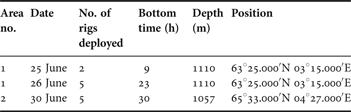
To test the performance of the equipment in the field, the rigs were tested on an environmental baseline survey cruise at two deep-water sites where oil exploration is planned (Børseth et al., Reference Børseth, Myhre and Sundt2007). The sites are situated in the Vøring area on the continental slope off Norway and are characterized by clay bottom and depths of approximately 1100 m (locations are given in Table 1). The field testing was commenced in the period from 23 June to 1 July 2005 using the research vessel ‘Polarbjørn’ (IMO 9233997). On each of the areas five to seven rigs were deployed. The first rig in each area was deployed at the position given in Table 1 and the subsequent rigs were deployed approximately 100 m from the position on a 90º transect on the current direction. Bottom time is given in Table 1.
Station information.

RIG PERFORMANCE AND CATCH OF DEEP-SEA ORGANISMS
By means of transducer readings connected to GPS positioning, drift was tracked after deployment. Rigs typically drifted approximately 150 m from the drop point to the seabed. Typical sink time to 1100 m was approximately 20 minutes (~0.91 m s–1). Typical float time from 1100 m was approximately 25 minutes (~0.75 m s–1), information that together with current data can be used to estimate drift.
All rigs were retrieved without problems containing organisms in a good condition suitable for bio-monitoring. The fish catch consisted exclusively of the deep-water species Arctic rockling, Onogadus argentatus. Between zero and eight fish were caught in each trap (indicating patchy distribution) with an average of two specimens per trap. The size ranged from 190 to 620 g with average weight of 373 g.
The catch of invertebrates consisted solely of amphipods. The most abundant species were Eurythenes gryllus (giant amphipods) and Anonyx magox. Both species are big enough for individual sampling and both species were present in sufficient numbers for biological sampling in all rigs. In addition to the two big amphipod species several other smaller species were caught in abundance in all traps. Each rig setting (fitted with four internal traps) caught between 250 and 1250 g of amphipods.
ACKNOWLEDGEMENTS
The development and testing were part of an environmental baseline study founded by Statoil, ENI Norge AS, Chevron-Texaco and AS Norske Shell. Taxonomy of amphipod species was performed by Anne Helene Tandberg (IRIS).