Introduction
Nanomaterials and, in particular, nanoparticles are everywhere. They exist in air, water, and soil. They have existed through geologic time, and they probably account for much of the chemical reactivity in the Earth and on other planets, as well as in interplanetary space. We have discovered them, named them, made them fashionable, and of course, made them technologically useful.
The main question about nanomaterials is, “how are they different from bulk materials?” Certainly, they are more reactive, but they are also different in their fundamental thermodynamic properties. Many of the behaviors that we have previously ascribed to kinetics are, in fact, thermodynamically driven. Kinetic constraints obviously do exist, but there are often other underlying drivers, including thermodynamics.
Current issues such as energy, environment, waste, and climate are interrelated in that they all essentially reflect the physics and chemistry of materials. These encompass materials in the solid state ranging all the way from the Earth’s core to its crust, in soils, and in particulates in the atmosphere, as well as materials in the liquid and dissolved state, as found in the Earth’s molten metallic outer core, in magmas and lavas, in oceans, lakes, and rivers, and in the gaseous atmosphere. Materials issues are important in the balance of energy in the planet and in the balance of materials in geochemical cycles. Materials are also important in how we interact with the planet. With the human population at its current level, using resources and emitting CO2 into the atmosphere, materials, and especially nanomaterials, have global impacts. To understand these impacts (e.g., the persistence of CO2 in the atmosphere) one has to understand geochemical cycles and nanomaterials. For example, the precipitation of carbonates in the ocean and elsewhere, which is crucial to the removal of atmospheric carbon dioxide, may occur through nanophase and amorphous intermediates.Reference Radha, Forbes, Killian, Gilbert and Navrotsky1
We know that the rates at which processes occur are controlled by kinetics, and their end products are eventually controlled by thermodynamics. With nanomaterials, as well as with all processes technological or natural, lack of knowledge of the sign and magnitude of a free energy change makes it difficult to judge what reactions (e.g., synthetic pathways, corrosion processes) are possible.
In many cases, such as in precipitation, sol-gel processing and hydrothermal synthesis in the natural or anthropogenic environment, particles that initially form are small. These nanoscale particles often persist because coarsening requires a higher temperature to strip off their hydration shells to enable them to come together. One is left with nanomaterials that are metastable with respect to beautiful, bulk single crystals, but that are nevertheless very persistent. Dealing with the chemistry of metastable states is nothing new; a mixture of hydrogen and oxygen has well-defined thermodynamic properties, but at the same time, one should not light a match to it. Similarly, we ourselves are metastable with respect to CO2, H2O, and a small pile of ash, but that does not matter for most of our lives. So dealing with metastable states persisting under kinetic constraints is commonplace. In the case of such nanoparticles, although each particle contains a small number of atoms, an assemblage of many nanoparticles defines an ensemble average of properties and falls within the realm of normal thermodynamics, not the thermodynamics of small systems.
Nanoscale particles, of course, have surfaces, such as the interfaces between the different solid phases of nanoceramics. Interfaces are also present between nanoparticles and water, between nanoparticles and air, and between nanoparticles and other particles. If the interfacial areas are defined by the initial synthesis, then one must ask, “how do the particle and the system optimize free energy under the constraint of constant interfacial area?” The major issue then is that different crystal structures have different surface energies. Thus, different polymorphs, hydrated and dehydrated materials, and materials in different oxidation states, have different surface energies. Different crystal faces also have different surface energies, but as a synthetic or environmental nanoparticle assemblage usually exposes a variety of surfaces, its properties are an average of all such surfaces—as well as the structure of these surfaces, including defects and impurities.Reference Navrotsky2
Today, we have a fortunate confluence of endeavors to understand such differences. Theoretical calculations and computational simulations are increasingly able to deal with nanoparticles, surfaces, and systems of the appropriate size.Reference Navrotsky3 Spectroscopic and imaging techniques are better able to explore the nanoscale, and we now have calorimetric measurements to obtain surface energies of materials.Reference Navrotsky4–Reference Ushakov and Navrotsky7 We attempt to bring all of these things together to describe structure, stability, and reactivity at the nanoscale.
Changes in thermodynamic properties at the nanoscale
How do thermodynamic properties change at the nanoscale because of the differences in surface energies, and are such differences really significant? A back-of-the-envelope, order-of-magnitude estimate can be obtained as follows: Typical surface energies of materials are in the range of 0.5 to 4 J m–2, as obtained from calculations and from measurements.Reference Navrotsky2 Assuming that one phase has a surface energy of 1 J m–2, another 3 J m–2, and that a typical surface area is 100 m2 g–1, this would give a difference of 200 J g–1 between the two samples, which is a seemingly small effect. However, given that thermodynamic calculations are per mole and typical molecular weight (e.g., for iron oxide) is near 150, this energy difference is better expressed as 30 kJ mol–1, which will strongly affect the free energy of a phase transformation or chemical reaction. If one thinks of the reaction as a chemical equilibrium, changing the free energy by 30 kJ mol–1 can shift that equilibrium substantially (by several orders of magnitude in oxygen fugacity or more than a hundred degrees in temperature) in the pressure–temperature–composition (P, T, X) space.
In principle, if materials with the same composition but different surface areas are made, and their enthalpy of dissolution in a solvent as a function of surface area measured, the difference between these values, divided by the difference in molar surface area, should give the surface energy. The complication is that nanoparticles have very active surfaces, and those surfaces are never naked—they are always covered. Whether they are covered with an organic capping agent, have adsorbed organics from the atmosphere or aqueous solution, have surface H2O, CO2, or something else, the particles create a complex multicomponent chemical system. Perhaps it is better to think of nanoparticles and what’s on their surfaces as a single large molecule.
To deal with this complexity, we can carry out a combination of calorimetric measurements. We measure the enthalpy of dissolution by molten-oxide solution calorimetryReference Navrotsky2,Reference Navrotsky4,Reference Navrotsky5 (Figure 1), and we measure the surface hydration energies by water adsorption calorimetryReference Ushakov and Navrotsky7 (Figure 2). Water content is also accurately measured, often by thermogravimetric analysis. H2O has a low molecular weight of 18, so a little bit of water goes a long way in terms of molecules. For example, 1 wt% of water corresponds to almost 10 mol% of water on an iron oxide surface, which is enough to coat the surface completely. The chemistry of total system must be considered.
Schematic diagram of a calorimeter for high-temperature oxide melt solution calorimetry. Small pellets (5 mg) of nanophase oxides are dropped into a large amount (15–20 g) of lead borate or sodium molybdate solvent in a platinum crucible surrounded by a thermopile (heat flow sensor) in a Tian-Calvet twin microcalorimeter. Differences in heat of the drop-solution of samples with different surface areas are used to calculate surface energy.

Schematic representation of the calorimeter and gas-dosing system for water adsorption calorimetry. Gas from the dosing system is adsorbed by the sample in the calorimeter, leading to an enthalpy peak. The isotherm and differential heat of adsorption are obtained simultaneously.
Control of polymorphism at the nanoscale
We know that a number of oxides are polymorphic: TiO2 has rutile, anatase, and brookite structures;Reference Ranade, Navrotsky, Zhang, Banfield, Elder, Zaban, Borse, Kulkarni, Doran and Whitfield8,Reference Levchenko, Li, Boerio-Goates, Woodfield and Navrotsky9 Al2O3 has alpha and gamma aluminaReference McHale, Auroux, Perrotta and Navrotsky6,Reference Castro, Ushakov, Gengembre, Gouvêa and Navrotsky10,Reference Majzlan, Navrotsky and Casey11 and the oxidesReference Navrotsky, Mazeina and Majzlan12 and manganese oxidesReference Birkner and Navrotsky13 have a plethora of structures and polymorphs. Very often, the structures that are metastable as bulk phases—gamma alumina relative to alpha, gamma Fe2O3 (maghemite) relative to hematite, anatase relative to rutile—predominate at the nanoscale, and our argument is that they persist for thermodynamic reasons, namely, that the polymorph that is metastable at the bulk scale often has a lower surface energy. Therefore, at the nanoscale, there is a crossover in the energetics.
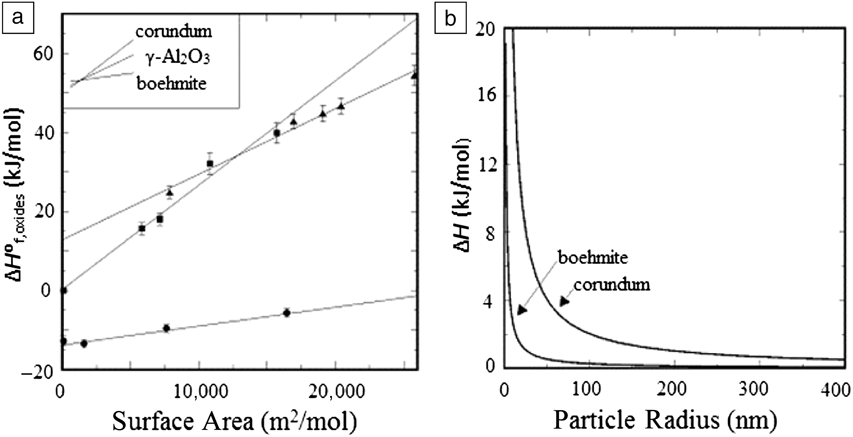
Figure 3 shows these energetic crossovers in alumina.Reference McHale, Auroux, Perrotta and Navrotsky6,Reference Castro, Ushakov, Gengembre, Gouvêa and Navrotsky10,Reference Majzlan, Navrotsky and Casey11 With increasing surface area, the material becomes more metastable, but that increase for a material with lower surface energy is smaller for a given surface area (Figure 3a). Figure 3b shows enthalpy as a function of particle size. We should ask, “at what particle size is a given material really nanophase in the sense of having different properties from the bulk?” If it has a small surface energy like gamma alumina or boehmite, a higher surface area is required before the thermodynamic properties become significantly different, allowing for experimental error. So the term “nano” itself is relative. There are no absolutes. A material becomes “nano” when some property of interest becomes significantly different from that of the bulk material.
Energetics of nanophase aluminum oxides. (a) Enthalpy of formation (ΔH°f,oxides) of polymorphs relative to the bulk corundum plus water as a function of surface area. The slope of each line gives the surface energy, which decreases in the order of alpha alumina, gamma alumina, and boehmite. Note the crossover in energetic stability between alpha and gamma alumina. (b) Excess enthalpy (ΔH) of boehmite and corundum versus particle size. Adapted with permission from Reference Reference Majzlan, Navrotsky and Casey11. © 2000 The Clay Minerals Society.
Figure 4 shows the energetics of iron oxides and oxyhydroxides.Reference Navrotsky, Mazeina and Majzlan12 The upper diagram shows energetics for hydrated surfaces, the lower one for anhydrous surfaces. Hydrated iron oxides are relevant to most terrestrial conditions; for example, anhydrous ones may be relevant to the present-day Martian surface. For large particles, there is a significant difference in the enthalpy and also in the free energy between polymorphs. For particles below 50–100 nm in diameter, as the ones that are metastable in the bulk have lower surface energies, many polymorphs become competitive.
Free energy of iron oxide polymorphs versus surface area for (a) hydrated surfaces and (b) anhydrous surfaces. ΔG t, Gibbs free energy of transformation to α-Fe2O3 and liquid water. Reproduced with permission from Reference Reference Navrotsky, Mazeina and Majzlan12. © 2008 American Association for the Advancement of Science.
Often, in both synthetic and natural environments, one gets a mixture of fine-grained iron oxide, oxyhydroxide, and hydroxide polymorphs. The exact phases formed, with tiny free-energy differences, are strongly affected by small changes in synthesis conditions, including surface-adsorbed ions in the aqueous synthesis mixture. Each of these phases will have somewhat different properties, different magnetic properties, different optical properties, different transport properties, and different catalytic activity. When trying to maximize the properties of a thin film, for example, an iron oxide, the phase produced must be controlled. This can be quite challenging and, at the same time, critical to the quality of the product.
There are certainly practical aspects to nanoparticulate oxides. Most of the TiO2 used in catalytic and solar-cell applications is nanoscale anatase rather than rutile, and it does not transform under typical operating conditions because of an energy crossover. Likewise, most of the alumina used as supports in catalysis and in chromatography and other separations is nanophase gamma alumina, stabilized by its lower surface energy, and not corundum.
Dehydration reactions
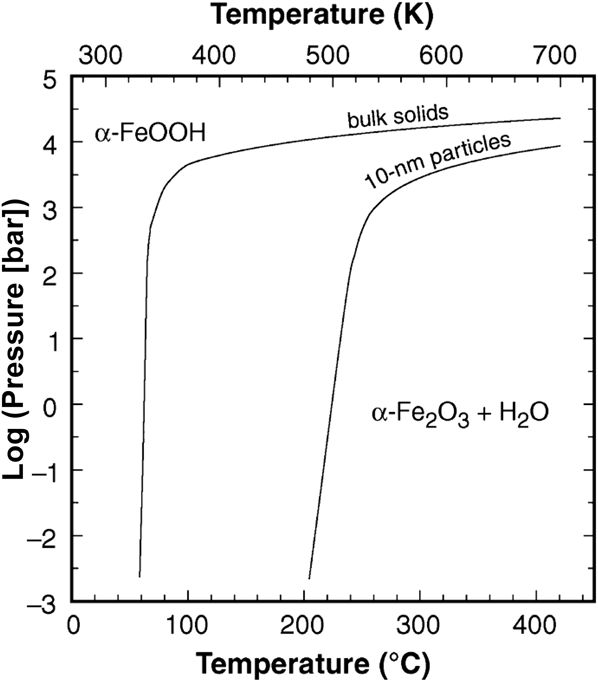
The oxyhydroxide polymorphs (e.g., boehmite AlOOH and goethite FeOOH) have a “picket post” structure of hydroxyl groups decorating their layers, with rather small surface energies.Reference Majzlan, Navrotsky and Casey11,Reference Navrotsky, Mazeina and Majzlan12 When the dehydration reaction at the bulk scale and at the nanoscale as a function of water fugacity is calculated, the result is a typical sigmoid curve, but that curve can be shifted by as much as 100°C at the nanoscale to favor the hydrated polymorph (Figure 5). This is important geochemically because hydrated iron oxides or hydrated aluminum hydroxides appear to exist in geologic environments in which the bulk oxyhydroxides should have dehydrated. Therefore, complex kinetic arguments for their persistence must be invoked. However, the cause is thermodynamic and not kinetic; nanophase oxyhydroxides are thermodynamically stable to a higher temperature (as long as that temperature is low enough to preclude coarsening) because of their lower surface energies. The same argument holds for materials synthesis for technological applications. Nanomaterials will often dehydrate and coarsen simultaneously; once the temperature is high enough to get rid of the water, the particles can come together and coarsen and transform, losing the advantage of a lower surface energy for hydrated phases.
Shift in dehydration equilibrium for the transformation of goethite to hematite plus water for bulk versus 10-nm particles, calculated using measured surface-energy data. Reproduced with permission from Reference Reference Navrotsky, Mazeina and Majzlan12. © 2008 American Association for the Advancement of Science.
Oxidation state effects
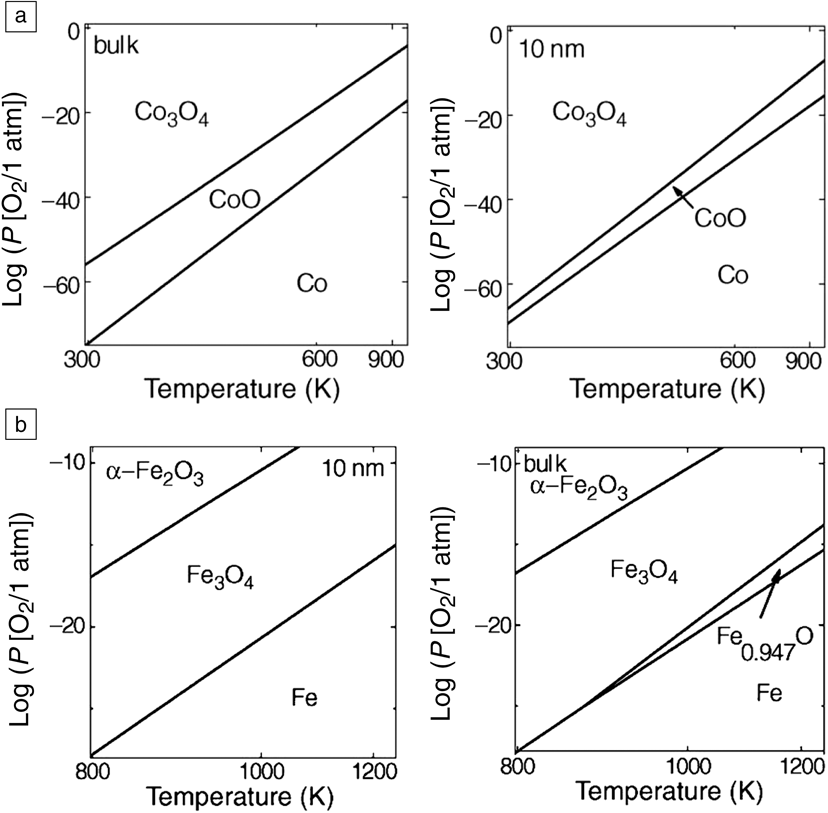
For materials that have different surface energies for different oxidation states, small particle sizes will favor the material that has the lowest surface energy.Reference Navrotsky, Ma, Lilova and Birkner14 Oxidation-reduction (redox) equilibria will shift as a function of particle size. If a standard Ellingham diagram of phase boundaries in oxygen fugacity–temperature (f O2–T) space is plotted, those lines will shift substantially at the nanoscale (Figure 6). This is important because many catalysts and proposed new materials for fuel cells and batteries are nanoscale. Thus, the oxidation state of the working nanoscale material may be different from that of the bulk material because of surface-energy effects.
(a) Equilibria for cobalt oxides for bulk (left) versus 10-nm particles (right). (b) Equilibria for iron oxides for bulk (right) versus 10-nm particles (left). Note the expansion of the stable region for the spinel phase (Co3O4 and Fe3O4) caused by their smaller surface energies and the disappearance of the FeO phase field at the nanoscale. (P, pressure). Reproduced with permission from Reference Reference Navrotsky, Ma, Lilova and Birkner14. © 2010 American Association for the Advancement of Science.
An example is cobalt oxide,Reference Navrotsky, Ma, Lilova and Birkner14 used as a catalyst for carbon monoxide (CO) oxidation. Though assumed to be Co(II) oxide under operating conditions, the nanophase powder is probably Co(II,III) oxide, the spinel Co3O4, because of its lower surface energy. This may give the advantage of a mixed-metal valence state to the catalytic process. The iron–oxygen system is an even more extreme case. Because of the lower surface energy of Fe3O4, the phase diagram at the nanoscale (Figure 6b) essentially eliminates wustite as a phase. Magnetite and metallic iron will coexist until the system coarsens.
Manganese oxides tell a similar story. Mn3O4 spinel has the lowest surface energy, Mn2O3 with the bixbyite structure has intermediate surface energy, and MnO2 pyrolusite has the highest surface energy.Reference Birkner and Navrotsky13 The phase diagram changes, and the phase field in oxygen fugacity–temperature space of the spinel increases with decreasing particle size (Figure 7). Because these phases have different hydration energies as well as different surface energies, the phase diagram also changes depending on whether the surfaces are hydrated or dehydrated. Indeed, hydration can actually induce rapid reduction of nanophase Mn2O3 to Mn3O4 in air, and dehydration can reverse the reduction.Reference Birkner and Navrotsky15 Again, this is thermodynamically driven. Thus, if we want to use manganese oxides as an indicator of their formation conditions and the oxidation and hydration level in soil, they may not tell us anything about conditions when they formed 1000, 10,000, or one million years ago. On the other hand, they may tell us we had rain yesterday because the hydration and the oxidation state are closely balanced, and redox reactions occur rapidly. They may reflect seasonal wet-dry cycles on a local scale.
Phase equilibria in the Mn-O System. Left: bulk materials. Top right: anhydrous 10-nm particles. Bottom right: 10-nm hydrated particles. (P, pressure). Reproduced with permission from Reference Reference Birkner and Navrotsky13. © 2014 National Academy of Sciences.
Systematics, speculations, hypotheses, and applications
It is striking that most materials with spinel structures have relatively low surface energies (in the range 0.6 to 1 J m–2).Reference Navrotsky2,Reference Lilova, Pearce, Rosso and Navrotsky16 The olivines, which have similar stoichiometries, have higher surface energies.Reference Navrotsky2 In the 20 or so materials for which we have determined surface energies, it appears that structure has a stronger effect than composition. Structures of significantly lower symmetry typically have higher surface energies than higher symmetry structures. An exception is rock-salt-structured oxides, which have high surface energies. It appears that layered structures that are hydrated have low surface energies, and structures containing mixed-valence ions also have low surface energies.Reference Birkner, Nayeri, Pashaei, Najafpour, Casey and Navrotsky17 These trends need further exploration by both experiment and computation.
There is speculation that redox reactions in biological systems can be controlled by fine-tuning the particle size to match enzymatic pathways. Such control of redox reactions at the nanoscale might have influenced the development of prebiotic chemistry, eventually leading to metal-containing enzymes. Two modern examples of such control are the manganese–calcium cluster in photosynthesis and the iron-storage protein ferritin. Did these develop by evolution from appropriate nanomaterials? Can we make nanophase catalysts inspired by these biological materials? Does the effect of surface energy on the thermodynamics of redox reactions play a role in relating the inorganic and the biological world?
We can take a deeper look at the calcium–manganese oxide materials that have been made as biomimetic materials related to the calcium–manganese clusters found in the photosystem II protein complex involved in photosynthesis. These are layered oxides that are related to the manganese mineral birnessite (a layered phase in which alkali ions and water occur in the interlayer space and the manganese has a mixture of trivalent and tetravalent oxidation states to balance the charge), and they also occur in other alkali and alkaline-Earth manganese oxides. The role of calcium, sodium, or potassium is charge-balancing and energetically stabilizing the mixed-valence layered materials, which have both trivalent and tetravalent manganese.
Our calorimetric study of their energeticsReference Birkner, Nayeri, Pashaei, Najafpour, Casey and Navrotsky17 proved very informative. First, the redox energy in these materials is smaller in magnitude than that of the Mn2O3/MnO2 equilibrium; that is, we can form a mixed valence thermodynamically more easily. Second, the materials are layered structures with nanoscale particles, so diffusion is not a problem. Finally, they are hydrated and their hydration energy is relatively small. We can consider a reaction that transfers electrons or ions through the interface between the oxide and water. If the water on that surface is tightly bound, then it is difficult, both thermodynamically and kinetically, to move some other ion through the interface, because that ion has to compete with tightly bound water molecules. Therefore, one of the factors that make these materials good catalysts is having relatively loosely bound surface water. There is a very good correlation between surface energy and the binding energy for water:Reference Drazin and Castro18 The higher the surface energy, the more tightly the water binds to relax the surface. So, another criterion for excellent function for these materials is a low surface energy that enables ions and molecules to easily move in and out. These are the properties needed for a good functional material.
There is interest in the lithium–cobalt oxides with layered rock-salt structures that are commercial-battery materials. The energy-efficient Boeing 787 Dreamliner aircraft is enabled, in part, by lithium-ion batteries based on LiCoO2. Its rock-salt-related structure has layers of lithium with layers of cobalt. As intercalated lithium is removed electrochemically when the battery is charged, the cobalt is oxidized and energy is stored, to be released when a spontaneous (downhill in free energy) reaction occurs. This is where the redox energy and the surface energy play a role. We found that the surface energy of these layered materials is much lower than that of the parent rock-salt oxide CoO,Reference Maram, Costa and Navrotsky19 and they are more like the oxyhydroxides. Shirley Meng’s group at the University of California, San Diego performed some experiments and density functional theory (DFT) calculations on the same system.Reference Qian, Hinuma, Chen, Du, Carroll, Ceder, Grey and Meng20 They came to very similar conclusions: these materials had low surface energies and low hydration energies, and a good part of their function was probably related to the easy transfer of ions and electrons through the interface.
Summary
The implications of thermodynamics for nanomaterials in the environment and for functional and biologically active nanomaterials rely on the same fundamental principles. We need to pay special attention to the surface energies, the hydration energies, and polymorphism. The path forward might be to look both at detailed specific systems and, more generally, to build a systematic picture of surface energies and to combine this with CALPHAD-type thermodynamics calculations in order to calculate phase diagrams for nanoscale materials. In phase-equilibrium calculations, either using first-principles calculations by DFT or phase-equilibrium optimizations by CALPHAD-type methods, the two aspects that are not typically included are high pressure, which is required by the geophysics and planetary science communities, and the effects of particle size, which is essential for nanomaterials.
The calorimetric data for nanophase oxides have not only let us understand the thermodynamics of these materials, but they have also enabled us to understand function and perhaps to predict the properties of new materials or old materials.
Acknowledgments
I thank the many students and postdocs who have worked with me on these projects, the many colleagues who have encouraged me and provided spirited discussions and constructive criticism, and the National Science Foundation and US Department of Energy for almost continuous support of this line of research from both the geochemical and materials point of view.
Alexandra Navrotsky holds the Edward Roessler Chair in Mathematical and Physical Sciences and is a Distinguished Professor of Ceramic, Earth, and Environmental Materials Chemistry at the University of California, Davis, where she directs the Organized Research Unit on Nanomaterials in the Environment, Agriculture, and Technology (NEAT ORU) and the Peter A. Rock Thermochemistry Laboratory. She has published over 700 scientific papers and has received many awards, including the Benjamin Franklin Medal in Earth Science in 2002. She was elected to the National Academy of Sciences in 1993 and to the American Philosophical Society in 2011. She has been an American Ceramic Society Fellow since 2001, and an American Geophysical Union Fellow since 1998. Navrotsky can be reached by phone at 530-752-3292 or by email at anavrotsky@ucdavis.edu.