Under a pseudonym in December 2011, I published an article titled “al-Jaysh wa-l-Iqtisad fi Barr Misr” (The Army and the Economy in Egypt) in Jadaliyya.Footnote 1 I wrote it after months of participating in numerous protests in Cairo against the government of the Supreme Council of Armed Forces (SCAF), which took power upon President Hosni Mubarak's abdication in February 2011, and of searching fervidly for the political sources that had allowed the military to prevail over civilian forces. In addition to the tanks and fighter jets, I found some of these sources hidden in a gigantic business empire that the military had clandestinely developed for years. In early 2012 the editor of an online edition of a widely read Egyptian newspaper, a revolutionary female journalist who would later be arrested and detained, invited me to write a series of articles on this business empire, this time using my real name.Footnote 2 The first work in decades to be published on this taboo topic, this became the foundation for my later book-length study. As a scholar, this was my humble contribution to an ongoing revolution.Footnote 3
Ten years later it would be nice to be able to report that the Egyptian military has abandoned its profitable business enterprises and political offices and returned to its barracks. Unfortunately, the exact opposite has occurred. The country's economy has been militarized to unprecedented levels, and a new military regime has placed the entire society under close surveillance.
In this essay I do not attempt to present yet another academic analysis of what happened in Egypt over the past decade. Rather, I seek to present some observations, posted as diary entries, as a surveilled citizen following a failed revolution.
I do not look with total pessimism on the outcomes of the 2011 uprisings in Egypt. I believe that although the revolution failed politically, it succeeded in opening wide doors for social change and that many repressed and marginalized groups have been able to snatch some small rights here and freedoms there. The secular “revolutionary youth” could not gain power for several reasons, including their lack of political experience, which allowed in part for the domination of Islamist forces over the transitional process. Despite their romanticized image, many of those young rebels who called for freedom and social justice could not free themselves from inherently conservative views regarding gender, class, sect, race, ethnicity, and sexual orientation. Sadly, too many of them were either killed during the first few months of the uprisings or later disappeared in prison cells. Despite this, great social movements have emerged, even if small, and this would not have happened without the events that began on 25 January 2011.
However, when it comes to the military's control over the economy and the state, nothing has changed. Indeed, things have gotten much worse. When the 2011 uprisings took place, Egyptian society had already been deeply militarized. Mubarak, an ex-military pilot, had kept a civilian facade for his government but allowed fellow officers and ex-officers to function as de facto rulers of the country. Throughout the 1990s and early 2000s, he appointed a large number of retired generals to top administrative positions in the state's bureaucratic apparatus, in almost every big city, small town, or village across the country. He allowed the military institution to expand massive investments in almost every economic sector, and their concealed, untaxed, and unaudited business empire sold the consuming masses almost every good they needed to purchase or service they used in the liberalized economy. Whether managing government offices or lucrative enterprises, officers and ex-officers securitized everyday life and closely watched and disciplined citizens from all social classes and in every locality. After the abdication of Mubarak, one of the main goals of the protests that continued throughout the rest of 2011 was to “demilitarize” the country, but these failed.
In 2011 and early 2012, I shared with revolutionary groups actively fighting for an agenda of demilitarization every piece of data I collected about the military's accumulated wealth and subsequent economic and political control. Using academic research as a tool of resistance against the SCAF, I collaborated with three main teams of activists. The first was a youth campaign with a Facebook page, “Boycott SCAF Products,” that posted images of various brands of home appliances, canned food, cars, pesticides, pasta, etc., made in military-owned plants and urged citizens not to buy them to help financially disarm the officers.Footnote 4 A second youth campaign called NoMilCivilPositions (La li-‘Askarat al-Waza'if al-Madaniyya) diligently compiled lists of ex-officers in top or lower bureaucratic positions and drew electronic maps locating their exact posts in Cairo and every province across the country.Footnote 5 The third was a popular street movement called The Military are Liars (‘Askar Kadhibun), which screened in open spaces videos of the army's brutal practices against protesters. Its members incorporated information on the military's business activities into their raw footage of tanks chasing after and spraying tear gas on protesters on side streets off Tahrir Square, and they attempted to spread political awareness of how the army's political oppression was inseparable from its economic domination.Footnote 6
I also wrote extensively about protests led by workers in military-owned enterprises or government employees who worked under ex-military administrators. As the military police were dispersing their strikes, I collaborated with human rights organizations and journalists to amplify the voices of these demonstrators.Footnote 7 None of this risky activism by myself and other researchers and journalists succeeded. In 2014, a new military president swept the presidential elections. Since then, military business has expanded to monopolize more key sectors of the economy, and ex-officers have seized all essential and most government positions, entrenching their control over daily life. All movements are now under surveillance. The goal is obvious: to insure that 2011 never again happens. In the age of smartphones and social media, a military regime that does not take advantage of new technologies of cyber control would not count as an efficient dictatorship. As Foucault wrote in a short treatise titled Security, Territory, and Population, “defense of society is tied up with war by the fact that . . . it is thought of in terms of ‘an internal war’ against the dangers arising from the social body itself.”Footnote 8
If one considers the events of 2011 a war launched by the Egyptian armed forces against the lost sheep from the good citizens’ flock, then what has happened since has turned Egypt into an infinite military camp in which every citizen, rebellious or docile, is subjugated and closely surveilled. The new military regime has invented creative measures of control that penetrate deeply into the homes and bodies of its population so that they can never take to Tahrir Square again. In the age of information technology, the daily tasks of managing the camp have become easier.
What follows are a few, random diary entries from my life as a surveilled citizen in Egypt under a new military regime. As an Egyptian who works and lives in the US, I visit my family in Cairo routinely every year and spend long months in the city. Back in the US, as an academic, the regime's panopticon follows me to rural Ohio.
Cairo University Gate (Giza, 27 December 2014)
Cairo University has always been a center of political activism in the country. As young leftist students in the 1990s, we always complained about how the “security” forces interfered in our cultural activities. Security had one simple and familiar meaning: the police. In 2014, when I visit my old college located beyond the high walls and large gates of the university—I usually use a side gate to get to the political sciences department from which I graduated—a new private security firm, Falcon Group, is now guarding the gate.Footnote 9
Securing Cairo University, whose campus contains tens of thousands of students across colleges and departments, was among the first fruitful contracts for Falcon. The head of the firm is an ex-military intelligence officer, and Falcon recruits retired army and police officers to become its professional and highly trained guards.Footnote 10 The Falcon teams, in special uniforms with visible guns, are stationed at every gate of the walled university to identify those entering; inside the campus their duties include tackling undesired protests.Footnote 11 Falcon has gone on to gain other government contracts, to secure Cairo's underground metro and Cairo International Airport. Falcon prides itself on delivering the best services to its clients, the state and business tycoons, by buying the newest surveillance technology for facial and audio recognition that functions well in “places of mass gatherings” such as football stadiums and entertainment sites.Footnote 12
The Electricity Meter (Maadi, 1 August 2017)
At the beginning of every month, an agent from the Ministry of Electricity knocks on our apartment door to read the electricity meter or collect the bill. Families always feel uncomfortable letting strangers into their homes. Now Falcon Group has offered its services to help the government monitor millions of homes; this year the ministry contracted the private security firm and it hired thousands of agents to undertake the task in Cairo and other provinces. The minister of electricity told his clients—the entire population, since the ministry is the sole provider of electricity in the country—that Falcon is a part of a “sovereign authority” (jiha siyadiyya), an expression usually used to refer to military or intelligence agencies connected directly to the president. Falcon's scope of coverage includes commercial stores. (Update, 2020: With the sharp increases in electricity bills and the difficult COVID-19 conditions, Falcon has embarked on making things easier for both the ministry and the citizens by digitizing the collected information. It will take photos of the meters and electronically send them—to, of course, the ministry. All home electricity meters are being replaced with “smart” meters).Footnote 13
The Electronic Government (Tahrir Square, 17 June 2018)
The Egyptian bureaucracy is like an endless labyrinth, and one of the most dreadful errands that I must face is to go to Tahrir's Mugamma‘, the mammoth office building housing most governmental authorities, to get some necessary paperwork done. It would be a dream come true to shift to electronic services, where you can submit all forms and get all signatures and stamps online. But this luxury comes with privacy sacrifices: making all of your information and live details readily available and easily accessible not only to the civilian employees but also to the closely observing security apparatus. The information that you would normally be reluctant to give to a police officer who might stop you at a regular checkpoint (lajna or kamin) in a Cairo street or driving into or out of the city would now be visible out there on their computerized systems.
While waiting in a long line in front of a fee-collection window, I hear great news: the government has just initiated a “Digital Egypt” project. The Information and Computers Center (ISCC) of the Ministry of Military Production (MoMP), whose headquarters are located in Lazoughly Square, close to Tahrir, has already embarked on digitizing the records of the Ministry of Supply, responsible for providing low- and middle-class citizens with subsidized food, and issuing them new electronic cards (bataqat tamwin) to obtain their rations at state outlets. During the digitization process, MoMP dropped millions of beneficiaries from the system because they were judged unqualified to continue to receive government subsidies. Similarly, MoMP has already digitized records for the Ministry of Health and issued new medical insurance cards (kart al-ta'min al-sihhi) for citizens who benefit from public health services. The Ministry of Defense (MoD) is responsible for securing the electronic files of the new health-care system, and all records will be eventually transferred to this ministry.Footnote 14 The MoMP, which owns about twenty manufacturing plants for military and civilian products, has recently ventured into building new factories to produce and sell drugs for profit. Moreover, to contribute to digitizing the electricity services, the MoMP just started a new production line to make smart electricity meters—a product that the above-mentioned Falcon security service will surely find helpful.Footnote 15 This simply means that MoMP, whose job is supposedly to manufacture weapons, and MoD, whose job seems to be related to barracks, now have access to data on millions of civilians about the food they eat, the drugs they take, and the energy they consume at home.
So where are the servers of the electronic government? According to the president, in a friendly conversation with young people, the “inclusive brain” of the e-government exists “14 meters underground in some [hidden] place and it will be greatly secured.” Some might guess that unknown place: at the president's new administrative capital, which is being lavishly constructed by military engineers in a desert area near decaying Cairo.Footnote 16 The digitized records of all the ministries will be connected to each other, and this artificial “brain” should include every little detail about every citizen at every stage in their subjugated lives: their birth certificates and national ID cards; their photos from youth to old age; their contracts of marriage and divorce and the exact amount of alimony, if applicable; how many loaves of bread, bottles of cooking oil, or bags of sugar they consume every month on their subsidy cards; what type of medicine they take; how much they pay in utility bills every month; their properties and taxes; how many times they have traveled abroad, where, and when exactly; whether they have completed compulsory military service . . . and more.
With full control over all this data, one imagines that the government could simply turn a switch and pause all public services in the entire country in a matter of moments. One might recall the unpleasant memory of the night of January 28 in 2011, when the internet services were switched off in Tahrir Square and the whole country went digitally dark.
The Lawyers Association (Ramsis Street, 30 July 2019)
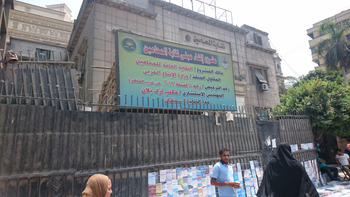
I have to run a family errand at the Lawyers Association downtown. It is one of the oldest syndicates in the country and has played an important role in the national struggle since its establishment in 1912. My late father spent most of his life among its elected leaders and political activists. There is construction work underway. I see a sign on the top of the syndicate's front gate, facing Ramsis Street, and I am not certain how my father, a hard-core Nasserist, would have felt about it. The sign reads, “Project of Constructing the Lawyers Association. Executing Contractor: the Ministry of Military Production” (Fig. 1).
Sign outside the Lawyers Syndicate promoting the Ministry of Military Production. Photograph by the author.

It is not news to see the military engaged in the construction sector. Since the 1980s, different army contractors have taken charge of building public schools, hospitals, stadiums, airports, telephone central stations, bridges, roads, and more. The news is that in the past few years, one army force has emerged as sole contractor for nearly all public construction projects, with massive investment in almost every corner in Cairo and across the south and north of the country: the Engineering Authority of the Armed Forces (EAAF). Besides being the sole contractor for building the military president a new capital and digging a Suez Canal extension, EAAF engineers have been building new highways, multi-lane bridges, new cities in Sinai and by the Mediterranean coast, new airports and universities, and much more. The announced size of EAAF's investments has reached a figure never before heard of for one contractor in Egypt: 2.2 trillion EGP ($141 billion).Footnote 17 The MoMP generals now compete with private businesses in this lucrative field. Apparently, this does not distract MoMP from leading the above-mentioned efforts to digitize public services.
The Cairo–Ismailia Road (Ismailia, 12 August 2019)
The occasional trip with my family to visit my elderly uncle in his quiet Suez Canal city during the Eid holidays has lately become much easier. Last time we took the Cairo–Ismailia Desert Road we found a newly paved toll highway with multiple fast lanes and barriers to collect passage fees. Atop the toll stations there is a large signboard with the logo of the Ministry of Defense that reads “The National (Wataniyya) Company for the Construction, Development, and Management of Roads.” This is one of a long chain of companies that all carry the word wataniyya in their names, and they are all in turn owned by MoD. They include, for example, Wataniyya for petroleum, which owns hundreds of gas stations, and the gigantic manufacturing plants of Wataniyya for steel in Suez. There also is Wataniyya for cement in Sinai and Middle Egypt, and Wataniyya for granite and marble in several provinces. All of them trade in for-profit essential goods that citizens require to take a microbus or personal car to work, or to build a small apartment in an informal housing area or a big home in a luxury compound in New Cairo. The Cairo–Ismailia Road is only one of a large number of toll highways that the Wataniyya for roads has recently developed and on which it is collecting daily fees from millions of passing cars and trucks. To further serve travelers, the same company has opened restaurants, cafés, and stores on these roads, which extend for hundreds of miles.Footnote 18
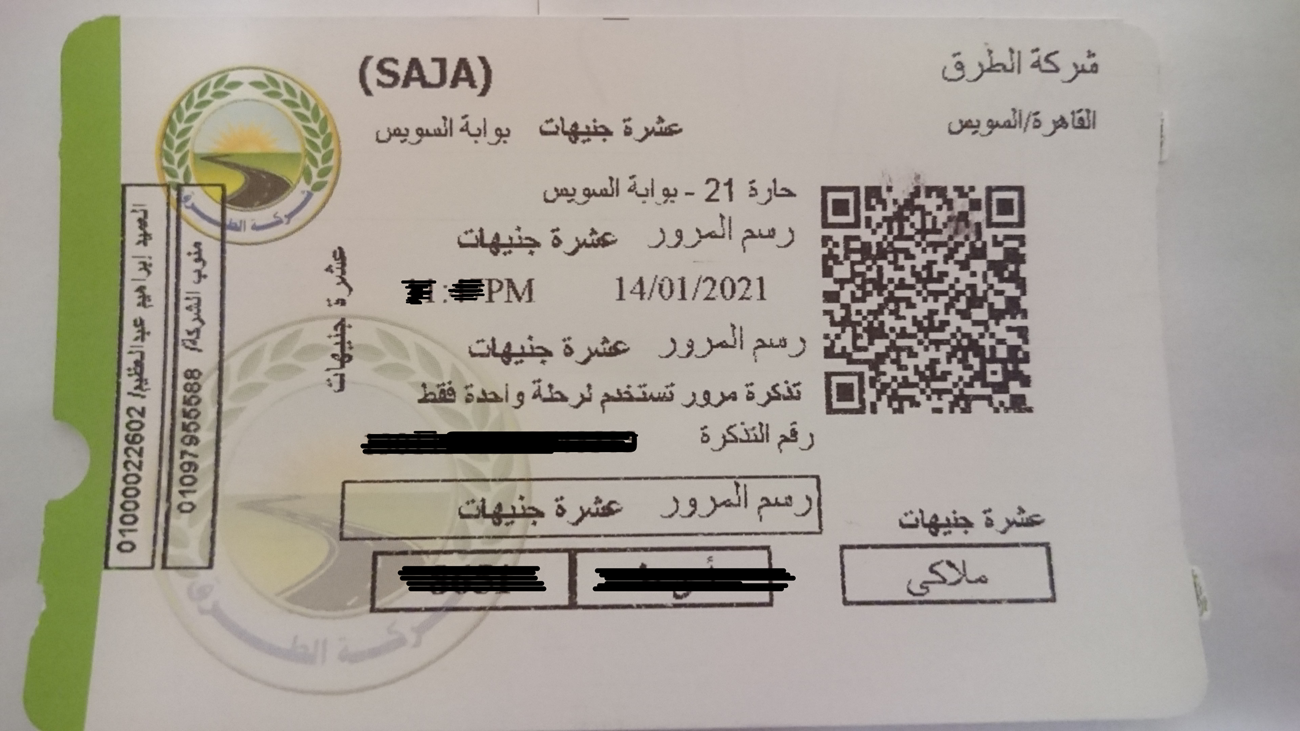
On the road to Ismailia, we wait our turn in a long line of cars to reach the tollbooth. We pay our 10 LE and take a ticket with a long serial number that reflects how many cars have passed before us. The ticket also includes our license plate number, the exact date and time we passed, and the name of the officer managing the road at the time we did (Fig. 2). We are therefore easily trackable. Waiting to move ahead, I remember a conversation with a young Egyptian military intelligence officer who I met while he was studying in the US at the Marine Corps University. I had asked him why the military has its own contracting companies to construct roads and why ex-officers are hired in government posts in charge of public transportation, like Kamil al-Wazir, the minister of transportation, a former general who used to head the EAAF.Footnote 19 His simple answer was: “So if the enemy invades, the army knows the entrances and exits of the country.” He did not indicate, however, who exactly this enemy was.
Highway toll ticket administered by Wataniyya for roads. Car information is redacted. Property of the author.

From the Slums to Al-Asmarat (Mokattam, 2 January 2020)
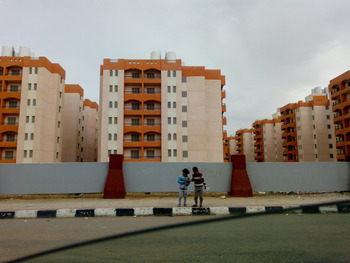
After watching on TV the festivities celebrating the opening of this area and relocation of families there, I decide to take an Uber to visit al-Asmarat on the outskirts of Cairo. The housing project contains hundreds of tall colorful apartments buildings with thousands of flats, placed on the top of the Mokattam hill, to accommodate the inhabitants of Cairo's old slums. Arriving at its destination, my Uber faces a large wall surrounding the area and a big gate with many police officers and patrol cars guarding it. You cannot enter the area unless you know someone inside, so I say I have come to visit a relative at the health center. My driver finds a health center, but it is not yet functioning. I explore the area on foot (Fig. 3). It is a huge zone constructed on dozens of acres with many green spaces in between the apartment buildings, and it contains a mosque, a church, schools, and football grounds. Kids are playing safely, and their mothers and older sisters seem to be walking freely, enjoying the clean, fresh air in their ‘abayas and isdals, typical lower-class garments.
Apartment buildings in al-Asmarat housing project. Photograph by the author.

The EAAF built this area, and many others like it on desert lands near Cairo, and relocated the poor families from their old, decayed neighborhoods in Islamic Cairo or from areas by the Nile Corniche such as the Maspero Triangle near the state-owned TV and radio premises and the ministry of foreign affairs. Ten years ago, during the 2011 uprisings, the residents of Cairo's slums came to Tahrir Square from these areas and brought “violence” to the protests. They attacked police stations, burned down ruling-party buildings, and engaged in street fighting with army and police forces, throwing stones and Molotov cocktails. The unemployed, angry youth of the marginalized, neglected quarters of Mubarak's neoliberal Cairo found in the revolution their long-awaited opportunity to take revenge against the security state. Now the slum people are displaced into desert flats far from downtown Cairo, and they are surrounded by high walls with large police trucks parked day and night outside their gates. They have all the goods that they need inside, which they can easily buy at military-owned stores.
After he assumed his position as the new governor of Cairo in 2018, General Khalid ‘Abd al-‘Al pledged to declare Cairo a city free of dirty, unsafe slums and to provide its inhabitants with a more “civilized” life.Footnote 20 ‘Abd al-‘Al is the first ex-officer to serve as the capital's governor in at least three decades. Mubarak had appointed the last retired general to run the city in 1989.Footnote 21 Since 2011, most of the country's provinces received ex-officers, mostly from the military and a few from the police, as governors. Cairo received an ex-police general; the heads of the large quarters of the city are mostly ex-army officers, including the areas where the old slums were located.
Walking deeper inside the al-Asmarat zone, I notice a flock of stray dogs moving along piled bags of trash. There are only a few jobs available inside the area, because the inhabitants left behind their shops or sources of income as daily laborers back in their demolished neighborhoods. Driving a TukTuk, a three-wheeled motor rickshaw, to carry riders between the widely spaced Asmarat buildings is not allowed. Some of the families fail to pay the rent for their apartments, which they lease from the government and do not own, as they did their old houses and shops. The only places available for shopping for basic goods are owned by the Ministry of Defense. The residents of ground-floor apartments have already installed iron bars on their windows and around their balconies because crimes of robbery and murder have occurred. On an earlier ride to the neighborhoods from which they were displaced in old Cairo, I observed huge foreign investments in luxury towers for residential and commercial purposes, and upscale tourist projects.
Maadi Metro Station (Maadi, 15 January 2020)
Cairo's traffic is always congested, so I usually depend on the underground metro to reach my family's home in Maadi. Since it was developed in the 1980s, the exit of the Maadi metro station has always had street sellers from whom passengers can purchase anything from vegetables, fruits, and fish to cheap clothes and slippers. In the past few years a competitor has appeared: military-owned refrigerated trucks that sell packaged frozen beef and poultry. At the door of the covered truck, conscripted soldiers stand to sell, at affordable prices, meat from vast military commercial farms: hundreds of thousands of acres on which the Wataniyya company for land reclamation and other military-owned agricultural firms raise livestock and cultivate fields, with stockyards and food processing mills attached. On the other side of the metro station, there is a small kiosk where other soldiers sell light goods such as Coca-Cola, biscuits, chocolate bars, and mineral water bottled at a Wataniyya plant. In the past, the image of a militarized city was of streets full of tanks, often with armed soldiers riding atop them. This does not seem to be necessary anymore.
Cairo Railway Station (Ramsis Square, 30 January 2020)
Waiting for my train at the station. Like half of the inhabitants of Cairo, I take the railroad south to visit my relatives in Upper Egypt during the holidays or on other family occasions. The only railway services available to citizens are owned by the state, and a military-owned factory manufactures the train wagons (a factory it purchased back in the early 2000s when Mubarak privatized it).Footnote 22 When the new minister of transportation, ex-general al-Wazir, assumed his position and promised major improvements in the service, civilian travelers like me were optimistic.Footnote 23 The Cairo railway station, known as Ramsis or Bab al-Hadid, is overcrowded with too many passengers at any moment of the day or night. Arriving at the platforms for Upper Egypt with your heavy luggage, it is nearly impossible to find chairs for a family or even individual riders waiting for their frequently late trains. The platforms of the station, built more than 160 years ago in the 1850s, are not wide enough to fit many seating areas in any case. Recently, the armed forces decided to take a considerable chunk of the Upper Egypt platform and close it off with a low fence. There are comfortable chairs behind this fence, and they are visible to the waiting passengers with tired feet and dragged suitcases. But these chairs are not for the likes of us, civilians. It is an exclusive area for uniformed travelers.
Watching TV at Home (Rural Ohio, Ramadan, April–May 2020)
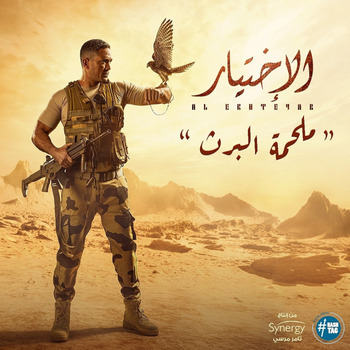
Every Ramadan, like most Egyptians, I am glued to the TV after sunset to watch the latest Egyptian dramatic serials (musalsalat) made especially for this month. Living in Ohio, where I teach, thousands of miles away in a totally different time zone, does not break this habit, which I developed when I was a teenager in the 1980s, watching seasons of iconic dramas such as Layali al-Hilmiyya and Ra'fat al-Hjjan. This year, along with most of Egypt, I watch an eventful series titled al-Ikhtiyar (The Choice), the heroic story of an army officer who was killed in Sinai by operatives of the Islamic State (Fig. 4).
The poster for al-Ikhtiyar. Source: Official Facebook page of the producer, accessed 19 January 2021, https://www.facebook.com/SynergyTamer.M/photos/2048166901994818.

Since the first TV channel started broadcasting in Egypt in 1960, drama has had different sources of funding for production. Initially, in Nasser's socialist state, all shows were produced by the state-owned television. Private capital later swept the field with economic liberalization under Mubarak, and by 2011 there were a large number of production companies funding numerous TV series with high budgets. This situation continued for a few years after the revolution, until two years ago. One company called Synergy has emerged as the sole producer of most, if not all, TV series during the past two Ramadans. Although Synergy poses as a private business with a civilian chairman and a headquarters in Cairo's upscale district of Dokki, it is not a secret that it is owned by the state—again, like the above-mentioned Falcon, allegedly by the jiha siyadiyya. Private producers have been crowded out of the drama-making market. Directors and scriptwriters are heavily censored, and undesirable scripts, those politically or socially problematic, are kept in closed drawers, never to be seen on screen.Footnote 24
A Synergy epic and its most expensive production for this Ramadan, al-Ikhtiyar brought the nation to tears as viewers followed, for over thirty nights, the story of an elite army officer, leader of a highly trained group of Egyptian special forces modeled on an American SEAL unit, who sacrificed his life to defend his country, attaining martyrdom.Footnote 25 Anyone who does not watch this show or dares to critique the script (or even the cameraman) is accused on social media of being unpatriotic, or sometimes a traitor.
As the show is aired and after it has ended, I watch YouTube videos of the army special forces enduring harsh training with much enthusiasm and interviews with officers, some of whom were injured in action, recalling the lives of their fallen peers. Other homemade videos show schoolboys singing the stimulating anthem of the special forces and expressing their desire to join the army when they grow up, to fight for their country like the martyrs whose names are listed in this anthem.Footnote 26 MoD does have its own sophisticated propaganda department with online channels and social media pages that attract millions of patriotic subscribers.Footnote 27 But getting into citizens’ homes on prime days and at prime times and making it to their YouTube channels, regardless of the location from which they connect to a Wi-Fi network and watch, is another level of innovative penetration and optimized control at which the new security state is increasingly excelling.