


Economic development and gender equality typically go hand in hand. Indeed, a wealth of cross-national evidence demonstrates that economic development has a powerful, transformative, and profoundly positive effect on the social, economic, and political circumstances of women. And nowhere is this relationship more apparent than in Europe, where the advanced industrialized countries of the European Union (EU) consistently and systematically score highly across all indicators commonly associated with gender equality.Footnote 1 Because of this, the EU is often considered the de facto world leader in gender equality.
However, despite these advances, the EU has a hitherto unheeded problem — its extremely high rates of everyday violence against women (EVAW) and, more specifically, intimate partner violence (IPV) (Figure 1).Footnote 2 For instance, in Denmark, 52% of all women report experiencing some form of physical and/or sexual violence in their lifetime. Thirty-two percent of Danish women will experience this violence at the hands of an intimate partner. And 60% of women are subjected to psychological violence from either a current or former partner (European Union Agency for Fundamental Rights 2015).
Prevalence of everyday and intimate partner violence in the European Union.

Figure 1. Long description
The figure consists of two panels.
Top Panel:
The x-axis represents G D P per capita, 2012 on a log scale, with markers at $10,000, $30,000, and $100,000. The y-axis represents the Lifetime rate of physical or sexual E V A W in percent, ranging from 20 to 50. A linear regression line shows a positive correlation. Countries with lower G D P and lower rates include Bulgaria and Romania. Countries with higher G D P and higher rates include Denmark, which is the highest outlier at over 50 percent, followed by Finland, Sweden, and the Netherlands. Luxembourg is the furthest right on the x-axis with a rate near 38 percent.
Bottom Panel:
The x-axis is identical to the top panel. The y-axis represents the Lifetime rate of physical or sexual I P V in percent, ranging from 15 to 30. A linear regression line shows a slightly less steep positive correlation compared to the top panel. Latvia is a high outlier at lower G D P levels. Denmark again shows the highest rate at approximately 32 percent. Countries like Poland, Croatia, Slovenia, Spain, and Austria cluster at the bottom of the graph with rates between 13 and 15 percent, despite varying G D P levels.
Even more puzzling is that Denmark is not abnormal within the EU. Indeed, contrary to common expectations about the positive correlation between economic development and gender equality, recent survey research emerging from the EU shows that the most industrialized countries in Europe are those with the highest rates of EVAW. This trend is both disturbing and perplexing. Why do so many highly developed and egalitarian states that actively promote economic, social, and political equality for women have such high incidences of violence against them? And why do rates of violence vary across Europe so dramatically?
In this article, I argue that these high levels of IPV are associated with certain types of European social welfare policies. In particular, I contend that family policies designed to redress gender disparities in formal employment and socialize the costs of “familyhood” (Fraser Reference Fraser1994) are simultaneously correlated with higher reported rates of violence and abuse within families. Following Nancy Fraser, I term these family policies the “universal breadwinning model” (UBM), and I focus on two specific UBM policies — state-subsidized childcare and parental leave entitlements. Importantly, while these policies have helped to reshape and transform women’s roles within the family and broader society, in particular by promoting greater labor force participation, I suggest that they have been accompanied by an unintended consequence — namely, a violent backlash from men. Drawing on theories of hegemonic and precarious masculinity, I argue that backlash occurs because men perceive breadwinning as central to establishing and maintaining not only their dominant position within the family but also their masculinity identity. Consequently, when UBM policies incentivize women into employment, the resulting shift in familial power threatens a core tenet of men’s sense of manhood, which, in turn, leads some of them to use violence in order to reclaim it.
To investigate the connection between IPV and the UBM, I utilize the first nationally representative dataset on EVAW collected by the EU with over 42,000 female respondents. Using these cross-national data, I find that higher rates of in-kind state expenditure on childcare are correlated with a greater likelihood that women will experience physical and/or sexual violence by an intimate partner, while more generous parental leave schemes, which frequently encourage women to stay home for longer periods, are associated with a lower risk of IPV.
Investigating the connection between politics, social policy, and EVAW is important for several reasons. First, EVAW remains the single greatest threat to a woman’s security and a serious violation of human rights. It is estimated that approximately one-third of women globally will experience some form of physical and/or sexual violence in their lifetime — a rate that vastly outstrips the number of women who suffer from violence during conflict (“Facts and Figures” 2018; World Health Organization, Department of Reproductive Health and Research, South African Medical Research Council, and London School of Hygiene and Tropical Medicine 2013). Moreover, IPV is also associated with substantial monetary costs — not only for individuals but also for governments (Fearon and Hoeffler Reference Fearon, Hoeffler and Lomborg2018; Hoeffler Reference Hoeffler2017; Hoeffler and Fearon Reference Hoeffler and Fearon2026).
Second, while it is easily assumed that the state plays a large and important role in manufacturing and influencing violence against women during conflict, the assumption of the political often disappears when discussing everyday violence. Yet, “times of peace” do not curtail the state’s ability to shape patterns of violence, whether it be through direct involvement or interference, the construction and continuation of permissive conditions, or willful ignorance. This article therefore emphasizes the potential negative impact of the state on women’s everyday lives.
Third, this article also helps to highlight that there is a significant difference between legal and institutional equality for women and women’s actual, lived experience of gender equality. These experiences, including those about violence and abuse, are frequently excluded or overlooked in formal equality measures, such as the Gender Inequality Index, which then, in turn, makes countries appear to be more egalitarian than they actually are. Finally, while others have suggested women’s increasing economic and political power incites a violent backlash from their partners (Ahmed Reference Ahmed2005; Amaral, Bandyopadhyay, and Sensarma Reference Amaral, Bandyopadhyay and Sensarma2015; Brulé Reference Brulé2020a, Reference Brulé2020b; Eastin and Prakash Reference Eastin and Prakash2013; Finnoff Reference Finnoff2012; Prillaman Reference Prillaman2023), this mechanism is less frequently proposed in the context of highly developed European states. My argument, therefore, helps to dismantle the unproductive barriers between empirical research on gender and violence in highly industrialized countries and the Global South.
This article proceeds as follows. First, I examine the existing literature on violence against women as well as the social welfare state, highlighting that — despite its prevalence — everyday violence remains undertheorized in political science. After identifying this gap, I outline my theoretical framework focused on the state’s implementation of the UBM and its relationship with IPV. Next, I discuss the measurement of IPV before using a series of multilevel logistic models to show that there are significant relations between universal breadwinning policies, particularly subsidized childcare, and EVAW. Finally, I conclude by discussing some of the study’s limitations and implications for research and policy, including the need to disaggregate social policies into their component parts to accurately assess their consequences for women and families, and the need for the state to implement policies designed to promote normative change to gender roles — not only for women, which has been extremely successful, but also for men.
The Undertheorization of Everyday Violence Against Women in Political Science
Empirical research focused on gender and politics has become increasingly prevalent and mainstream in political science over the past three decades (Beckwith Reference Beckwith2010; Chappell Reference Chappell2006; “Moving to a Comparative Politics of Gender?” 2006; Nagel Reference Nagel2019; Nordås and Cohen Reference Nordås and Cohen2021; Tripp Reference Tripp2006; Weldon Reference Weldon2006). However, within this research agenda, investigations focused on everyday forms of violence against women and politics are still a nascent area of research.Footnote 3
For example, one of the most important areas of research in gender and politics has been the examination of war, conflict, and violence against women (VAW). Recognizing the shortcomings of traditional conflict studies, academics have increasingly incorporated women and gender into analyses of conflict. Consequently, we now have better data on the incidence of sexual and gender-based violence during conflict (Cohen and Nordås Reference Cohen and Nordås2014; Davies and True Reference Davies and True2017; Roth, Guberek, and Green Reference Roth, Guberek and Green2011), better knowledge about the variation in wartime violence (Wood Reference Wood2006), and a better understanding of the causes and consequences of VAW in conflict (Cohen Reference Cohen2013a, Reference Cohen2013b; Cohen and Nordås Reference Cohen and Nordås2015; Ferrales, Nyseth Brehm, and Mcelrath Reference Ferrales, Brehm and Mcelrath2016; Hoover Green Reference Hoover Green2016; Marks Reference Marks2014; Meger Reference Meger2016). Additionally, this research agenda has also investigated women’s roles in perpetrating wartime violence (Coulter Reference Coulter2015; MacKenzie Reference MacKenzie2015; Sjoberg and Gentry Reference Sjoberg and Gentry2007), as well as gender in postconflict societies (Carpenter Reference Carpenter2006; Goldstein Reference Goldstein, Ember and Ember2003; Karim Reference Karim2016; Karim and Beardsley Reference Karim and Beardsley2017; Nagel and Doctor Reference Nagel and Doctor2020).
Yet, although women and gender have become increasingly important to the examination of war and conflict, the study of violence against women in times of peace — everyday violence — has lagged behind.Footnote 4 Most recently, violence against women in politics (VAWP) and its impact on women’s political participation have emerged as an important intellectual advancement (Biroli Reference Biroli2018; Krook Reference Krook2018; Kuperberg Reference Kuperberg2018; Sanín Reference Sanín2020). Likewise, new literature examines how feminist social movements have compelled the state to undertake policy action to combat EVAW (Htun and Jensenius Reference Htun and Jensenius2020; Htun and Weldon Reference Htun and Weldon2018). However, while these literatures do examine EVAW, they largely do not study questions relating to the potential political causes of the phenomenon.
Similarly, there is also a theoretical and empirical gap in political science surrounding EVAW in the literature on the welfare state and social policy. Feminist research on the social welfare state has highlighted the significant and diverse interactions between gender and social policies. For instance, women’s movements have been important in the development of the welfare state and the institutionalization of social policies concerning mothers and children (Bock and Thane Reference Bock and Thane2012; Koven and Michel Reference Koven and Michel1990; Lewis Reference Lewis1992; Sainsbury Reference Sainsbury1999, Reference Sainsbury2001). Additionally, we also have significant evidence that social policies have had a profound impact on women, influencing their labor market participation and employment opportunities, occupational sex segregation, wage compensation, fertility, division of household labor, and political preferences, participation, and representation (Bock and Thane Reference Bock and Thane2012; Ellingsæter Reference Ellingsæter2009; Estevez-Abe Reference Estevez-Abe2006; Huber and Stephens Reference Huber and Stephens2000; Iversen and Rosenbluth Reference Iversen and Rosenbluth2006, Reference Iversen and Rosenbluth2010; Leira Reference Leira1992; Morgan Reference Morgan2003, Reference Morgan2006; Morgan and Zippel Reference Morgan and Zippel2003; O’Connor, Orloff, and Shaver Reference O’Connor, Orloff and Shaver1999; Orloff Reference Orloff1993, Reference Orloff1996; Rosenbluth Reference Rosenbluth2006; Sapiro Reference Sapiro1982).
However, the welfare state literature rarely touches upon EVAW, and when it has been incorporated, it is usually assumed the state has a positive effect. For example, Elman (Reference Elman1996) finds that decentralization and federalism make states more responsive to EVAW than corporatist countries, while Sidorsky and Schiller (Reference Sidorsky and Schiller2023) argue that the state — particularly the federal government — remains a positive force for victims of DV. Likewise, Morrow, Hankivsky, and Varcoe (Reference Morrow, Hankivsky and Varcoe2004) argue that welfare state retrenchment makes it more difficult for women to leave violent relationships by raising welfare eligibility thresholds, reducing legal aid, and eroding crisis support. Indeed, when the impact of social welfare policy on EVAW has been examined, it has primarily been done in economics where studies have tried to assess the causal impact of state transfers on violence in a development context (Bobonis, González-Brenes, and Castro Reference Bobonis, González-Brenes and Castro2013; Buller et al. Reference Buller, Hidrobo, Peterman and Heise2016; Haushofer et al. Reference Haushofer, Ringdal, Shapiro and Wang2019; Heath, Hidrobo, and Roy Reference Heath, Hidrobo and Roy2020; Hidrobo and Fernald Reference Hidrobo and Fernald2013; Hidrobo, Peterman, and Heise Reference Hidrobo, Peterman and Heise2016; Molyneux and Thomson Reference Molyneux and Thomson2011). This article, therefore, brings together these disparate literatures and builds upon them, arguing not only that the social welfare state can affect women and EVAW, but that this impact can be profoundly negative.
Finally, in addition to contributing to the study of EVAW in political science, this article also engages with the literature examining gender equality paradoxes and backlash (Berry Reference Berry2015; Corredor Reference Corredor2019; Hemmings Reference Hemmings2022; Krizsán and Roggeband Reference Krizsán and Roggeband2021; Kuhar and Paternotte Reference Kuhar and Paternotte2017; McEwen and Narayanaswamy Reference McEwen and Narayanaswamy2023; Zaremberg, Tabbush, and Friedman Reference Zaremberg, Tabbush and Friedman2021), and in particular, the Nordic paradox, a phenomenon where Nordic countries with high gender equality also simultaneously report high levels of IPV (Gracia and Merlo Reference Gracia and Merlo2016; Lundgren et al. Reference Lundgren, Heimer, Westerstrand and Kalliokoski2002; Wemrell et al. Reference Wemrell, Lila, Gracia and Ivert2020). The reason for this pattern is contested, with some scholars arguing that it is a function of measurement, reporting, and modeling biases (Humbert et al. Reference Humbert, Strid, Hearn and Balkmar2021; Permanyer and Gomez-Casillas Reference Permanyer and Gomez-Casillas2020), and others highlighting a growing disconnect between the public and private spheres, where people support gender equality broadly but not within their families (Wemrell et al. Reference Wemrell, Stjernlöf, Lila, Gracia and Ivert2022). More importantly, some researchers argue that the Nordic paradox is a backlash against women’s empowerment and equality (Flood, Dragiewicz, and Pease Reference Flood, Dragiewicz and Pease2021; Gracia and Merlo Reference Gracia and Merlo2016; Wemrell Reference Wemrell2023) — an argument that aligns with and reinforces the theoretical contribution of this article.
The Interaction Between the Social Welfare State, Universal Breadwinning Model and Everyday Violence
So, what explains this dramatic variation in EVAW in the world’s most advanced and gender-equal countries? I argue that the state’s implementation of family policies, and specifically the UBM, has an important yet unexplored relationship with the prevalence of EVAW. Here, family policies are considered part of the UBM when they are designed to socialize (or marketize) the burdens of informal, caring work — the majority of which falls upon women — which, in turn, enables them to participate in full-time employment (Borchorst and Siim Reference Borchorst and Siim2002, 95–96; Fraser Reference Fraser1994). While many policies fall under this UBM framework, the most critical are those concerning children, as motherhood continues to be the predominant cause of gender inequality in labor market outcomes (Kleven, Landais, and Søgaard Reference Kleven, Landais and Søgaard2018). Therefore, in this article, I focus on two specific policies — subsidized childcare and parental leave entitlements.
But how exactly is the UBM associated with violence? I argue that one plausible mechanism for the linkage between the UBM and violence is a “backlash” effect against women. While UBM policies, such as childcare, increase the ability of women to engage in formal employment and lead to greater financial independence, they also simultaneously challenge men’s familial position as breadwinners by decreasing their economic power vis-à-vis their female partners. Men then attempt to reclaim power through the use of physical and/or sexual violence.
Importantly, I hypothesize that IPV and backlash — rather than divorce, petty crime, hooliganism, voting for misogynists, or a raft of other negative and undesirable behaviors — are likely to be men’s default reaction for several reasons. First, there is an immediacy to violence, which is not present with other potential reactions (although other reactions are not mutually exclusive). Second, even in modern society, hegemonic masculinity promotes the ideal of men as breadwinners and providers, while women are supposed to remain economically dependent, which legitimizes men’s power and authority within the family (Connell Reference Connell2020; Connell and Messerschmidt Reference Connell and Messerschmidt2005; Myers and Demantas Reference Myers and Demantas2016). However, in addition, this masculine position is also a precarious and earned identity, which requires constant and continual validation. Indeed, it has been shown that when men’s masculinity is threatened — for example, by publicly braiding hair instead of rope — they often psychologically need to reestablish their manhood through aggressive and violent behavior (Bosson et al. Reference Bosson, Vandello, Burnaford, Weaver and Wasti2009; Caswell et al. Reference Caswell, Bosson, Vandello and Sellers2014; Vandello and Bosson Reference Vandello and Bosson2013; Vandello et al. Reference Vandello, Bosson, Cohen, Burnaford and Weaver2008). And this is the case even in highly gender egalitarian societies. For instance, in Denmark, masculinity and breadwinning are so inextricably linked that when men are outearned by their wives, even by a small margin, they are more likely to use erectile dysfunction medication (Pierce, Dahl, and Nielsen Reference Pierce, Dahl and Nielsen2013). Being outearned has also been linked with higher rates of depression, anxiety, and insomnia as well as lower self-esteem for men (Crowley Reference Crowley1998; Getik Reference Getik2022; Rosenfield Reference Rosenfield1992; Syrda Reference Syrda2020). Consequently, when breadwinning dynamics and relative bargaining power change, IPV is an easy and immediate avenue for a man to reestablish his manhood within his intimate relationship.
Lastly, while it is often believed that employment increases women’s “exit” options and thereby decreases IPV, leaving a violent relationship is extremely difficult. Instead of decreasing abuse, the phenomenon of backlash fueled by men’s loss of relative power has been frequently documented not only in the developing world (Finnoff Reference Finnoff2012; Guarnieri and Rainer Reference Guarnieri and Rainer2018; Heath Reference Heath2014; John Reference John2020; Koenig et al. Reference Koenig, Ahmed, Hossain and Mozumder2003; Luke and Munshi Reference Luke and Munshi2011; Tandrayen-Ragoobur Reference Tandrayen-Ragoobur2020; Weitzman Reference Weitzman2014), but also in developed countries that are usually perceived as more gender egalitarian (Bergvall Reference Bergvall2024; Boxall and Morgan Reference Boxall and Morgan2021; Munsch Reference Munsch2015; Pierce, Dahl, and Nielsen Reference Pierce, Dahl and Nielsen2013; Syrda Reference Syrda2020; Zhang and Breunig Reference Zhang and Breunig2021). Backlash is, therefore, one plausible mechanism for violence not only in developing countries but also in the highly industrialized states of Europe.
Subsidized Childcare
The first UBM policy examined in this article is the provision of childcare external to the household. Publicly funded or subsidized childcare is an essential part of the UBM, as without such government assistance, private childcare is often prohibitively expensive and families are often forced to either (1) rely on informal networks, such as family members, for childcare or (2) abandon formal employment, especially when children are very young and unable to participate in the education system.
Following the Organisation for Economic Cooperation and Development (OECD), I define childcare as all formal care services, including creches, day care centers, and family day care aimed at children aged between 0 and 2, as well as all preprimary education services, like kindergarten, for children between 3 and 5 (OECD 2016b). Further, because I am interested in the state’s provision of childcare services and its relationship with violence, I focus on public expenditure — that is, how much the state spends on childcare services. Expenditure can be either in-kind or cash expenditure. In-kind expenditure on childcare services refers to the state funding (either partially or completely) childcare directly — for instance, by financing public childcare placements or paying providers — so that families receive free or reduced-cost care rather than a cash payment. An example of this subsidized model is Germany, where there is a legal entitlement to childcare and, in an attempt to meet demand, German states and municipalities fund and operate Kitas (day care centers). In-kind expenditure can be classified as part of the UBM as it is designed to provide cheap(er), external care for children and thus facilitate women’s formal employment. Because this increased labor market participation likely disrupts familial power dynamics, I anticipate that higher in-kind expenditure on childcare services will be associated with higher rates of IPV.
H1: States that spend more money on in-kind childcare services should have higher rates of intimate partner violence.
However, states can also provide cash benefits for childcare directly to families. These cash transfers are often mutually exclusive with accessing external, state-subsidized childcare and therefore often incentivize women to stay at home in order to receive the benefit. An example of this is the Betreuungsgeld, which was a cash benefit introduced in 2013 and provided to German families who chose not to utilize publicly funded childcare services. And in 2014, 94.7% of Betreuungsgeld recipients were women. Because cash transfers encourage women to remain at home (at least temporarily), which does not challenge men’s position as breadwinners, I hypothesize that these transfers will have the opposite association with violence.
H2: States that spend more money on cash transfers for childcare should have lower rates of intimate partner violence.
Parental Leave Entitlements
The second set of policies that can often — but not always — be considered part of the UBM are parental leave entitlements. In this article, leave entitlements are legally protected periods of absence from employment for the purposes of care, which may or may not be monetarily compensated.Footnote 5 Moreover, leave can be categorized into three different forms: (1) maternity leave (exclusively reserved for women), (2) paternity leave (exclusively for men), and (3) more general parental leave (can be used by either parent).Footnote 6 Because of the continuing gender disparities in utilizing leave entitlements, I consider parental leave for women as any entitlement that is exclusively reserved for mothers plus any shareable/general entitlements, as it is substantially more likely that women are taking the preponderance of these communal entitlements (Brandth and Kvande Reference Brandth and Kvande2019; Castro-García and Pazos-Moran Reference Castro-García and Pazos-Moran2016; Kaufman Reference Kaufman2018; McKay and Doucet Reference McKay and Doucet2010).
Parental leave provides a crucial opportunity for parents to bond with their baby, and for women to recover from childbirth, all with the knowledge that their job is secure and protected. Importantly, for mothers, moderate amounts of parental leave have been shown to increase women’s post-birth job tenure, labor market attachment, and wages (Fagan and Norman Reference Fagan, Norman and Hennig2012; Hashimoto et al. Reference Hashimoto, Percy, Schoellner and Weinberg2004; Rasmussen Reference Rasmussen2010; Schönberg and Ludsteck Reference Schönberg and Ludsteck2014), while, conversely, longer periods seem to negatively affect women’s employment continuity and monetary compensation (Dahl et al. Reference Dahl, Løken, Mogstad and Salvanes2016; Gangl and Ziefle Reference Gangl and Ziefle2015; Lalive and Zweimüller Reference Lalive and Zweimüller2009; Morgan and Zippel Reference Morgan and Zippel2003). This means that short to medium periods of maternal leave — but not long periods — can be considered part of the UBM as they help to enhance women’s participation in the formal workforce. Likewise, any amount of leave given to fathers should also be conceptualized as a UBM policy as it, in principle, is designed to encourage men to shoulder more of the caring responsibilities and thus assist with mothers’ return to employment.Footnote 7
To measure leave entitlements, I focus on two interrelated concepts. First, I examine the duration of the leave period for both mothers and fathers. Duration here simply refers to the length of parental leave measured in weeks. Since shorter periods of parental leave for mothers are part of the UBM, I hypothesize they correlate with higher rates of IPV.
H3a: States with shorter durations of parental leave for mothers should have higher rates of intimate partner violence.
Conversely, this simultaneously means that longer, non-UBM periods of maternal leave are more likely to discourage women from working and not challenge men’s familial position as breadwinners, which will coincide with a decrease in the incidence of IPV.
H3b: States with longer durations of parental leave for mothers should have lower rates of intimate partner violence.
I also expect that the duration of paternity leave will affect violence. Fundamentally, paternity leave is designed to allow men to bond with their new child but also to encourage men to adopt more family and caring responsibilities. This is often accomplished by making “Daddy weeks” mutually exclusive with mothers’ leave, which encourages women to resume working while fathers undertake caregiving responsibilities. However, because paternity leave shifts familial divisions of labor and undermines men’s position as breadwinners, I predict that longer periods of paternity leave will be correlated with an increase in IPV.
H3c: States with longer durations of parental leave for fathers should have higher rates of intimate partner violence.
Likewise, I would suggest that shorter periods of paternity leave should correspond to a decrease in the level of IPV. However, the prevalence and extent of paternity leave are so low — even within the EU — that it may be difficult to estimate an effect.Footnote 8
The second concept I use to assess the relationship between leave entitlements and IPV is the average payment rate provided during parental leave. The average payment rate is the “proportion of previous earnings replaced by the [state] over the length of the paid leave entitlement for a person earning 100% of average national full-time earnings” (OECD 2016a). Examining the compensation rate is important as its generosity likely determines how much leave is taken by each parent, especially in previously two-income households. For mothers, higher compensation rates likely lead to longer absences from formal employment and the assumption of a more traditional, caregiving role within the family unit — a contravention of the UBM’s universal employment principle. High compensation rates during maternal leave periods, therefore, are not part of the UBM, and I hypothesize that higher average payment rates to women will correlate with lower rates of violence.
H4a: States with higher average payment rates during mothers’ leave periods should have lower rates of intimate partner violence.
Following a similar logic as before, higher average payment rates for fathers should encourage them to maximize their leave entitlement and simultaneously undermine their typical role as a breadwinner. Therefore, countries with higher average payment rates for men should also have higher rates of IPV.
H4b: States with higher average payment rates during fathers’ leave periods should have higher rates of intimate partner violence.
Scope Conditions
Because of the breadth of EVAW, there are several scope conditions that need to be applied to my argument. First, this article holds that EVAW is a gender asymmetrical phenomenon. Although women can be violent, the vast majority of EVAW (and indeed, violence in broader society) is, in fact, perpetrated by men (Criminal Justice Information Services Division 2011; Office for National Statistics 2018a, 2018b; Petrosky et al. Reference Petrosky, Blair, Betz, Fowler, Shane and Lyons2017).
Second, this article focuses on IPV as it is the most predominant form of EVAW and most likely to be related to the UBM and family policies. This means I am unable to discuss more “random” acts of EVAW such as a woman being assaulted by a stranger. Then, within IPV, this article is concerned with physical and sexual violence. This is a narrow conceptualization, as IPV can also include emotional and psychological abuse, financial and economic abuse, harassment, stalking, and digital abuse. I focus on physical and sexual violence as they are widely regarded as the most serious forms of violence directed toward women and are therefore worthy of explanation.
Finally, although recent research indicates that violence in same-sex relationships may be as high as or even higher than in heterosexual relationships (Edwards, Sylaska, and Neal Reference Edwards, Sylaska and Neal2015; Goldberg and Meyer Reference Goldberg and Meyer2013; Hellemans et al. Reference Hellemans, Loeys, Buysse, Dewaele and Smet2015; Stiles-Shields and Carroll Reference Stiles-Shields and Carroll2015), my research is predominantly concerned with women in heterosexual relationships. This focus has been determined partially by data availability, my positionality as an outsider to the LGBTQ community, and the possibility that while violence in same-sex relationships is also motivated by control, the mechanism of backlash to the disruption of traditional breadwinning and family power dynamics may be different.
Measuring Everyday Violence
Dependent Variable — Intimate Partner Violence
One of the major challenges in researching IPV is the scarcity of reliable and comparable data. Because of significant issues with administrative data, the current “gold standard” for data collection on sensitive subjects like IPV has been victimization surveys, primarily because they are able to capture experiences directly from victims and survivors.Footnote 9 In this article, I utilize a victimization survey that was developed and implemented by the EU’s Agency for Fundamental Rights (FRA) in 2012. The FRA’s victimization survey is the first cross-nationally comparable dataset on women’s experiences of everyday violence, including physical, sexual, and psychological violence, stalking, harassment, and childhood abuse by both partners and nonpartners. To do this, the FRA conducted standardized face-to-face interviews with 1,500 women in each EU country for a total of 42,000 respondents.Footnote 10 The sample was randomly selected for participation from the general population and interviewed in the local language with specially trained and exclusively female enumerators. The respondents were also asked about very specific and concrete acts of violence — “How often has your current partner slapped you?” — rather than using ambiguous terms like “harassment,” “violence,” and “assault.” A more detailed discussion of the quality and limitations of the FRA data is included in Section A.1 of the Supplemenatry Appendix.
Using the FRA dataset, I construct a variable measuring physical and sexual IPV. I select the questions in the dataset that focus on incidences of physical and sexual violence by current and former partners.Footnote 11 The physical violence items ask how often a partner has threatened to hurt the respondent physically; pushed or shoved them; slapped them; thrown a hard object at them; grabbed them or pulled their hair; beat them with a fist or a hard object, or kicked them; burned them; tried to suffocate them or strangle them; cut or stabbed them, or shot them; or beat their head against something. The sexual violence questions ask how often a partner has forced the respondent into sexual intercourse by holding them down or hurting them in some way; attempted to do so; made them take part in any form of sexual activity when they did not want to or they were unable to refuse; or if the respondent has consented to a sexual activity because they were afraid of what their partner might do if they refused.
Using these questions, I construct a binary variable for IPV where each respondent who has experienced any form of IPV at any time is coded as 1, and 0 otherwise. Although coding IPV incidence as a binary variable results in information loss, it is a more straightforward measure than constructing an intensity variable. An intensity variable would involve weighing different types of IPV and making judgments about which forms of IPV are worse than others. For instance, is it worse to be strangled once or burned multiple times? Using a binary variable also allows the broad prevalence of IPV to be established — that is, how many European women report victimization, which is an important metric in and of itself — and follows other analyses in the wider literature on EVAW and IPV (Caleyachetty et al. Reference Caleyachetty, Uthman, Bekele, Martín-Cañavate, Marais, Coles, Steele, Uauy and Koniz-Booher2019; Cochran et al. Reference Cochran, Kashy, Bogat, Levendosky, Lonstein, Nuttall and Muzik2023; Hidrobo, Peterman, and Heise Reference Hidrobo, Peterman and Heise2016; La Mattina Reference La Mattina2017; Stojetz and Brück Reference Stojetz and Brück2023).
After constructing this measure of IPV, I test my theory through a series of increasingly specific models. I first estimate my models using lifetime rates of IPV, before reestimating models with both a more restrictive dependent variable and sample. With the dependent variable, rather than lifetime exposure, I limit it to IPV occurring in the previous 12 months to ensure that the results are not being driven by violence that occurred years or even decades ago. Next, since my hypotheses are focused on women (and families) with children, I restrict my sample to only mothers aged 25–39 with under-18s in the house, as this age group is the most likely to have young children, particularly as European women have been increasingly postponing motherhood (Nicoletti and Tanturri Reference Nicoletti and Tanturri2008; Oláh Reference Oláh2015; Romeu Gordo Reference Romeu Gordo2009).Footnote 12 I apply these restrictions to the sample as it is less likely that childcare subsidies and parental leave influence childless women’s (immediate) engagement in employment.Footnote 13 Finally, I also disaggregate violence depending on whether it was committed by a current or former partner within the last 12 months.
Independent Variables — Universal Breadwinning Policies
To operationalize the UBM, I collect country-level data on state expenditures and policies relating to the family, particularly childcare subsidies and leave entitlements. Expenditures are calculated as a percentage of a country’s GDP, which allows for comparability between units (Alber and Gilbert Reference Alber and Gilbert2010). I utilize expenditure data from 2012 as it is the same year the FRA survey was conducted, and I do not anticipate that the effect of spending on violence is substantially lagged. Additionally, in 2012, no EU country spent more than 1.55% of GDP on family expenditures, indicating that while there are cross-national differences in spending, they are not so pronounced as to undermine comparison.
Importantly, I disaggregate family expenditure not only into cash and in-kind spending but also according to its specific purpose. For example, cash spending includes cash allowances given to families for child-rearing and care (Cash Allowances), income support and allowances provided during periods of parental leave (Cash Parental Leave), and other miscellaneous cash spending (Cash Other). Meanwhile, in-kind spending includes public financing and subsidizing of childcare and early education facilities (In-Kind Childcare) and other noncash-related assistance, which usually involves home help and center-based facilities for families in need (In-Kind Accommodations).Footnote 14
In addition to these expenditure data and based on the theoretical discussion above, I also include two measures of parental leave entitlements — Leave Duration (number of weeks) and Payment Rate (percent of previous earnings replaced).Footnote 15 I calculate both of these variables for both mothers and fathers.Footnote 16
All the data for these UBM variables come from the OECD and, more specifically, the OECD’s Social Expenditure and Family Databases (OECD 2019a, 2019b).Footnote 17 To increase confidence that my findings do not depend on the data source used, I have replicated my OECD analysis with data from Eurostat.Footnote 18 Although these data contain the same categories as the OECD data, they are calculated under the European System of Integrated Social Protection Statistics (ESSPROS) framework. This replication is included in the Supplementary Appendix (Section C.2).
Other Variables
In addition to these main independent variables, I also incorporate several variables at both the individual and country levels as controls and to test alternative explanations. At the individual level, I include the following variables derived from the FRA dataset: age, children (Y/N), respondent’s highest level of education and main occupation, religion (Christian or not),Footnote 19 sexual orientation, locality type, citizenship status (citizen or not), and minority status (ethnic, immigrant, religious, sexual, disability, other). The FRA survey also includes measures such as household net income, partner’s age, and partner’s drinking level; however, these variables are only concerned with a respondent’s current status and current partner. Therefore, these variables are only included when the analysis concerns current partners.
Then, at the country level, I also include a number of variables to differentiate between the influence of the UBM policies and other economic or social forces that might impact the prevalence of IPV. First, many people argue that drinking and alcohol abuse have a causal relationship with IPV. However, while alcohol may be a trigger or escalatory factor, IPV does not suddenly “just happen” in healthy relationships even with the introduction of alcohol. Instead, alcohol magnifies existing abuse and increases its severity. I, therefore, include a country’s Binge Drinking Rate, which is defined as the consumption of at least 60 grams of pure alcohol on at least one occasion in the past 30 days. Although binge drinking does not measure overall consumption, if alcohol is acting as a trigger, greater consumption in a single instance is more likely to lead to violence. The data for this measure are from 2010 — the closest year available from the WHO (World Health Organization 2014).
In addition, my analysis also includes several measures of cultural and religious conservativism. These variables are incorporated as a competing alternative hypothesis would anticipate that violence is a function of conservative cultures where women’s rights are not prioritized or acknowledged. To test this alternative explanation, I included measures of the proportion of Catholics (Percentage Catholic), Protestants (Percentage Protestant), and Muslims (Percentage Muslim). Then, to measure more general forms of conservativism, I include a measure called LGBT Concealment. I construct this measure from another FRA survey on LGBTI equality and discrimination in the EU, where respondents were asked how open they were about being part of the LGBT community. I assume that in more conservative countries, LGBT individuals will be less open about their identity for fear of discrimination, hostility, and violence, and therefore I combine the survey responses of “Never Open” and “Rarely Open” to gauge the socially conservative nature of EU countries.
Finally, I also include the log of GDP per capita as a measure of economic development, as it is commonly assumed that there should be lower rates of IPV in more developed European countries.
Analytical Plan and Results
To investigate whether the UBM and its policies of subsidized childcare and parental leave entitlements are associated with higher rates of IPV, I estimate a series of multilevel logistic models:

where Yij represents the likelihood of an individual i in country j experiencing physical and/or sexual violence, β0j is the group-specific (random) intercept capturing variation across countries, β1Xij represents the fixed effects of the covariates Xij, including the variables of interest surrounding UBM childcare and parental leave policies and control variables, and u0j is the residual term representing unexplained variation within countries.Footnote 20 I use multilevel models because of the complex nature of the FRA survey data, where it is important to consider the nested structure of individuals within countries so as not to produce biased standard errors and inflate the prevalence of type I errors.
There is ongoing debate about the number of countries (technically “clusters”) that are needed to ensure unbiased estimates (Bryan and Jenkins Reference Bryan and Jenkins2016; Elff et al. Reference Elff, Heisig, Schaeffer and Shikano2021; Maas and Hox Reference Maas and Hox2004; Stegmueller Reference Stegmueller2013). A small number of upper-level units is a common concern for those studying Europe or the EU (Bárcena-Martín and Pérez-Moreno Reference Bárcena-Martín and Pérez-Moreno2017; Busemeyer and Tober Reference Busemeyer and Tober2023; Charron, Lapuente, and Rodríguez-Pose Reference Charron, Lapuente and Rodríguez-Pose2023; Corrigan Reference Corrigan2014; Davidovic and Harring Reference Davidovic and Harring2020; Eugster Reference Eugster2018), and recommendations for the minimum number of upper-level units typically range from 10 to 50. Most recently, the evidence seems to indicate that when the size of the clusters is large (i.e., many individuals per country), the point estimates are reliable, but a small number of clusters will lead to confidence intervals that are anti-conservatively biased (i.e., too narrow and overstate statistical significance) (Elff et al. Reference Elff, Heisig, Schaeffer and Shikano2021). To address this, Elff et al. (Reference Elff, Heisig, Schaeffer and Shikano2021) suggest two corrections — first, they recommend using a restricted maximum-likelihood estimate (REML) rather than using maximum likelihood (ML) and, second, that researchers use a t-distribution with the appropriate degrees of freedom by incorporating an m − l − 1, Satterthwaite, or Kenward-Roger approximation. I, therefore, estimate all models using both ML and REML methods, and the results remain largely consistent. I have chosen not to incorporate a degrees of freedom correction into the models given that there is limited theoretical support for applying these to generalized linear models (for more discussion, see Bolker Reference Bolkern.d.). To enhance the robustness of findings, in all models, I have chosen to display confidence intervals corresponding to both p < .05 and p < .025 significance thresholds. I also redo my analysis using a Bayesian framework (see Section C.1 in the Supplementary Appendix), which helps to avoid these anti-conservative biases, and in this reestimation, the results remain robust.
Throughout these analyses, I find strong evidence that greater state expenditure on childcare subsidies has a significant and positive association with IPV, while longer periods of parental leave for mothers correspond with lower levels of violence. For simplicity, the results for the individual and macrolevel controls are not presented in subsequent figures but were included in all models, and complete results are provided in the Supplementary Appendix (Section B.1). The results for the individual-level covariates largely conform to prior understandings of IPV.Footnote 21 I present the results for the main explanatory variables below as odds ratios.Footnote 22
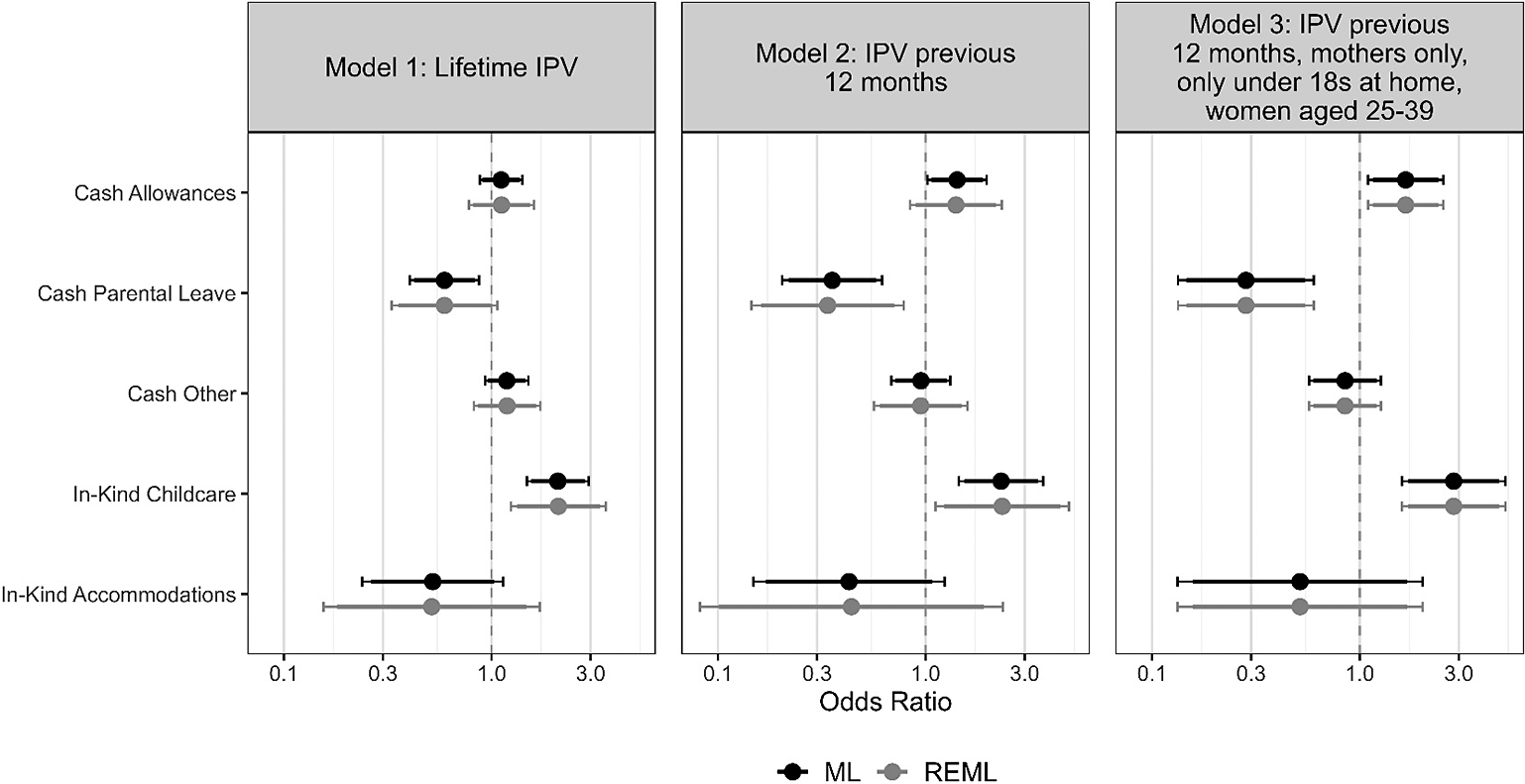
Figure 2 examines the interaction between state expenditure on the family and IPV using several alternative (and increasingly restrictive) specifications.Footnote 23 Most importantly, in all models in Figure 2 (including both the ML and REML estimations), in-kind spending on childcare has a positive and statistically significant association with IPV. This result remains robust regardless of whether IPV exposure is measured across a woman’s lifetime (Model 1), within the prior 12 months (Model 2), or occurring in the prior year specifically among mothers aged 25 to 39 with children aged under 18 living at home (Model 3). The latter result is particularly important as I anticipate that mothers with young children (proxied by a woman’s age) are the most likely to need and use state-subsidized childcare, and therefore, may have an increased risk of experiencing violence at the hands of a partner. Indeed, the predicted probability that these mothers experience IPV in the previous 12 months increases by roughly 12 percentage points — from 3% to 15% — as countries move from the lowest to the highest level of in-kind childcare spending. These results reveal that there is a meaningful and noteworthy connection between the state’s provision of childcare and the likelihood of women experiencing IPV in the EU, which corroborates H1.
Family expenditure and intimate partner violence — macrolevel, restricted models.
Note: Thick lines show 95% CI (p < 0.05), thin lines with end caps show 97.5% CI (p < 0.025).

Figure 2. Long description
A multi-panel figure with three panels. The y-axis, shared across all panels, lists five categories from top to bottom: Cash Allowances, Cash Parental Leave, Cash Other, In-Kind Childcare, and In-Kind Accommodations. The x-axis represents Odds Ratio on a logarithmic scale with values 0.1, 0.3, 1.0, and 3.0. A vertical dashed line is at the null value of 1.0. Data points are shown for two estimation methods: M L (black circles) and R E M L (grey circles), each with horizontal error bars representing confidence intervals.
* Panel 1: Model 1: Lifetime I P V. Cash Allowances and Cash Other are slightly above 1.0. Cash Parental Leave and In-Kind Accommodations are below 1.0 (around 0.5). In-Kind Childcare is above 1.0 (around 2.0).
* Panel 2: Model 2: I P V previous 12 months. Cash Allowances and In-Kind Childcare remain above 1.0. Cash Parental Leave and In-Kind Accommodations remain below 1.0. Cash Other is centered on the 1.0 line.
* Panel 3: Model 3: I P V previous 12 months, mothers only, only under 18s at home, women aged 25-39. Cash Allowances and In-Kind Childcare are above 1.0. Cash Parental Leave is significantly below 1.0 (around 0.3). Cash Other and In-Kind Accommodations are centered near or slightly below 1.0 with wide error bars.
In addition to these findings about childcare, Figure 2 also presents some interesting results concerning other forms of state expenditure on the family. First, Models 1–3 show — almost uniformly — that higher cash transfers provided to families during periods of parental leave are related to a lower likelihood of IPV by as much as 7 percentage points. Although these types of disbursements are ostensibly a family benefit, the de facto recipients are disproportionately mothers as they take the vast majority of (paid) parental leave even when allowances are officially “shareable.” More generous parental leave policies can either encourage more women to become (at least temporarily) stay-at-home parents and/or allow them to do so for longer periods of time.
While this result provides some suggestive evidence for H2, it is possible that this negative association may be a matter of resources and economic stress. Under this alternative explanation, more generous cash transfers help replace lost income and absorb (some of) the additional costs of a child/newborn, decreasing the economic strain and stress of families, which would usually provoke fights and violence. However, if a lack of resources were the primary and determinative factor for IPV, then any and all additional resources provided by the state would negatively affect the odds of violence, including in-kind childcare subsidies, which is not the case.
This also highlights the second interesting result in Figure 2 — that state spending on general cash allowances given to families with children is correlated with an increase in the odds of IPV. This is particularly true in Model 3, where the predicted probability of abuse rises from 4% to 10% as countries increase these types of cash expenditures. Importantly, because of the fungibility of cash, it is impossible to determine how each family uses these transfers. However, it is highly probable that, at least, some families use them to (partially) subsidize either full- or part-time childcare, which my theory predicts should show a similar association with IPV as in-kind childcare subsidies. This may also help explain that while general cash allowances have a positive and statistically significant association with violence, the coefficient is not as large as in-kind childcare spending because cash allowances are not exclusively used for external childcare but potentially other family necessities as well.
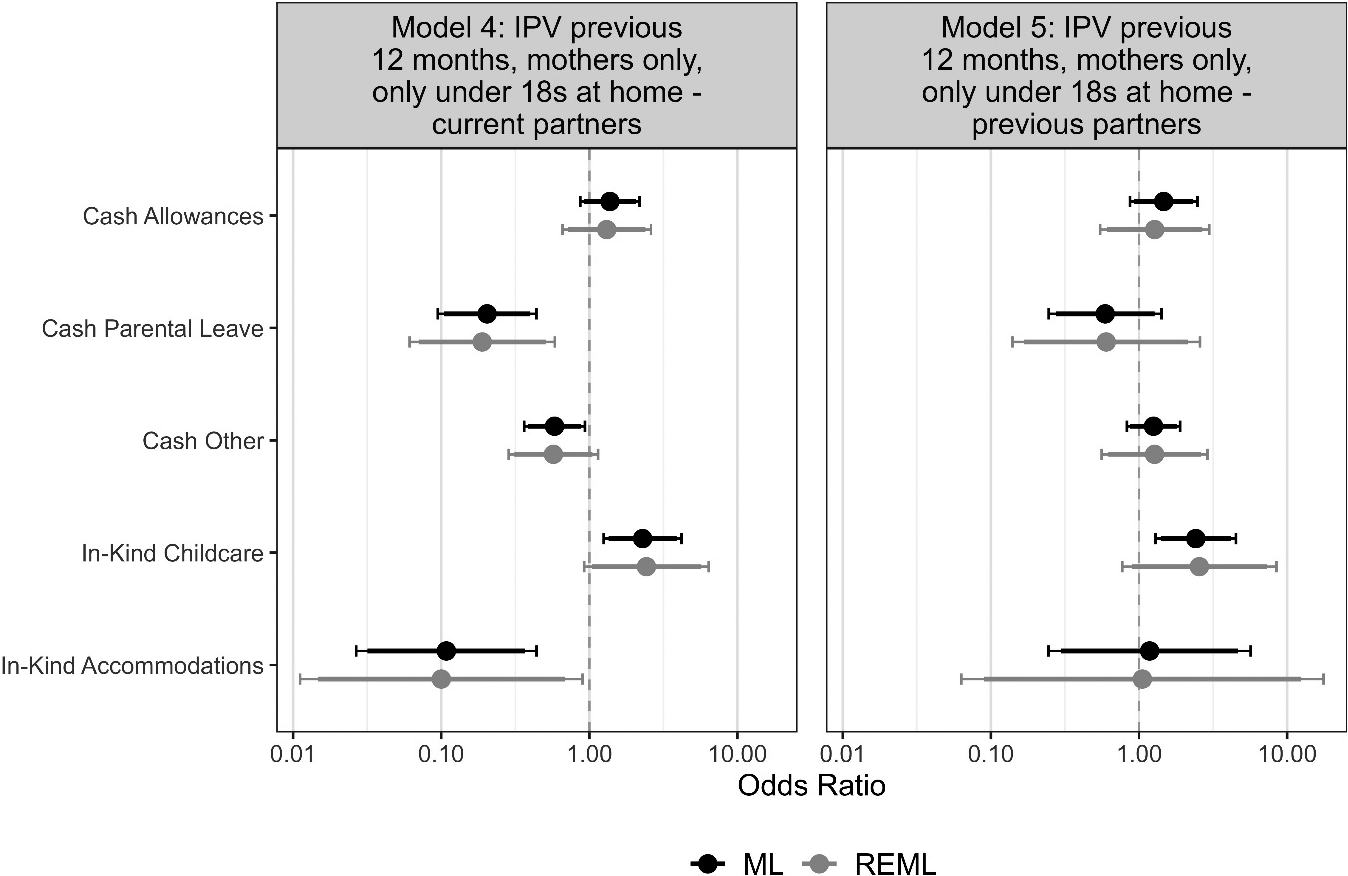
Next, Figure 3 explores how the connection between family spending and violence differs depending on whether the perpetrator is a current or former partner. Distinguishing between different partners is important, as if the results were concentrated among former partners, this could suggest that the state’s provision of resources, particularly childcare, was helping women to leave abusive situations. However, this does not seem to be borne out in Models 4 and 5. Rather, state expenditure on the family corresponds more strongly with violence committed by current partners (Model 4). More specifically, for current partners, cash for parental leave and in-kind childcare subsidies (Model 4 REML estimate for in-kind childcare: p = .039) remain statistically significant, and the direction of their associations with IPV is consistent with previous models. Cash provided during periods of parental leave is associated with a decrease in violence of approximately 3 percentage points, while in-kind childcare correlates with a 4-point increase. Meanwhile, for former partners (Model 5), only in-kind childcare remains significant in the ML-specification (REML estimate: p = .079).
Family expenditure and intimate partner violence — current and previous partners.
Note: Thick lines show 95% CI (p < 0.05), thin lines with end caps show 97.5% CI (p < 0.025).

Figure 3. Long description
The image consists of two side-by-side forest plots. The x-axis for both is a logarithmic scale representing Odds Ratio, ranging from 0.01 to 10.00, with a vertical dashed reference line at 1.00. The y-axis lists five categories: Cash Allowances, Cash Parental Leave, Cash Other, In-Kind Childcare, and In-Kind Accommodations. Each data point includes a black dot for M L and a grey dot for R E M L, both with horizontal error bars representing confidence intervals.
* Panel 1 (Left): Model 4, I P V previous 12 months, mothers only, only under 18s at home - current partners.
- Cash Allowances: Points are slightly above 1.00.
- Cash Parental Leave: Points are below 1.00, centered around 0.20.
- Cash Other: Points are below 1.00, centered around 0.60.
- In-Kind Childcare: Points are above 1.00, centered around 2.00.
- In-Kind Accommodations: Points are below 1.00, centered around 0.10 with wide error bars.
* Panel 2 (Right): Model 5, I P V previous 12 months, mothers only, only under 18s at home - previous partners.
- Cash Allowances: Points are slightly above 1.00.
- Cash Parental Leave: Points are below 1.00, centered around 0.60.
- Cash Other: Points are slightly above 1.00.
- In-Kind Childcare: Points are above 1.00, centered around 2.50.
- In-Kind Accommodations: Points are centered on 1.00 with very wide error bars extending from 0.06 to 15.00.
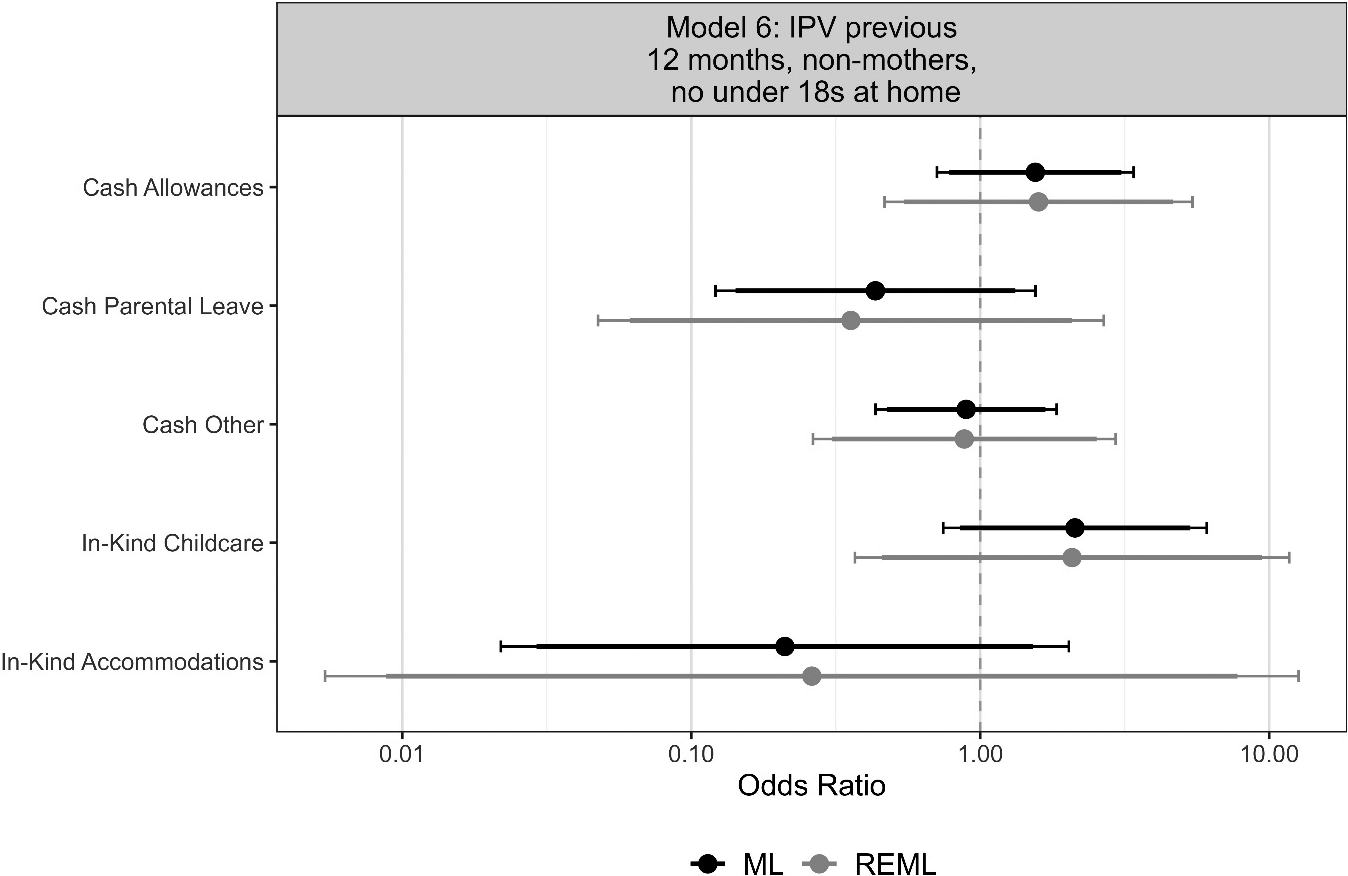
Finally, for state expenditure, Figure 4 reports the effect of family spending on IPV for nonmothers (Model 6). Given that my theory is focused on universal breadwinning policies, which are specifically intended to alleviate mothers’ caring responsibilities, we would expect to observe no relationship between social policies and IPV for women without children since they are ineligible for these family benefits. And consistent with my theoretical framework, Model 6 shows that there are no meaningful or statistically significant associations with violence for any of the family expenditure variables.
Family expenditure and intimate partner violence — nonmothers.
Note: Thick lines show 95% CI (p < 0.05), thin lines with end caps show 97.5% CI (p < 0.025).

Figure 4. Long description
A forest plot titled Model 6: I P V previous 12 months, non-mothers, no under 18s at home. The x-axis represents Odds Ratio on a logarithmic scale with major ticks at 0.01, 0.10, 1.00, and 10.00. A vertical dashed reference line is at 1.00. The y-axis lists five categories from top to bottom: Cash Allowances, Cash Parental Leave, Cash Other, In-Kind Childcare, and In-Kind Accommodations. Each category displays two horizontal error bars with central dots: black for M L and grey for R E M L.
* Cash Allowances: Both M L and R E M L dots are positioned slightly above 1.00 with narrow error bars.
* Cash Parental Leave: Both dots are positioned below 1.00, approximately at 0.40, with error bars crossing the 1.00 line.
* Cash Other: Both dots are centered very close to the 1.00 reference line.
* In-Kind Childcare: Both dots are positioned above 1.00, approximately at 2.00, with error bars extending from 0.80 to 10.00.
* In-Kind Accommodations: Both dots are positioned below 1.00, approximately at 0.25, with very wide error bars extending from 0.005 to 10.00.
A legend at the bottom indicates black dots represent M L and grey dots represent R E M L.
While the models above examine cash expenditure on parental leave, Figure 5 presents other dimensions of leave entitlements, including the duration and payment rates given to both mothers and fathers. In all of the ML models, higher maternal payment rates have a statistically significant (at the .05 level) and negative association with IPV. Indeed, in Model 8, higher wage replacement for mothers corresponds to a 4-percentage-point drop in violence and abuse by partners as payments increase from 25 to 100 percent of previous earnings. These results are also replicated with the REML estimates for maternal payment rates, which are significant at p < .025 in Models 8 and 11, and p < .05 in Model 10. Additionally, Figure 5 also shows that, in some instances, longer periods of maternal leave also corresponded to a decrease in the odds of IPV by approximately 3 points (Model 11). These results provide support for H3b.
Parental leave and intimate partner violence.
Note: Thick lines show 95% CI (p < 0.05), thin lines with end caps show 97.5% CI (p < 0.025).

Figure 5. Long description
A multi-panel coefficient plot with five vertical panels.
Shared Axes and Legend:
* Y-axis (left): Four variables from top to bottom: Maternal Leave Duration, Maternal Payment Rate, Paternal Leave Duration, and Paternal Payment Rate.
* X-axis (bottom): Odds Ratio ranging from 0.96 to 1.04 with a dashed vertical reference line at 1.00.
* Legend (bottom center): Black dots represent M L and gray dots represent R E M L, both with horizontal error bars indicating confidence intervals.
Panel Breakdown from left to right:
* Model 7: Lifetime I P V, mothers only, only under 18s at home. Maternal variables are slightly below 1.00. Paternal variables are slightly above 1.00.
* Model 8: I P V previous 12 months, mothers only, only under 18s at home. Maternal variables show a stronger decrease below 1.00 compared to Model 7. Paternal variables remain above 1.00.
* Model 9: I P V previous 12 months, mothers only, only under 18s at home, women aged 25 to 39. Trends are similar to Model 8 but with wider confidence intervals for leave duration.
* Model 10: I P V previous 12 months, mothers only, only under 18s at home - current partners. Maternal payment rate shows the most significant decrease below 1.00. Paternal leave duration has the widest confidence interval, extending from 0.98 to 1.04.
* Model 11: I P V previous 12 months, mothers only, only under 18s at home - previous partners. Maternal variables are below 1.00. Paternal variables are above 1.00, with leave duration showing a notable increase.
Then, for fathers, Figure 5 indicates a small, positive association between the UBM and IPV. For example, several models, including Models 10 and 11, suggest that higher payment rates during periods of exclusive paternity leave are correlated with a 2-percentage-point increase in violence. Similarly, Model 7 also indicates that longer periods of parental leave for fathers are associated with mothers experiencing more violence over the course of their lifetime. Critically, the divergent results for parental leave entitlements for mothers and fathers are consistent with my theoretical framework about the UBM and related hypotheses.
However, although the estimates presented in Figure 5 provide some support for H3c and H4b, it is worthwhile noting that it may be difficult to detect a statistically or substantively significant effect for these types of UBM policies for two reasons. First, in “progressive” European countries, variation in leave entitlements is marginal. In addition, while generous when compared to the rest of the world, exclusive periods of paternity leave are often only an extremely small entitlement as well as a very recent policy development, even in the EU in 2012. This may mean that it is difficult to establish a connection between parental leave characteristics and IPV, particularly for paternal leave. Second, even if benefits for fathers were more generous, there is no guarantee that men would actually use their entitlement, particularly if they subscribe closely to patriarchal ideas and believe it would undermine their position as head of the household. Therefore, the state could provide generous entitlements to fathers, but they might eschew using them. However, while men ultimately do have a choice in using leave entitlements, the increasingly common “use it or lose it” conditionality imposed on paternal leave potentially reduces a father’s choice set. And if my theory about the UBM and IPV is accurate, this exclusivity conditionality would help to exacerbate violence.
Overall, the findings presented above indicate that there is an important connection between the social welfare state and EVAW. In particular, the results demonstrate that policies related to the UBM, such as subsidized childcare, are frequently associated with a higher likelihood of IPV for women. Conversely, there is also evidentiary support for the idea that more generosity given to mothers during parental leave — measured by either state expenditure (H2), leave duration (H3b), or the payment rate (H4a) — corresponds to a reduction in the odds of violence. Finally, there is also tentative evidence that generosity in parental leave entitlements given to men has the opposite effect and helps to exacerbate IPV (H3c and H4b). These results are, therefore, consistent with my theoretical argument that family policies which are part of the UBM and help to facilitate women’s formal employment are associated with elevated levels of IPV. However, while this analysis is supportive of this theoretical framing, it is also important to acknowledge some of the limitations of these results, which are discussed in the next section.
Conclusion
Contrary to expectations about gender equality in Europe, European women continue to experience extremely high rates of physical and sexual violence, especially at the hands of their male partners. What explains this counterintuitive pattern of everyday violence? In this article, I have argued that there is an association between these disturbing rates of violence and the social welfare state. More precisely, I have argued that the likelihood of IPV is related to the state’s implementation of the UBM, which is linked to women’s entry/return to formal employment and thus, in turn, to the disruption of men’s traditional breadwinning role and shifts in familial power dynamics. IPV is, therefore, theorized to partially reflect a violent backlash from men as they try to salvage power within their intimate relationships.
Critically, the cross-national evidence presented in this article supports my hypothesis that universal breadwinning policies are linked to the incidence of IPV. The article demonstrates that higher state expenditure on in-kind childcare benefits is significantly and positively associated with the probability of women, especially mothers, experiencing IPV. Likewise, my results also suggest that when women are encouraged to center caring responsibilities, through policies such as longer or better-compensated parental leave entitlements, this corresponds to a decrease in the likelihood of violence and abuse.
However, the results in this article have limitations that are important to acknowledge. First, it cannot be claimed that the findings detailed above are causal relationships, as they materialize from observational data. Although causal inference research examining interventions to reduce EVAW and IPV is increasing (Boyer et al. Reference Boyer, Paluck, Annan, Nevatia, Cooper, Namubiru, Heise and Lehrer2022; Green, Wilke, and Cooper Reference Green, Wilke and Cooper2020; Heath, Hidrobo, and Roy Reference Heath, Hidrobo and Roy2020; Hidrobo, Peterman, and Heise Reference Hidrobo, Peterman and Heise2016), it is still often infeasible or unethical to conduct experiments. In addition, conducting research with vulnerable populations, such as domestic violence (DV) victims, can also be challenging due to concerns surrounding access, retraumatization, confidentiality, and safety (Barnes Reference Barnes2026; Ellsberg and Heise Reference Ellsberg and Heise2005). However, while observational studies are often, therefore, driven by necessity, they can nonetheless add to our understanding of violence against women.
Second, this article is based on cross-sectional data rather than a time series or panel data. It is therefore not possible to determine how varying social welfare and family expenditure impact IPV over several years. Perhaps 2012 was an anomalous year for violence, particularly as it was during the Eurozone debt crisis, and economic stress is often considered to be an underlying cause of familial violence. However, if macroeconomic conditions were having an impact on rates of IPV, this would likely be reflected in some of the control variables such as unemployment.
The lack of a time series also means it is difficult to tell if the associations in this article are a permanent or temporary phenomenon, as social norms about women’s roles lag behind social welfare policy. This is unfortunately a difficult question to answer, as time series data focused on EVAW and/or IPV are rare unless they are from crime statistics. Instead, European countries have often commissioned one-off victimization surveys with little or no follow-up. Additionally, collecting an accurate time series is complicated as definitions of EVAW have changed over time. However, as of September 2022, the FRA has an open call for tenders for a follow-up survey.
In addition to these limitations, the results presented in this article may seem to have potentially concerning implications not only for the social welfare given to families but also for the support and consolidation of women’s rights and independence. Initially, the findings seem to imply that European states should abolish the UBM and subsidized childcare, which create opportunities for women to participate in the formal labor market. However, I would argue that this interpretation is overly simplistic and unsophisticated.
Rather, there are several more constructive implications of this article.First, this article demonstrates that it is important to examine social welfare policies in a disaggregated manner. This disaggregation should occur by purpose — parental leave versus childcare — and also by the means of distribution — cash versus in-kind benefits. Disaggregation is important because too often it is assumed that welfare state generosity always corresponds to positive outcomes for both recipients and broader society. Instead, this article demonstrates that different types of social assistance to families may have unintentional but dramatically different consequences for IPV. Understanding these differences is important as it provides a greater understanding of the trade-offs of family policies and may allow for the development and application of mitigation and prevention strategies for violence — for example, greater funding for domestic violence organizations and shelters.
Second, my results show that social welfare benefits, such as childcare subsidies and paternity leave, are associated with higher rates of EVAW, while benefits, like longer maternal leave, that help to reinforce more traditional gender norms do not. However, rather than arguing that this is a problem with the social welfare state, I would argue that this is a problem with men and their views about masculinity and their place within families. Viewing the results in this manner highlights the need to implement policies that promote broad normative change about gender roles and the unacceptability of violence. Research on altering perceptions of the acceptability of domestic violence has been conducted in the developing world (Boyer et al. Reference Boyer, Paluck, Annan, Nevatia, Cooper, Namubiru, Heise and Lehrer2022; Green, Wilke, and Cooper Reference Green, Wilke and Cooper2020), but more work on altering men’s perceptions even in the developed world remains a necessity (Ellerby Reference Ellerby2017; Keller, Wilkinson, and Otjen Reference Keller, Wilkinson and Otjen2010).
Beyond interventions and campaigns to shift perceptions of domestic violence, the state may also engage in normative change by modifying the model of social welfare utilized. Instead of pursuing the universal breadwinning model, states could increasingly move toward a universal caregiving model (Fraser Reference Fraser1994). A universal caregiving model would incentivize men to undertake substantially greater amounts of informal caring work, which would, in turn, promote the equal distribution of paid and unpaid work regardless of gender. By actually valuing care work, states would also reject and challenge traditional ideas about gender, the division of household labor, and the “proper” roles for men and women. Hopefully, over time, this would reduce the number of men feeling threatened by women working, thus decreasing violent backlash and therefore IPV.
Supplementary material
The supplementary material for this article can be found at http://doi.org/10.1017/S1743923X26101147.
Data availability statement
The FRA data that support the findings of this study are available from the UK Data Service (https://ukdataservice.ac.uk), study number: 7730, doi: 10.5255/UKDA-SN-7730-1. Restrictions apply to the availability of these data, which were used under license for this study (project number: 117203). In compliance with the license conditions, the European Union Agency for Fundamental Rights reviewed the study design and secondary data analyses conducted in this article to prevent the disclosure of potentially identifiable information.
Acknowledgments
I would like to thank Phillip Ayoub, David Bateman, Isabel Castillo, Mark Copelovitch, Debak Das, Colleen Driscoll, Karin Goihl, Sabrina Karim, Peter Katzenstein, Nazlı Konya, Julius Lagodny, Douglas Page, Pauliina Patana, Thomas Pepinsky, Kenneth Roberts, Stephen Roblin, Jake Swanson, Valeriia Umanets, Jimena Valdez-Tappata, Christopher Way, the 2019–20 Berlin Program Fellows, the Comparative Politics Colloquium at the University of Wisconsin-Madison, my panel participants at the Annual Conference of the American Political Science Association in 2022, and the anonymous reviewers for their thoughtful comments and feedback.
Funding statement
Support for this research was generously provided by the National Science Foundation Political Science Doctoral Dissertation Research Improvement Grant Program (Award No. 746065) and the Berlin Program for Advanced German and European Studies at the Freie Universität Berlin. Any opinions, findings, and conclusions or recommendations expressed in this material are those of the author and do not necessarily reflect the views of the National Science Foundation.
Competing interests
The author declares none.



 Open access

