

Introduction
Peter Maxwell Davies (universally known as Max) was almost certainly the very first composer in the UK to be represented by an agent, and here I examine the commissioning of his Third Symphony by the BBC, addressing two principal questions. Firstly, when and where did Maxwell Davies acquire an agent? And secondly, how did the arrival of this new species affect the ecology of the musical world around commissioning new music? The BBC is the largest patron of new music in the UK; in taking a deep dive into its commissioning of a significant single work by a leading British composer, I shine a light on one aspect of the often obscure and apparently secretive process by which composers are commissioned. This also illuminates the important role the BBC played in the wider musical world, and the delicate balance of power between the BBC as a corporation, other musical organizations, and the creative individuals who work at or for those institutions. I argue that the appearance of the composer’s agent marked a moment of profound change in the power relationships in the social and professional networks surrounding composers, and instigated a new commercialization in the world of new music.
Examination of the music of Maxwell Davies has not diminshed since his death in 2016, as is so often the case with contemporary composers, and Maxwell Davies studies continue apparently unabated, with important recent scholarly work including The Music of Peter Maxwell Davies from 2020, Peter Maxwell Davies: Selected Writings from 2017, and a collection, Peter Maxwell Davies Studies, from 2009, which follow up on the edited collection Perspectives on Peter Maxwell Davies from 2000.Footnote 1 These publications take an analytical line for the most part, following Nicholas Jones’s groundbreaking analysis of the sketches for the Third Symphony,Footnote 2 although in the most recent work, as well as compositional technique and process, ‘genre, form, and architecture; tonality and texture; allusion, quotation and musical critique; and landscape and place’ are taken into account.Footnote 3 There is also the relatively recent trend to put composers into their musical, cultural, and social context, seen for example in the Cambridge Composers in Context series, which aims to ‘cover topics including educational and cultural influences, social and professional networks, developments in performance practice, technology, business and politics, and critical reception’.Footnote 4 Given the richness and diversity of scholarly material already in print that deals with the music of Maxwell Davies and his Third Symphony, it might be asked: what is there to add? This article expands these elements of studies of the composer to include significant social and professional networks: the composer’s publisher, his agent, and the BBC, embracing the business of the music industry and considering political economy in its relation to how a publicly funded body like the BBC chooses to spend licence-fee money on commissioning new music.
In the same way that the sociology of medicine has broadened our understanding of disease in acknowledging that illness is, at least to some extent, a social construct, a discourse made up of the diverse and sometimes conflicting understanding of doctors, nurses, pharmacologists, social workers, patients, and so on, it is possible to understand a musical work from many points of view, not just that of the composer.Footnote 5 In decentring the composer and examining the discourse created by the network surrounding them, a more nuanced and thorough understanding is made possible.
As well as the social, cultural, and political context of composers and their music, there has also been a recent rise of academic interest in the business of music publishing, which is mostly historical or is focused around the ownership of copyright, intellectual property rights, and the economics of royalty collection and payment.Footnote 6 Attempts to position music publishing in the wider music industry have tended to be situated in discussions around popular music.Footnote 7 Robert Montgomery and Robert Threlfall’s fascinating examination of Delius’s publishing history charts the relationship the composer had with various publishers, the nature of the contracts they signed, and the income that was generated.Footnote 8 The present article contributes another approach to the debate around the function of the music publisher, investigating their role as an active partner in the commissioning and creation of new music, as part of the network which surrounds and supports the work of the composer in the phase of creativity before and during the period when the work is written, published, and performed.
Alongside that interest in music publishing, the role of the BBC and its contribution to music in the twentieth century has also come under scrutiny from several quarters. There have been several studies of the importance of popular music at the BBC, from the magisterial study of popular music on the BBC during World War II by Christina Baade, through David Hendy’s investigation of Radio One and public taste, which informed his history of the BBC, to the polemic by Simon Frith and Martin Cloonan, which suggests that ‘in the classical music world no one doubts the importance of the BBC’.Footnote 9 In the world of classical music scholarship there have been several examples that would support Frith and Cloonan’s assertion, from an examination of the BBC’s importance to the dissemination of avant-garde music during the 1920s and 1930s to its significance to Benjamin Britten.Footnote 10 The impact the BBC Proms has had on new music is woven through a recent study edited by Jennifer Doctor, David Wright, and Nicholas Kenyon, and I have written a more detailed study of the commissioning fund for new music at the Proms.Footnote 11 The present article pursues, in greater depth than has hitherto been undertaken, the role that the BBC played in the commissioning of a specific work, and in doing so interrogates the particular power relationships that exist between BBC executives, publishers, and composers, and how the arrival of the composer’s agent in the network has modified those relationships.
Since 2002, when Julian Johnson asked ‘Who needs classical music?’ and Hans Abbing asked ‘Why are artists poor?’, there have been diverse investigations into the economy of the arts.Footnote 12 Johnson decided that classical music had a value in itself, divorced entirely from the world of economics; of those who have taken a more nuanced stance, most of those, Abbing included, have concentrated either on the market for the visual arts or popular music.Footnote 13 Explorations of a broader milieu of cultural workers have tended to concentrate on issues of class and gender, or else bypass the world of classical music altogether, although some recent commentators have dipped their toes into this field of study.Footnote 14 This article engages head on with the underexplored area of the economics of commissioning new music, with a detailed exploration of the negotiation of a fee for a specific work from a leading British composer.
In a more recent book-length study of arts markets, Abbing suggested that ‘it is in approximately 1980 that we see several important changes, including a general commercialisation in the arts, sometimes referred to as a commercial turn’.Footnote 15 This commercial turn has not only been observed in the arts, but more generally has been predominant in changing attitudes towards not-for-profit organizations, seen most clearly in the UK in the privatization of public services during the Thatcher government and after, and the rise of the consumer as customer. The emergence of internal markets in the National Health Service and the BBC are also symptoms of this turn. It is from this period of the early 1980s and the commercial turn that the central subject of this article emerges: the commissioning of Maxwell Davies’s Third Symphony by the BBC in 1983. This work was given its first performance by the BBC Philharmonic Orchestra, conducted by their then principal conductor, Edward Downes, at the Free Trade Hall in Manchester on 19 February 1985, and was broadcast live on BBC Radio 3 as part of a BBC Philharmonic Orchestra 50th Anniversary Concert, itself part of European Music Year.Footnote 16
This commission is interesting for several reasons. Firstly, the fee for this commission was negotiated not by Maxwell Davies’s publisher but by his agent. As already mentioned, Maxwell Davies was almost certainly the very first British composer to be represented in this way, and as well as the advantages that brought, it was not an unmitigated success; in purely financial terms the relationship between artist and agent got into rather a mess.Footnote 17 In fact, mess is rather central to the methodology of the present article: the sources for this paper include files in the BBC Written Archives Centre; an unpublished memoir by Maxwell Davies’s agent, Judy Arnold, held at the Orkney Library and Archive; and interviews with some of the interested parties. So the result is not a neat, positivist history but an untidy array of personal accounts, none of which can necessarily be taken at face value, although — with a little interpretation — together they create a cohesive discourse.Footnote 18 This approach, which enables a rich and diverse narrative to develop, is especially well suited to the complexity of the commissioning process and its multifaceted nature, involving a network of individuals and organizations, each with a different set of priorities. Investigating the network involved in the commissioning of Maxwell Davies’s Third Symphony reveals the changing balance of power between the individuals and organizations, and the introduction of an agent into the mix is seen to be a critical intervention.
Context: The Role of Publishers and Agents
It is now commonplace for composers to be represented by an agent. For example, Cathy Nelson, one of the pioneers in this field, describes what she does on her website:
Cathy Nelson set up her own company in 2006 after twenty years working in both the orchestra and agency world. Her focus is primarily composers, frequently working in collaboration with a publisher. She aims to provide long-term advice, guidance and practical support to enable artists to achieve their potential world-wide.Footnote 19
This has not always been the case, however, and before the 1980s it was publishers, and in particular the publishers’ promotions executives, who fulfilled this function. They were responsible for hunting down commissions and negotiating fees, as well as enabling artists ‘to achieve their potential world-wide’. At that time, agents fulfilled a similar function for performing musicians.
Composers who also performed, Pierre Boulez being a pre-eminent example, would have had an agent who managed their performing work, but the publisher was responsible for the composition side. The two sides of Boulez’s musical life were quite independent: from the mid-1950s and Le Marteau sans maître, his compositional life was handled by Universal Edition, foremost among publishers of the avant-garde and based in Vienna. His activities as a conductor were looked after by the London-based agency Ingpen and Williams. Among Nelson’s clients is the composer/conductor Matthias Pintscher, whose performing activities are handled by Opus 3 Artists. On the other hand, she deals with both sides of the careers of composer/conductor Richard Baker and composer/pianist Thomas Larcher. Nelson spent several years as an artists’ agent at Harrison Parrott, one of the UK’s leading agencies. Her website is explicit about which publisher also represents each composer. Of the ten composers Nelson represents, only three are also performers, so the adoption of the composer’s agent is not directly linked to the rise of the composer/conductor, as might be imagined.
Whoever secures the commission and negotiates the fee, once a commission is safely landed and the composer completes the score, it is the publisher who is then responsible for the costly business of producing the performance materials: the score and parts. Sometimes the commissioning body contributes towards these costs. Having an agent and a publisher involved avoids a potential conflict of interests, as explained by Sally Groves, Head of Promotions at Schott’s London office from 1974 to 2014:
That’s where an agent comes in, because the agent is acting on the composer’s behalf, whereas if it’s the publisher negotiating the commission there could be a conflict of interests, because we’re trying to get as much money as we can towards the parts and are therefore maybe not prepared to fight for the last £5000 for the composer, whereas the agent will do both of those things, and that’s fine.Footnote 20
Commissioning Maxwell Davies’s Third Symphony: The Network of People
The first of the key players in this little drama was Maxwell Davies himself: other than writing the symphony, his role in the action was, as far as it is possible to tell, passive, although his input in unreported conversations may have been more important than any surviving written materials might suggest.Footnote 21 Maxwell Davies sits in the middle of a web of interrelated participants, representatives of three organizations: his publisher, Chester Music; his agent, Judy Arnold; and the commissioner of his Third Symphony, the BBC. At Chester Music the key personnel were the managing director, Robin Boyle, along with Chester’s promotions manager, Sheila MacCrindle; as well as Arnold, her husband, Michael, came as part of the package;Footnote 22 and over at the BBC, there was the Controller of Music, Robert Ponsonby, the Chief Producer of Contemporary Music, Stephen Plaistow, and the BBC Philharmonic Orchestra and its management. This is the network as it became established; in Pierre Bourdieu’s terms, ‘the aggregate of the actual or potential resources which are linked to possession of a durable network of more or less institutionalized relationships of mutual acquaintance and recognition’.Footnote 23
This group of people is institutionalized insofar as the employees of the BBC and Chester Music were working at institutions; the ostensibly independent freelancers, Maxwell Davies and the Arnolds, are nonetheless drawn into the institutionalized arrangement by dint of working with the others. As Bourdieu explains:
The existence of a network of connections is not a natural given, or even a social given, constituted once and for all by an initial act of institution […] It is the product of an endless effort at institution […] which is necessary in order to produce and reproduce lasting, useful relationships.Footnote 24
It is this endless effort, the meetings, phone calls, letters, memos, and contracts, which forms the essence of this article. The addition of an agent into this network is an example of Goethe’s metaphor, in his novel Elective Affinities, of a chemical reaction, where the introduction of new figures into a stable set of relationships results in a radical reorganization of the original set-up.Footnote 25
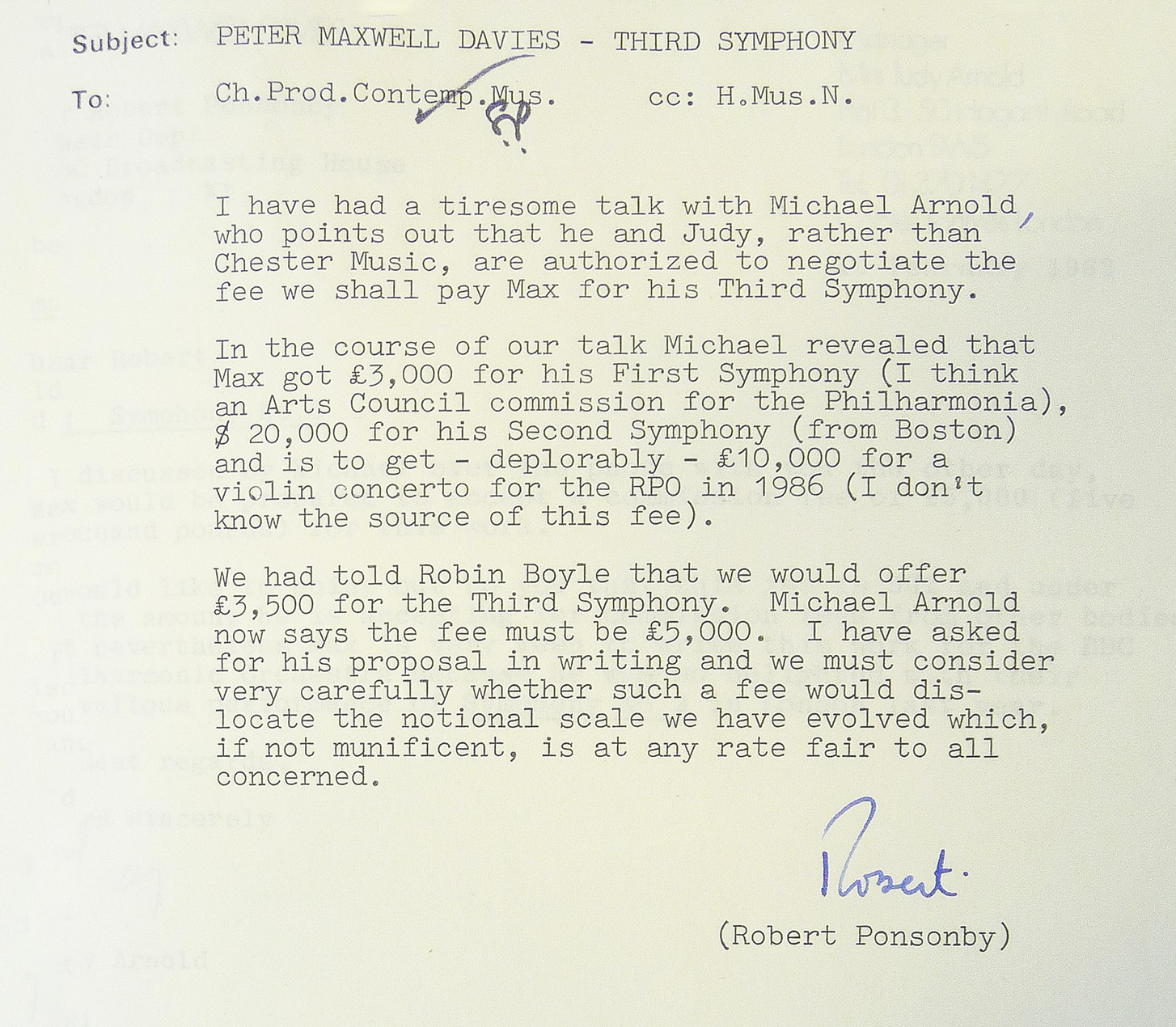
As Kenyon noted in his history of the BBC Symphony Orchestra, ‘the BBC, it is said, has lived by the memo and may yet perish by it’.Footnote 26 On 11 February 1983 Robert Ponsonby sent a memo to Stephen Plaistow (see Figure 1).Footnote 27 A BBC memo from 1983 seems as exotic and distant today as a medieval manuscript, typed on what appears to be a golf ball electric typewriter, an innovation introduced in 1961, and signed in fountain pen. The BBC’s abbreviations of job titles here need some explanation: ‘Ch.Prod.Contemp.Mus’ is Plaistow, the Chief Producer of Contemporary Music; he has initialled his title to indicate that he has read the memo, which is copied to ‘H.Mus.N.’, the Head of Music, North, meaning David Ellis, the Head of Music at New Broadcasting House in Manchester at that time, who was in overall charge of the Music Department there, including the BBC Philharmonic Orchestra.
Memo from Robert Ponsonby to Stephen Plaistow, 11 February 1983. BBC copyright content reproduced courtesy of the British Broadcasting Corporation. All rights reserved.

Figure 1. Long description
A typewritten B B C memorandum with handwritten annotations.
Header section:
Subject: PETER MAXWELL DAVIES - THIRD SYMPHONY
To: Ch. Prod. Contemp. Mus. (with a handwritten checkmark and initials above it) cc: H. Mus. N.
Body text:
I have had a tiresome talk with Michael Arnold, who points out that he and Judy, rather than Chester Music, are authorized to negotiate the fee we shall pay Max for his Third Symphony.
In the course of our talk Michael revealed that Max got £3,000 for his First Symphony (I think an Arts Council commission for the Philharmonia), $20,000 for his Second Symphony (from Boston) and is to get - deplorably - £10,000 for a violin concerto for the R P O in 1986 (I don't know the source of this fee).
We had told Robin Boyle that we would offer £3,500 for the Third Symphony. Michael Arnold now says the fee must be £5,000. I have asked for his proposal in writing and we must consider very carefully whether such a fee would dislocate the notional scale we have evolved which, if not munificent, is at any rate fair to all concerned.
Closing:
A blue ink signature reads Robert. Below it, the name (Robert Ponsonby) is typed in parentheses.
This brief memo requires some unpacking and raises several important factors affecting the commissioning of music, and the evolving relationship between the BBC and individual composers, during this period. Ponsonby’s frustration is clear from the language he chose to use: ‘tiresome’ and ‘deplorably’. These are not the words of a high-ranking BBC bureaucrat going about his quotidian duties. One small but vital remark: Ponsonby refers to ‘a notional scale we have evolved’. It was his predecessor as Controller of Music at the BBC, William Glock, who had established and developed a fund specifically for the commissioning of new music during the 1960s. This was a scale of fees offered to composers, which, although not generous, was fair to all. Glock’s was a straightforward list of fees for different types of musical composition: £75 for one of these, £100 for one of those, irrespective of the reputation or seniority of the composer.Footnote 28
Ponsonby’s approach was, in many ways, more in keeping with the wider culture at the BBC. Nothing is written down, it is ‘notional’, and it has ‘evolved’, and therefore will continue to evolve as circumstances dictate or allow.Footnote 29 It still retains the BBC’s straight-bat approach of being on the one hand stingy (‘not munificent’), but on the other hand equally stingy to everybody (‘fair to all’).Footnote 30 This contrasts with William Mann’s 1968 article in The Times on commissioning and commission fees, where he argued that fees offered to composers should correlate to a reasonable salary paid pro rata for the time the music took to write: ‘The money offered should accord with the domestic finances of [the composer] while he is composing this masterpiece. Better pay one composer decently than offer niggardly sums to five.’Footnote 31 It should perhaps be remembered here that, as Jonathan Potter and Margaret Wetherell argue, everything that is written and said about an event constructs that event, rather than describes it, and that the cultural heft of The Times or the BBC does not make one account any more valid or truthful than any other. As will become clear, the patrician Ponsonby — ex-Eton, ex-Guards, ex-Cambridge, with the institutional weight of the BBC behind him — could be as creative in constructing his favoured version of this discourse as anybody else.
The key issue here, though, is the four-way relationship between the composer, the BBC, the composer’s publisher, and the composer’s agent. The larger organizations, like the BBC and the publisher, would consist of a team of individuals, each of whom plays a role in the commissioning process. At the BBC, Ponsonby and Plaistow are the key figures, as outlined above, but there are many others involved: the Copyright Department draws up the contracts, Concerts Management promotes the performance in the concert hall, and the Production Department broadcasts the concert, and there are also the orchestras and their management, and the conductors and soloists who perform the music. This begins to people the ‘film credits’, to use an image from Howard Becker’s Art Worlds, in which he explores the network of people involved in making a work that is often perceived as the lonely activity of the creative individual. Becker uses the credits at the end of a feature film as an extreme example of all the people without whose input the film might not have happened, or would at least have been different in some way, small or large.Footnote 32
In the same way, the publisher would have a team of people, the most critical of whom would be the Director of Promotions (this title varies from publisher to publisher and has changed over time, but the function remains much the same), the principal point of contact for the composer and the go-between with the commissioning body, promoter, or performing organization. Their job, in simple terms, is to drum up interest in the composer and their work, encourage performances, and seek out fresh opportunities and commissions. They would then be responsible for negotiating the commission fee, as outlined by Sally Groves above. Publishers would also have editors, who would prepare scores for performance, correct mistakes, untangle notational ambiguities, and produce scores and parts for the performers. There would also be a marketing department which would get involved with the promotion of performances of works by their composers.
This was the situation prior to the arrival on the scene of the composer’s agent. The agent’s role can be very varied, according to who they are working with, what their specific interests are, and what variety of work they undertake. Many composers will have a foot in more than one musical camp, composing serious music to commission (‘art for art’s sake’) and also undertaking more commercial work in the fields of film and TV, for example (‘money for God’s sake’).Footnote 33 Publishers have separate departments dealing with these disparate areas of the music industry, and agents would approach these areas quite differently. The long-time Director of Promotions at the publisher Schott, Sally Groves, put it succinctly: ‘Nowadays all composers have agents, and agents are used to screwing money out of people, so they screw money for the composers. Well, good luck to them!’Footnote 34
Some agents that work with composers are employed by the big artists’ agencies and manage conductors and performers as well. It is a specialized type of management, and only individual managers with a particular interest and aptitude for it would be suitable. One such is Cathy Nelson, mentioned earlier, who worked at a major UK artists’ agency, Van Walsum Management, and also held important posts in the new music scene in the UK, including managing the Society for the Promotion of New Music and the new music group the London Sinfonietta. She subsequently set up on her own as an agent specifically to manage composers. The obvious question is how the publisher and agent could work together, and again Groves is illuminating:
We had very clear lines of demarcation. I was very happy for Cathy to manage the whole commissioning thing, whereas Janis [Susskind, for many years Groves’s opposite number at Boosey & Hawkes] won’t let that out of her control. But you’ve got to be very trusting, because if the agent is getting commission after commission for the composer, we’re the ones who have to pay for all of this and fit it into our schedules. So you’ve got to have a great deal of trust to make the relationship work.Footnote 35
Groves describes a delicate balancing act. The publisher is an entirely commercial concern; the complexities of ‘serious’ music publishers, like ‘literary’ fiction publishers, where more popular products underwrite slow-burning prospects, is beyond the scope of this article. However, put simply, while it is in the interest of the agent to find new commissions for their composers and collect their percentage of the fee, and in the long-term interest of the publisher to have the copyright on a large catalogue of frequently performed music, it is the publisher who has to produce performance materials in the short term, which is a considerable capital outlay on an uncertain investment. For the BBC, spending licence-fee money, this was not so much of an issue. The significance lies in the intersection of these sometimes conflicting interests of composer, publisher, agent, and commissioning body — and often, as in the case of the BBC, this is also the performing organization.
Arnold recounts in her memoir how she became Maxwell Davies’s agent.Footnote 36 She had no management experience: she first met Maxwell Davies in 1970 at the Dartington Summer School, where he was teaching, and she got to know him and became something of a camp follower, until in 1975 he invited her to manage both his performing group, the Fires of London, and himself as a composer.Footnote 37 According to Arnold’s memoir, which may or may not be entirely accurate, during the phone conversation in which she accepted the job, her husband, Michael, took the phone, ‘and said that he would help me as far as business matters were concerned’.Footnote 38 She explained what she felt her role was as far as Maxwell Davies the composer went:
I was always endeavouring to do the best for the already existing works, and to act as midwife to the newly-born works, and later as nanny to the infant works as they toddled off on their own two feet. My aim was to provide a platform upon which Max would be able to operate on his own terms, and to compose the works that he wanted to, and at the time that he wanted to.Footnote 39
This is a clear statement of the narrative that the network surrounding the composer was there to allow the creative genius to ‘operate on his own terms’; the caring, domestic analogy is in contrast to the hard-headed negotiations required to ‘screw money for composers’. This was mainly left to Michael. To describe Michael Arnold as a chancer might not be inappropriate: on 2 November 2009 he was jailed for eighteen months after admitting to defrauding Maxwell Davies out of £522,333 through false accounting to fund a gambling habit.Footnote 40 Nonetheless, Maxwell Davies was happy to leave his financial affairs to the Arnolds at least until this fraud came to light. At Michael Arnold’s trial, it was reported that:
He [Maxwell Davies] was ‘not a worldly man’ and had given complete control of his bank accounts to the defendant, said Justin Cole, prosecuting. ‘He was not interested in the material world and was more interested in his music’, Mr Cole added.Footnote 41
Evidence of the Arnolds’ involvement in fee negotiations for Maxwell Davies for commissions prior to the Third Symphony is sketchy; certainly there is nothing in his BBC files about his previous BBC commission, for the chamber opera The Martyrdom of St Magnus (1977). According to her memoir, when Arnold was working as the manager of the Fires of London, she asked Elliott Carter for a piece for the group when they were on tour in the USA in 1976. Carter agreed, but insisted that there should be no specified date by which the work should be completed. Arnold settled a fee with Carter’s publisher, Boosey & Hawkes, and then approached Lady Roslyn Lyons to ask her to fund the commission. Lady Lyons assented, even though there was no performance date, and according to Arnold they stayed in touch until 1982, when Carter announced that the piece was finished. Arnold went back to Lady Lyons, who explained that the work had been intended as a gift to her husband, Sir Jack Lyons; the occasion for giving him such a present had passed, and she was no longer interested in Carter’s piece.Footnote 42
According to Arnold, Michael then approached the BBC, and Robert Ponsonby commissioned the work, which was first performed by the Fires of London on 23 April 1983 at Symphony Space, New York, and subsequently at the Proms on 7 August. When asked about this work, Triple Duo, in an interview for this research, Ponsonby replied: ‘What induced us to go and help Elliott Carter? I mean I’m glad we did, but he didn’t need […] “help” [which might be] one way of describing it; “patronage” could be another way.’Footnote 43 Given the dates of the first performances, the discussions over Triple Duo would have been wrapped up well before the negotiations for Maxwell Davies’s symphony began in February 1983.
Another key player on Maxwell Davies’s team was Robin Boyle, at the time managing director of Chester Music, the London-based subsidiary of the Danish publishing company Edition Wilhelm Hansen and one of Maxwell Davies’s publishers. Boyle had been a chorister at Westminster Abbey and a choral scholar at King’s College, Cambridge. He was a self-described ‘built-in entrepreneur’, who began his career in an international paper firm in Hong Kong, where he was ‘proud to have sold the Chinese the automatic offset printing machines used for Mao’s Little Red Book’.Footnote 44 (It is safe to assume an element of irony here.) He returned to the UK to become managing director of Chester Music, a suitable job ‘because I could read a full score and a balance sheet — of course!’Footnote 45 He explained his attitude to the composers that he published at Chester Music, a slightly more businesslike perspective than Arnold’s more nurturing approach:
I have always been on the side of the composer and have done whatever I could to advance the interests of ‘my’ composers. Without the composer there is no music, there are no performers, no listeners and no music industry. Too many people take the attitude that a living composer is ‘lucky’ to have his or her music performed, and need not be adequately remunerated.Footnote 46
The Background
The background leading up to the ‘tiresome talk’ between Michael Arnold and Ponsonby can be traced back through Judy Arnold’s account of events, which can be corroborated and expanded by the evidence in Maxwell Davies’s BBC file.Footnote 47 This casts a good deal of light on the relationship between the various interested parties, and can serve as a case study for the way they worked together. According to Arnold, whose reliability as a witness is at least open to an element of doubt, Maxwell Davies left his then publisher, Schott, in 1963 to go to Boosey & Hawkes on an exclusive contract, at the suggestion of Benjamin Britten:
This contract stipulated that Max was obliged to offer everything that he wrote to Booseys, and if they accepted the work, Max would then assign it, and then Booseys would own the copyright of that work. What actually happened was that Max automatically gave all his works to Booseys and assigned all the copyrights to them. There was never any discussion on the matter. Under the terms of each assignment, Booseys were obliged to publish the work within a reasonable time, but it was this latter part which was not complied with.Footnote 48
Maxwell Davies was happy enough with the support he got from Boosey & Hawkes as far as preparing new works for performance went, but was unhappy that thereafter they had become very slow at producing properly published scores and parts. These were essential to getting further performances, quite apart from the status they conferred on the composer. When Arnold became Maxwell Davies’s manager in 1975, she was aware that there was a problem and that she would have to deal with it. She drew up a list of works which had been assigned to Boosey & Hawkes, had received their first performances, but had not been published (i.e. no proper printed performing materials had been produced). In February 1978 she fixed a meeting with Boosey & Hawkes ‘to thrash out the problem’:
My husband Michael suggested taking legal advice prior to that meeting, so that we would know exactly where Max stood in regard to the assignments which he had made. The barrister expressed very considerable surprise at the inordinate delay in publication, in some cases stretching back over a period of fourteen years. We were advised that Booseys were legally bound to publish within a reasonable time. I was naturally very uncomfortable about a confrontation with Booseys, but there was no other way than a show of force than had heretofore been the case.Footnote 49
According to Arnold, the staff at Boosey & Hawkes were shocked that the situation had developed as far as seeking legal advice, and they agreed to publish thirty of the outstanding works over the next two years. Given that there were forty-five scores in their possession, none of which had been published in accordance with Maxwell Davies’s contract with the firm, perhaps shock was an inappropriate reaction; on the other hand, the world of music publishing, especially at the long-established companies like Boosey & Hawkes, was possibly rather complacent at that time. As shall be seen, this complacency was soon to be given a good shake. The other fifteen scores were to be held in Boosey’s library pending Maxwell Davies’s decision over what to do with them. Everybody was happy, and that was how things stood in May 1978 when Arnold received a phone call from Hanne Wilhelm Hansen, who with her sister Lohne owned Edition Wilhelm Hansen, the parent company of Chester Music. She had contacted Boosey & Hawkes about one of Maxwell Davies’s works in their library which was not as yet assigned. On discovering that there were fifteen such works, she flew to London (according to Arnold, that same afternoon) and asked that Chester Music publish them, as they were technically ‘free’ (i.e. not formally assigned to the publisher), along with a new work, Le Jongleur de Notre Dame, which had yet to be offered to Boosey & Hawkes. This is Arnold’s version of events:
Hanne’s action had been brilliant and high-handed. The managing director of Chester Music was Robin Boyle, who was nothing if not a very hands-on person. Robin was in Australia when all this activity between me and Hanne had been going on and he knew nothing whatsoever about it. Hanne had obviously told him about it because, on his return, even prior to going to his own office, he asked to come and see me in a greatly agitated state. It wasn’t that he objected to having those works by Max. It was the fact that Hanne had taken the action over his head as the boss of Chester Music. Robin in his turn was not too pleased with Hanne for not making him a partner in Chester Music, rather than the manager, so his anger was part of a wider source of contention. However, there it was, and Chester Music was now to be the publishers of sixteen of Max’s works.Footnote 50
When the contract at Boosey & Hawkes lapsed, Maxwell Davies went to Chester Music on an exclusive contract for three years. In the authorized history of Boosey & Hawkes, the account is, perhaps understandably, slightly different. According to this source, Boosey & Hawkes were overwhelmed by Maxwell Davies’s prodigious output: it was they who produced the list of unpublished works, they who agreed to a joint venture with Chester Music, and they who in 1980 drew up a schedule to clear the backlog of scores:
Three years later Judy Arnold wrote to [Tony] Fell [managing director of Boosey & Hawkes between 1974 and 1996] to congratulate his production team on ‘an incredible achievement’: in 36 months they had produced 23 scores, two of them major operas and one a 264-page symphony: ‘this certainly is publishing history’, she concluded.Footnote 51
The 264-page symphony was the Third Symphony, something to be borne in mind. The official history of Boosey & Hawkes and Arnold’s account agree that subsequently, the Arnolds negotiated a deal whereby Maxwell Davies did not have an exclusive contract with either publisher but could offer his new works to either. This was exceptional, in that Maxwell Davies was one of a very small number of composers who had this sort of power: in his case, his cultural capital far outweighed the economic capital wielded by his publishers. This balance of power is crucial to this set of relationships, as will be seen. It was just after Maxwell Davies’s exclusive contract with Chester Music ended that the negotiations over the commission fee for the Third Symphony took place, but Chester Music clearly felt that they were still firmly in the driving seat.
The Negotiation
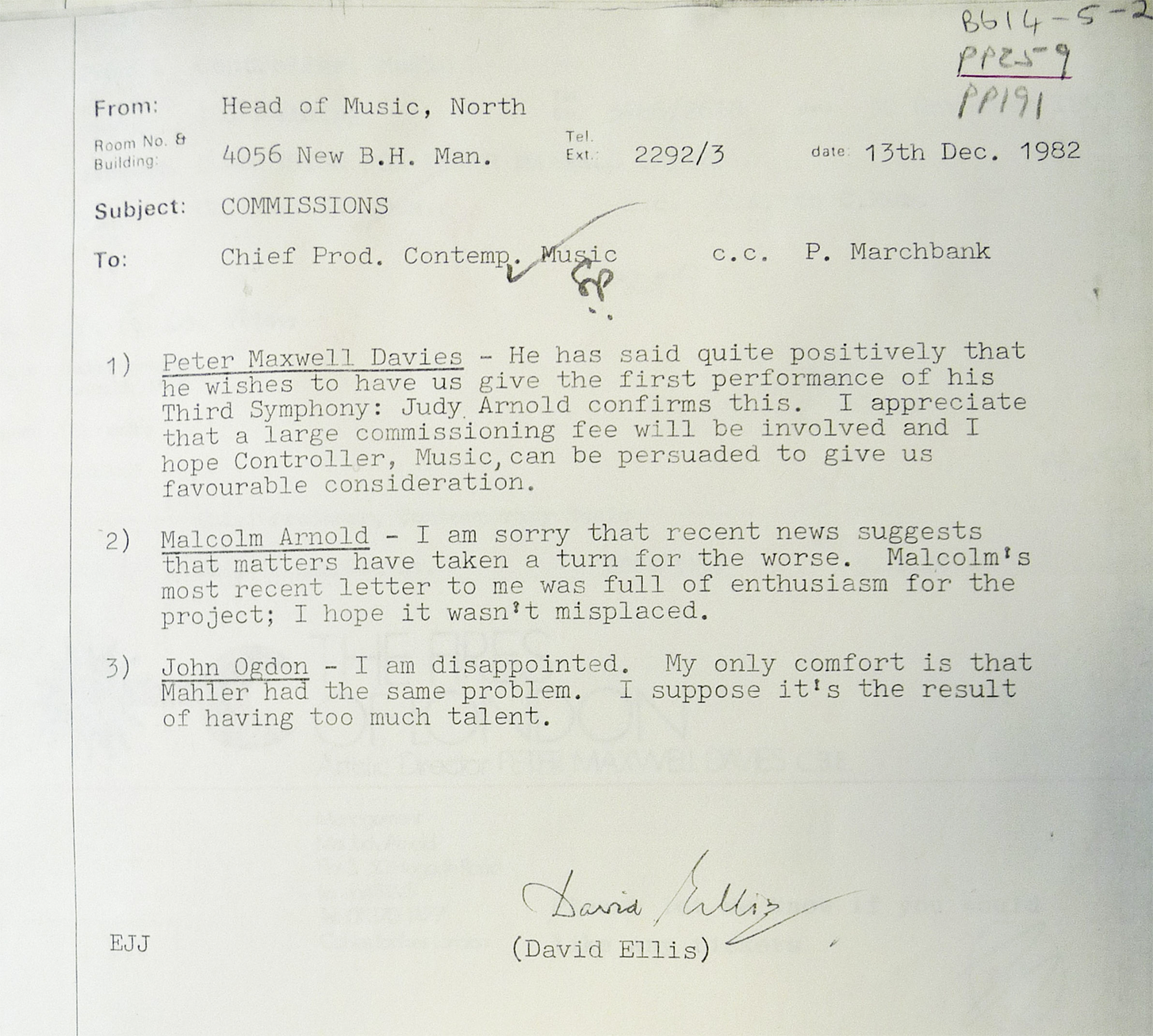
A memo from David Ellis to Stephen Plaistow dated 13 December 1982 already hints at some of the power relationships at play (see Figure 2).Footnote 52 Firstly, it was an honour for the orchestra to give the first performance of this important new work by such an eminent composer; secondly, on top of this kudos or cultural capital, there would be a considerable financial outlay. Ellis was asking Plaistow to put in a good word with Ponsonby, as although Plaistow (and indeed Ellis) had influence, in the end it was Ponsonby’s budget and he who ultimately held the purse strings. From the memo it is also clear that Ellis had already ensured that Maxwell Davies was on side, and that he had taken the precaution of confirming this with Arnold, which implies that she also held considerable sway here. We can add Ellis to the list of ‘film credits’, as well as Peter Marchbank, to whom the memo is copied. Marchbank was the BBC producer with responsibility for the BBC Philharmonic Orchestra and its broadcasting activities, its artistic director to a very great extent. He was nonetheless answerable to Ellis in the BBC hierarchy.
Memo from David Ellis to Stephen Plaistow, 13 December 1982. BBC copyright content reproduced courtesy of the British Broadcasting Corporation. All rights reserved.

Figure 2. Long description
The document is a typewritten memorandum on B B C letterhead.
Header Information:
- From: Head of Music, North
- Room No. and Building: 4056 New B. H. Man.
- Tel. Ext.: 2292/3
- Date: 13th Dec. 1982
- Subject: COMMISSIONS
- To: Chief Prod. Contemp. Music (Stephen Plaistow)
- c.c. P. Marchbank
- Handwritten notes in the top right corner include ‘B 6 1 4 - 5 - 2’, ‘P P 2 5 9’, and ‘P P 1 9 1’.
- A handwritten checkmark and the initials ‘S P’ appear next to the ‘To’ field.
Body Text:
1) Peter Maxwell Davies - He has said quite positively that he wishes to have us give the first performance of his Third Symphony: Judy Arnold confirms this. I appreciate that a large commissioning fee will be involved and I hope Controller, Music, can be persuaded to give us favourable consideration.
2) Malcolm Arnold - I am sorry that recent news suggests that matters have taken a turn for the worse. Malcolm's most recent letter to me was full of enthusiasm for the project; I hope it wasn't misplaced.
3) John Ogdon - I am disappointed. My only comfort is that Mahler had the same problem. I suppose it's the result of having too much talent.
Footer:
- Bottom left: E J J
- Bottom right: A handwritten signature ‘David Ellis’ above the typed name (David Ellis).
Plaistow followed up this memo with a letter, dated 30 December 1983, to Sheila MacCrindle, promotions manager at Chester Music. He wrote:
David Ellis assures me that Max is burning to write his Third Symphony for the BBC Philharmonic, or so Judy Arnold assures him. You and I spoke on the phone. I mentioned the kind of fee Robert Ponsonby has in mind*, and I think you felt that it was not going to be acceptable. In this instance, you and I agreed that Robin Boyle would discuss the fee with Robert personally. Robert awaits his approach.
We should like to settle the details of the commission just as soon as we can. I’ll be most grateful if you can help us make progress over the next few weeks. At the risk of being misunderstood, perhaps I should add that we are not expecting to settle the details of the commission with Judy Arnold!
*£3,000Footnote 53
How could anybody possibly misunderstand Plaistow here? A more explicit nudge and wink could hardly be imagined. This particular musical world had got along very nicely without the interference of agents before now; if agents were there to ‘screw money out of people’, then it would be expedient to keep them out of the picture, as far as possible, and leave the negotiations to known quantities, like Boyle and Ponsonby.
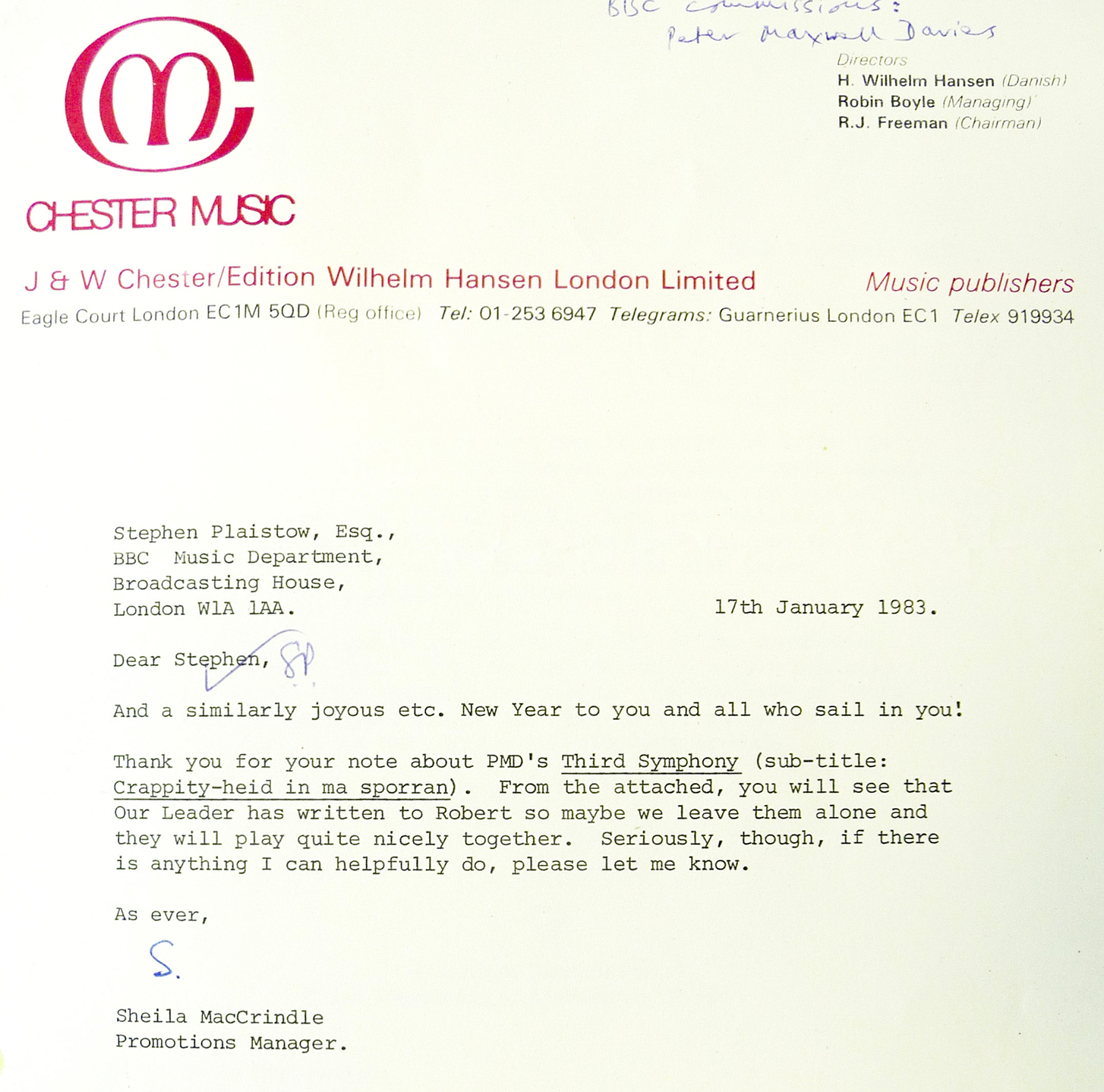
After the Christmas holidays were over, MacCrindle replied to Plaistow in a letter dated 17 January 1983 (see Figure 3).Footnote 54 Her letter, or rather the tone of her letter, conveys a great deal about her relationship with Plaistow, her relationship with her boss and, by implication, Plaistow’s with his, and her relationship with Maxwell Davies. It would appear that MacCrindle and Plaistow have a warm, jokey, relaxed relationship, based on trust and mutual respect. MacCrindle only needs to sign off with the intimate ‘S’ rather than her full name. They both know that it is they who get the actual work done — ‘if there is anything I can helpfully do’ — but they have to pretend to defer to their bosses, who are caricatured firstly as dictators — ‘Our Leader’ — and then as children in a playground. Then there is MacCrindle’s naughty suggested subtitle for Maxwell Davies’s new piece; he had by this time decamped to live on the island of Hoy in Orkney, and made much of this Scottishness-by-association in many of his pieces. This is not to suggest that MacCrindle held Maxwell Davies in anything but the highest regard; as is already apparent, his credentials were beyond doubt, but this affectionate jibe still kept him in his place, at least as far as MacCrindle and Plaistow were concerned.
The next letter from Boyle to Ponsonby, dated 18 January 1983, reads:
I write to you with some trepidation about Max’s 3rd Symphony because I am having to assume that everything Stephen Plaistow said in his letter to Sheila of 30 December [1982] is correct.
The fee I propose would be not less than £3,500. I hope this doesn’t frighten you too much. I shall be grateful if you will let me know what date you have in mind for the first performance.Footnote 55
Letter from Sheila MacCrindle to Stephen Plaistow, 17 January 1983. BBC copyright content reproduced courtesy of the British Broadcasting Corporation. All rights reserved.

Figure 3. Long description
The document is a typed letter on official stationery.
At the top left is a large red circular logo containing a stylized lowercase m and c. To its right, the text reads CHESTER MUSIC in red. Below this is the company name J and W Chester forward slash Edition Wilhelm Hansen London Limited, followed by the address Eagle Court London E C 1 M 5 Q D (Reg office). Contact details include Tel: 01-253 6947, Telegrams: Guarnerius London E C 1, and Telex 919934.
In the top right corner, handwritten blue ink notes mention B B C commissions: Peter Maxwell Davies. Below this, printed text lists Directors: H. Wilhelm Hansen (Danish), Robin Boyle (Managing), and R. J. Freeman (Chairman).
The recipient block on the left reads: Stephen Plaistow, Esq., B B C Music Department, Broadcasting House, London W 1 A 1 A A. The date 17th January 1983 is aligned to the right.
The letter begins with the salutation Dear Stephen, with a handwritten blue checkmark and the initials S P next to it.
The body text reads:
And a similarly joyous etc. New Year to you and all who sail in you!
Thank you for your note about P M D's Third Symphony (sub-title: Crappity-heid in ma sporran). From the attached, you will see that Our Leader has written to Robert so maybe we leave them alone and they will play quite nicely together. Seriously, though, if there is anything I can helpfully do, please let me know.
The closing reads As ever, followed by a large handwritten blue S. The typed name below is Sheila MacCrindle, Promotions Manager.
Boyle suggested that he was writing in ‘trepidation’, but made it clear that he knew exactly what had been written already by Plaistow, and in particular that the BBC had in mind a commission fee of £3,000. Not much trepidation, however, as he came straight out with his revised bid for a fee, although he tempered this with his concern that this proposal might have been frightening. He knew he held the upper hand here, though, as he confidently assumed that Ponsonby and the BBC would cave in and the first performance would go ahead anyway, and that these negotiations were a formality. This is the letter of a man who, in Bourdieu’s term, ‘knows the game’. Sure enough, Ponsonby’s reply, dated 28 January 1983, acceded to Boyle’s demands:
I have made some internal comparisons and have related the proposed fee with the one we paid to Max for The Martyrdom of St. Magnus. Though I understand that the new symphony will be relatively short — about 30 minutes — I think that your proposal of a fee of £3,500 is acceptable to us. We could not, I fear, go higher.Footnote 56
This was a characteristic display of brinkmanship on Ponsonby’s part. He refused to be bested, and made it clear that he had only agreed to the increased fee because it compared to a fee the BBC had already paid to Maxwell Davies for a chamber opera. Boyle had not upped the ante; Ponsonby had held firm to the fee scale the BBC always paid. This fee did not represent an inflation that could be expected to be paid to Maxwell Davies, or any other composer, in the future. Ponsonby then retreated behind the power of the BBC, and resorted to the royal ‘we’. It was not just Ponsonby who could not improve on this offer; no, it was the mighty edifice of the BBC itself that would not be able to increase the fee. Is it fanciful to suppose that this message was reinforced by having his secretary sign the letter in his absence? It was from ‘the office of CMus’ rather than ‘Robert’, as he signed many of his letters. So far, so good. An agreement had been reached, there had been no loss of face, and honour was preserved.
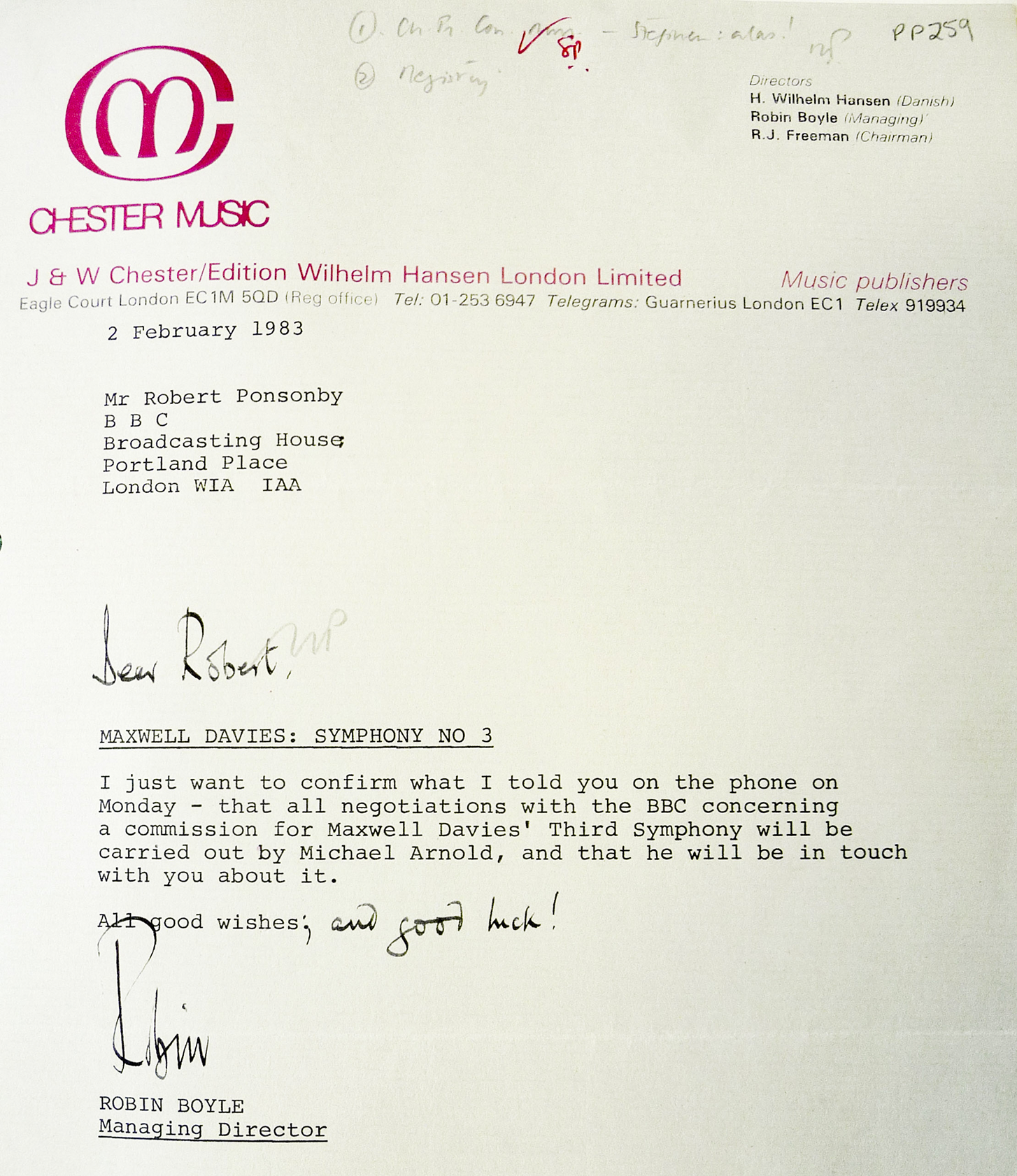
Then came another letter from Boyle to Ponsonby, on the face of it straightforward, businesslike, and to the point (see Figure 4).Footnote 57 It is the handwritten ‘and good luck!’ that reveals a possible subtext here. The letter is direct, and the carbon copy kept in Chester’s files gives nothing away; Boyle’s good luck was for Ponsonby’s eyes only. Ponsonby’s reaction, for Plaistow alone, can be seen by the eagle-eyed in the top right-hand corner, written in pencil: ‘Stephen: alas!’ Ponsonby’s letter agreeing the fee was written on a Friday. By the next Monday Boyle was phoning Ponsonby to tell him that it would be Michael Arnold negotiating the commission. It is not difficult to imagine the train of events: a phone call from Boyle to Judy Arnold to tell her the good news of the increased £3,500 commission fee; a conflab between the Arnolds over the weekend, debating whether this really was good news or not, deciding that it was not, and that they could do better; another call from one of the Arnolds to Boyle to tell him that they will be negotiating on the composer’s behalf and that he had better let Ponsonby know. Was Maxwell Davies involved here? Perhaps the Arnolds spoke to him over that weekend as well. Who knows? Although Maxwell Davies had no phone at his house on Orkney, he would phone Arnold almost every day if he could find a public phone box, according to her memoir.
Letter from Robin Boyle to Robert Ponsonby, 2 February 1983. BBC copyright content reproduced courtesy of the British Broadcasting Corporation. All rights reserved.

Figure 4. Long description
At the top left is a magenta logo consisting of a stylized ‘m’ inside a ‘C’ above the words CHESTER MUSIC. To the right are handwritten notes in pencil and red ink, including ‘P P 2 5 9’. Below the logo, the letterhead lists J & W Chester/Edition Wilhelm Hansen London Limited, Music publishers, with an address at Eagle Court London E C 1 M 5 Q D. The right side lists Directors H. Wilhelm Hansen, Robin Boyle, and R. J. Freeman.
The letter is dated 2 February 1983 and addressed to Mr Robert Ponsonby, B B C, Broadcasting House, Portland Place, London W 1 A 1 A A.
A handwritten salutation reads ‘Dear Robert,’ followed by a typed subject line: MAXWELL DAVIES: SYMPHONY NO 3. The body text states: ‘I just want to confirm what I told you on the phone on Monday - that all negotiations with the B B C concerning a commission for Maxwell Davies’ Third Symphony will be carried out by Michael Arnold, and that he will be in touch with you about it.’
The closing reads ‘All good wishes;’ followed by a handwritten ‘and good luck!’. It is signed ‘Robin’ in ink above the typed name ROBIN BOYLE, Managing Director.
Boyle’s reaction to this put-down can only be imagined. He believed himself to be a ‘built-in entrepreneur […] [doing] whatever I could to advance the interests of “my” composers’.Footnote 58 Here he was, being told that he was incapable of negotiating a deal with the BBC and to leave it to the Arnolds. Sure enough, there was a phone conversation between Michael Arnold and Ponsonby about the fee (the ‘tiresome talk’ of Ponsonby’s original memo above) and a letter from Judy Arnold to Ponsonby, dated 10 February, following it up:
As discussed by Michael over the phone with you the other day, Max would be prepared to accept a commission fee of £5,000 (five thousand pounds) for this work.
I would like to point out to you that this fee is 50% and under of the amount he is accepting for commission fees from other bodies, but nevertheless Max is very keen to write this work for the BBC Philharmonic Orchestra because he was so delighted with their marvellous performance of Symphony No 2 in London last year.Footnote 59
A neat display of managerial prestidigitation, juggling economic and cultural capital, and a first-rate example of ‘screwing money out of people’. Firstly, the BBC will pay not £500 more than the original offer, as Ponsonby previously thought, but £2,000. Even so, that is much less than the going rate for this work.
This part of the negotiation can be interpreted as an example of Bourdieu’s concept of the forms of capital. From the Arnolds’ point of view, the reason they are able to compromise is that the composer appreciates the fine quality of the BBC’s orchestra. This is Bourdieu’s cultural capital, in its institutionalized form, acknowledging the excellence of the orchestra as an institution that is also part of the BBC. Intriguingly, neither party brings up the other institutional benefits that accrue to a composer in accepting a commission from the BBC: the fact that the new work would be broadcast on BBC Radio 3, and thereby reach a far wider audience than would be present in the concert hall, as well as the distinct possibility that it would be taken by the World Service, and also offered to radio stations around the world through the auspices of the European Broadcasting Union.Footnote 60 Perhaps it is not surprising that Arnold would choose to ignore this, but odd that Ponsonby did not play this card; on the other hand, he was an impresario, with a background in orchestral management rather than broadcasting, and there is considerable evidence in the files at the BBC Written Archives Centre and elsewhere that he often neglected the broadcast side of his remit, thinking first and foremost of the work he did at the BBC in terms of the public events in a concert hall.
Arnold’s argument seemed to go as follows: you have an orchestra (institutional cultural capital) and money (economic capital), which we want, and we have a composer (embodied cultural capital), whose music (objectified cultural capital) you want. The question is, given that we have already agreed that our composer and his music are worth more than your orchestra in terms of cultural capital, how much money (economic capital) will make up the balance? You say £3,000, we say £5,000. This was the predicament Ponsonby found himself in, and the stimulus for his memo to Plaistow, which is where this discussion started. The world of the BBC and negotiating commission fees had changed, for the worse as far as Ponsonby and the BBC were concerned. The composer’s agent had appeared on the scene, and in place of gentlemanly agreements between the BBC and publishers, and notional scales of fees agreed internally among BBC staff and accepted — however grudgingly — by composers and their publishers, there would be market forces, international comparisons of fees, and hard bargaining.
In this instance, the agent was in a very strong position: by 1983, Maxwell Davies had already written three big pieces to commissions from the BBC: two orchestral works for the Proms and the opera The Martyrdom of St Magnus. He had also had important commissions for symphonies from the Philharmonia Orchestra in London and the Boston Symphony Orchestra. Under these circumstances, the lure of a BBC commission was not so strong. The BBC’s historically powerful position was largely a result of the cultural capital they could bestow: Bourdieu’s ‘consecration’.
It is tempting when engaging in archival research to speculate on what might appear to be missing material. There is no follow-up letter from Ponsonby to Arnold in Maxwell Davies’s BBC file. There could be several mundane reasons for this: the letter got lost, or was misfiled, or archivists thought it unimportant. Or perhaps the letter never got written, and Ponsonby chose not to concede the outcome of his negotiations in writing. However, the proof of whether these agents really did wield the power in their relationship with the BBC, and whether they could negotiate better deals than the publisher, rests with the fees they were able to get on behalf of their composers. So given that there is no written acknowledgement of an agreed fee from Ponsonby, how much did the BBC pay for Maxwell Davies’s Third Symphony? The answer is in another file at the BBC’s Written Archives Centre: the contract for the commission from the BBC for Maxwell Davies’s Third Symphony tells us £5,000 plus VAT.Footnote 61 Game, set, and match to the Arnolds.
The success of this negotiation was a victory for the composer and his agent over the BBC, and also a threefold blow to the staff at Chester Music. Firstly, their exclusive contract with Maxwell Davies had been renegotiated into a joint agreement with Boosey & Hawkes. Secondly, the negotiation over the commission fee had been hijacked, the Arnolds outperforming them in obtaining a substantially increased fee. Thirdly, after the negotiation was completed, there was a further indignity visited upon Robin Boyle and his staff: according to Arnold:
My idea was always to be fair to both publishers. In deciding who got what, there were many factors to be taken into consideration. I discussed all the factors with Max. One of the works was Symphony No. 3 for the BBC Philharmonic. Max reasoned that as Booseys had had the first two symphonies, they should also get the third. I sent the letters respectively to Tony Fell at Booseys and to Robin Boyle at Chester Music. Robin Boyle responded very angrily and asked for a meeting. I was too scarred [sic] of Robin to go to that meeting myself, and Michael went on my behalf. Robin’s rage at not getting the symphony knew no bounds, and he climbed on the table, and screamed at Michael for a prolonged time. But he finally calmed down and, most reluctantly, accepted the situation. Passions run high in the publishing world.Footnote 62
Whether the suave and urbane Boyle actually climbed on the table and screamed is perhaps open to question; it may be that this hyperbole casts doubt on everything in Arnold’s memoir, but, exaggerated or not, it is her perception of events that matters here, rather than impartial reporting. In Potter and Wetherell’s terms, this is one contribution to the creation of the discourse of this narrative, and even if Arnold was overstating the case, Boyle and the staff at Chester Music must have been hugely disappointed (at the very least) that Maxwell Davies’s Third Symphony had slipped through their fingers in this way.
Conclusion
With reference to the initial questions posed, this account of the commission for Maxwell Davies and his Third Symphony, told from a variety of sometimes contradictory perspectives, demonstrates a number of changes in the world of commissioning new music in the early 1980s; it also casts light on much wider issues of power relations in the music business and the institutionalization of creative individuals in the cultural industries. The changes manifested are threefold: firstly, the balance of power between a composer and the BBC could shift dramatically. The cultural capital that a BBC commission could bestow, the ‘consecration’ in Bourdieu’s terms, or ‘the ultimate validation for a composer’, as Sally Groves described a BBC commission for the Proms, lost its value when it no longer had significant meaning to a composer.Footnote 63 In the equation ‘money + cultural capital = value to the composer’, as the cultural capital became less valuable, then the financial element had to be topped up to keep the scales in balance. Although there is a dominant narrative surrounding the composition of serious art music that suggests that the composer is the sole creative individual, and that the network surrounding that individual is there to support whatever creative endeavours he or she wishes to pursue, there is plenty of evidence to indicate an alternative narrative in which that network is far more influential in the creation of new music.Footnote 64 Although there is no direct correlation between the activities of Maxwell Davies’s agent, publisher, or commissioner on the composition of his Third Symphony, nonetheless the present article reinforces the argument that the composer is by no means a lone creative genius ensconced in their ivory tower (or even on the island of Hoy), and that Maxwell Davies’s score is just one contribution, albeit a key one, in the discourse creating his Third Symphony.
Secondly, adding the agent into the mix helped to give the composer more power, the additional element in terms of Goethe’s Elective Affinities. Judy and Michael Arnold recognized this and were perfectly placed to ‘screw money’ on behalf of their client, a talent that would not be lost on Maxwell Davies’s composer colleagues. This was Abbing’s ‘commercial turn’ of the 1980s as it applied to the world of new music and its commissioning. The power dynamic between composer and patron has been explored more thoroughly in regard to earlier eras than the late twentieth century, and defining the role of the BBC as patron is a complex issue, but this demonstration of the adjustment in the power balance between a composer, their publisher, and the BBC goes some way towards identifying a hierarchy operating in this arm of the music industry and interrogating both its permanence and its adaptability.Footnote 65
As well as securing a significantly enhanced commission fee from the BBC, in pitting two publishers against each other, the agent could negotiate terms that were far more beneficial to their client — and, by association, to themselves — and could rebalance the power dynamic in favour of the composer. In terms of institutionalization, this relationship of composer and publisher is much longer lasting than the negotiation of a one-off commissioning fee, and the long-term consequences of Maxwell Davies and his music moving from an exclusive contract with Boosey & Hawkes to a joint arrangement with Chester Music were perhaps the most significant outcome of his agent’s intervention. While Hanne Wilhelm Hansen’s commando-style raid on behalf of Chester Music might be seen as pure commercial opportunism, it was a recognition of Maxwell Davies’s cultural capital that prompted her intervention, and the dissatisfaction of Arnold with her composer’s treatment at Boosey & Hawkes that enabled it. Whether or not the finger of complacency could be pointed at Boosey & Hawkes, or indeed at Chester Music for allowing the rights to the Third Symphony to escape their grasp, a major composer’s desertion of one publisher for another would have been a wake-up call to every publisher of new music. Boosey & Hawkes were quick to recognize their mistake, and to clear the backlog of Maxwell Davies’s works.
Furthermore, the presence of an agent acting on the composer’s behalf in fee negotiation radically altered that three-way conversation. Before the intervention of the Arnolds, the exchanges between Ponsonby and Plaistow at the BBC and Boyle and MacCrindle at Chester Music were affable, even when discussing a modest increase in the commissioning fee for Maxwell Davies’s symphony. These were well-established relationships, and negotiations took place within parameters that were understood on both sides. Conversation was conducted at the high table, and the composer, who was not directly involved and certainly not present, was expected to accept the outcome, for good or ill. The agent was a rather less well-mannered interloper crashing this party, with their own agenda which did not necessarily respect the conventional niceties established by those institutional figures with their comfortable offices and salaries. These modifications in hierarchies and power dynamics apply to many organizations operating in the cultural industries, and, to develop Becker’s approach in Art Worlds, a similar methodology could be applied fruitfully to the worlds of fine art, theatre, and literature, and to other genres in the media, including drama and comedy, as well as to other areas of music composition and performance.
Thirdly, it is also a clear example of Bourdieu’s forms of capital in action, with the BBC’s economic capital in the shape of the commission fee and institutional cultural capital in the BBC Philharmonic Orchestra. The further institutional cultural capital of the BBC, the bestowal of prestige or consecration, had become less valuable in Maxwell Davies’s eyes, given his burgeoning international reputation and the lucrative fees he could attract elsewhere. That Ponsonby did nothing to leverage the institutional cultural capital of the BBC as an international broadcaster is perhaps not as surprising as it might be, because, as explained above, he hardly recognized it himself. The embodied cultural capital of Maxwell Davies as a composer, with his accumulation of education, experience, and individual prestige, along with the objectified cultural capital of the symphony he was able to write, had in this case become more valuable than the BBC’s institutional cultural capital, hence the increase in the economic capital, the commission fee.
The dynamics between the networks imagined in Becker’s ‘film credits’ had altered: in Vincent Mosco’s definition of political economy, ‘the social relations, particularly the power relations, that mutually constitute the production, distribution, and consumption of resources’ had shifted, and although it is tempting to think it was Maxwell Davies’s Third Symphony which had been central to that shift, the objectified capital of that single work was only one element in the network of people and things surrounding the composer.Footnote 66 In the wake of the adventures of Maxwell Davies and Judy Arnold, some composers decided that they were happy with the status quo, and continued to trust their publishers to find commissions and negotiate fees; some found agents working as part of the big agencies (as did Maxwell Davies, after the debacle with Michael Arnold’s fraud); and others followed Maxwell Davies’s lead in working with a sole agent or manager. It was the addition of the composer’s agent in Becker’s network which upset a delicately balanced ecology, and it was the agent that was instrumental in shifting the balance of power within that ecosystem.