Introduction
Termites are among the most abundant arthropods in tropical ecosystems that provide essential ecosystem services (e.g. Ashton et al. Reference Ashton, Griffiths, Parr, Evans, Didham, Hasan, Teh, Tin, Vairappan and Eggleton2019, Pringle et al. Reference Pringle, Doak, Brody, Jocque and Palmer2010). In lowland tropical ecosystems, they are the most important animals decomposing dead plant material, which can make up 95% of the soil insect biomass (Eggleton et al. Reference Eggleton, Bignell, Sands, Mawdsley, Lawton, Wood and Bignell1996). In dry tropical forests, they consume between 40% and 100% of the dead wood and in savannahs up to 20% of the grass and leaf litters (Collins Reference Collins1981). Termites are also essential with regard to the structure, functioning and dynamics of tropical ecosystems (Whitford Reference Whitford1991). Their mounds and their foraging activities have strong effects on soil structure, nutrient cycles (Lavelle et al. Reference Lavelle, Bignell, Lepage, Wolters, Roger, Ineson, Heal and Dhillion1997) and soil chemical composition (Holt & Lepage Reference Holt, Lepage, Abe, Bignell and Higashi2000). They contribute to improve the water retention of soils that strongly affects vegetation structure and local primary productivity (e.g., Evans et al. Reference Evans, Dawes, Ward and Lo2011, Nash & Whitford Reference Nash and Whitford1995). In addition, as litter decomposers, they provide material for microbial attack, which fosters mineralization processes (Chapin et al. Reference Chapin, Matson and Mooney2002). Yet, termites are also sensitive to disturbance. Their species richness, abundance and composition changes with anthropogenic disturbance, as do feeding type composition and community structuring mechanisms (Alves et al. Reference Alves, Mota, Lima, Bellezoni and Vasconcellos2010, Attignon et al. Reference Attignon, Lachat, Sinsin, Nagel and Peveling2005, Bandeira et al. Reference Bandeira, Vasconcellos, Silva and Constantino2003, Eggleton et al. Reference Eggleton, Bignell, Sands, Waite, Wood and Lawton1995, Jones et al. Reference Jones, Susilo, Bignell, Hardiwinoto, Gillison and Eggleton2003, Vasconcellos et al. Reference Vasconcellos, Adelmar, Flavia, Virgınia, Maria Avany and Reginaldo2009, for West-African savannahs: Hausberger & Korb Reference Hausberger and Korb2015, Reference Hausberger and Korb2016, Schyra & Korb Reference Schyra and Korb2019, Schyra et al. Reference Schyra, Gbenyedji and Korb2019a). Due to these important roles and their sensitivity to habitat disturbance, termites are considered to be good bioindicators of tropical ecosystem health (Pribadi et al. Reference Pribadi, Raffiudin and Harahap2011).
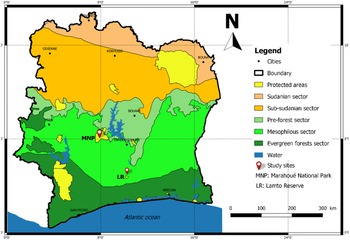
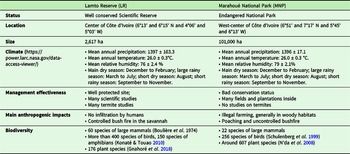
Protected areas are important for biodiversity conservation, especially given the strong human pressure on nature. The Convention for Biological Diversity encourages countries to increase their terrestrial protected area to 17% of a country’s surface and to manage them in order to ensure permanent ecosystem services. In Côte d’Ivoire, only about 6% of the national territory has been put under strict protection. These 6% are divided into 16 national parks and reserves. The Marahoué National Park (MNP) is one of the most important parks in Côte d’Ivoire because it is located in the transition zone between forest and savannah. Therefore, it comprises both savannah and forest ecosystems and their biodiversity, including endemic species restricted to this transitional zone. During the last decades, the MNP suffered from illegal settlements and activities such as farming, tree cutting, cattle grazing and poaching (see Supplementary Material Figure S1). It lost several hectares of forest cover and natural habitat to the benefit of plantations. While the MNP’s natural habitats are being destroyed, its biodiversity is expected to disappear. To test this hypothesis, we studied termite communities and compared them with those of a better-protected area located in the same phytogeographical zone (i.e., the Guinean zone) in Côte d’Ivoire, the Lamto Reserve (LR). The LR is a relatively small, strictly protected area (Figure 1, Table 1).
Map of Côte d’Ivoire showing the different phytogeographical zones and study sites. The red points LR (Lamto Reserve) and MNP (Marahoué National Park) indicate the study sites.

Description of study sites located in the forest savannah mosaic of the Guinean biome in Côte d’Ivoire

Our study aimed at evaluating the impact of anthropogenic pressure on ecosystems and their biodiversity by using the MNP and the LR as a case example and termites as target organisms. To this end, we (i) sampled termites and determined species identity of termite communities in both areas, (ii) compared estimated species richness and abundance across four habitats between study sites and (iii) identified termite feeding types to characterize their functional role. We analyzed our data set to reveal species, which could serve as bioindicators of ecosystem health and discuss expected long-term consequences of anthropogenic disturbance on ecosystem services provided by termites. This study is the first systematic assessment of termites from the MNP.
Materials and methods
Study sites
The study was done in the LR and the MNP (for details see Table 1). Within each study site (MNP and LR), four homologous plots of 2.5 hectares each were selected, in which the termite communities were studied: Forest Islands (FI), Woodland Savannahs (WS), Shrub Savannahs (SS) and Grass Savannahs (GS).
Sampling design
Sampling in both study sites was done following the standardized belt transect protocol, first developed for sampling termites in forests (Jones & Eggleton Reference Jones and Eggleton2000) and then adapted to savannahs (Dosso et al. Reference Dosso, Konaté, Aïdara and Linsenmair2010, Hausberger et al. Reference Hausberger, Kimpel, Van and Korb2011). In each plot, five transects were established. Each transect was 100 m long and 2 m wide and divided into 20 sections of 5 m × 2 m. The sampling consisted of a thorough search of dead plant material on the ground, on and in trees and mounds as well as soil sampling to assess termite diversity (Jones & Eggleton Reference Jones and Eggleton2000). Each transect section was systematically searched by four trained people for termites. The search time per transect section was in total 10 and 15 minutes for savannah and forest, respectively. Forests have higher termite abundances, which therefore require more effort than savannahs (Hausberger et al. Reference Hausberger, Kimpel, Van and Korb2011). Additionally, 12 soil scrapes of 12 cm × 12 cm × 10 cm were done and searched per transect section. Whenever we found/encountered termites during the search within a transect section, this was treated as a single sample as it consisted of conspecific foraging individuals, probably nestmates from the same colony. Then a few specimens (5–10 individuals) were collected in a vial; priority was given to soldiers as they were easier to identify. The sampled termites were stored in 97% alcohol for identification. Then, we continued searching within the same section and when we encountered termites again, they were placed in a separate vial. Within a single section, the presence of a species represents one encounter regardless of how often it was encountered within this section. This means that there could be a maximum of 20 encounters (corresponding to the 20 sections) of a species per transect. Total encounter of each termite species in each given transect or habitat was used as a surrogate for abundance (Davies et al. Reference Davies, Hernández, Eggleton, Didham, Fagan and Winchester2003).
Identification of termites
Termites were identified to morpho-species level using individuals of the soldier caste, a low-power stereo microscope with a reticle (Leica MZ6) and identification keys (Bouillon & Mathot Reference Bouillon and Mathot1965, Webb Reference Webb1961), including region-specific illustrations and keys (Josens Reference Josens1972, Konaté Reference Konaté1998).
For soldierless species, identification was mainly based on workers’ gut structure, especially the armature of the enteric valves, which can provide species-specific information (Sands Reference Sands1998). Enteric valves were dissected by excising the second proctodeal segment.
After identification, all termite species were classified into four feeding types according to Dosso et al. (Reference Dosso, Yéo, Konaté and Linsenmair2012, Reference Dosso, Deligne, Yéo, Konaté and Linsenmair2013) and Koné et al. (Reference Koné, Silué, Konaté and Linsenmair2018), namely (1) fungus growers, Macrotermitinae, species which live in an obligate exosymbiosis with fungi of the genus Termitomyces (Lyophillaceae family); (2) wood feeders, which consume dead wood; (3) grass feeders, which thrive on grass and (4) soil feeders, which feed on soil organic matter and very decayed wood.
Data analyses
Termite sampling efficiency was evaluated by analyzing the sampling coverage for each habitat. Sampling coverage is the percentage of the cumulative number of observed species (Sob) in relation to the cumulative number of estimated species (Chao2 mean). It was calculated with EstimateS 8.0.0 (Robert K. Colwell, Department of Ecology & Evolutionary Biology, University of Connecticut, Storrs, CT 06869-3043, USA; Website: http://purl.oclc.org/estimates) using 500 randomizations (Cao et al. Reference Cao, Williams and Larsen2002). Chao2 mean is a non-parametric estimator used to estimate species richness for incidence data (present = 1/absent = 0). We used the calculated sampling coverage to compare the sampling effort for each plot. For each plot, each single transect was considered one sampling unit for the inference tests (N = 5 per plot; each plot characterizes one habitat type at a study site). Species richness was calculated as the total number of termite species in a community, which can be (i) a transect, (ii) a plot consisting of five transects that represent a habitat or (iii) a study site, which is either the MNP or the LR. Species abundance is the total number of termite encounters per species within a community. In the present study, we considered a species as common within a study site if it was encountered at least 20 times within a plot representing a habitat (maximum possible encounters: 5 transects × 20 sections = 100).
Inference statistics at the 5% significance level were used to test for significant differences between the study sites with R version 4.0.2 (R Core Team 2016). After testing for normality and homogeneity of variances, we used parametric or non-parametric tests, accordingly. As the same data set was analyzed repeatedly, we used the false discovery rate approach (Benjamini & Hochberg Reference Benjamini and Hochberg1995) to correct for multiple testing.
Results
Sampling efficiency
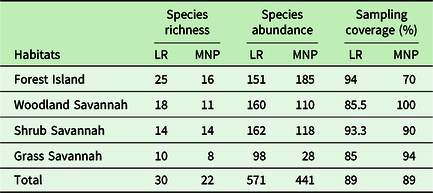
For the LR, we had a mean sampling coverage of 89% with the highest values in FI (94%) and SS (93%). Sampling coverage was lower for WS (86%) and the GS (85%). In the MNP, we also reached a mean sampling coverage overall plots of 89% with the highest value (100%) recorded for the WS and the smallest value (70%) for the FI (Table 2). In the GS and SS, sampling coverage accounted to 94% and 90%, respectively.
Termite species richness, abundance and sampling coverage for both study sites, separated by habitat

Termite species richness: total number of termite species in each habitat; Species abundance: the total number of encounters in each habitat; Sampling coverage: proportion (in %) of the cumulative number of observed species in relation to the cumulative number of estimated species (Chao2 mean) for each habitat. LR (Lamto Reserve) and MNP (Marahoué National Park) were the study sites.
Taxonomic comparison across both study sites, covering all habitats
In the LR, 30 termite species belonging to two families (Termitidae and Rhinotermitidae) and 21 genera were recorded (see Supplementary Material Table S1). Species from five subfamilies of the Termitidae were collected: Macrotermitinae (12 species), Termitinae (six species), Nasutitermitinae (five species), Cubitermitinae (two species) and Apicotermitinae (three species). For the Rhinotermitidae, only one species was found for each of the two encountered subfamilies, Coptotermitinae and Rhinotermitinae.
In the MNP, 22 termite species from 14 genera were collected and all belonged to five subfamilies of the Termitidae: Macrotermitinae (11 species), Termitinae (three species), Nasutitermitinae (five species), Apicotermitinae (two species) and Cubitermitinae (one species) (Table S1).
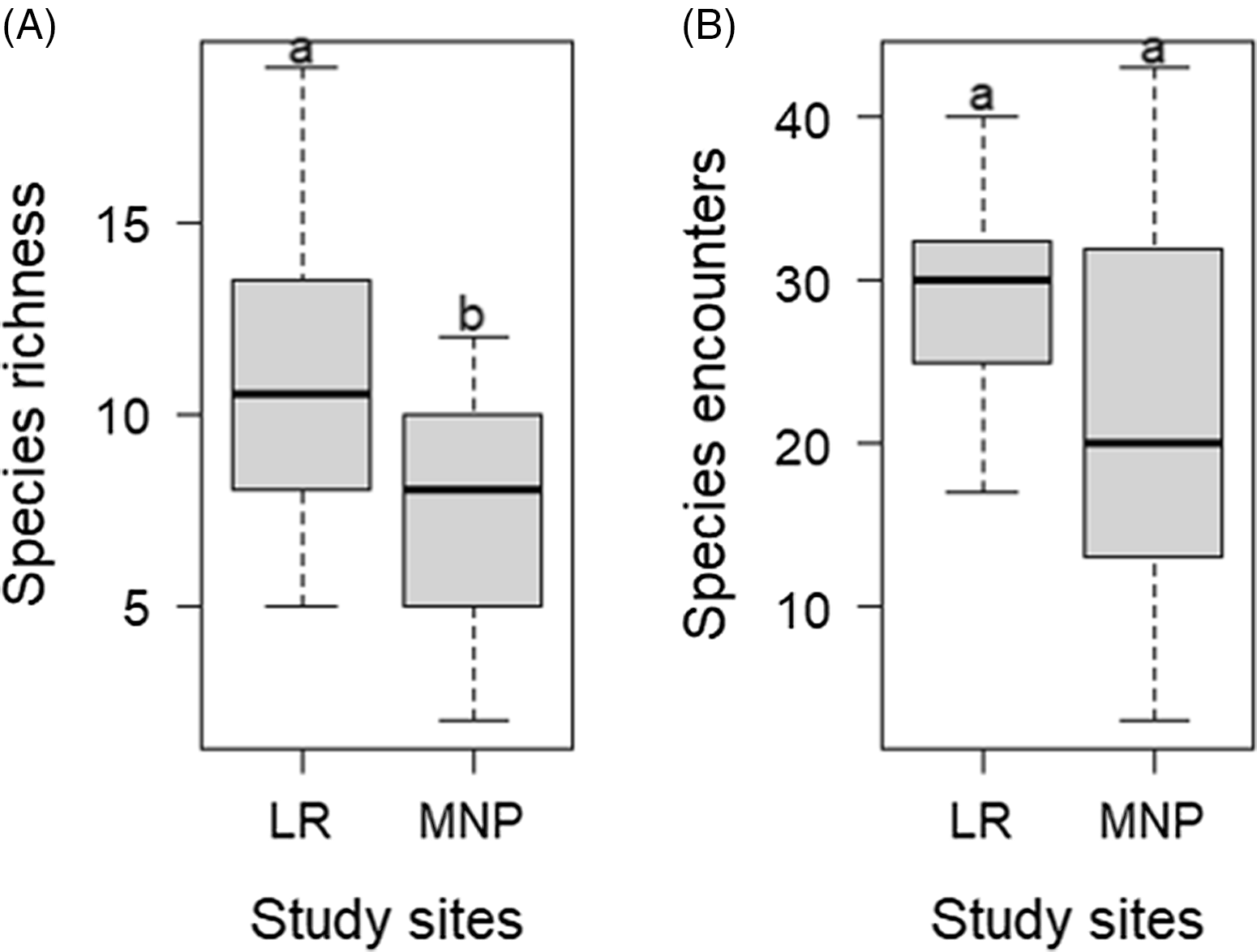
Across both study sites, we collected 21 termite genera, all being present in the LR, but only 14 genera were found in the MNP. In total, we identified 37 termite species in our study. Fifteen out of the 37 termite species were common to both study sites, and also 15 species were found in the LR only and not in the MNP. The remaining seven species were discovered only in the MNP. Using transects as replicates, over all habitats, termite species richness was significantly higher in the LR than the MNP (Wilcoxon test: N = 40, W = 295, p = 0.010) (Figure 2A).
Comparison of (A) termite species richness and (B) termite encounters between both study sites, the LR (Lamto Reserve) and the MNP (Marahoué National Park). Shown are boxplots with the quartiles, median (bold line) and whiskers representing the minimum value and the maximum value. Different letters within graphs indicate significant differences at P < 0.05 level (Wilcoxon test, N = 40).

In total, there were 571 encounters of termites in the LR and 441 in the MNP. Using transects as replicates, across all habitats, the number of termite encounters did not differ significantly between both study sites, though there was a trend for more encounters in the LR than the MNP (Wilcoxon test: N = 40, W = 267, p = 0.071) (Figure 2B). Species of all four feeding groups (fungus growers, wood feeders, grass feeders and soil feeders) were recorded in both study sites.
Habitat-specific comparisons between study sites
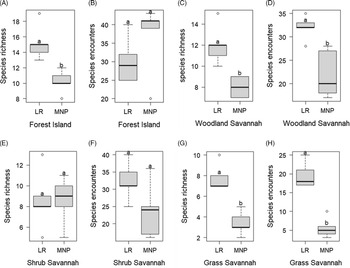
In both study sites, we investigated four different habitats using ‘homologous’ plots with five transects each as replicates (e.g. termite species richness and abundance in the FIs of the LR compared to those of FIs in the MNP). In FIs, there were significantly more species in the LR than the MNP (Wilcoxon test: N = 10 W = 25, p = 0.010) (Figure 3A), while species encounters did not differ significantly (Wilcoxon test: N = 10, W = 6, p = 0.207) (Figure 3B). In total, the cumulative species richness in the FIs of the LR was 25 species compared to 16 species for the MNP, while total encounters were 151 versus 185 for the LR and the MNP, respectively (Table 2).
Comparison of the termite species richness and termite encounters between both study sites, the LR (Lamto Reserve) and the MNP (Marahoué National Park) separated by habitat types. (A) Richness in forest islands, (B) encounters in forest islands, (C) richness in woodland savannah, (D) encounters in woodland savannah, (E) richness in SS, (F) encounters in shrub savannah, (G) richness between grass savannah, and (H) encounters in grass savannah. Shown are boxplots with the quartiles, median (bold line) and whiskers representing the minimum value and the maximum value. Different letters on or under the boxplots within graphs indicate significant differences at P < 0.05 level (Wilcoxon test, N = 10), are outliers, defined as data that fall not within the whiskers.

In the WSs, species richness and encounters were significantly higher in the LR than in the MNP (Wilcoxon test: richness: N = 10, W = 25, p = 0.011; encounters: N = 10, W = 24.5, p = 0.015) (Figure 3C, D). The cumulative species richness and encounters in the WS of the LR were 18 species in 160 encounters and for the MNP, 11 species in 110 encounters (Table 2).
For the SSs, both species richness and encounters did not differ significantly between the LR and the MNP (Wilcoxon test: richness: N = 10, W = 11, p = 0.832; encounters: N = 10, W = 11, p = 0.115) (Figure 3E, F). In the SS of the LR, we found in total 14 species in 162 encounters compared to 14 species also in 118 encounters in the MNP.
For the GSs, species richness and encounters were significantly higher in the LR than in the MNP (Wilcoxon test: richness: N = 10, W = 25, p = 0.010; encounters: N = 10, W = 25, p = 0.011) (Figure 3G, H). The cumulative species richness was 10 species and 98 encounters in the LR and 8 species and 28 encounters in the MNP.
Comparison of feeding type frequencies between both study sites
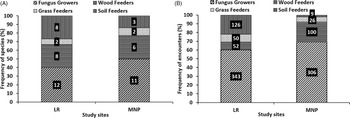
Comparing the frequencies of feeding types between both study sites across all habitats, the number of species with different feeding types did not differ significantly between sites (Fisher’s Exact test: p = 0.704; Figure 4A), while encounters of different feeding types differed significantly (chi2 = 111.38, N = 8, df = 3, p < 0.001). In the LR, there were relatively more encounters with soil feeders while the proportion of wood feeders, and partly fungus growers were reduced (Figure 4B).
Comparison of feeding type frequencies at (A) species level and (B) encounter level between both study sites, the LR (Lamto Reserve) and the MNP (Marahoué National Park). Shown are the numbers of species/encounters of different feeding types (numbers inside bar) and their relative frequencies (y-axis). Fungus growers: black diagonal stripes in bold; wood feeders: black horizontal stripes in bold; grass feeders: black dotted, and soil feeders: black vertical stripes in bold.

The most common termite species in the LR belonged to the fungus growers (Ancistrotermes cavithorax, Microtermes sp.2, Pseudacanthotermes militaris) and the soil feeders (Adaiphrotermes sp., Aderitotermes sp., Basidentitermes sp.) (Table S1). In the MNP, the most common termite species were wood feeders (Microcerotermes sp.1), grass feeders (Trinervitermes geminatus) and several fungus growers (Microtermes sp.1, Microtermes sp.2, Odontotermes sp.3, Pseudocanthotermes spiniger, Ancistrotermes guineensis and Ancistrotermes cavithorax) (Table S1). Microtermes sp.2 and Ancistrotermes cavithorax were found across all plots in both sites. Soil feeders were not common in the MNP (Table S1).
Discussion
The objective of this study was to compare two protected areas with a diverse range of habitats that differ in management effectiveness so that one, the LR, is very well protected, while the other, the MNP, is strongly impacted by human disturbance (see also Supplementary Material Figure S1). We assessed effects on termite communities as they are fundamental components of these habitats that provide essential ecosystem services. Our results showed that overall the less-well protected MNP had significantly fewer termite species within a standardized study unit (i.e., a transect) than the well protected LR (Figure 2). This applied to all habitats, except the SS (Figure 3). Termite abundance, measured as termite encounters per study unit/transect, was also often significantly lower in the MNP than in the LR (Figure 3). Additionally, the abundance of soil feeders, indicators of ecosystem health in woody habitats, was significantly lower in the MNP than the LR. All these results support the notion that the MNP is a less-well protected area and that this lack of efficient protection has ecosystem consequences.
We obtained high values of sampling coverage (70–100%). This can be explained by our increased sampling effort, as we investigated five transects per plot rather than one, suggested by Jones & Eggleton (Reference Jones and Eggleton2000). Similarly, Dosso et al. (Reference Dosso, Konaté, Aïdara and Linsenmair2010) and Koné et al. (Reference Koné, Silué, Konaté and Linsenmair2018) achieved high sampling coverage with five transects. This extensive sampling effort ensured high data quality.
A potential weakness of our study concerns the lack of longitudinal data. Assessing the same area repeatedly can provide more direct estimates of changes of diversity over time and its causes, especially when combined with measures of the effectiveness of park management than a cross-sectional snapshot study that we did. Unfortunately, a longitudinal study was impossible as our study was the first assessment of termite diversity in the MNP and very generally, one of very few systematic diversity studies in the MNP. Thus, we had to rely on a cross-sectional design using a better-protected area from the same biome and with similar environmental conditions as a reference. The LR is the best available reference and if anything, we would expect as a null hypothesis lower diversity in the LR than the MNP because of the smaller size and the lower legal status in the former (Table 1). However, repeated monitoring over longer time periods is advisable to follow the development of the MNP.
Termite communities, anthropogenic disturbance and bioindicators of ecosystem health
Termites have been proposed for use as bioindicators of habitat quality in monitoring programs of tropical ecosystems due to their sensibility to anthropogenic disturbance (Pribadi et al. Reference Pribadi, Raffiudin and Harahap2011). In tropical forests, soil feeding termites have been identified as the most sensitive group to anthropogenic disturbance (e.g. Davies Reference Davies2002, Eggleton et al. Reference Eggleton, Bignell, Hauser, Dibog, Norgrove and Madong2002). In African savannahs, strong anthropogenic disturbance is considered as an environmental filter that selects for a subset of termite species, which are generally well-known pests of crops (Schyra & Korb Reference Schyra and Korb2019; Schyra et al. Reference Schyra, Gbenyedji and Korb2019a). In addition, even slight disturbance seems to affect the processes of termite community assembly in African savannahs (Hausberger & Korb Reference Hausberger and Korb2015, Reference Hausberger and Korb2016).
Also in the current study, we found a decline in the encounters of soil feeders in the less-well protected MNP compared to the LR, while the species richness of different feeding types was not significantly affected. Fungus-growing termites seemed to be equally abundant in both sites, where they made up the highest proportion of all feeding types (≥40 % of the species, >60 % of all encounters) (Figure 4). This is similar to previous studies in savannahs (Hausberger et al. Reference Hausberger, Kimpel, Van and Korb2011, Hausberger & Korb Reference Hausberger and Korb2015, Reference Hausberger and Korb2016, Muvengwi et al. Reference Muvengwi, Mbibal, Ndagurwa, Nyamadzawo and Nhokovedzo2017, Schyra et al. Reference Schyra, Gbenyedji and Korb2019a, 2019b). A reason for the ecological success of fungus-growing termites seems to lie in their ectosymbiotic mutualistic relationship with fungi of the genus Termitomyces (Wood & Johnson 1978, Nobré et al. Reference Nobré, Lefèvre, Aanen, Bignell, Roisin and Lo2011, Korb Reference Korb, Schultz, Peregrine and Gawne2022). This symbiosis seems to give fungus-growing termites an advantage especially in drier ecosystems, although the symbiotic interaction can also come with costs limiting the distribution of the termites (Korb et al. Reference Korb, Silué and Koné2020, Korb Reference Korb, Schultz, Peregrine and Gawne2022). At the species level, however, some fungus growers seemed to be strongly affected by disturbance (Table S1). Macrotermes bellicosus and Macrotermes subhyalinus as well as Pseudacanthotermes militaris, Ancistrotermes crucifer and Odontotermes sp.1 only occurred in the LR. Thus, these species (except for Odontotermes sp.1, which is ambiguous to identify) could serve as good bioindicators of ecosystem health, especially as they are among the few termite species, which can be easily and unambiguously identified (Korb et al. Reference Korb, Kasseney, Cakpo, Casalla Daza, Gbenyedji, Ilboudo, Josens, Koné, Meusemann, Ndiaye, Okweche, Poulsen, Roisin and Sankara2019). Comparisons with other regions are difficult because of problems in species identification, especially for fungus-growing termites that lack gut characteristics, which are useful to determine soil-feeding termites to species level (Korb et al. Reference Korb, Kasseney, Cakpo, Casalla Daza, Gbenyedji, Ilboudo, Josens, Koné, Meusemann, Ndiaye, Okweche, Poulsen, Roisin and Sankara2019). In line with our results for Côte d’Ivoire, Macrotermes bellicosus is also extremely rare in disturbed areas in northern Benin and northern Togo, though this is only partly apparent from the published studies, which specifically aimed to include plots with this important mound-building species (Hausberger & Korb Reference Hausberger and Korb2015, Reference Hausberger and Korb2016; Schyra & Korb Reference Schyra and Korb2019, Schyra et al. Reference Schyra, Gbenyedji and Korb2019a, 2019b). Pseudacanthotermes militaris and Ancistrotermes crucifer have not been recorded in the northern regions, while Macrotermes subhyalinus becomes more dominant there and is also found in disturbed areas (Hausberger & Korb Reference Hausberger and Korb2015, Reference Hausberger and Korb2016; Schyra & Korb Reference Schyra and Korb2019, Schyra et al. Reference Schyra, Gbenyedji and Korb2019a, 2019b). This implies a need for region-specific bioindicators, although Macrotermes bellicosus might be a suitable indicator species of ecosystem health across West-African savannah biomes. This is good news as this mound-building species is easy to identify. The rarity/absence of Macrotermes bellicosus in anthropogenically disturbed areas seems less related to a strong sensitivity of this species to disturbance as it can be commonly found in cities or villages when protected. Its absence seems to be rather due to the utilisation of Macrotermes bellicosus and its mounds by humans as chicken feed, for construction, for traditional medicine and/or for fetishes (Van Huis Reference Van Huis2017).
Potential consequences of disturbance for ecosystem services provided by termites
The occurrence of different termite species in an area is partly dependent on vegetation and on the availability of the food they feed upon. Accordingly, grass-feeding specialists like Trinervitermes are most abundant in GSs but absent in forests (Schyra et al. Reference Schyra, Gbenyedji and Korb2019a). In line, wood-feeding termites were relatively more abundant in the MNP where more wood was available due to logging than in the LR. However, many savannah termites, like the fungus-growing species, are non-specialists that feed on a broad variety of dead plant material (da Costa et al. 2019 and references therein). They seem to replace each other depending on anthropogenic disturbance with some species being more resilient than others (Table S1). Thus, we do not expect a huge impact of anthropogenic disturbance on ecosystem services like decomposition of dead plant material or water retention capacity of soils (all these termites’ tunnel within soils) if their abundance does not drop too drastically with strong disturbance. The latter is, however, often the case in modern agricultural fields (Schyra & Korb Reference Schyra and Korb2019) (and in some habitats also in the MNP; Figure 3) with negative consequences for soil quality and problems of erosion (Vanacker et al. Reference Vanacker, Bellin, Molina and Kubik2014). Yet traditional methods can overcome these problems, like the Zai system, a tradional West-African technique, in which termites are purposefully lured into degraded soil by deposition of dead plant material to improve its quality (e.g., Fatondji et al. Reference Fatondji, Martius, Zougmore, Vlek, Bielders and Koala2009). Severe negative consequences, even with lower levels of disturbance as in the MNP, might however occur with regard to other ecosystem services that termites provide. Soil mineralization processes might be retarded due to the decline of soil feeders. Furthermore, the lack of mound-building Macrotermes bellicosus colonies is expected to have severe consequences. Such mounds create habitat heterogeneity and provide special microhabitats, which are essential for the occurrence and the long-term stable co-existence of a broad range of species, ranging from plants and other arthropods to amphibian, reptiles and mammals (e.g. Pringle et al. Reference Pringle, Doak, Brody, Jocque and Palmer2010). Thus, strong emphasis should be placed in protecting the MNP to guarantee its long-term ecosystem services and biodiversity.
Conclusion
Our study illustrates the impact that less effective park management can have on a fundamental group of tropical organisms, the termites. It identifies suitable bioindicator species of ecosystem health for West-African savannahs and outlines the consequences of anthropogenic disturbance for ecosystem services provided by termites. It stresses the importance of effective management of protected areas to maintain their long-term biological diversity.
Supplementary material
To view supplementary material for this article, please visit https://doi.org/10.1017/S0266467422000207
Acknowledgments
We are grateful to Soro Tionkélé Drissa for the study sites mapping. We thank Mr. Romeo Kouadio, Mr. Kouakou, Mr. Alexi and Mr. Kaboré for technical assistance during fieldwork and the OIPR (Office Ivoirien des Parcs et Réserves) for the research permits to work in the protected areas.
Financial support
This work was partially funded by the Deutscher Akademischer Austausch Dienst (DAAD)/Research Grants - Short-Term Grants, 2018 (No57381332).
Conflict of interest
None.
Ethical standards
None.