While a business person enjoys a cup of coffee to start a day in New York, a university professor in Amsterdam lectures on how koffie stimulates neural activity, and a student with drowsy eyes in Tokyo sips on another cup of コーヒー to concentrate on his homework. The words coffee /khɔfi/, koffie /kɔfi/, and コーヒー /koohii/ (with the double vowels representing a moraic long vowel) are examples of cognates. These are words with a significant degree of semantic, orthographic and/or phonological form overlaps across languages, which often reflects a cross-linguistic historical link or lexical borrowing. Although it is easy to see that cross-language semantic similarity motivates orthographic and phonological resemblance (e.g., coffee in English, koffie in Dutch, and caffè in Italian), the orthographic similarities of the words in two languages are not always guaranteed (e.g., coffee in English alphabet, コーヒー /koohii/ in Japanese katakana, and 咖啡 /kafei/ in Chinese hanzi, with phonological resemblance maintained across these languages).
When comparing typologically different languages, lexical borrowings are the main source of cross-language phonological similarity. In Japanese, lexical borrowing is ubiquitous and ongoing, and the presence of katakana scripts makes it possible for any foreign word to be absorbed into the Japanese lexicon irrespective of whether it is a frequent word across cultures (e.g., ウォーター for water) or a proper noun (e.g., サリー for Sally).Footnote 1
The large number of borrowings in Japanese provides a unique opportunity for investigating how the specific characteristics of English and Japanese writing systems affect bilingual visual word recognition. Resolving this issue is important for the characterization of the human language-processing architecture, which at its most abstract level may arguably be language-independent. We addressed this issue by investigating to what extent katakana word knowledge is activated when Japanese–English bilinguals perform a visual lexical decision task on English words.
Visual word processing in bilinguals of languages with different scripts
Some initial studies proposed that reading a word in one language might lead to a restricted activation of words only in that language (the so-called “language-selective access view”, Gerald & Scarborough, Reference Gerard and Scarborough1989; Rodriguez-Fornells, Rotte, Heinze, Nösselt & Münte, Reference Rodriguez-Fornells, Rotte, Heinze, Nösselt and Münte2002; Scarborough, Gerard & Cortese, Reference Scarborough, Gerard and Cortese1984). However, the majority of experimental studies indicate that a presented visual word input leads to activation of word candidates in both languages (the so-called “language non-selective access view”, Dijkstra & Van Heuven, Reference Dijkstra, Van Heuven, Grainger and Jacobs1998, Reference Dijkstra and Van Heuven2002; Van Heuven, Dijkstra & Grainger, Reference Van Heuven, Dijkstra and Grainger1998).
A direct consequence of such a language non-selective access process is that cognates, due to representations linked in memory, are processed more quickly. Such cognate facilitation effects have been reported for a variety of experimental tasks, such as word association (e.g., Van Hell & De Groot, Reference Van Hell and De Groot1998), word naming (De Groot, Borgwaldt, Bos & Van den Eijnden, Reference De Groot, Borgwaldt, Bos and Van den Eijnden2002), picture naming (Hoshino & Kroll, Reference Hoshino and Kroll2008; Kohnert, Reference Kohnert2004), sentence reading with eye-tracking (Duyck, Van Assche, Drieghe & Hartsuiker, Reference Duyck, Van Assche, Drieghe and Hartsuiker2007; Van Assche, Drieghe, Duyck, Welvaert & Hartsuiker, Reference Van Assche, Drieghe, Duyck, Welvaert and Hartsuiker2011; Van Assche, Duyck, Hartsuiker & Diependaele, Reference Van Assche, Duyck, Hartsuiker and Diependaele2009), and vocabulary learning (Otwinowska-Kasztelanic, Reference Otwinowska-Kasztelanic2009). Collectively, these studies indicate that the lexical processing architecture of bilingual readers utilizes lexical distributional properties of two languages in lexical memory even when processing words in one language.
Perhaps surprisingly, there is a growing amount of data supporting exhaustive cross-language lexical activation even in bilinguals of languages with different scripts. Gollan, Forster and Frost (Reference Gollan, Forster and Frost1997), Kim and Davis (Reference Kim and Davis2003) and Nakayama, Sears, Hino and Lupker (Reference Nakayama, Sears, Hino and Lupker2012) tested Hebrew–English bilinguals, Korean–English and Japanese–English bilinguals respectively with a masked cross-script priming paradigm and reported that a word in one language still activated its phonologically and semantically related cognate in another orthographically distinct language.
Note that the observation of language non-selective lexical activation in bilinguals of languages with different scripts does not imply that the underlying lexical processing architecture is the same as in bilinguals of languages with identical scripts. In fact, given differences in orthography, there must be some differences in the organization of the first stages of visual word processing for the two languages involved. At more abstract levels, however, the underlying processing mechanisms are likely to be similar. For instance, the role and interaction of lexical-phonological and semantic information sources within the lexicon might be analogous in Japanese–English and Dutch–English bilinguals. The present study aims to clarify what mechanisms remain the same and what must be different to account for lexical processing across languages with different scripts. In this study, we will consider this issue from the theoretical perspective of a localist connectionist framework.
Extending the BIA+ model to languages with different scripts
The Bilingual Interactive Activation (BIA) model (Dijkstra & Van Heuven, Reference Dijkstra, Van Heuven, Grainger and Jacobs1998, Reference Dijkstra and Van Heuven2002; Dijkstra, Van Heuven & Grainger, Reference Dijkstra, Van Heuven, Grainger and Jacobs1998) is a localist connectionist model that extends the monolingual Interactive Activation (IA) model (McClelland & Rumelhart, Reference McClelland and Rumelhart1981) and allows us to conceptualize monolingual and bilingual lexical processes within one theoretical framework. While the original BIA model was limited to orthographic aspects (Dijkstra & Van Heuven, Reference Dijkstra, Van Heuven, Grainger and Jacobs1998; Dijkstra, Van Heuven & Grainger, Reference Dijkstra, Van Heuven and Grainger1998), it has been extended to account for experimental evidence on cross-language phonological and semantic activation (the BIA+ model, Dijkstra & Van Heuven, Reference Dijkstra and Van Heuven2002). In addition, the BIA+ model attempts to account for cross-task variations by incorporating a task/decision system explicitly in the model architecture. Currently, this extra-linguistic system is not expected to immediately affect lexical activation in the word identification system, based on the experimental evidence that bilinguals automatically activate two languages or word representations even when this language non-selective activation is not necessary in the task and, in fact, can even be detrimental (Dijkstra, de Bruijn, Schriefers & Ten Brinke, Reference Dijkstra, de Bruijn, Schriefers and Ten Brinke2000; Dijkstra & Van Hell, Reference Dijkstra and Van Hell2003; Dijkstra, Van Jaarsveld & Ten Brinke, Reference Dijkstra, Van Jaarsveld and Ten Brinke1998; Van Assche et al., Reference Van Assche, Drieghe, Duyck, Welvaert and Hartsuiker2011; Van Hell & Dijkstra, Reference Van Hell and Dijkstra2002).
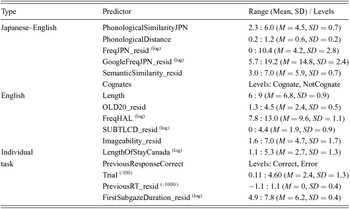
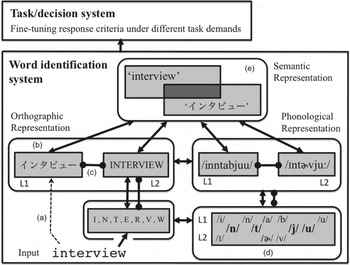
For languages sharing the same script (e.g., Dutch–English and French–English bilinguals with Latin alphabets), the BIA and BIA+ models predict that orthographic features of the input word immediately activate orthographic lexical representations in the two languages simultaneously. In contrast, for languages with different scripts, identification of script-specific orthographic features is not expected to facilitate activation of words in both languages. When the BIA+ model is generalized to languages with different scripts, the model may provide different predictions. In the example shown in Figure 1, the input word interview activates the corresponding letter nodes I, N, T, E, R, V, W, and these letter features then activate the word node interview. For Japanese–English bilinguals, however, it is expected that the feature set coding visuoperceptual features of Latin alphabets does not directly encode Japanese katakana script (the dotted line (a) in Figure 1). Consequently, the orthography-driven non-selective lexical access across languages is not expected for bilinguals of languages with different scripts at the earliest processing stages. The section below summarizes our hypotheses for Japanese–English bilinguals with respect to the BIA+ architecture, together with diagnostic variables used to test the predictions in the following lexical decision with eye-tracking experiments (Table 1). Appendix A (online, along with Appendices B–F referred to below) provides detailed descriptions about the lexical predictors, individual differences, and task effects considered in the present study. The lexical predictors are classified into those specific to Japanese–English bilinguals and those of English target words. All predictors were centered for the regression analyses. In order to study independent contributions of lexical distributional properties, we opted for a residulization procedure to orthogonalize correlated variables, as in Kuperman, Schreuder, Bertram and Baayen (Reference Kuperman, Schreuder, Bertram and Baayen2009) and Miwa, Libben, Dijkstra & Baayen (published online May 28, 2013). Residualized variables are indicated by the suffix _resid in Table 1 (see Appendix B for the correlational structure among Japanese and English frequencies, and Appendix C for the details on the residualization procedure).
Lexical predictors, individual differences, and task effects considered in this study. The range and mean are presented for their original values before residualization and centralization procedures. The superscripts represent a transformation method used for the given predictor. The values for Individual and Task variables are those in Experiment 1 (Japanese–English bilinguals).

A bilingual interactive activation (BIA+) architecture applied for Japanese–English bilinguals’ processing of an L2 English word. Arrows represent facilitatory links and circular connectors represent inhibitory links.

Cross-language phonological similarity
Phonological effects in visual word recognition have been studied predominantly in monolingual word recognition research (Carreiras, Ferrand, Grainger & Perea, Reference Carreiras, Ferrand, Grainger and Perea2005; Ferrand & Grainger, Reference Ferrand and Grainger1992, Reference Ferrand and Grainger1994; Perfetti, Zhang & Berent, Reference Perfetti, Zhang, Berent, Frost and Katz1992), but there is growing evidence for cross-language phonological activation in bilingual visual word recognition as well (Brysbaert, Reference Brysbaert, Kinoshita and Lupker2003; Brysbaert, Van Dyck & Van de Poel, Reference Brysbaert, Van Dyck and Van de Poel1999; Dijkstra, Grainger & Van Heuven, Reference Dijkstra, Grainger and Van Heuven1999; Duyck, Reference Duyck2005; Duyck, Diependaele, Drieghe & Brysbaert, Reference Duyck, Diependaele, Drieghe and Brysbaert2004; Schwartz, Kroll & Diaz, Reference Schwartz, Kroll and Diaz2007).
For Japanese–English bilinguals, if activation of orthographic lexical representations of L1 words is mediated only by the conceptual route, then a cross-language phonological similarity effect should appear late in time. However, phonology-driven sublexical language non-selective access is theoretically still possible (the route to the box (d) in Figure 1). In the latter case, an effect of cross-language phonological similarity may appear early. For Japanese–English bilinguals, it is expected that the activation of English phonemes leads to activation of the corresponding Japanese phonemes and syllabic and/or moraic phonological nodes (e.g., the activation of phonemes /i/, /n/, /t/, /a/, /b/, /j/, and /u/ facilitates the activation of syllabic representations or moraic representations of /i/, /nn/, /ta/, /bju/, and /u/). The phonological similarity between English and Japanese may lead to a larger global activation in the lexicon, just like a greater degree of orthographic similarity between L1 and L2 words matters for languages with the same script. As a diagnostic measure of phonological similarity, we used rated phonological similarity (PhonologicalSimilarityJPN).
Relative word frequencies in two languages
Like the monolingual IA model, the BIA+ model maintains inhibitory connections among words in the target language and also assumes inhibitory connections between orthographic lexical representations in two languages (Figure 1, line (c)). One consequence of such inhibitory connections is that the magnitude of the expected facilitatory effect of target English word frequency will be smaller when the Japanese translation equivalent has a high frequency of occurrence, because an English lexical orthographic representation and the Japanese lexical orthographic representation become co-active at some point in the course of word identification. It has been reported that word frequencies in two languages interact for interlingual homographs, words that share orthography across languages but not meaning (Dijkstra et al., Reference Dijkstra, de Bruijn, Schriefers and Ten Brinke2000; Dijkstra, Moscoso del Prado Martin, Schulpen, Baayen & Schreuder, Reference Dijkstra, Moscoso del Prado Martin, Schulpen, Baayen and Schreuder2005; Dijkstra, Van Jaarsveld & Ten Brinke, Reference Dijkstra, Van Jaarsveld and Ten Brinke1998; Kerkhofs, Dijkstra, Chwilla & de Bruijn, Reference Kerkhofs, Dijkstra, Chwilla and de Bruijn2006).
The BIA+ model predicts that, for Japanese–English bilinguals, any orthographic cross-language inhibition can only occur later in the recognition process, because the Japanese orthographic representation becomes activated only by virtue of cross-language phonological or conceptual mediation. We used log-transformed English word frequency (FreqHAL, Balota, Yap, Cortese, Hutchison, Kessler, Loftis, Neely, Nelson, Simpson & Treiman, Reference Balota, Yap, Cortese, Hutchison, Kessler, Loftis, Neely, Nelson, Simpson and Treiman2007) and log-transformed Japanese word frequency (FreqJPN, Amano & Kondo, Reference Amano and Kondo2003) as diagnostic measures of strength of the activation of lexical orthographic representations to test this prediction.
Semantic similarity
Translation equivalents in two languages occasionally have different shades of meaning. For example, unlike the English word interview which is used unrestrictedly in various contexts, the use of the Japanese translation equivalent インタビュー is restricted to “mass media interviews” and not typically used for “job interviews”. A question relevant to bilingual word processing is whether such cross-language semantic similarity contributes to recognition of L2 words. In an unprimed English progressive demasking task with Dutch–English bilinguals, Dijkstra, Miwa, Brummelhuis, Sappelli and Baayen (Reference Dijkstra, Miwa, Brummelhuis, Sappelli and Baayen2010) reported a processing advantage for English words with higher semantic similarity. As shown in Figure 1 box (e), we predicted that semantic similarity contributes relatively late in the course of word recognition. We used rated semantic similarity as the diagnostic measure to test this prediction (SemanticSimilarity).
Cognate status
While the BIA and BIA+ models account for cognate facilitation effects by means of cross-language orthographic, phonological, and semantic overlaps alone, it has been suggested that a shared morpheme representation for cognate may underlie the effects (Davis, Sánchez-Casas, García-Albea, Guasch, Molero & Ferré, Reference Davis, Sánchez-Casas, García-Albea, Guasch, Molero and Ferré2010; Lalor & Kirsner, Reference Lalor and Kirsner2000; Sánchez-Casas & García-Albea, Reference Sánchez-Casas, García-Albea, Kroll and de Groot2005). The present study considers cognate effects as orchestration of gradient lexical effects but also considers a dichotomized factor coding cognate status to test the special representation view. If cognates have shared morpheme representations, then a factor encoding cognate status should emerge significant on top of relevant numerical predictors encoding orthography, phonology, and semantics. We straightforwardly tested this theoretical prediction with a factor Cognate (levels: Cognate and NotCognate) in a regression model.
Extra-linguistic task/decision processes
Although the BIA and BIA+ models have been frequently discussed together in relation to language non-selective lexical access, the latter is distinguished from the former with respect to its explicit consideration of a non-linguistic system co-determining responses in a given task. The BIA+ model currently assumes that the non-linguistic system does not modulate lexical processes at the earliest processing stages. This assumption will be falsified if response-based data and data sampled from the earliest time frame both reveal the same interactions between lexical and task-related variables. To the best of our knowledge, however, no study has identified such interactions. In order to fully test the BIA+ model, we tracked participants’ global and local response criteria by studying extra-linguistic variables: Trial, the number of preceding trials, and PreviousResponseCorrect, whether the responses in the preceding two trials were correct.
Control variables
We considered objective phonological similarity based on Levenshtein distance (PhonologicalDistance, Levenshtein, Reference Levenshtein1966; see Gooskens & Heeringa, Reference Gooskens and Heeringa2004; Schepens, Dijkstra & Grootjen, Reference Schepens, Dijkstra and Grootjen2011; Schepens, Dijkstra, Grootjen & Van Heuven, Reference Schepens, Dijkstra, Grootjen and Van Heuven2013) to check the validity of rated PhonologicalSimilarity. A log-transformed Google document frequency measure (GoogleFreqJPN) was considered to check the validity of FreqJPN because the latter newspaper-based measure contains zero frequencies for some words.
As lexical control predictors, word length (Length), orthographic Levenshtein distance (OLD20, Yarkoni, Balota & Yap, Reference Yarkoni, Balota and Yap2008), log-transformed context diversity (SUBTLCD, Brysbaert & New, Reference Brysbaert and New2009a, Reference Brysbaert and Newb), and rated Imageability were considered.
As task-related variables, we considered PreviousRT, inversely transformed RT in the previous trial, and PreviousFixationDuration for second fixation duration analyses to account for potential spillover effects from the previous fixation.
To safeguard against potential individual differences (Kroll & Stewart, Reference Kroll and Stewart1994; Potter, So, von Eckhardt & Feldman, Reference Potter, So, von Eckhardt and Feldman1984), we considered log-transformed participants’ months of stay away from Japan (LengthOfStayCanada) as a measure of L2 English proficiency.
Methodological concerns and goals of this study
Previous priming studies for bilinguals with different scripts have provided evidence supporting automatic language non-selective lexical activation within an integrated lexicon, as implemented in the BIA model. However, when Japanese–English readers encounter an English word, Japanese lexical orthographic representation is not yet activated due to the orthographic dissimilarity (Figure 1 line (a)). It is important to note that, in the context of cross-script priming, a lexical orthographic representation of one language (Figure 1 box (b)) is artificially pre-activated. This raises a concern as to what extent language non-selective activation holds in a task without priming (as exceptions, see Thierry & Wu, Reference Thierry and Wu2004, Reference Thierry and Wu2007; Wu & Thierry, Reference Wu and Thierry2010, for implicit priming to study bilinguals of languages with different scripts). While masked priming is one of the most popular techniques to test subconscious lexical processes, researchers have not reached a consensus on an interpretation of a masked priming effect (e.g., see Forster, Reference Forster1998, for a lexical pre-activation account, Kinoshita & Norris, Reference Kinoshita and Norris2010, for a non-lexical account, and Marsolek, Reference Marsolek2008, for an antipriming account). At the moment, studies without priming for bilinguals with different scripts are scarce, and we investigate this issue using eye-tracking.
In the present study, combining English lexical decision tasks with eye-tracking, we tested the above predictions of the extended BIA+ model with Japanese–English bilinguals (Experiment 1) and with native monolingual readers (Experiment 2). Lexical decision was chosen, as this has been the most widely used experimental task (Libben & Jarema, Reference Libben and Jarema2002). Eye-tracking was used because previous studies employing lexical decision with eye-tracking (Kuperman et al., Reference Kuperman, Schreuder, Bertram and Baayen2009; Miwa et al., published online May 28, 2013) reported that early and late lexical processes systematically co-determine the initial and late eye-fixation measures respectively.
Although the vast majority of psycholinguistic studies on bilingual processing have analyzed bilingual-specific effects solely in bilingual readers, we also compared late bilinguals and native monolinguals (i) to make sure that effects of interest are genuine bilingual effects, rather than artifacts arising from statistical correlation across languages and general processing mechanisms in reading English words; (ii) to confirm that there is a reasonable amount of functional overlap between bilinguals and monolinguals because part of the BIA/BIA+ model architecture, in theory, accounts for monolingual readers’ lexical processing; and (iii) to explore the “expert” ability in reading, as native proficiency also provides a benchmark of an expert reader, and the acquisition of such “expert” ability is often viewed as a goal of late bilinguals.
In order to test the above predictions of the BIA+ model, we opted for a mixed-effects analysis (Baayen, Davidson & Bates, Reference Baayen, Davidson and Bates2008) without dichotomization of numerical predictors for more power and precision (Baayen & Milin, Reference Baayen and Milin2010; Cohen, Reference Cohen1983; MacCallum, Zhang, Preacher & Rucker, Reference MacCallum, Zhang, Preacher and Rucker2002). Mixed-effects modeling allows us to test lexical distributional properties, participants’ characteristics, and task-related variables in a single statistical model.
Experiment 1: English lexical decision with Japanese–English bilingual readers
Method
Participants
Nineteen Japanese–English late-bilingual readers (three males, mean age = 25.1, SD = 5.8) were recruited at the University of Alberta. The participants had stayed in Canada for 33 months on average (SD = 45.6) and acquired English as their second language.
Materials
We sampled 250 words from the English Lexicon Project database (Balota et al., Reference Balota, Yap, Cortese, Hutchison, Kessler, Loftis, Neely, Nelson, Simpson and Treiman2007) based on the following criteria: (i) the word length was between six and nine letters; (ii) the word frequency was greater than 2,000 in the FreqHAL frequency distribution; (iii) the morphological status was simplex; (iv) the part of speech was noun; and (v) the mean accuracy rates in lexical decision and naming were at least .9 (see Appendix D for the list of words used in the present study). We also sampled 200 nonwords from the ARC Nonword Database (Rastle, Harrington & Coltheart, Reference Rastle, Harrington and Coltheart2002) to make a total of 450 letter strings. These nonwords were similar to the words: between six and nine letters long, with existing onsets, existing bodies, and legal bigrams.
Apparatus
The experiment was designed and controlled by SR Research Experiment Builder software. Words were presented on a 20-inch display. Eye movements were tracked by an EyeLink II head-mounted eye-tracker (SR Research, Canada) in the pupil-only mode with a sampling rate of 250 Hz. Calibrations were conducted with horizontal three points.
Procedure
In this lexical decision with eye-tracking experiment, participants were asked to decide as quickly and accurately as possible whether the letter strings presented on the computer display were legitimate existing English words or non-existent words (nonwords) by pressing the right and left buttons of a Microsoft SideWinder game-pad respectively. The words were presented following a fixation circle, on which participants were asked to fixate their eyes. This fixation circle served as a drift correct point allowing the researcher to correct for head drifts between trials.
Given our understanding of the optimal viewing position in sentence reading and in isolated word reading (Brysbaert & Nazir, Reference Brysbaert and Nazir2005; Farid & Grainger, Reference Farid and Grainger1996; O'Regan & Jacobs, Reference O'Regan and Jacobs1992; Vitu, O'Regan & Mittau, Reference Vitu, O'Regan and Mittau1990), the location of the fixation mark was slightly shifted horizontally so that the first fixations were positioned slightly (1.5 letters) to the left of the word centre. The target words were presented in Courier New 44-point white font on a black background. At a viewing distance of 70 cm from the screen, the visual angle was estimated to be 1.1° for each letter (i.e., for six-letter words and nine-letter words, such as camera and interview, the visual angles were approximately 6.7º and 10.0º, respectively). A testing session contained two breaks, one after every 150 words. Participants saw a summary of their performance regarding accuracy and response speed after the practice trials and at each break point. The experiment took roughly 90–120 minutes. The right eye was tracked throughout the experiment.
Results
Response latency
R version 2.13.2 (R Development Core Team, 2011) was used for statistical analyses. We opted for a mixed-effects regression analysis with subjects and items as crossed random effects (Baayen et al., Reference Baayen, Davidson and Bates2008; Bates, Maechler & Dai, Reference Bates, Maechler and Dai2007). Response accuracy across subjects ranged from .86 to .98 (M = 0.92, SD = 0.04). Therefore, no participant was excluded from the analyses. Of all 4,750 trials, those with response latency either shorter than 300 ms or longer than 3,000 ms were excluded (14 trials). Twenty-one words with more than 30% erroneous responses and one word (heroin) with a coding error were excluded from the analysis (414 trials, 8.7% of the remaining data). The following analyses are based on the remaining 228 words, amounting to 4,099 trials after excluding the 5.1% of trials that contained incorrect responses.
A reciprocal transformation (–1000/RT) was applied to the RTs to attenuate skewness in their distribution, based on the appropriate exponent suggested by the Box-Cox power transformation technique (Box & Cox, Reference Box and Cox1964; Venables & Ripley, Reference Venables and Ripley2002). The Box-Cox transformation technique was applied to all dependent measures in the rest of this paper.
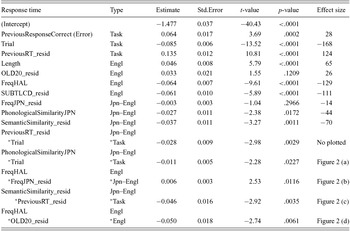
We first fitted a simple main effects model with all predictors and also considered all pairwise interactions. We then tested interactions between task-related predictors and lexical predictors. Potentially influential outliers were removed with standardized residuals exceeding 2.5 standard deviation units (1.8% of the data points). Table 2 summarizes the fixed-effects in our final model, and Figure 2 visualizes significant interactions. The reference level for the factor PreviousResponseCorrect was Correct throughout this study. The random-effect structure of this model consists of random intercepts for item (SD = 0.09) and subject (SD = 0.16), by-subject random slopes for Trial (SD = 0.02), and by-subject random contrasts for PreviousResponseCorrect (SD = 0.06). The standard deviation of the residual error was 0.24. Other random slopes for subjects did not reach significance.
Estimate, standard error, t-value, p-value, and effect size of the fixed effects in the model of Japanese–English bilingual readers’ lexical decision response times. Task = task-related predictors, Engl = English target word properties, Jpn–Engl = Japanese–English bilingual-specific predictors. The effect sizes refer to the magnitude of an effect calculated as the difference between the model's prediction for the minimum and the maximum back-transformed values of a given predictor.

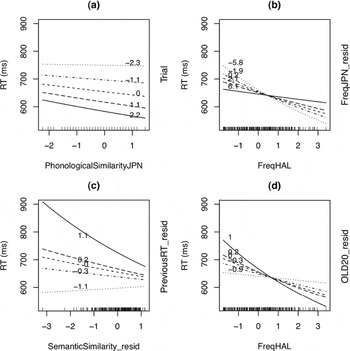
Lexical interactions in the mixed-effects model for Japanese–English bilinguals’ lexical decision response times. Different lines represent quantiles, and the rug in the x-axes represents the pattern of distribution.

Interestingly, all bilingual-specific predictors, except the factor Cognate, co-determined the lexical decision response latencies (Figure 2 Panels (a), (b), and (c)). Although the effect of PhonologicalSimilarityJPN reached significance in a simple main-effects model, a model allowing interactions into the model specification further clarified that PhonologicalSimilarityJPN facilitated responses later in the experiment (Panel (a)). Replacing PhonologicalSimilarityJPN with PhonologicalDistance successfully replicated this interaction.
The effect of FreqJPN_resid emerged in an interaction with target word frequency FreqHAL (Panel b). For words with large FreqJPN_resid (the solid line in Panel (b)), the magnitude of the FreqHAL effect was attenuated. When FreqJPN_resid was replaced with GoogleFreqJPN_resid, a virtually identical interaction was obtained.
SemanticSimilarity_resid had a small yet significant facilitatory effect in a simple main-effects model. Upon close inspection, its interaction with the task-related variable, PreviousRT (Panel (c)) indicated that when the response latency in the previous trial was long (the solid line in Panel (c)), cross-language SemanticSimilarity_resid facilitated the response more strongly. This is in line with the finding that the cross-language semantic similarity effect is more likely to be observed when the task induces longer response times (Dijkstra et al., Reference Dijkstra, Miwa, Brummelhuis, Sappelli and Baayen2010, using a progressive demasking word identification task).
Cognate was not significant in this model, indicating that the variance explained by Cognate was absorbed by the numerical predictors.
Several other lexical distributional properties of the English target words co-determined response latencies. The magnitude of the FreqHAL facilitatory effect was the greatest for words with large OLD20_resid, which are words situated in a sparse orthographic space (the solid line in Figure 2 Panel (d)). As summarized in Table 2, the context diversity of words gauged by SUBTLCD_resid contributed beyond FreqHAL, and Length inhibited responses.
The effect of SemanticSimilarity_resid was not modulated by LengthOfStayCanada, suggesting that, for Japanese–English bilinguals, the recruitment of cross-language semantic activation did not vary across readers with different L2 proficiency.
It is likely that the above effects reflected in response times also guide eye movements. We investigated the time-course of the above effects by studying whether they load onto the early or late fixations, or a combination of both. Japanese–English bilinguals read words with a single fixation only 1% of the time (36% showed two fixations, 39% three fixations, and 17% four fixations, with a mode at three fixations). In order to include as many data points as possible, for all trials with at least two fixations, we analyzed (i) first fixation durations, (ii) first subgazes (in this study, sum of all non-final fixations, which were ended by a saccade to a next location), and (iii) last fixations as measures of very early processing, relatively early processing, and late processing respectively. The first fixation and subgaze durations were measured from the onset of target word presentation, excluding the fixation duration on the fixation point. It is assumed that the former two measures are less contaminated by conscious lexical decision response strategies than the last fixation, which was ended with a button press.
First fixation duration
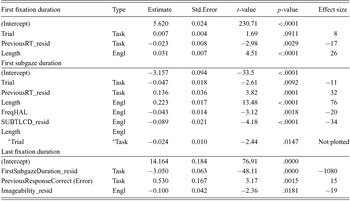
For the analysis of the first fixation durations, data points with a first fixation shorter than 100 ms and longer than 850 ms, those before a blink, and those with an incorrect response were excluded from the analysis. A log-transformation was applied to attenuate skewness in the distribution of the fixation durations (M = 5.7, SD = 0.3, raw median = 280 ms). As in the response time analysis, we tested simple main effects and pairwise interactions, as well as interactions between lexical and task-related predictors. Potentially influential outliers were removed with standardized residuals exceeding 2.5 standard deviation units (2.0% of the data points). The final model is summarized in Table 3. The random-effect structure of this model was comprised of random intercepts for item (SD = 0.05) and subject (SD = 0.11), and by-subject random slopes for Trial (SD = 0.01). The standard deviation of the residual error was 0.21.
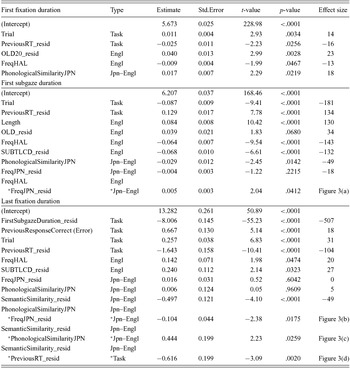
Estimate, standard error, t-value, p-value, and effect size (ms) of the fixed effects in the model of Japanese–English (Jpn–Engl) bilingual readers’ first fixation durations, first subgaze durations, and last fixation durations.

As expected, the first fixation duration was co-determined by the signature of early bottom–up orthographic processing. The inhibitory effect of OLD20_resid indicates that words in sparse orthographic neighbourhood receive a longer first fixation. A word frequency effect (FreqHAL) was observed already as well, replicating the early word frequency effects in previous studies (Kuperman et al., Reference Kuperman, Schreuder, Bertram and Baayen2009; Miwa et al., published online May 28, 2013).
Interestingly, the bilingual-specific predictor PhonologicalSimilarityJPN already contributed at this earliest time frame, indicating that a sublexical cross-language phonological decoding route is used (the route to the box (d) in Figure 1). Unlike its effect in the RT analysis, however, its effect was inhibitory. It should also be noted that the objective PhonologicalDistance measure, when replaced with PhonologicalSimilarityJPN, did not reach significance.
First subgaze duration
For the analysis of the first subgaze durations, data points with a first fixation shorter than 100 ms, those before a blink, and those with an incorrect response were excluded from the analysis. A log-transformation was applied to attenuate skewness in the distribution of the subgaze durations (M = 6.2, SD = 0.4, raw median = 500 ms).
After testing simple main effects, pairwise interactions, and interactions between lexical and task-related predictors, potentially influential outliers were removed with standardized residuals exceeding 2.5 standard deviation units (1.2% of the data points). The final model is summarized in Table 3. The random-effect structure of this model was comprised of random intercepts for item (SD = 0.08) and subject (SD = 0.16), and by-subject random slopes for Trial (SD = 0.04). The standard deviation of the residual error was 0.31.
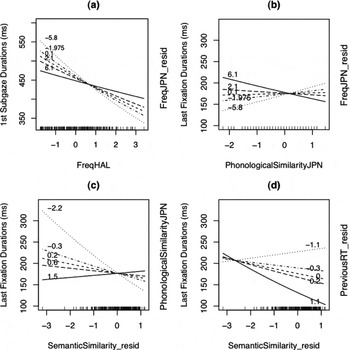
At the first subgaze, some bilingual-specific effects were observed. Whereas at the first fixation, PhonologicalSimilarityJPN was inhibitory, at the second fixation, PhonologicalSimilarityJPN became facilitatory. It should be noted, however, that PhonologicalDistance did not reach significance when replaced with PhonologicalSimilarityJPN. Interestingly, the interaction between FreqHAL and FreqJPN_resid observed in the response time analysis was also observed at the first subgaze in a virtually identical form (Figure 3 Panel (a)). This interaction was successfully replicated when FreqJPN_resid was replaced with GoogleFreqJPN_resid.
Lexical interactions in the mixed-effects model for Japanese–English bilinguals’ first subgaze and last fixation durations in trials with two fixations. Different lines represent quantiles, and the rug in the x-axes represents the pattern of distribution.

Cognate and SemanticSimilarity_resid were not significant predictors. LengthOfStayCanada was not a significant predictor and did not modulate any lexical effects either.
Last fixation duration
For the analysis of the last fixation duration, the words excluded in the analysis of response latencies were excluded here as well. Trials with last fixation durations longer than 900 ms, those before or after a blink, and those with an incorrect response were also excluded from the analysis. A square-root transformation was applied to attenuate the skewness in the distribution of the fixation durations (M = 13.5, SD = 4.3, raw median = 188 ms). Unlike the first fixation and subgaze durations, which were terminated by the eye moving to another location in the word, the last fixation duration was terminated by the readers’ button-press. Consequently, we expected that the last fixation durations would reflect, in addition to lexical predictors, variables associated with response planning and execution.
We tested simple main effects, pairwise interactions, and tested interactions among task-related predictors and lexical predictors. As in the response time analysis, with all relevant numerical predictors considered in a model, Cognate did not contribute significantly to the model fit. The final model for Japanese–English bilinguals’ last fixation durations is summarized in Table 3. Figure 4 presents the significant lexical interactions in the model. Potentially influential outliers were removed with standardized residuals exceeding 2.5 standard deviation units (1.6% of the data points). The random-effect structure of the final model was comprised of random intercepts for item (SD = 0.93) and subject (SD = 1.08). The standard deviation of the residual error was 2.97.
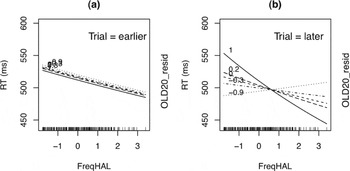
Lexical interactions in the mixed-effects model for monolingual English readers’ response latencies. Different lines represent quantiles, and the rug in the x-axes represents the pattern of distribution.

Several bilingual-specific effects co-determined the last fixation durations. FreqJPN_resid interacted with PhonologicalSimilarityJPN. Larger PhonologialSimilarityJPN shortened the fixation duration for words with high FreqJPN_resid (the solid line in Figure 3 Panel (b)), suggesting that words with higher cross-language PhonologicalSimilarityJPN and FreqJPN were perceived as more word-like. In a model in which PhonologicalDistance was used instead of PhonologicalSimilarityJPN, a virtually identical interaction was obtained.
SemanticSimilarity_resid facilitated processing. The magnitude of facilitation was greater for words with low cross-language phonological similarity (Panel (c)). This interaction may indicate an L1-based response strategy to rely on either phonological similarity or semantic similarity to make a lexical decision response. SemanticSimilarity_resid also interacted with PreviousRT_resid (Figure 3 Panel (d)). Recall that the facilitatory effect of SemanticSimilarity for words preceded by long PreviousRT_resid was also observed in the RT analysis. Since SemanticSimilarity_resid was absent both at the first fixation and subgaze, we can conclude that this semantic effect emerges late.
The last fixation seems to be qualitatively different from the first fixation and subgaze, as indicated by the atypical inhibitory effects of FreqHAL (20 ms) and SUBTLCD_resid (27 ms). The inhibitions from L2 word properties may be due to a response strategy to rely on L1 word properties. Involvement of a conscious response strategy is evident from the significant effect of PreviousResponseCorrect. When participants make an error, they usually become aware of it immediately after a button press and try to be cautious in the following trials. LengthOfStayCanada did not reach significance and did not modulate lexical effects either.
Discussion
Lexical decision measures emerged, from our analyses, as a composite measure amalgamating processing costs that arise at different stages of information uptake. First fixations reflected early bottom–up processing as witnessed by orthographic neighbourhood density and target word frequency. First subgazes reflected lexical effects in the word identification system not affected by conscious response strategies, followed by last fixations, which were more dedicated to response planning and execution in the task/decision system.
Importantly, using a regression technique, we observed all the expected bilingual-specific effects in the reaction times (i.e., phonological similarity effect, interaction between L1 and L2 frequencies, and semantic similarity effect) simultaneously in a task without priming. Interestingly, these effects also co-determined eye movements but at different points in time. The early contribution of cross-language phonological similarity indicates that, even for languages with different scripts and in a task without priming, sublexical phonological decoding immediately takes place. It should be noted, however, that its effect was inhibitory in the earliest time frame and facilitatory in later time frames.
It was also notable that the interaction between L1 and L2 frequencies was found relatively early at the first subgaze. Under the assumption that response planning and execution takes approximately 200 ms (Schmidt, Reference Schmidt and Kelso1982), it is likely that the cross-language competition was not due to readers’ conscious response strategy but rather part of central lexical processing mechanism, as assumed in the BIA+ model.
The time-course of lexical activation characterized by the relatively early contribution of cross-language phonological similarity, followed by the competition between L1 and L2 words, and then by a cross-language semantic similarity effect is in line with the predictions of the BIA+ model.
In Experiment 2, we tested monolingual readers of English to ensure that the bilingual-specific effects observed in Experiment 1 arose from a bilingual-specific processing mechanism, as well as to explore whether the within-language English lexical distributional properties are utilized similarly by the two groups of readers.
Experiment 2: English lexical decision with English monolingual readers
Method
Participants
Nineteen monolingual English readers (7 males, mean age = 21.6, SD = 7.1) were recruited at the University of Alberta. There was no significant difference between the late bilinguals in Experiment 1 and the monolingual readers with respect to age. Monolingual readers were defined here as native readers of English with more than 80% daily exposure to English relative to the amount of exposure to their second languages at the time of the experiment, as reported by the participants. None of the participants had Japanese as their second or third language.
Materials, apparatus, and procedure
Materials, apparatus, and procedure were the same as in Experiment 1.
Results
Response latency
In the analyses of Experiment 2, we excluded the words which elicited higher error rates in Experiment 1 to ensure that the comparisons of Experiment 1 and 2 are based on the same set of words. Response accuracy rate ranged from .96 to 1.00 (mean = 0.99, SD = 0.01) for English monolingual readers. Therefore, no subject was excluded from the analyses. Of all trials (4,750 data points), data points with response latency shorter than 300 ms or longer than 2,000 ms were excluded (11 data points). The following analyses are based on the same 228 words analyzed in Experiment 1 with correct responses (4,275 data points, after excluding 1.1% of trials with incorrect responses). A reciprocal transformation (–1000/RT) was applied to RTs to attenuate the skew in its distribution.
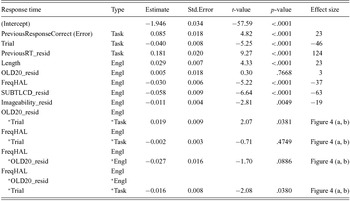
We tested simple main effects, all pairwise interactions, and finally interactions between task effects and lexical effects. Potentially influential outliers were removed with standardized residuals exceeding 2.5 standard deviation units (1.9% of the data points). Table 4 summarizes the coefficients of the final model. The random-effect structure of this model was comprised of random intercepts for item (SD = 0.07) and subject (SD = 0.14), and by-subject random slopes for Trial (SD = 0.03) and PreviousRT_resid (SD = 0.07). The standard deviation of the residual error was 0.25.
Estimate, standard error, t-value, p-value, and effect size (ms) of the fixed effects in the model of English monolingual readers’ lexical decision response times.

There were qualitative differences between bilinguals and monolinguals. A three-way interaction of FreqHAL by OLD20_resid by Trial was observed. As illustrated in Panels (a) and (b) of Figure 4, FreqHAL provided facilitation without interacting with OLD20_resid early in the experiment (Trial was dichotomized only for the purpose of visualization in Figure 4). However, later in the experiment, the interaction between FreqHAL and OLD20_resid emerged (Panel (b)), as observed for Japanese–English bilinguals in Experiment 1. Unlike Experiment 1, Imageability_resid co-determined response times as well, such that the responses were delayed for words with low imageability (Balota, Cortese, Sergent-Marshall, Spieler & Yap, Reference Balota, Cortese, Sergent-Marshall, Spieler and Yap2004).
As reported by previous bilingual processing studies (e.g., Duyck, Vanderelst, Desmet & Hartsuiker, Reference Duyck, Vanderelst, Desmet and Hartsuiker2008; Gollan, Montoya, Cera & Sandoval, Reference Gollan, Montoya, Cera and Sandoval2008), the magnitude of the English word frequency effect was larger for Japanese–English late bilinguals than for English monolingual readers. This larger frequency effect for non-native readers can be interpreted by the negative decelerating functional form of the word frequency effect, indicating that each additional log unit of frequency provides smaller and smaller processing benefits (Baayen, Feldman & Schreuder, Reference Baayen, Feldman and Schreuder2006; Baayen & Milin, Reference Baayen and Milin2010; Duyck et al., Reference Duyck, Vanderelst, Desmet and Hartsuiker2008). Overall, monolingual English readers’ response latencies (M = 546 ms, SD = 138) in Experiment 2 were faster than those of Japanese–English bilingual readers (M = 733 ms, SD = 248) in Experiment 1 (p < .0001, mixed-effects model not shown).
A direct quantitative comparison between monolinguals and bilinguals was also conducted by including a factor FirstLanguage (levels: Japanese, English) in a regression model for all data. The results indicate that supposedly bilingual effects (Freq_HAL × FreqJPN_resid, PhonologicalSimilarityJPN, and SemanticSimilarity_resid) did not reach significance for the English monolinguals (See Appendix E for the analysis).
First fixation duration
Like bilingual speakers in Experiment 1, native English speakers read words with multiple fixations most of the time (8% showed a single fixation, 66% two fixations, 23% three fixations, and 2% four fixations). We therefore analyzed first fixation durations, first subgaze durations, and last fixation durations, as in Experiment 1.
For the analysis of the first fixation durations, data points with a first fixation shorter than 100 ms and longer than 850 ms, those before a blink, and those with an incorrect response were excluded from the analysis. A log-transformation was applied to attenuate skewness in the distribution of the fixation durations (M = 5.6, SD = 0.2, raw median = 264 ms).
The final model is summarized in Table 5. Potentially influential outliers were removed with as standardized residuals exceeding 2.5 standard deviation units (2.7% of the data points). The random-effect structure of this model was comprised of random intercepts for item (SD = 0.03) and subject (SD = 0.11), and by-subject random slopes for Trial (SD = 0.01) and Length (SD = 0.03). The standard deviation of the residual error was 0.16. For the expert readers, Length was the only significant lexical predictor. An item-wise correlation between the first fixation durations of Japanese–English bilingual readers (Experiment 1) and those of English monolingual readers was significant but weak (r = .19, p < .01). The first fixations of the monolinguals were not significantly faster than those of the bilinguals.
Estimate, standard error, t-value, p-value, and effect size (ms) of the fixed effects in the model of English monolingual readers’ first fixation durations, first subgaze durations, and last fixation durations.

First subgaze duration
Data points before a blink and trials with incorrect responses were excluded from the analysis. Trials with a first subgaze duration shorter than 100 ms were excluded, and an inverse transformation was applied to the remaining fixation durations to attenuate skewness in the distribution (M = –3.2, SD = 0.9, raw median = 308).
Table 5 summarizes the final model, after testing all main effects and pairwise interactions. Potentially influential outliers were removed with standardized residuals exceeding 2.5 standard deviation units (1.3% of the data points). The random-effect structure of this model was comprised of random intercepts for item (SD = 0.14) and subject (SD = 0.4), and by-subject random slopes for Trial (SD = 0.07). The standard deviation of the residual error was .73. The fixed-effect structure of this model was comprised of Length, FreqHAL, and SUBTLCD_reisd, all of which co-determined Japanese–English bilinguals’ first subgaze in Experiment 1. A significant item-wise correlation between the first subgaze durations of Japanese–English bilingual readers (Experiment 1) and those of English monolingual readers (r = .46, p < .01) also indicates strong commonality in information uptake during the relatively early stage of word recognition. The first subgaze durations of the monolingual readers were significantly faster than those of the bilingual readers (p < .0001, effect size = 163 ms, mixed effects model not shown).
Last fixation duration
In the same subset of words analyzed above, we excluded last fixation durations longer than 900 ms and applied a square root transformation to attenuate a skew in the distribution (M = 14.2, SD = 3.7, raw median = 216). Fixations before or after a blink and trials with incorrect responses were excluded from the analysis.
The final model is summarized in Table 5. Potentially influential outliers were removed with standardized residuals exceeding 2.5 standard deviation units (1.9% of the data points). The random-effect structure of this model was comprised of random intercepts for item (SD = 0.81) and subject (SD = 0.75), and by-subject random slopes for FirstSubgazeDuration_resid (SD = 0.61). The standard deviation of the residual error was 2.35.
The Imageability_resid was the only lexical predictor co-determining monolingual English readers’ last fixation durations. Recall that Imageability_resid also co-determined the same readers’ response times to a comparable magnitude. Interestingly, as in Experiment 1, PreviousResponseCorrect was significant here as well. When participants make an error response (which they are usually aware of), their immediately following responses become slower to be more cautious. Such strategic effects do not seem to co-determine early measures and only inflated last fixation durations.
An item-wise correlation between the last fixation durations of Japanese–English bilingual readers (Experiment 1) and those of English monolingual readers was significant but weak (r = .29, p < .01). Furthermore, the last fixations of the monolingual English readers were not significantly faster than those of the late bilinguals.
Discussion
Experiment 2 confirmed that there was commonality in processing between monolingual readers and bilingual readers: The lexical processes proceed from visuo-perceptual and sublexical orthographic effects (Length and OLD20_resid) to orthographic lexical effects (FreqHAL and SUBTLCD_resid) and then to semantic processes (Imageability_resid and SemanticSimilarity_resid). Importantly, however, the bilingual-specific effects obtained in Experiment 1 did not reach significance in Experiment 2. This indicates that the bilingual-specific effects of our interest were genuine bilingual effects arising from the theoretical bilingual-specific architecture rather than artifacts arising from processes of target words per se. The functional overlap across different groups of readers and the significance of bilingual-specific effects only for bilingual readers are in line with the BIA and BIA+ models.
However, it should be noted that Experiment 2 also identified differences between monolingual readers and late bilinguals. Length was a significant predictor at the first fixation only for the monolinguals. Imageability_resid was similarly a significant predictor at the last fixation durations only for the monolinguals.
Finally, the significant effects of PreviousResponseCorrect on last fixation durations and response times, but not first fixations and subgaze durations, of both monolingual readers and bilingual readers suggest that this is a language-general phenomenon and that readers’ conscious strategy to respond more cautiously affects only the late processes. This, in turn, indicates that the first fixations and subgazes are relatively strategy-free measures for automatic lexical processing. The late involvement of a response strategy and the word identification system's insensitivity to a strategic factor is in line with the prediction of the BIA+ model.
General discussion
This study addressed the question of the time-course of lexical activation in Japanese–English bilinguals. To this end, we combined lexical decision with eye-tracking because eye-tracking, unlike button press responses, affords insight into the time-course of lexical activation. Importantly, because the task did not involve cross-script priming, the lexical orthographic representation (Figure 1 box (b)) was not artificially activated when the L2 target word was presented, allowing a more natural interpretation of the results. As predicted by the BIA+ model, we observed clear effects of all the bilingual-specific lexical predictors (cross-language phonological similarity, L1 word frequency interacting with L2 word frequency, and cross-language semantic similarity), but not the factor coding cognate status.
First, cross-language phonological similarity facilitated the lexical decision responses of Japanese–English bilinguals. The eye-tracking record clarified that the phonological similarity effect emerged already at the first fixation. Within the framework of BIA+ model, we interpret this effect as sketched in Figure 1 box (d). Once the alphabetic letter representations I, N, T, E, R, V, and W are activated, based on the written input interview, the corresponding phonemes (e.g, /ɪ/, /n/, /t/, /ɚ/, /v/, /j/, and /u/) are activated to derive the appropriate lexical phonological representation /ɪntɚvju:/. It is conceivable that, at the same time, the activation of English phonemes can lead to (at least partial) activation of the corresponding Japanese phonemes (e.g., /i/, /n/, /t/, /a/, /b/, /j/, and /u/), eventually leading to the activation of /inntabjuu/.
In this lexical decision study without priming, however, its effect was inhibitory at the first fixation, facilitatory at the first subgaze, and facilitatory also at the moment of the response. Previous studies reported mixed results: Dijkstra et al. (Reference Dijkstra, Grainger and Van Heuven1999) reported an inhibitory effect of phonological similarity, and Lemhöfer and Dijkstra (Reference Lemhöfer and Dijkstra2004) and Haigh and Jared (Reference Haigh and Jared2007) reported facilitatory effects. Our results indicate that this is not an either–or problem but that inhibition and facilitation manifest themselves at different points in time. Given that this inhibitory effect was not replicated with the objective PhonologicalDistance measure, this may be due to early noise induced by co-activation of English and Japanese sublexical phonology (e.g., vowel–consonant distinction and stress pattern), which are not accounted for by the edit distance coding.
Second, L1 Japanese word frequency co-determined lexical decision responses in an interaction with L2 English word frequency. The English word frequency effect was progressively attenuated as Japanese frequency increased. Importantly, this interaction was also observed at the first subgaze, but not at the first and last fixations. This finding can be understood within the BIA+ model as follows. The BIA+ model posits, as does any interactive activation model, inhibitory links between non-identical orthographic/phonological lexical representations (see Figure 1 line (c), and previous studies by Dijkstra, Van Jaarsveld & Ten Brinke, Reference Dijkstra, Van Jaarsveld and Ten Brinke1998; Kerkhofs et al., Reference Kerkhofs, Dijkstra, Chwilla and de Bruijn2006). Because there are no links projecting from the English letter units to the Japanese katakana word representation (i.e., the dashed line (a) in Figure 1 is not active), the input word interview cannot activate the Japanese lexical katakana representation インタビュー at an early stage. However, the English input word interview activates the alphabetic letter representations I, N, T, E, R, V, and W, and consequently the English orthographic lexical representation INTERVIEW relatively early. The activation of the L1 Japanese lexical orthographic representation of a cognate can and does occur but only via indirect activation mediated by sublexical and lexical phonological representations or via top–down activation from the conceptual representation (see, for instance, the significant cross-language masked priming effect for non-cognate translation equivalents reported by Grainger & Frenck-Mestre, Reference Grainger and Frenck-Mestre1998; see also Duñabeitia, Perea & Carreiras, Reference Duñabeitia, Perea and Carreiras2010; Pecher, Reference Pecher2001; Perea, Duñabeitia & Carreiras, Reference Perea, Duñabeitia and Carreiras2008).
Third, a small significant facilitatory contribution of semantic similarity was observed. Its effect arose late, at the last fixation and in the lexical decision responses. In the present study, the semantic similarity effect did not depend on readers’ L2 proficiency. This finding is consistent with models assuming a strong form-to-meaning mapping for both L1 and L2, allowing rapid semantic activation in L2 word processing (Duyck & Brysbaert, Reference Duyck and Brysbaert2004).
Fourth, regression modeling allowed us to straightforwardly test the view that cognate facilitation arises from special morphological representations for cognates (Davis et al., Reference Davis, Sánchez-Casas, García-Albea, Guasch, Molero and Ferré2010; Lalor & Kirsner, Reference Lalor and Kirsner2000; Sánchez-Casas & García-Albea, Reference Sánchez-Casas, García-Albea, Kroll and de Groot2005). Although models with the factor Cognate as a sole lexical predictor replicated standard cognate facilitation effects (mixed-effect models not shown), it was no longer a significant predictor once the relevant numerical predictors were included in the regression equations. This is in harmony with Voga and Grainger's (Reference Voga and Grainger2007) conclusion; a cognate facilitation effect is not due to special morphological representations but due to shared form overlaps.
Finally, we observed similarities and differences in how monolingual readers and bilingual readers make lexicality judgments. On one hand, the lexical decision processes of the two groups were comparable, as indicated by the lexical distributional properties that similarly co-determined the lexical decision responses of the two groups of readers (e.g., the interaction between FreqHAL and OLD20_resid). Such a functional overlap between groups is consistent with the general architecture of the BIA+ model, which is a generalization of the monolingual interactive activation model.
On the other hand, the lexical decision process of the bilingual readers diverged from that of the monolingual readers, beyond the bilingual-specific lexical effects mentioned above. At the first fixation, Length was significant only for monolinguals, and OLD_resid was significant only for bilinguals. This may reflect the fact that the perceptual span of proficient readers is wider than that of less proficient readers (Rayner, Slattery & Belanger, Reference Rayner, Slattery and Belanger2010). At the last fixation, Imageability_resid was significant only for monolinguals.
Japanese–English bilinguals and English monolinguals also fine-tuned response criteria differently throughout the experiment. The former group apparently adjusted the response threshold for lexical decision with respect to a Japanese word property (i.e., cross-language phonological similarity). Because the co-activation of an L1 Japanese word via its phonological overlap with the L2 English word is a reasonable criterion for a “yes” response in lexical decision, participants may have fine-tuned their response criteria so that phonology received progressively more weight to optimize responses. Monolinguals, on the other hand, fine-tuned response criteria with respect to word frequency and orthographic density (FreqHAL * OLD20_resid).
The above qualitative differences between bilinguals and monolinguals reconfirm that bilinguals are not two monolinguals in one mind (Grosjean, Reference Grosjean1989). Although the BIA+ is, in terms of processing architecture, an extension of the monolingual IA model, such an architectural extension leads to qualitative and quantitative differences in processing (see Appendix E for a direct quantitative comparison between the two groups with the factor FirstLanguage in a mixed-effects analysis). The processing differences observed in this study do not provide evidence against the BIA+ model but point out specific areas that are yet to be clarified, namely the visuo-perceptual level and the decision/response level. The observed processing differences between bilinguals and monolinguals also imply that it requires caution to use monolinguals as experimental controls when studying bilingual processing.
Future research should further investigate potential consequences of quality of lexical predictors, experimental manipulations, and individual differences. As for quality of lexical predictors, human-rated phonological and semantic similarity measures were used in this study, as in many previous studies. The objective edit distance measure replicated the late effect, but not early effects, of the rated phonological similarity successfully. It is important to clarify what constitute rated measures and how to code them objectively (see Appendix F for a comparison of various rated measures). As for experimental manipulations, the font size chosen in this study was relatively larger than that in normal reading. While readers made multiple fixations most of the time in this study, an analysis of eight native English speakers’ reading with smaller font (visual angle per letter = 0.4˚) revealed that multiple eye movements were still used 73% of the time (median = 2, range = 1:5), indicating that isolated word reading itself triggers a task-specific pattern of eye movements. As for individual differences, we only considered a potential effect of readers’ length of stay in Canada, and we leave it to future research to disentangle contributions of various related measures. In addition, although monolinguals and bilinguals tested in this study were comparable in terms of age, more rigorous assessment should be conducted in the future (e.g., matched intelligence and reading speed). It is likely that the by-subject random intercepts, which capture between subject variability that cannot be traced back to the predictors included in the present study, comprise variation that can be explained by more refined measures characterizing the individual subjects, including measures for their reading skills.
In conclusion, without using a priming technique, the present study tapped into the time-course of lexical activation by observing eye movements to test various predictions of the BIA+ model. The bilingual-specific lexical processes that are characterized by early cross-language phonological similarity to an interaction between L1 and L2 frequency, and then to late cross-language semantic similarity is in line with the BIA+ model. The absence of a significant contribution of a factor coding cognate status indicates that a cognate facilitation effect can be sufficiently captured by numerical predictors coding form and meaning in two languages. The localist connectionist framework of the BIA+ model, which thus far has been guided by research on bilinguals with the same script, can be modified to account for lexical processes of Japanese–English bilinguals, under the straightforward assumption that English letter units do not project onto Japanese word units.