The 113th Congress was on track to be the least productive congress in 60 years. For example, the 113th passed fewer than half as many bills as the average congress since 1973 at comparable points in the session. Footnote 1 Something that Congress has to do, regardless of gridlock, is pass a budget in some fashion. The Congress has not done so on time and in “regular order” since 1994, just before the election of the “Republican revolution.” Footnote 2 And, of course, it failed even to pass a continuing resolution twice in this period, shutting the government down temporarily in 1995 and 2013.
William Galston laments what he calls governmental “dysfunction,” saying that Footnote 3
Today's political polarization is … more intense than at any time in the past century, and it pervades our political system from top to bottom. It feeds legislative gridlock and damages trust and confidence in political institutions. Abroad as well as at home, observers question America's ability to govern itself as the times require.
Tom Mann and Norm Ornstein think that It’s Even Worse Than It Looks. Footnote 4 Mann attributes congressional dysfunction first to polarized parties amidst a government of separated powers, secondly to a close balance as to which party controls the House, the Senate, and the presidency, and thirdly and especially to the Tea Party, which by his account is the reason that the Republican Party is particularly at fault for extreme and uncompromising policy stances—and votes. Footnote 5
In this presentation I will develop the institutional context for Mann’s three-part argument. As to the first point, the potential for this kind of contemporary “dysfunction” has been with us since the Founders created our system of separated but intermingled powers and then created the first two political parties. These two institutional features are essentially necessary conditions for the kind of “gridlock” that Galston, Mann, and Ornstein disparage.
A second set of necessary conditions for systematic and durable versions of this contemporary type of dysfunction, is that there is a close balance between the two parties. Without competitive elections and consequent divided control of government, the gridlock that Galston, Mann, and Ornstein disparage will not be a regular feature of polarized parties, separated powers or not. A full accounting takes us from the Jacksonian era when the first genuine, mass-based, two-party system was created, through today. Looking, for example, at the Democratic-Republican two-party system (1877–today), we observe several periods of relatively even competition, the late nineteenth century and today. And we observe in between a relatively long period of Republican majority followed be an even longer dominance of the New Deal Democratic Party. These two periods are coterminous with the Jim Crow era of the South and contain within it our longest periods of lesser polarization. The evenly balanced eras, by contrast, feature high degrees of partisan polarization. Perhaps that is not coincidental.
Third, the electoral environment facing candidates, parties, and officeholders has changed considerably since the Jacksonian period, and it is the culmination of this that I take to be Mann’s third point. Is there something different about the contemporary situation that makes strategies such as those followed by the Tea Party particularly likely and also, perhaps, dysfunctional? I argue that the culmination of two centuries of institutional development combine with special features of the current era, such as today’s more wide-open campaign finance era, to make the circumstances facing both parties, but especially the Republicans, unique. In sum, I want to present a reflection on just how we got into this position of possible dysfunction and thus perhaps on how we might seek to form a new version of “a more perfect union” in order to address the problems identified.
It took us since the Founding to reach this point of dysfunction. Footnote 6 In this presentation, I address one half of the account, dealing primarily with institutional developments and reforms within the government and the party system. This set of developments will be presented by dividing our nation’s history into five periods, each period offering a unique set of innovations in our governing institutions. Except for that odd period in our history, in the decades immediately after World War II when our parties were unusually deeply divided, each period’s development adds to the institutional features that culminate in the new millennium to create this contemporary sort of “dysfunction.” Footnote 7
The second half of the story is rooted more deeply in political behavior. I place this part of the story primarily in post-war America, although it too can be extended back to the Founding and even earlier. But with the principal action being the Civil Rights Movement, we can start generating real consequences for the story here as beginning around 1955. Of course, the time path is an unintended consequence. We can hardly hold the Civil Rights Movement responsible for the design of institutions such that the Tea Party could emerge a generation later!
The intersection of this dynamic of institutional politics with that dynamic of behavioral politics tells the story of the allegedly dysfunctional politics of the last 20 years or so, roughly since the surprising 1994 election. Of course this intersection of institutions and behavior is precisely how the rational choice style of the new institutionalism explains outcomes. Footnote 8 The summary is that the tale told here about institutions sets the stage for the alleged dysfunction to be institutionally achievable. The behavioral portion combines with the institutional so as to actually generate that dysfunction. Footnote 9
Institutional Developments
We can divide the development of American political institutions into five periods. The first is the Founding, which sets the stage by creating a government with separated powers and a first version of a party system. The Antebellum period built on the development of a market economy, a middle class, and more wide-spread education to create mass-based parties and a new version of elites. The former more fully incorporates the general public into party politics, while the latter infuses the system with career-oriented, ambitious politicians who replace the “natural aristocracy” of the Founders. The Populist and Progressive period had two different consequences. One was regional, the creation of the Jim Crow South, which effectively created something closely akin to an authoritarian one-party state embedded in a liberal democracy. Footnote 10 In the remaining liberal democracy, such reforms as the secret ballot and primary elections were central examples of reforms meant to undermine the power of parties Footnote 11 and create a first version of candidate-centered politics and office-centered (rather than party-centered) opportunities for ambitious politicians. In the Post War era, television and a post-Watergate campaign finance regime made possible the emergence of full-bodied candidate-centered elections, primarily manifested as a significant incumbency effect. These interacted with the national salience of race in the Civil Rights era to separate especially the southern and northern wings of the majority Democratic Party. Real but lesser divisions within the Republican Party as well added up to an unusually non-polarized party system, weakening the content and reputation of the parties and thereby accelerating the trend to candidate-centered politics. The Civil Rights and Voting Rights Acts essentially ended the legal parts of the Jim Crow South, but it took many years (“all deliberate speed,” as it were) to realize that consequence. The eventual emergence of a two-party South (really gaining traction in and after 1980) in the Contemporary period rebalanced the party system so that the Republicans and Democrats stand on more nearly even grounds in elections. Footnote 12 It also re-sorted and then re-polarized the two parties in Washington. Footnote 13 The demise of the Watergate-era finance regime led to an explosion in the ability of congressional contenders to acquire money based on their ideological grounds, rather than their political experience to redefine just what a “strong challenger” is. One consequence is that Republicans may legitimately have to look to their right for a newly serious ideological threat for nomination or for resources and to their left for a potentially serious threat in the general election, pinning them more sharply than ever before. I now briefly take up each in turn.
The Founding with Separated Powers and Political Parties
The prominence of separated but intermingled powers in the United States is the result of the historical context in which the founding was set. Given that the Revolution was a rebellion against the tyranny of the central government, the Articles of Confederation had, perhaps quite naturally, erred on the side of giving the national government too little power with which to work. The new Constitution, therefore, had to strike a balance between strengthening the too-weak confederal government and avoiding the too-strong British model.
It is thus our Founders’ genius to create separated powers, following such writers as James Harrington in The Commonwealth of Oceana and Charles-Louis de Secondat, Baron de Montesquieu, in The Spirit of the Laws. Footnote 14 Note however that we cannot simply hold the Founders at fault. The United States and UK show that whether there is a single central government or one with separated powers is, at least over enough time, shaped by what political leaders do. Montesquieu drew from England (as well as Greece and Rome) in The Spirit. It was the consequence of actions taken over time that led to the balancing of power to be among King, Commons, and Lords. Footnote 15 It was the further consequence of human action that led from the original separated and balanced powers to its opposite of unified powers today in the UK. The United States might have traveled a different path in which such balancing of powers across so many institutions of the national government would have been lost, perhaps through a UK-like parallel atrophying of Senate powers relative to the House, but they were not. Indeed, if anything, a tighter balance of power grew over time, such as the growth of the Supreme Court from its founding as the “least dangerous branch.”
The Constitution was written in a context with Founders asserting their antipathy to the very idea of political parties. Footnote 16 But unity even among the more nationalist Founders soon collapsed. Heretofore Constitutional allies gravitated into Hamiltonian and Jeffersonian camps when they were faced with actually running their new government. Footnote 17 The emerging Federalist and Democratic-Republican Parties organized themselves to maximize their leverage over the first contended presidential election, in 1796. For 1800, both parties rewrote laws governing the selection of Electors to their advantage in every state in which they held unified party control. Footnote 18 The Jeffersonian victory in 1800 was nearly lost, however, due to the quirky tie between Jeffersonians because, one might say, the parties were too organized (although perhaps also not quite organized enough), combined with the timing of the transition, such that the old, defeated Federalist majority in the House remained in power to choose between Jefferson and Burr.
These circumstances were brought about by increased partisan polarization, spreading over new dimensions of politics and policy. They were brought about by close electoral parity between the two parties. These circumstances were also brought about, in the most immediate sense, by the consequence of intermingling separated powers, by giving the House the final say in the presidential election. Footnote 19 Their inability to choose which Jeffersonian to elect president exacerbated what was almost certainly the most contended and partisan election in American history. Jefferson nearly lost the presidency his party intended for him, and with it the Republic was nearly lost.
Jefferson was famous as president for finding one solution to the quandary for taking positive action under separated powers. He used unified party control of government to overcome the checks and balances formally built in by maintaining sufficient unity among partisans across the different branches. Footnote 20 Of course, unified government was necessary, but it also took positive action on his and his partisans’ part, as there were divisions within the party that could have emerged, not unlike the splits between, say, the establishment and Tea Party Republicans today.
These sets of ideas are well known to, and well developed by, political scientists. We attribute the empirical observation of the existence of two major parties to Duverger’s Law Footnote 21 and subsequent theoretical explanations for the “tendencies” he observed in first-past-the-post systems to models of “strategic voting.” Footnote 22 The American party system stands out among all nations with Duvergerian electoral systems as being especially “two party-ish.” Not just any two-party system will do, however. The two-party system must also be a polarized one for there to be gridlock.
The Federalists and Democrat-Republicans presented just such a polarized system, approximately as polarized as in this century. Footnote 23 Polarization, however, is historically variable. Therefore, however polarized the parties were in the eighteenth and nineteenth centuries, that fact is not directly relevant for considering dysfunction in the twenty-first century. The transition from a relatively non-polarized party system in the mid-twentieth century to a highly-charged polarization today is one part of the story. A possibly closely-related second piece of the puzzle is how the parties today are, as they were in 1796 and 1800, closely balanced nationally. The only time invariant part of the story is separated powers.
The analysis of separated powers has generated a very large number of scholarly models. Those developed by Keith Krehbiel, Sarah Binder, and David Brady and Craig Volden are most relevant here. Footnote 24 Theirs are models of “gridlock,” the inability to pass legislation, even when preferred by majorities. And these models require both polarization and a complex balance of powers. Without polarization, the “gridlock region,” as Krehbiel called it, shrinks toward zero, and Congress can pass what majorities favor. Polarized parties are thus necessary. But separated yet intermingled powers are also necessary. In a unitary government, all the party would need would be to hold a majority in that one chamber to make policy. There would be none of the veto-points that define the gridlock region. Footnote 25 And thus follows the joint necessity of checks and balances, partisan polarization, and divided control of government.
Democratization between the Era of Good Feelings and the Rise of the Republican Party
The eventual Jeffersonian victory in 1800 brought the Democrat-Republicans to power for a generation. At the end of their Virginia Dynasty, the Republic looked quite different. The public was becoming increasingly sovereign in the selection of national political leaders. This was brought about by the emergence of a market economy, the beginnings of a middle class in America, a significant change in the nature of political careers, and an expansion of democracy reinforced by the beginnings of universal education. And the invention of the world’s first two mass-based political parties tied these developments together politically.
Charles Sellers for one argued that the end of the War of 1812 marked the takeoff toward the establishment of a full market economy (what he called the market revolution, beginning in or about 1815). Or as Sellers put it, “capitalist transformation invaded the southern and western interior when postwar boom [following the War of 1812] galvanized market culture into the market revolution.” Footnote 26 The economy remained a mix of economies of subsistence, near the frontier, and of market, near the developed coast, but the relative balance was shifting decisively.
This coast-interior axis served as the source of major, overt political conflict, one that mapped geographically from east to west. This axis of political competition was not as potentially explosive as the north-south axis, but it was nonetheless a division of real political substance, based on issues such as the tariff and national development. These were the issues that shaped the actual politics of the period. Slavery and related issues were often latent because of the extensive efforts from all party leaders to suppress them for as much of the time and for as long as was possible. Footnote 27
As the market revolution took effect, a middle class began to arise, and this had consequences both for who would be politicians and how they would engage the electorate. Consider the public. With at least some decreased need for household labor by the 1840s, the idea of public provision of universal education was beginning to take hold. Horace Mann (Whig–MA) sought to create public education in the United States arguing that it should be universal, free, and non-sectarian. Footnote 28
All of this helped strengthen the normative case for expansion of the role of the public in politics. Jefferson’s notion of a democracy resting on the autonomy of yeoman farmers was in its own way becoming more nearly descriptive. Easy availability of land made actual yeoman farming broadly viable, even at the frontier. Increasing access to at least modest wealth in the market revolution proved to demonstrate that Jefferson’s assumption that wages would so entangle work with politics as to reduce the political autonomy of the wage laborer proved exaggerated. Politics, especially national politics, was just not important enough to owners of capital to impose political conditions on employment to any extent that seriously affected democracy. And thus the political benefits Jefferson imagined for yeomanry could extend broadly.
There were institutional advances, as well. In 1800, the strengthening parties pulled back from broad, public voting for Electors. Footnote 29 But by 1832, only South Carolina kept the casting of electoral votes in the hands of the state government. The full electorate of its day could vote for presidential Electors in all other states. While Senators would remain indirectly elected until the Seventeenth Amendment was ratified in 1913, the Lincoln–Douglas debates are sufficient reminder that senatorial elections at times could have had public dimensions in this period.
Most of all, suffrage expanded toward something approximating one definition of “universal.” By 1840, nearly all white males were able to vote, regardless of property status, and at least some free blacks were also enfranchised. To be sure, this definition is a pale imitation of today’s understanding of “universal.” In its day, however, it was quite expansive compared to anywhere else in the world. And, to be sure, expanded political opportunities did not come out of the goodness of political elites’ hearts. The collapse of the Era of Good Feelings due to economic hard times led to public demands for reduced property qualifications for voting. Footnote 30 By 1840, only Louisiana, Rhode Island, and Virginia retained any restrictions of suffrage for white males for property ownership or tax paying. Footnote 31
Consider then the politician. Time and perhaps the market revolution made a dramatic change in the nature of political leadership in America. The Founders saw themselves as the “natural aristocracy.” To quote Jefferson, “I agree with you [John Adams]. There is a natural aristocracy among men. The grounds of this are virtue and talents.” Footnote 32 Jefferson thought that the people would regularly elect the natural aristocrats, the “real good and wise.” Adams was more dubious. Still, they agreed there was such a type, and many thought the United States lucky to have had so many “natural aristocrats” at the founding. But there was a generational change in leadership well underway even before Monroe took office. On the Whig side, the “Great Triumvirate” of Clay, Calhoun, and Webster was fully engaged in national politics by then. Footnote 33 On the other side of the new partisan divide, Martin Van Buren was not in the Senate until 1821, and while Andrew Jackson was born before the Revolution and was a Member of Congress in 1796–1797, he represented the frontier spirit of this new generation.
This new breed was a very different “natural aristocracy.” In this era they were an “aristocracy” that emerged by working their way up the ladder of success. This burgeoning middle class served as the base on which political men could build a political party that could then be used to appeal to the newly-strengthened electorate. And the new breed of striving, ambitious politicians fit neatly with, and were highly recruitable into, the new mass parties.
And the parties’ ambitious strivers did appeal to the public. In 1824, barely more than one in four of the eligible electorate voted. Over half the electorate voted in the next three presidential elections. The first two presidential contests of the 1840s, that is the first contests with two full, mass-based political parties, saw turnout rise to unprecedented heights of over three in four. Footnote 34
Given the success of this “full flowering” of democracy, the two parties acted as we might well expect them to; to try to ensure that they would be able to dominate politics for the foreseeable future. Congress used the very first opportunity provided by reapportionment in 1841 to require single-membered congressional districts for the first time. Footnote 35 To be sure, the upheavals of the slave issue, nativism, and the declining position of the South disrupted this duopoly more than mere creation of single-membered districts could hold it together. What had been established, however, was an institutional setting in which third parties had most difficult traction contesting to replace either or both of the two major parties, no matter how unpopular those major parties might be.
Populists, Progressives, and the Professionalization of National Politics:
The post-Reconstruction period was perhaps most (in-)famous for the coming of Jim Crow laws and practices to the South. For many that was understood as turning the nation’s back on the Civil War Amendments, and the legal cornerstone of Jim Crow was the creation of the various means by which southern states effectively disenfranchised African Americans. Footnote 36 While the creation of the “lily-white,” one-party South was purely regional, the succeeding Progressive Era also had important implications for the electoral system and the party systems that compose the major institutions of democracy, and these were national in scope.
The end of the nineteenth and beginning of the twentieth centuries marked a dramatic change in America more generally. The Gilded Age was so gilded because of the dramatic take off of industrialization, to which we would add the perfection of the party machine as one of its (and related immigration’s) consequences. In machine politics, partisan influence was concentrated at the state and local levels, with national parties often little more than holding operations, or as Key described them, “congeries” of state and local organizations. Footnote 37 This subnational strength of political parties fit naturally with a system in which much of the policy action of the government was at the state and local levels. McKinley and Roosevelt’s administrations began to turn that around, as the “age of American empire” combined with industrialization to make what happened in Washington increasingly important. Accompanying this were progressive era and “good government” reforms that changed the relationship between political elites and the public once again, this time in a way that even more closely resembles the present day.
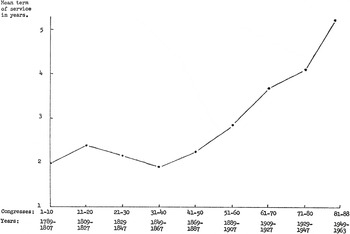
As to the political elites, the Congress served as a target of growing careerism. That trend had been developing since the end of the Civil War. Data reported in Polsby’s “institutionalization” article and reproduced in figure 1 show an almost linear increase in the average length of service of members of Congress, as a primary indication of the regularly-increasing attraction of a more nearly permanent home in the U.S. House from Reconstruction onward. Footnote 38
Institutionalization of the House circa 1900 and the Rise of the “Textbook Congress” of the 1950s: The Development of Careerism
Source: Polsby, Reference Poole and Rosenthal1968, Fig. 2, p. 147.

Institutional reforms in this period created new bonds between politicians and the public. These new relationships made possible the ambitious-candidate-centered elections that began in this period. Footnote 39 Thus, for example, Katz and Sala demonstrated that the Australian or secret ballot broke the links between party and the vote in such a way that an incumbent could imagine developing a personal vote for himself, independent of the vote for the party. Footnote 40
The direct primary election was a second reform aimed at weakening the worst excesses of machine politics. Footnote 41 According to Ansolabehere et al., “primaries were an important source of electoral competition during the first 30–40 years following their introduction, both in open-seat contests and in incumbent challenger races. This is no longer the case, however, except in open seat contests, where competition remains robust.” Footnote 42
The direct primary and secret ballot together made possible candidate-centered evaluations and voting. This worked disproportionately to the advantage of only one set of candidates, those who were already incumbents. They could use even a slight advantage in name recognition and favorability ratings to add to the usual partisan advantage in congressional districts that got them elected in the first place. Even such small gains could secure their return to the House, providing some insurance against the vagaries of the party-centric vote, over which the incumbent held little direct control.
The enhancement of power of the national government strengthened the incentive for an office-centered career ambition. That is, not only could they stay, but more ambitious politicians found that they wanted to stay in the highest possible office rather than following the more traditional, party-centric career path of rotation in office, a system parties had used to populate government and party posts in the more party-centric era. Footnote 43
To be sure there were many other important reforms of relevance in this period: voter registration, the spread of initiative, referendum and recall elections, reforming of city governments, and, looming on the horizon, female suffrage in 1920. And, of course, these were the national reforms, often targeted at reducing party machine power or dealing with the vast immigrant population. But the primary and the secret ballot (especially with office bloc design) were directly relevant and sufficient to show the logic and attraction of candidate-centric careers maintained through candidate-centered elections.
Candidate-Centered Campaigns and the Incumbency Advantage in Post-War America
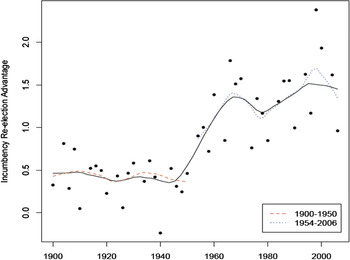
The development of a personal vote for the incumbent in Congress was discovered by Erikson and then Mayhew. Footnote 44 There have been several ways of measuring it. Alford and Brady proposed what they called their “slurge” measure, Footnote 45 Gelman and King offered a fuller and “unbiased” measure, and more recently Wilkins has reported a new measure, as reproduced in figure 2. Footnote 46 All point to a similar story. While there was a small incumbency advantage in the early twentieth century, the true incumbency advantage was primarily a product of the post War era, climbing in Wilkins’ measure to an average of 1.5 percent, or three times its earlier extent. Footnote 47 Roberts and Carson and Roberts attribute about 20 percent of the advantage to ballot structure. Footnote 48 The remaining 80 percent is then, at least according to Cox and Katz, primarily a “quality” advantage between the two candidates, by which they mean the ability of the incumbent to discourage entry of strong contenders and thus face weaker challengers. Footnote 49
Incumbency re-election advantage, 1900–2006
Source: “Electoral Security of Members of the U.S. House, 1900–2006,” Arjun S. Wilkins, Stanford University, unpublished manuscript., figure 3.

I propose that this advantage itself comes from two sources. The first is that the development of the “personal vote” in the 1950s and 1960s coincides with the time of deepest internal partisan divisions. This was especially true in the majority Democratic Party. While the division between northern and southern wings of the Democratic Party over racial and other issues began to appear in and after 1936, the salience of race grew dramatically in the public during the years of the Civil Rights Movement. This had the effect of reducing the value of the party label, and made obvious that what the Democratic Party stood for could be very different from place to place, even to the eyes of an inattentive public.
This was the era of the so-called “textbook Congress” that many see nostalgically, even if through rose-colored glasses. Footnote 50 By this Shepsle meant a congressional era dominated by a committee-centered division of power, allocated to individuals through sheer seniority designed to serve members’ interests in winning reelection. Footnote 51 It was so in part because it was an era of internal partisan differentiation and only relatively modest external party differentiation (or what Aldrich and Rohde call the condition in conditional party government being less well satisfied). Footnote 52 The primary reason for this was because the Democrats were seeking to hold a liberal northern wing and a conservative, deeply segregationist, southern wing together under one label, creating a large, durable, but not especially meaningful, majority (meaningful at least in terms of policy). The result was a label with little meaning and often little ability to ally across its own divides. And the Republican Party was only somewhat less internally divided. Thus, since power could not be allocated via party, it was allocated on other, seemingly “neutral” grounds such as seniority. Of course, that neutrality was fictitious when virtually or actually unopposed southern Democrats could gain seniority more easily than others, and thus could more easily than others gain key committee positions and powers (and since the Democrats were the majority party, they could gain chairmanships and other perks of majority status and powers). Footnote 53
As to the second source, the potential to strengthen the incumbency advantage had been there since the coming of the Australian ballot, but there had been no useful technology for large numbers of candidates, even incumbents, to develop a personal relationship with voters, beyond laboriously working their district retail. The coming of television slowly changed that. And while it was first the presidential candidates, particularly John F. Kennedy, who could take advantage of this new technology, it trickled down to lower (if still high) levels of office, such as to candidates for the House of Representatives. And those who were best positioned to take advantage of creating a personal vote were incumbents, who could raise the large sums of money newly needed to create a personal vote.
While that provides an edge over most challengers, it is not inevitable. It only takes enough money to help overcome the liabilities of being little known and therefore not taken seriously, and that is the third source of the ability to develop a personal vote. This begins to take hold in this period, but is particularly characteristic of the contemporary era. Indeed, the regime of campaign finance put in place in the wake of Watergate served to be particularly useful for incumbents. In particular PACs and other such beneficiaries of this finance regime were particularly interested in backing those who could win, perhaps even reaching out to those whose party and ideology ran in different directions from those of the PACs.
Backing winners meant supporting incumbents. Only when there was no incumbent running might funders turn next to those who would be the strongest challengers. Those strongest challengers were those already holding elective office high up the opportunity structure, often but a step or two below the Congress. These strongest challengers, however, had the most at risk, by virtue of holding such a high office already. Therefore they often found it better to await an incumbent’s retirement or scandal. That left inexperienced and (therefore) ill-financed challengers, whom no one thought could win, and therefore no one backed financially, making the prophecy of likely defeat come true.
The Watergate-era finance regime had to end before money would flow strongly into elections based more heavily on what candidates stood for and less heavily on the likelihood that those candidates would win. Footnote 54 Which in turn leads to the final era in which the parties develop ideological reputations, campaign funders value ideology more and winning less (and as a result candidates need attend less often to the accommodation that winning frequently entails), and thus on the potential for well-funded but less experienced and more ideological challengers to emerge in larger numbers and to use those funds to compete more effectively.
The Contemporary Era
Three tasks remain. The first is to account for the development of the contemporary instantiation of partisan polarization. The second is to explain the degree of parity in partisan support. The final step is to assess the degree of threat from the partisan “outside” or ideologically extreme flank in primaries or resources to counterbalance that of the pull to the “inside” induced by competition from the other party’s candidate in the general election.
What is odd about the twentieth century in these terms is not that it started and ended with polarized parties. What is odd is that there was a low degree of polarization in the middle. I attribute that primarily to the oddity of the Jim Crow South. As Poole and Rosenthal show (refer, for example, to “polarized America” in voteview.com) the two parties were strongly polarized in the U.S. House until about the 1920s, at least as measured by the distance separating the average member of each party in the House on their “first dimension” of roll-call voting. Party differences in the House declined, reaching a nadir around 1936 that increased very little at all through about 1976. Beginning then, there was a dramatic increase in polarization in House voting that surpassed the late ninetheenth and early twentieth century polarization early in the twenty-first century. Footnote 55
There are two possible sources of divisions within the parties: division among Democrats and division among Republicans. There were, of course, both in the mid-twentieth century (and indeed longer). Footnote 56 But the Democratic division was the more important, deeper, and more institutionalized. It was more important because, after 1932, the party had a working majority in the nation through at least 1980, if not 1994 (when the GOP carried the House for the first time since 1954). They didn’t win all elections but could count on winning most, with more identifiers in the public and the longest one-party run of congressional-election victories in American history. It was a deeper division because of race and especially in the1950s a liberal civil rights agenda led in government by northern Democrats with determined resistance to that in the South. It was, indeed, the heightened salience of race, induced by the successes of the Civil Rights Movement and broadcast-media coverage of same that deepened the division to, at times, simply incompatible positions. And it was institutionalized in the Jim Crow South by the creation of the institutions of the “lily-white” Democratic Party there and in Congress by the features of the “textbook” Congress that gave the South disproportionate weight.
The divisions within the Republican Party, if this view is correct, can be seen as the reflections of those on the Democratic side. To be sure, the Republican Party was divided between the northeastern wings of socially liberal, internationalists sometimes referred to as the “Rockefeller wing” of the party and the wing of “Main Street Republicans” more conservative socially and isolationist internationally. At least with respect to social liberalism, the Rockefeller wing retained the embodiment of the party of Lincoln. While it is quite probable that it was the minority wing of the GOP, they were successful in nominating one of their own for president from 1940 until 1964, when Goldwater defeated governor Nelson A. Rockefeller (NY) for the Republican nomination. Footnote 57
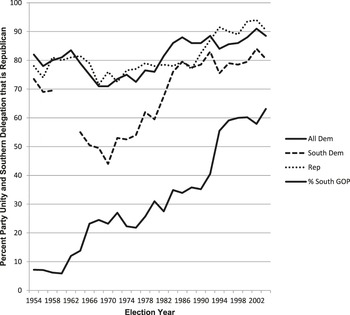
In this view, it is the actions of the majority party in passing civil rights and voting rights legislation, and the actions of the minority party in pursuing a “southern strategy,” that together broke the odd majority alliance of the New Deal Democrats. The consequence of breaking apart this coalition was what led to a “sorting” of party elites such that “liberal” and “Democrat” became synonymous, as did “conservative” and “Republican.” Once sorted into these two camps, the differences deepened into a true polarization. Figure 3 provides a kind of basic evidence to support this claim.
Party unity among all Republicans, all Democrats, and just southern Democrats and the growth of the Republican Party in the South, U.S. House, 1954–2006.

The top two lines of figure 3 report the average amount of time that members of Congress voted with their party when there was a party vote. Footnote 58 While party unity declined somewhat in the late 1960s and early 1970s, and while party support increased from the 70–80 percent to the 85–90 percent range in the 1990s and on, the two lines are relatively flat over time. Perhaps even more to the point, the Democrats were no less united or disunited than their Republican counterparts.
And yet, buried within the overall Democratic voting figures, are southerners. They began with party support only slightly less than the rest of their peers, but this declined precipitously to under 50 percent from 1968 to 1972, and then began a regular increase back towards levels similar to the rest of their party, in the 80 percent range. So, southerners defected from their party, even in votes that divided the two parties. And then the smaller number of southern Democrats began to return to their party at levels only somewhat less than their northern brethren, and at a time when inter-party separation was increasing.
The fourth line indicates the percent of southern seats that were held by the Republican Party. From roughly the turn of the twentieth century until the 1960s, the Republicans held only the few seats in the Appalachian Mountains. They began to contest seats almost exactly at the same time that southerners began to defect more from their party. At the nadir of southern Democratic support for their party, the GOP had climbed to about a quarter of the southern seats. This is, of course, upon passage of the Civil Rights and Voting Rights Acts, the time of Goldwater, and the ensuing southern strategy within the Republican Party. Southern incumbents might well have been feeling the heat of competition from their right for the first time—and voting accordingly to try to fend it off, at least in their district. As Republicans began to pick up more and more southern seats, southern Democrats were, for the first time in modern history, in competitive general elections. They were becoming like their northern counterparts in electoral circumstances (that is, with a reasonable expectation of regular competition from Republicans on their right). Those representing the most conservative seats increasingly lost them to the GOP. In other cases, heretofore conservative electorates had African-American and other more liberal voters added in. A more moderate voting record was thereby sustainable, perhaps even preferable for some incumbent Democrats. And, in short, almost by lockstep beginning in 1980 or so, Republicans piled up more and more victories, leaving only more moderate, perhaps even liberal, Democrats winning in the South. And thus, the southern wing became more like (but not identical to) the northern wing of the Democratic Party.
With that, Republicans became identifiably more conservative on all issues, including social ones. They began to lose support in more liberal areas of the country, such that New England, for example, elected nearly zero Republicans to national office. Partisan sorting became, increasingly, partisan polarization, and the condition for conditional party government became increasingly descriptive. In 1994, the Republicans not only won a House majority for the first time in nearly a half century, but their new leadership that year was almost entirely southern Republicans—for the first time ever. Footnote 59
The second question about competitive elections is easy to answer. It is the second half of the same story. The New Deal coalition was rather artificially held together and formed a majority because of the non-competitive South. Take the liberal portion of the electorate and add to it nearly a third of the electorate without a choice of supporting the other party and one can forge a majority in most elections. Take away the artificial constraint and let the South divide along similar partisan lines as the rest of the country, and elections become more competitive nationally. Given reasonably rational politicians seeking to win the presidency and they maneuver to do the best they can, which means that they reach the half most attuned to their appeal, as the other side does likewise to the other half. In two-party equilibrium, as it were, one expects something approaching a tied vote.
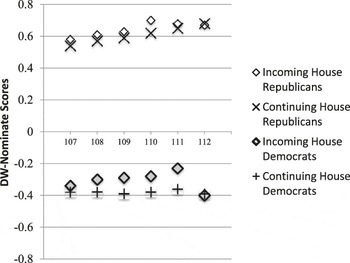
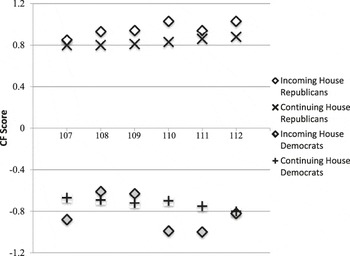
The final question is why might there be asymmetries between the two parties, as Mann indicates? Footnote 60 Republicans seem to many observers to be more extreme or less willing to compromise. There is some reason to believe this to be true. Poole–Rosenthal scores do show the Republicans more extreme to the right than Democrats are to the left. Consider figure 4, in which the xs mark the average nominate score of continuing members of the House and outlined diamonds indicate the positions of incoming members, by party, from the 107th (2001–2002) to the 112th (2011–2012) congress. Note first that, by the Poole–Rosenthal scaling, the continuing Republicans are quite a bit farther from the midpoint of zero than are the Democrats. Further, their extremity has increased every election year, while the Democrats scores remain more or less unchanging. Finally, note that incoming, newly-elected members are more moderate every year except the last among Democrats than are the continuing members, and they are essentially the same in the 112th congress. Among Republicans, the newly-elected are consistently a bit more extreme than their continuing counterparts, except again for the 112th.
Difference between continuing and newly-elected members to the U.S. House On DW-Nominate First Dimension Scores, 107th–112th Congresses

In figure 5, I report a different but closely related set of scores, those due to Adam Bonica. Footnote 61 These are scores culled from the positions of those giving money in support of the candidates. Here note that there is less difference in financial ideology than in Poole–Rosenthal roll-call voting ideology by party. Perhaps the Republicans are again more extreme, but it is not as vividly so. But, again, incoming Republicans have attracted more extreme money than continuing ones, year after year. Democrats have a mixed record by comparison. In two elections they attracted more moderate money, at least slightly, while in three it is more extreme and in the final election, it is a toss-up between continuing and new Democrats. While we cannot make direct comparisons between these two kinds of scores, we can see that Republicans appear to have a continuing pull to the extreme, perhaps to ward off Tea-Party-style challengers but more certainly to find more money. We can therefore hypothesize, if not show with certainty, that there is an asymmetry between the parties pulling Republicans harder to the extreme due directly or indirectly (or both) to more extreme concentrations of money in a post-Bipartisan Campaign Reform Act, post-Citizens United financial climate.
Comparing differences between continuing and newly-elected members to the U.S. House on DW-Nominate First Dimension Scores, with campaign funding scores 107th–112th Congresses

Conclusions
My central argument is that what many are calling the “dysfunctional” government of today is the consequence, in part, of a stream of institutional design decisions made throughout American political history. In many respects, the Constitution was designed for a different place and time, designed to solve a different set of problems than our own. The Madisonian problem, as it were, was how to create a viable nation—one that was small, still largely based on subsistence agriculture, isolated, and (once the slavery “compromises” were set aside) rather homogenous. It was also one that had been 13 separate and distinct entities, first colonies and then sovereign states, for 150 years. It is perhaps not surprising in this light that the Founders settled on an answer that was to design a government that could act in time of crisis, perhaps, but otherwise would only take actions when there was a high, indeed a very high, degree of consensus. Footnote 62 The problem was how to take a government that at that time was even unable to raise money via taxation and give it sufficient strength as to be viable, but not so strong as to raise the specter of that problem that gave rise to the move to independence in the first place. Footnote 63 This account of institutional development since the Founding has led us to today, with partisan polarization flourishing, with elections often not at risk locally but nation-wide in close balance between the two parties, and with candidates and officeholders pulled, on both sides, both left and right, all but freezing them into place.
Today’s polarization is novel to many living Americans. There is a tendency today to point nostalgically back to the 1950s, say, or even to the 1970s, with more than a hint of rose coloring one’s glasses, to an era when President Eisenhower and House Speaker Sam Rayburn, or to when President Ronald Reagan and House Speaker Tip O’Neill, could “reach across party lines” to work out bipartisan solutions to pressing problems. Footnote 64 If only such bipartisanship could be found today, the lament goes.
Not that long ago, no matter what one might have thought about what George C. Wallace stood for, many agreed with his claim that “there ain’t a dime’s worth of difference” between the two parties. Polarization is necessary to the contemporary account, however. That has now changed considerably, largely due to the long-run effects of the Civil Rights Movement in undermining the one-party, essentially non-democratic South. But polarization is also obviously insufficient for the kind of dysfunction lamented today. In the UK, even in the fabled 1950s with their high degree of polarization, the government was able to pass legislation and thus to take positive action on society’s problems. They could do so because whichever party held the majority in the House of Commons could enact almost anything they wanted.
And there is a third component, a polarized two-party system paired with a government with checks and balances needs also to be tied with regularly competitive elections between the two parties to create today’s dysfunction. The Jeffersonian solution of unified control would still work today, but only if one party holds unified control of government most of the time. But unified government is relatively rare today and often short-lived when it exists, precisely because the two-party polarized system is competitively balanced and polarized. Divided government, infrequent in the United States in the first half of the twentieth century, is now commonplace.
This summary suggests a number of new lines of inquiry for political scientists that are likely to yield answers of interest to the society more generally. Let me close with three. One relates to the public, one to officeholders, and one to interest groups and their activist members.
An implicit assumption here, but often explicit in the literature, is that the public takes its cues on what to believe from the candidates and officeholders themselves (at the heart of much research in political behavior, but see especially Zaller). Footnote 65 Recent events have posed what I believe to be a theoretically exciting challenge about the public and their beliefs. How can we explain massively different dynamic paths of two seemingly similar concerns, ones that touch more or less directly on values many hold? Jacob Montgomery analyzed all available polls on abortion policy and discovered that the aggregate shape of public opinion is essentially unchanged from the 1960s, in the pre-Roe v. Wade era, when there was essentially little public discussion of the issue, followed by periods in which discussion was dominated by mostly pro-choice arguments, or by the pro-life side, or by both positions over this long sweep. Footnote 66 That is to say that the public’s preferences over abortion appear to have been essentially immune to elite discourse, whether, to use Zaller’s terms, it was a one-sided discussion, a two-sided discussion, or no discussion at all among elites. Another direct value has instead been quite remarkably dynamic, but has appeared to be equally autonomous from elite discourse. It was only ten years ago that Republicans were happily encouraging ballot initiatives on gay marriage to coincide with the presidential election, because the overwhelming opposition to advances on that front would motivate turnout from these conservatives that would spill over to Bush’s and other Republicans’ advantages. Today such opinions and beliefs are held by only a minority and public expression of such views is in dramatic retreat. These two value-based policies are following extraordinarily different time paths. And yet they share one similarity. They seem to travel a dynamic essentially immune to elite political discourse, at least how the best of our science understands that relationship. What might we learn by considering alternatives to responsiveness to elite discourse when assessing the origins of politically relevant public opinion?
Second, what are the motivations of officeholders, and have they changed? We have two widely-believed versions of politics, in this regard, even within the common theoretical tradition of rational choice institutionalism. In one, the politicians are motivated by office seeking. This need to win—the electoral connection as Mayhew calls it Footnote 67 —not only can be used as a very good description of their behavior, theoretically and empirically, but it also may well be normatively desirable for democracies in particular (refer to Schlesinger, inter alia). Footnote 68
As to the alternative, the most important data base in this regard is the Congressional roll-call voting record and its use in, for example, Poole–Rosenthal scaling and other versions of inferring motivation from (copious mounds of) behavior. Their best evidence is that “members of Congress die in their ideological boots. That is, based upon the roll-call record, once elected to Congress, members adopt an ideological position and maintain their position throughout their careers—once a liberal or a conservative or a moderate, always a liberal or a conservative or a moderate.” Footnote 69 While less developed, there is a perfectly good theory of democracy with fixed elite positions. Voters select their favorite ideologue confident that this representative will remain faithful to the positions advanced in the electoral campaign. It is thus a sort of Darwinian selection process, but instead of politicians adjusting as best they can to their inference about what the public wants, the public picks and chooses what they want among the essentially fixed ideological entities. They change representatives only when the electorate itself changes its aggregate ideological beliefs sufficiently.
At one reasonably macro viewpoint, the two accounts may be observationally equivalent. But we live in the micro here and now. For this reason, we do care if Senator Coburn moves an amendment, or if Congress partially shutdowns for a week or two.
The correct account may be one based on a time dynamic. In a Congress with little partisan or ideological teeth, as in the 1950s and 1960s, it may attract those with little interest in partisanship or ideological outcomes. Footnote 70 And now, a highly charged partisan and ideological atmosphere may well attract those who find such circumstances congenial. This would not be surprising if members once emerged from win-oriented machines whereas today they emerge from those active in the world of policy advocacy.
Which one is true matters a great deal as well if we believe that Congress is dysfunctional. The strategy for reform will differ considerably if it is to revise the way the constituency relates to its member and what it expects by way of representation, if the goal is to get a Congress in which the member “panders” to the district’s median voter. Then we must find a way to reshape districts such that they are more likely to be mixtures of partisanship and ideology. If instead Congress is filled with those committed personally to the expression of ideology, then we must find a way to recruit and elect sufficient moderates. Or, if it is to a different dynamic that politicians today must pander, such as for raising resources from ideologically motivated groups and appealing to the disproportionately ideologically extreme partisans in primaries, then a third and different set of reforms come to mind.
Which leads to the final question: why is polarization, one of the necessary conditions for gridlock, still increasing? Is it, for one example, that we finally have a balance between the pull toward the center to win general elections and the push toward the extreme for nominations? While there is some evidence for the latter (as noted earlier) and while the possibility of anticipated reactions may mean that we cannot observe the effects of this push are unobservable, the very low levels of competition for most congressional nominations seem insufficient to account for such a large macro-phenomenon. Perhaps more promising, is it that the ever-present, ever-growing need for resources is generating the pull toward the extremes? If so, and if as the Supreme Court holds, money is speech, do those with more money therefore get to speak more loudly and thus wield greater influence? Should we be seeking something closer to a “one voice, one vote” standard so that there is something closer to an equal set of opportunities to wield influence, regardless of financial circumstances? Can shareholders actually shape the political expenditures of those large firms that supply so many resources currently? And if the firms need not reveal their identity in support of their political expenditures, is there realistically any way to balance their influence? Or, might there be reforms that distinguish money from speech in a constitutionally-appropriate fashion? These are but a few of the questions that come to mind today as we consider how to take today’s conditions to create the contemporary version of America’s more perfect union for our time.