Introduction
Every year 800000 people die from suicide, with a rate of 11.4 per 100000 (WHO, 2014). The WHO estimates that suicide represents 1.8% of the total global burden of disease and as such, suicide is a major, worldwide public health issue. It is well established that mental health problems are one of the key risks for suicide (Harris & Barraclough, Reference Harris and Barraclough1997). In a systematic review of psychological autopsies (i.e. retrospective interviews with relatives of the deceased and review of psychiatric/medical case notes), approximately 90% of people who had completed suicide had a pre-existing mental health problem (Cavanagh et al. Reference Cavanagh, Carson, Sharpe and Lawrie2003). However, cohort studies of specific diagnostic clusters suggest that as less than half of those individuals with mental illness experience suicidal ideation or make a suicide attempt (Novick et al. Reference Novick, Swartz and Frank2010; Robinson et al. Reference Robinson, Harris, Harrigan, Henry, Farrelly, Prosser, Schwartz, Jackson and McGorry2010; Hauser et al. Reference Hauser, Galling and Correll2013). In this context, focus on the presence of pre-existing diagnoses is important but provides only part of the picture on risk.
Research has identified a number of other risk factors for suicidal ideation and eventual suicide including social isolation (Trout, Reference Trout1980; Beautrais, Reference Beautrais2002; Eagles et al. Reference Eagles, Carson, Begg and Naji2003), psychiatric hospitalization (Beautrais et al. Reference Beautrais, Joyce and Mulder1998; Beautrais, Reference Beautrais2002), social and economic disadvantage such as unemployment and low income (Beautrais, Reference Beautrais2000), and psychological vulnerability (Beautrais, Reference Beautrais2000) such as negative appraisal biases and proneness to hopelessness (Brown et al. Reference Brown, Beck, Steer and Grisham2000; Acosta et al. Reference Acosta, Aguilar, Cejas and Gracia2013). Such research on risk factors is informative, yet examination of risk factors in isolation is of limited practical value. For example, how does social isolation link with suicidal ideation? Empirically validated models or explanations for the pathways through which these risk factors lead to subsequent suicidal behaviours are required.
One potential risk factor that has received comparatively little attention is the stigma associated with mental health problems and associated experience of discrimination (Rüsch et al. Reference Rüsch, Zlati, Black and Thornicroft2014). It has been suggested that the acceptance of stigmatizing beliefs about mental illness may influence levels of hopelessness (Livingston & Boyd, Reference Livingston and Boyd2010; Sharaf et al. Reference Sharaf, Ossman and Lachine2012). For example, if individuals accept that they have a mental health problem, and internalize the often negative stereotypes associated with mental illnesses (e.g. dangerousness, chronicity), they will feel more hopeless and despairing of their future. There is some evidence for this proposition, for example, people with mental illness who hold their in-group in ‘low group value’ (conceptually similar to stereotype agreement and internalized stigma) experience increased hopelessness, even after controlling for depression (Rüsch et al. Reference Rüsch, Corrigan, Wassel, Michaels, Olschewski, Wilkniss and Batia2009a ). Further, the cognitive appraisal of stigma as a stressor has also been shown to contribute to hopelessness (Rüsch et al. Reference Rüsch, Corrigan, Wassel, Michaels, Olschewski, Wilkniss and Batia2009a , Reference Rüsch, Corrigan, Wassel, Michaels, Olschewski, Wilkniss and Batia b ).
While there is emerging evidence that the stigma associated with mental health problems may contribute to individuals’ feelings of hopelessness, the experience of behavioural manifestations of stigma (i.e. discrimination) may be particularly defining in that it may be interpreted as confirmatory evidence of negative stereotypes and/or a reduction in status in the community. Perceived racial discrimination and experience of acculturation in minority ethnic communities has been associated with increased risk of suicidal ideation (Gomez et al. Reference Gomez, Miranda and Polanco2011; Wang et al. Reference Wang, Wong and Fu2013) and there are similar findings in the Lesbian, Gay, Bisexual and Transgender communities (Clements-Nolle et al. Reference Clements-Nolle, Marx and Katz2006; Cleary, Reference Cleary2012). However, we were unable to find any research linking the experience of discrimination due to mental health problems and subsequent suicidal ideation or behaviours.
In this context, this mixed methods study aimed to:
-
(1) describe the proportion of service users who were at risk of suicide and the extent to which discrimination is linked to suicidality (a pragmatic term for the constellation of suicidal ideation and attempts, self-harm and hopelessness studied here);
-
(2) explore the process through which discrimination is linked to suicidality from the perspectives of service users using qualitative data;
-
(3) test the model of service users’ perspectives (produced in aim 2) of the link between discrimination and suicidality, using quantitative methods.
Method
The MIRIAD (Mental Illness-Related Investigations on Discrimination) study is a cross-sectional study of 202 individuals using secondary mental health services in South London, funded by the National Institute for Health Research as a part of the SAPPHIRE programme (http://www.sapphire.iop.kcl.ac.uk). Data were collected between September 2011 and October 2012. The study was approved by the East of England/Essex 2 Research Ethics Committee (ref. 11/EE/0052).
This paper presents an analysis of the association between experiences of discrimination and suicidal ideation amongst MIRIAD participants. Recruitment of the sample has been described elsewhere (Farrelly et al. Reference Farrelly, Clement, Gabbidon, Jeffery, Dockery, Lassman, Brohan, Henderson, Williams, Howard and Thornicroft2014) but is briefly described below. Qualitative and quantitative data were collected at the same time. Qualitative data analysis was conducted before the quantitative data to lessen the risk of bias. In this way, qualitative data were prioritized. The two sets of data were integrated at the point of quantitative analysis by using the quantitative data to investigate proposed qualitative theoretical framework.
Recruitment and sample
Inclusion criteria for participants were: aged at least 18 years; a clinical diagnosis of either major depression, bipolar or schizophrenia spectrum disorders (ICD-10: F32, F21 and F20-F29, respectively); self-defined Black, White or Mixed (Black and White) ethnicity; current treatment with a community mental health team; sufficiently fluent in English to provide informed consent; and sufficiently well for participation to not pose a risk to their or others’ health or safety. We did not include people of Asian ethnicities due to low prevalence numbers in the target area.
Service user participants were recruited from community mental health teams in South London. Staff in the community mental health teams were approached for their approval to participate in the study and provided with a list of eligible service users. Clinicians were asked if the service user was sufficiently well to participate, and if so, a letter was posted to the service user inviting them to contact the research team if they were interested in participating. This letter was followed by a reminder flyer if there had been no response within 1 month.
As reported elsewhere (Farrelly et al. Reference Farrelly, Clement, Gabbidon, Jeffery, Dockery, Lassman, Brohan, Henderson, Williams, Howard and Thornicroft2014), 4233 service users were screened for eligibility for inclusion in the MIRIAD study. A total of 1345 (31.7%) were eligible and were invited to participate; of these 207 (15.4%) service users provided written and informed consent. There were no differences between eligible consenting and eligible non-consenting service users in terms of diagnoses, age, gender and ethnicity. Five service users were excluded after interview due to incorrect diagnoses (n = 4) or incomplete data (n = 1), leaving 202 participants for the overall MIRIAD sample.
Data collection
Research assistants administered the interview to consenting service users. The quantitative interview schedule collected demographic clinical information and contained a battery of measures on stigma, discrimination and access to physical and mental healthcare; those relevant to this paper are detailed below. Clinical data, including diagnoses generated by clinicians, were also extracted from electronic patient records.
At the end of the quantitative interview, participants were asked the following screening questions: ‘Have stigma or discrimination ever contributed to you having feelings of hopelessness, you self-harming yourself, you having thoughts about suicide, or to you attempting suicide?’ Those who responded affirmatively to any of these were asked for examples of this and prompted to elaborate. These responses were audio-recorded and transcribed. For analysis, a purposive sub-sample of 60 participants was selected for analysis based on gender, ethnicity and self-reported diagnosis. Two of these participants were subsequently excluded from the overall study as information later collected their clinical notes indicated they did not met the diagnostic eligibility criteria, making a total sub-sample of 58 for the qualitative analyses.
Measures
Suicide Behaviours Questionnaire (SBQ; Linehan, Reference Linehan 1996 ). The SBQ is a 4-item self-report version of the widely used 34-item SBQ. The revised brief version was shown to have good psychometric properties with α = 0.87 and differentiated between those with clinically assessed suicide risk and those not at risk (Osman et al. Reference Osman, Bagge, Gutierrez, Konick, Kopper and Barrios2001). Each of the four items is rated on a likert scale: lifetime suicide ideation and attempts (1 = ‘never’ to 4 = ‘I have attempted’); past 12 months frequency of ideation (1 = ‘never’ to 5 = ‘very often’); communication of suicide intent to others (1 = ‘no’ to 3 = ‘yes, more than once’); and self-assessed likelihood of suicide attempt in the future (0 = ‘never’ to 6 = ‘very likely’). A total score is obtained by summing all four items. Higher scores on the SBQ-R mean greater suicidality, with scores ⩾8 indicating suicide risk.
In addition to the SBQ, we also analysed participants’ responses to the screening questions for the qualitative component.
Discrimination and Stigma Scale (DISC; Brohan et al. Reference Brohan, Slade, Clement and Thornicroft 2013 ). The DISC is an interviewer-delivered measure of experiences of discrimination (‘unfair treatment’) in the last 12 months due to having a diagnosis of mental illness. Participants report experiences of discrimination across 21 items including employment, parenting, mental health treatment, dating or intimate relationships and the extent to which participants had been avoided or shunned by people on a 4-point Likert scale [not at all (0), a little (1), moderately (2), a lot (3)]. The DISC has good psychometric properties (Brohan et al. Reference Brohan, Slade, Clement and Thornicroft2013). A ‘severity’ score (range 0–3) was calculated by adding each item score (0, 1, 2 or 3) and dividing by the number of applicable, non-missing items in the subscale.
Stigma Stress Scale (SSS; Rüsch et al. Reference Rüsch, Corrigan, Wassel, Michaels, Olschewski, Wilkniss and Batia 2009a ). The SSS is an eight-item measure completed in interview. Four items assessed the extent to which stigma was appraised as personally harmful (e.g. ‘Prejudice against people with mental illness will have harmful or bad consequences for me’). Four additional items measured appraisal of perceived resources to cope with stigma (e.g. ‘I have the resources I need to handle problems posed by prejudice against people with mental illness’). Items are scored from 1 to 7 with higher scores equalling higher agreement. A ‘stress appraisal’ variable (SSA) was computed by subtracting perceived resources from perceived harmfulness. A higher difference score indicated the appraisal of stigma as stressful and as exceeding personal coping resources.
Beck Hopelessness Scale (BHS; Beck & Steer, Reference Beck and Steer 1988 ). The BHS is a self-completed measure assessing hopelessness. The version used in this study had a 5-point Likert scale (ranging from 1 ‘strongly agree’ to 5 ‘strongly disagree’) on 20 items. A total score was calculated by summing the items (possible range 20–100).
Internalized Stigma of Mental Illness Scale (ISMI; Ritsher et al. Reference Ritsher, Otilingam and Grajales 2003 ). The ISMI is a 29-item measure that assesses mental health service users’ experience of internalized stigma. Items such as ‘I feel out of place in the world because I have a mental illness’, are self-rated on a 4-point Likert scale. Strong internal consistency and test–retest reliability have been reported (Ritsher et al. Reference Ritsher, Otilingam and Grajales2003). There are five subscales including a 5-item ‘Discrimination Experience’ subscale, which due to being conceptually similar to the DISC was excluded. A total score was generated by summing the remaining 24 items.
Confidant. A binary variable regarding the presence/absence of a confidant was calculated based on the participants’ responses to three questions about their social network: ‘Of the people you see regularly, is there someone you consider a friend?’, ‘Do you have a best friend you can confide in?’, ‘Are you particularly close to someone in your family?’
Data analysis
Qualitative interviews were audio-recorded and transcribed by an independent transcriber. Transcripts were read while listening to recordings to check for accuracy. Transcripts were imported into NVivo 9 (QSR International's NVivo 9 software) together with respondent's gender, diagnosis and ethnicity. A framework analysis was conducted (Ritchie & Spencer, Reference Ritchie, Spencer, Bryman and Burgess1994). This analysis method is a five-stage method for analysing qualitative data and is widely used in social policy and health services research. In the first stage – the Familiarization Process – D.J. and S.C. immersed themselves in the data by reading all the transcripts and making notes of the recurring and salient ideas and themes in the data. In stage two – Developing a Thematic Framework – D.J. developed a ‘thematic framework’ or list of recurring themes from the familiarization process. In the Indexing stage, D.J. applied the thematic framework to the data and coded each part of text, merging and creating new themes as necessary. In stage four – Charting, data were organized in thematic charts in an Excel spreadsheet. Data were lifted from the transcript and placed in charts organized according to theme. This process was undertaken independently by D.J. and S.C. who met to agree any disparities. Finally, team members (D.J., S.F., S.C.) synthesized the data by comparing themes and sub-themes, merging, splitting and re-naming these as required and noting any associations or links between the themes. A schematic diagram representing the process of participant's experiences was produced and the final model agreed.
Quantitative analyses were conducted using Stata v. 11 (StataCorp., USA) and Mplus (http://www.statmodel.com/). The proportions of participants at risk of suicide (SBQ score ≥8) and the proportion reporting discrimination as a contributory factor to the suicidality indicators (i.e. qualitative screening questions) were reported. A path analysis was fitted in Mplus to test the proposed model linking discrimination experiences to subsequent suicidality as described by participants in the qualitative interviews, using maximum likelihood (ML) estimation, boostrapped standard errors and confidence intervals, and excluding those with missing data on predictor variables. To assess the overall fit of the model, the following indices were used: the χ2 statistic where non-significant scores indicate acceptable fit; the comparative fit index (CFI) for which values between 0 and 1 and >0.95 indicate good fit; the Tucker–Lewis Index (TLI) where scores >0.90 are considered acceptable fit; and the root mean square error of approximation (RMSEA) where scores <0.08 indicate reasonable fit.
Ethical standards
The authors assert that all procedures contributing to this work comply with the ethical standards of the relevant national and institutional committees on human experimentation and with the Helsinki Declaration of 1975, as revised in 2008.
Results
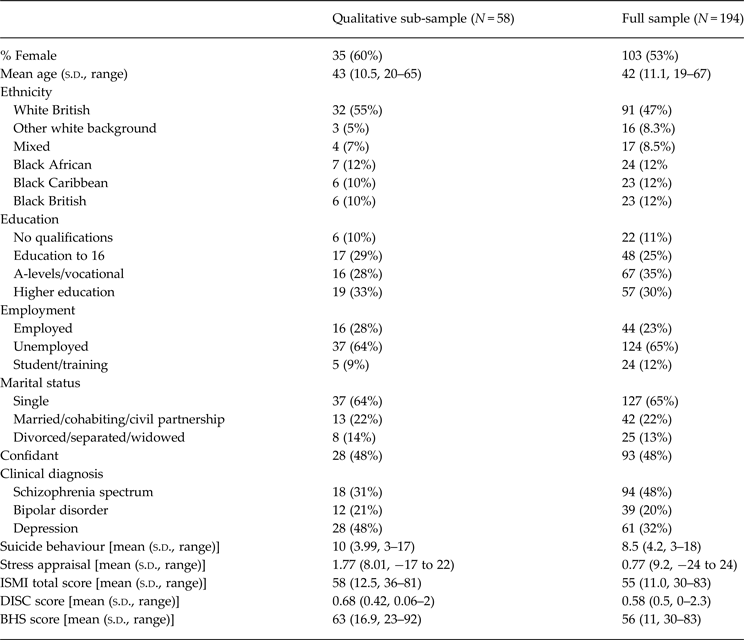
Eight individuals did not complete the SBQ and therefore the total sample for this study was 194. A sub-sample of 58 individuals was included in the qualitative analysis. The socio-demographic characteristics of the full and qualitative sub-sample are shown in Table 1. There was a greater proportion of people with a clinical diagnosis of depression in the qualitative sub-sample compared to the overall sample, but otherwise the two samples were similar.
Participants’ socio-demographics and clinical characteristics

s.d., Standard deviation; ISMI, Internalized Stigma of Mental Illness Scale; DISC, Discrimination and Stigma Scale; BHS, Beck Hopelessness Scale.
Experience of suicidality
Of the 194 participants, 38% had experienced thoughts of, but had never attempted, suicide, and 36% of the sample had attempted suicide. Over half (55%) of the sample had thought about suicide in the past year, 18% of whom had considered it ‘very often’. While most (80%) thought it was unlikely that they would attempt suicide in the future, 20% of the sample reported that it was either rather likely or very likely that they would attempt suicide. Using the cut-off of 8 points suggested by the SBQ authors, 50% of the sample were at risk of suicide.
The experience of stigma and discrimination led 65% of the sample to have feelings of hopelessness. A substantial minority (21%) reported that stigma and discrimination contributed to their self-harm episodes, 38% reported that it led to suicidal feelings, and 20% reported that it had contributed to making a suicide attempt. For the sub-sample of participants who had made a suicide attempt in the past, 48% of these individuals reported stigma and discrimination contributed to their decision.
Links between discrimination and suicidality – qualitative analyses
Following indexing, a model containing core themes linking the experience of discrimination to hopelessness and suicidality was devised. The core themes were: being treated unfairly is a stressor; this affects how I feel about myself; and isolation from supportive social structures. The theoretical framework organizing these themes to hopelessness and suicidality is shown in Fig. 1.
Model derived from qualitative analysis with proxy variables from quantitative analysis and path coefficients. Variables from qualitative analyses are shown in the figure within quotation marks; quantitative proxy variables are in parentheses. DISC, Discrimination and Stigma Scale; ISMI, Internalized Stigma Scale; BHS, Beck Hopelessness Scale; SBQ, Suicide Behaviours Questionnaire. Scores are standardized path coefficients; * significant at 0.05 level; ** significant at 0.01 level.

Being treated unfairly or differently is a stressor
The experience of being treated differently from others or from one's conception of what is fair and reasonable was a source of significant stress for participants in this study. Participants described a range of experiences from interpersonal interactions to being denied access to work and support. Participants spoke about how they were laughed at or called names like ‘schizo’ or ‘mad’. Others described how people were cautious around them or actively avoided them. Many participants described how medical staff made assumptions about them based on their diagnosis, for example,
Originally it was assumed that I was making the [physical] illness up because it's actually hard to find with blood tests or anything. They couldn't find it so they saw mental illness in my history and just assumed I was making it up and indeed, one doctor said ‘When was the last time you had a schizophrenic attack?’
In this sub-sample, several participants described difficulties in relation to work – either finding or keeping a job after disclosing their mental health problems. For many, employers’ reactions to mental health problems exacerbated their symptoms by creating additional stress. For example,
I got ill in October this year, and I got ill in June this year and, erm, I know that the pressure of feeling that I shouldn't be ill again and I was letting them down and they were going to want to sack me and all of that. I know that pressure contributed to my mental illness, my feelings of hopelessness and desperation.
One participant described developing a mental health problem after working for an organization for several years. This participant felt that despite her good work and loyalty, as soon as she was unwell her employed abandoned her and made it very difficult to continue working. This experience led to feeling worthless, isolated and distrustful as the people that she thought would support her let her down.
This affects how I feel about myself
For some the experience of mental health problems or diagnosis was related to negative thoughts about themselves. However, for most participants in this sub-sample, it was the experience of unfair treatment that led to negative feelings about themselves. For example,
I feel like it is myself and people around me who are doing the stigma. The stigma from others leads me to stigmatize myself, which in turn leads to disinterest that leads to feelings of hopelessness.
In this category, most participants described how unfair treatment led them to feeling worthless and that their lives lack value:
It's not every day you're unwell. Just because you're in the system and you have mental health problems, doesn't mean you're unwell all the time. I don't think it is right. In the ideal world none of this would be going on. People take the mickey and it's not fair… [It] makes me feel small and unimportant. Don't feel equal. It belittles me.
Several participants described how unfair treatment made them feel trapped – that they had few options or that they were out of control of their life.
If I admitted that I was schizophrenic, they say, what, this man is schizophrenic he's making the illness up, or if I deny it I'm schizophrenic then I'm in denial and I'm therefore mad and not to be treated. I was trapped.
Isolation from supportive social structures
Being treated unfairly by others and feeling negatively about oneself led to feelings of isolation through three processes: taking oneself away to avoid anticipated unfair treatment; unfair treatment reinforced feelings of being different from others and others not understanding; and finally, isolation due to not being able to engage in or actively excluded from normative life experiences such as work and relationships.
Participants described how others avoided them once they found out about their mental health problems. As a result, many of these participants avoided social interactions as a preventative measure. For example,
Hopelessness well it's like everything like as soon as you mention bipolar to anybody they tend to sheer away and distance themselves from you, like with everything.
I've isolated myself so much it's like been on a desert island and nobody wants to be there.
Many participants described feeling isolated as a result of feeling different from others and/or trying to seek help but finding that no one really understood their problems or concerns. This lack of understanding occurred in relation to their mental health problem, and also feelings of suicidality. For example,
I tend to find that when you say you feel low and you're going to commit suicide because of your mental state I think they don't believe that you do or you will. I think there's a lot of disbelief in what you will do. And I think sometimes they think you're making up your emotions as well.
All I know is that I'm not like other people and a lot of people haven't got time for depression and they haven't got time for dips in moods and they'll quickly jump on you if you don't want to interact with them. You quickly become bullied.
Others described the difficulties in getting professional help as an additional stressor which created feelings of isolation and being trapped. For example,
I went there for help. I finally plucked up the courage to get the help, and when I finally got there for help I didn't get any help. I was just, it felt like I was being discriminated against. That they just weren't interested or didn't believe me.
The authorities, the people that are meant to be there to help you and you just get to this brick wall and you just can't seem to get over it, you can't seem to be able to do anymore, to help your own situation so you just feel like giving up I suppose.
Not being able to access help or support, led participants to feel like they needed to deal with both the stress of their mental health problem and the feelings of being treated unfairly on their own. For some participants feeling alone and without support exacerbated already stressful situations and exceeded their internal coping resources.
I was ashamed that I was an alcoholic. And my [work] was going down the pan and I couldn't explain [to others] why, I just knew why, that I was drinking too much […]. And I started getting little snide remarks […]. And I sort of held it in and couldn't take no more.
Further, experience of unfair treatment altered participants’ trust in others – the ensuing social isolation and not being able to rely on others for support meant they often felt out of control or trapped. This in turn meant that they anticipated that their experiences would never improve:
Misunderstanding and discrimination does have a, has had an impact on me with relationships and so I think, in low moments, ‘Am I just going to be on my own?’
The whole experience of being rejected in a sense through work and feeling that nobody would ever … and getting to the point where you think ‘Well nobody's ever going to employ me on a full-time basis’. That can definitely lead to feelings of hopelessness.
In summary, the experience of discrimination or unfair treatment as a stressor led to negative thoughts about themselves and a perception of decreased supportive networks/social structures. These lack of social networks or normative social structures (e.g. work) meant that individuals felt isolated and by themselves in dealing with both unfair treatment/discrimination and (sometimes interrelated) mental health problems. The anticipation of further negative events and treatment, and the perception of a lack of supportive networks led individuals in this study to feelings of being trapped and hopeless regarding the future, and then onto feelings of suicidality (see Fig. 1).
Quantitative analyses
We used measures collected in the full sample to construct a model that closely matched the one identified by the qualitative analysis. The measures were: experienced discrimination (DISC score for ‘unfair treatment’), internalized stigma (ISMI total score for ‘this affects how I feel about myself), availability of a confidant (confidant variable), stress appraisal (SSA) and hopelessness (BHS score); and SBQ total score for suicidality.
Results from the path analyses indicate some support for the model. See Fig. 1 for the standardized path coefficients (StdYX). The CFI was 0.95; CFIs >0.95 indicate good fit. The TLI was 0.922; scores >0.90 are considered acceptable. The RMSEA was 0.076 (95% CI 0.025–0.125); scores <0.08 indicate reasonable fit. The χ2 was [χ2 (df = 9) = 18.79, p < 0.05], which does not support fit; however, the χ2 statistic can be overly conservative, particularly in larger sample sizes with fewer parameters as is the case in for these analyses.
The effect of experienced discrimination on stress appraisal was statistically significant (coefficient: 5.48, 95% CI 2.97–7.99, p < 0.01; StdYX: 0.298). Stress appraisal was significantly linked with internalized stigma (coefficient: 0.609, 95% CI 0.44–0.77, p < 0.01; StdYX: 0.508) and presence of a confidant (coefficient: 0.01; 95% CI 0.003–0.019, p < 0.01; StdYX: 0.021). The were significant effects on hopelessness from confidant (coefficient: 4.47, 95% CI 0.577–8.365, p < 0.05; StdYX: 0.141) and internalized stigma (coefficient: 0.681; 95% CI 0.507–0.855, p < 0.01; StdYX: 0.474). Finally, hopelessness has a significant effect on suicidality (coefficient: 0.146, 95% CI 0.015–0.146, p < 0.01; StdYX: 0.544). Overall the model accounted for 29.5% of the variance in SBQ scores.
Discussion
In this study of 194 mental health service users, we found 50% had suicide behaviours scores indicating risk of suicide. Our theoretical model suggests that the experience of discrimination is linked with suicidality through affecting an individual's trust in the availability of help, feelings regarding their own self-worth and through creating additional stress which may exceed the individuals’ own coping resources. These experiences are associated with feelings of being trapped, out of control and hopeless for the future. Our exploratory quantitative analyses provided initial support for an association between these themes and subsequent suicidality.
One of the key factors influencing suicidal behaviours in this study was the relationship between the experience of discrimination as a stressor and feelings of social isolation. Unfair treatment led participants to distrust that others would understand their experiences or would provide help should it be required. Further, participants described how the exclusion from normative social structures such as work and supportive interactions confirmed for them that as an individual with mental health problems, they lacked sufficient status to be treated fairly by members of their community, thus confirming or leading to internalized feelings of low worth. Finally, not being able to rely on support from others lead to people isolating themselves, partly for self-protection against further disappointment. A lot has been written about the influence of social isolation in suicidal behaviours (see Wray et al. Reference Wray, Colen and Pescosolido2011 for a review); however, many studies appear to place the responsibility for social isolation with the individuals themselves, as lacking the capacity to maintain relationships with others (Trout, Reference Trout1980; Lester, Reference Lester1994). For example, studies of suicide behaviours amongst men suggest that adherence to notions of ‘masculinity’ by concealing distress or an inability to recognize distress are contributory factors to subsequent suicide (Cleary, Reference Cleary2012). These themes, in particular the concealment of distress, were present in our study, however rather than being a deficit of the individuals, our data place these experiences within a social context that does not facilitate or support such disclosure of distress, and may in fact be the source of distress.
In the late 19th century, Emile Durkheim proposed that rates of suicide were partly associated with the extent to which individuals felt integrated with society and societal groups such as work and family (Durkheim, Reference Durkheim1951/1897). Durkheim proposed that a more dislocated society would lead to increased rates of suicide. More recent sociological accounts use network theory to specify the relationship between suicide and the ‘presence or absence of interlocking social relationships’ (Wray et al. Reference Wray, Colen and Pescosolido2011, p. 520). Our theoretical model would suggest that a mediator in this relationship could be discrimination. A more dislocated society with low social cohesion, would view individuals with mental health problems as ‘other’. The more ‘other’ such individuals are considered, the easier it becomes to treat them unfairly (Benning et al. Reference Benning, O'Leary, Avevor and Avevor2006), leading to a lack of support, isolation and negative self-worth. More recently, the association between social isolation and subsequent suicide has been discussed at an individual level in the ‘Interpersonal-psychological theory of suicide’ (Joiner, Reference Joiner2005) which has three main components: ‘perceived burdensomeness’; ‘low belonging/social alienation’; and ‘acquired ability to enact lethal self-injury’. The first two of these components appear particularly pertinent to these data. Perceived burdensomeness is the sense that one is burdensome to friends, family or society and seems similar to notions of internalized stigma, that is, feelings of low self-worth and being unable to usefully contribute. Low belonging/alienation refers to the feelings of not being an integral part of a valued group. Our data suggest that people's experience of discrimination contribute to both of these components by undermining their trust in others. It is clear from our analyses that factors influencing suicide are active at both the individual and societal levels (Wray et al. Reference Wray, Colen and Pescosolido2011).
This study has a number of strengths. Qualitative data enable the development of a proposed pathway through which discrimination may lead to suicidal behaviour, rather than examining such variables in isolation. The use of mixed methods enabled both the development of a theoretical model and quantitative testing within the same sample. Further, the model indicates firstly, how suicidality is influenced by both individual and social level factors, and secondly, the need for research and prevention strategies which address both levels (Wray et al. Reference Wray, Colen and Pescosolido2011). There are also limitations to these data. Our research aims were to capture the perspectives of service users on the link between discrimination and suicidal behaviours and to test this quantitatively. The model generated from the qualitative analyses and tested quantitatively, is linear in nature. However, more recent theoretical discussions of suicidality suggest that this process is more complex with direct and indirect effects. In this context, it is possible that our design which prioritized the perspectives and understandings of the service users led to an overly simplistic account of the links between discrimination and suicidality and therefore require replication and further exploration. Additionally, participants knew it was a study on discrimination and therefore the sample may over-represent those with discriminatory experiences to report. Similarly, the overall MIRIAD sample was recruited from individuals engaged with secondary mental health teams, who were sufficiently well at the time of participation to not pose a risk to themselves or others. In this context, the findings of this study may not generalize to those with more severe symptoms and/or those who are not engaged with service, or indeed those whose lived experience of mental illness may not meet threshold for secondary services. A further limitation is that the authors were involved in a research programme examining the impact of stigma and discrimination on mental health and may have therefore been primed to see such links in the data. However, the rigorous qualitative analytical process, the involvement of different authors at different stages of the analysis and the repeated checking of the fit of emerging themes with the participants’ own data, reduced the risk of bias erroneously influencing the results. Further, the testing of quantitative exploration of the model developed from qualitative analysis, provides preliminary support for its validity. Nevertheless, these findings do require replication. A further limitation is the lack of consideration of ethnicity in the model. Participants did not raise ‘ethnicity’ as a concern in the qualitative interviews and therefore it was not added to our conceptual model. Analyses using the same dataset (see Gabbidon et al. Reference Gabbidon, Farrelly, Hatch, Henderson, Williams, Bhugra, Dockery, Lassman, Thornicroft and Clement2014) suggest that those of black ethnicity are more likely to attribute negative experiences to their ethnicity than other ethnic groups. In this context, further analyses should consider the impact of ethnicity to suicidality (Wray et al. Reference Wray, Colen and Pescosolido2011). The study design was cross-sectional and thus it is difficult to make strong assertions regarding direction of effects and causality. However, we felt justified in conducting a path analysis and making preliminary comments regarding the directionality of effect, based on our qualitative data in which participants described a clear progression of events. However, the proposed model requires testing in a longitudinal study.
Conclusion
Previous research has shown that individuals with a diagnosis of mental illness continue to experience high levels of negative discrimination (Thornicroft et al. Reference Thornicroft, Brohan, Rose, Sartorius and Leese2009; Lasalvia, Reference Lasalvia, Zoppei, Van Bortel, Bonetto, Cristofalo, Wahlbeck, Bacle, Van Audenhove, Van Weeghel, Reneses, Germanavicius, Economou, Lanfredi, Ando, Sartorius, Lopez-Ibor and Thornicroft2013). Our model suggests that such experience of discrimination may contribute to subsequent suicidal behaviour by confirming the individual's low social status and undermining their trust in others and their community, leading to feelings of isolation and hopelessness. This raises the important possibility that population level anti-stigma interventions that reduce the occurrence of discrimination may also provide some protection against suicide amongst individuals with mental health problems (Rüsch et al. Reference Rüsch, Zlati, Black and Thornicroft2014). Additionally, psychological interventions aimed at improving stress coping resources and self-stigma may also provide some protection against suicide.
Acknowledgements
This publication is independent research funded by the National Institute for Health Research under its Programme Grants for Applied Research scheme (Improving Mental Health Outcomes by Reducing Stigma and Discrimination: RP-PG-0606-1053). The views expressed in this presentation are those of the author(s) and not necessarily those of the NHS, the National Institute for Health Research or the Department of Health. G.T. is also funded in relation to the NIHR Specialist Mental Health Biomedical Research Centre at the Institute of Psychiatry, King's College London and the South London and Maudsley NHS Foundation Trust. G.T. is an Honorary Professor at the University of KwaZulu Natal, Durban. We would like to thank the MIRIAD participants who generously gave their time and stories to this study. The qualitative data have previously been presented in poster format at the following conference: 5th International Stigma Conference, Ottawa, Canada, 3–5 June 2012.
Declaration of Interest
None.