Introduction
Gastropods of the family Turritellidae, subfamily Turritellinae (sensu Marwick, Reference Marwick1957) are a diverse clade with some 150 valid Recent and 800 fossil species (Allmon, Reference Allmon2011). They are often among the most numerically abundant gastropods in shallow subtidal habitats and are an important component of many modern marine benthic communities across the world, such as in the Gulf of California (Allmon et al., Reference Allmon, Jones and Vaughan1992; Waite & Allmon, Reference Waite and Allmon2013), Danish waters (Thorson, Reference Thorson1957), North Sea (Buchanan & Moore, Reference Buchanan and Moore1986), English Channel (Capasso et al., Reference Capasso, Jenkins, Frost and Hinz2010), Baltic Sea (Gogina et al., Reference Gogina, Nygård, Blomqvist, Daunys, Josefson, Kotta, Maximov, Warzocha, Yermakov, Gräwe and Zettler2016), Aegean Sea (Dimitriadis et al., Reference Dimitriadis, Koutsoubas, Garyfalou and Tselepides2014), Red Sea (Fishelson, Reference Fishelson1971), South Africa (Herbert, Reference Herbert2013), India (Khan et al., Reference Khan, Manokaran, Lyla and Nazeer2010), China (Shu et al., Reference Shu, Chen, Li, Yu and Feng2015; Li, et al., Reference Li, Du, Gu, Ning and Wang2016; Xu et al., Reference Xu, Li, Ma, Dong, Kou, Sui, Gan and Wang2017; Zhang et al., Reference Zhang, Gao, Shi and Lü2017; Lu et al., Reference Lu, Zhu, Xu, Zhou, Dai and Lu2018), Venezuela (Petuch, Reference Petuch1976), and New Zealand (McKnight, Reference McKnight1969; Allmon et al., Reference Allmon, Jones, Aiello, Gowlett-Holmes and Probert1994). Turritelline fossils are also found in such very high numbers in some localities that they can form turritelline-dominated assemblages (TDAs), defined by Allmon (Reference Allmon2007: 513) as ‘a macrofaunal assemblage in which turritelline gastropods (1) comprise either at least 20% of the total actual or estimated biomass or at least 20% of the macroscopic individuals in the assemblage, and (2) are at least twice as abundant as any other macroscopic species in the assemblage’. Despite their abundance, however, knowledge of the modern ecology of such assemblages is still insufficient to fully understand their ecological significance or mode of formation (Allmon, Reference Allmon1988, Reference Allmon2011). In general, high numerical abundance of a species can suggest its ecological dominance over other species within a marine benthic community (Nephin et al., Reference Nephin, Juniper and Archambault2014) and this might also be the case for turritelline gastropods. Although direct observations are limited, a variety of proxy and circumstantial evidence suggests that high abundance in living turritellines may be associated with high levels of nutrients and primary productivity (Allmon, Reference Allmon1988, Reference Allmon2011; Allmon et al., Reference Allmon, Jones and Vaughan1992, Reference Allmon, Jones, Aiello, Gowlett-Holmes and Probert1994; Teusch et al., Reference Teusch, Jones and Allmon2002), conditions which also appear to have characterized turritelline-rich communities in the geological past (Allmon, Reference Allmon1992; Jones & Allmon, Reference Jones and Allmon1995; Anderson et al., Reference Anderson, Hendy, Johnson and Allmon2017; Anderson & Allmon, Reference Anderson and Allmon2020).
Situated in the subtropics and in close proximity to the marine biodiversity hotspot of the western Indo-Pacific region (Tittensor et al., Reference Tittensor, Mora, Jetz, Lotze, Ricard, Berghe and Worm2010), Hong Kong has a dynamic marine environment and a rich diversity of marine life, ranging from temperate macroalgae to tropical corals (Ng et al., Reference Ng, Cheng, Ho, Lui, Leung and Williams2017). Quantitative data on turritellines have been reported from Hong Kong waters since the 1970s, showing that they have sometimes comprised 50–90% of the total benthic biomass (e.g. Wu & Richards, Reference Wu and Richards1981; Taylor, Reference Taylor and Morton1994; Leung & Morton, Reference Leung, Morton and Morton2000). Cumulatively this dataset on turritelline abundance through time may be the largest in the world. Many of these reports have listed Turritella terebra (Linnaeus, 1758) as the most common species, but it is now clear that most if not all of these actually refer to Turritella bacillum Kiener, 1843, which is closely related to Turritella terebra (see Sang et al., Reference Sang, Friend, Allmon and Anderson2019). The coastal waters of Hong Kong have undergone substantial anthropogenic environmental changes since those first surveys, which can be attributed to bottom trawling, dredging and pollution (Leung & Morton, Reference Leung, Morton and Morton2003). Hong Kong therefore represents a unique opportunity to examine how turritelline abundance has changed in the presence of significant environmental change over time in one relatively small area.
Understanding the population dynamics of a species over time requires information on its life history. Oxygen isotope sclerochronology can be used as a proxy for age in shelled gastropods, and has demonstrated that most modern turritellines are relatively short-lived, living no more than 5 years, and usually 2–3 (Allmon, Reference Allmon2011; Anderson & Allmon, Reference Anderson and Allmon2020). Application of this technique to turritellines in Hong Kong (Kwan et al., Reference Kwan, Cheung, Chan and Shin2018) may be informative of the factors involved in controlling the observed variations in their population densities within different coastal areas.
In the present study, we investigate Hong Kong T. bacillum densities between 1990–2015, compare these patterns to environmental variables, and expand on previous oxygen isotope sclerochronology for this species to estimate life history. To elucidate potential commonalities between turritelline species, we compare observations from this Hong Kong dataset with data on T. communis Risso, 1826 from the western English Channel, which has been studied for longer than any other living turritelline species (Graham, Reference Graham1938; Yonge, Reference Yonge1946; Allmon, Reference Allmon1988). (Turritella communis has recently been synonymized with Turritellinella tricarinata (Brocchi, 1814) by Harzhauser & Landau (Reference Harzhauser and Landau2019), but because the name Turritella communis is so widely used, we continue to adopt it here.)
Materials and methods
Study area
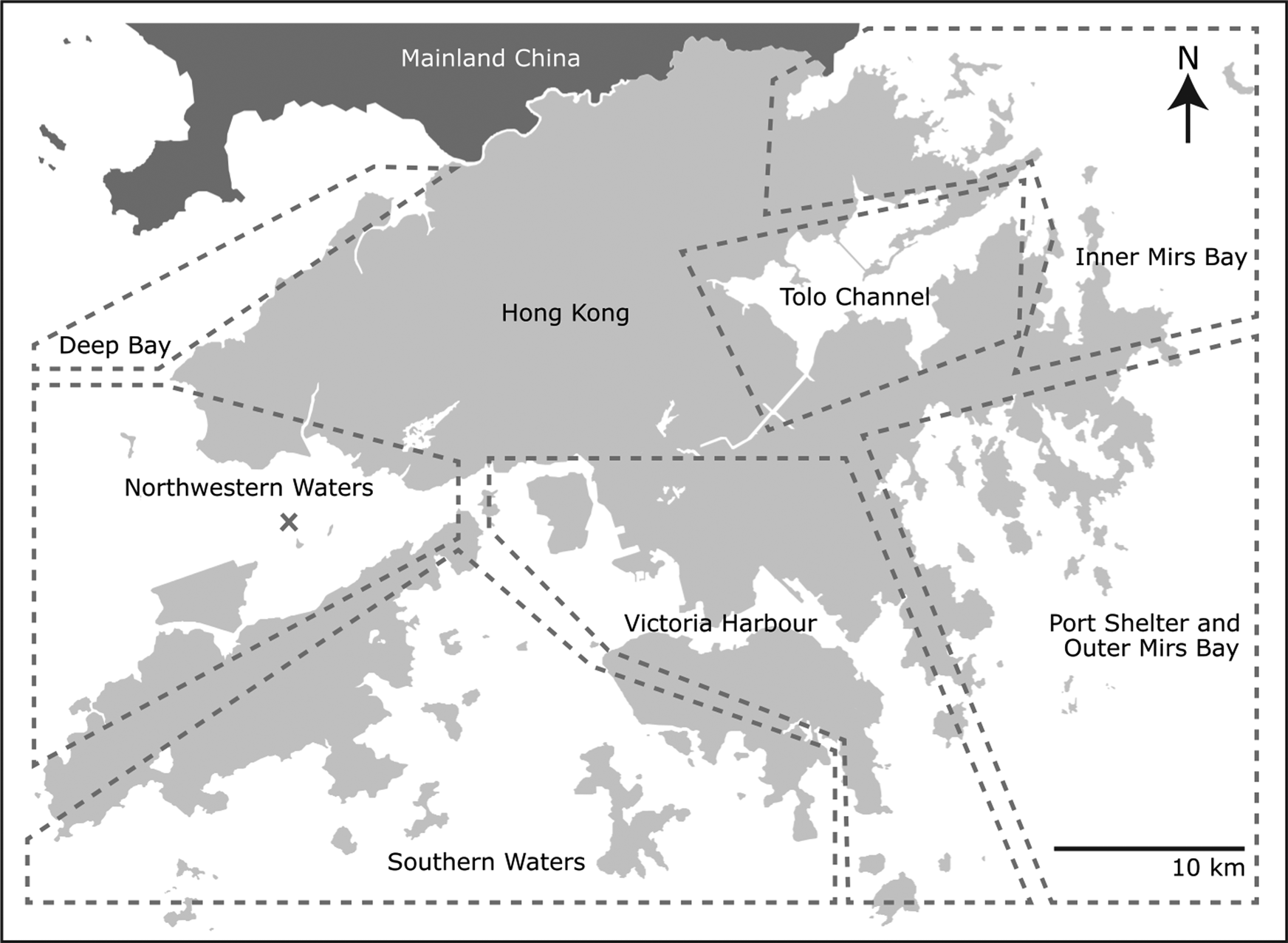
Hong Kong (22°N, 113–114°E) lies on the southern coast of China, in a transitional geographic position between the temperate and tropical zoogeographic regions, and has a subtropical climate with hot, wet summers and cool, dry winters (Morton & Morton, Reference Morton and Morton1983; Morton & Blackmore, Reference Morton and Blackmore2001). The ~1650 km2 sea area of Hong Kong can be divided into seven zones: Inner Mirs Bay, Port Shelter and Outer Mirs Bay, Tolo Channel, Victoria Harbour, Southern Waters, Northwestern Waters, and Deep Bay (Figure 1). At a local scale, Deep Bay in the west and the Northwestern Waters are influenced by the Pearl River, the second largest river in mainland China (Zhang et al., Reference Zhang, Lu, Higgitt, Chen, Sun and Han2007), and therefore are estuarine, especially during the summer rainy season (Morton & Wu, Reference Morton and Wu1975). As a semi-enclosed embayment, water circulation within Deep Bay is relatively slow, whereas faster water movement is noted in the channel area of Northwestern Waters. In contrast, Inner Mirs Bay, Port Shelter and Outer Mirs Bay in the east are affected by major currents from the South and East China Seas and the Pacific, and experience more stable marine conditions throughout the year (Morton & Morton, Reference Morton and Morton1983). These marine zones are oceanic throughout the year, with high water quality. Victoria Harbour and Southern Waters are located in a transitional zone between these western estuarine and eastern marine waters. Located in the centre of high-density residential and business areas, Victoria Harbour has suffered from sewage pollution in the past. In contrast, Southern Waters has higher water quality due to its proximity to the South China Sea. Tolo Channel is a semi-enclosed waterway with a narrow outlet towards inner Mirs Bay. It has an area of about 52 km2 and extends ~16 km from the south-west at the inner harbour to the north-east at the outer channel (Chau, Reference Chau2004). In addition to limited tidal flushing, pollution from domestic sewage discharge since the 1970s has resulted in summer hypoxia in the harbour and channel area (Wu, Reference Wu1982; Lui et al., Reference Lui, Ng and Leung2007). The eutrophic condition of Tolo Channel was markedly improved with the implementation of the Tolo Harbour Effluent Export Scheme by the Hong Kong government in 1995–1998 (Lie et al., Reference Lie, Wong, Lam, Liu and Yung2011), although occasional hypoxic events are still reported (Fleddum et al., Reference Fleddum, Cheung, Hodgson and Shin2011).
The marine water zones of Hong Kong, southern China (zones are described in the Materials and methods), and 2012 Northwestern Waters sampling locality (marked by ‘×’).

Data used in this study
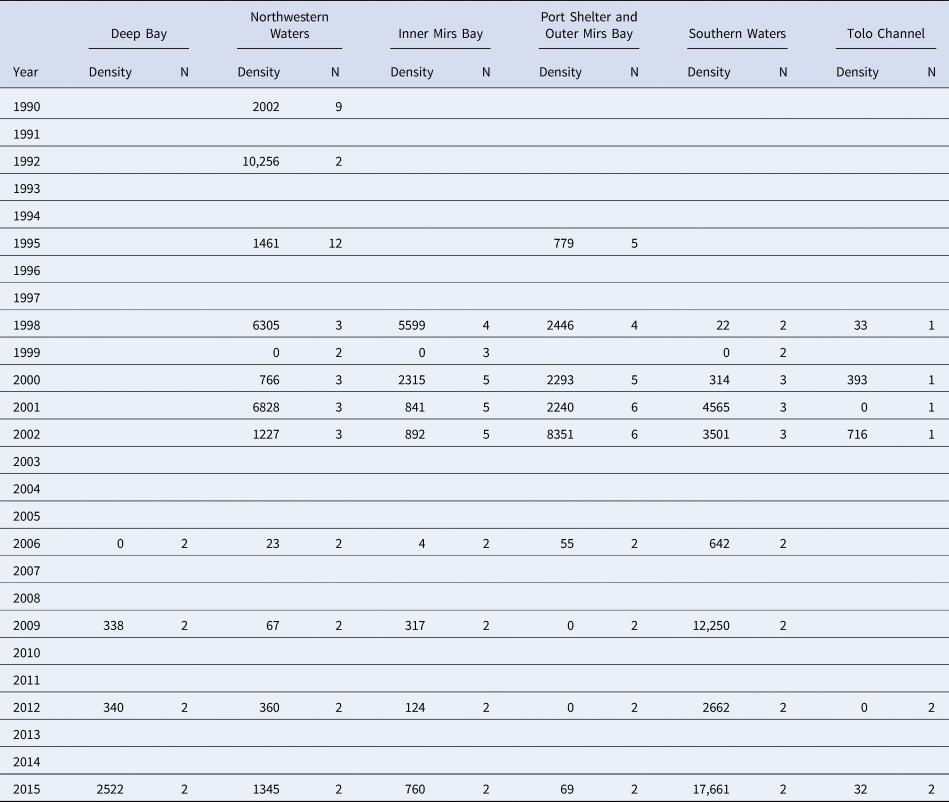
Quantitative reports on abundance of turritelline gastropods from Hong Kong go back to the 1970s (Horikoshi & Thompson, Reference Horikoshi, Thompson and Morton1980; Wu & Richards, Reference Wu and Richards1981; Shin & Thompson, Reference Shin and Thompson1982; Thompson et al., Reference Thompson, Wu, Phillips, Morton and Tseng1982) and 1980s (Taylor & Shin, Reference Taylor, Shin and Morton1990; Taylor, Reference Taylor and Morton1992, Reference Taylor and Morton1994), with average densities of T. bacillum from 0–4 individuals/m2. Most studies during these decades only documented the occurrence of the numerically dominant benthic fauna and their distribution, without details on the abundances of individual species. However, data on T. bacillum from 1990–2015 from Leung & Morton (Reference Leung, Morton and Morton2003), and unpublished monitoring reports by the Environmental Protection Department (EPD), Hong Kong Special Administrative Region Government (CPSL, 2006, 2010, 2013), are much more detailed (Table 1). These studies were relatively standardized – carried out in April (spring) or August (summer) using a beam trawl with 2–2.35 m width and a cod-end mesh size of 1–2.5 cm, with sampling area of ~0.02 km2 per station visited. In addition, we conducted field sampling of T. bacillum in October 2012 in Northwestern Waters with a trawl net of 1 cm cod-end mesh (Figure 1). Since the smallest T. bacillum individuals collected were larger than 2.5 cm in length (Kwan et al., Reference Kwan, Cheung, Chan and Shin2018), individuals sampled from these datasets using 1–2.5 cm cod-end mesh are comparable.
Average density of Turritella bacillum (individuals/km2) recorded in different monitoring zones in Hong Kong from 1990–2015 (N = number of sampling stations per zone; blank = no study); sampling time in April for data before 1998 and in August thereafter; data extracted from Leung & Morton (Reference Leung, Morton and Morton2003), CPSL (2006, 2010, 2013) and unpublished EPD monitoring reports. Six zones are included in this study (Victoria Harbour is excluded as limited data were available)

We standardized all available data in terms of the trawled area based on the description of the trawling time and the speed of the vessel employed, according to six zones: Deep Bay, Northwestern Waters, Inner Mirs Bay, Port Shelter and Outer Mirs Bay, Southern Waters and Tolo Channel (Figure 1). Victoria Harbour was excluded from the present study as the central harbour area is mainly designated for marine traffic and so historical data for T. bacillum in this zone are limited. The difference in abundance data of T. bacillum recorded from the six zones in Hong Kong was compared using Kruskal–Wallis one-way analysis of variance, followed by post-hoc pairwise Mann–Whitney tests with Bonferroni correction applied if the result was significant at α = 0.05. Statistical tests were performed in PAST (Hammer et al., Reference Hammer, Harper and Ryan2001) and R (R Core Team, 2019).
Selected environmental parameters from sediment (total carbon, total Kjeldahl nitrogen, total phosphorus) and bottom water (dissolved oxygen, chlorophyll-a, total nitrogen, total Kjeldahl nitrogen, temperature, suspended solids, salinity, orthophosphate phosphorus, turbidity, total phosphorus) within these six zones corresponding to years with available T. bacillum data were downloaded from EPD's online database (2019). Since in some years environmental data in April or August were not available for all zones, the annual means of these parameters were used for analyses (Supplementary Table S1). Spearman's rank correlation was also performed to identify the relationship between the abundance data and nutrient parameters in each zone. To incorporate multiple environmental variables and distinguish the relative effects among variables on densities, multiple regression analyses using sediment, bottom water and both factor types were conducted. F-tests were used to compare between multiple regressions, and t-tests to identify statistically significant environmental parameters.
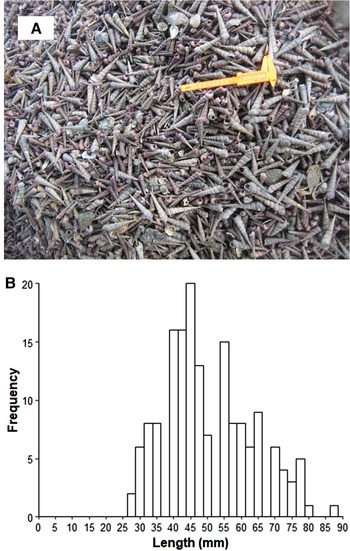
Size-frequency data were measured from photographs of T. bacillum collected in the 2012 trawl sampling by randomly selecting individuals that were clearly visible and that were not tilted or appeared underneath other specimens, so as to avoid skewed measurements for the construction of the size-frequency diagram (N = 162, Figure 2). To determine whether there was more than one size class, one, two, and three normal distributions were fitted, and compared using log-likelihood ratio tests (King, Reference King1989) and Akaike Information Criterion (AIC) values (Burnham & Anderson, Reference Burnham and Anderson2002).
(A) Photograph of Turritella bacillum sampled in 2012 in Hong Kong, with Vernier calliper in photograph approximately 15 cm in length for scale, and from which (B) T. bacillum were measured for this size-frequency diagram (N = 162).

For T. communis in the UK, all but two records (for 1975, in Hiscock & Oakley, Reference Hiscock and Oakley2005 and for 2007, K. Hiscock, unpublished data; both sources are sea-bed images) of quantitative density data (individuals/m2) from the western English Channel (Figure 6A) were extracted from published literature, documenting densities spanning 1923–2007 (Ford, Reference Ford1923; Steven, Reference Steven1930; Holme, Reference Holme1950), from study areas ~300, 13, and 500 km2 respectively.
Oxygen isotope analysis
δ18O isotope values for T. bacillum individuals (N = 4, Supplementary Table S2) collected from the Northwestern Waters zone of Hong Kong in the 2012 trawl sampling were analysed using techniques previously applied to turritellines (Allmon et al., Reference Allmon, Jones and Vaughan1992, Reference Allmon, Jones, Aiello, Gowlett-Holmes and Probert1994; Waite & Allmon, Reference Waite and Allmon2013). The shell surface of each individual was washed in de-ionized water, and cleaned ultrasonically for 5 minutes before sampling. Aragonite powder samples for isotope analysis were obtained by grinding the outer shell layer of the specimen serially in ontogenetic sequence (i.e. spirally) using a dental drill. Samples were analysed at the University of Michigan Stable Isotopes Laboratory using a Finnigan MAT 251 mass spectrometer coupled to a Finnigan Kiel automated preparation device dedicated to the analysis of carbonates and using NBS 19 limestone as a standard. Data were normalized to Vienna Pee Dee Belemnite (VPDB). Analytical error was found to be <0.1% for both carbon and oxygen.
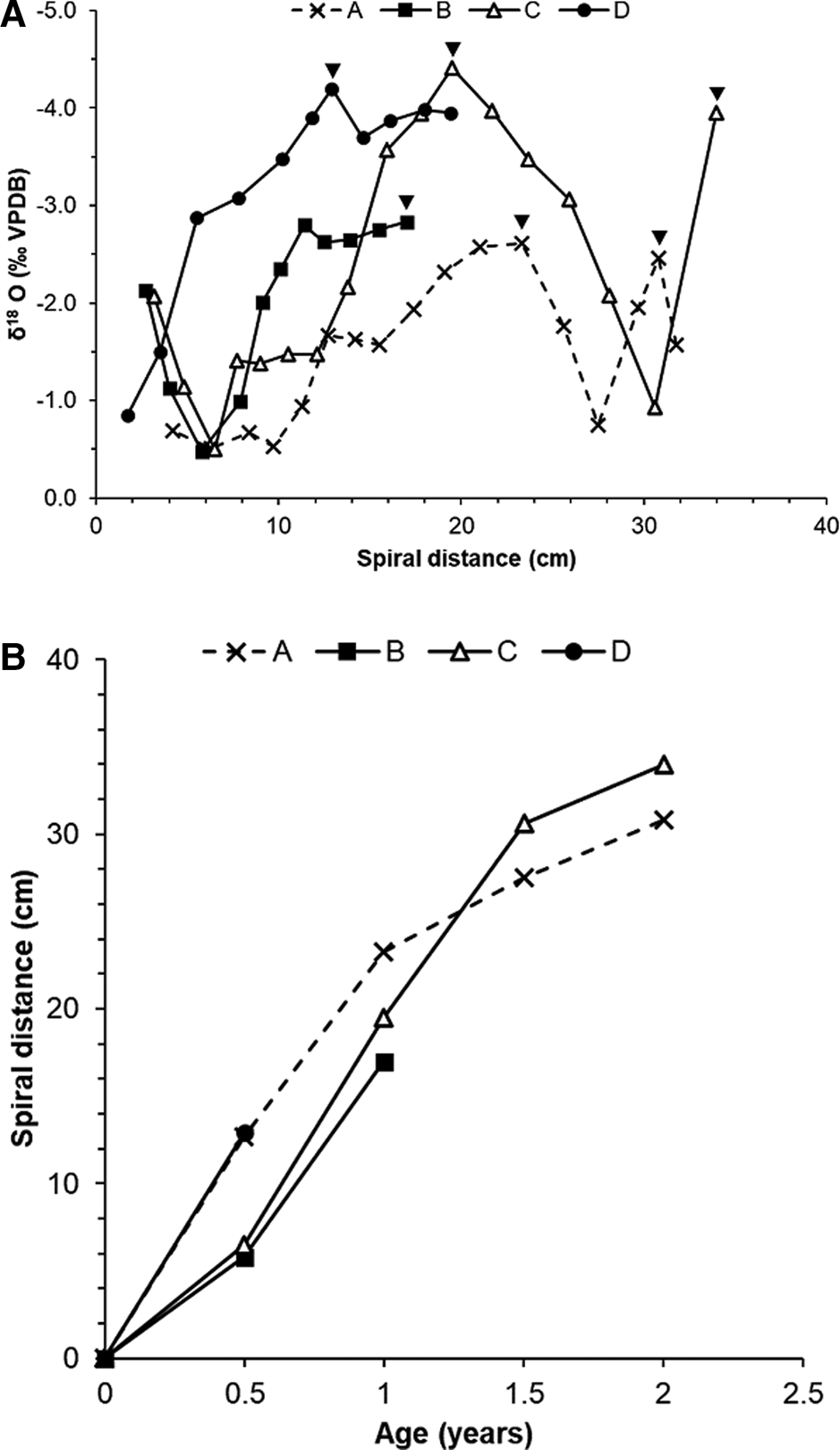
To determine the periodicity of shell growth in T. bacillum, the δ18O values of the samples were plotted against spiral distance from the apex (following Allmon et al., Reference Allmon, Jones and Vaughan1992, Reference Allmon, Jones, Aiello, Gowlett-Holmes and Probert1994; Jones & Allmon, Reference Jones and Allmon1995; Waite & Allmon, Reference Waite and Allmon2013). Peaks of the most depleted δ18O values on the plot depict the warmer periods of carbonate precipitation and isotopically light runoff, presumably during the summer months, whereas higher δ18O values correspond to the cooler water temperatures in the winter (Arnold et al., Reference Arnold, Brenner, Curtis, Dutton, Baker, Escobar and Ortega2014). As seasonal freshwater input is also highest in the summer in this region, light isotopic values recorded in the shell are indicative of the synergistic interaction of higher temperatures and isotopically lighter seawater values in the summers compared with shell grown during winters (Grossman & Ku, Reference Grossman and Ku1986; Jones & Allmon, Reference Jones and Allmon1995). In the present study, the age of the gastropods under analysis was estimated by referring to these summer minima and winter maxima, with one year assessed as return to the isotopic values similar to those first recorded in the shell (interpreted as a return to the season of settlement).
Results
Hong Kong T. bacillum abundance
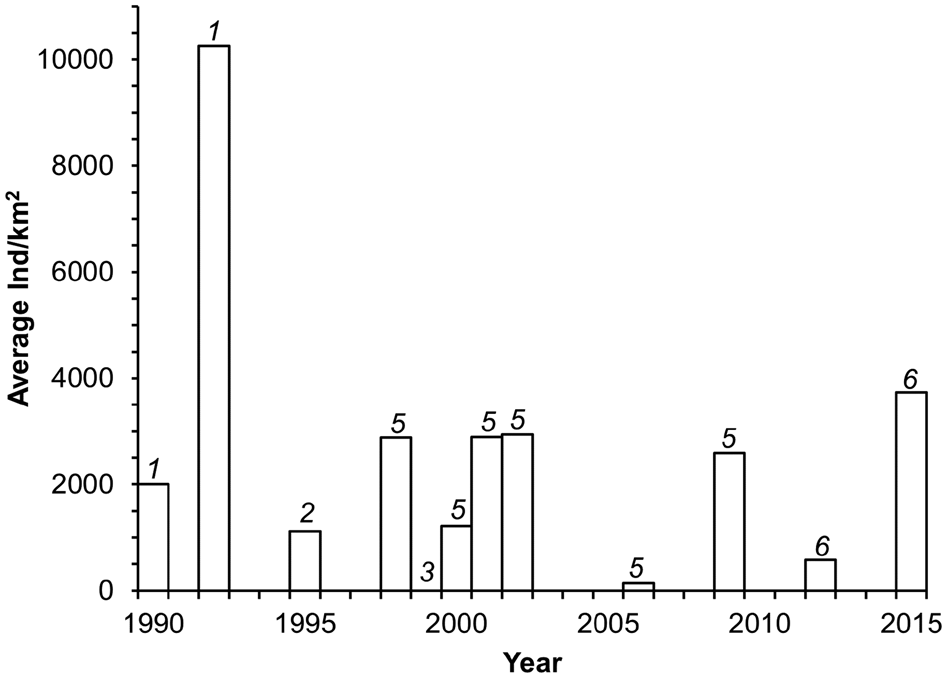
Turritella bacillum population densities in Hong Kong were not uniform, and fluctuated, persisted, and rebounded after sharp declines (Figure 3). For one sampled year (1999), there were no T. bacillum found from three sampled zones. None of each zone's data across sampled years were normally distributed. Kruskal–Wallis tests did not reveal a statistically significant difference among zone medians (χ2 = 6.45, P > 0.05). This may be due to the wide range (0–17,661 individuals/km2) in recorded densities, and inconsistent reporting of zone-specific data over time. There were not enough data to statistically test for potential cyclicity in average annual densities, but a peak and trough can be observed every ~5 years during the 1990–2015 study period. These peaks and troughs in abundance were not synchronous across sampled zones.
Annual average densities (individuals/km2) of Hong Kong Turritella bacillum from 1990–2015 with italicized number of zones sampled.

Density and environmental variables
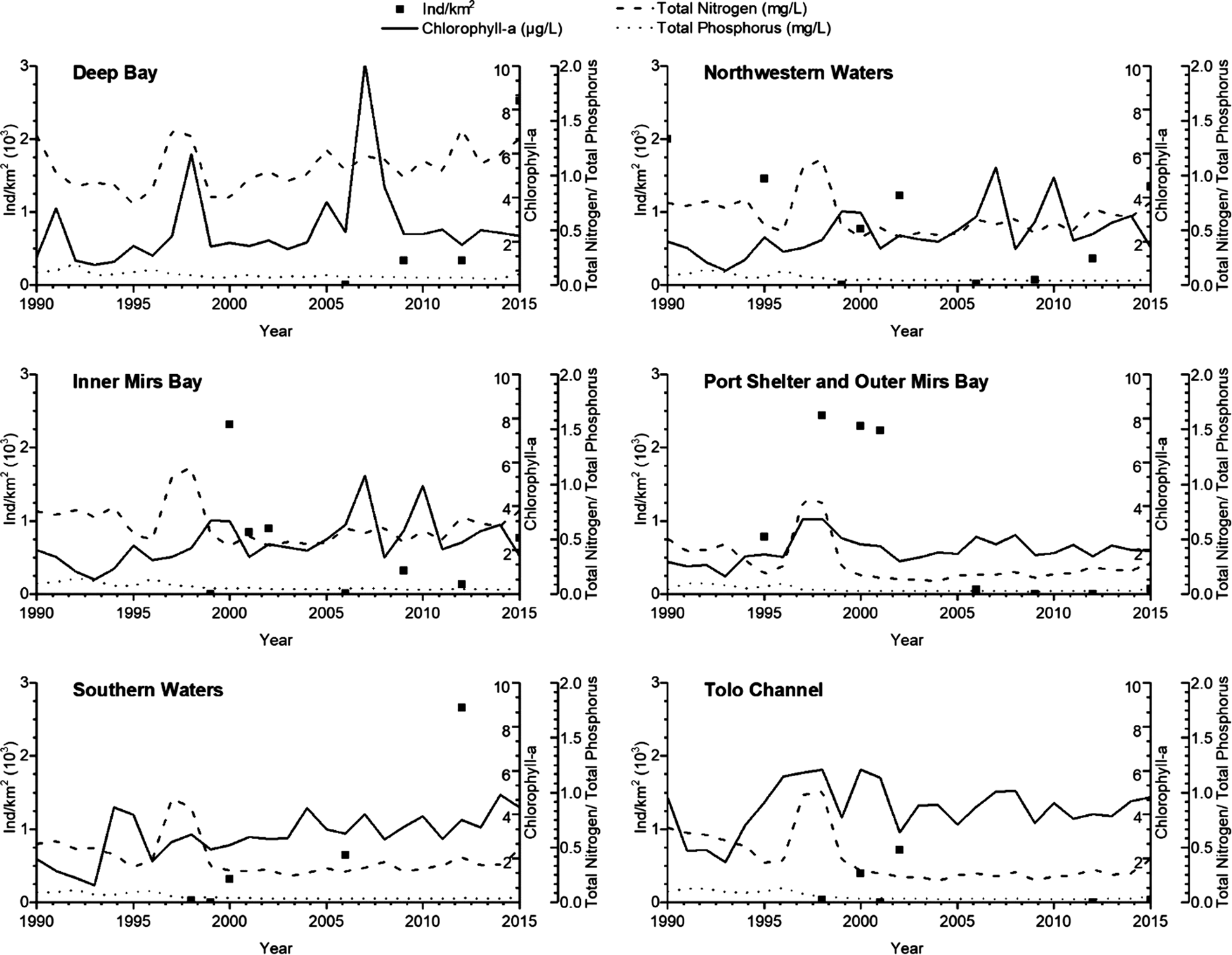
No statistically significant correlations were found between T. bacillum densities by zone with annual means of selected sediment (total carbon, total Kjeldahl nitrogen, total phosphorus) or bottom water variables for their zone (dissolved oxygen, chlorophyll-a, total nitrogen, total Kjeldahl nitrogen, temperature, suspended solids, salinity, orthophosphate phosphorus, turbidity, total phosphorus). This suggests that no single environmental parameter alone is the major influence on T. bacillum densities. Three bottom water variables (chlorophyll-a, total nitrogen, total phosphorus) were used to indicate a general trend of nutrient levels across study areas (Figure 4).
Changes of annual mean chlorophyll-a, total nitrogen and total phosphorus in bottom waters of the six marine water zones of Hong Kong from 1990–2015 in relation to recorded densities of Turritella bacillum.

For zones with enough data, T. bacillum densities were regressed against sediment and bottom water variables, but none of the coefficients were significant (F-test, P > 0.05), nor were their coefficients (P > 0.05). When zone-specific density data and environmental data were grouped into larger regions of Eastern Waters (Inner Mirs Bay, Port Shelter and Outer Mirs Bay) and Western Waters (Deep Bay, Northwestern Waters), there were also no significant environmental variables (F-test, P > 0.05).
Size-frequency of T. bacillum
Between fitting one or two normal distributions to the size-frequency data of turritelline shells collected in 2012, both the log-likelihood ratio test (18.03, df = 4, P < 0.01) and AIC values suggest two normal distributions better fit (AIC value 1280.54) than one (AIC value 1296.57), indicating that more than one size-class is present. These roughly correspond to individuals younger than 1 year or 2 years old, based on isotopic sclerochronology (below).
Oxygen isotope sclerochronology
The four specimens (A, B, C, D) yielded 17, 12, 18 and 12 samples respectively for δ18O analysis. The δ18O profiles of these specimens exhibit summer minima (rainy season) and winter maxima (dry season) of δ18O values (Figure 5A). The larger individuals (A, C) are estimated to be ~2 years old, and the smaller individuals (B, D) are nearly 1 year old (Figure 5B). This is slightly older than previous samples of T. bacillum (Kwan et al., Reference Kwan, Cheung, Chan and Shin2018), but consistent with other species, e.g. 1.5–2 years for T. leucostoma Valenciennes, 1832 (Allmon, Reference Allmon2011; Waite & Allmon, Reference Waite and Allmon2013). As is true for other modern turritelline species, comparatively faster growth in the first year of life compared with subsequent periods is observed.
(A) δ18O isotope profiles with summer minima denoted by downward pointing triangles, with data normalized to Vienna Pee Dee Belemnite (VPDB), and (B) size at age growth profiles of 2012 sampled Turritella bacillum (N = 4).

Western English Channel T. communis abundance
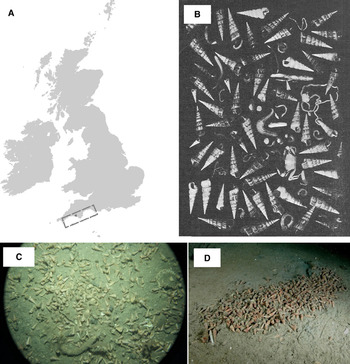
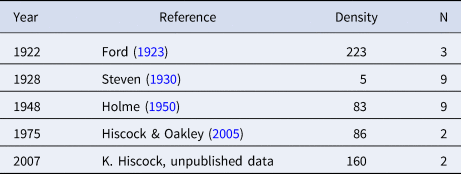
Abundance of Turritella communis in the western English Channel (Table 2, see Figure 6A for location) varied, with average annual densities (individuals/m2) ranging from 5 (Steven, Reference Steven1930) to 223 (Ford, Reference Ford1923). The most recent record in 2007 is estimated to be about 160/m2 (seabed images and unpublished data collected by K. Hiscock), although this could be an underestimate, since densities at specific sites could be as high as 500/m2 (Holme, Reference Holme1950) or 600 m−2 (Ford, Reference Ford1923). Selected images of T. communis abundance are reproduced (Figure 6B–D). Sampled years were spread out irregularly over the study interval (1923, 1928, 1948, 1975 and 2007), and the mixture of methods (grab, trawl, photo) for different samples is a potential source for variability in T. communis recorded densities. Due to the observed patchy spatial distribution of T. communis, and differences in sampling (primarily grab sampling for T. communis, and trawl sampling for T. bacillum), absolute densities between T. communis, sampled on a m2 scale, and T. bacillum, sampled on a km2 scale, could not be compared quantitatively in detail.
(A) Map of the British Isles, with approximate location of cited literature (marked by dashed lines) and Plymouth (marked by a solid circle), and images from Plymouth, western English Channel, of Turritella communis densities from sampling years (B) 1923 (number of animals recorded in 0.1 m2, Ford 1923), (C) 1975 (Hiscock & Oakley Reference Hiscock and Oakley2005), and (D) 2007 (K. Hiscock, pers. obs.), each T. communis individual's shell length is ~3 cm.

Quantitative records of Turritella communis (average number of individuals/m2) abundance from around Plymouth, western English Channel (N = number of sampling sites used to calculate the average density)

Discussion
A tale of two turritelline species: all or nothing?
Both Turritella species from Hong Kong and the western English Channel demonstrate density fluctuations on a similar magnitude, geographic scale (300 and 500 km2 respectively), and time scale (~5 and ~10 years respectively). This suggests that modern turritelline populations have short-lived, spatially restricted, highly abundant phases. Three main factors have been identified as major causal factors for the formation of living turritelline-dominated communities (Allmon, Reference Allmon2011; Anderson et al., Reference Anderson, Hendy, Johnson and Allmon2017): (1) varying nutrient supply, (2) other fluctuating environmental factors, and (3) the Allee effect, in which there are benefits to aggregations of individuals of the same species. For Hong Kong turritellines during the study period 1990–2015, it seems that apart from perhaps variable nutrients, none of the other environmental factors tested significantly contribute to their near-cyclic density fluctuations. The Allee effect may well exist for turritellines, since at least T. communis in the English Channel employs internal fertilization and requires short distances (~0.5 m) for sexual recognition (Kennedy, Reference Kennedy1995). While this may contribute to patchiness, it does not explain the observed fluctuations in abundance through time.
Our data from Hong Kong indicate that on an ecological timescale of decades, there is no direct correlation between annually averaged zone-specific turritelline densities and the selected environmental factors. It is, however, possible that a combination of environmental variables should be considered. Li et al. (Reference Li, Du, Gu, Ning and Wang2016) suggested that T. bacillum can live in a wide range of environmental conditions, with higher abundance in coarser sediment, which may be related to stronger bottom water movement. In our study, though none of the multiple regressions using the selected sediment and bottom water factors were statistically significant, it appears that there are generally more T. bacillum in Western Waters, which is influenced by seasonal discharge from the Pearl River, than in Eastern Waters, which is considered to have more stable and homogenous marine conditions (Watts, Reference Watts1973; Morton & Wu, Reference Morton and Wu1975; Morton, Reference Morton, Morton and Tseng1982, Reference Morton1989; Morton & Morton, Reference Morton and Morton1983). Fluctuating salinity and increased suspended solids from the river's discharge might be influencing densities in Western Waters, where T. bacillum show higher abundance (Wu & Richards, Reference Wu and Richards1981; Shin & Thompson, Reference Shin and Thompson1982; Shin & Ellingsen, Reference Shin and Ellingsen2004; Kwan et al., Reference Kwan, Cheung, Chan and Shin2018). While the species is motile to some degree, and might be able to track its preferred salinity, the accentuated light oxygen values recorded in their shells, and records of high-abundance communities at sites with salinites as low as 10–15 psu in summer (Kwan et al., Reference Kwan, Cheung, Chan and Shin2018), suggest that T. bacillum is tolerant of less-than-normal marine salinities. This contrasts to previous characterizations of turritellids as usually fully marine (Allmon, Reference Allmon1988, Reference Allmon2011), despite recognition of several occurrences to the contrary in modern (e.g. Blay & Dongdem, Reference Blay and Dongdem1996) and fossil (e.g. Naughton et al., Reference Naughton, Bourillet, Goñi, Turon and Jouanneau2007) assemblages. We therefore caution against interpreting fossil TDAs or turritelline-rich assemblages as necessarily coming from fully marine environments.
It is noteworthy that Turritella are able to also persist, although at extremely low densities, in Tolo Channel. Summer bottom-water conditions are often hypoxic in this area, which may enable other opportunistic species to dominate, since these are not tolerable conditions for many benthic animals (Trott & Fung, Reference Trott and Fung1973; Morton, Reference Morton1989; Fleddum et al., Reference Fleddum, Cheung, Hodgson and Shin2011). As a motile gastropod, T. bacillum may also be able to leave and return when oxygen conditions improve, in contrast to obligately sessile filter feeders. Such behavioural response has also been suggested for other taxa in Tolo Channel, where mantis shrimps and crabs move out from the channel during hypoxia in the summer and return when bottom oxygen increases in the winter (Fleddum et al., Reference Fleddum, Cheung, Hodgson and Shin2011). Regional bottom water characteristics may explain why, at the scale of zones, western and eastern macrobenthic communities can be differentiated (Shin & Ellingsen, Reference Shin and Ellingsen2004), as well as indicate that T. bacillum are opportunistic and favour variable environmental conditions which may exclude other competitors or predators. As turritellines are not exclusively suspension feeders but are also known to deposit feed (Allmon, Reference Allmon1988, Reference Allmon2011), the regions with generally higher nutrient input may be able to support higher turritelline abundances, while population densities are less tied to annual variations in water-column productivity. Additional data on the relative importance of deposit vs suspension feeding is limited to T. communis (Graham, Reference Graham1938; Yonge, Reference Yonge1946), which suggests that suspension feeding is the primary feeding mode in that species. Observational or experimental study of additional turritelline species would greatly improve our understanding of how their natural history relates to their distribution and the structure of the communities of which they are a part.
In addition to the importance of abiotic factors on structuring communities, biotic interactions can affect the distribution and abundance of turritellines. When abundant, turritellines have been suggested to be competitively dominant species (Thorson, Reference Thorson1957; Shin & Thompson, Reference Shin and Thompson1982). Large numbers of T. bacillum have also been observed more broadly as a dominant macrobenthic species in semi-enclosed embayments and coastal areas of the South China Sea region close to Hong Kong (Shu et al., Reference Shu, Chen, Li, Yu and Feng2015; Zhang et al., Reference Zhang, Gao, Shi and Lü2017; Lu et al., Reference Lu, Zhu, Xu, Zhou, Dai and Lu2018), with one study noting a density of 17 individuals/m2 (Li et al., Reference Li, Du, Gu, Ning and Wang2016). Turritella communis was noted to be a key component in one of Petersen's soft-bottom communities in the North Sea (e.g. Petersen, Reference Petersen1913, Reference Petersen1915; Thorson, Reference Thorson1957; Göransson, Reference Göransson2002), and this community importance is also mentioned in reports from the western English Channel (e.g. Ford, Reference Ford1923). In western waters of Hong Kong, Wu & Richards (Reference Wu and Richards1981) observed that the spatial and temporal patterns of T. bacillum were mirrored by one of its potential predators, the muricid gastropod Murex trapa Röding, 1798, a relationship inferred from observations made by Petuch (Reference Petuch1976) of a turritelline-dominated assemblage off Venezuela. However, no evidence of this direct predator–prey interaction is known, although a recent trophic study using an isotope mixing model by Kwan et al. (Reference Kwan, Cheung, Chan and Shin2018) demonstrated that gastropods are a potential food source for M. trapa in Hong Kong waters. We encountered large numbers of M. trapa in our 2012 trawls in Northwestern Waters, and high numbers of both species were also found together in three areas surveyed by Leung & Morton (Reference Leung, Morton and Morton2003), which correspond to the Northwestern Waters, Southern Waters, and Port Shelter and Outer Mirs Bay zones in this study.
Additional environmental factors such as xenobiotics (foreign substances in an ecosystem) may also influence species density, such as by affecting reproduction (inconclusively suggested for T. communis in the North Sea by Göransson, Reference Göransson2002), although there is no evidence that this is the case in Hong Kong. Various metals have been shown to bioaccumulate in Turritella species, but it is unclear if the animals suffer negative impacts from them (Gibbs et al., Reference Gibbs, Nott, Nicolaidou and Bebianno1998 from Plymouth Sound, England; Langston et al., Reference Langston, Burt and Pope1999 from Dogger Bank, North Sea; Paul et al., Reference Paul, Radhakrishnan and Hemalatha1999 from Porto Novo Coast, India).
Turritella bacillum densities similarly do not seem affected by other ongoing anthropogenic environmental disturbance, such as trawling and dredging, on Hong Kong's benthic communities (Morton, Reference Morton1996). It remains to be seen if densities have responded differently since a ban on trawling for fishing in Hong Kong waters came into effect on 31 December 2012, since average Turritella densities appear to have fluctuated within the range of values found during the 1990–2015 survey data in this study.
Although we cannot exclude the possibility that some unknown environmental variable is the primary cause of the variations in abundance in Hong Kong turritellines, our results suggest that the variations we document here for Turritella bacillum in Hong Kong – and by extension other turritelline species – are mainly a result of stochastic larval recruitment within an environment that is generally conducive to their survival. Since all turritellid species for which data are available reproduce seasonally (Allmon, Reference Allmon2011), fluctuations in cohort survival may also contribute to the observed periodic pattern in abundance. In another suspension-feeding marine gastropod with a similar lifespan and time to sexual maturity, the trochid Umbonium moniliferum (Lamarck, 1822), some populations identified as sinks were reliant on nearby source populations to persist, as recruitment was inhibited by ghost shrimp sediment destabilization, and exacerbated when there were high shrimp abundances (Tamaki & Takeuchi, Reference Tamaki and Takeuchi2016).
Turritellines as a group show a variety of life history patterns, but most have short-term planktonic larvae that live in the plankton for a few weeks (Allmon, Reference Allmon2011). High numbers of pelagic larvae have been noted for T. communis (Ryan et al., Reference Ryan, Rodhouse, Roden and Hensey1986), and egg clusters have also been reported (Holme, Reference Holme1950), although the precise factors that cause larval settlement are unknown. In 2007, settled, benthic juvenile T. communis were observed in aggregations (K. Hiscock, personal observations). The reproductive and larval developmental patterns of T. bacillum have never been documented, although as noted above, size-frequency and oxygen isotope data of specimens collected in 2012 show at least two overlapping age classes. For Umbonium moniliferum, seasonal reproduction and short-term dispersal may play a role in segregating cohorts of different ages (Tamaki & Takeuchi, Reference Tamaki and Takeuchi2016).
From published T. communis records in the western English Channel, it is unclear if population fluctuations are periodic. However, the large variability in average density over time (e.g. >90% decrease from 1923 to 1928) was similar to that noted in Hong Kong (e.g. from 1990–2015, values from 0 to >10,000 individuals/km2 were recorded in Northwestern Waters and Southern Waters), and occurred at similar geographic scales (up to 500 km2 in the western English Channel, vs on average 300 km2 in Hong Kong), indicating that both of these turritelline species are capable of persisting in their environment through substantial local population changes. Indeed, the uneven distribution of densely abundant Turritella observed at both locations at different spatial scales (between zones in Hong Kong, and between sampled sites in the western English Channel; Holme, Reference Holme1950, Reference Holme1961), further demonstrates the dynamic and transient nature of these patches. Like T. bacillum, T. communis appears to be resilient to anthropogenic disturbance, particularly trawling and its consequential environmental changes (e.g. Capasso et al., Reference Capasso, Jenkins, Frost and Hinz2010).
The frequently high abundance of turritelline gastropods is one of their most conspicuous characteristics, both in modern and fossil marine communities, and considerable attention has been devoted to possible environmental causes for their occurrence (Allmon, Reference Allmon1988, Reference Allmon2007, Reference Allmon2011; Anderson et al., Reference Anderson, Hendy, Johnson and Allmon2017). The data we summarize here, which probably represent the longest and largest datasets available for living turritellines, suggest that time-averaging of ephemeral, localized, high-density communities is more likely to be a good model for the generation of fossil TDAs than more evenly distributed and persistent live communities. It may be that in environments that allow them to survive (e.g. have appropriate temperature, salinity and nutrients), turritelline gastropods show significant fluctuations in abundance in time and space due largely to stochastic variation in patterns of larval settlement (about which we need more information), and that individual, small-scale, high-abundance assemblages at the scale of tens to hundreds of metres may not have a particular environmental trigger. If this is true, then interpretations of particular turritelline-dominated assemblages should focus on the larger-scale spatial and temporal distribution of the occurrences, in addition to details of their local environmental (or palaeoenvironmental) conditions. Together with additional information on their larval biology, and a more temporally resolved quantitative baseline of their population densities, such information might provide a more adequate understanding of the role of stochastic vs deterministic factors in affecting this widespread phenomenon, as well as the response of these species to anthropogenic influence.
Supplementary material
The supplementary material for this article can be found at https://doi.org/10.1017/S0025315420001204
Acknowledgements
For assistance with fieldwork, we are grateful to Alice Chan, Kevin Laurie, Jonathan Leung and Wai Leung. For assistance with isotopic analyses, we are grateful to Lora Wingate. We thank EPD, Hong Kong Special Administrative Region, China for allowing access to unpublished survey data in CPSL reports and data from their biological monitoring programme. We also thank The Marine Biological Association of the United Kingdom for allowing reproduction of the plates for Figure 6, and two anonymous reviewers for their helpful comments.
Financial support
This research received no specific grant from any funding agency, commercial or not-for-profit sectors.