Introduction
Tombarthite-(Y), Y4(Si,H4)4O12–x(OH)4+2x with x ≤ 4, was first described as a new species (IMA 1967-031) from a pegmatite at the Høgetveit farm, Evje and Hornnes, Aust-Agder, Norway by Neumann and Nilssen (Reference Neumann and Nilssen1968). Tombarthite-(Y) was named after Tom F. W. Barth (1870–1953) former Professor in Geology at the Natural History Museum (NHM) in Oslo. Since the original description, tombarthite-(Y) has only been observed at the following three localities: Ivedal, Iveland, Aust-Agder, Norway (Nilssen, Reference Nilssen1971); the Reiarsdal pegmatite (also known as Tjomsås), Vest-Agder, Norway (Griffin et al., Reference Griffin, Nilssen and Jensen1979); and the Mont Blanc Massif (Rolland et al., Reference Rolland, Cox, Boullier, Pennacchioni and Mancktelow2003). In connection with the move of the mineral collection at the NHM in Oslo, the type material of tombarthite-(Y) was sought as no material in the collection was labelled as being the type material. As a result, a detailed review of the original description raised several concerns about the scientific approach and consequently the validity of tombarthite-(Y) as a mineral species.
Type material
In the original description of tombarthite-(Y) no collection number was given for the type material, but it states: “Type material is preserved at the Mineralogical-Geological Museum, Oslo University, Norway” (Neumann and Nilssen, Reference Neumann and Nilssen1968). Raade (Reference Raade1996) attempted to identify potential type material in the collection of the museum in Oslo and wrote: “The Oslo Museum possess a large number of tombarthite specimens from Høgetveit, stored in seven drawers. Numerous specimens have been X-rayed, most of them with pointers showing from where the samples have been taken. Unfortunately, the labels do not indicate on which specimen or specimens the description was actually based, and it is therefore not possible to designate any of them in particular as holotype or cotype specimens”. Consequently, no samples in the collection of the museum in Oslo could be identified as material used for the description of tombarthite-(Y).
Identifying potential type material
In order to discredit a mineral species the type material should be analysed, but if it cannot be located efforts should be undertaken to find it or related material, which can then be defined as the neotype (Dunn, Reference Dunn1990; Nickel and Grice, Reference Nickel and Grice1998). Therefore, substantial work was carried out to locate material at the NHM (Oslo), which could be the type material or material that was part of the original description.
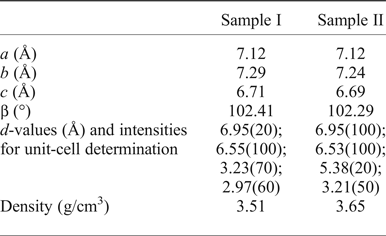
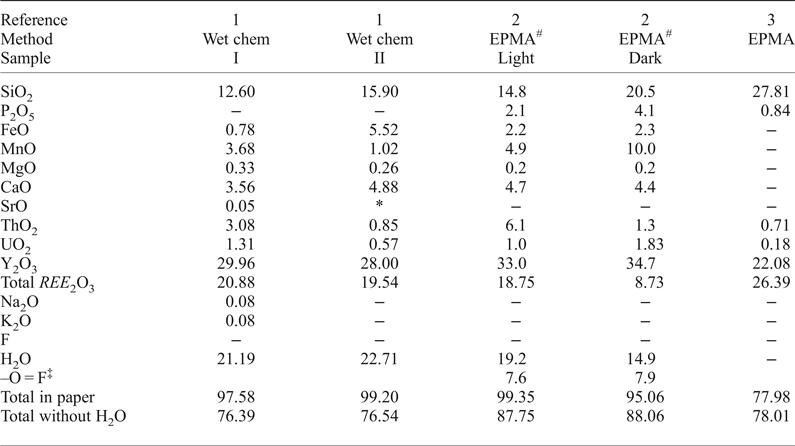
Neumann and Nilssen (Reference Neumann and Nilssen1968) used two samples for their description and labelled them Sample I and Sample II. They mentioned that analyses were performed on material free of inclusions and impurities, which indicates that the material used was from mineral separates. The results for the two samples used in the original description of tombarthite-(Y) are summarized in Table 1.
Summary of data from the original description of tombarthite-(Y)

The mineral collection of the NHM in Oslo has 24 samples registered as tombarthite-(Y), of these only 18 state when they entered the collection and these were all acquired in 1971 or more recently, i.e. minimum of three years after the description was published and therefore cannot be type material. Sample KNR 39591 has a noteFootnote † stating “Remains of material given to Professor Barth”, but this collection number consists of three pieces of feldspar and nothing resembling tombarthite-(Y).
As mentioned by Raade (Reference Raade1996), the NHM in Oslo has a large volume of unregistered pegmatite material in its storage. However, most of the material was acquired post the description of tombarthite-(Y), hence could readily be excluded as potential type material. Both registered and unregistered samples often have a pointer identifying where material has been removed for XRD analyses, mostly Debye-Scherrer, and the corresponding film number. A systematic review of all Debye-Scherrer films (~150) identified as tombarthite-(Y) revealed that a lot of analyses and heating experiments were performed on only a few samples. Of particular interest were some labelled 16/64 and 4/65, as some had “analytical material” written on the film sleeves. Labels in that format is not used for specimens in the collection, however among the storage material some boxes and vials containing separates were found with such labels.
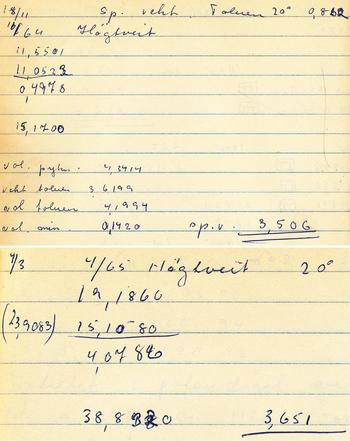
Old laboratory books from Borghild Nilssen (second author of the original description) were retrieved from the archive, which confirmed that the material was mineral separates labelled in the format of Batch/Year (Fig. 1). It is written that 16/64 was made from a “thalénite” specimen, but no further information. For 4/65 it states that material was from the same sample as Debye-Scherrer film no. 15009 (Fig. 1b). A search did not provide a sample with such a pointer, but a vial containing a few fragments has a XRD pointer with the number 15009 written on it. Subsequently, a sample with 15009 written on the specimen label was located. The sample was registered as thalénite-(Y) from Høgetveit (KNR 39585) and is likely to be the sample from which separate 4/65 was generated. Neither in the lab books nor on the X-ray film sleeves was it written how the samples 16/64 and 4/65 corresponded to Sample I and Sample II of the original description. However, based on Fig. 1c and Table 1, it is inferred that 4/65 corresponds to Sample II, as it states that material was sent for DTA (differential thermogravimetric analyses) and Neumann and Nilssen (Reference Neumann and Nilssen1968) wrote that only Sample II was sent for DTA.
Pages from the mineral separation lab book. (a) Entry from May 26th 1964 stating that separate 16/64 is a 90 mesh created from a “thalénite” sample. (b,c) mineral separate 3/65 was made on February 18th 1965 from the same sample as 15009 (which is a Debye-Scherrer film number) and subsequently material was further separated into fractions (sample 4/65). Of these fractions T4 and T5 were combined for XRD. Further it can be seen that T3 was sent for DTA on March 4th 1965 and has Debye-Scherrer number 16756. Note the density determination of 3.66 g/cm3 does not match those given in the original publication, but see below for further details.

Borghild Nilssen's lab books contained a series of density calculations revealing that the measured densities for 16/64 and 4/65 were 3.506 ≈ 3.51 and 3.651 ≈ 3.65 g/cm3, respectively (see Fig. 2 and Table 1). Consequently, Sample I corresponds to the material labelled 16/64 and 4/65 is Sample II of the original description of tombarthite-(Y). The material in the vial labelled with XRD number 15009 is from the same specimen as Sample II. Therefore, the material in the vial has been registered in the collection as the neotype for this work as KNR 43777. It is highly likely, but not conclusive, that the neotype originates from sample KNR 39585; a sample that was collected in 1931. The remaining mineral separates of 16/64 and 4/65 have been assigned collection numbers KNR 43778 and KNR 43779, respectively.
Pages from B. Nilssen's lab book, showing density determination of the two samples 16/64 and 4/65, respectively.

Original data
Diffraction data
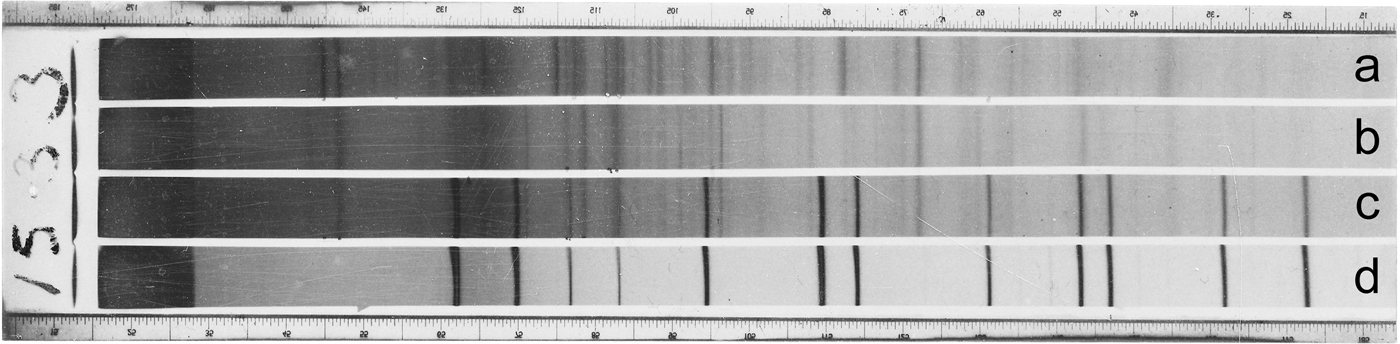
Neumann and Nilssen (Reference Neumann and Nilssen1968) carried out a series of Debye-Scherrer analyses on tombarthite-(Y) and noticed that the material had some degree of metamictization. The unit-cell determinations were carried out using a Guinier camera with Mn-filtered FeKα-radiation and Pb(NO3)2 as the internal standard. The only Guinier films for 16/64 and 4/65 with internal standards are the films 1533 and 1113, respectively. Film 1533 is shown in Fig. 3 and it is apparent that there are significant differences in the diffraction pattern of the two samples (Fig. 3a,b).
Scan of Guinier film (no. 1533) of tombarthite-(Y) used for unit-cell determination of Sample I. (a) 4/65; (b) 16/64; (c) 16/64 + Pb(NO3)2; (d) Pb(NO3)2. Note 16/64 and 4/65 refers to Samples I and II, respectively.

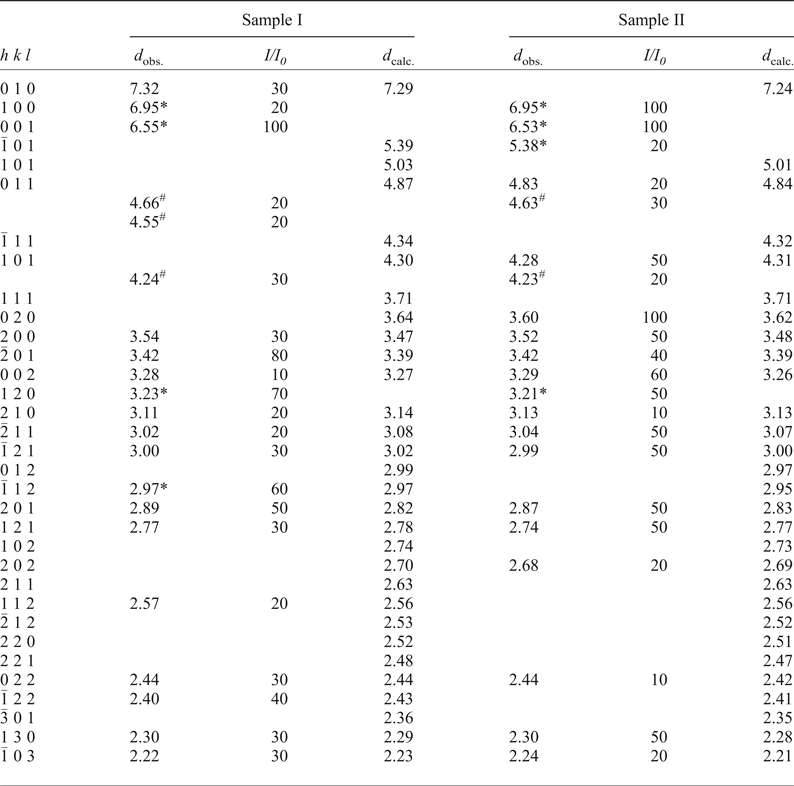
The observed and refined d values for the published tombarthite-(Y) are given in Table 2. The variations between the two samples is particularly emphasized by the strong reflection (020) with 100% intensity in Sample II being absent in Sample I, indicating that the two samples are not the same material or at least not a pure phase. In addition, while Neumann and Nilssen (Reference Neumann and Nilssen1968) ascribed the (020) reflection observed in only one sample to originate from tombarthite-(Y) they assumed the relative strong reflections with d values of 4.66 and 4.24 Å (Sample I) and 4.63 and 4.23 Å (Sample II) to be caused by contamination despite being present in both samples.
Observed and calculated d-values (Å) of tombarthite-(Y) from the original publication.

* Reflections used for unit-cell refinement; # reflections considered contaminations in the original description.
The unit-cell refinements of tombarthite-(Y) were reported in the monoclinic space group P21/n because of the similarity in the diffraction pattern to that of monazite. The refined unit cells were based on only four reflections for each sample of which two to three were among the highest d values observed and all reflections used had d > 2.97 Å (see Tables 1 + 2). That is, the reflections used for the cell refinements are those that have the lowest accuracy in a measured position. Another peculiarity in the reflections chosen for the cell refinements, is that the strong reflection ( $\bar{1}$12) is used for the refinement in Sample I, but it is absent in Sample II. Correspondingly, the (
 $\bar{1}$01) reflection used for the refinement of Sample II is not present in Sample I. Furthermore, Neumann and Nilssen (Reference Neumann and Nilssen1968) mention that several of the observed reflections should have been absent in the chosen space group, e.g. (100), (001), (010) and (
 $\bar{2}$01).
Chemical data
An overview of all published compositions of tombarthite-(Y) is provided in Table 3. It is important to note that the water content from Neumann and Nilssen (Reference Neumann and Nilssen1968) was not determined directly, but: “…water was determined as loss on ignition, and the ignited sample was afterwards used for the main analysis”. In other words, the entire loss of mass during the heating experiment was ascribed to water (H2O and OH). Furthermore, the chemical composition was not determined on fresh material, but only on heated material. The heating experiment revealed that all water had been removed when the temperature reached 1000°C. Under such conditions other elements such as C (in the form of  ${\rm CO}_3^{2\ndash} $) or F are likely to be lost. From the pegmatites of the region Y-minerals such as kainosite-(Y) and thalénite-(Y) have been described, hence it is very likely that the original material contained
 ${\rm CO}_3^{2\ndash} $ or F–.
Published composition of tombarthite-(Y)

References: (1) Neumann and Nilssen (Reference Neumann and Nilssen1968); (2) Griffin et al. (Reference Griffin, Nilssen and Jensen1979); and (3) Rolland et al. (Reference Rolland, Cox, Boullier, Pennacchioni and Mancktelow2003).
* The CaO contained 5% SrO; # Scanned over an area of 300–500 μm2; – below limit of detection or not analysed for; ‡note that no F was found in the analyses.
The large variation of published tombarthite-(Y) compositions is shown in Table 3. For example, the SiO2 varies from 12.6 to 27.8 wt.%, MnO from 1.0 to 10.0 wt.% and total REE 2O3 between 8.7 and 26.4 wt.%. In this paper REE solely refers to the lanthanides. The compositional data for tombarthite-(Y) by Griffin et al. (Reference Griffin, Nilssen and Jensen1979) subtracts 7.6 and 7.9 F for O equivalents despite not having any F in the analyses. If the cited F for O equivalents are true they correspond to F content in the two samples of 18.04 and 18.76 wt.%, respectively. Either way the published totals are wrong. The conclusion from the published compositions of tombarthite-(Y) is that they show a greater variation than what is possible for a single mineral species. In addition, the fact that the original composition was based solely on heated material makes the compositional data doubtful.
New data
Diffraction data
Powder X-Ray diffraction (PXRD) data were collected on a Simens D5005 diffractometer using CuKα radiation housed at the NHM in Oslo. Material was taken from several samples from Høgetveit and Reiarsdal, where old XRD pointers indicated previous analyses had identified the mineral as tombarthite-(Y). In addition, various separates labelled 16/64 and 4/65 were also analysed. The material was ground and placed on zero-background plates. Data were collected typically between 2 and 70°2θ, with 0.02° step-size and counting for 3 s. For identification purposes the PDF2 (powder diffraction files from the International Centre for Diffraction Data, http://www.icdd.com/) and other databases were used, both with and without chemical constrains, e.g. must contain Y.
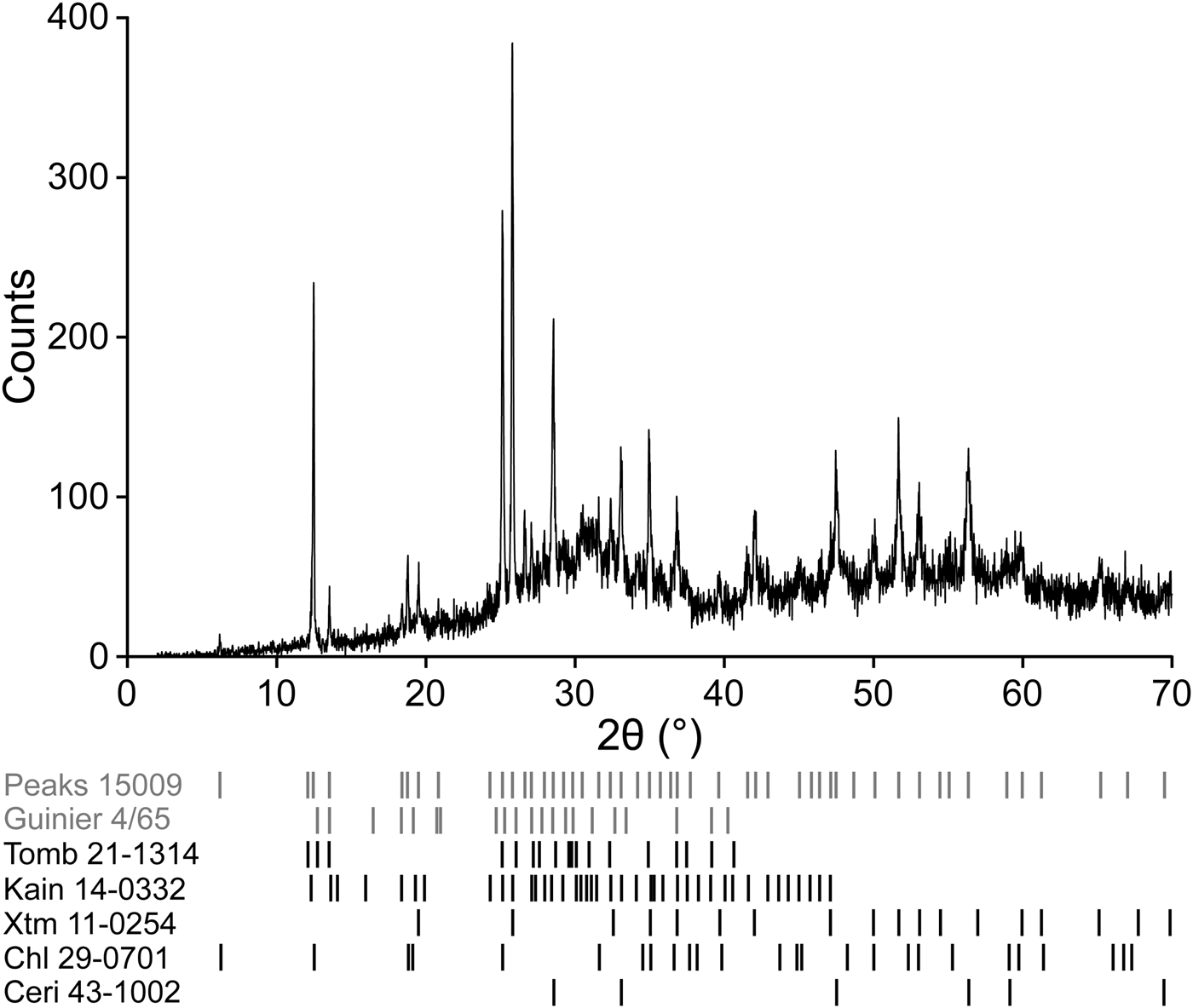
Three findings were characteristic for the new PXRD analyses: (1) all diagrams showed high backgrounds indicative of metamictization; (2) none of the analysed samples were automatically identified as tombarthite-(Y) when applying the search-match function in EVA (Bruker software); (3) all samples were mixtures of several mineral species. The PXRD of sample XRD 15009 is shown in Fig. 4, which could be explained by a mixture of xenotime-(Y), kainosite-(Y), cerianite-(Ce) and clinochlore. The PXRD analyses of other samples gave similar results; the actual phases present varied but minerals such as keiviite-(Y), iimoriite-(Y) and caysichite-(Y) were typically identified. As seen from Fig. 4 the diffractograms are complex and several of the minerals mentioned above have significant overlaps making it impossible to confidently identify the minerals present in the diagrams. In addition, the XRD pattern reveals a large portion of metamict material in the sample. A recalculation of the original data for sample 4/65 is also given in Fig 4 and it is clear it can be explained by a mixture of the minerals identified from the same material with modern XRD.
Powder XRD of a fragment of tombarthite-(Y) from the vial labelled 15009 compared with Sample II (4/65) from Table 2. The lower part of the figure shows the minerals identified with their PDF record number and tombarthite-(Y) (Tomb) for comparison. Kainosite-(Y) (Kain), xenotime-(Y) (Xtm), clinochlore (Chl) and cerianite-(Ce) (Ceri).

Neumann and Nilssen (Reference Neumann and Nilssen1968) ascribed the reflections with d values of 4.66, 4.55 and 4.24 Å (Sample I) and 4.63 and 4.23 Å (Sample II) to impurities in the samples, but from Fig. 4 it is evident that some of these can be attributed to the minerals listed above e.g. clinochlore, xenotime-(Y) and kainosite-(Y). The PXRD data of one of the 16/64 fractions revealed it to be almost pure xenotime-(Y) showing that this mineral was present in significant quantities in the original sample.
Chemical data
Semi-quantitative energy-dispersive analyses were carried out on a Hitachi S-3600 equipped with a Bruker XFlash 5030 EDS detector housed at the NHM, Oslo. Analyses were carried out in low vacuum to avoid coating the specimens and the analytical points were the same as for XRD, i.e. where pointers indicated the mineral to be tombarthite-(Y). In addition, heating experiments of material were carried out with the conditions stated in Neumann and Nilssen (Reference Neumann and Nilssen1968), i.e. heating for one day at 1000°C. For the heating experiments a sample was broken off a specimen and XRD collected on part of the fragment prior to heating. The other part of the fragment was analysed with energy-dispersive spectroscopy (EDS) before being wrapped in Pt-foil (this was the routine at NHM, Oslo to minimize loss of water) and placed in a muffle furnace. The sample was weighed (with and without the Pt-foil) before and after heating and the loss of mass calculated. The sample was then placed in the scanning electron microscope in the same orientation as before heating and where possible analyses were carried out on the same spots. After EDS analyses the sample was ground and another XRD diagram collected.
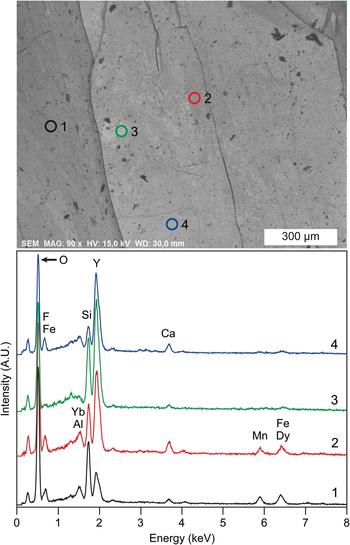
Semi-quantitative analyses of sample KNR 39583 is shown in Fig. 5 and it is clear from the EDS spectra that the sample is heterogeneous. Although EDS from just one sample is presented here, all samples investigated with EDS were heterogeneous. In EDS there are some overlaps of importance, which must be considered e.g. FeKα and DyLα ~6.4; YbMα and AlKα ~1.6 as well as FKα and FeLα ~0.7 keV. For these reasons the F content in spectra 1 and 2 may be high due to contribution from FeLα. However, spectrum 4 only has minor, if any, Fe and the peak ~0.7 keV must originate from F. It is also clear that the relative contents of Y and Si varies throughout the phases in the sample. The EDS shows that F is present in the material identified as tombarthite-(Y) despite not being present in the original description.
Semi-quantitative EDS analyses of sample KNR 39583, where Debye-Scherrer identified it as tombarthite-(Y).

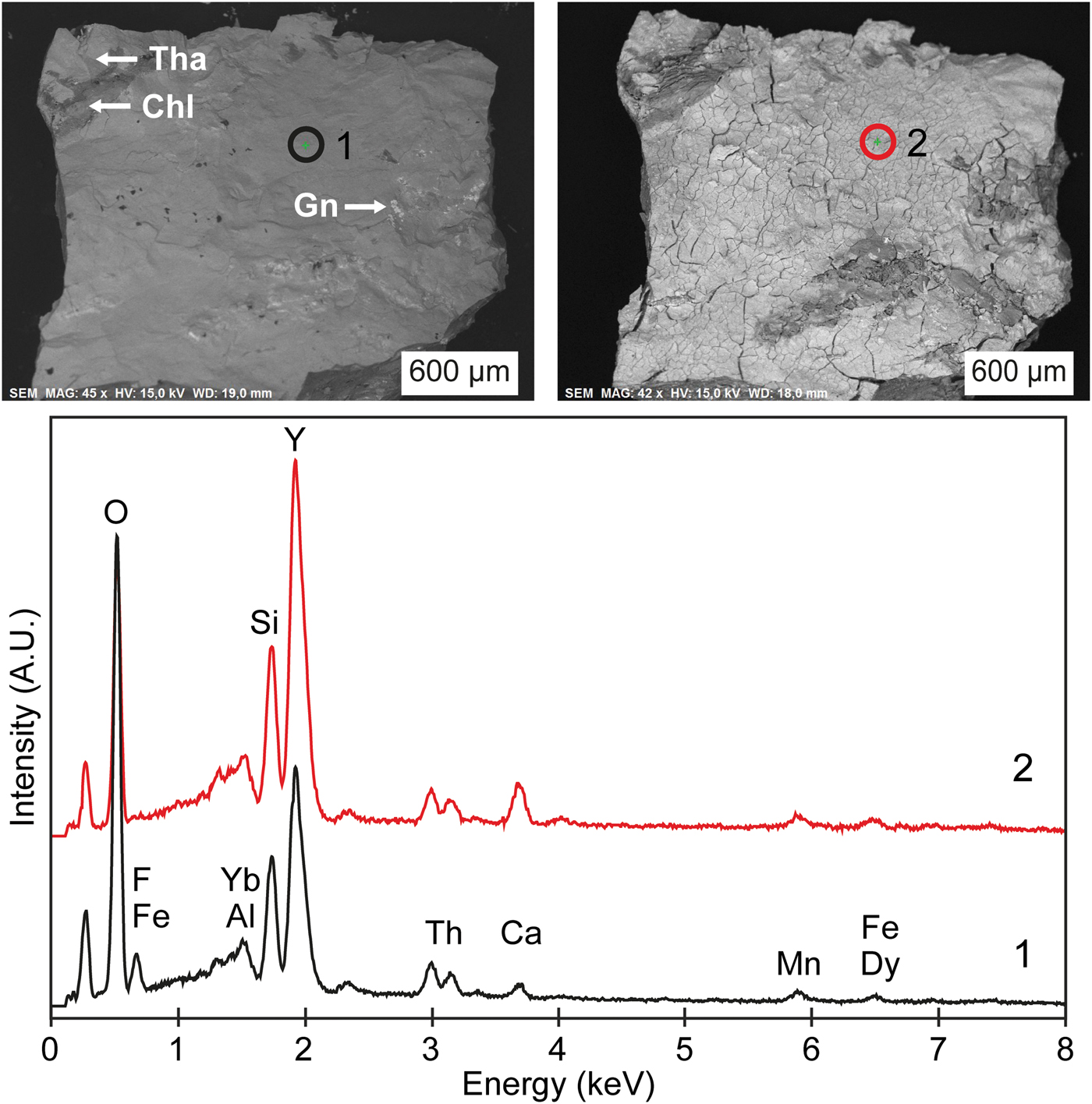
The results of the heating experiment carried out on XRD 18055 are shown in Fig. 6. The heating resulted in a 25.6% loss of mass, which is similar to the 22.7% loss for Sample II reported by Neumann and Nilssen (Reference Neumann and Nilssen1968). Another heating experiment carried out on KNR 37812 resulted in 15.4% loss of mass further illustrating the varied composition of what was identified as tombarthite-(Y). In addition, Fig. 6 shows that F was lost during the heating experiment. To ensure that this was not the result of a new surface being formed during the heating, the sample was broken in half. However, no F was observed in the analyses of the freshly broken surface. The heating experiments clearly illustrates that not only H2O, but also F will be lost under the heating conditions employed by Neumann and Nilssen (Reference Neumann and Nilssen1968). The XRD analyses of material before and after heating show that the original phases re-crystallize into a silicate with an apatite structure as described by Neumann and Nilssen (Reference Neumann and Nilssen1968).
Semi-quantitative EDS analyses of XRD 18055 before and after heating for 1 day at 1000°C. The sample contained small inclusions of galena (Gn), chlorite-group mineral (Chl) and thalénite-(Y) (Tha).

Conclusions
On the basis of unregistered material from the NHM in Oslo, old XRD-films and laboratory books it was possible to locate the material used for the original description of tombarthite-(Y). Sample I and Sample II from the original description comes from the mineral separates 16/64 and 4/65, respectively. The unit-cell refinements of the original material only relied on four reflections, some of which are only present in one of the samples. In addition, Guinier films of the original material show significant differences indicative of the material being mixtures of different minerals. New XRD and semi-quantitative EDS analyses of material labelled as tombarthite-(Y) from both the type locality and Reiarsdal has unambiguously shown that all analysed samples are heterogeneous, and hence not a single mineral species. Analyses of material identified as tombarthite-(Y) before and after heating shows that F is present in some of the phases and is lost during the heating scheme applied following the original description. As the original description relies solely on chemical data of heated material, not fresh material, F was not detected as a consituent of the mineral. Consequently, the published formula for tombarthite-(Y) is erroneous. Based on the above analyses and detailed investigation of the original description it must be concluded that tombarthite-(Y) is not a valid mineral species, but an intimate mixture of several minerals. It has also been shown that the minerals present vary from sample to sample, hence each sample of tombarthite-(Y) must be analysed to know what minerals it contain. The discreditation of tombarthite-(Y) has been approved by the International Mineralogical Association Commission on New Minerals, Nomenclature and Classification (proposal 16-K).
Acknowledgements
The manuscript benefitted from a detailed review by Ritsuro Miyawaki.