Introduction
Aging populations represent a great challenge to health and social care systems. Dementia is one of the most common age-related disorders, and with the number of cases expected to double every 20 years, governments worldwide are being urged to make dementia a clinical and research priority (Alzheimer's Disease International, 2009). Investigation into modifiable risk and protective factors could lead to the identification of preventative strategies or habits that people might integrate into their lifestyle (Desai et al., Reference Desai, Grossberg and Chibnall2010). Indeed, in a recent review of population attributable risk (PAR) it was estimated that potentially modifiable risk factors may contribute to a third of cases of Alzheimer's Disease (Norton et al., Reference Norton, Matthews, Barnes, Yaffe and Brayne2014). The impact of these risk factors may be modified or mediated by interactions with other concurrent factors, and is likely to be related to the age at which exposures occur (Norton et al., Reference Norton, Matthews and Brayne2013).
Participation in mentally stimulating leisure activities has emerged as a potential contributor to sustained cognitive health, exerting a protective effect against decline and dementia (Fratiglioni et al., Reference Fratiglioni, Paillard-Borg and Winblad2004), as well as having other social and psychological benefits (Lennartsson et al., Reference Lennartsson and Silverstein2001). Associations between non-cognitive leisure pursuits, such as social (Marioni et al., Reference Marioni2015) and physical (Willey et al., Reference Willey2016) activities and risk of cognitive decline and dementia have also been reported, but currently do not appear to be as robust as mentally stimulating activities. Maintaining cognitive health may prolong independence resulting in reduced institutionalization, reduced dependence on health, and social care services, and improved quality of life (Stern et al., Reference Stern and Munn2010).
Verghese et al. (Reference Verghese2006) provide a definition of leisure activities as those which “individuals engage in for enjoyment or well-being that are independent of work or activities of daily living.” The impact of a range of leisure pursuits, including physical (Wang et al., Reference Wang, Xu and Pei2012), mental (Wilson et al., Reference Wilson2010), and social (Saczynski et al., Reference Saczynski2006) activities has been explored, generating suggestions for possible mechanisms of action. A popular theory for the observed advantages of leisure activities is that participation can improve cognitive reserve (CR), a function that allows neurons to communicate with increased efficiency, flexibility, and adaptability as well as increasing neuronal capacity (Katzman, Reference Katzman1993; Tucker-Drob et al., Reference Tucker-Drob, Johnson and Jones2009).
Previous reviews have investigated the potential impact of cognitively stimulating leisure activities on cognitive decline and risk of dementia in non-parametric formats (Valenzuela and Sachdev, Reference Valenzuela and Sachdev2006; Stern and Munn, Reference Stern and Munn2010). However, this review seeks to (a) pool data from studies on cognitively stimulating leisure activities in a series of meta-analyses, (b) assess the impact on cognition and risk of dementia in later life, and (c) determine the quality of evidence.
Methods
Criteria for inclusion and exclusion of studies
Types of participants: Cognitively healthy adults (i.e. no diagnosis of impairment or dementia), aged 18 or over.
Types of activity: Unstructured leisure activities which elicit a “mental response” from the participant (Stern and Munn, Reference Stern and Munn2010). Standardized or structured activity interventions were excluded (e.g. manual approaches, professionally delivered programs, or formal courses).
Types of studies: Quantitative studies published as English-language journal articles including randomized controlled trials (RCTs), cross-sectional studies, case-control studies, and cohort studies.
Types of outcome: Scores on one or more tests of cognitive functioning, diagnosis of aMCI, MCI, or dementia using standardized criteria (e.g. Diagnostic and Statistical Manual of Mental Disorders, 4th Edition (DSM-IV) (American Psychiatric Association (APA), (2000)).
Search terms
Combinations and variations of the search terms; “dementia”, “cognitive activity,” “leisure activity,” “cognition,” “lifestyle,” and “hobbies” were selected. Studies published between 2004 and 2014 were considered. Systematic searches of PsychInfo, MEDLINE, CINAHL, EMBASE, and the Web of Knowledge (Web of Science) were carried out in March 2014. A three-stage screening process was carried out: (1) titles were assessed for relevance to the search topic, and duplicates deleted, (2) abstracts were examined (referring to full text if relevance was unclear from title and abstract alone), and (3) the quality of the remaining papers after title and abstract sifts was assessed (see below for details). LY conducted the initial title sift and removal of duplicates. Title and abstract sifts were performed by LY and SZ. The reference lists of papers passing the quality control stage were reviewed to ensure no relevant papers were overlooked.
A template data collection spreadsheet was created and used by the reviewing authors to record study details and reasons for exclusion. In cases where multiple papers were based on the same cohort, papers were assessed for relevance to the review question, or use of a particular subset of the cohort not included in alternative papers. Several large projects were identified: the Kungsholmen Project (Fratiglioni et al., Reference Fratiglioni, Viitanen, Bäckman, Sandman and Winblad1992), Mayo Clinic Study of Aging (MCSA) (Roberts et al., Reference Roberts2008), Bronx Aging Study (Verghese et al., Reference Verghese2003), RUSH Memory and Ageing Project (Bennett et al., Reference Bennett, Schneider, Buchman, Mendes de Leon, Bienias and Wilson2005), and the Age Gene/Environment Susceptibility-Reykjavik Study (Harris et al., Reference Harris2007). Nine studies were excluded as one of multiple papers based on the same project.
Assessing study quality
Quality was assessed using guidelines provided by the Critical Appraisal Skills Programme (CASP) Oxford UK (CASP, 2014). Specifically, checklists for cohort and case control studies were applied in the reading of papers reaching the quality assessment stage. The checklists included items assessing appropriateness of the issue investigated, recruitment, risk of bias, confounders, follow-up, results (strength of effect, precision, viability), generalizability, comparison to other available evidence, and implications. LY and SZ conducted the quality assessments independently with guidance from MO, a practicing clinician and expert in dementia research. If there were any differences in judgment of appropriateness and quality of the papers, the team reconsidered them collaboratively to reach a consensus.
Data extraction
Descriptive data from the final studies, including study sample, methods (including variables adjusted for in analyses), types of leisure activities, measures (e.g. leisure activity scales, cognition, diagnoses of cognitive impairment), and outcomes relevant to the review were summarized by the primary author (Table 1).
Descriptive summary of studies. Studies are grouped into their analysis sets

Analyses
Studies included in the meta-analyses were grouped by outcome (dementia, cognitive impairment including aMCI, MCI, and cognitive decline) and type of output (risk (RR), odds (OR), or hazard ratios (HR)). Where necessary, ORs, and RRs were calculated based on raw data from the papers so that data from several studies could be pooled for analysis. In the first instance, a random effects model of meta-analysis was selected as studies varied in population and measures, hence it was expected that effect sizes would vary between studies. This model accounts for random error within studies as well as this variation in effect sizes between studies (Borenstein et al., Reference Borenstein, Hedges and Rothstein2007). Where a random effects model did not adequately reflect patterns in the data, the analysis was repeated using a fixed effects model.
Five meta-analyses were performed using data from 15 of the 19 studies. Three of the meta-analyses pooled data on the association between participation in leisure activities and risk of developing dementia, and two were focused on the association between leisure activities and cognitive decline and impairment. The remaining four studies provided other types of data including output from brain imaging tests.
Selection of data from studies
In cases where multiple models of analysis were applied to data to adjust for variables such as age and baseline cognition, the adjusted output was used for our analysis. RRs and ORs calculated by the authors of this review were based on data presented in the papers, therefore output does not take into account statistical adjustment for covariables. Where papers presented data on a range of specific leisure activities or authors created composite categories, activities, or categories were included in the analyses when fulfilling the following criteria:
-
1. Activity is common amongst the studies. To discern their frequency, the activities specified in each paper were listed and ranked according to how many studies gathered data on them. For example, reading was cited most frequently (15 studies), so data pertaining to reading would be prioritized over data for playing games (11 studies).
-
2. Activity is predominantly cognitive in nature and requires active processing of information. For example, reading requires the use of memory, and stimulates visual and abstract thinking.
-
3. Composite categories must be specified as “mental”, “intellectual,” or “stimulating”, or describe an active cognitive skill (e.g. novelty seeking activities).
Results
Search results
In total, 3,859 references were located across the five databases (see Figure 1). After the initial title sift and removal of duplicates, 494 papers remained. The title and abstract review yielded 92 papers which passed to the quality assessment stage. Nineteen papers were included in this review.
Study selection.

Included studies
Of the 19 included studies, there were 17 longitudinal cohort studies and two case control studies (Table 1). The studies were carried out in several countries: France (1), Germany (1), Iceland (1), Australia (1), Japan (1), Singapore (1), Sweden (3), China (3), and the USA (7). All participants were 46 years or older (mean = 77 years).
Participation in leisure activities and risk of dementia
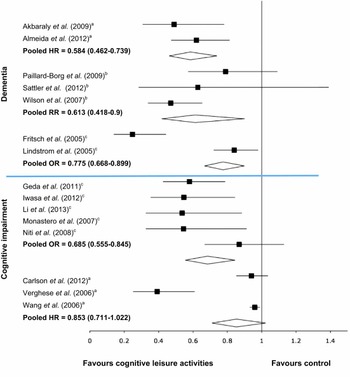
Data was pooled for studies by Akbaraly et al. (Reference Akbaraly2009) and Almeida et al. (Reference Almeida, Yeap, Alfonso, Hankey, Flicker and Norman2012) for the first meta-analysis (Figure 2). Pooling the results revealed an overall significant reduction in risk of dementia for those participating in stimulating activities including using computers (HR = 0.58, 95% CI: 0.46–0.74, p = 0.00).
Effect sizes for five meta-analyses (95% confidence intervals) including pooled values for each grouping. Output type: aHazard Ratio (HR) bRelative Risk (RR) cOdds Ratio (OR).

Three studies (Wilson et al., Reference Wilson, Scherr, Schneider, Tang and Bennett2007; Paillard-Borg et al., Reference Paillard-Borg, Fratiglioni, Winblad and Wang2009; Sattler et al., Reference Sattler, Toro, Schonknecht and Schroder2012) were collated for the second meta-analysis in this set, of which Paillard-Borg et al., Reference Paillard-Borg, Fratiglioni, Winblad and Wang2009 and Wilson et al., Reference Wilson, Scherr, Schneider, Tang and Bennett2007, respectively, provided RRs as original data (RR = 0.79, 95% CI:0.57–1.09; RR = 0.47, 95% CI:0.34–0.66) (Figure 2). The RR was calculated for Sattler et al. (Reference Sattler, Toro, Schonknecht and Schroder2012) (RR = 0.63, 95% CI: 0.28–1.39). The overall result of the meta-analysis was significant (RR = 0.61, 95% CI: 0.42–0.90, p = 0.01).
Two case control studies were included. Fritsch et al. (Reference Fritsch, Smyth, Debanne, Petot and Friedland2005) found novelty seeking cognitive activities had the strongest association with this reduction in odds (OR = 0.25, 95% CI: 0.15–0.41). The data from Lindstrom et al. (Reference Lindstrom2005) was categorized as “intellectually stimulating” activities (OR = 0.84, 95% CI: 0.72–0.98). Both concluded that the odds of developing dementia were significantly lower for those frequently participating in leisure activities. However, despite this pattern the random effects model was not significant. Since both studies independently had shown significant results, the analysis was repeated using a fixed effects model (OR = 0.78, 95% CI: 0.67–0.90). This analysis found a significant association between participation in leisure activities and reduced risk of dementia.
Participation in leisure activities and risk of cognitive decline and impairment
ORs were calculated using data presented in papers by Geda et al., (Reference Geda2011); Li et al., (Reference Li2013); Iwasa et al., (Reference Iwasa, Yoshida, Kai, Suzuki, Kim and Yoshida2012); Monastero et al., (Reference Monastero, Palmer, Qiu, Winblad and Fratiglioni2007); and Niti et al. (Reference Niti, Yap, Kua, Tan and Ng2008). Of the raw data available from Geda et al., (Reference Geda2011), “reading books” was used according to the defined criteria for selection of activity/composite score data (see selection of data from studies), and was found to be significantly associated with a reduction in odds of cognitive impairment (OR =0.58, 95% CI: 0.43–0.70). Leisure activities were found to be significantly associated with a reduction in odds of cognitive impairment (OR = 0.58, 95% CI: 0.43–0.70). The association was not significant based on data (full sample, high vs. low participation in leisure activities) from Niti et al. (Reference Niti, Yap, Kua, Tan and Ng2008) (OR = 0.87, 95% CI: 0.67–1.13).
Li et al. (Reference Li2013) performed an analysis of variance (ANOVA) between MCI and “cognitively normal” groups, thus an OR was calculated. Complete raw data necessary to calculate the OR was only available for two cognitive activities (reading, writing), of which the data for “reading” was used (OR = 0.54, 95% CI: 0.33–0.89) (see selection of data from studies).
Iwasa et al. (Reference Iwasa, Yoshida, Kai, Suzuki, Kim and Yoshida2012) and Monastero et al. (Reference Monastero, Palmer, Qiu, Winblad and Fratiglioni2007) presented ORs expressing increased odds of developing cognitive impairment. Data from the papers was taken to calculate reduction in odds (OR = 0.55, 95% CI: 0.35–0.85 (Iwasa et al., Reference Iwasa, Yoshida, Kai, Suzuki, Kim and Yoshida2012); OR = 0.54, 95% CI: 0.33–0.91 (Monastero et al., Reference Monastero, Palmer, Qiu, Winblad and Fratiglioni2007)) in order to be consistent with the format of the ORs from the other papers contributing data to this meta-analysis set. Reduction in odds was significant (OR = 0.69, 95% CI: 0.56–0.85, p = 0.00) when data from the five studies was pooled.
Significant associations between participation in leisure activities and reduced risk of cognitive impairment were reported by Verghese et al. (Reference Verghese2006) (HR = 0.39, 95% CI: 0.25–0.61, p = 0.00) and Wang et al. (Reference Wang2006) (HR = 0.96, 95% CI: 0.93–0.99, p = 0.01). The association did not reach significance in the study by Carlson et al. (Reference Carlson2012). (HR = 0.94, 95% CI: 0.85–1.037, p = 0.22), nor when the overall HR for the studies were combined (HR = 0.85, 95% CI: 0.71–1.02, p = 0.08).
Relative risk reduction (RRR), Hazard reduction & odds reduction
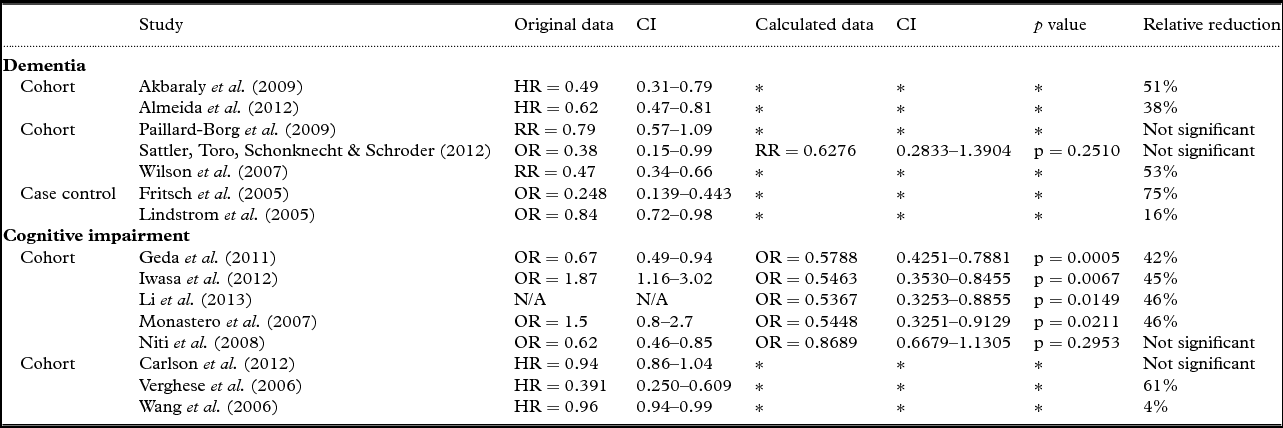
Relative risk, hazard and odds reduction percentages were calculated (Table 2) to assess the magnitude of significant protective effects. The reduction in risk of cognitive impairment or dementia associated with participation in cognitive leisure activities ranged from 4% to 75% (mean = 43.36%). The analysis set including data from Geda et al. (Reference Geda2011) had the most consistent reduction effects (range = 42–46%). Effect sizes were considerably different for two of the analysis sets: (1) Fritsch et al. (Reference Fritsch, Smyth, Debanne, Petot and Friedland2005) (75%) and Lindstrom et al. (Reference Lindstrom2005) (16%), and (2) Carlson et al. (Reference Carlson2012), Verghese et al. (Reference Verghese2006) (61%), and Wang et al. (Reference Wang, Xu and Pei2012) (4%).
Data for meta-analyses. RRRs calculated when data was significant. * indicates data extracted from original paper rather than calculated as part of this review
Tests of heterogeneity
The I2 statistic was used as a measure of the impact of heterogeneity on the meta-analysis. Developed by Higgins & Thompson (Reference Higgins and Thompson2002), the calculation represents the proportion of total variation in estimates of treatment effects that are attributable to differences between studies rather than sampling error within studies. The I2 statistics produced for each meta-analysis set were interpreted according to the p value from the χ 2tests (i.e.: strength of evidence) alongside the following thresholds outlined in the Cochrane Handbook (Higgins and Green, Reference Higgins and Green2008):
-
(i) 0–40%: may not be important
-
(ii) 30–60%: moderate heterogeneity
-
(iii) 50–90%: substantial heterogeneity
-
(iv) 75–100%: considerable heterogeneity
The level of heterogeneity for the meta-analysis set including Akbaraly et al. (Reference Akbaraly2009) was potentially negligible and did not reach significance (p = 0.39). Heterogeneity was “moderate” in two of the sets; Paillard-Borg et al. (Reference Paillard-Borg, Fratiglioni, Winblad and Wang2009) (p = 0.09) and Geda et al. (Reference Geda2011) (p = 0.15). “Substantial” heterogeneity was detected in the meta-analysis set including Carlson et al. (Reference Carlson2012) (p = 0.08), and highly significant (p = 0.000) and “considerable” heterogeneity was found in the meta-analysis including Fritsch et al. (Reference Fritsch, Smyth, Debanne, Petot and Friedland2005).
Findings of other studies included in the review
Kåreholt et al. (Reference Kåreholt, Lennartsson, Gatz and Parker2011) conducted a longitudinal cohort study on the association between leisure activities in mid-life and cognition in later life with 1,643 participants. Mental activities (e.g. reading books, playing a musical instrument, hobby activities) were found to be significantly associated with later life cognition (β = 0.11, p = 0.05).
Saczynski et al. (Reference Saczynski2008) found that frequent participation in leisure activities was associated with better cognition; memory (β = 0.20, 95% CI: 0.11–0.29), speed of processing (β = 0.37, 95% CI: 0.29–0.45), and executive functioning (β = 0.23, 95% CI: 0.15–0.29). In addition, participation in leisure activities was found to modify the link between white matter lesions (WML) and speed of processing (β = 0.15, 95% CI: 0.01–0.30, p < 0.05).
Wang et al. (Reference Wang2013), discovered high engagement in mental activity was significantly associated with less decline in overall cognition (β = −0.23, p < 0.01), language (β = −0.11, p < 0.05), and executive function (β = −0.13, p < 0.05).
Wilson et al. (Reference Wilson2010) studied the relationship between participation in cognitive activities and rate of cognitive decline. Participation in cognitive activities did not have the same effect on those with cognitive impairment or AD at follow up as those without cognitive impairment. Rate of cognitive decline was reduced by 52% per year for each additional point on the cognitive activity scale (CAS) for those without cognitive impairment (estimate = 0.03, SE = 0.01, p = 0.00). By contrast, rate of cognitive decline was not significantly associated with participation in cognitive activity for people with MCI (estimate = −0.02, SE = 0.02, p = 0.30). For those with AD, for each point on the CAS, the mean rate of decline increased by 42% per year (estimate = 0.08, SE = 0.02, p < 0.00).
Publication bias
We could not assess publication bias as there were too few studies within each grouping (i.e. meta-analysis groups and other studies group), therefore there would not be sufficient power to detect true asymmetry (Higgins and Green, Reference Higgins and Green2008).
Discussion
Summary of findings
This review includes five meta-analyses; three focusing on the impact of cognitively stimulating leisure activities on risk of dementia, and two on risk of cognitive impairment and decline. Participation in cognitive leisure activities was consistently shown to be associated with reduced risk of dementia and cognitive impairment. This suggests that mental stimulation can have a protective effect on cognitive abilities, an association observed as early as Cicero (106 B.C.–43 B.C.), writing that “Old men retain their intellects well enough, if only they keep their minds active and fully employed.” Neuropsychological evidence of capacity for change, new learning, and plasticity also suggests that cultivation of an enriched cognitive environment may contribute to successful aging (Mora et al., Reference Mora, Segovia and Del Arco2007).
Interpretation of findings
Aging can be seen as a dynamic interplay of gains and losses in function, influenced not only by the physiological capacity of the brain, but also by the cognitive pragmatics of intelligence or skills learned as a result of cultural environment. Cognitive mechanics are largely contained within the pattern of growth in early life, stability in adulthood, and decline in later life (Baltes and Singer, Reference Baltes and Singer2001). By contrast, uptake, maintenance, and abandonment of cognitive pragmatics varies across lifespan and between individuals, according to levels of cultural exposure, motivation to seek out opportunities for stimulation, and perhaps innate intelligence. It is thought that CR is developed through formation and exercise of cognitive pragmatics. Multiple or well-developed cognitive resources (e.g.: alternative neural pathways) are available should cognitive networks be damaged, meaning deficits in functioning associated with cognitive impairment and dementia are not expressed at all, or are not as profound as they might be in individuals with less CR (Scarmeas and Stern, Reference Scarmeas and Stern2003).
The selective-optimization with compensation model (SOC), posits that successful maintenance of functioning in the face of the challenge of losses is best achieved by reducing the variety of channels in which cognitive investments are made (selection) (Baltes and Baltes, Reference Baltes and Baltes1993). Cognitive resources can then be channeled into a smaller pool of interests, in which performance is concentrated and, as a result optimized. The key then may be quality and level of investment in, rather than quantity and variety of cognitive leisure activities in later life. If evidence emerges that certain activities are more beneficial than others, we then need to discern any specific qualities that are responsible for their effectiveness, and ideally when in lifespan participation should be advised to achieve maximum benefits.
Methodological strengths and limitations
Although incidence rates were not available, an alternative analytic approach would have been to examine actual incidence rates of cognitive impairment/dementia in exposed and non-exposed groups and the absolute risk reductions. Considerable heterogeneity was detected in two of the meta-analyses. Higgins et al. (Reference Higgins, Thompson, Deeks and Altman2003) reported that amongst 509 meta-analyses in the Cochrane Database of Systematic Reviews, a quarter had heterogeneity of over 50%. This suggests the levels of heterogeneity observed in this review (e.g. 41%, 58.51%, 87.23%, 93.71%) are not uncommon. Additionally, the distribution of all of the findings was weighted towards a protective effect. An advantage of heterogeneity is the generalizability of findings. Whilst other associated risk factors for dementia (e.g. age, gender, vascular health) were accounted for in the models of analysis in the majority of studies, these variables may have factored into the differences detected.
There were no standardized classifications of leisure activities, making it difficult to compare studies. The most common composite categories included were “mental,” “physical,” and “social”. Problems of collating individual activities to create composites include the fact that some leisure activities have multiple components, so it is difficult to identify a primary characteristic, which determines their classification. Furthermore, it is difficult to know how many activities within each category classification were practiced per person where overall categories were assigned. Frequency of participation was often recorded in daily, weekly, monthly, or yearly terms, then converted into an overall “high,” “moderate,” or “low” levels. Again, the thresholds for category placement were not standardized, and so varied according to the judgment of authors. This might affect the reliability of the results.
The majority of studies included were observational studies. Whilst this methodology represents the most practical way of investigating this area, it is limited because participants select themselves into different groups (i.e., exposed and unexposed). This methodology is also prone to bias. Sample bias was noted in some studies, such as Verghese et al. (Reference Verghese2006). More positively, the populations included were relatively ethnically diverse owing to the dispersion of locations of the studies. Due to the nature of the research, “survival bias” requires consideration. A less active lifestyle is associated with higher mortality, as is lower socio-economic status (Adler and Ostrove, Reference Adler and Ostrove1999), thus the strength of associations between participation in leisure activities and cognitive impairment may be under-estimated (Elias et al., Reference Elias, Beiser, Wolf, Au, White and D'Agostino2000).
The studies acknowledge the potential risk of “reverse causality” whereby low levels of participation in leisure activities may not be a cause of cognitive decline, rather an indication of experience of cognitive deficits in pre-clinical dementia (Roberts et al., Reference Roberts2008). Measures to avoid this were incorporated into the design or factored into the analysis of most studies. For example, most screened for dementia and cognitive impairment at baseline using standardized diagnostic criteria. Studies with shorter follow up periods (e.g.: Akbaraly et al., Reference Akbaraly2009) were more prone to detecting leisure behaviors attributable to pre-clinical dementia, as changes including apathy may begin to occur up to 10 years prior to the development of dementia (Elias et al., Reference Elias, Beiser, Wolf, Au, White and D'Agostino2000). However, in order to reduce this risk, a “cut off point” was often defined, with those diagnosed with dementia at or before this time being excluded.
All of the studies identified and adjusted for confounding variables, as this was necessary for them to qualify for inclusion in this review at the quality control stage. However, some were more comprehensive than others. Age, sex/gender, education, and significant co-morbidities were universally factored into analyses. Other risk factors that have been associated with dementia and cognitive impairment were considered as confounders in some studies including; vascular health, negative health behaviors (e.g.: smoking, drinking), depressive symptoms, physical functioning, socio-economic status, and APOE genotype.
Implications of findings
Interventions at a population level with a focus on reducing incidence may make a promising contribution to reducing future prevalence of dementia (Ritchie et al., Reference Ritchie, Carriere, Ritchie, Berr, Artero and Ancelin2010; Norton et al., Reference Norton, Matthews and Brayne2013). Delaying the onset or progression of cognitive decline could impact incidence. Desai et al. (Reference Desai, Grossberg and Chibnall2010) estimate that even a relatively moderate delay could significantly impact incidence, as deaths are attributable to others causes before any experience of impairment. Projections of global dementia cases suggest that of the 106 million cases expected by 2050, 23 million could be averted if onset were delayed by just 2 years (Brookmeyer et al., Reference Brookmeyer, Gray and Kawas1998). These delays could also translate to economic savings, an estimated $10 billion over 10 years for an average one-year delay (Brookmeyer et al., Reference Brookmeyer, Johnson, Ziegler-Graham and Arrighi2007). Given the growing body of evidence that participating in cognitively stimulating leisure activities may contribute to reducing the risk of cognitive impairment in later life, promoting participation in such activities across lifespan, or at least from middle adulthood onwards, could be a worthwhile primary prevention strategy which could be used in combination with other strategies for overall maintenance of cognitive health.
Increasing awareness of the advantages of an engaged and cognitively enriching lifestyle may be achieved through public awareness campaigns, which may be led by the government, health service, voluntary organizations, or academic institutions. Desai (Reference Desai2011) emphasized the need for individualized cognitive fitness plans tailored to the strengths, limitations, and preferences of the individual, and that these should be integrated into daily routine as soon as possible for maximum effect. There may be an argument for encouraging cognitive leisure activities from an early age in education (Gold et al., Reference Gold, Andres, Etezadi, Arbuckle, Schwartzman and Chaikelson1995).
Future research
By identifying the methodological limitations of studies, systematic reviews assist research groups to design and conduct subsequent research of a higher quality. In addition, reviews can help to identify gaps in the field for further investigation. In this field, there is a significant paucity of RCTs. However, this trial design may not be the most appropriate method of collecting epidemiological data owing to issues around the feasibility and ethical implications of manipulating exposure to something like leisure activities at random. The development of a standardized measure of leisure activities, with clearly defined categories and details of where individual activities should be placed; would be a useful contribution to this area of research. Placement of activities could be corroborated by both experts in the field and target populations. Further examination of specific leisure activities and differential impacts would also be valuable once a standardized scale is available. The benefits of using technology such as computers is an area of research warranting attention, since current data suggests an association with reduced risk of dementia. Given general computer use is helpful, cognitive leisure activities delivered via a computer platform may have enhanced benefits, as the content and platform are cognitively stimulating in their own right.
Conflict of interest
None.
Description of authors’ roles
LY and MO developed the research question for the review. MO provided supervision and guidance at all stages including the analyses. LY conducted the literature searches and initial sifting. SZ assisted LY with further sifting, assessments of the quality of studies, and meta-analyses. AS assisted with drafting the paper. SZ prepared the manuscript for publication. All authors reviewed and commented on drafts of the manuscript. All authors read and approved the final manuscript.
Acknowledgments
We would like to thank Ruth Muscat (knowledge resources librarian, University College London (UCL)) for her advice on the development of the search strategy for this review, and Dr. Shaun Scholes (research associate, epidemiology and public health, UCL) for consultation on statistical methods.